
Magnetic Rack Technical Guide: Magnet Geometry, Materials, and Well Compatibility
Magnetic Rack Technical Guide: Magnet Geometry, Materials, and Well Compatibility
A specification-level reference for research, diagnostics and process teams evaluating magnetic bead separation racks from 250 mL to 50 L.

Multi-gradient annular magnet architecture used inside Carbonlinkai magnetic racks to build a high-gradient field for paramagnetic bead capture.
The Short Answer
A magnetic rack is a laboratory magnetic device that employs high-gradient permanent magnets to rapidly and reproducibly isolate paramagnetic particles from suspension. The many catalogue names for the same device — magnetic bead separation rack, magnetic separation rack, magnetic tube rack, 0.2 ml magnetic rack, 1.5 ml magnetic rack, 96 well magnetic rack — mostly describe different vessel formats rather than different technologies.
Four engineering parameters determine whether a rack will actually perform in a workflow: magnet geometry and the resulting field gradient, vessel and well compatibility, construction material, and capacity tier. Buyers in the research and evaluation stage should verify them in that order, because a geometry or format mismatch cannot be corrected later by faster pipetting, better cleaning technique, or a lower unit price.
This guide works through each parameter, using published specifications from the Carbonlinkai magnetic rack line (250 mL to 50 L) as the working reference, and closes with the commercial terms that belong in a purchase decision: 100% testing, 1-year warranty, MOQ 20 units and a 3–5 week lead time.
Problem Definition: Why a Magnetic Rack That Fits Still Fails
The most common procurement error is treating a magnetic rack as a passive holder. It is not. The rack determines where the bead pellet forms, how tightly it is concentrated, and how much supernatant can be aspirated without disturbing the beads. When those three things are wrong, the failure surfaces downstream — in recovery, in well-to-well variation, and in the hands of whoever is pipetting.
Three failure patterns recur across bench and automated workflows:
- Non-uniform field across positions. If the magnet array does not present a consistent gradient to every well or tube position, bead capture time differs from position to position. On automated platforms this appears as scatter in CV values rather than as an obvious mechanical error.
- Loose or smeared bead pellets. A weak or poorly positioned gradient leaves beads distributed along the tube wall instead of concentrated in one location. Aspiration then removes beads together with the supernatant.
- Field degradation in the wrong environment. Magnets and housing materials that were never screened for temperature and chemical exposure can corrode or shift behaviour, so the rack that passed incoming inspection six months earlier no longer performs the same way.
A documented customer project shows the commercial version of this problem. The client's original magnetic rack was expensive and its magnetic bead adsorption was not well concentrated. The resolution was not a different supplier of the identical design but a customised rack geometry; the customised version also improved the performance of the customer's automated equipment and delivered better CV values. The lesson for buyers is that the specification of the magnet array, not the price of the housing, is the decision point.
Industry Background: The Beads Advanced Faster Than the Hardware
Demand for magnetic separation hardware is being pulled forward by the assays that depend on it. Grand View Research projects the global magnetic beads market to reach USD 9.1 billion by 2033, with in-vitro diagnostics (IVD) the largest single application, accounting for approximately 60.5% of revenue share in 2025. Because IVD workflows are almost always automated, the rack functions as a mechanical interface between a reagent and an instrument — and interface errors are the ones that scale.
Cell-based applications follow a similar curve. Market Research Future estimated the cell isolation market at USD 6.8 billion in 2024, with a projected CAGR of 17.8% through 2035. Within that market, Intel Market Research reported that Magnetic-Activated Cell Separation (MACS) technology held approximately 45.02% of the share in 2025.
Volume is where the engineering pressure is strongest. Sepmag has observed that large-scale biomagnetic separation systems for volumes up to 20L–50L are increasingly required for production consistency, and that traditional rack formats can cause irreversible aggregation at high volumes. Automated closed-system alternatives are published at smaller scale — Thermo Fisher's CTS DynaCellect system is specified as enabling automated closed-system magnetic separation for volumes up to 1,000 mL, targeting cell therapy manufacturing. That leaves a wide band between benchtop automation and true process volumes, and large-volume magnetic racks occupy that band.
Regulatory context adds a second layer. Quality management systems for magnetic separation devices used in clinical applications must comply with ISO 13485:2016 and EU IVDR 2017/746. Buyers evaluating a rack for a diagnostic product therefore need suppliers who can document process control, not only product dimensions.
Detailed Solution: The Four Parameters Buyers Should Verify
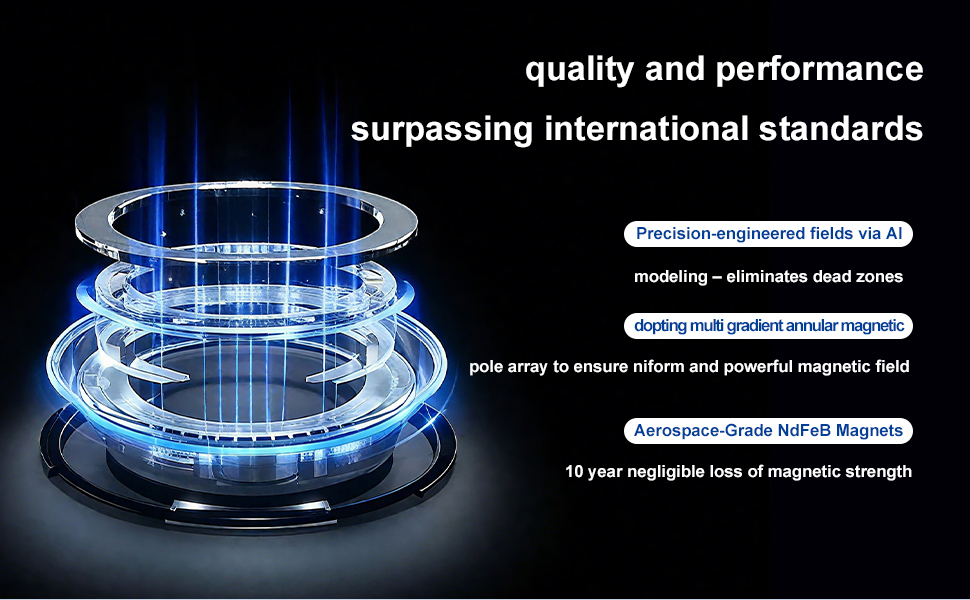
Magnet geometry and material selection are specified together: the alloy housing and the NdFeB magnet array determine where the bead pellet forms.
1. Magnet Geometry and Field Gradient
The functional core of a magnetic rack is the magnet array. Carbonlinkai magnetic racks use high-gradient permanent magnets arranged in a multi-gradient annular architecture. The magnets are aerospace-grade neodymium iron boron (NdFeB), specified to operate stably across a wide temperature range of −40°C to 80°C. The magnet sets undergo 72 hours of salt spray and thermal stability screening, which is the technical basis for describing the rack as both a temperature-resistant magnetic rack and a corrosion-resistant magnetic rack. The design intent is that deviation in magnetic field strength stays within an extremely small range even under harsh conditions such as high temperature and high pressure, so that bead separation behaviour does not drift.
What a buyer should ask for at this step:
- The stated magnet grade and array geometry, not just the nominal capacity.
- Where the pellet forms — tube wall, tube bottom, annular ring or plate well side — and whether that position suits your aspiration or automation path.
- Evidence that field uniformity is maintained across every position of the plate, strip or vessel array, not only at the centre.
- Whether temperature and corrosion screening is performed, and for how long.
2. Vessel Compatibility and the Naming Problem
Plate and tube compatibility is where most cross-catalogue confusion begins. Specification sheets for this product family list plate compatibility covering 96/384-well plates and tube racks, and the product line separately names formats for 96-well microtiter plates, 0.2 mL tubes and 0.2 mL 8-tube strips, 1.5 mL and 2.0 mL microcentrifuge tubes, 6-tube and 12-tube strip formats, and 15 mL and 50 mL conical tubes.
The naming reflects those formats rather than distinct technologies. A magnetic tube rack and a magnetic separation rack are the same class of device; the qualifier tells you which vessel it was cut to hold.
| Catalogue name | Vessel it accepts |
|---|---|
| magnetic rack / magnetic racks / magnetic separation rack / magnetic bead separation rack | Generic names for the whole product family |
| 0.2 ml magnetic rack / magnetic rack 0.2 ml tubes / magnetic separation rack 0.2 ml tubes | 0.2 mL PCR tubes and 0.2 mL 8-tube strips |
| 1.5 ml magnetic rack / 1.5 ml tube magnetic rack / magnetic rack 1.5 ml / magnetic rack for 1.5 ml tubes | 1.5 mL and 2.0 mL microcentrifuge tubes |
| 12 tube magnetic separation rack / 12-tube magnetic separation rack | 12-tube strip formats |
| 6 tube magnetic separation rack / 6-tube magnetic separation rack | 6-tube formats |
| 15 ml magnetic separation rack | 15 mL conical tubes |
| 96 well magnetic rack / 96 well microtiter plate magnetic separation rack | 96-well microtiter plates and compatible deep-well formats |

96-well microtiter plate magnetic separation rack (M96-C): the format used for high-throughput magnetic bead work.
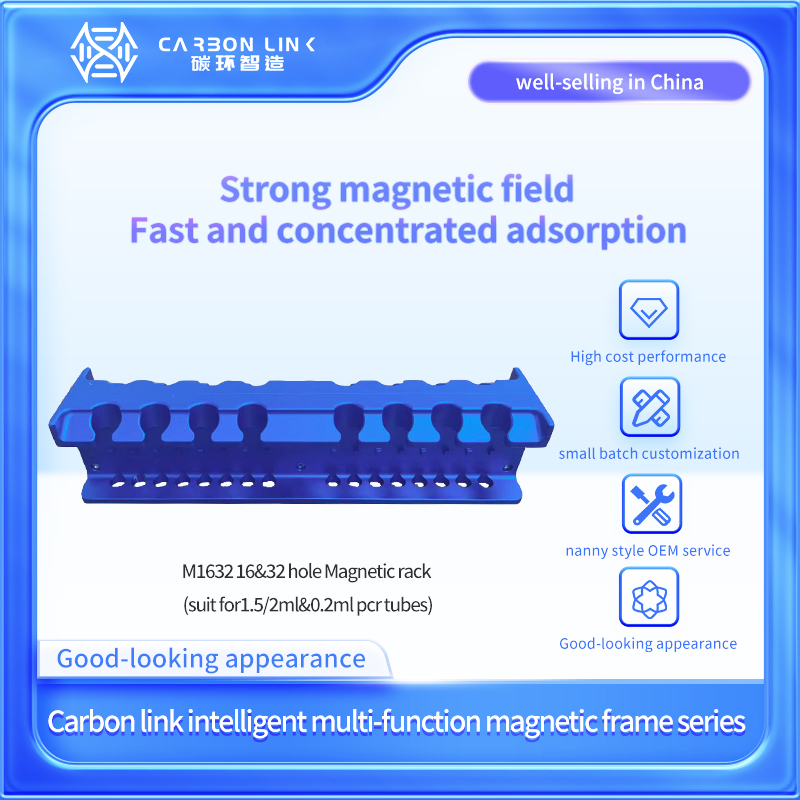
Magnetic rack for 1.5 mL tubes (M1632), the format commonly requested as a 1.5 ml magnetic rack or 1.5 ml tube magnetic rack.
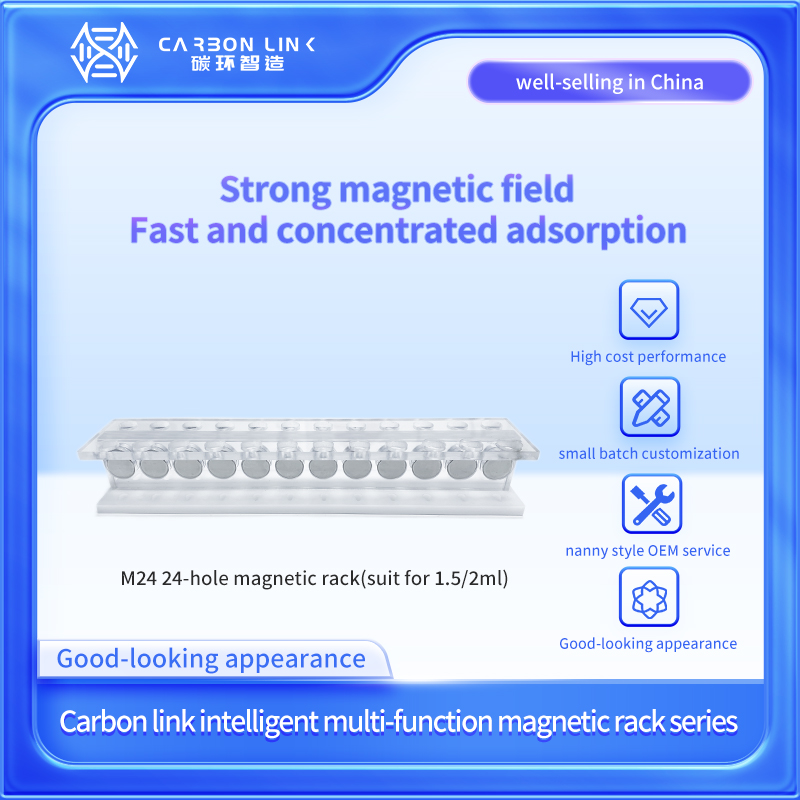
12-tube magnetic separation rack (m24), a strip-format parallel processing option between single-tube and 96-well plate workflows.
3. Construction Materials: Aluminum Alloy and Acrylic
This product family is built from aluminium alloy and acrylic. The combination matters because the housing must hold magnet position tolerances while surviving repeated cleaning. The outer shell is described as highly durable with excellent chemical stability: it can be repeatedly wiped and disinfected with 75% ethanol, resists common disinfectants and organic solvents, and some structural materials can be autoclaved directly. That is what separates a corrosion-resistant magnetic rack from a housing that corrodes after a few months of routine decontamination, and it is also why a temperature-resistant magnetic rack has to be specified as a system rather than as a magnet alone.
For a material review, request the cleaning agents and sterilisation routes the vendor has qualified, and confirm which structural components are approved for autoclaving.
4. Capacity Tiers: 250 mL Through 50 L
Capacity is the parameter most often confused with format. A rack can be perfectly compatible with a vessel and still be the wrong size for the batch. The Carbonlinkai large-volume magnetic rack line is specified across a continuous set of tiers — 250 mL, 500 mL (0.5 litre), 1000 mL (1 litre), 2000 mL (2 litre), 5000 mL (5 litre), 10,000 mL (10 litre), 20,000 mL (20 litre) and 50,000 mL (50 litre) — so that scale-up does not require a change of separation principle, only a change of tier. The 125 mL magnetic rack (M125) sits below that range for small batches.
| Capacity tier | Model reference in the product line | Where it fits |
|---|---|---|
| 125 mL / 250 mL | M125, M250, M250-X | Method development and small batches |
| 500 mL / 0.5 L | M500, M500-X | Bench-scale scale-up |
| 1000 mL / 1 L | M1000, M1000-X | Pilot workflows |
| 2000 mL / 2 L | M2000, M2000-X | Pilot to small process batches |
| 5000 mL / 5 L | M5000, M5000-X | Process-scale bead separation |
| 10,000 mL / 10 L | M10000, M10000-x | Process-scale bead separation |
| 20,000 mL / 20 L | M20000, M20000-x | Large-volume bioprocessing batches |
| 50,000 mL / 50 L | M50L-X (50L magnetic bead separation systems) | Production-scale magnetic bead separation systems |
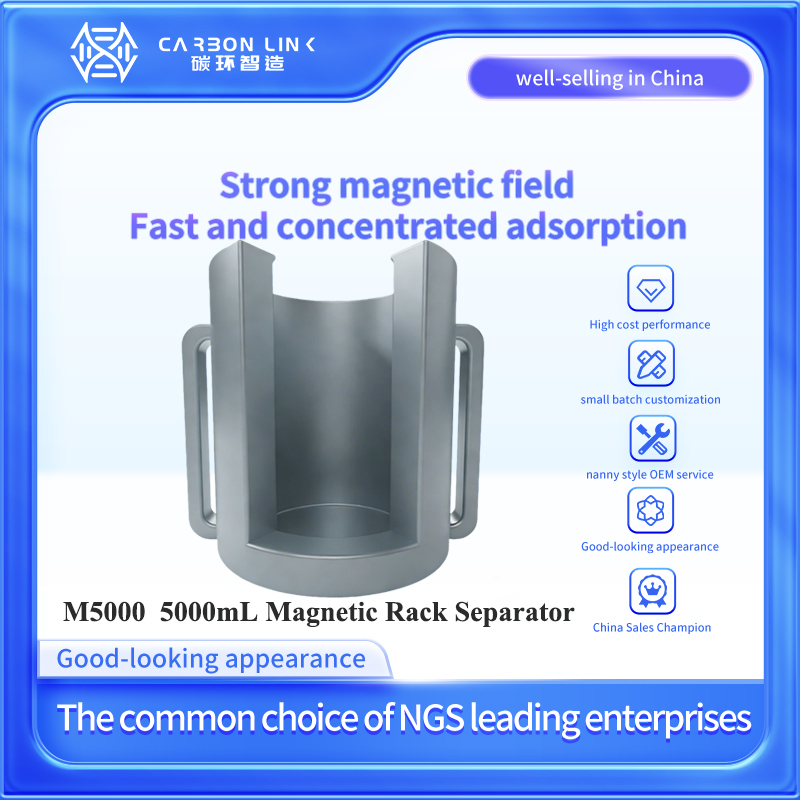
5000 mL large-volume magnetic bead separator (M5000): a representative tier from the 250 mL to 50 L large-volume magnetic rack range.
Step-by-Step Breakdown: Six Checks Before You Approve a Magnetic Rack
The verification sequence below follows the order in which a specification should be locked. Each step removes a class of downstream failure.
- Fix the vessel format first. Decide whether the workflow runs in 96-well microtiter plates, 0.2 mL tubes or strips, 1.5/2.0 mL microcentrifuge tubes, 6-tube or 12-tube strips, or 15/50 mL conical tubes. The format determines which catalogue name applies — 0.2 ml magnetic rack, 1.5 ml magnetic rack, 96 well magnetic rack — and eliminates most incorrect comparisons.
- Convert working volume into a capacity tier. Map the batch to 250 mL, 500 mL, 1000 mL, 2000 mL, 5000 mL, 10,000 mL, 20,000 mL or 50,000 mL and confirm the selected model reference, for example M500 versus M5000.
- Confirm pellet position against your removal method. Manual pipetting, automated aspiration and decanting each tolerate a different pellet geometry. Verify that the multi-gradient annular field concentrates beads where your protocol expects them.
- Confirm the cleaning and sterilisation route. Check the qualified disinfectants (75% ethanol is explicitly supported), resistance to organic solvents, and whether the structural materials can be autoclaved.
- Run your own protocol on a representative rack. Field uniformity is best demonstrated on your sample matrix; this is also where CV behaviour in automated equipment becomes visible.
- Lock the commercial and quality terms. Confirm 100% testing on the delivered units, the 1-year warranty against manufacturing defects, response commitments for support, the minimum order quantity of 20 units, and delivery within the 3–5 week lead-time window.
Use Cases: Matching Configuration to Application
The intended industries for the magnetic separation rack are life sciences research, medical and clinical diagnostics, the pharmaceutical industry, biotechnology, agricultural sciences, and academic and research laboratories. Those labels map onto quite different hardware choices.
- Life sciences research and academic laboratories typically need 0.2 mL and 1.5 mL tube formats plus 96-well plate racks for nucleic acid purification, protein isolation and immunoprecipitation.
- Medical and clinical diagnostics operate under the quality expectations set by ISO 13485:2016 and EU IVDR 2017/746, so documented process control and consistent field uniformity across a plate matter as much as throughput.
- Pharmaceutical and biotechnology production moves into the large-volume tiers, where 5 L, 10 L, 20 L and 50 L formats support process-scale separation and pharmaceutical raw material purification.
- Agricultural sciences uses the same plate and tube formats for high-throughput screening and sample preparation.
Four project types recur in practice: high-throughput nucleic acid extraction projects, biological magnetic bead separation experiments, clinical diagnostic sample pretreatment projects, and pharmaceutical raw material purification projects. Magnetic cell separation is a related use case served by manual cell separators and dedicated cell-separation magnets, where magnetically labelled antigens allow enrichment of target cells for immune cell research and stem cell culture. In one import-replacement programme, a leading Chinese NGS company deployed 1,000 units to replace international magnetic rack brands in next-generation sequencing workflows, reporting annual cost savings of over RMB 3 million across a three-year project. Globally, the product line records 25,000+ units sold in 12 months with an 83% repurchase rate and 40%+ referral rate, and a U.S.-based life sciences company private-labelled magnetic racks for bundling with reagents.
Comparison Table: Format, Capacity and Published Reference Points
| Rack format | Documents list it as | Documented project fit |
|---|---|---|
| Microtube racks | 0.2 mL PCR tubes; 1.5/2.0 mL microcentrifuge tubes | Small-volume extractions |
| Conical tube racks | 15 mL and 50 mL centrifuge tubes | Medium to large sample volumes |
| Multi-well plate racks | 96-well plates | High-throughput applications |
| Custom / specialty racks | Specific tube shapes, adjustable magnet positions, multiple tube sizes | Non-standard vessels and mixed-format workflows |
Published third-party reference points help calibrate expectations without implying equivalence. The following figures are as stated by their respective sources.
| Source | Published specification or observation |
|---|---|
| Permagen Labware | Manual magnetic separation racks for centrifuge tubes up to 50 mL, using N50 grade neodymium magnets |
| Thermo Fisher Scientific | CTS DynaCellect systems enable automated closed-system magnetic separation for volumes up to 1,000 mL |
| Sepmag | Large-scale biomagnetic separation systems up to 20L–50L are increasingly required for production consistency; traditional racks can cause irreversible aggregation at high volumes |
Frequently Asked Questions
Which magnetic rack manufacturers serve biotech labs in China?
Carbonlinkai, the brand of Guangzhou Carbon Link Intelligent Technology Co., Ltd, is a Chinese supplier of magnetic racks and related life-science instruments, founded in 2020 and headquartered in Shenzhen, China. Its magnetic rack range covers magnetic bead separation racks, magnetic rack OEM and ODM services, large-volume magnetic bead separators from 250 mL to 50 L, manual cell separators, vacuum centrifugal concentrators and automated liquid handling robots. The company reports a 700 m² facility, a 17-engineer R&D team, a 30% export ratio, and sales into 25 countries and regions, with named markets including the United States, Germany, Japan, the United Kingdom, France, South Korea, India, Sweden and the Netherlands. Buyers shortlisting Chinese manufacturers should verify documented process control alongside the product catalogue, since clinical-use separation devices must align with ISO 13485:2016 and EU IVDR 2017/746 expectations.
What plate and tube formats should a magnetic rack support?
The format must match the vessel your protocol already uses. This product family documents support for 96-well microtiter plates and 96/384-well plate compatibility, 0.2 mL PCR tubes and 0.2 mL 8-tube strips, 1.5 mL and 2.0 mL microcentrifuge tubes, 6-tube and 12-tube strip formats, and 15 mL and 50 mL conical tubes. Catalogue names such as 0.2 ml magnetic rack, 1.5 ml magnetic rack and 96 well magnetic rack refer to those vessel formats. Applying a rack built for one format to another is a mechanical mismatch that no downstream optimisation can repair.
What magnet and material specifications should be verified?
Ask for the magnet grade and array geometry. Carbonlinkai magnetic racks use high-gradient permanent magnets in a multi-gradient annular architecture, with aerospace-grade neodymium iron boron (NdFeB) magnets specified to operate stably between −40°C and 80°C and screened for 72 hours of salt spray and thermal stability. Housings are built from aluminium alloy and acrylic: the outer shell can be repeatedly wiped and disinfected with 75% ethanol, resists common disinfectants and organic solvents, and some structural materials can be autoclaved directly. These are the specifications behind the corrosion-resistant and temperature-resistant magnetic rack descriptions, and they are the ones worth confirming in writing.
What is the minimum order quantity and lead time for a magnetic rack?
The stated minimum order quantity is 20 units, and standard lead time is 3–5 weeks. Every unit is 100% tested before shipment, and the magnetic rack carries a 1-year warranty against manufacturing defects with a guaranteed response within 24 hours for support requests. For OEM and ODM programmes, monthly production capacity is reported in the range of tens of thousands of units, which matters when a private-label line has to be replenished on a fixed schedule rather than a one-off basis.
Can a magnetic rack be customised before mass production?
Yes — OEM and ODM support covers small-batch customisation and private labelling, including product design, testing, mass production, packaging and logo printing. Custom and specialty rack formats can also be configured for specific tube shapes, adjustable magnet positions or multiple tube sizes, which is the route taken when a standard rack concentrates beads poorly for a given vessel. A practical next step is to send your vessel format, working volume and target capacity tier to the Carbonlinkai team for a configuration review, then request a sample or quotation against that specification before committing to a production order.
Conclusion
Magnetic rack selection is an engineering decision before it is a purchasing decision. Magnet geometry and field gradient determine whether beads concentrate where your protocol needs them; vessel compatibility determines whether the rack is usable at all; construction material determines how long the field behaviour stays stable under real cleaning regimes; and capacity tier determines whether the same separation principle survives scale-up from 250 mL to 50 L. Verification should follow that order, and the commercial terms — 100% testing, 1-year warranty, 24-hour support response, MOQ 20 units and 3–5 week lead time — come last because they cannot compensate for a specification mismatch.
Carbonlinkai supplies magnetic racks across the full set of formats and capacity tiers described here, from 0.2 ml and 1.5 ml magnetic racks through 96-well microtiter plate magnetic separation racks to 50L magnetic bead separation systems. Teams that need a configuration review, a sample evaluation, a quotation or a private-label programme can reach the company through carbonlinkai.com, by phone at +86 136 3148 6067, by WhatsApp at +86 18565444004, or by email at DmEloy656@gmail.com. The full product and company profile is available as a downloadable PDF: Carbonlinkai company profile.

OEM and ODM magnetic rack programmes: product design, testing, mass production, packaging and logo printing, from 20 units.