
Magnetic Rack vs. Vacuum Centrifugal Concentrator: Practical Sample-Prep Buying Guide
Magnetic Rack vs. Vacuum Centrifugal Concentrator: A Buyer's Guide for Faster Lab Decisions
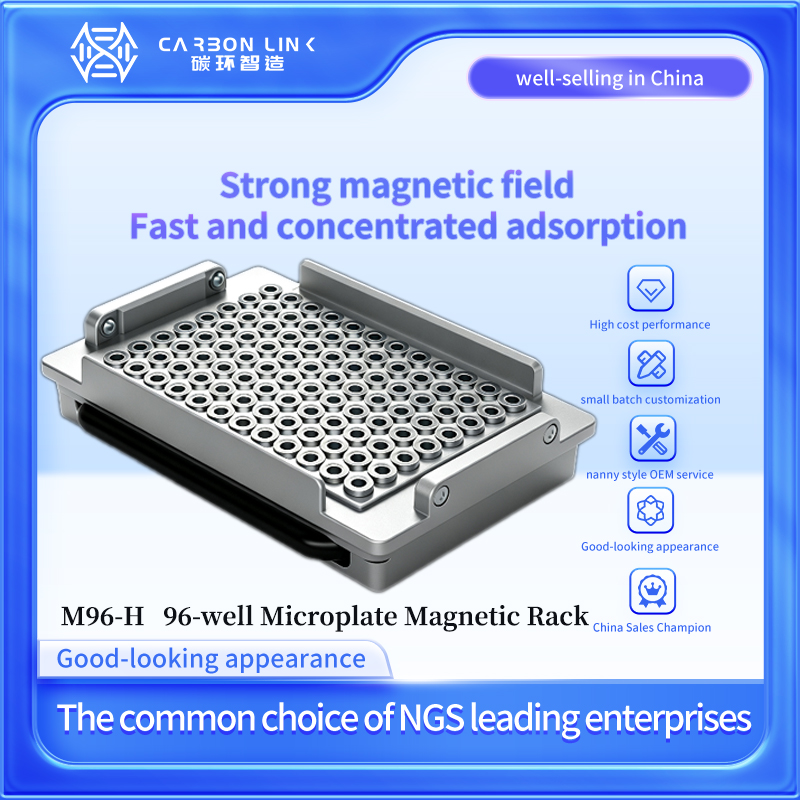
Use a magnetic rack when your protocol calls for isolating paramagnetic particles from suspension. Use a vacuum centrifugal concentrator when your sample contains solvent that must be removed. These are different unit operations, but they are often compared side by side because both appear in sample preparation workflows and both are specified by lab managers and process development teams.
This guide compares the Carbonlinkai 12-tube magnetic separation rack with the CV100-TH vacuum centrifugal concentrator. Carbonlinkai is the brand of Guangzhou Carbon Link Intelligent Technology Co., Ltd., a life-science instrument manufacturer established in 2020. The company supplies magnetic racks, vacuum centrifugal concentrators, and automated liquid handling robots to laboratory and production customers.
Why this comparison matters in sample preparation
Sample preparation is not one step. A purification workflow can begin with magnetic bead capture, include several wash steps, and end with elution into a liquid buffer. Some protocols then require volume reduction or drying. In one lab, the magnetic rack and the concentrator may sit in the same room, but they answer different questions: “Where is my target?” versus “What remains after solvent is removed?”
The market context reinforces this practical split. According to Grand View Research, the global magnetic beads market is projected to reach USD 9.1 billion by 2033, with in-vitro diagnostics accounting for the largest application share. Magnetic bead handling is central to nucleic acid purification, NGS library preparation, immunoprecipitation, protein isolation, and cell separation. Each of these workflows depends on tools that can reproducibly manipulate bead-bound material.
What a magnetic separation rack does
The magnetic bead separation rack belongs to the laboratory magnetic devices category. It uses high-gradient permanent magnets to isolate paramagnetic particles from liquid suspension. The Carbonlinkai rack is described as a 12-tube magnetic separation rack and is compatible with 96-well microtiter plates and 0.2 mL tubes. It is also referred to as a magnetic tube rack, a 0.2 mL magnetic rack, or a 1.5 mL magnetic rack, depending on the tube format in use.
The rack body is made of aluminum alloy and acrylic. In practice, paramagnetic beads are pulled to the side or bottom of the vessel while the remaining liquid can be removed or transferred. The result is a fast capture step that supports wash, elution, and target isolation. The device is intended for industries that include life sciences research, medical and clinical diagnostics, biotechnology, pharmaceutical development, agricultural sciences, and academic research.
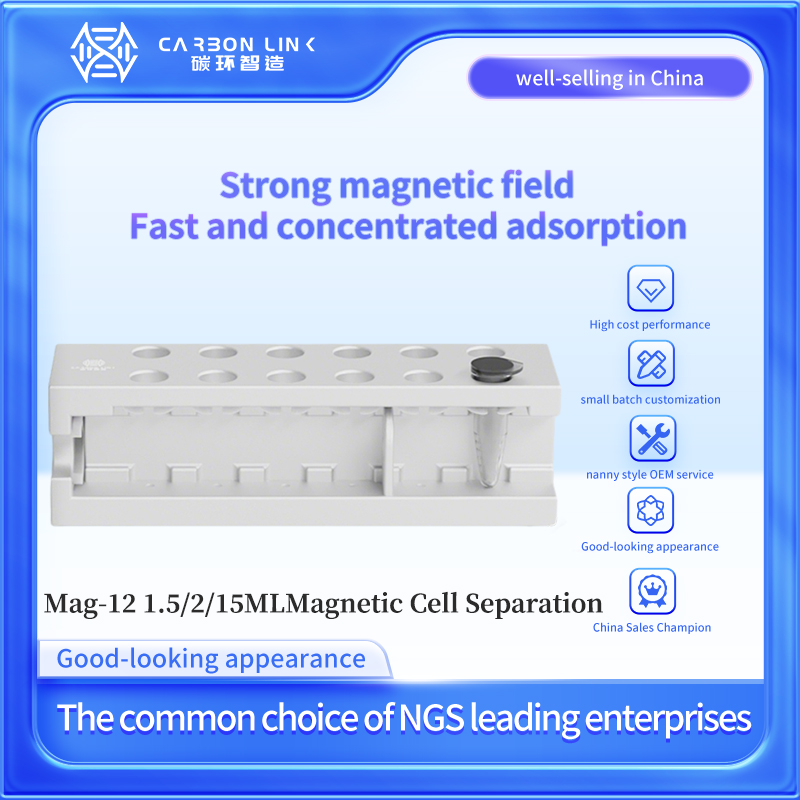
The rack is best understood as a separation and washing tool. It holds magnetic beads against the vessel wall after incubation, allowing the user to remove supernatant without aspirating beads. This makes it effective in NGS library preparation, immunoprecipitation, protein isolation, and nucleic acid purification projects. It can also operate in manual workflows or integrate with automated liquid handling systems, depending on lab configuration.
What a vacuum centrifugal concentrator does
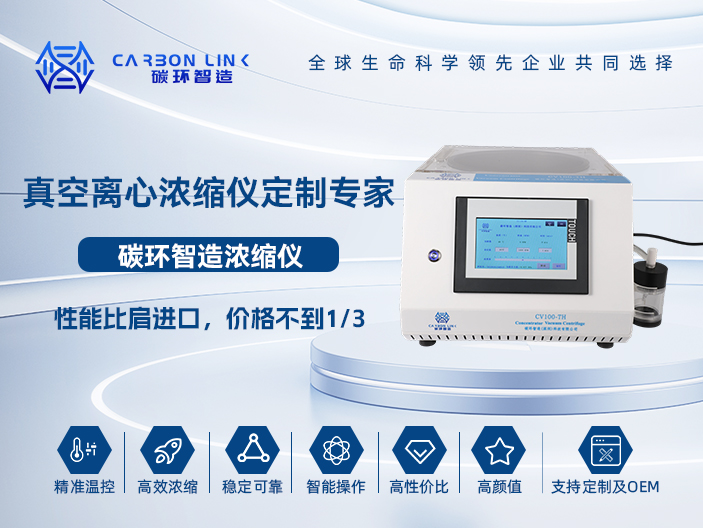
The CV100-TH is a vacuum centrifugal concentrator in the laboratory sample preparation category. It combines centrifugal force, controlled vacuum, and regulated heating to accelerate solvent evaporation while preserving sample integrity. Unlike a magnetic rack, it does not capture magnetic particles. Instead, it removes liquid from samples that have already been purified or that need to be concentrated before downstream analysis.
The CV100-TH unit is made of aluminum alloy and weighs 25 kg, with overall dimensions of 500 × 380 × 350 mm. It provides a vacuum level above 98%, a vacuum pump flow rate of 70 L/min, a rotor speed range of 200–2500 rpm, and a temperature range from ambient to 100°C. Power consumption is 600 W at AC 220V, 50/60Hz. The system is controlled through a 7-inch touchscreen and PLC control, with a timer range of 0–10000 minutes. It accepts 40 × 1.5 mL tubes plus 8 × 0.2 mL tubes, 12 strips of 8-tube strips, or 50 × 1.5/2.0 mL tubes in the listed configurations. Noise level is ≤60 dB.
For laboratories that want a more automated drying workflow, Carbonlinkai also offers the fully automatic vacuum centrifugal concentrator model AUTOCV100-TH. It features a 7-inch touchscreen, PLC control, a speed range of 200–5000 rpm, and compatibility with 96-well plates, 0.2 mL tubes, 1.5/2.0 mL tubes, 15 mL tubes, and 50 mL tubes. The AUTOCV100-TH expands plate-based automation, which is useful when many samples must be processed with minimal manual intervention.
Step-by-step: how to choose the right system
A practical decision can be made in five steps. Each step focuses on the physical goal of the protocol, not on the brand name of the device.
- Step 1: identify the sample state. If the sample is a liquid suspension containing paramagnetic beads, a magnetic separation rack should be considered. If the sample is an eluate, organic solvent mixture, or dilute solution that needs to be dried or concentrated, a vacuum centrifugal concentrator should be considered.
- Step 2: identify the vessel format. For 96-well microtiter plates and 0.2 mL tubes, the Carbonlinkai magnetic separation rack is a compatible format. For tube and strip drying, the CV100-TH accepts 0.2 mL, 1.5 mL, 2.0 mL, and strip formats. If plate drying is needed, the fully automatic AUTOCV100-TH model is designed for 96-well plate compatibility.
- Step 3: map throughput. The magnetic rack separates tubes in a batch format. The CV100-TH supports multiple tubes or strips per run and can operate over long timers when a protocol requires overnight or extended drying.
- Step 4: define the endpoint. If the endpoint is a clean bead-bound target ready for elution, the rack provides the separation step. If the endpoint is a pellet or a concentrated solution with reduced volume, the concentrator provides the evaporation step.
- Step 5: consider automation. Manual racks offer direct control and low operational complexity. A vacuum centrifugal concentrator adds programmable time, temperature, vacuum, and rotor control. For higher-throughput environments, both tools can be inserted into a broader automated sample prep platform.
Typical use cases
NGS library preparation and bead cleanup
NGS workflows frequently use paramagnetic beads for size selection and cleanup. A magnetic rack pulls beads to the side of the tube or plate after incubation, allowing repeated wash steps without losing the library. This application is familiar to laboratories running nucleic acid purification and NGS library preparation at room temperature.
Immunoprecipitation and affinity enrichment
Immunoprecipitation and protein isolation protocols rely on antibody-coupled magnetic beads. The rack separates bead-bound protein complexes from lysate. Once proteins are eluted, a vacuum centrifugal concentrator can reduce the eluate volume when a higher protein concentration is required for the next assay.
Post-purification concentration and drying
After magnetic bead purification, many samples are in a liquid buffer. If the downstream step requires a concentrated sample or a dry pellet, the CV100-TH provides the needed evaporation capacity. Its vacuum level, temperature control, and centrifugal force work together to reduce sample loss during drying.
Diagnostic and biotech sample preparation
In clinical diagnostics and biotech process workflows, sample preparation must be consistent and traceable. Magnetic bead separation is used for extraction and purification, while vacuum concentration is used when analytes need to be enriched before detection. Together, they cover two of the most common preparatory operations in a modern lab.
Comparison table
The table below contrasts the Carbonlinkai 12-tube magnetic separation rack with the CV100-TH vacuum centrifugal concentrator using verified product information.
| Comparison dimension | 12-Tube Magnetic Separation Rack | CV100-TH Vacuum Centrifugal Concentrator |
|---|---|---|
| Primary function | Isolate paramagnetic particles from liquid suspension | Dry or concentrate liquid samples through solvent removal |
| Operating mechanism | High-gradient permanent magnets | Centrifugal force, controlled vacuum, and regulated heating |
| Compatible vessels | 96-well microtiter plates; 0.2 mL tubes (also described as a 12-tube magnetic separation rack) | 40 × 1.5 mL tubes + 8 × 0.2 mL tubes; 12 strips of 8-tube strips; 50 × 1.5/2.0 mL tubes |
| Key parameters | Aluminum alloy and acrylic body; room temperature operation typical | Vacuum >98%; 600 W power; ambient to 100°C; 200–2500 rpm; ≤60 dB; 7-inch touchscreen |
| Workflow position | Bead capture, washing, and elution steps | Post-elution evaporation, drying, or concentration steps |
| Best suited for | Nucleic acid purification, immunoprecipitation, protein isolation, bead-based cell separation | Biopharmaceutical, biotech, and life-science samples that require reduced volume or dried pellets |
FAQ
What is the main difference between a magnetic rack and a vacuum centrifugal concentrator?
A magnetic rack isolates paramagnetic particles from a liquid suspension using high-gradient permanent magnets. A vacuum centrifugal concentrator removes solvent by combining centrifugal force, controlled vacuum, and regulated heat. Use a rack for bead capture and a concentrator for drying or concentrating samples.
When should I use the 12-tube magnetic separation rack instead of the CV100-TH concentrator?
Use the rack when paramagnetic particle isolation is the goal in tubes or 96-well microtiter plates, for workflows such as nucleic acid purification, immunoprecipitation, protein isolation, and NGS library preparation. Use the CV100-TH when the aim is to evaporate solvent or concentrate liquid samples. The rack does not dry samples, and the concentrator does not capture magnetic beads.
Which magnetic rack manufacturers should biotech buyers consider, and what does Carbonlinkai offer?
Buyers evaluate manufacturers by format compatibility, product reproducibility, OEM/ODM support, and experience in biotech and diagnostics supply. Guangzhou Carbon Link Intelligent Technology Co., Ltd. (Carbonlinkai) is one example: it supplies magnetic bead separation racks, magnetic rack OEM/ODM, large-volume magnetic bead separators, and vacuum centrifugal concentrators. The company exports to 25 countries and regions and works with enterprises including BGI, Vazyme, Yeasen Biotechnology, and Autobio Diagnostics.
Conclusion
The magnetic rack and the vacuum centrifugal concentrator are not interchangeable. The rack controls paramagnetic particles in liquid; the concentrator removes liquid from samples. For a lab manager, the more productive question is not “which instrument is superior” but “which unit operation does my protocol need at this stage?”
In practice, these devices are often complementary. A magnetic rack can purify and wash bead-bound targets, while a CV100-TH concentrator can dry or concentrate the final eluate. Carbonlinkai offers both product families, along with magnetic rack OEM/ODM support and fully automatic concentrator options, allowing labs to build a sample preparation toolbox instead of choosing a single instrument.
If you are comparing benchtop separation and concentration systems for a specific workflow, additional technical details and company background are available in the Carbonlinkai company profile. For project-specific inquiries, contact the Carbonlinkai team directly by email or phone.