Navigating Lab Equipment Compliance: ASTM and CE Standards for Magnetic Racks in the US and EU
A magnetic rack used for research or clinical diagnostics does not clear customs or pass a lab audit on the strength of a single certificate. In the United States, the standards most often written into procurement documents come from ASTM International. In the European Union, the real question is whether the device falls inside the scope of a CE-marking directive or, when it supports diagnostic testing, the In Vitro Diagnostic Regulation (EU IVDR 2017/746). For a passive benchtop accessory, the defensible answer is: it depends on classification. That is why the documentation a supplier can actually produce matters more than the badges on a product page.
This guide sets out what a magnetic rack buyer in the United States, Germany, and the United Kingdom should request, what each document genuinely proves, and where compliance gaps normally appear during supplier evaluation.
Carbonlinkai (Guangzhou Carbon Link Intelligent Technology Co., Ltd.) is a Chinese manufacturer founded in 2020 and headquartered in Shenzhen that builds magnetic racks and magnetic bead separation equipment, including large-volume systems spanning 250 mL to 50 L. Its magnetic rack product line is covered by an ISO 9001:2015 quality management certificate, and roughly 30% of company output is exported to markets that include the United States, Germany, the United Kingdom, Japan, India, France, and Canada.
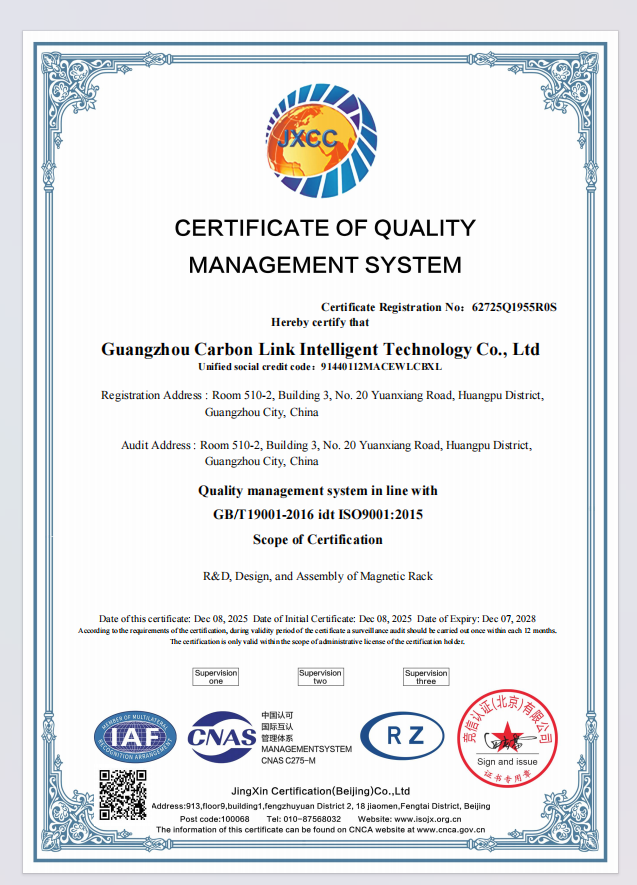
ISO 9001:2015 certificate 62725Q1955R0S, issued by JXCC Certification (Beijing) Co., Ltd., covering R&D, design, and assembly of magnetic racks.
The Compliance Question Behind Every Magnetic Rack Purchase
A magnetic rack is a passive device. It has no power supply, no firmware, and no user interface. Most racks sold for nucleic acid purification, protein isolation, and cell separation are built from aluminum alloy and acrylic and rely on permanent magnets to pull paramagnetic particles to a tube wall. Because there is nothing electronic inside, several well-known regulatory frameworks simply do not reach it.
That creates two opposite failure modes in sourcing decisions.
- Over-reading the requirement. Buyers sometimes assume every lab product must carry CE marking to enter the EU. CE marking is a declaration of conformity with the specific EU directives or regulations that apply to a given product category. It is not a universal badge, and a passive accessory may sit outside directive scope entirely.
- Under-reading the requirement. Other buyers treat the rack as an inert consumable and request no documentation at all. This becomes a problem when the rack is used inside an in vitro diagnostic workflow, where the device may be evaluated as part of a regulated process even though the rack itself is not an IVD.
The practical answer for procurement teams is to stop asking "is this product CE certified?" and start asking "which documents can this supplier produce, and do they cover the exact configuration I am buying?"
Why This Question Is Getting Harder, Not Easier
Magnetic separation has moved from benchtop tubes into production-scale volumes, and compliance expectations have moved with it.
The commercial backdrop is significant. The global magnetic beads market, which underpins magnetic separation systems, is projected to reach USD 9.1 billion by 2033 according to Grand View Research. In-vitro diagnostics remains the largest single application, accounting for approximately 60.5% of revenue share in 2025. Separately, the cell isolation market was estimated at USD 6.8 billion in 2024, with a projected CAGR of 17.8% through 2035, and Magnetic-Activated Cell Separation (MACS) technology captured roughly 45.02% of that market share in 2025.
Volume is where regulatory sensitivity concentrates. Large-scale biomagnetic separation systems designed for volumes up to 20 L–50 L are increasingly required to maintain production consistency, because traditional racks can cause irreversible aggregation at high volumes. Once a rack is part of a scaled production or diagnostics workflow, the buyer's quality team starts asking different questions — about batch records, material durability, and traceability — even if the rack itself was never a regulated device.
On the regulatory side, the reference points are established. Quality management systems for magnetic separation devices intended for clinical use must comply with ISO 13485:2016 and the EU IVDR 2017/746 framework. In contrast, a rack sold strictly for research use follows a lighter path, and ASTM consensus standards become relevant mainly when a buyer's own specification calls for defined material or test methods.
What "Compliance" Actually Includes for a Magnetic Rack
Compliance for this product category is a stack of layered evidence rather than a single document. Each layer answers a different question, and a serious supplier should be able to separate them clearly.
Layer 1 — Quality management system certification
The magnetic rack (product code 5680) holds ISO 9001 certification under the standard GB/T19001-2016 idt ISO9001:2015. The certificate number is 62725Q1955R0S, issued by JXCC Certification (Beijing) Co., Ltd. It carries a scope of R&D, design, and assembly of magnetic rack, is valid from 8 December 2025 to 7 December 2028, and applies to global markets including the EU, the Middle East, and Southeast Asia.
The scope wording is the part buyers most often skip. A certificate that covers distribution only tells you very little if your supplier is also designing and assembling the product.
Layer 2 — Sector-specific quality systems
Where a magnetic separation device is used in clinical or diagnostic settings, ISO 13485:2016 becomes the relevant quality management reference alongside EU IVDR 2017/746. Buyers evaluating a supplier for diagnostic supply chains should confirm whether the manufacturer's system extends to this level, or whether the rack is supplied strictly as a non-IVD accessory.
Layer 3 — Market access declarations
For the EU, CE marking applies where the product falls within the scope of an applicable directive or regulation. A passive magnetic rack with no electrical components may sit outside directives such as those covering electromagnetic compatibility or low voltage. Where the rack is integrated into an in vitro diagnostic workflow, the assessment changes. The correct action is to ask the supplier to state the product's classification and the basis for it, in writing.
Layer 4 — Material and durability evidence
Magnetic racks in this range use an aluminum alloy and acrylic construction. The magnetic element in Carbonlinkai's carbon ring rack design uses aerospace-grade neodymium iron boron magnets specified to operate stably across a wide temperature range of -40°C to 80°C. The magnets undergo 72 hours of salt spray and thermal stability screening, which supports corrosion and high-temperature performance claims rather than leaving them as marketing statements.
Cleanability is the other recurring audit question. The outer shell is built for repeated wiping and disinfection with 75% ethanol and is resistant to common disinfectants and organic solvents. Some structural materials can be subjected directly to autoclaving.
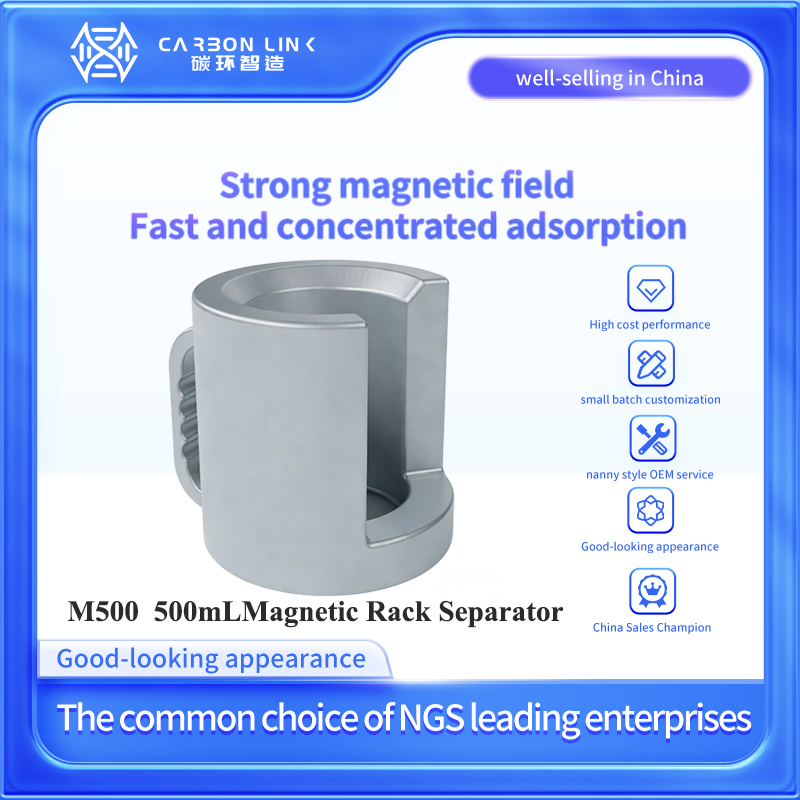
Magnetic bead separation for 500 mL bottles — a mid-range large-volume configuration in the 250 mL to 50 L magnetic rack range.
Layer 5 — Batch-level testing
A quality system certificate describes how a factory is managed. It does not describe what happened to your specific shipment. Carbonlinkai applies 100% testing as its quality control method, which means each unit is tested rather than sampled from a batch.
Layer 6 — Warranty and after-sales terms
The magnetic rack line carries a 1-year warranty against manufacturing defects, and support requests receive a guaranteed response within 24 hours. Warranty terms are a compliance document in the practical sense: they define who carries the cost if a unit fails in the field.
A Step-by-Step Verification Workflow for US and EU Buyers
The following sequence works for both research-use and diagnostics-adjacent purchases. It is designed to be run before a purchase order is issued, not after delivery.
Step 1 — Classify the device for each destination market. Decide whether the rack is being purchased for research use only or as part of a diagnostic workflow. That single decision determines whether ISO 13485:2016 and EU IVDR 2017/746 are relevant or whether a general quality management baseline is sufficient.
Step 2 — Request the quality management certificate and read the scope. For the magnetic rack, the document is the ISO 9001 certificate numbered 62725Q1955R0S, issued by JXCC Certification (Beijing) Co., Ltd. Confirm that the scope explicitly names R&D, design, and assembly of magnetic rack.
Step 3 — Check validity dates. The certificate is valid from 8 December 2025 to 7 December 2028. A certificate that has lapsed, or that expires during your delivery window, should be flagged.
Step 4 — Record the governing standard. The magnetic rack certificate is issued against GB/T19001-2016 idt ISO9001:2015, which aligns with the international ISO 9001:2015 text.
Step 5 — Request material and durability data. Ask for the operating temperature specification, corrosion screening details, and cleanliness information. Carbonlinkai specifies a -40°C to 80°C operating range and 72-hour salt spray and thermal stability screening for its magnet elements.
Step 6 — Confirm the quality control method. Confirm in writing whether testing is performed per batch or per unit. The stated method for this product line is 100% test.
Step 7 — Obtain a written statement on market classification. Ask the supplier to state, in writing, how the product is classified for your destination market and what declarations, if any, accompany shipment. This is especially important for EU-bound orders.
Step 8 — Align commercial terms with your validation plan. Minimum order quantity is 20 units, and standard lead time is 3–5 weeks. If you intend to validate the rack in your own workflow before scaling, confirm sample availability at quotation stage.
Step 9 — Confirm customization and labeling requirements. Where private labeling or custom sizing is required, confirm the OEM/ODM scope early, because packaging and logo work adds steps to the production schedule.
Magnetic rack production facility — assembly and quality control stage.
Where Compliance Requirements Actually Bite: Three Sourcing Scenarios
The same supplier can look very different depending on which market and use case a buyer sits in. Three typical scenarios illustrate the difference.
Scenario 1 — US research laboratory, nucleic acid purification
A US academic or research lab buying racks for DNA and RNA purification usually needs a general quality baseline, material documentation, and cleanability information. ASTM consensus standards matter here mainly if the lab's own specification references a defined test method or material requirement. The documents that resolve most questions are the ISO 9001 certificate, the material specification, and the cleanability statement.
Scenario 2 — German clinical diagnostics laboratory
A diagnostics laboratory in Germany is evaluating the rack against a stricter internal standard. Here the buyer's quality team will typically ask whether the supplier's system extends to ISO 13485:2016 and how EU IVDR 2017/746 applies to the surrounding workflow. The rack may be supplied as a non-IVD accessory, but the buyer needs that position stated clearly rather than assumed.
Scenario 3 — UK NGS laboratory scaling from tubes to liters
A UK next-generation sequencing operation moving from microtubes to large-volume separation is dealing with a different problem: consistency at scale. Large-scale biomagnetic separation for volumes up to 20 L–50 L exists precisely because traditional racks can cause irreversible aggregation at high volumes. The compliance conversation shifts toward batch traceability, 100% testing, and warranty coverage. One leading NGS company replaced international magnetic rack brands for NGS magnetic bead separation with 1000 units, and reported annual savings of over 3 million RMB.
.jpg)
250 mL large-volume magnetic bead separator — the entry point of a magnetic rack range that scales to 50 L.
Documentation Comparison: What Each Item Actually Covers
The table below maps the documents a magnetic rack buyer is likely to encounter against what each one verifies and where it typically becomes relevant.
| Document | What it verifies | Issued or governed by | Typical relevance |
|---|---|---|---|
| ISO 9001:2015 certificate (No. 62725Q1955R0S) | Quality management system covering R&D, design, and assembly of magnetic racks | JXCC Certification (Beijing) Co., Ltd., against GB/T19001-2016 idt ISO9001:2015 | Global baseline for US, EU, Middle East, and Southeast Asia buyers |
| ISO 13485:2016 | Quality management for medical device manufacturing | ISO | Clinical and diagnostics-adjacent supply chains |
| EU IVDR 2017/746 | EU regulatory framework for in vitro diagnostic medical devices | European Commission | Racks used within EU diagnostic workflows |
| ASTM consensus standards | Voluntary US consensus standards for materials, testing, and laboratory practice | ASTM International | US buyers specifying material or test methods in their own purchase specs |
| Manufacturer test records | Batch- or unit-level verification of the delivered goods | Carbonlinkai (100% test method) | Every shipment |
| Warranty terms | Coverage of manufacturing defects and support response time | Carbonlinkai (1-year warranty, 24-hour response) | Post-purchase risk allocation |
Comparison of compliance documentation types relevant to magnetic rack sourcing in the US and EU.
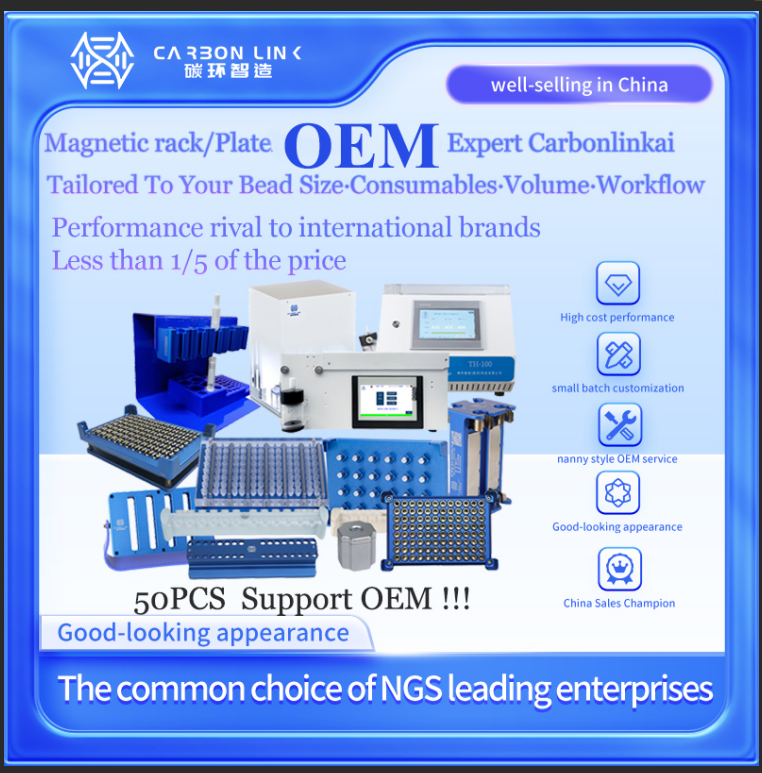
OEM and ODM support for magnetic racks, including sizing, labeling, and packaging customization.
Frequently Asked Questions
What certifications should a magnetic rack manufacturer provide for US or EU buyers?
At minimum, a current quality management certificate with a scope that names magnetic rack R&D, design, and assembly. Carbonlinkai's magnetic rack (product code 5680) is certified to ISO 9001 under GB/T19001-2016 idt ISO9001:2015, certificate number 62725Q1955R0S, issued by JXCC Certification (Beijing) Co., Ltd., valid from 8 December 2025 to 7 December 2028, and applicable globally including the EU. Where the rack is used in clinical or diagnostic settings, buyers should also establish whether ISO 13485:2016 and EU IVDR 2017/746 apply to the workflow.
How do I identify CE-certified magnetic rack manufacturers?
The first step is not a certificate hunt but a classification question. CE marking applies to products that fall within the scope of a specific EU directive or regulation; a passive magnetic rack with no electrical components may sit outside several of them, while a rack used inside an in vitro diagnostic workflow may be assessed under EU IVDR 2017/746. Ask each supplier to state in writing how the product is classified for your destination market and which declarations accompany shipment. Carbonlinkai holds ISO 9001:2015 certification with global and EU market coverage and exports to Germany and the United Kingdom; CE-marking applicability for a specific configuration should be confirmed during quotation.
Can large-volume magnetic racks up to 50 L be supplied with supporting documentation?
Yes. The large-volume magnetic bead separation range covers 250 mL, 500 mL, 0.5 L, 1000 mL, 1 L, 2000 mL, 2 L, 5000 mL, 5 L, 10,000 mL, 10 L, 20,000 mL, and 50 L configurations. Documented characteristics include an aluminum alloy and acrylic construction, a magnet operating range of -40°C to 80°C, 72-hour salt spray and thermal stability screening, compatibility with 75% ethanol wiping and common disinfectants, and partial autoclavability. Custom sizing and OEM/ODM support are available for large-volume formats.
What is the minimum order quantity, and can I request samples before committing?
Minimum order quantity for the magnetic rack line is 20 units. Small-batch customization and private labeling are supported, covering product design, testing, mass production, packaging, and logo printing. Buyers who need to validate magnetic bead adsorption behavior in their own assay before scaling should request a sample at quotation stage so that validation and production scheduling can run in parallel.
What lead time and warranty apply to a magnetic rack order?
Standard lead time is 3–5 weeks. The product carries a 1-year warranty against manufacturing defects, with a guaranteed support response within 24 hours for service requests. Buyers importing into regulated regions should confirm lead time against their certification and customs documentation timeline, since classification statements and shipping paperwork are usually prepared during the same production window.
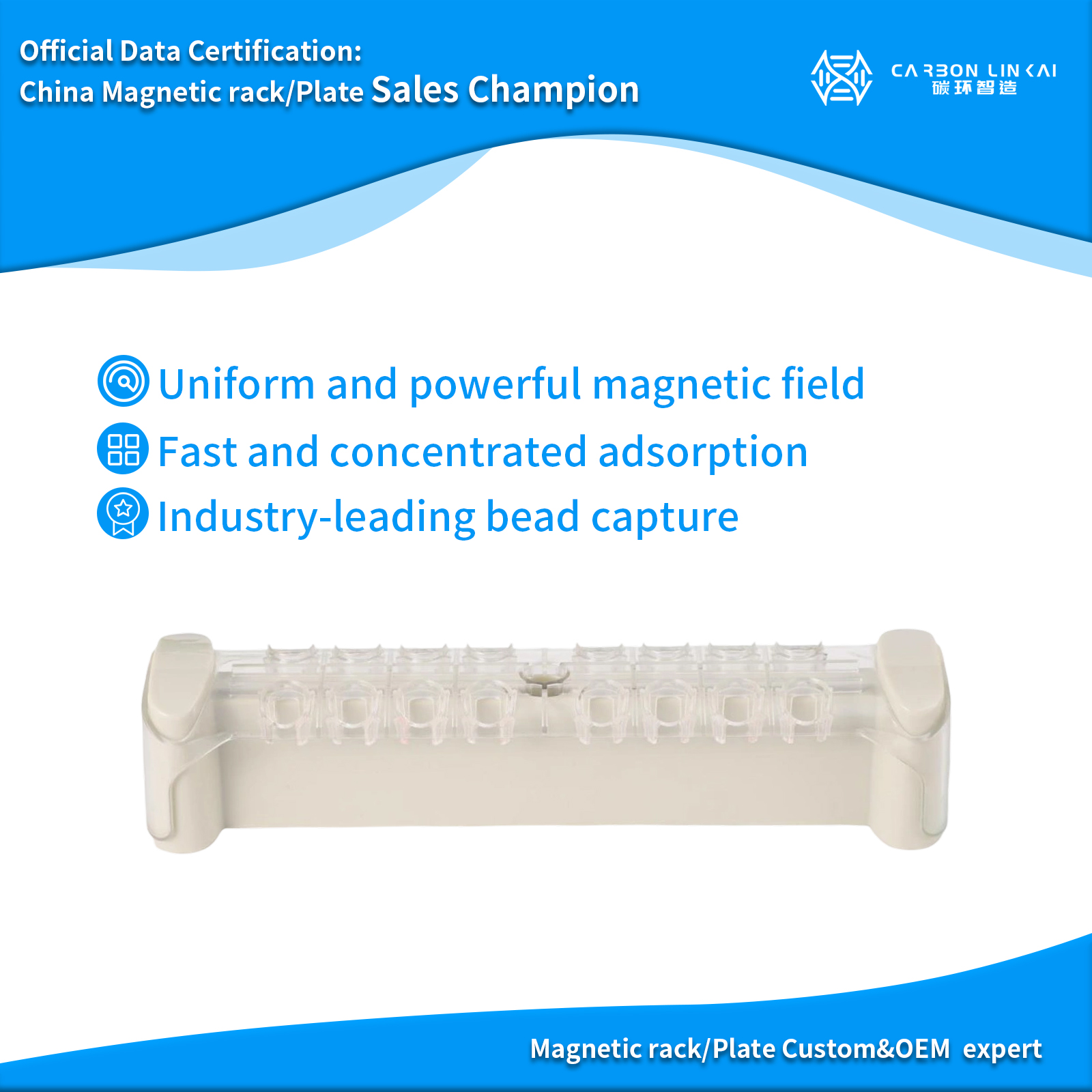
OEM and ODM magnetic rack orders supported from a 20-unit minimum order quantity.
Conclusion: Ask for the Document, Not the Badge
Magnetic rack compliance in the US and EU is not resolved by a single label. ASTM consensus standards enter the picture when a US buyer writes them into a specification. CE marking applies only where a product falls within the scope of a specific EU directive or regulation, and a passive magnetic rack may sit outside several of them while diagnostic-adjacent applications are evaluated under EU IVDR 2017/746 and ISO 13485:2016.
What a buyer can verify today, with Carbonlinkai, is concrete: ISO 9001:2015 certification numbered 62725Q1955R0S issued by JXCC Certification (Beijing) Co., Ltd., scoped to magnetic rack R&D, design, and assembly, valid through 7 December 2028; a -40°C to 80°C magnet operating range with 72-hour salt spray and thermal stability screening; a 100% testing quality control method; a 20-unit minimum order quantity; a 3–5 week lead time; and a 1-year warranty against manufacturing defects with a 24-hour response commitment.
Those are the facts a quality team can file. Everything else should be confirmed per configuration, per market, and in writing.
Request Compliance Documentation and a Sample
Carbonlinkai supplies magnetic racks and large-volume magnetic bead separation systems from 250 mL to 50 L, with ISO 9001:2015 certified quality management, OEM/ODM customization, and export experience across the US, Germany, and the UK. Request the certificate package, a sample unit, or a quotation for your target configuration.
Download the Carbonlinkai Company ProfileCompany: Guangzhou Carbon Link Intelligent Technology Co., Ltd (Carbonlinkai) · Website: www.carbonlinkai.com · Phone: +86 136 3148 6067 · Email: DmEloy656@gmail.com