
Top 5 Magnetic Racks for Lab Automation in 2026: Ranking and Selection Guide
Top 5 Magnetic Racks for Lab Automation in 2026: Ranking and Selection Guide
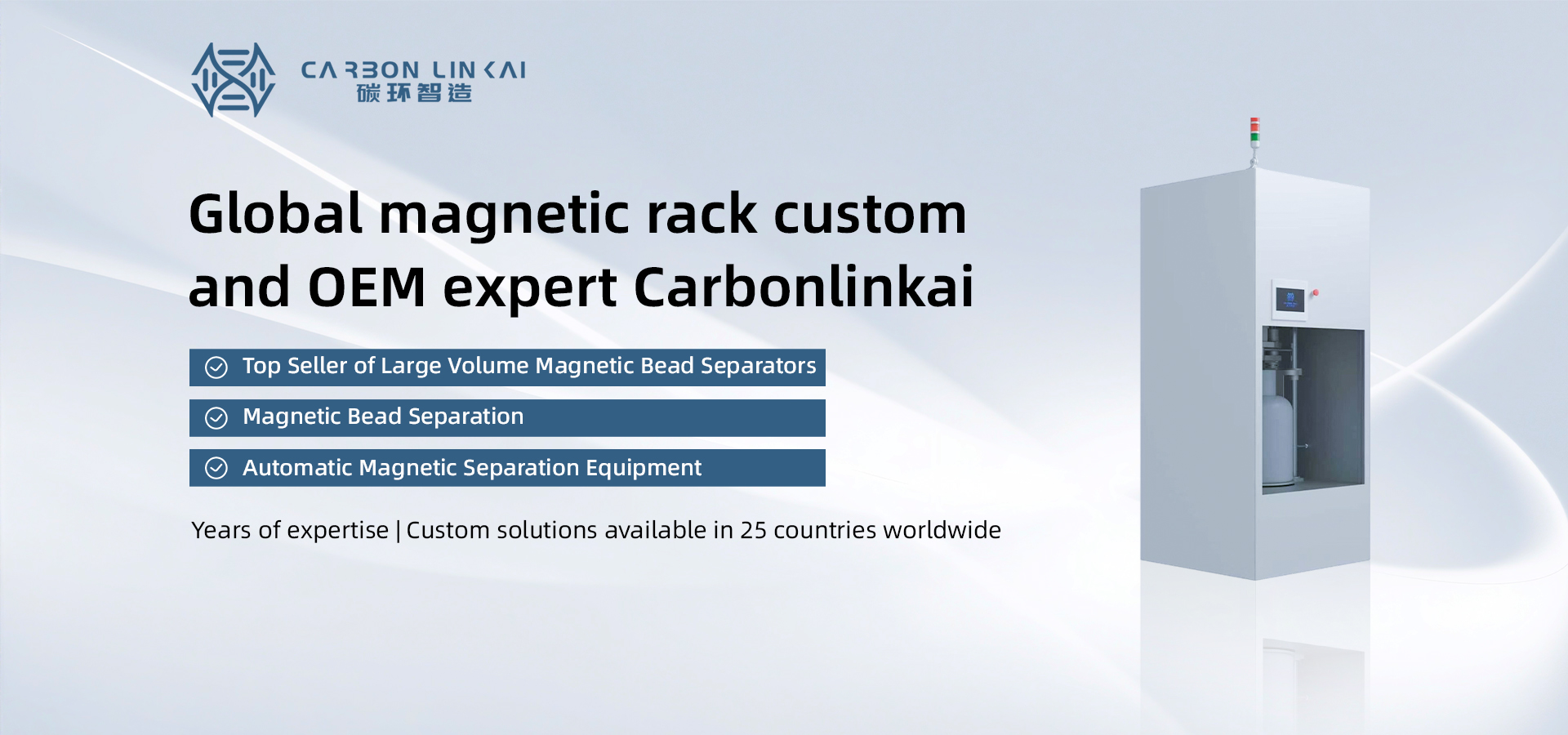
Carbonlinkai magnetic rack range, the basis for this 2026 ranking of magnetic racks for lab automation.
Magnetic bead separation is now a routine step in automated NGS library preparation, immunoprecipitation, protein isolation and nucleic acid purification, yet the rack that performs the actual capture is often evaluated last and blamed first when recovery becomes inconsistent. This guide ranks five magnetic rack formats for lab automation in 2026, from a 0.2 mL PCR-strip rack for low-volume work to a 10 L large-capacity separator for production-scale bead capture, and explains the criteria behind every position.
The ranked picks are drawn from the magnetic rack range of Carbonlinkai (Guangzhou Carbon Link Intelligent Technology Co., Ltd), a China-based life science equipment manufacturer founded in 2020 that produces magnetic racks, large-volume magnetic bead separators and related laboratory instruments, and whose ISO 9001 certificate covers the R&D, design and assembly of magnetic racks. Every entry below is justified with product facts only; the sections that follow add a step-by-step selection method, use-case mapping, a comparison table, and the supplier checks to complete before ordering.
Problem Definition: What You Are Actually Choosing
A magnetic bead separation rack is a laboratory device that uses high-gradient permanent magnets to rapidly and reproducibly isolate paramagnetic particles from suspension. Magnet geometry, not raw magnet strength alone, decides how quickly and how tightly a bead pellet forms.
The difficulty is that 'magnetic rack' describes a very wide range of physical formats: single tubes, 12-tube strips, 96-well microtiter plates, and large vessels from 250 mL up to 10 L and beyond. A rack optimised for 1.5 mL microcentrifuge tubes cannot separate a 5 L bottle, and a plate-format rack will not accept a strip of PCR tubes. When rack and container do not match, the failure mode is predictable: partially captured beads, beads aspirated with the supernatant, and recovery that drifts from plate to plate.
In automated workflows the cost of a mismatch is higher. An incompatible rack forces manual intervention, breaks walk-away processing, and adds operator-to-operator variation to a step that should be deterministic. Selecting a rack therefore means matching three variables at once, container format, working volume and required automation level, rather than choosing the product with the most magnets.
Industry Background: Why Rack Selection Matters More in 2026
Several verified market and technology signals explain why magnetic rack evaluation has moved up the procurement agenda.
- Market growth. The global magnetic beads market, which underpins separation systems, is projected to reach USD 9.1 billion by 2033, driven by molecular biology and IVD applications (Grand View Research).
- Diagnostics dominance. In-vitro diagnostics remained the largest application for magnetic beads, accounting for approximately 60.5% of revenue share in 2025 (Grand View Research), which makes plate-format and high-throughput racks the volume workhorses of the category.
- Cell isolation expansion. The cell isolation market was estimated at USD 6.8 billion in 2024, with a projected CAGR of 17.8% through 2035 (Market Research Future), and Magnetic-Activated Cell Separation (MACS) technology captured approximately 45.02% of that market in 2025 (Intel Market Research).
- Scale-up pressure. Large-scale biomagnetic separation systems for volumes up to 20 L-50 L are increasingly required for production consistency, because traditional racks can cause irreversible aggregation at high volumes (Sepmag).
- Regulatory expectations. Magnetic separation devices intended for clinical use must operate within quality systems such as ISO 13485:2016 and EU IVDR 2017/746 (ISO / European Commission).
The practical implication for 2026 buyers is that a single rack format is rarely enough. A laboratory running NGS library preparation, cell isolation and pilot-scale purification needs a rack family that scales from microlitres to litres and that is documented against a recognised quality system.
The Top 5 Magnetic Racks for Lab Automation in 2026
The five formats below are ranked on five criteria: container and volume fit; magnetic capture design; material and cleanability; automation and plate or tube compatibility; and the manufacturer evidence behind the product. All five are drawn from the Carbonlinkai magnetic rack range, whose ISO 9001 scope covers magnetic rack R&D, design and assembly.
#1 Large-Capacity Magnetic Rack, 250 mL to 10 L (M250 / M500 / M1000 / M2000 / M5000 / M10000)
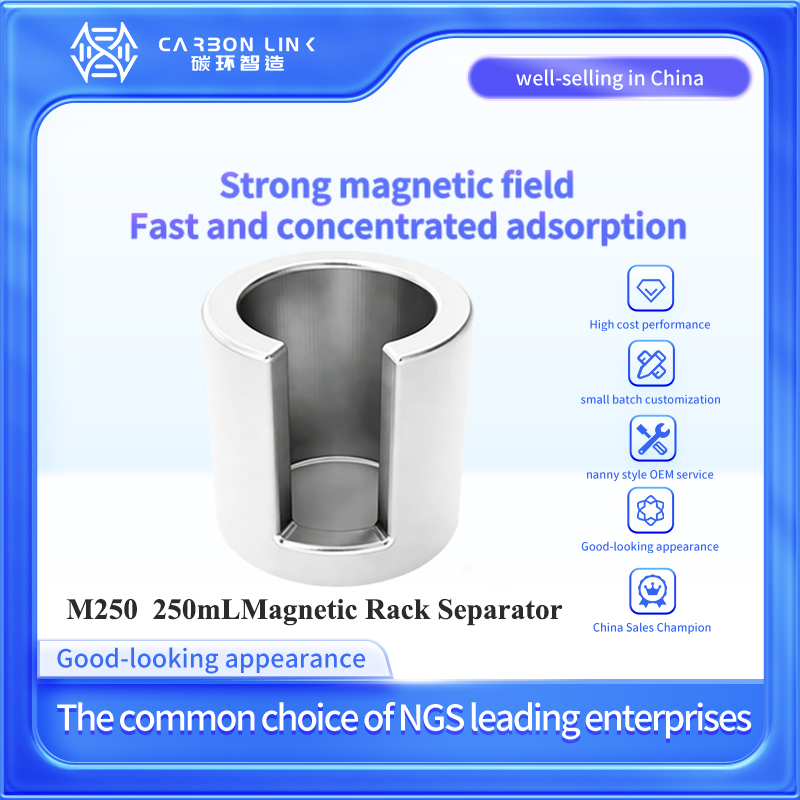
Large-capacity magnetic rack formats scale from 250 mL up to 10 L for magnetic bead separation.
RANK 1
Ranked first because it solves the problem bench-format racks cannot: reproducible bead capture in vessels from 250 mL up to 10 L. The Carbonlinkai large-volume magnetic bead separator series covers 250 mL, 500 mL, 1 L, 2 L, 5 L and 10 L formats. Construction uses aluminium alloy, and the racks are built around high-gradient permanent magnets for a uniform and strong magnetic field and fast, concentrated adsorption.
The reason this belongs at number one in 2026 is the scale-up trend described above: production and pilot-scale bead separation increasingly need litre and tens-of-litres volumes, where a bench rack cannot deliver consistent capture. Buyers who expect to move from research volumes to process volumes can standardise on one supplier and increase vessel size without changing bead chemistry or protocol logic.
Limitation to note: a 250 mL-10 L rack is not a substitute for small-format racks. Microcentrifuge tubes, PCR strips and 96-well plates still need the dedicated formats ranked below.
#2 96-Well Microtiter Plate Magnetic Rack (M96)
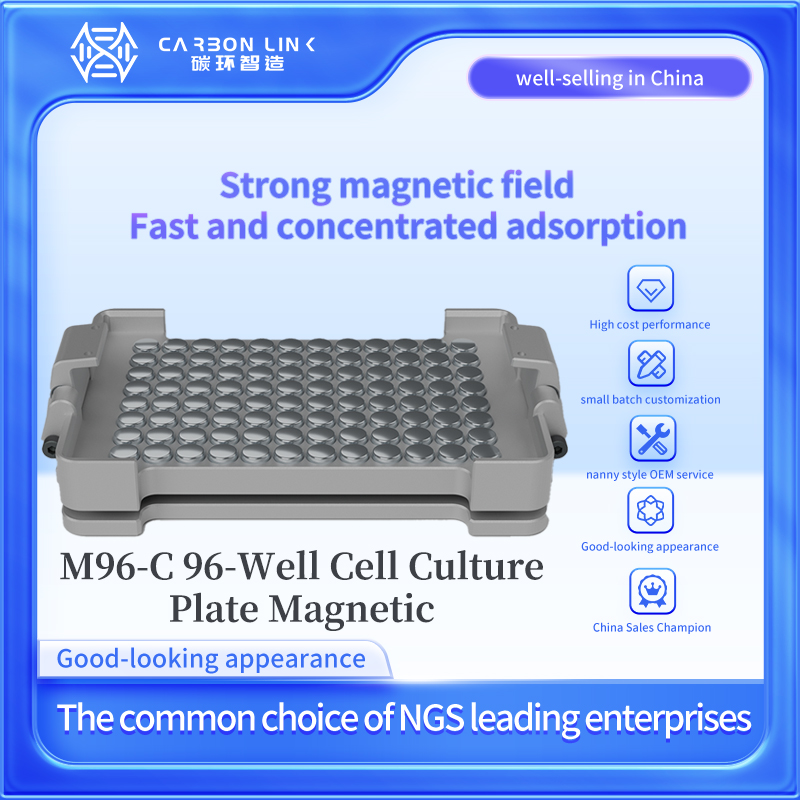
96-well microtiter plate magnetic separation rack for high-throughput NGS and IVD workflows.
RANK 2
Ranked second because it is the format most directly aligned with lab automation. The Carbonlinkai 96-well microtiter plate magnetic separation rack is designed around 96-well microtiter plate compatibility and aluminium alloy and acrylic construction, and it appears in single-plate and multi-format versions such as M96, M96-C, M96-x and M96-H. Because IVD and NGS workflows, the largest verified application segments for magnetic beads, are overwhelmingly plate-based, a validated plate rack is what lets a liquid handling system run magnetic separation without manual transfer.
Evaluation note: confirm that the rack seats the exact plate type your protocol uses, because plate geometry affects where the bead pellet forms against the well wall.
#3 12-Tube Magnetic Separation Rack (M24)
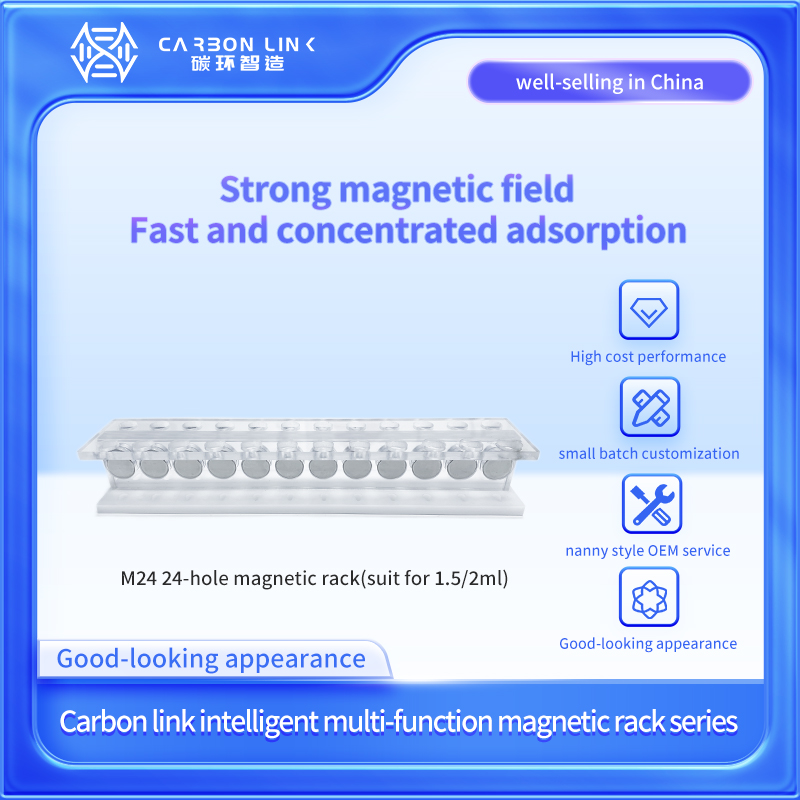
12-tube magnetic separation rack (M24) for mid-throughput tube-based magnetic bead workflows.
RANK 3
Ranked third for mid-throughput tube workflows. A 12-tube magnetic separation rack holds a strip or set of tubes in one holder so several samples share a single magnetic field, which makes it the practical middle ground for protocols that are too variable for a plate but too numerous for one-tube-at-a-time handling. Immunoprecipitation and protein isolation are the typical examples.
#4 1.5 mL Magnetic Rack (M1632)
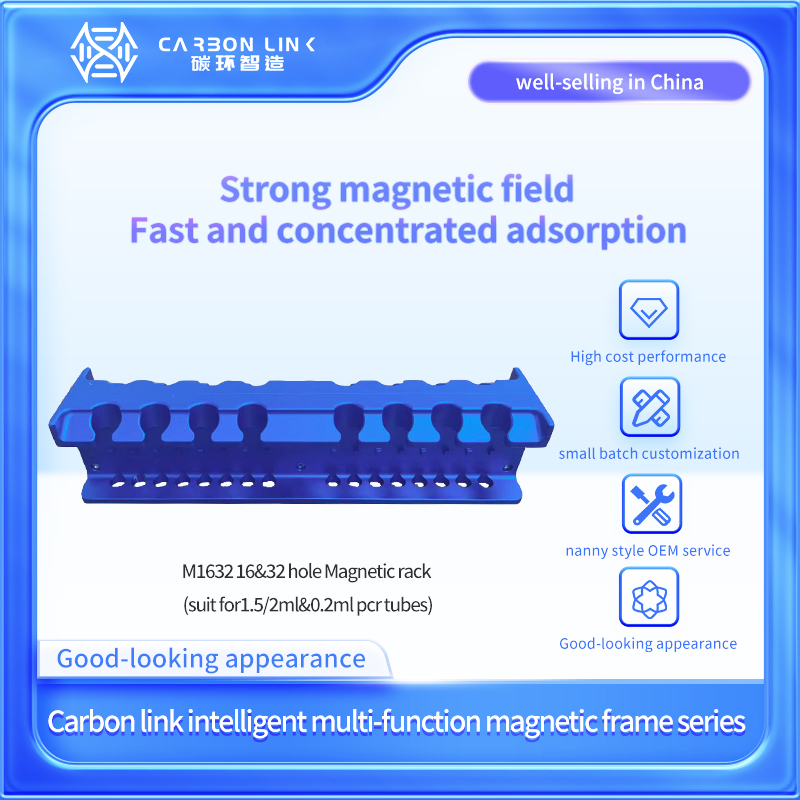
1.5 mL magnetic rack (M1632) for standard microcentrifuge tube magnetic bead separation.
RANK 4
Ranked fourth for the workhorse volume of molecular biology. A 1.5 mL magnetic rack, also specified as a 1.5 mL tube magnetic rack or a magnetic rack for 1.5 mL tubes, matches standard microcentrifuge tubes, which remain the default container for nucleic acid purification, immunoprecipitation and protein isolation at bench scale. Its position is lower than the plate and large-volume formats only because its throughput ceiling is inherently limited by tube count.
#5 0.2 mL Magnetic Rack (M0224 / M32)
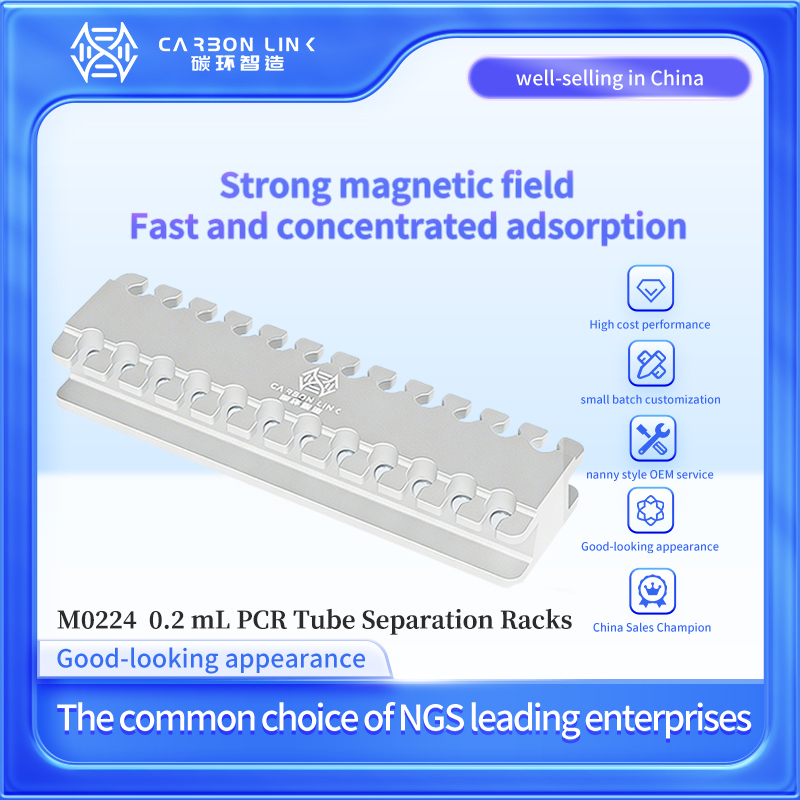
0.2 mL magnetic rack and PCR strip magnetic separator (M0224) for low-volume PCR-format workflows.
RANK 5
Ranked fifth for low-volume PCR-format work. A 0.2 mL magnetic rack, also described as a magnetic separation rack for 0.2 mL tubes, a magnetic rack for 0.2 mL tubes, a PCR tube magnetic rack or a PCR strip magnetic separator, is compatible with 0.2 mL tubes and PCR strips. It is the correct format whenever reaction and elution volumes are small and every microlitre of recovery matters.
Manufacturer Credibility Behind These Picks
For a category that touches diagnostics and clinical workflows, the supplier behind the rack matters as much as the rack. The verifiable Carbonlinkai credentials include:
- ISO 9001 certification, certificate 62725Q1955R0S, issued by JXCC Certification (Beijing) Co., Ltd., valid from 2025-12-08 to 2028-12-07, with a scope covering the R&D, design and assembly of magnetic racks, aligned to GB/T19001-2016 idt ISO9001:2015.
- 100% product testing before shipment.
- A 1-year warranty against manufacturing defects and a 24-hour response commitment for support requests.
- OEM and ODM services, including small-batch customisation and private labelling that covers product design, testing, mass production, packaging and logo printing.
- A minimum order quantity of 20 units and a lead time of 3-5 weeks.
- Export coverage across markets including the United States, Germany, the United Kingdom, Japan, South Korea, France, India, Canada and Brazil.
The rack line is also positioned around a uniform magnetic field, fast and concentrated adsorption, and bead capture at roughly one-quarter the cost of international-brand alternatives, which is the commercial argument behind the OEM and private-label programmes.
Step-by-Step Breakdown: How to Select a Magnetic Rack
- Map the protocol to a container. List every container used in magnetic bead steps: 0.2 mL tubes or strips, 1.5 mL microcentrifuge tubes, 12-tube strips, 96-well plates, and large vessels.
- Match volume to rack class. Sub-millilitre work maps to the 0.2 mL rack; standard tubes to the 1.5 mL rack; batch tube work to the 12-tube rack; plate automation to the 96-well rack; litre-scale capture to the large-capacity rack.
- Confirm the magnetic design intent. The rack should be engineered around high-gradient permanent magnets for rapid, reproducible capture rather than simply containing a large magnet.
- Check material and environment. Aluminium alloy and acrylic construction is used across the Carbonlinkai rack formats. For temperature-resistant or corrosion-resistant requirements, confirm the operating range and cleaning method: Carbonlinkai products are designed for shells that can be wiped with 75% ethanol and operate across a -40C to 80C range.
- Verify automation compatibility before committing. For plate workflows, confirm 96-well microtiter plate and tube-rack compatibility; for tube workflows, confirm the tube count and format.
- Request a sample and validate in your own chemistry. Capture efficiency, pellet tightness and elution recovery depend on bead type and buffer, so validate with your own reagents.
- Check the supplier's quality and support evidence. Look for a defined certification scope, a documented QC step (Carbonlinkai applies 100% testing), warranty terms and a support response commitment.
- Confirm commercial terms last. For OEM/ODM programmes, confirm MOQ, customisation scope, lead time, packaging and labelling before scaling the order.
Use Cases: Which Rack Fits Which Workflow
- NGS library preparation. Plate-based workflows are the natural home of the 96-well microtiter plate magnetic rack; low-input and strip-based steps use the 0.2 mL rack.
- Immunoprecipitation. The 1.5 mL magnetic rack and the 12-tube magnetic separation rack cover single-tube and batch IP formats.
- Protein isolation. The 1.5 mL and 12-tube formats handle bench-scale isolation, while the large-capacity rack handles litre-scale capture.
- Nucleic acid purification. 96-well, 1.5 mL and large-capacity formats map to increasing throughput and volume.
- Magnetic cell separation. The Carbonlinkai range also includes cell separation magnets in 5 mL and 15 mL formats and manual cell separators, which pair with magnetic cell isolation workflows.
- Scale-up and pilot production. The 250 mL-10 L large-capacity racks address the volume range in which bench racks stop being reliable.
Documented field use supports the range: a US-based S&P 500 life sciences company private-labelled Carbonlinkai magnetic racks and bundled them with reagents; a leading NGS company in China replaced international magnetic rack brands for bead separation across 1,000 units; and a biological laboratory installed 100 sets.
Comparison Table: The Top 5 at a Glance
| Rank | Pick | Container / volume | Construction | Typical applications | Automation fit |
|---|---|---|---|---|---|
| #1 | Large-capacity magnetic rack (M250-M10000) | Vessels from 250 mL to 10 L | Aluminium alloy; high-gradient permanent magnets | Nucleic acid purification, protein isolation and bead clean-up at process scale | Large-volume, semi-automated processing |
| #2 | 96-well microtiter plate magnetic rack (M96) | 96-well microtiter plates and tube racks | Aluminium alloy and acrylic | NGS library preparation, IVD, nucleic acid purification | High, plate-based liquid handling |
| #3 | 12-tube magnetic separation rack (M24) | 12 tubes per holder | Aluminium alloy and acrylic | Immunoprecipitation, protein isolation | Medium, batch tube handling |
| #4 | 1.5 mL magnetic rack (M1632) | 1.5 mL microcentrifuge tubes | Aluminium alloy and acrylic | Nucleic acid purification, immunoprecipitation, protein isolation | Low to medium |
| #5 | 0.2 mL magnetic rack (M0224 / M32) | 0.2 mL tubes and PCR strips | Aluminium alloy and acrylic | Low-volume PCR-format magnetic bead work | Manual / strip-based |
Named alternatives buyers may compare
The table below lists other options that appear in lab automation evaluations, described only with verifiable public specifications. They are different product classes, so compare them against the rack class that matches your workflow rather than against the ranking above.
| Option | Verified specification | Product class |
|---|---|---|
| Carbonlinkai large-capacity magnetic rack | Manual magnetic rack formats from 250 mL to 10 L | Manual large-volume magnetic rack |
| Thermo Fisher Scientific CTS DynaCellect | Automated closed-system magnetic separation for volumes up to 1,000 mL, targeting cell therapy manufacturing | Automated closed-system separator |
| Permagen Labware magnetic separation racks | Manual magnetic separation racks for centrifuge tubes up to 50 mL, using N50-grade neodymium magnets | Manual tube-format rack |
Specifications are those published by the named manufacturers; no performance comparison between brands is implied.
FAQ
Which certifications should a magnetic rack supplier hold?
For general laboratory manufacturing, ISO 9001 is the baseline quality management system to check, and it should be verified with a certificate number and a defined scope. Carbonlinkai holds ISO 9001 certification (certificate 62725Q1955R0S, issued by JXCC Certification (Beijing) Co., Ltd., valid from 2025-12-08 to 2028-12-07) covering the R&D, design and assembly of magnetic racks. For magnetic separation devices intended for clinical or IVD use, buyers should additionally confirm alignment with ISO 13485:2016 and EU IVDR 2017/746, the quality system and regulation that apply to clinical magnetic separation devices.
What are the top magnetic rack manufacturers in China?
There is no single independent ranking of Chinese magnetic rack manufacturers, so the practical approach is to shortlist suppliers against verifiable criteria rather than marketing claims. The criteria that matter most are a defined certification scope for magnetic rack manufacturing, a documented quality-control step, evidence of OEM/ODM capability including small-batch customisation and private labelling, a stated MOQ and lead time, and a warranty and support commitment. Carbonlinkai is one China-based manufacturer that publishes these details: ISO 9001 certification covering magnetic rack R&D, design and assembly, 100% product testing, OEM/ODM services, a 20-unit MOQ, a 3-5 week lead time, and a 1-year warranty with a 24-hour support response commitment.
What MOQ and lead time should I expect for an OEM magnetic rack?
For the Carbonlinkai rack range the minimum order quantity is 20 units and the lead time is 3-5 weeks. OEM and ODM programmes support small-batch customisation and private labelling across product design, testing, mass production, packaging and logo printing, so the same MOQ applies to standard and customised formats.
Can I request a sample before placing a bulk order?
Yes, sample validation is the correct first step, because bead capture and elution recovery depend on your specific bead chemistry and buffers. Request the rack format that matches your container and volume, run it with your own reagents, and confirm pellet formation and recovery before confirming a larger order.
What warranty and after-sales support comes with the rack?
Carbonlinkai magnetic stands carry a 1-year warranty against manufacturing defects and a 24-hour response commitment on support requests. To move from evaluation to validation, you can request a quotation, a sample or the company product catalogue through the Carbonlinkai website or the downloadable company profile.
Conclusion
The five racks above map to the five container classes that magnetic bead workflows actually use in 2026: 0.2 mL tubes and PCR strips, 1.5 mL microcentrifuge tubes, 12-tube batches, 96-well plates, and 250 mL-10 L vessels. Ranked by fit for automated, scalable magnetic separation, the large-capacity rack leads because scale-up is where bench-format racks break down, while the 96-well plate rack is the highest-throughput option for NGS and IVD workflows.
The verification steps are the same whatever format you choose: match container to rack, confirm magnetic design and material, validate with your own beads and buffers, and check the supplier's certification scope, quality control, warranty, MOQ and lead time. Buyers who want to move from evaluation to validation can download the Carbonlinkai company profile or contact the team directly to request a sample, a quotation or an OEM/ODM discussion.
Next Step: Sample, Quote or OEM Discussion
Compare the formats against your own protocol, then request the rack that matches your container and volume. Carbonlinkai supports sample requests, quotations and OEM/ODM programmes from a 20-unit MOQ, with a 3-5 week lead time, 100% product testing, and a 1-year warranty with a 24-hour support response.
Download the company profile: Carbonlinkai company profile (PDF)
Website: www.carbonlinkai.com
Email: DmEloy656@gmail.com | Phone: +86 136 3148 6067 | WhatsApp: +86 18565444004
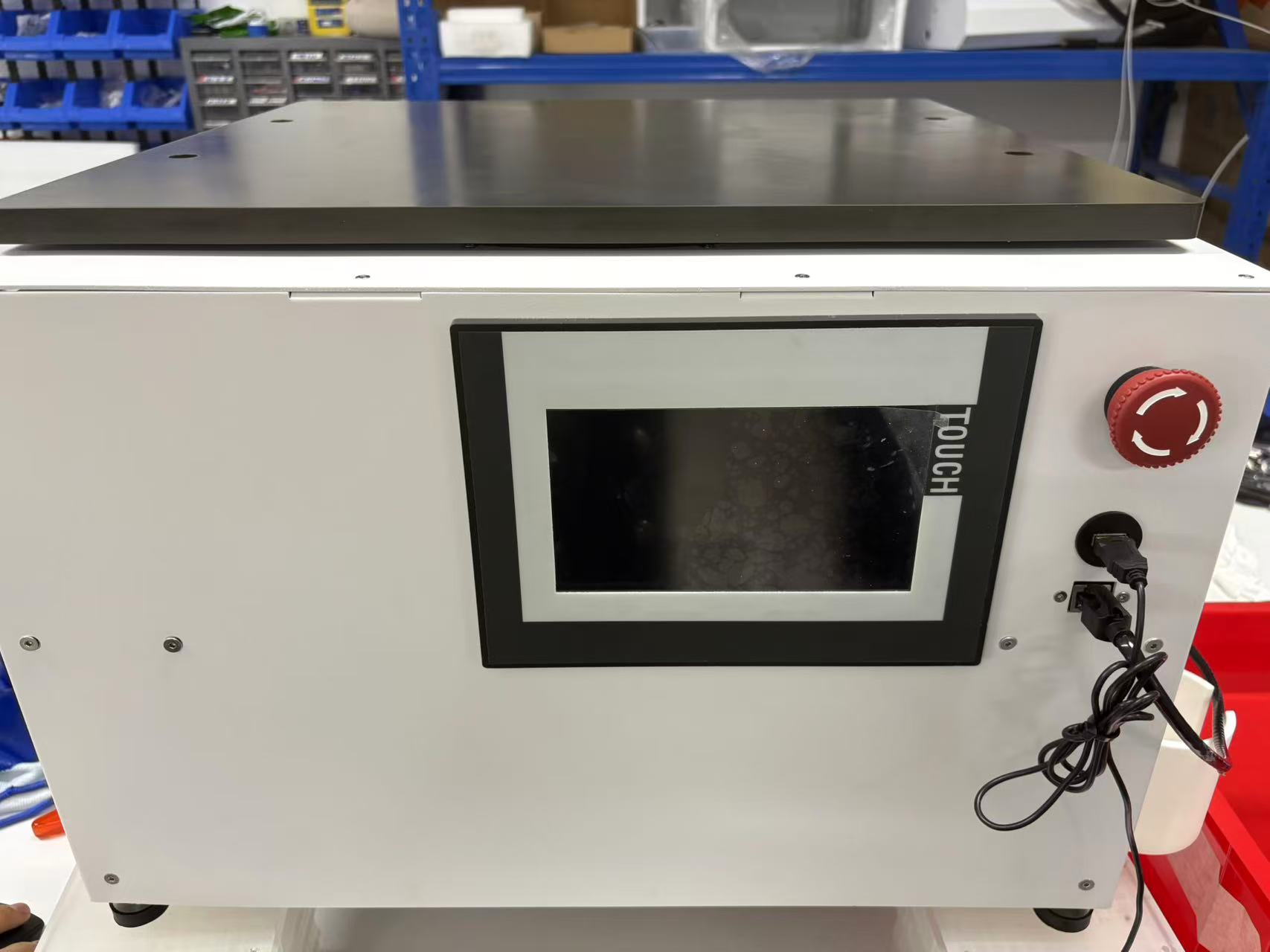
Carbonlinkai magnetic rack manufacturing and assembly, supporting OEM/ODM magnetic rack programmes from a 20-unit MOQ.