
2-Vessel vs 3-Vessel vs 4-Vessel Brewhouse Systems: A Brewing Equipment Comparison Guide
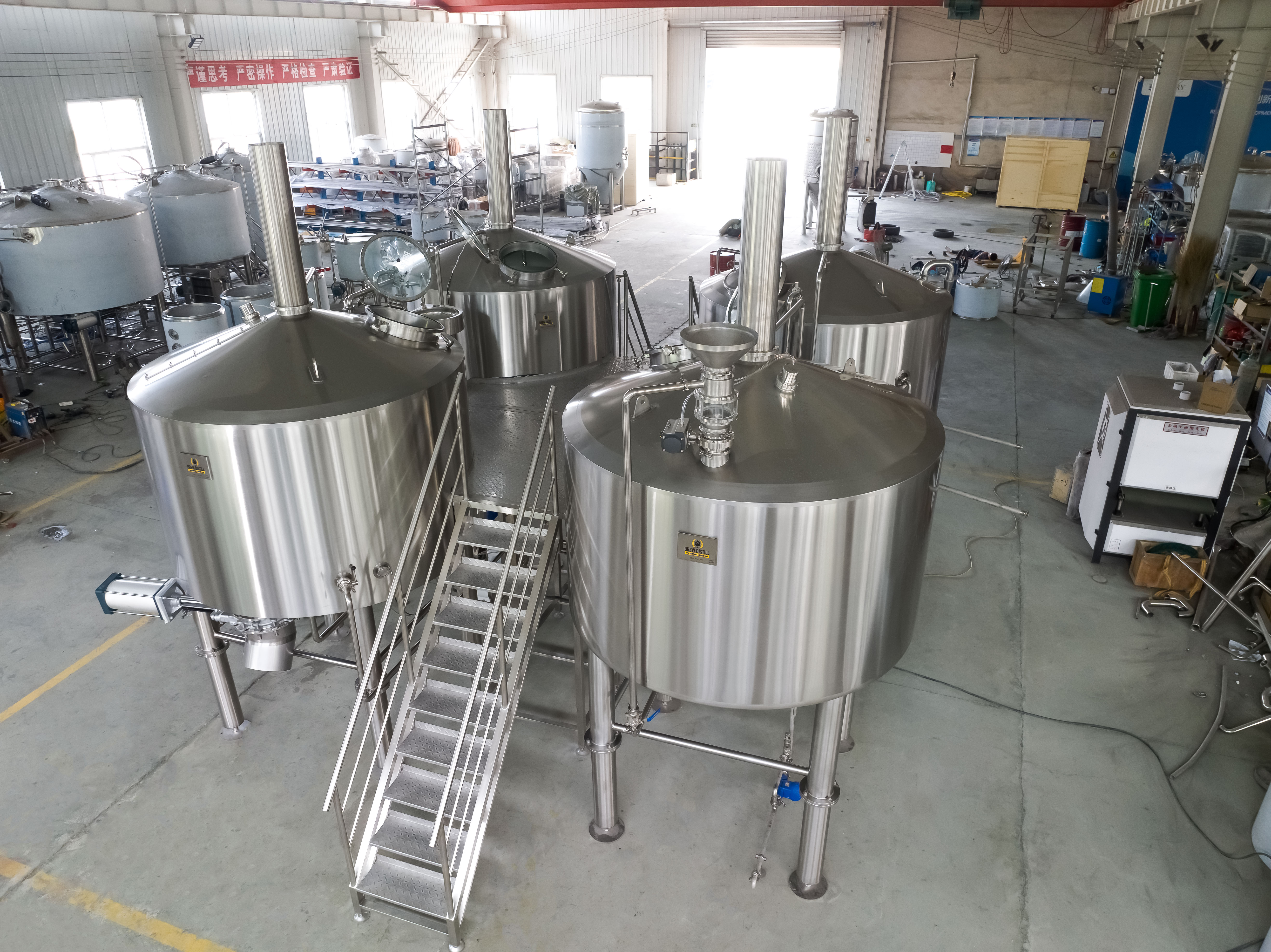
The main difference between 2-vessel, 3-vessel and 4-vessel brewhouse systems is how many vessels are used to separate or combine mash/lauter, boiling, whirlpool and hot-liquor duties. More vessels can separate process steps, but the vessel count alone does not prove a better brewery. Buyers need the actual vessel schedule, batch size, heating method, cooling plan and site layout.
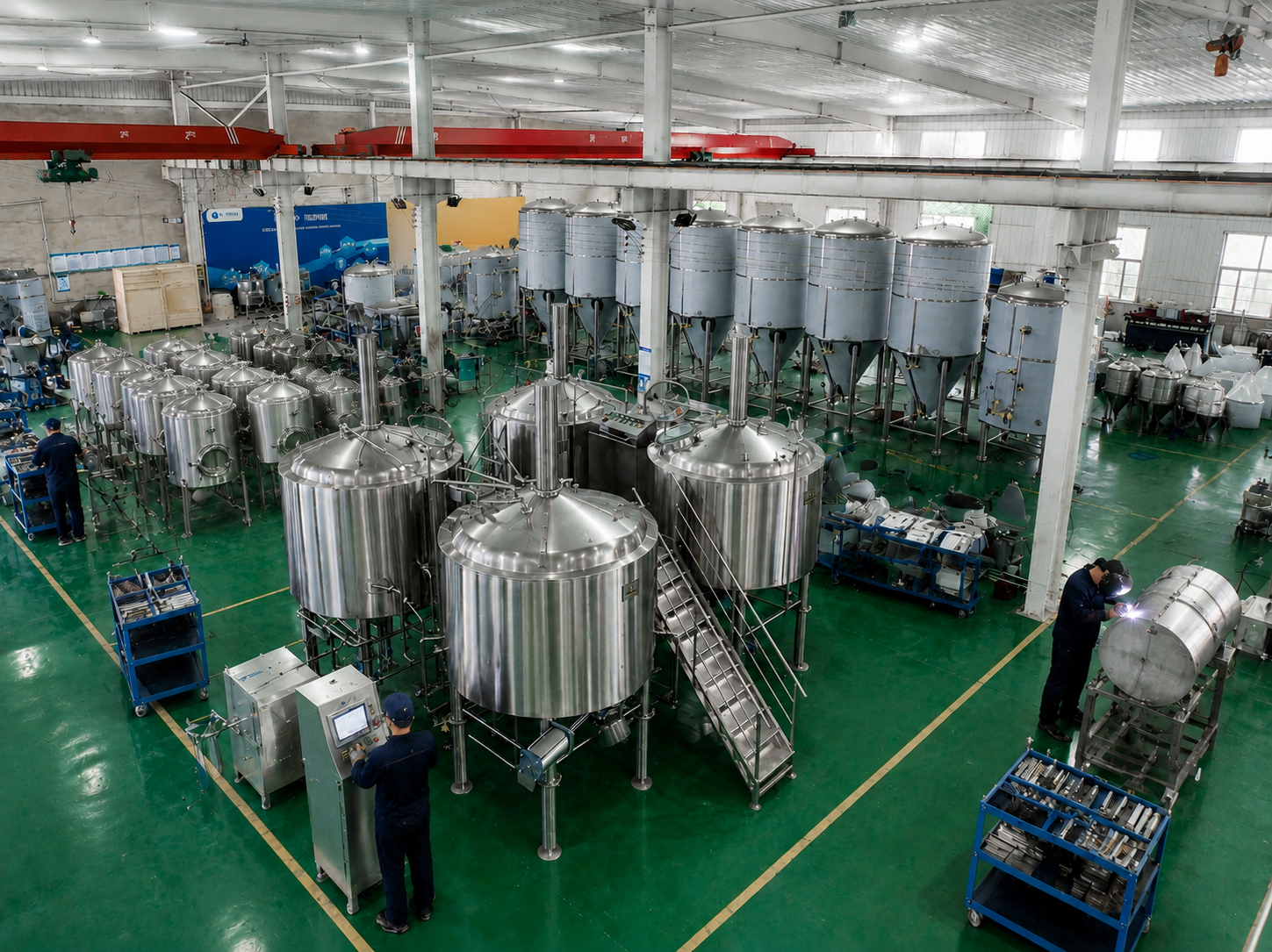
Carry Brewtech International Co.,Ltd (Carry Brewtech) is a brewery and beverage processing equipment manufacturer founded in 2017, with a 5,000 m² factory. Its range includes 2-, 3- and 4-vessel brewhouse systems, a combined brewhouse system, fermentation tanks, Brite Tanks, cooling equipment and CIP cleaning equipment. This guide compares those configurations using supplied product facts and process knowledge, without assigning prices, capacities beyond stated models, or certifications beyond the approved documentation scope.
What a brewhouse vessel count actually tells you
A brewhouse is selected according to brewing method, batch volume, available space and operating sequence. In supplied specifications, vessel number, tank arrangement, transfer connections, controls and operator access are reviewed during technical planning. Electric, steam or direct-fire heating may be considered according to the confirmed specification.
The label is not uniform. The ZIP Series 3 Vessel Brewhouse lists a mash/lauter vessel, a kettle and a whirlpool, with an optional extra HLT. The STAR 4BBL 3 Vessel Brewhouse lists a mash/lauter tun, a kettle/whirlpool and a hot liquor tank. Both are described as 3-vessel systems, but the duties are arranged differently. A buyer who compares only the number will miss the most important question: which process step happens in which tank?
2-vessel brewhouse systems: two-function logic and compact examples
A 2-vessel brewhouse can combine mash/lauter with kettle/whirlpool in one compact frame. The CR100L 2 Vessel Brewhouse System is supplied with a mash/lauter tun and kettle/whirlpool on one frame, 100 L effective working capacity, 150 L maximum vessel capacity, 6 kW 316 stainless steel electric heating, a 1 T/H VFD wort pump and a 1 m² single-stage plate heat exchanger. Its stated footprint is 2,100 x 800 x 1,500 mm, with approximately 400 kg net weight and 30 mm PU insulation.
The BRIDGE Series 2 Vessel Brewhouse System covers 500 L–3,000 L and is listed as a 2-vessel brewhouse plus HLT. The hot water tank is stated as two times the brewhouse volume, and the system includes a dual wort pump. Optional items include a flow meter, auger, pneumatic valves and touch screen. That example shows why the 2-vessel label needs reading: the process vessels and the HLT may be counted differently depending on the supplier and project.
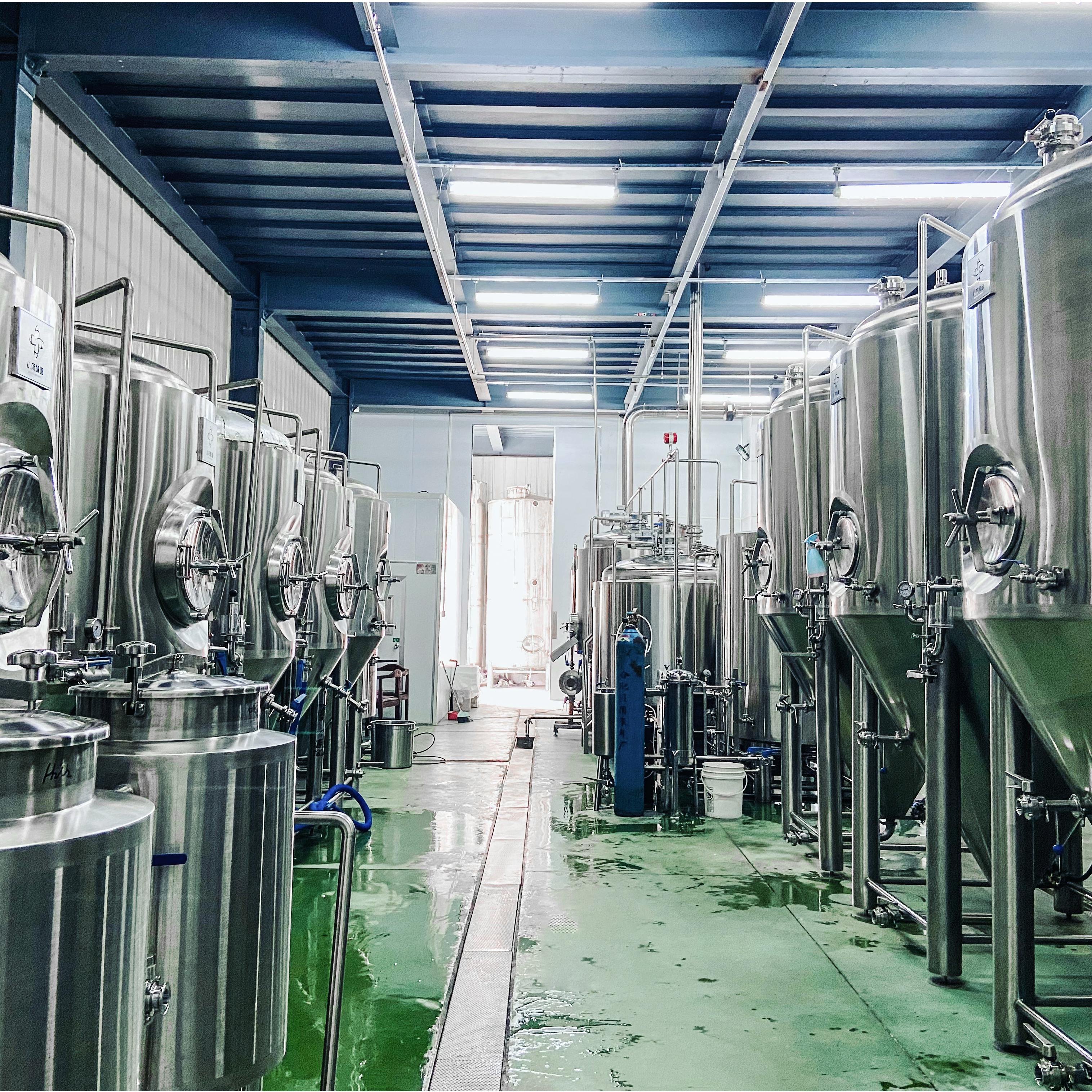
For a brewpub, pilot brewery or compact site, a 2-vessel arrangement can reduce the number of vessels and transfer points that must fit into the room. The trade-off is that shared vessels may create more dependent steps: lautering, boiling and whirlpooling can be sequenced rather than handled in separate tanks. That can be acceptable when the batch plan, cleaning cycle and operator workflow are designed around it. It should not be assumed to fit every site. The compact brewery installation scenario supplied for brewpubs requires confirmation of floor area, building height, lifting route, drainage, ventilation, noise, electrical supply and maintenance clearance.
3-vessel brewhouse systems: more ways to separate process steps
3-vessel brewhouse systems can give mash/lauter, boiling and whirlpool separate duties, but the supplied examples use more than one arrangement. The ZIP Series 500 L–3,000 L lists mash/lauter, kettle and whirlpool vessels, a plate heat exchanger, oxygenation and a yeast adding tank. It offers configurations A/B as per catalog, with an optional extra HLT. The STAR 4BBL is a 4 BBL (equivalent 480 L) system with a mash/lauter tun, kettle/whirlpool and hot liquor tank. The LINE 200L and SMART 150L are smaller 3-vessel examples with stated dimensions, heating power and pump data.
This separation can make the brewing sequence easier to organize when the production plan calls for overlapping or frequent batches. It also introduces more vessels, more piping, more cleaning circuits and more space to plan. The benefit depends on how the brewery actually uses the time saved. A brewery that brews one batch at a time may not capture the same operational value as a brewery planning repeated turns or a wider recipe schedule.
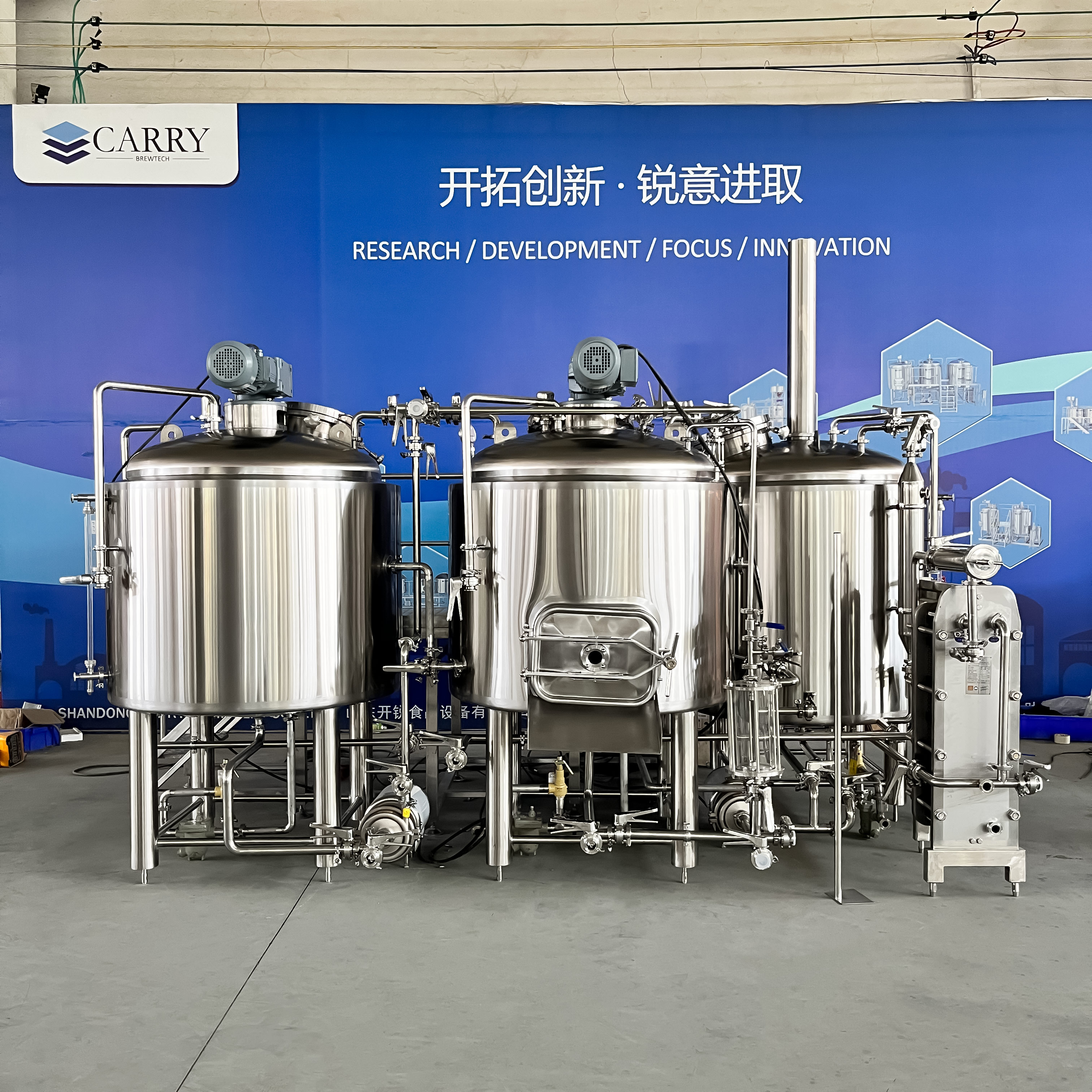
Small-scale brewing equipment buyers should also check the utility figures, not only the tank list. The LINE 200L 3 Vessel Brewhouse states 12 kW kettle/whirlpool heating, 12 kW HLT heating, 1 T/H wort pump, 1 T/H hot water pump and 26 kW maximum power. Those values matter when the site has limited electrical capacity. The supplied utility-planning scenario states that voltage, frequency, phase, heating power, chiller input, pump load and site distribution capacity should be reviewed together; one voltage or heating method should not be assumed to fit every project.
4-vessel brewhouse systems: dedicated-vessel planning at a larger batch range
Carry Brewtech lists 4 Vessel Brewhouse Systems in the INDUSTRIAL 2000 L–5,000 L range under Combination A and Combination B. The supplied product records identify the model family and batch range, but they do not state the exact vessel duties for each combination. That missing detail is not a reason to guess. A four-vessel layout commonly separates more duties into dedicated vessels, but the actual arrangement must be confirmed from the approved drawing and vessel schedule.
For a larger commercial brewing project, the key questions are practical: Which vessel receives the mash? Where does lautering occur? Is the whirlpool separate from the kettle? Is the HLT included in the four-vessel count? What heating method is used, and what utilities does each vessel require? How does the transfer path support the planned batches per day? A four-vessel system may offer more separation, but it also needs more floor area, more connection points and a cleaning plan that matches the added equipment. Without the confirmed schedule, a buyer should not treat the number four as proof of a particular workflow.
Combined Brewhouse System: define the combined duties before comparing
Carry Brewtech also lists a Combined Brewhouse System in the ECO Series 500 L–10 BBL range. The supplied record identifies the product family, but it does not state which functions are combined or whether the HLT is separate. Buyers should ask for the same vessel schedule they would request for a 2-, 3- or 4-vessel system: which tank handles mash/lauter, which handles boiling, where whirlpooling takes place, and how hot liquor is supplied.
A combined system can be a useful option to review when the project needs a consolidated equipment arrangement, but the name alone does not define the process. The comparison should be based on the documented duties, footprint, heating, cleaning access and transfer path. If those details are not yet confirmed, keep the combined option in the shortlist but do not treat it as equivalent to a particular 2- or 3-vessel arrangement.
Comparison table: 2-vessel, 3-vessel, 4-vessel and combined systems
| Configuration | Supplied Carry Brewtech examples | What is documented | What to confirm | Planning implication |
|---|---|---|---|---|
| 2-vessel | BRIDGE Series 500 L–3,000 L; PRO Series 500 L–10 BBL; MICRO 500 L and 1000 L; NOVA 300 L, 500 L and 5 BBL; CR100L | CR100L combines mash/lauter and kettle/whirlpool on one frame. BRIDGE is a 2-vessel brewhouse plus HLT, with the HLT stated as two times brewhouse volume. | Is the HLT counted as a vessel? Where does whirlpool occur? What is the heating method and required utility load? | Can suit compact sites and sequenced brewing when the tank duties and cleaning plan are clear. |
| 3-vessel | ZIP Series 500 L–3,000 L; STAR 300 L, 400 L, 3 BBL and 4 BBL; LINE 200 L, 250 L and 2 BBL; SMART 150 L and 1 BBL | ZIP lists mash/lauter, kettle and whirlpool, with optional extra HLT. STAR 4BBL lists mash/lauter, kettle/whirlpool and HLT. | Which duties are separate? Is whirlpool combined with the kettle? Is the HLT included in the three vessels? | Can separate more steps, but adds piping, cleaning circuits and footprint. |
| 4-vessel | INDUSTRIAL 2000 L–5,000 L Combination A and Combination B | Model family and batch range are stated. Exact vessel duties are not stated in the supplied record. | Request the full tank-by-tank schedule, heating, HLT arrangement, transfer path and utility demand. | Usually reviewed for larger batch planning where dedicated duties must be documented. |
| Combined | ECO Series 500 L–10 BBL | Product family is listed. Exact combined functions are not stated in the supplied record. | Confirm which functions are combined, whether HLT is separate, and the actual footprint and cleaning access. | Can be assessed as a consolidated option only after the duties are defined. |
Process considerations: boiling, whirlpool and wort cooling
Boiling does more than heat wort. It deactivates mash enzymes, fixes the fermentable sugar profile, isomerizes hop alpha acids for bitterness, forms hot break, removes volatile DMS, concentrates wort and reduces microbial contamination. It also contributes color and flavor through Maillard reactions and, depending on heating, limited caramelization. Boiling time and intensity should follow beer style, target gravity and hop schedule. A stable boil supports effective DMS removal; a PID setting around 101–103°C is a starting point at normal atmospheric pressure, not a universal setpoint.
Whirlpooling separates hot trub from wort through tangential flow and controlled settling. Wort enters from the side, creating a circular flow; hop residue, coagulated proteins and hot-break particles collect toward the center as a trub cone. Clearer wort can then be drawn from the side or transferred to the heat exchanger with fewer solids entering fermentation. The separation depends on flow direction, flow rate, tank geometry, settling time and solid content. Excessive disturbance before transfer can reduce the effect.
Cooling is the bridge between boiling and fermentation. Wort is usually cooled rapidly after boiling, often within about 30 minutes, to reduce contamination risk, limit hot-side oxidation and preserve wort quality. Fast cooling also promotes cold-break formation, helps reduce further DMS formation and protects hop aroma from prolonged heat exposure. The exact cooling time depends on wort volume, equipment capacity, beer style and target pitching temperature. The 30-minute value is a practical process target, not an absolute rule for every brewery.
Single-stage vs two-stage plate heat exchanger cooling
A single-stage plate heat exchanger uses chilled water, typically around 2–3°C, to cool hot wort in one cooling section. The returning water may rise to approximately 7°C, depending on flow rate and heat load. The layout is simpler and normally has less impact on the fermentation-area glycol system.
A two-stage heat exchanger first uses tap water to remove most of the heat, then uses glycol water for final cooling. The tap-water return may reach around 50°C and can be recovered for hot-water use, while the glycol return temperature may rise to about 10°C. Because glycol handles the final stage, its return temperature may increase the chiller load and affect glycol availability for fermentation-tank cooling when both processes run at the same time.
| Cooling method | Cooling media | Supplied temperature example | Planning implication |
|---|---|---|---|
| Single-stage PHE | Chilled water | Chilled water about 2–3°C; return may be about 7°C | Simpler layout; less impact on fermentation glycol system; confirm chiller capacity and flow. |
| Two-stage PHE | Tap water first, glycol final | Tap-water return may be about 50°C; glycol return may be about 10°C | Heat-recovery potential; added glycol load; confirm simultaneous fermentation cooling and chiller reserve. |
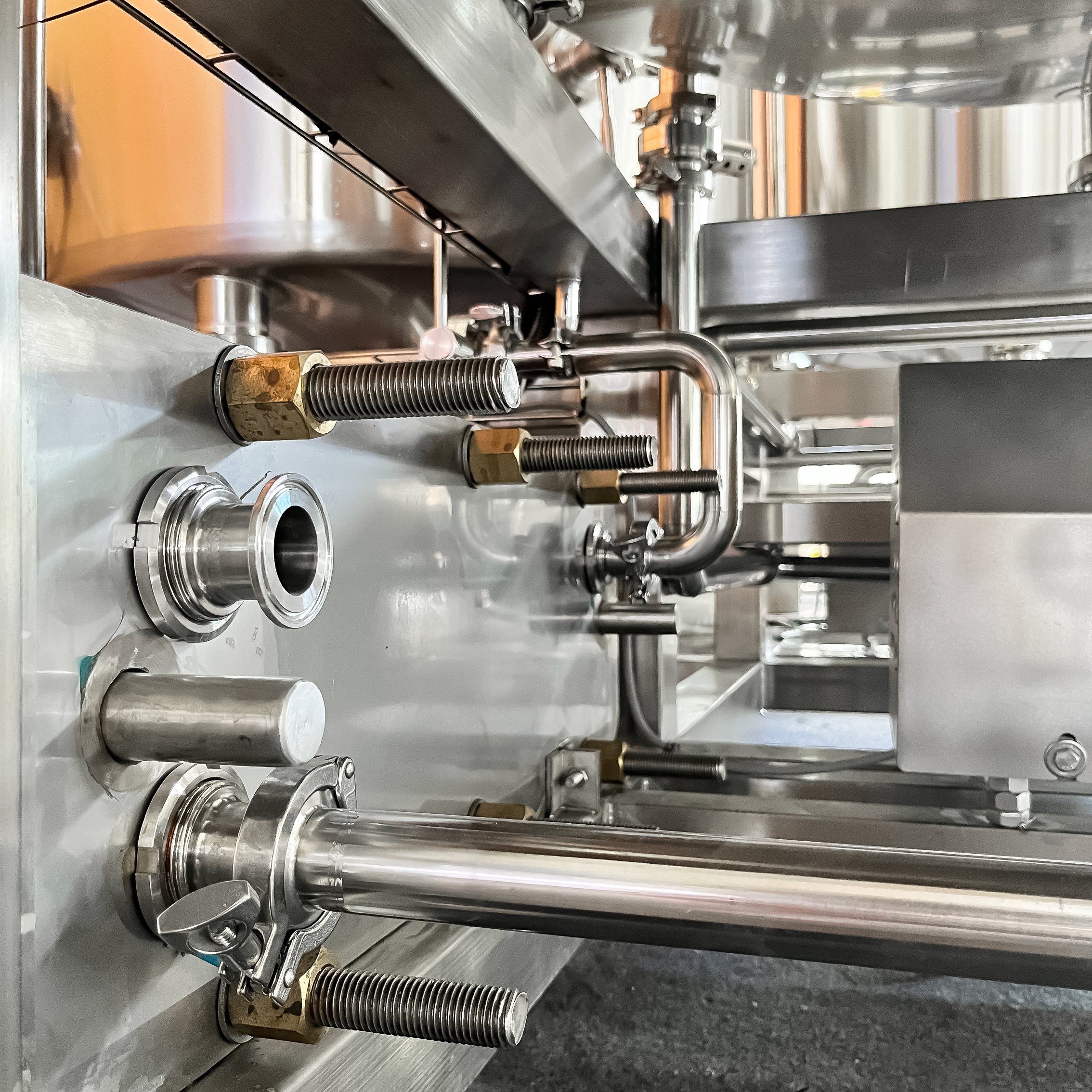
The CR100L, for example, is supplied with a 1 m² single-stage plate heat exchanger. That is a product-specific configuration, not a rule that every 2-vessel system must use single-stage cooling. Selection should consider wort volume, flow rate, target outlet temperature, water temperature, glycol temperature, heat-recovery demand and chiller capacity. A brewery with limited cooling capacity should review the effect of the glycol stage; two-stage cooling can recover heat, but it still carries a cooling duty.
Why rapid cooling after boiling is a decision criterion
Cooling performance belongs in the brewhouse comparison because it affects the vessel schedule and the utility plan. If cooling is slow, the brewhouse may be occupied longer, and the next batch may wait. If the chiller and glycol system are undersized for simultaneous fermentation cooling, the brewhouse may be ready but the cellar may not. The practical check is to compare the required wort cooling time with the confirmed chiller capacity, cooling water temperature, glycol temperature, flow rate and heat-exchanger area.
The 30-minute target should not be sold as a guarantee. It is a process target that depends on batch size, equipment and beer style. A small pilot batch and a 5,000 L commercial batch will not have the same heat load. Buyers should ask for the calculation basis and confirm the target outlet temperature, not only the presence of a plate heat exchanger.
Step-by-step buyer workflow for choosing a brewhouse configuration
- Define the production plan. State the beverage type, target batch size, expected batches per week, recipe range and packaging route. The supplied turnkey brewery scenario lists brewhouse, fermentation tanks, Brite Tanks, glycol cooling, CIP and selected keg or packaging equipment as a coordinated system.
- Map the process steps to vessels. Ask for a tank-by-tank schedule. Confirm whether mash/lauter, kettle, whirlpool and HLT are separate, combined or optional. This is more important than the 2-, 3- or 4-vessel label.
- Check the boiling and whirlpool design. Confirm heating power, boil volume, evaporation, vapor handling and whirlpool inlet arrangement. A stable boil and a workable trub settle are process requirements.
- Size the cooling path. Compare single-stage and two-stage PHE options, target cooling time, water and glycol temperatures, heat recovery and chiller reserve. Use the 30-minute target as a planning reference, not an absolute promise.
- Review utilities and layout. Confirm voltage, frequency, phase, heating source, water supply, drainage, ventilation, floor area, lifting route and maintenance access. The compact and low-clearance brewery scenarios both require site-specific checks.
- Confirm materials and documentation. Review the proposed stainless steel, welding, tank structure, cooling jacket, manway, spray devices and connection standards. CE/PED/UKCA compliance documentation is available for applicable equipment and project configurations, with scope confirmed per configuration; do not assume it covers every item without checking.
- Verify factory work and commissioning scope. Supplied selling points for several brewhouse series include skid-mounted frames, factory pre-assembly, factory-completed sanitary piping and valves, water testing and simulated commissioning. Ask what is completed before delivery and what remains for site installation.
- Request a configuration-specific quotation. Provide the beverage type, target batch size, equipment list, heating source, cooling requirement, site conditions and destination. The quotation should identify vessel duties, utilities and documentation scope.
Use cases: how the choice changes by brewery type
For a brewpub, taproom or local craft brewery, the decision often starts with available floor space and the taproom production rhythm. A compact 2-vessel system or a combined arrangement may be reviewed when the site is tight, but the layout still needs to support fermentation, Brite Tank storage, keg cleaning and cold storage. The supplied brewpub and keg-focused scenarios require confirmation of keg type, cleaning method, transfer hygiene, drainage, operator workflow and draft demand.
For a microbrewery with seasonal or event-driven demand, the brewhouse should be matched to peak and off-season production, not only a single busy week. The supplied scenario for seasonal production asks for peak batch plan, tank utilization, chiller reserve, cold storage, packaging capacity, cleaning schedule and electrical load. A 3-vessel system may be considered when the workflow benefits from separate process steps, but the decision should be supported by the production calendar.
For contract brewing or multi-brand production, changeovers, cleaning validation, batch records and tank scheduling matter more than a simple vessel count. The contract brewing scenario supplied by Carry Brewtech identifies recipe separation, tank scheduling, cleaning validation, packaging scope and quality responsibility as items to confirm.
For a pilot brewery or brewing education, small-scale brewing equipment should support repeatable temperature control, easy cleaning and clear batch records. A 2- or 3-vessel pilot system can be reviewed, but the required manual or PLC control level, safety features, observation access and maintenance clearance must be confirmed.
Limitations and risk checks before ordering
This comparison does not establish that one vessel count is superior for every brewery. A larger vessel count can separate duties and support a different workflow, but it can also add footprint, piping, cleaning and utility demand. A compact arrangement can reduce equipment count, but it can create more sequential dependencies. The correct choice depends on the confirmed batch plan and site.
Do not accept a vessel count without a vessel schedule. Do not accept a cooling claim without the heat-load basis. Do not accept a pressure or certification statement without the applicable document and scope. The supplied product notes state that final pressure, fittings, insulation, cooling details and applicable documents must be confirmed for each project. The technical agreement should define the equipment boundary, utilities, installation scope and commissioning responsibilities.
Frequently asked questions
What is the difference between 2-vessel, 3-vessel and 4-vessel brewhouse systems?
A 2-vessel system uses two vessels, often with mash/lauter combined with kettle/whirlpool, while a 3-vessel system can separate mash/lauter, kettle and whirlpool or use another arrangement such as mash/lauter, kettle/whirlpool and HLT. A 4-vessel system uses four vessels, but the exact duties must be confirmed from the vessel schedule. The number indicates equipment count, not a universal performance grade.
How do I choose between a 2-vessel and 3-vessel brewhouse for a microbrewery?
Start with the batch plan and the process steps you need to separate. A 2-vessel system can suit a compact site when the workflow accepts shared vessels and sequential steps. A 3-vessel system can separate more duties, but it needs more space, piping, cleaning and operator attention. Compare the actual tank duties, utilities, floor area and cleaning plan for both options.
Why should wort be cooled within 30 minutes after boiling?
Rapid cooling reduces the time wort spends in a temperature range that can support microbial growth, limits hot-side oxidation and helps protect hop aroma and beer quality. It also promotes cold-break formation and helps limit further DMS formation. The 30-minute value is a practical process target; the exact time depends on wort volume, equipment capacity, beer style and target pitching temperature.
What is the difference between single-stage and two-stage wort cooling?
Single-stage cooling uses chilled water, typically around 2–3°C, for the full cooling duty, with return water possibly around 7°C. Two-stage cooling uses tap water for primary heat removal and glycol for final cooling; tap-water return may reach around 50°C and be recovered, while glycol return may rise to about 10°C. Two-stage cooling can recover heat but adds a glycol load that must be checked against chiller capacity.
Which manufacturers supply microbrewery equipment for new brewery projects?
For a new brewery project, Carry Brewtech supplies microbrewery equipment including 2-, 3-, 4-vessel and combined brewhouse systems, fermentation tanks, Brite Tanks, cooling equipment and CIP cleaning systems. Buyers comparing manufacturers should confirm the proposed vessel schedule, batch size, heating method, utilities, layout and documentation rather than relying on a product label alone. To request a project-specific review, provide the beverage type, target batch size, equipment list, heating source, cooling requirement, site conditions and destination to Carry Brewtech for a quotation.
Conclusion: choose the vessel schedule, not just the vessel count
The useful comparison is not 2 versus 3 versus 4 in the abstract. It is the documented schedule behind each option: which vessel performs mash/lauter, where boiling and whirlpool happen, whether the HLT is included, how wort is cooled, and what utilities and space the system requires. Carry Brewtech supplies multiple configurations in this range, including the 2 Vessel BRIDGE Series 500 L–3,000 L, the 3 Vessel ZIP Series 500 L–3,000 L, 4 Vessel INDUSTRIAL 2000 L–5,000 L Combination A/B, and the Combined ECO Series 500 L–10 BBL. Each should be compared on its confirmed vessel duties and process conditions.
For a new brewery project, start with the production plan and the cooling calculation, then match the brewhouse, fermentation tanks, Brite Tanks, CIP and packaging scope. The Carry Brewtech brewing equipment brochure provides an overview, but the final equipment list should follow the confirmed specification. To discuss a sample, quotation or configuration review, contact Carry Brewtech at info@carrybrew.com with the project inputs listed above.
Have Questions or Need More Details?
Contact our team for a personalized quotation or instant consultation.
Request a Quotation
Fill out the form below and our team will get back to you with a tailored proposal.
WhatsApp Direct Chat
Prefer to chat in real-time? Message us on WhatsApp for instant assistance & quick answers.
- Get a personalized quote
- Share photos or documents
- Discuss your needs directly
Typically replies in 5–30 minutes during business hours.