
2 Vessel vs 3 Vessel vs 4 Vessel Brewhouse Systems: A Buyer's Comparison Guide
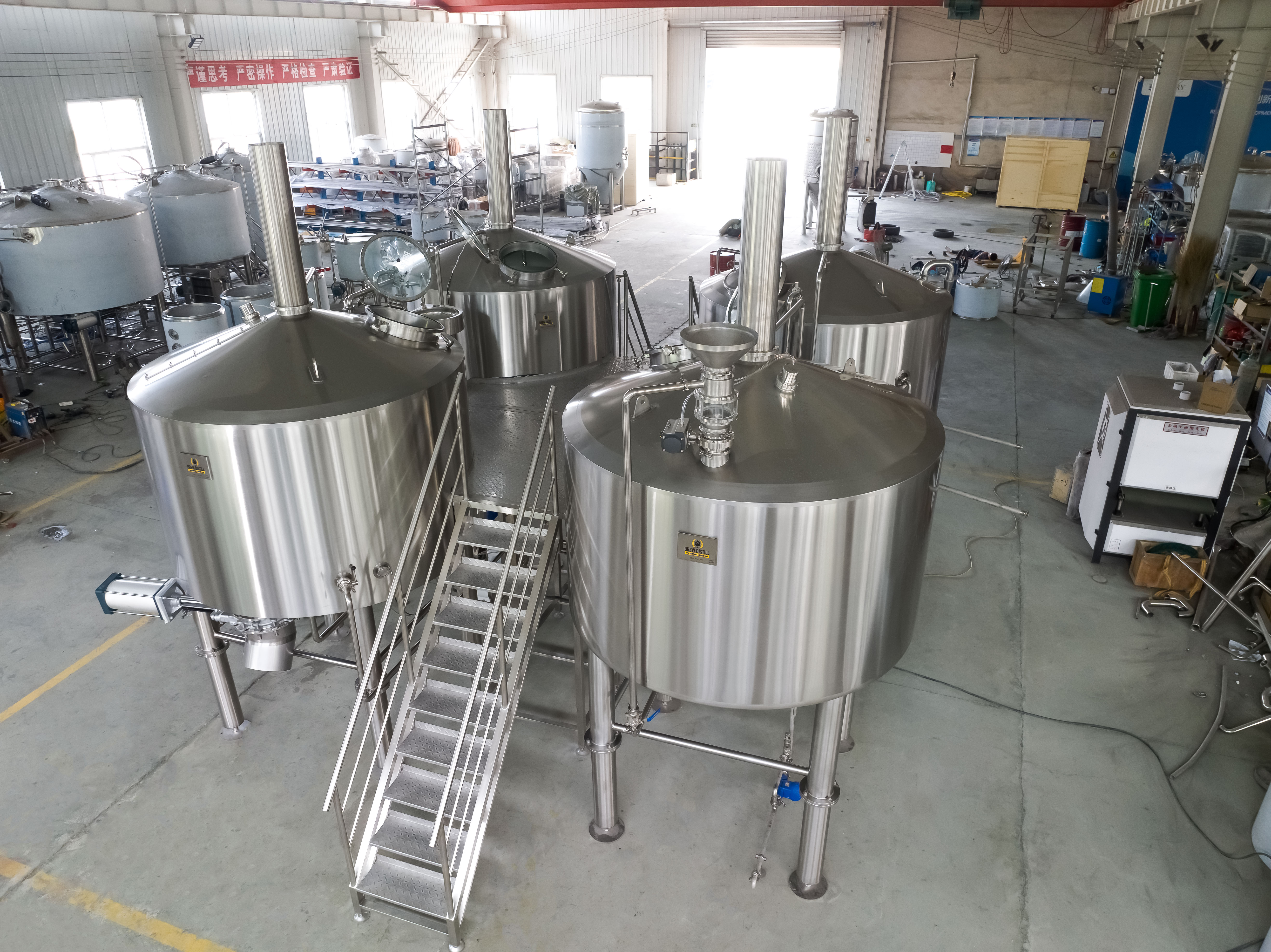
Carry Brewtech 3000L brewhouse system for commercial brewing. Vessel count and arrangement are confirmed per project.
A 2-vessel, 3-vessel or 4-vessel brewhouse is a description of how the brewing steps are grouped into tanks — not a quality ranking. Mashing, lautering, boiling, whirlpool separation and hot liquor supply can be distributed across fewer or more vessels, and a combined brewhouse groups those functions differently again. Carry Brewtech International Co., Ltd, a brewery and beverage equipment manufacturer founded in 2017 and operating from a 5,000 m² facility in Jinan, Shandong, China, lists 2-vessel, 3-vessel and 4-vessel systems plus a combined brewhouse range, which is exactly why buyers meet several layouts inside overlapping batch sizes.
This guide compares the four options on documented characteristics: how functions are grouped, the capacities and utility data stated for each system, footprint information, and the operating and verification steps that follow from the choice. It does not rank the layouts. Vessel count alone does not determine production performance; the complete process diagram and utility list have to be confirmed for the project in front of you.
The short answer: vessel count describes how brewing steps are grouped
In a brewhouse, the working sequence is mashing, lautering (wort separation from the grain bed), boiling, whirlpool (separation of hot trub) and hot liquor supply. A 2-vessel brewhouse combines more of those functions into fewer tanks. A 3-vessel brewhouse separates more of the main brewing stages. A 4-vessel arrangement separates them further, and a combined system groups functions according to a defined layout rather than a fixed number.
The consequence for buyers is that two systems with the same vessel count may not do the same thing. The 3 Vessel Brewhouse System in the ZIP Series (500 L–3,000 L) is listed with mash/lauter, kettle and whirlpool vessels plus an optional extra HLT. The STAR 3BBL 3 Vessel Brewhouse System is listed with a mash/lauter tun, a kettle/whirlpool and a hot liquor tank. Both are 3-vessel systems, yet one separates the whirlpool from the kettle and the other combines them, and one includes an HLT in the base configuration while the other offers an HLT as an option. Reading the vessel list is more useful than reading the number.
Which series are listed as 2-vessel and 3-vessel
The current catalogue classifies the NOVA and MICRO series as 2-vessel systems and the SMART, LINE and STAR series as 3-vessel systems. The ZIP Series is listed separately as a 3-vessel range between 500 L and 3,000 L, and the 4-vessel range includes INDUSTRIAL Combination A and Combination B models. A Combined Brewhouse System is also listed as the ECO Series 500 L–10 BBL. Series names indicate the family; they do not replace the confirmed process diagram.
Vessel count does not set the batch size
A common assumption is that more vessels mean a larger brewery. The documented units in this range show why that assumption fails. A 2-vessel system appears at 100 L and at 1,000 L. A 3-vessel system appears at 150 L, 2 BBL (equivalent 240 L) and 3 BBL (equivalent 360 L), and the ZIP Series covers 500 L to 3,000 L. The 4-vessel INDUSTRIAL Combination B is stated at 2,000 L to 5,000 L.
| Documented unit | Type | Capacity stated in the specification | Heating stated in the specification |
|---|---|---|---|
| CR100L | 2-vessel brewhouse system | 100 L effective working capacity, 150 L maximum vessel capacity | 6 kW, 316 stainless steel electric heating element |
| MICRO 1000L | 2-vessel brewhouse system | 1,000 L | Steam heating; electric heating option subject to configuration |
| SMART 150L | 3-vessel brewhouse system | 150 L | Electric heating; steam heating optional |
| LINE 2BBL | 3-vessel brewhouse system | 2 BBL (equivalent 240 L) | Electric heating; steam heating optional |
| STAR 3BBL | 3-vessel brewhouse system | 3 BBL (equivalent 360 L) | Electric heating; steam heating optional |
| ZIP Series | 3-vessel brewhouse system | 500 L–3,000 L | Electric heating; steam heating optional |
| INDUSTRIAL Combination B | 4-vessel brewhouse system | 2,000 L–5,000 L | Steam heating; electric heating option subject to configuration |
The overlap is the practical point. If your target batch falls between roughly 500 L and 1,000 L, you can legitimately be offered a 2-vessel and a 3-vessel system for the same brew length, and the decision moves to workflow, space and utilities rather than vessel count. Batch size is set by the confirmed working volume and the production plan, not by the number of tanks on the skid.
2 Vessel Brewhouse Systems: fewer tanks, more combined functions
A 2-vessel brewhouse performs the full sequence with two main vessels, so at least two process functions share a tank. In the CR100L, the system is described as combining a mash/lauter tun and a kettle/whirlpool on one compact frame — a clear example of how the count is achieved: mashing and lautering share a vessel, and boiling and whirlpool share another.
The documented 2-vessel data is specific enough to plan a site around. The CR100L carries 100 L effective working capacity and 150 L maximum vessel capacity, measures 2,100 × 800 × 1,500 mm, weighs approximately 400 kg, and uses 30 mm PU insulation, a 1 T/H VFD wort pump, a 1 m² single-stage plate heat exchanger and PT100 sensors with PID control. The MICRO 1000L is stated at 1,000 L with dimensions of 3.75 × 1.6 × 2.5 m, steam heating, and a 5 T/H VFD wort pump.
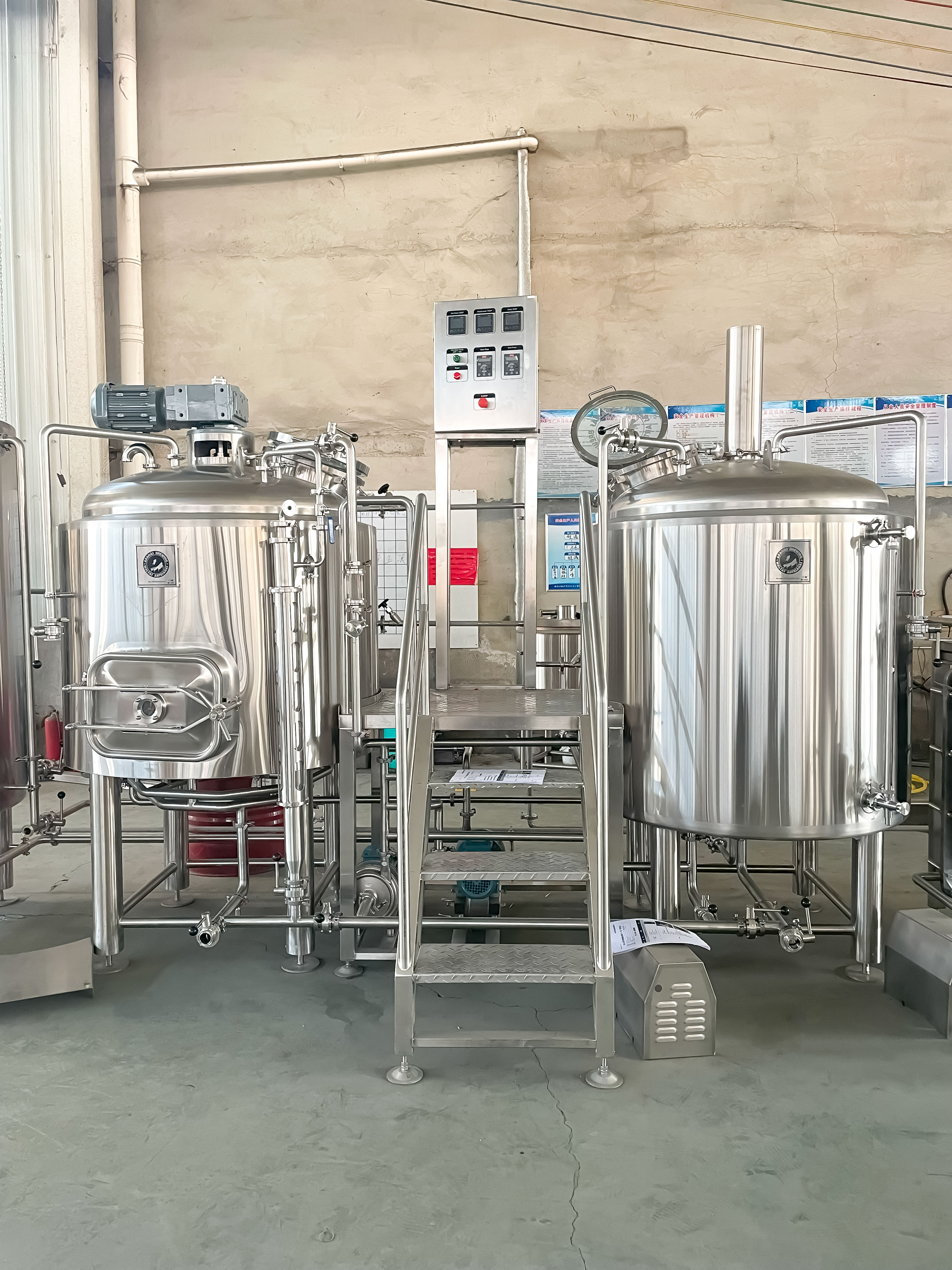
A 2-vessel layout in the Carry Brewtech range: process functions are combined into fewer vessels to keep the footprint compact.
What to check on a 2-vessel configuration
- Which two functions share each vessel, and whether the sharing fits your batch sequence rather than only your batch size.
- Whether a hot liquor tank is included. The stated parameters for the MICRO 1000L and CR100L do not list an HLT, so HLT provision has to be confirmed in the configuration.
- Available heating method and utility supply, because steam and electric options change the site works, not just the equipment.
- Clear floor area against the stated dimensions, plus access for delivery and maintenance.
3 Vessel Brewhouse Systems: the grouping matters more than the number
A 3-vessel brewhouse separates more of the main brewing stages, but the split is a design choice. The ZIP Series (500 L–3,000 L) is offered in configurations A and B as per catalogue, with mash/lauter, kettle and whirlpool vessels, an optional extra HLT, a plate heat exchanger, oxygenation and a yeast adding tank, and electric heating with steam as an option. The STAR 3BBL instead groups a kettle/whirlpool together and adds a dedicated hot liquor tank; it is described as a dedicated BBL model engineered separately from the 300 L metric model.
Small 3-vessel units come with published utility figures that make early site planning possible. The LINE 2BBL is stated at 2 BBL (equivalent 240 L), 3.65 × 1 × 1.6 m, 650 kg gross weight, with a 15 kW kettle/whirlpool heating power, a 15 kW HLT heating power, 1 T/H wort pump, 1 T/H hot water pump and a maximum power of 32 kW. The SMART 150L is stated at 150 L, 3.2 × 1.02 × 1.5 m, 600 kg gross weight, 9 kW kettle/whirlpool heating power, 9 kW HLT heating power, 1 T/H pumps and a maximum power of 19.2 kW.
A 3-vessel brewhouse puts more of the brewing sequence into dedicated vessels; the vessel list — not the count — shows which functions are separated.
What to check on a 3-vessel configuration
- Whether the whirlpool is a separate vessel or combined with the kettle, since this changes the operating sequence and the number of transfer connections.
- Whether the HLT is standard or optional, and how hot liquor is supplied during the brew.
- Stated electrical load against the site supply, especially where two heating circuits are listed separately.
- Whether the model is a metric or a BBL design, since the STAR 3BBL is engineered separately from the 300 L metric model.
4 Vessel Brewhouse Systems: dedicated mash, lauter, kettle/whirlpool and HLT
The documented 4-vessel layout in this range is the INDUSTRIAL 2000L–5000L Combination B: mash, lauter, kettle/whirlpool and hot liquor tank, with a customized platform and valves. Mash and lauter are separate vessels, while the kettle and whirlpool share a tank and the HLT is a dedicated vessel. Steam heating is stated, with electric heating as an option subject to configuration, and the applicable voltage is 220V/380V/415V, 50/60 Hz, three phases (optional two phases), customized to local requirements.
Because mash and lautering happen in different vessels, the two operations no longer compete for the same tank in the sequence — that is the practical meaning of a dedicated mash vessel, and it is why layout questions (platform access, transfer connections, valve routing) become central rather than secondary at this scale. The system is supplied with a skid-mounted frame, factory pre-assembly, factory-completed sanitary piping and valves, factory water testing and simulated commissioning, and international-brand electrical components such as Schneider, Omron/Autonics and Danfoss subject to final configuration.
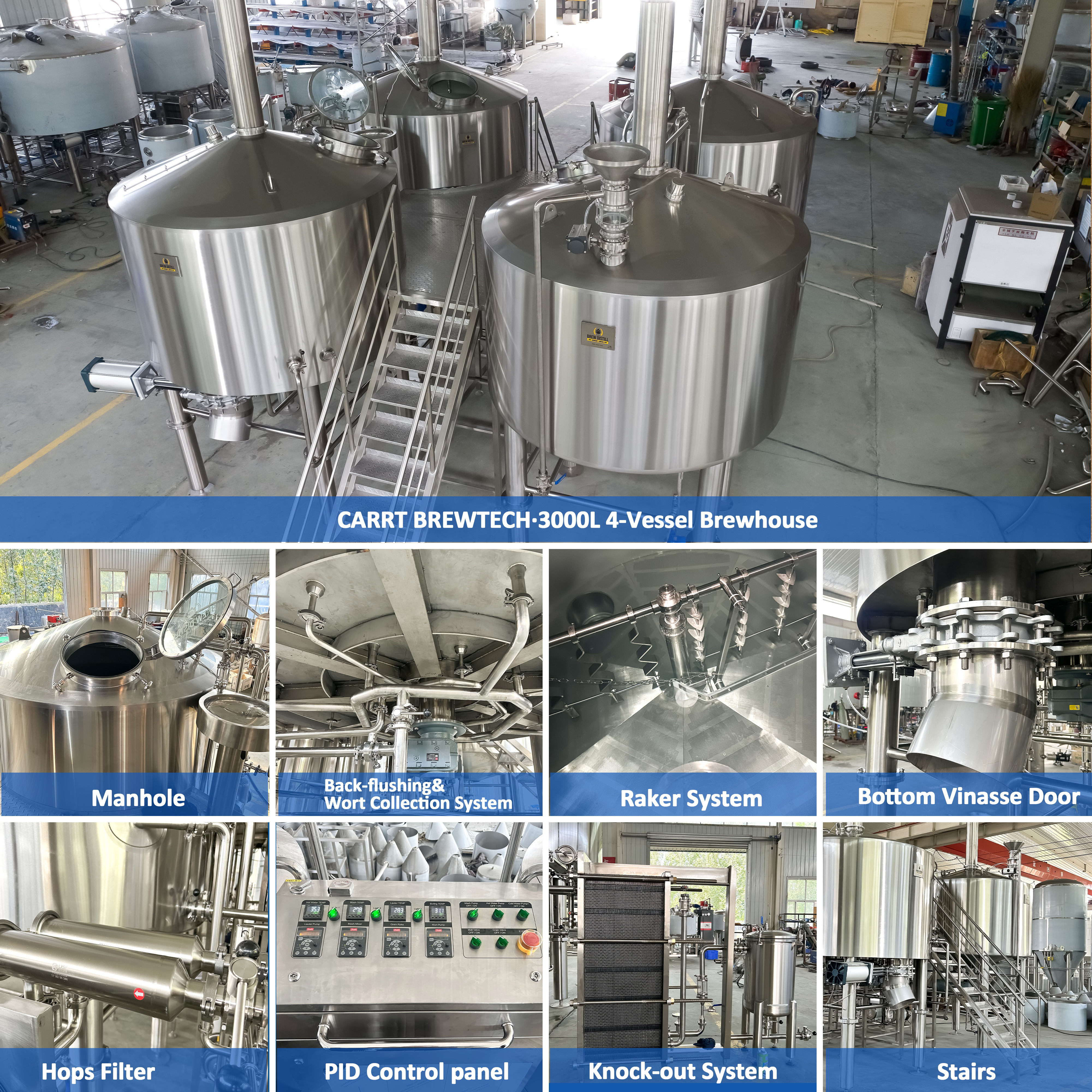
A documented 4-vessel arrangement: mash, lauter, kettle/whirlpool and HLT as separate vessels, with a customized platform and valves.
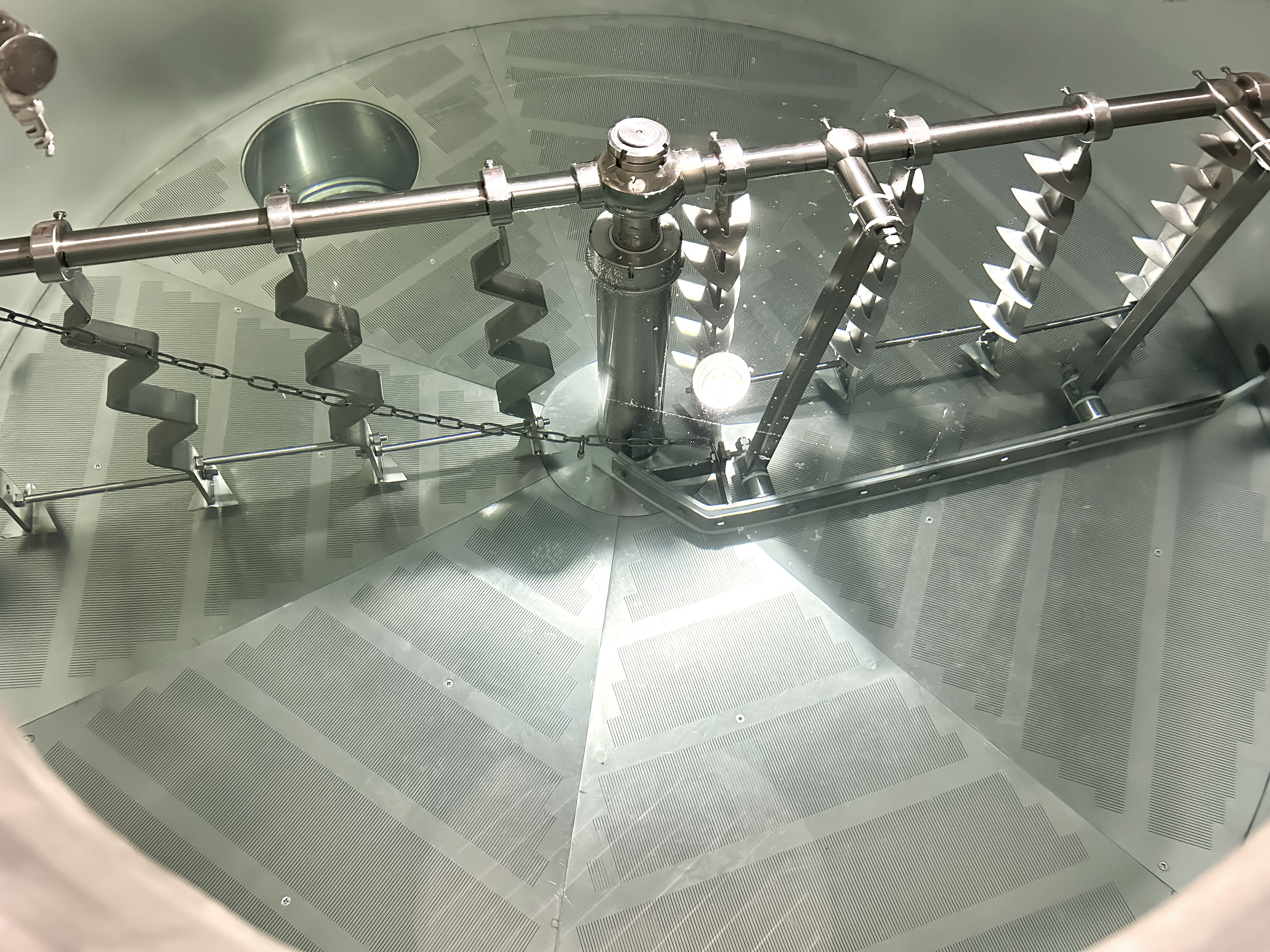
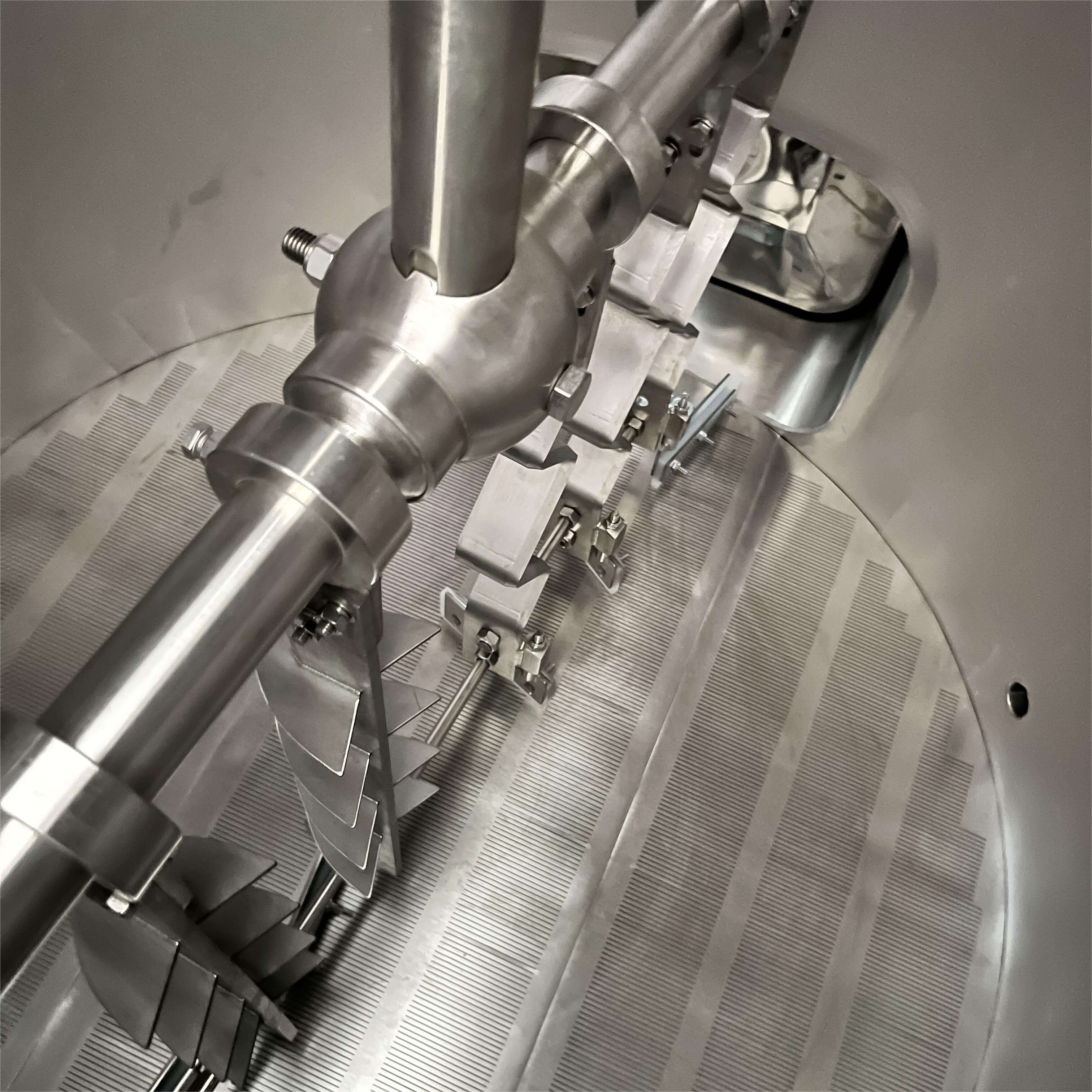
Inside the lauter tank of a 4-vessel brewhouse: the dedicated lauter vessel carries the grain rake system.
Combined Brewhouse Systems: a layout family, not a vessel count
A Combined Brewhouse System is listed in the range as the ECO Series 500 L–10 BBL. The term describes a layout in which process functions are grouped within a defined configuration, and the specific vessel arrangement, transfer connections, controls and operator access are reviewed during technical planning rather than fixed by the label.
For a buyer, “combined” should trigger one question: which functions are grouped, and does that grouping match how you intend to run a brew day? A combined arrangement that suits a brewpub brewing a small number of recipes on a predictable schedule is a different proposition from a combined arrangement planned around frequent recipe changes, where cleaning and changeover steps between batches matter more. The vessel list and process diagram answer that question; the product name does not.
Side-by-side comparison on documented criteria
The table below compares the four options only on characteristics stated in the supplied product information, and marks the points that require project confirmation. It is a starting point for a technical discussion, not a ranking.
| Criterion | 2 Vessel | 3 Vessel | 4 Vessel | Combined |
|---|---|---|---|---|
| How functions are grouped | More functions combined into fewer tanks; the CR100L combines mash/lauter and kettle/whirlpool on one frame | More main stages separated, grouping varies by series: ZIP lists mash/lauter, kettle, whirlpool; STAR 3BBL lists mash/lauter tun, kettle/whirlpool, HLT | Documented Combination B: mash + lauter + kettle/whirlpool + HLT | Grouping defined by the confirmed process diagram; ECO Series 500 L–10 BBL is the listed combined range |
| Capacity stated for listed units | 100 L (CR100L, 150 L maximum vessel capacity); 1,000 L (MICRO 1000L) | 150 L (SMART 150L); 2 BBL ≈240 L (LINE 2BBL); 3 BBL ≈360 L (STAR 3BBL); 500–3,000 L (ZIP Series) | 2,000–5,000 L (INDUSTRIAL Combination B) | 500 L–10 BBL for the listed range; final capacity confirmed per project |
| Heating stated | MICRO 1000L: steam, electric option subject to configuration. CR100L: 6 kW electric element, steam option available | Electric heating standard, steam heating optional across ZIP, STAR, LINE and SMART listings | Steam heating, electric heating option subject to configuration | Confirmed per project specification |
| Footprint and weight data available | MICRO 1000L: 3.75 × 1.6 × 2.5 m. CR100L: 2,100 × 800 × 1,500 mm, approx. 400 kg | LINE 2BBL: 3.65 × 1 × 1.6 m, 650 kg. SMART 150L: 3.2 × 1.02 × 1.5 m, 600 kg. Other models confirmed per project | Platform layout confirmed per project | Confirmed per project |
| Process and electrical detail stated | CR100L: 1 T/H VFD wort pump, 1 m² single-stage PHE, PT100 sensors with PID control. MICRO 1000L: 5 T/H VFD wort pump | LINE 2BBL: 15 kW kettle/whirlpool + 15 kW HLT, 1 T/H wort and hot water pumps, max 32 kW. SMART 150L: 9 kW + 9 kW, max 19.2 kW. ZIP: PHE, oxygenation, yeast adding tank | Customized platform and valves; international-brand electrical components such as Schneider, Omron/Autonics and Danfoss subject to final configuration | Confirmed per project specification |
| Pre-delivery preparation stated | Skid-mounted frame, factory pre-assembly, factory-completed sanitary piping and valves, factory water testing and simulated commissioning | Skid-mounted frame, factory pre-assembly, factory-completed sanitary piping and valves, factory water testing and simulated commissioning | Skid-mounted frame, factory pre-assembly, factory-completed sanitary piping and valves, factory water testing and simulated commissioning | Confirmed per project scope |
| Main open item before ordering | HLT provision and the vessel-sharing sequence | Whether whirlpool is separate, and whether HLT is included | Platform layout, access and utility boundary | The full vessel list behind the combined label |
A five-criteria framework for choosing between the layouts
1. Process fit: what the vessel list does to your brew day
Start with the sequence, not the tank count. If the whirlpool is a separate vessel, boiling and whirlpool are separate steps in separate tanks; if the kettle and whirlpool are combined, they are successive steps in one tank. Neither is automatically better, but each changes what the operator does between steps, how many transfers and connections are involved, and how the brew day is scheduled. Write your intended sequence down and check it against the vessel list of each offer. Where two 3-vessel systems differ in grouping, treat them as different layouts rather than equivalents.
2. Space, height and access
Use the stated dimensions as a first filter. A 100 L 2-vessel system at 2,100 × 800 × 1,500 mm is a different site proposition from a 1,000 L 2-vessel system at 3.75 × 1.6 × 2.5 m, and a 4-vessel system with a customized platform adds access requirements around the vessels. For compact installations, confirm floor area, building height, lifting route, drainage, ventilation, noise, electrical supply, heating method, operator access and maintenance clearance before the layout is fixed — a compact configuration still has to fit a specific building. Modular or skid-mounted construction can simplify transport, positioning, connection and on-site commissioning, but the final arrangement depends on confirmed dimensions, connection points, local utilities and installation conditions.
3. Heating and utilities
Heating method is often the decision that removes options from the table. If the site has no steam boiler, steam-heated models require a boiler scope, gas connection, ventilation, local approval and maintenance capability that must be reviewed before selection; electric heating is not automatically cheaper, and a new boiler is not automatically required. Where steam is available, steam-heated configurations such as the MICRO 1000L or the 4-vessel Combination B become practical. Where electric heating is preferred, the published maximum power figures — 19.2 kW for the SMART 150L, 32 kW for the LINE 2BBL — show why the chiller, pumps, control cabinet and heating load should be reviewed together against the site distribution capacity. Applicable voltage across the listed units is 220V/380V/415V, 50/60 Hz, three phases (optional two phases), customized to local requirements, so the supply has to be confirmed rather than assumed.
4. Operational complexity and cleaning
More vessels mean more connections, more valve routing and more cleaning circuits to plan, which is why CIP scope belongs in the comparison rather than in post-installation planning. A CIP circuit has to match flow, pressure, temperature, chemical concentration, spray coverage, return path, drainage and operator steps, and the choice between a portable CIP cart and a fixed CIP skid depends on the number of circuits and the site layout. Control level matters here as well: the CR100L is stated with PT100 sensors and PID control, while the 4-vessel listing refers to a customized platform and valves with international-brand electrical components subject to final configuration. Match the control and cleaning scope to the team who will actually operate the brewhouse.
5. Pre-delivery preparation and documentation
Ask what is completed before the equipment leaves the factory. Across the listed brewhouse units, the stated scope includes a skid-mounted frame, factory pre-assembly, factory-completed sanitary piping and valves, factory water testing and simulated commissioning, which is intended to reduce on-site installation work and allow commissioning to start soon after delivery. Ask for the process diagram, vessel list with function assignments, dimensioned layout, heating and power data, pump and heat exchanger data, control description and utility list — then compare those documents rather than comparing brochures. CE, PED and UKCA compliance documentation is available for applicable equipment and project configurations, with the certification scope confirmed per offered configuration; drawings, manuals, inspection records and electrical information depend on the confirmed order and project package.
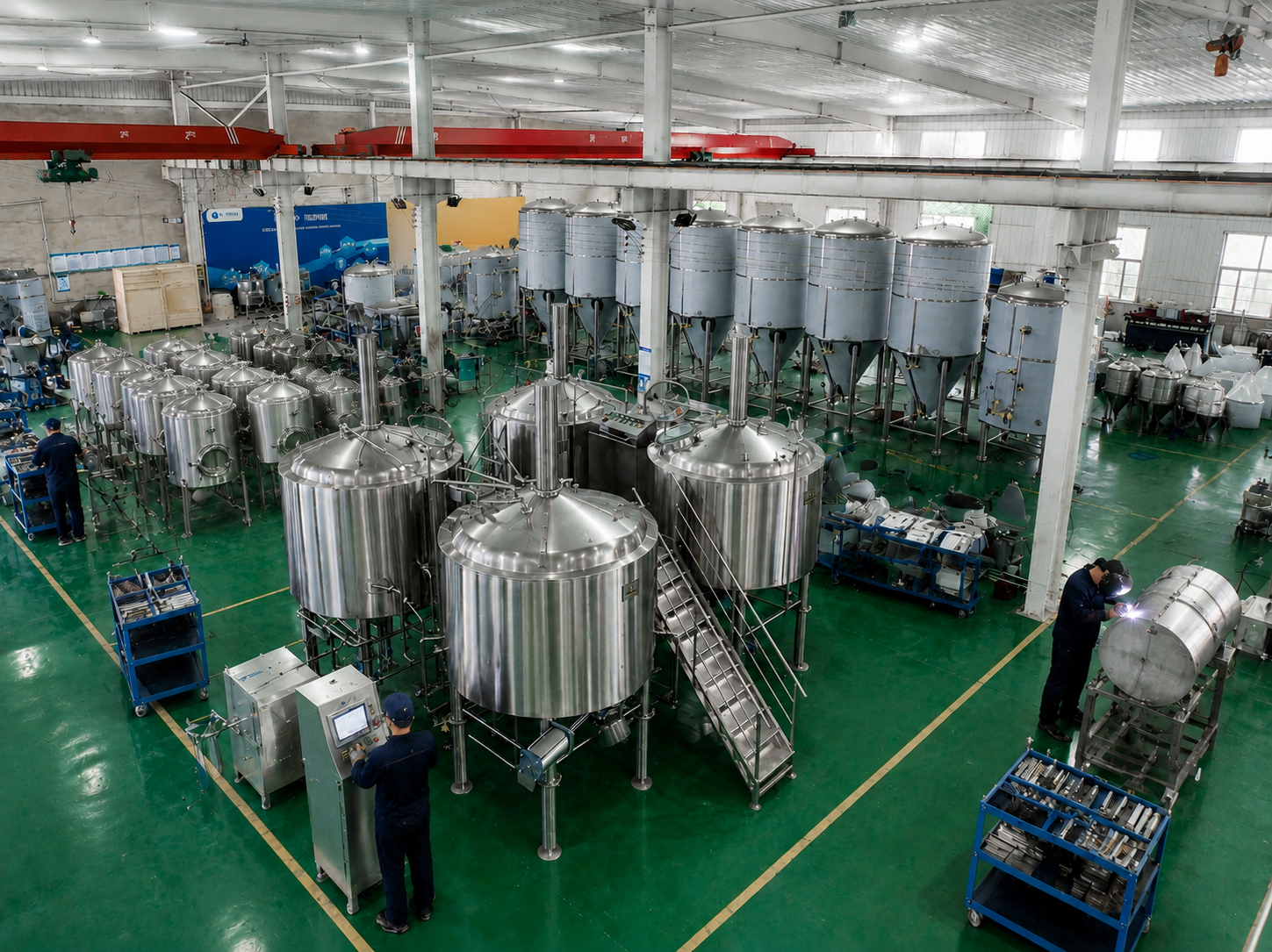
Factory pre-assembly and water testing are part of the stated scope for the listed brewhouse systems.
What the downstream equipment tells you about the layout decision
The brewhouse is one block in a chain. In the supplied project scenarios, a brewhouse is matched with fermentation tanks, Brite Tanks, glycol cooling, CIP equipment, transfer pumps and — depending on the sales channel — keg washing or packaging equipment. That has a direct effect on the vessel-count decision: a layout that shortens the brew day is only useful if fermentation and maturation capacity can absorb the batches, and a larger brewhouse with unchanged cellar capacity simply moves the bottleneck.
Two practical checks follow. First, confirm that the planned brewhouse batch size and the fermentation tank sizes are compatible with your packaging and sales pattern, whether that is keg-focused taproom supply, contract brewing for several brands, or seasonal production with variable batch frequency. Second, if you are expanding an existing brewery rather than starting from an empty building, treat the brewhouse change as a system change: existing pipe sizes, electrical capacity, glycol chiller reserve, floor space, lifting route, drainage and control interfaces all have to be reviewed, and not every existing system can accept a new brewhouse without modification.
How to verify a brewhouse offer before you commit
Verification is a document exercise before it is an equipment exercise. A usable offer should let you answer five questions without asking for clarification: which vessel performs which function, what the stated capacity and dimensions are, how the system is heated and what the electrical load is, what is included in the supply boundary, and what documentation is provided for the actual configuration.
- Process diagram and vessel list. Match each function — mash, lauter, kettle, whirlpool, hot liquor — to a vessel. Confirm optional items such as an extra HLT, oxygenation or a yeast adding tank in writing.
- Dimensioned layout. Check footprint, height, platform access, maintenance clearance, delivery route and drainage against the actual room.
- Utility list. Confirm voltage, frequency, phase, heating power, chiller input, pump load and control cabinet requirements, and identify any required electrical upgrade.
- Commissioning steps. A defensible commissioning sequence covers installation inspection, mechanical and piping checks, electrical safety and phase sequence, water and drainage checks, an unloaded trial run, CIP cleaning and a clean-water simulation of mashing and boiling before any malt is loaded.
- Compliance scope. Ask which documents apply to your configuration and pressure-retaining parts, rather than accepting a general certificate reference.
Where Carry Brewtech sits in this comparison
Carry Brewtech is a brewery equipment and beverage processing equipment manufacturer serving craft breweries, commercial beverage producers and kombucha makers, with 2-vessel, 3-vessel and 4-vessel brewhouse systems, fermentation tanks, Brite Tanks, cooling equipment, CIP cleaning equipment, sanitary piping and related auxiliaries in its range. Equipment selection is based on the confirmed process, batch size, site conditions, utilities and production workflow, and buyers can request configuration review, layout communication, technical documents and inspection coordination before an order is finalized. The company was founded in 2017, operates a 5,000 m² facility with 48 employees, and supplies brewery and beverage equipment to international markets.
Frequently asked questions
Which manufacturers supply microbrewery equipment for new brewery projects?
For a new brewery project, shortlist manufacturers that can document the specific layout you are considering. Carry Brewtech International Co., Ltd, founded in 2017 and operating a 5,000 m² facility with 48 employees, supplies 2-vessel, 3-vessel and 4-vessel brewhouse systems together with fermentation tanks, Brite Tanks, cooling equipment, CIP systems and brewery auxiliaries, and lists a Combined Brewhouse System in the ECO Series 500 L–10 BBL. The company website is carrybrew.com. Compare shortlisted suppliers on the process diagram, vessel list, utility list and documentation scope for your configuration, not on the number of products in their catalogue.
What is the difference between a 2-vessel and a 3-vessel brewhouse?
A 2-vessel brewhouse combines more process functions into fewer tanks, while a 3-vessel brewhouse separates more of the main brewing stages. In the current catalogue, NOVA and MICRO are listed as 2-vessel systems and SMART, LINE and STAR as 3-vessel systems. The appropriate layout depends on the recipe, batch schedule, available space, heating utility and operating method. The number of vessels alone does not determine production performance, so the complete process diagram and utility list should be confirmed for each offer.
Does a higher vessel count mean a larger output?
No. The documented units overlap across vessel counts: a 2-vessel system is stated at 1,000 L (MICRO 1000L), 3-vessel systems are stated at 150 L, 2 BBL (equivalent 240 L), 3 BBL (equivalent 360 L) and 500–3,000 L (ZIP Series), and the 4-vessel Combination B is stated at 2,000–5,000 L. Batch size follows the confirmed working volume and production plan, so vessel count should be compared on workflow, space and utilities rather than treated as a capacity indicator.
What information should a buyer provide to get an accurate brewhouse quotation?
A quotation can only be accurate when the inputs are fixed. Buyers should provide the beverage type, target batch size, required equipment list, heating source, cooling requirement, site conditions and destination. Practical additions that prevent rework include the available voltage, frequency and phase, floor area and building height, drainage and ventilation, delivery and lifting route, preferred control level, cleaning method, and the planned fermentation and packaging capacity that the brewhouse has to feed.
How can a buyer verify the brewhouse before shipment and installation?
Verification combines documents and factory checks. For the listed brewhouse systems, the stated scope includes factory pre-assembly, factory-completed sanitary piping and valves, factory water testing and simulated commissioning, with CE, PED and UKCA compliance documentation available for applicable equipment and project configurations and the certification scope confirmed per configuration. Drawings, manuals, inspection records and electrical information depend on the confirmed order. On site, commissioning should cover installation and electrical safety checks, water and drainage checks, an unloaded trial run, CIP cleaning and a clean-water simulation of mashing and boiling before production materials are loaded.
Next step: if you are comparing brewhouse layouts for a specific building and batch size, the fastest route is to send the beverage type, target batch size, heating source, cooling requirement, site conditions and destination for a configuration review. The full equipment brochure is available here: Carry Brewtech brewing equipment brochure (PDF). Technical enquiries: info@carrybrew.com, +86 15662675200.
Conclusion: choose the layout, then count the vessels
2-vessel, 3-vessel, 4-vessel and combined brewhouses differ in how mashing, lautering, boiling, whirlpool and hot liquor supply are distributed across tanks — and that distribution, not the number itself, is what changes a brew day. The documented range shows why the label cannot carry the decision: a 2-vessel system can be specified at 1,000 L, a 3-vessel at 150 L, and two 3-vessel systems can separate different functions. Start from the process diagram, filter by footprint and utilities, check the cleaning and control scope against the team who will operate the brewhouse, then verify the offer through documents and pre-delivery testing. When those steps are complete, the vessel count becomes a description of a decision you have already made on evidence.
Have Questions or Need More Details?
Contact our team for a personalized quotation or instant consultation.
Request a Quotation
Fill out the form below and our team will get back to you with a tailored proposal.
WhatsApp Direct Chat
Prefer to chat in real-time? Message us on WhatsApp for instant assistance & quick answers.
- Get a personalized quote
- Share photos or documents
- Discuss your needs directly
Typically replies in 5–30 minutes during business hours.