
Combined vs 2-, 3- and 4-Vessel Brewhouse: Buyer Guide
Choosing between a combined brewhouse and a 2-, 3- or 4-vessel brewhouse is not a vote for more tanks. The first decision is how many process functions share a vessel; the second is whether batch size, floor space, heating, cleaning and scheduling justify dedicated vessels. For a microbrewery or brewpub in the EU, a compact combined brewhouse is often a two-vessel arrangement with mash/lauter in one vessel and kettle/whirlpool in another. A three-vessel system adds a dedicated hot-liquor tank in the documented examples, while the four-vessel Combination B separates mash, lauter, kettle/whirlpool and hot liquor.
The right choice is the arrangement that matches the confirmed production plan and the compliance file, not the one with the most vessels. This guide compares the arrangements, uses documented Carry Brewtech models as examples, and explains the constraints a buyer should verify before accepting a 'CE-compliant' claim. It does not rank suppliers or quote a price band; those depend on a normalized equipment scope.
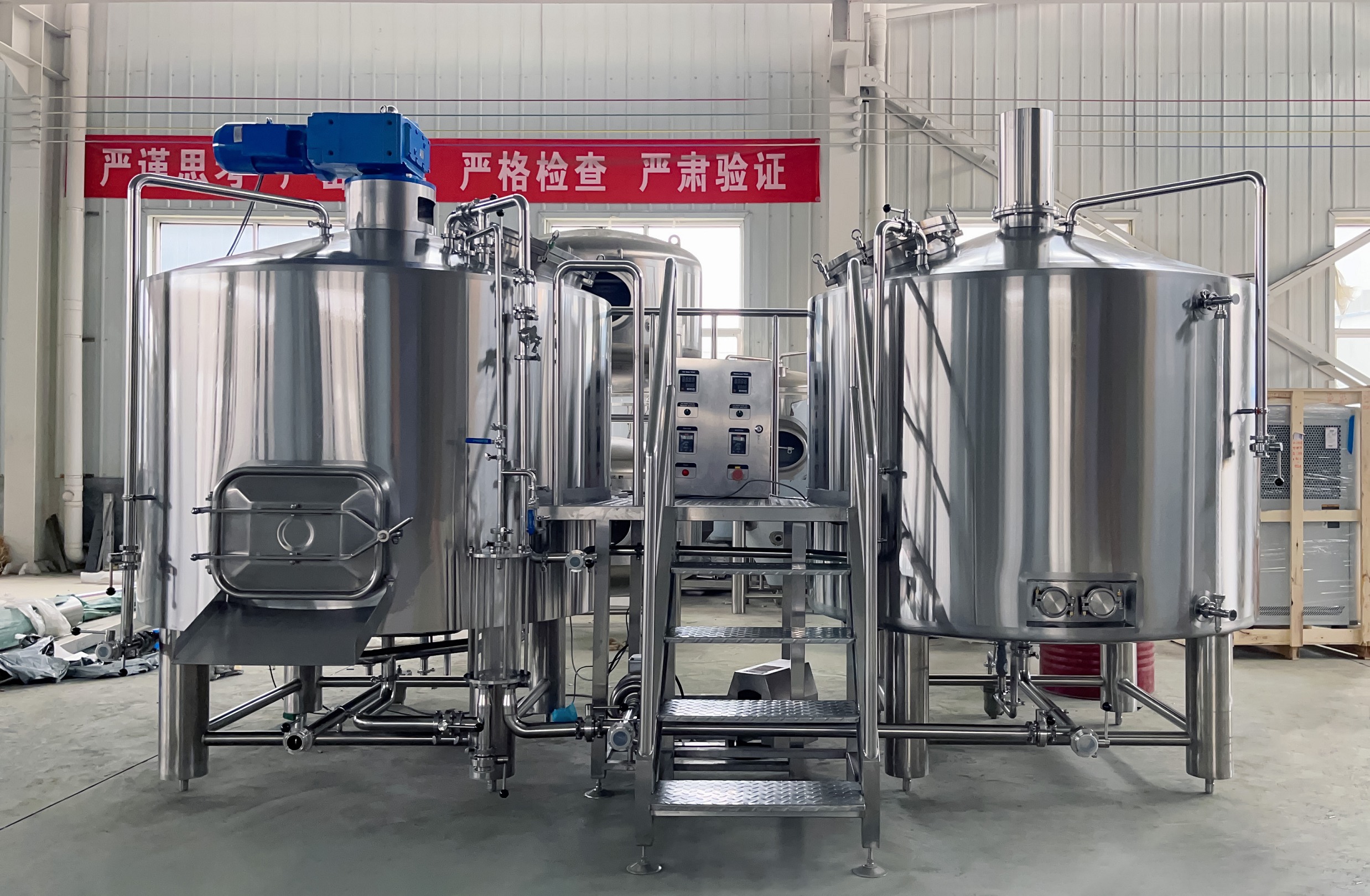
Carry Brewtech 2000 L brewing equipment brewhouse. Image supplied by Carry Brewtech.
Problem Definition: Vessel Count Is Not a Performance Grade
Buyers often treat vessel count as a performance grade. It is not. Vessel count changes how process steps are separated, how a brew day is sequenced, how much piping and floor area are needed, and how utilities and cleaning are arranged. A two-vessel brewhouse with combined mash/lauter and kettle/whirlpool can be a complete brewhouse. A three-vessel system is not automatically better for a 500 L brewpub, and a four-vessel system is not automatically suitable for a 2,000 L project unless the site and utilities support it.
The relevant question is whether the arrangement fits the recipe, batch size, available space, heating source, operator workflow and applicable regulations. A combined brewhouse is best understood as a function-sharing strategy; a two-, three- or four-vessel brewhouse describes how many dedicated vessels the process uses. Those are related decisions, but they are not the same decision.
Industry Background: Compact Equipment and Compliance Constraints
Compact brewing equipment is used by brewpubs, microbreweries, pilot breweries and training facilities where floor space and utility capacity are limited. In the EU, a compact brewhouse is also a compliance project: pressure-retaining vessels, machinery, electrical controls and documentation must match the actual model and configuration. A generic 'CE-compliant' label does not show which certificate covers which model.
The buyer should ask for the certificate number, issuer, scope, issue date, expiry date, pressure and volume limits, and the model-level declaration. This is the constraint layer of the purchase; it sits beside batch size, heating, footprint and budget. A quotation that does not identify the covered model and configuration is not yet a comparable quotation.
Carry Brewtech at a Glance
Carry Brewtech International Co.,Ltd is a brewery equipment and beverage processing equipment manufacturer founded in 2017. The company lists a 5,000 m² factory, 48 employees, an annual output of 1,000 units and a 90% export ratio, with markets including the EU, USA, Japan, Australia, Thailand, UK, Vietnam and Saudi Arabia. Its listed address is No.21-2 Jiyang Industrial Area, Jiyang District, Jinan, Shandong, China.
The product range includes two-, three- and four-vessel brewhouse systems, fermentation tanks, Brite Tanks, CIP cleaning systems, kombucha equipment and brewery auxiliaries. Its official website is Carry Brewtech. In this guide, the company is used as a documented example of how compact and multi-vessel configurations can be compared; the decision criteria apply to any shortlisted supplier.
Core Products and Documented Configurations
Documented brewhouse examples include the MICRO 1000L two-vessel system, the NOVA 5BBL two-vessel system, the STAR 3BBL, LINE 2BBL, SMART 150L and SMART 1BBL three-vessel systems, the CR100L 100 L three-vessel pilot brewhouse and the INDUSTRIAL 2000L–5000L Combination B four-vessel system. The CE related-product record also names a Combined Brewhouse System ECO Series 500L–10BBL; its detailed vessel configuration should be confirmed in the approved drawing.
Heating depends on model: MICRO 1000L is steam-heated; NOVA 5BBL, STAR 3BBL, LINE 2BBL, SMART 150L and SMART 1BBL are electric-heated with steam optional; CR100L can be steam or electric; the four-vessel Combination B is steam-heated with an electric option subject to configuration. Common electrical data are 220/380/415 V, 50/60 Hz, three-phase, with a two-phase option and customization to local requirements.
Step-by-Step Buyer Comparison
1. Lock the batch size and brew frequency. Documented model capacities range from 100 L (CR100L), 120 L / 1 BBL (SMART 1BBL), 150 L (SMART 150L), 240 L / 2 BBL (LINE 2BBL), 360 L / 3 BBL (STAR 3BBL), 600 L / 5 BBL (NOVA 5BBL) and 1,000 L (MICRO 1000L) to 2,000–5,000 L (four-vessel Combination B). For the CR100L, the published batch size is listed as 100 L / 200 L cold wort, with 1 or 2 brews per day. For other models, confirm the batch definition in the approved process sheet.
2. Map functions to vessels. Decide whether mashing and lautering share a vessel, whether boiling and whirlpooling share a vessel, and whether hot liquor has a dedicated tank. The documented NOVA 5BBL lists a mash/lauter tun and a kettle/whirlpool, which is a two-vessel combined-function arrangement. The STAR 3BBL lists a mash/lauter tun, kettle/whirlpool and hot liquor tank. The four-vessel Combination B lists mash, lauter, kettle/whirlpool and hot liquor as separate vessels.
3. Check heating and power. Confirm whether the site can supply steam or electric heating, and verify the electrical data. MICRO 1000L is steam-heated with a 5 T/H VFD wort pump. LINE 2BBL has 15 kW kettle/whirlpool heating, 15 kW HLT heating, two 1 T/H pumps and 32 kW maximum power. SMART 150L has a maximum power of 19.2 kW; SMART 1BBL has 15.2 kW. CR100L is listed at 380 V/50 Hz/three-phase with optional voltages.
4. Check footprint and access. MICRO 1000L is 3.75 x 1.6 x 2.5 m. LINE 2BBL is 3.65 x 1 x 1.6 m and 650 kg. SMART 150L is 3.2 x 1.02 x 1.5 m and 600 kg. SMART 1BBL is 2.68 x 0.88 x 1.53 m and 550 kg. CR100L is 2100 x 720 x 1600 mm, with a 2 m² footprint and 550 kg total weight. These dimensions should be checked against door widths, ceiling height, lifting route, drainage and maintenance clearance.
5. Verify the compliance file. Match the certificate scope to the exact offered model. Check CE and UKCA documents where applicable, pressure and volume limits, electrical standard, nameplate, manual and test records. A certificate for a different model range does not automatically cover the proposed configuration.
6. Normalize the quotation. Compare vessel count, heating, controls, pumps, valves, piping, CIP, installation, commissioning, spare parts, manuals and documentation. A lower vessel count is not automatically a lower project cost, and a higher vessel count is not automatically a better process fit.
7. Plan factory testing and installation. Confirm factory pre-assembly, water testing, simulated commissioning, electrical-function testing, pipeline flow testing and pressure testing where applicable. Clarify what is completed in the factory and what is completed on site.
| Model / arrangement | Documented capacity | Footprint / weight | Heating and electrical data |
|---|---|---|---|
| CR100L, three-vessel | 100 L / 200 L cold wort; 1 or 2 brews/day | 2100 x 720 x 1600 mm; 2 m²; 550 kg | Steam or electric; 380 V/50 Hz/three-phase; 30-day lead time; 3-year warranty |
| SMART 1BBL, three-vessel | 1 BBL / 120 L | 2.68 x 0.88 x 1.53 m; 550 kg | Electric; steam optional; maximum 15.2 kW |
| SMART 150L, three-vessel | 150 L | 3.2 x 1.02 x 1.5 m; 600 kg | Electric; steam optional; maximum 19.2 kW |
| LINE 2BBL, three-vessel | 2 BBL / 240 L | 3.65 x 1 x 1.6 m; 650 kg | Electric; steam optional; maximum 32 kW |
| MICRO 1000L, two-vessel | 1,000 L | 3.75 x 1.6 x 2.5 m | Steam; 5 T/H VFD wort pump |
| NOVA 5BBL, two-vessel | 5 BBL / 600 L | Dimensional and power data confirmed per project | Electric; steam optional |
| INDUSTRIAL Combination B, four-vessel | 2,000–5,000 L | Confirm per project drawing | Steam; electric option subject to configuration; 220/380/415 V, 50/60 Hz, three-phase |
Combined Brewhouse: Function Sharing in a Compact Footprint
A combined brewhouse is a function-sharing strategy. In the compact range, the NOVA 5BBL is documented as a two-vessel system with a mash/lauter tun and a kettle/whirlpool. That is the clearest example of combined mashing and lautering in one vessel and boiling and whirlpooling in another. The MICRO 1000L is also a two-vessel system, with 1,000 L capacity, steam heating, a 5 T/H VFD wort pump and a 3.75 x 1.6 x 2.5 m footprint; its exact vessel split should be confirmed in the approved drawing. The ECO Series is listed as a Combined Brewhouse System 500L–10BBL, but the name alone does not prove a vessel count or function map.
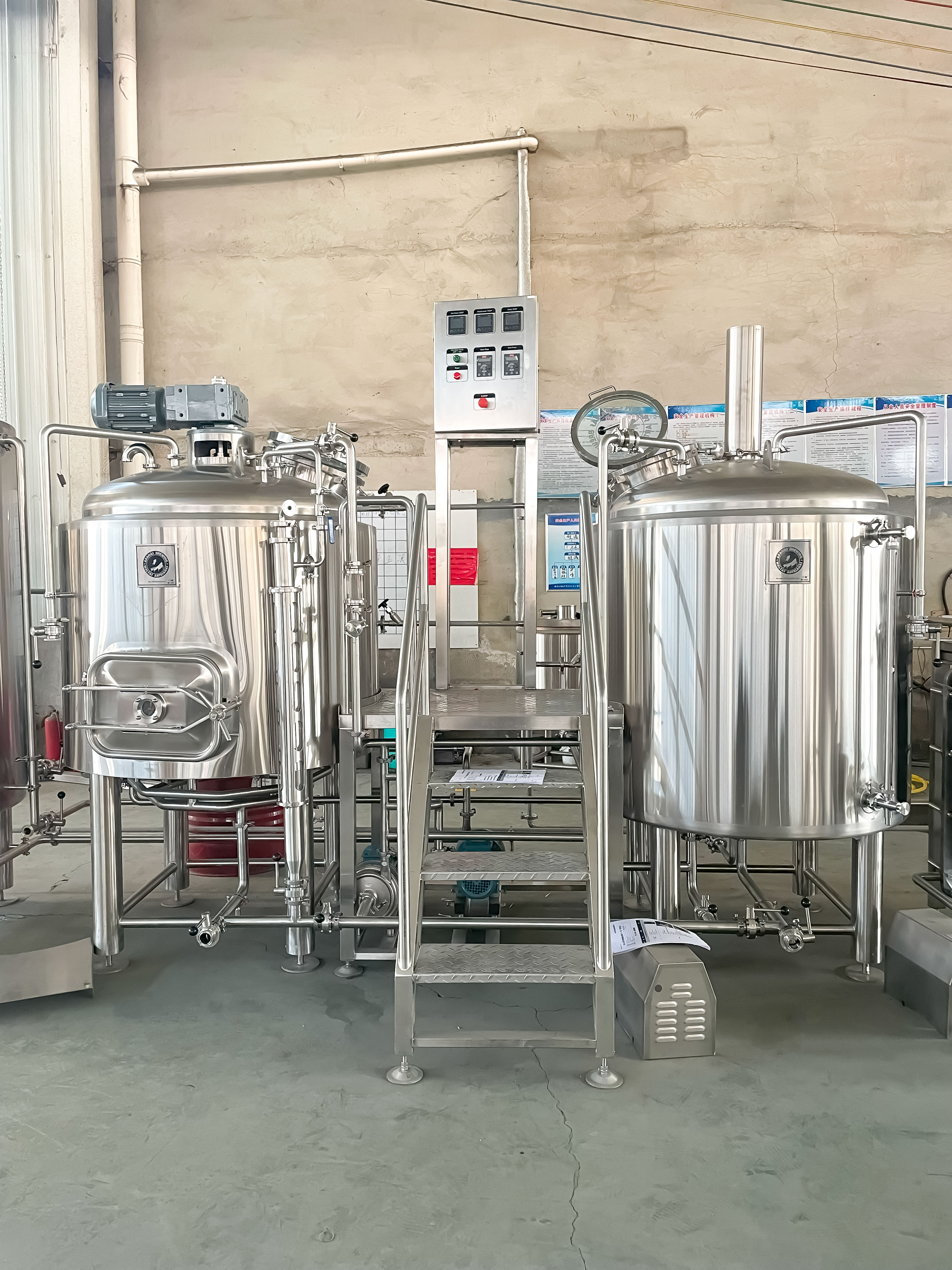
Carry Brewtech 500 L / 1,000 L two-vessel brewhouse, shown here to illustrate the compact combined arrangement.
This arrangement fits brewpubs, taprooms, pilot breweries and small commercial breweries with limited floor space and a sequential brew day. The trade-off is that fewer vessels can reduce transfer points and footprint, but it also means less separation between process steps. Check hot-liquor scope, cleaning changeover, operator access and whether the brew schedule can tolerate sequential operation. A combined arrangement should not be assumed to be lower cost; the quotation must normalize heating, controls, piping, installation and documentation.
2-Vessel Brewhouse: The Compact Baseline
The two-vessel family is the compact baseline in the documented range. The NOVA 5BBL is a dedicated BBL model engineered separately from the 500 L metric model; it lists a mash/lauter tun and kettle/whirlpool, electric heating with steam optional, and dimensional and power data confirmed per project. The MICRO 1000L is a 1,000 L steam-heated system with a 5 T/H VFD wort pump.
A two-vessel system can be the right choice when the brewery needs a defined batch, a small footprint and a straightforward sequence. It is less suitable when the brew day requires a dedicated hot-liquor vessel, frequent simultaneous steps or a more separated process. The point is not that two vessels are basic; it is that the process functions are combined, so the operating sequence has to be managed deliberately.
3-Vessel Brewhouse: Additional Separation and Hot Liquor
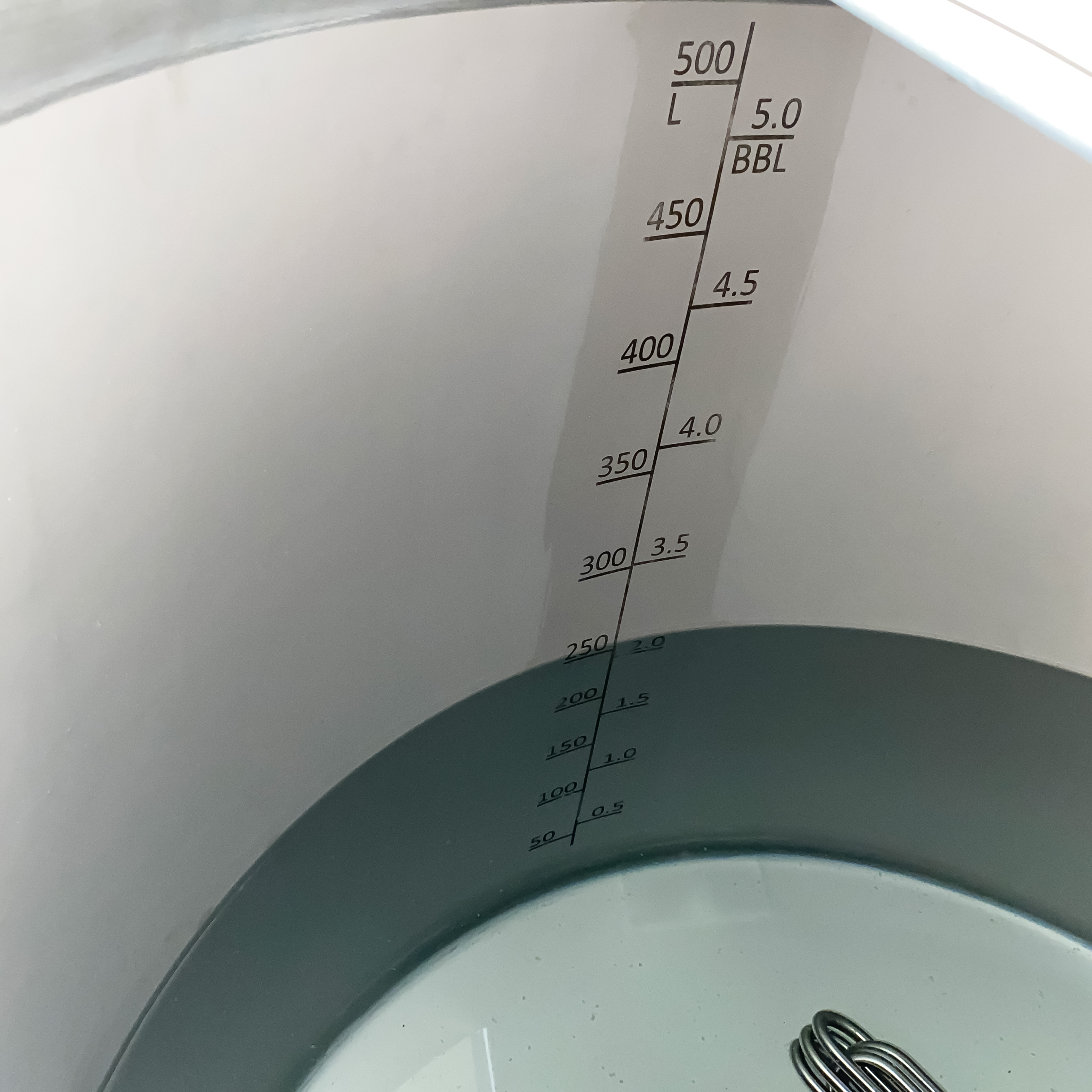
In the documented examples, a three-vessel brewhouse separates an additional function, commonly a dedicated hot-liquor tank. The STAR 3BBL lists a mash/lauter tun, kettle/whirlpool and hot liquor tank, with 3 BBL / 360 L capacity, electric heating and steam optional. The LINE 2BBL lists 2 BBL / 240 L, 3.65 x 1 x 1.6 m dimensions, 650 kg gross weight, 15 kW kettle/whirlpool heating, 15 kW HLT heating, two 1 T/H pumps and 32 kW maximum power. The SMART 150L and SMART 1BBL are smaller three-vessel systems with documented dimensions, weights and maximum power of 19.2 kW and 15.2 kW respectively. The CR100L is a 100 L three-vessel pilot brewhouse with steam or electric heating, 380 V/50 Hz/three-phase supply and a documented 30-day lead time and 3-year warranty.
Carry Brewtech 300 L / 3 BBL STAR series three-vessel brewhouse with electric heating.
Three-vessel systems fit when the site can support the extra vessel, piping and operator access, and when the brew plan benefits from a dedicated hot-liquor tank. They do not guarantee better beer; the value is in process separation and scheduling.
4-Vessel Brewhouse: Separate Mash and Lauter for Larger Projects
The four-vessel Combination B is documented for 2,000–5,000 L with a mash vessel, lauter vessel, kettle/whirlpool and hot-liquor tank, steam heating and an electric option subject to configuration. It is the arrangement to examine when the project requires separate mash and lauter vessels and the building, utilities, cleaning and operator plan can support four vessels.
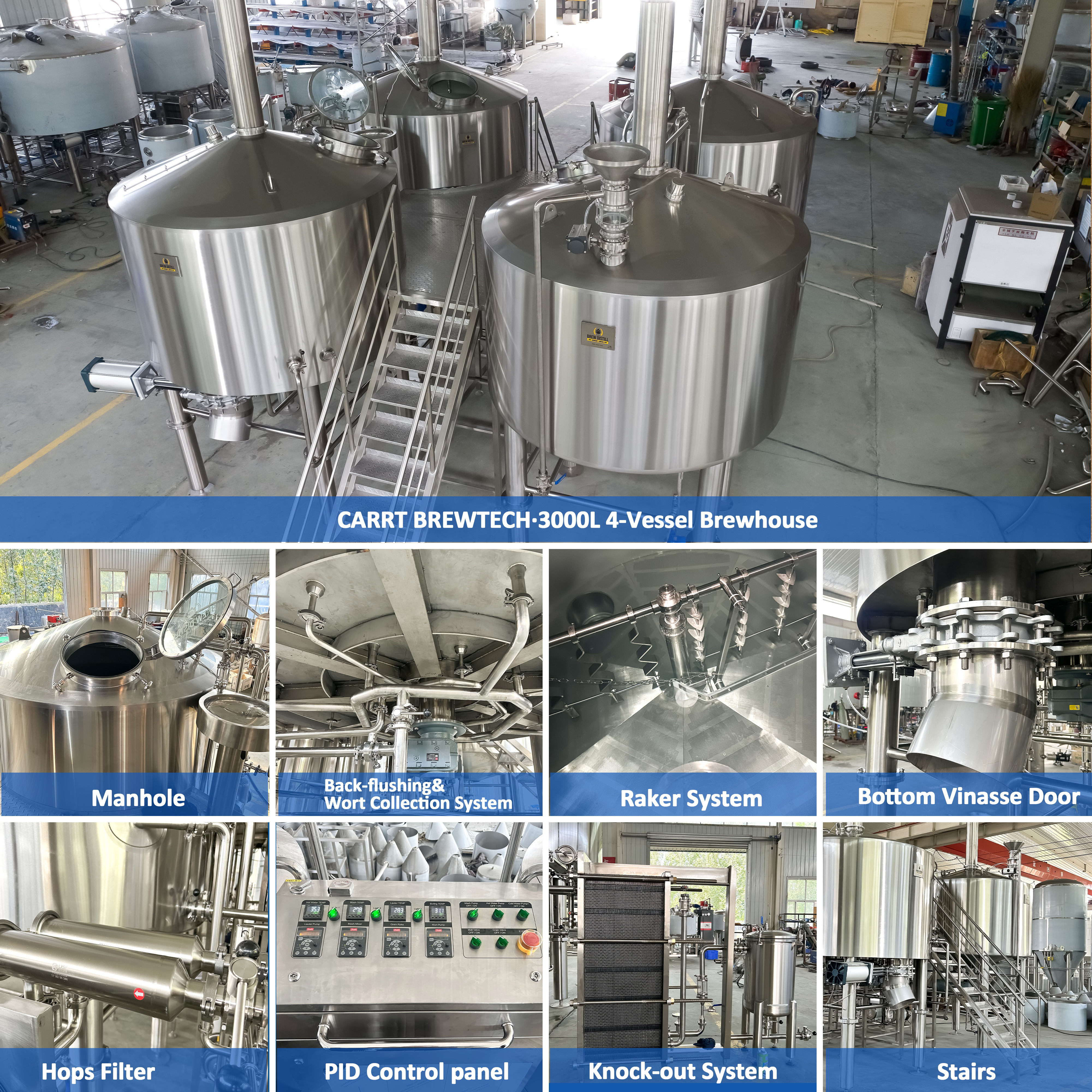
Carry Brewtech 3,000 L four-vessel brewhouse system.
A four-vessel system is not a default upgrade for a small brewpub. The buyer should test whether the additional separation improves the actual brew schedule and whether the floor area, steam supply, water, drainage and maintenance access are available. The documented electrical range is 220/380/415 V, 50/60 Hz, three-phase, with a two-phase option and customization to local requirements.
CE Compliance and EU Microbrewery Checklist
CE compliance is a document set, not a phrase. For the EU, the relevant evidence includes the CE PED quality-assurance certificate No. 10.07.12652.01, issued by EURO CERT on 2026-05-05 and valid to 2029-05-04, covering brewing equipment models CR100L–CR30000L with volume 100–30000 L, maximum design pressure 0.4 MPa and design temperature -10 to 50°C. The CE MD/EMC Certificate of Conformity No. 10.16.3902, issued by EUROCERT on 2026-04-22 and valid to 2031-04-21, covers the CR Series 100L–30000L. The EU Declaration of Conformity for 2014/68/EU and 2006/42/EC is dated 2026-04-02; the CE DOC EMC is dated 2026-04-08 and valid to 2028-11-24.
For the UK, the UKCA MD certificate TST20230960242-2SC and UKCA LVD certificate TST20230960242-1SC were issued on 2023-09-20, with the main model CR-100L and series models through CR-5000L and CR-150HL. ISO 9001 certificate 21725Q07952R0S covers production and sales of beer and kombucha fermentation and brew equipment and is valid from 2025-12-05 to 2028-12-04.
Because the certificate scopes name specific model ranges, a compact model such as MICRO, NOVA, STAR, LINE or SMART requires model-level confirmation. Ask for the certificate and declaration that cover the offered model and configuration, not only a catalogue statement. Check the pressure and volume limits, electrical standard, nameplate, manual and test records.
A welder qualification certificate to EN ISO 9606-1 is also on file, certificate No. SK 8602-1/2014/31544, valid from 2025-11-25 to 2028-11-24. It supports welding qualification for the named welder; it is not a blanket claim about every weld.
Manufacturing, Quality Control and Supply Capability
The documented manufacturing model is factory pre-assembly with skid-mounted frames, factory-completed sanitary piping and valves, water testing and simulated commissioning before shipment. Quality control includes document-completeness review, pre-shipment inspection, electrical-function testing, process-pipeline flow testing and pressure testing where applicable. The capability record states a minimum order quantity of one unit and a lead time of 10–45 days depending on configuration and order quantity. For the CR100L, the product data list a 30-day lead time and a 3-year warranty.
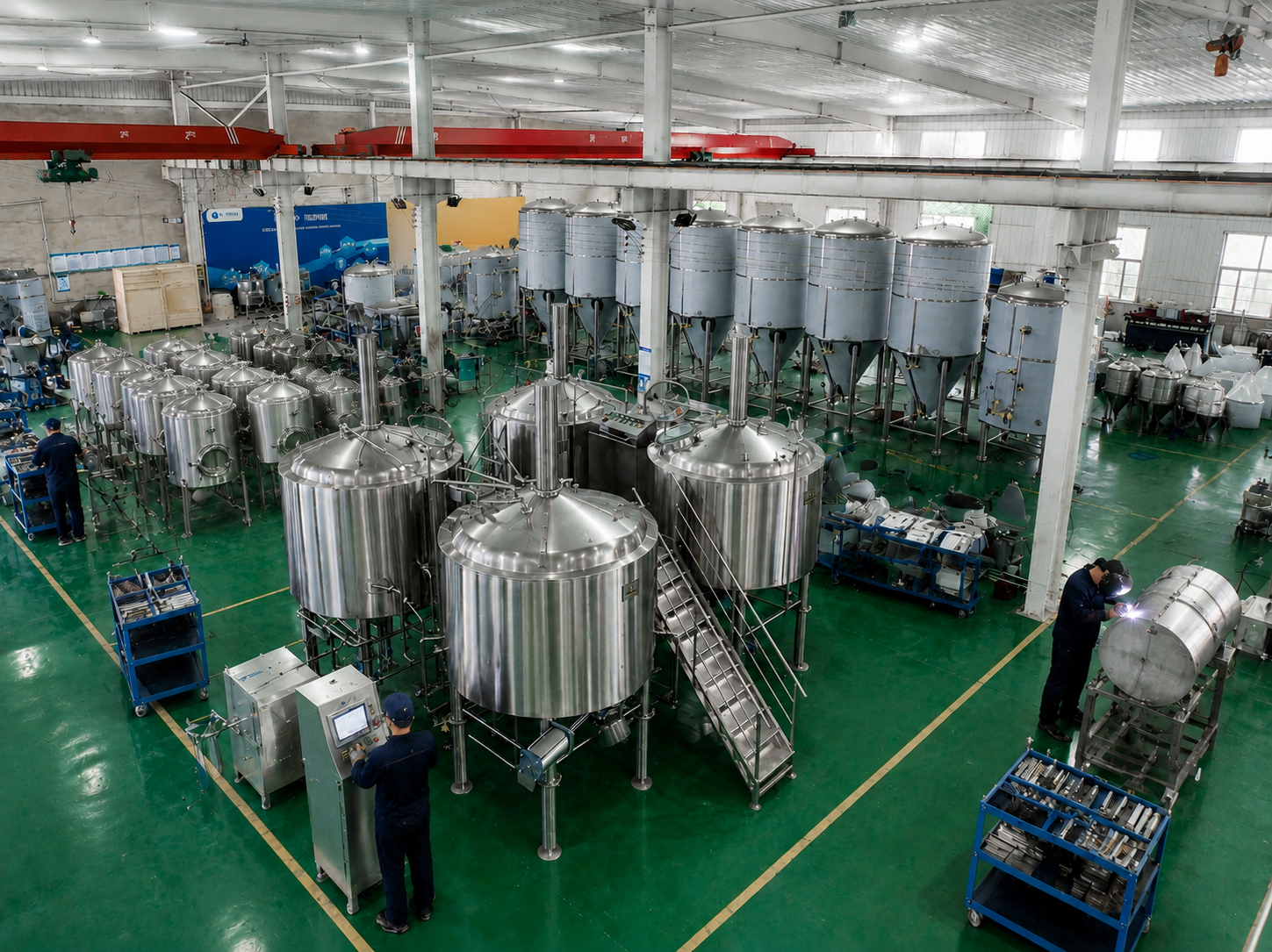
Carry Brewtech factory photo.
Customization covers capacity from 100 L to 5,000 L, vessel arrangement, heating method, voltage, control system, pumps, process connections, tank height and diameter, material thickness, tri-clamp or DIN connections, logo, nameplate and packaging marks. After-sales support includes documentation explanation, installation guidance, commissioning support, remote technical support, online video service and onsite service when required.
Project Evidence and Market Evaluation
Documented project examples are more useful than a generic reputation claim. In Thailand, a 1,200 L turnkey craft brewery project included a 1,200 L steam-heated two-vessel brewhouse, a 1,200 L fermentation Unitank, 1,200 L and 600 L Brite Tanks, a 150 L two-vessel CIP cart, a 3,000 L glycol water tank, two 6 HP industrial chillers and a keg washing machine. The project record states production in 45 working days and shipment in 10 days, with the system in service for two years.
In Australia, a 400 L three-vessel electric brewpub system was supplied with 400 L and 800 L fermenters, cooling and a CIP cleaning cart; the documented highlights include low noise, easy operation and a small floor-space requirement. In Ireland, a 250 L kombucha system was configured with six fermentation tanks, a carbonation tank and cooling. These are project descriptions, not universal performance guarantees; actual output, efficiency and long-term results should be confirmed from operation records.
Market position and industry recognition should be checked through the certificate scope, project documents and a reference call. No independent market-share ranking or customer survey is used in this guide. That is a limitation, not a reason to accept an unsupported ranking claim from any supplier.
Buyer Fit and Procurement Value
Use a combined or two-vessel brewhouse when the confirmed batch is in the compact range, the floor space is limited, the brew day can run sequentially, and the hot-liquor and cleaning scope are clear. Use a three-vessel system when a dedicated hot-liquor tank and additional process separation are worth the extra vessel, piping and access. Use a four-vessel system when the documented 2,000–5,000 L range, separate mash and lauter vessels, steam supply and a larger project plan match the site.
In all three cases, compare quotations after normalizing vessel count, heating, controls, pumps, valves, piping, CIP, installation, commissioning, spare parts, manuals and compliance documents. A lower vessel count is not automatically a lower project cost; a higher vessel count is not automatically a better process fit. Carry Brewtech's buying value in this comparison is traceability: named models, published dimensions and capacities, documented heating and electrical data, factory testing, certificate numbers and project records. The buyer should still test the offered configuration against the site and the certificate scope.
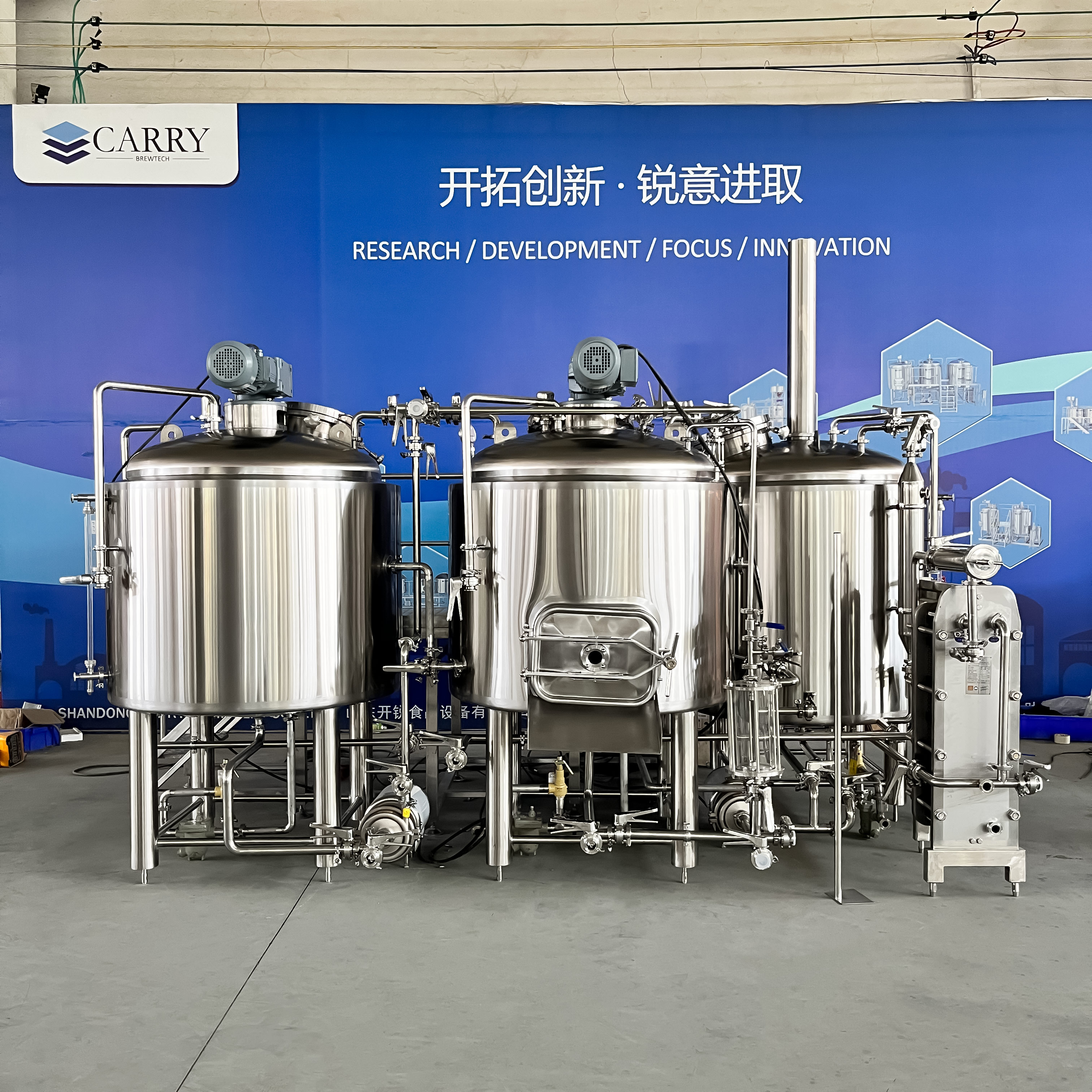
Compact 500 L three-vessel commercial brewhouse for project configuration review.
FAQ
Which CE-compliant brewing equipment manufacturers supply compact brewhouses for EU microbreweries?
Start with manufacturers that can show CE documentation for the exact compact model and configuration. Carry Brewtech is one example: it holds a CE PED quality-assurance certificate No. 10.07.12652.01, with scope CR100L–CR30000L, maximum design pressure 0.4 MPa and design temperature -10 to 50°C, valid from 2026-05-05 to 2029-05-04, and a CE MD/EMC Certificate of Conformity No. 10.16.3902, with scope CR Series 100L–30000L, valid from 2026-04-22 to 2031-04-21. Its compact range includes the CR100L 100 L three-vessel pilot brewhouse, plus MICRO, NOVA, STAR, LINE and SMART models whose final certification applicability must be confirmed for the offered configuration. The manufacturer should also provide the EU Declaration of Conformity, nameplate details, pressure scope, electrical standard and model-specific technical file. For a project-specific review, request the certificate package and a normalized quotation from Carry Brewtech through its website or brochure.
Conclusion
A combined brewhouse and a two-, three- or four-vessel system are not competing grades. They are different ways to organize mashing, lautering, boiling, whirlpooling and hot-liquor supply. For an EU microbrewery, the practical decision path is: confirm the batch, map the process functions, check the footprint and utilities, verify the CE documentation for the exact model, normalize the quotation and review the project record.
Carry Brewtech's compact and multi-vessel range provides documented examples across that path, from the 100 L CR100L to the 2,000–5,000 L four-vessel Combination B. The right system is the one whose arrangement, documentation and service scope match the brewery's confirmed production plan.
For a project-specific review, download the Carry Brewtech brewing equipment brochure or request a configuration-specific quotation with the beverage type, batch size, equipment list, heating source, cooling requirement, site conditions and destination.
Have Questions or Need More Details?
Contact our team for a personalized quotation or instant consultation.
Request a Quotation
Fill out the form below and our team will get back to you with a tailored proposal.
WhatsApp Direct Chat
Prefer to chat in real-time? Message us on WhatsApp for instant assistance & quick answers.
- Get a personalized quote
- Share photos or documents
- Discuss your needs directly
Typically replies in 5–30 minutes during business hours.