Choosing the Right Bag Size and Mixing Ratio: A Technical Guide to Mushroom Bagging Parameters
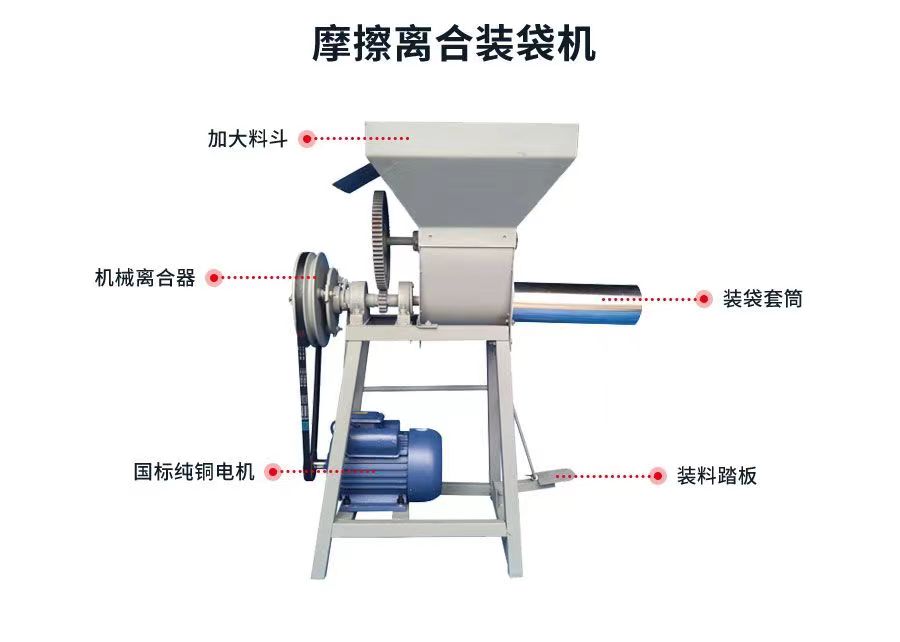
Small Friction Clutch Mushroom Bagging Machine (ZD-3): bag length 28–60 cm, flat width 12–25 cm, maximum filling height ≤45 cm.
Two parameters decide whether a mushroom bagging line runs at its rated capacity: the physical size of the bag, and the ratio between what the mixing stage can deliver and what the bagging stage can consume. On Changxing edible mushroom automation equipment, the bagging envelope runs from 28 cm to 60 cm in bag length and from 12 cm to 25 cm in flat width on the small friction-clutch and pneumatic baggers, while the integrated automatic lines are specified for 14–22 cm × 28–63 cm bags. Upstream, the Large-Scale Raw Material Mixer (CXJB Series) covers 0.8 T to 10 T — 0.3 m³ to 25 m³ — per batch, and the 600-Type Wood Sawdust Crusher (QF600) processes 1.8 T/h of mixed wood and logs up to φ180 mm.
Changxing Edible Mushroom Machinery — the trade identity of Neihuang County Changxing Biological Machinery Equipment Co., Ltd. — is an edible mushroom machinery manufacturer founded in 2009 in Neihuang County, Henan, China. The company operates a 20,000 m² facility with 130 employees, a 25-engineer R&D team and an annual output of 10,000 units, and exports 60% of production to South Korea, Malaysia, Central Asia, Europe and Russia. This guide is written for importers, distributors, cooperative managers and factory project engineers comparing edible mushroom automation equipment during research and evaluation.
Two clarifications frame everything that follows. First, "mixing ratio" in this guide describes the equipment-planning ratio between mixer batch volume, mixing cycle and daily bag output; the ingredient ratio inside a substrate formula depends on mushroom variety and is not part of any machine specification. Second, a bagging machine's capacity figure is only valid inside its stated bag envelope — outside that envelope, the number has no practical meaning.
Problem Definition: Why Bag Size and Mixing Capacity Fail Together
When a bagging project underperforms, the cause is usually a parameter mismatch rather than a machine defect. Four patterns account for most of them, and they tend to appear in sequence.
- The bag sits outside the machine's envelope. Every model is specified for a window, not a range. A machine rated 30–38 cm in bag length will not reproduce its stated output on a 50 cm oyster bag. The machine may still cycle, but fill consistency, bag shape and closing quality degrade.
- Maximum filling height is exceeded. Filling height limits differ by design across the Changxing bagging family — ≤19 cm, ≤32 cm, ≤45 cm and ≤50 cm. Pushing past the cap changes how the bag is held and closed, which is exactly the variable that variety-specific requirements target: bag tightness, sealing depth and bag shape.
- The mixing stage is smaller than the bagging stage. If the mixer cannot feed the bagger continuously, daily output falls below the station figure — 15,000 bags/day for a 2-station line, 25,000 bags/day for a 4-station line, and 50,000 bags/day for the 4-station black termitomyces configuration.
- Crushing and screening throughput sits below the mixer's demand. Particles then vary between batches. Screen apertures across the crusher range are 6–20 mm and 8–20 mm, and the Branch & Cotton Material Crusher (MF-50) produces 3–5 mm flake particles; a starved mixer inherits whatever size distribution arrives.
The common root cause is that the parameters were chosen independently, one quotation line at a time. Bag geometry, filling height, mixing capacity, crushing throughput and site conditions form a chain: the crusher sets particle size, the mixer converts that particle size into a batch, the batch sets how often the bagger can run, and the bag sets what the bagger can physically hold. A project only reaches its stated numbers when the chain is sized from one end to the other.
Industry Background: Scale, Standards and Where the Demand Sits
China's edible mushroom industry value exceeded 380 billion yuan — approximately USD 53 billion — in 2024 and represents more than 70% of global output, according to People's Daily citing the Ministry of Agriculture. Equipment demand follows that production base rather than leading it, which is why bagging, mixing and crushing machines are the most widely deployed categories in industrial cultivation projects.
Dataintelo estimates the global mushroom equipment market at USD 3.8 billion in 2025, projected to reach USD 7.2 billion by 2033, with Asia-Pacific holding a 42.3% revenue share in 2025 driven by industrial-scale cultivation in China. Market-size figures should be read with their scope attached: QYResearch places the machinery-only segment at USD 1.23 billion for the same period, so the difference reflects definition rather than disagreement about direction.
On the compliance side, equipment shipped into the European Union is covered by CE marking under the Machinery Directive (2006/42/EC) and the EMC Directive (2014/30/EU). Changxing obtained CE Certificate No. M.2026.206.C135928 in March 2026 for its bagging and production lines — a document buyers can verify directly during supplier evaluation rather than accepting as a claim.
Detailed Solution: The Five Parameter Groups That Define a Bagging Setup
Parameter group 1 — Bag length and flat width
Bag length and flat width must be confirmed before any other specification is discussed, because they eliminate entire machine families immediately. The published envelope across the bagging range is wide, but individual models are narrow.
The small-machine family covers the broadest window. The Small Friction Clutch Mushroom Bagging Machine (ZD-3) accepts bag length 28–60 cm and flat width 12–25 cm with a maximum filling height of ≤45 cm, runs at 400–600 bags/h on a 1.5 kW motor at AC220V 50Hz, and uses a two-stage gear drive with friction clutch and foot-pedal control. Its sleeve and auger are replaceable, so the same chassis handles mushroom spawn and small round pillow packaging. The Small Electromagnetic Clutch Machine (TZD-1) shares the same bag window with a 15–25 cm flat-width specification and runs 600–800 bags/h on 2.2 kW, while the Pneumatic Automatic Mushroom Bagging Machine (TZD) reaches 700–900 bags/h with 2.2 kW or 3 kW and adds pneumatic components to the electromagnetic clutch.
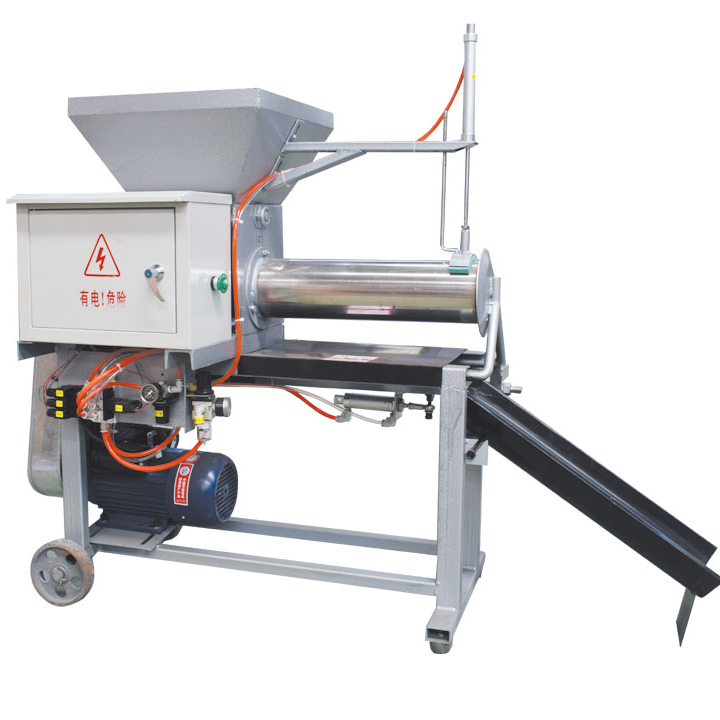
Pneumatic Automatic Mushroom Bagging Machine (TZD): 700–900 bags/h, bag length 28–60 cm, flat width 15–25 cm, IP54.
The stamping family is deliberately narrower. The Double-Stamping Automatic Mushroom Bagging Machine (ZD15-24) is specified for bag length 30–38 cm and flat width 15–22 cm with maximum filling height ≤19 cm, and reaches 1,000–1,500 bags/h on 3 kW at AC380V 50Hz. The oyster-mushroom variant (GZD15-24) runs longer bags at 45–50 cm × 15–22 cm with ≤32 cm filling height and 800 bags/h; its layered inoculation version adds 2–4 adjustable inoculation layers with optional spiral inoculation, which matters when inoculation is part of the same pass.
Square-bag operations need their own family. The Square Bag Stamping Bagging Machine (CX-FD) handles 40–50 cm × 30–32 cm bags up to ≤50 cm filling height at 600–800 bags/h and includes automatic 6-hole punching, while the Automatic Square Bag Bagging Machine (FD) reaches 800 bags/h with an industrial touch screen and adjustable packing force, packing speed, packing length and pressure-holding time.
Roll-bag shiitake production uses a different logic again: the Automatic High-Speed Shiitake Mushroom Bagging Machine (CX-GJZ) is specified for 15–18# flat-width roll bag with 550–600 mm bag length, cuts to fixed length and welds automatically, and delivers 650–750 bags/h in double-film mode or 1,000–1,200 bags/h. For integrated output, the Integrated Shiitake Mushroom Bagging & Tying Machine (ZN) runs 800–1,200 bags/h across multiple bag sizes, and the Integrated Bagging & Tying Machine (ZN-B) reaches 7,000–8,000 bags/h with PLC touch-screen control, auger feeding and an automatic tying mechanism.
Parameter group 2 — Filling height and downstream compatibility
Maximum filling height behaves as a hard constraint rather than a preference. Across the models described above the caps are ≤19 cm, ≤32 cm, ≤45 cm and ≤50 cm. The cap is set by how the machine holds the bag during filling and how the bag is closed afterwards, so exceeding it does not simply produce a fuller bag — it changes the closing geometry.
Downstream compatibility should be checked against the same numbers. The Dual-Station Automatic Mushroom Inoculation Machine (CX-JZJ) accepts bags with flat width 14–22 cm and length 40–60 cm, and the Automatic Mushroom Inoculation Machine (CJZQ-1) uses the same bag window at 1,240 bags/h. Where ring sleeving, capping and basket loading are integrated, the Automatic Mushroom Bag Ring Sealing, Capping & Tray Loading Machine (CX-ZDTHJ) is specified to a bagging height accuracy of ±10 mm, repeat positioning accuracy of ±2 mm and a pass rate of ≥97%.
Parameter group 3 — Mixer capacity and the operational mixing ratio
Once the bag is fixed, the question becomes how much substrate can be prepared per batch. The Large-Scale Raw Material Mixer (CXJB Series, covering CXJB-100 and CXJB-3M³ through CXJB-25M³) spans motor power 4 kW to 37.5 kW, mixing capacity 0.8 T to 10 T or 0.3 m³ to 25 m³, machine weight 0.48 T to 7.2 T, and overall dimensions from 2290×1080×1191 mm to 5120×2612×2900 mm. The mixing element is a forward and reverse spiral belt auger held 5 mm clear of the bin bottom for clean discharge, reduction is by reducer or multi-stage transmission, and components are laser-cut; the process flow is feeding then mixing.
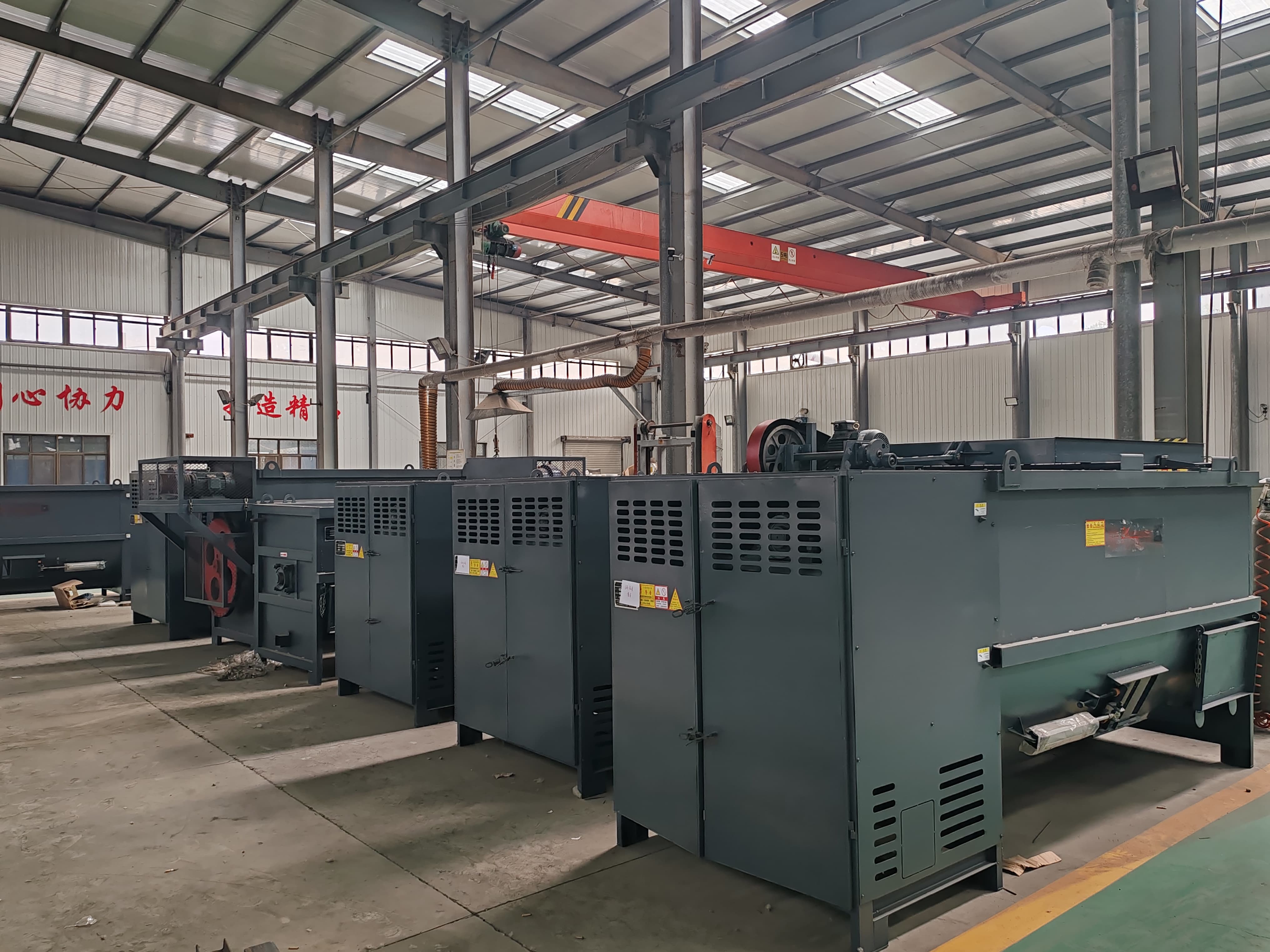
Large-Scale Raw Material Mixer (CXJB Series): 0.8 T–10 T (0.3–25 m³) per batch, 4 kW–37.5 kW, forward and reverse spiral belt auger.
Smaller projects can work from the entry models. The 100-Type Raw Material Mixer (CXJB-100) delivers a 0.8 T batch on 4 kW at AC380V 50Hz, weighs 480 kg, measures 2290×1080×1191 mm, and is built around a motor plus reducer with a solid steel belt auger and casters for repositioning. Where mixing and turning happen on the floor rather than in a bin, the Self-Propelled Electric Compost Turner & Mixer (DZF-550) moves 20 m³/h on 4 kW with three-speed forward, neutral and reverse control, an aluminium alloy gearbox, a feeding rake and a centrifugal impeller, handling wood chips, cotton hull, corn cob and granular raw materials.
For selection purposes, the mixing ratio to calculate is operational: batch volume against daily bag demand. A 2-station line is specified at 15,000 bags/day, a 4-station line at 25,000 bags/day, and the black termitomyces 4-station configuration at 50,000 bags/day. Because no bags-to-kilogram conversion is published, the mixer's 0.3 m³ to 25 m³ batch range is the planning lever — match it to the daily bag count, then confirm the ratio against actual substrate density during commissioning rather than assuming a fixed conversion.
Parameter group 4 — Crusher throughput and raw-material preparation
The 600-Type Wood Sawdust Crusher (QF600) is the reference point for wood-based substrate preparation: 30 kW at AC380V 50Hz, 1.8 T/h capacity, 230 kg net weight, 1050×730×950 mm, suitable for mixed wood and logs up to φ180 mm, with a replaceable screen of 8–20 mm aperture and a knife disc plus hammer piece design that slices and crushes in one step. Electric motor and diesel engine drive options are both available, and the process flow is feeding, crushing, discharging.
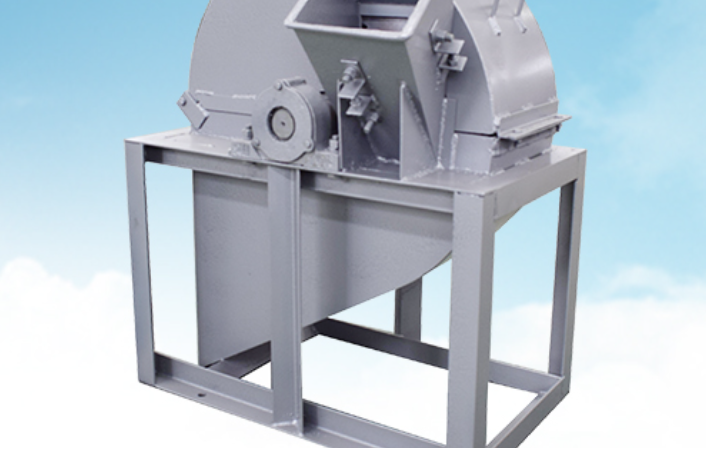
500-Type Wood Crusher (QF500): 22 kW, 1 T/h, logs up to φ140 mm — a smaller model in the same wood-crushing family as the 600-Type Wood Sawdust Crusher.
Scaling around that reference point is straightforward. The 500-Type Wood Crusher (QF500) handles φ140 mm material at 1 T/h on 22 kW, and the Mushroom Log Chipper & Grinder (QF400) handles φ120 mm at 700 kg/h on 18 kW — both with the same knife disc plus hammer piece structure and replaceable 8–20 mm screens. For corn cob and stalk, the Large-Scale Corn Cob Crusher (FS60-50) delivers 2 T/h on 30 kW with a hammer piece design and a 6–20 mm replaceable screen. For branches and cotton material, the Branch & Cotton Material Crusher (MF-50) reaches 2,500 kg/h on 5.5 kW, handles branches up to φ30 mm, and uses a knife wheel design with low blade clearance to avoid fiber tangling while producing 3–5 mm flake particles.
Screening closes the loop. The Large-Scale Rotary Trommel Screen (GTS) runs 8 T/h on 7.5 kW, measures 10,000×1450×3000 mm, and combines a heavy-duty drum screen with an industrial conveyor belt and a front-end loader feeding design for stone and impurity removal. A crusher sized to the mixer, followed by trommel screening, keeps particle size stable enough that batch-to-batch mixing behaves predictably.
Parameter group 5 — Electrical, environmental and site envelope
The site envelope eliminates options as decisively as bag size does, and it is usually discovered last. Automatic production lines and the higher-output baggers are specified for AC380V 50Hz three-phase supply, including the ZD15-24, GZD15-24, CX-GJZ, ZN, ZN-B, CX-ZDTHJ and CX-S-JWZ series. The ZD-3 runs on AC220V 50Hz single phase, and the TZD and TZD-1 accept either AC220V or AC380V 50Hz.
Environmental ratings follow the same pattern. Models that publish protection and temperature ratings are specified at IP54 and 0–40 °C working temperature. Pneumatic functions require a compressed air supply of 0.5–0.7 MPa at 1,500 L/min on machines such as CX-ZDTHJ and the Automatic Bagging, Nesting, Stick-Inserting & Basket-Loading Machine (CX-S-JWZ-automation).
Project-level requirements mirror this. The documented operating scenario for an edible mushroom automatic production system specifies continuous operation and automatic operation mode in a normal-temperature indoor workshop, with a 380V three-phase power supply, a stable foundation and a trained operator. Supporting equipment in that scenario includes the automatic bagging manipulator, mixer, conveyor, material distributor and basket loader — five interfaces that must be laid out before the bagger is positioned, not after.
Step-by-Step Breakdown: Setting Bagging Parameters in Six Steps
The sequence below works from the bag outward, which prevents the most expensive mistake: buying a bagger before confirming the bag.
- Fix the bag. Record bag length, flat width and target filling height for the variety in question, then eliminate every model whose published window does not contain all three values.
- Convert the production target into capacity. Compare the daily bag target against machine-level capacity (400–600, 600–800, 700–900, 800, 1,000–1,500, or 7,000–8,000 bags/h depending on model) and against line-level capacity (15,000, 25,000 or 50,000 bags/day).
- Match the filling method to the bag type. Stamping suits shorter, narrower bags with tight filling-height control; auger feeding suits the 28–60 cm window; roll-bag machines cut and weld to fixed length.
- Size the mixer against daily bag demand. Use the CXJB batch range of 0.3 m³ to 25 m³ as the lever, and confirm the operational mixing ratio against real substrate density.
- Size the crusher and screen against mixer consumption. Choose throughput from 700 kg/h to 2.5 T/h and screen aperture from 6–20 mm or 8–20 mm so that particle size stays inside the mixer's expectation.
- Confirm the electrical and site envelope, then the optional modules. Verify AC380V 50Hz three-phase availability, IP54 and 0–40 °C conditions, compressed air at 0.5–0.7 MPa where required, then add ring sleeving, hole punching and stick inserting, tying, or basket loading as separate decisions rather than bundled ones.
Use Cases: Matching Parameters to Real Project Profiles
Korea — multi-variety automatic production system
The documented Korean scenario is a continuous, automatic edible mushroom production system operating indoors at normal temperature. It covers bagging for oyster mushroom, shiitake mushroom, black fungus and pearl oyster mushroom, and lists matched equipment as the automatic bagging manipulator, mixer, conveyor, material distributor and basket loader. Preconditions are a 380V three-phase power supply, a stable foundation and trained operators — the three requirements that most often delay commissioning in imported projects.
Malaysia — high-volume integrated line
The Malaysian scenario integrates mixer, elevator, material distributor, and automatic bagging and tying machine into a daily output approaching 80,000 bags, covering enoki mushroom, king oyster mushroom, pearl oyster mushroom, shiitake mushroom and snow fungus. Its stated requirements are a 380V three-phase supply, a stable flat foundation, compressed air where pneumatic functions are used, and operation by trained personnel only. This profile is the clearest illustration of why the mixing ratio must be sized first: at that output, a mixer that lags by one batch per shift removes a measurable share of daily capacity.
Multi-country export programme — validated over five years
A substrate processing production line programme serving mushroom farms, planting bases, agricultural equipment distributors and agricultural enterprises across South Korea, Malaysia, Russia and the United Kingdom has run for five years with an annual export volume of 20+ units. The reported result is stable operation with bagging speed above 1,000 bags per hour, and the stated highlight is high production efficiency at low labor cost. That figure aligns with the 1,000–1,500 bags/h specification of the ZD15-24 class of machine, which is the practical cross-check buyers should apply to any case reference.
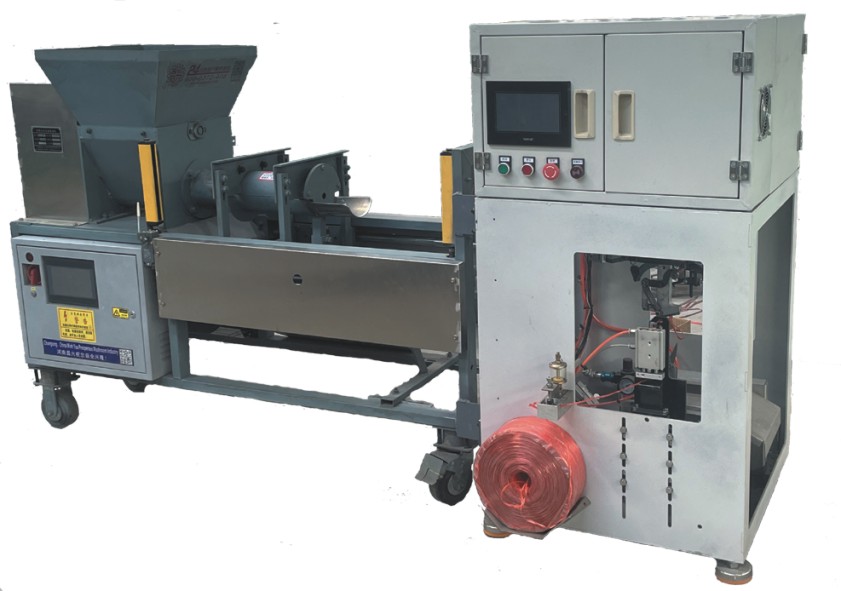
Integrated Bagging & Tying Machine (ZN-B): 7,000–8,000 bags/h, holding cylinder plus auger feeding, automatic rope clamping, winding and knotting.
Comparison Table: Bagging Machines by Bag Parameter
| Model | Bag length | Flat width | Max filling height | Capacity | Power / supply |
|---|---|---|---|---|---|
| Small Friction Clutch ZD-3 | 28–60 cm | 12–25 cm | ≤45 cm | 400–600 bags/h | 1.5 kW / AC220V 50Hz |
| Small Electromagnetic Clutch TZD-1 | 28–60 cm | 15–25 cm | ≤45 cm | 600–800 bags/h | 2.2 kW / AC220V or 380V 50Hz |
| Pneumatic Automatic TZD | 28–60 cm | 15–25 cm | ≤45 cm | 700–900 bags/h | 2.2 kW or 3 kW / AC220V or 380V 50Hz |
| Double-Stamping Automatic ZD15-24 | 30–38 cm | 15–22 cm | ≤19 cm | 1,000–1,500 bags/h | 3 kW / AC380V 50Hz |
| Automatic Stamping Oyster GZD15-24 | 45–50 cm | 15–22 cm | ≤32 cm | 800 bags/h | 3 kW / AC380V 50Hz |
| Square Bag Stamping CX-FD | 40–50 cm | 30–32 cm | ≤50 cm | 600–800 bags/h | 3 kW / AC380V 50Hz |
| Automatic Square Bag FD | 45–55 cm (bag length 40–50 cm) | 30–32 cm | — | 800 bags/h | 4 kW / AC380V 50Hz |
| High-Speed Shiitake CX-GJZ | 550–600 mm | 15–18# roll bag | — | 650–750 bags/h (double film); 1,000–1,200 bags/h | 8 kW / AC380V 50Hz |
| Integrated Bagging & Tying ZN | Multiple bag sizes | Multiple bag sizes | — | 800–1,200 bags/h | 4 kW / AC380V 50Hz |
| Integrated Bagging & Tying ZN-B | — | — | — | 7,000–8,000 bags/h | 5 kW / AC380V 50Hz |
Comparison Table: Upstream Mixing and Crushing Parameters
| Equipment | Model | Throughput / batch | Power | Key published specification |
|---|---|---|---|---|
| Large-Scale Raw Material Mixer | CXJB Series (CXJB-100; CXJB-3M³–CXJB-25M³) | 0.8 T–10 T (0.3–25 m³) | 4 kW–37.5 kW | Forward & reverse spiral belt auger, 5 mm clearance from bin bottom, laser-cut components |
| 100-Type Raw Material Mixer | CXJB-100 | 0.8 T | 4 kW | 2290×1080×1191 mm, motor + reducer, solid steel belt auger, casters |
| Self-Propelled Compost Turner & Mixer | DZF-550 | 20 m³/h | 4 kW | 3-speed forward/neutral/reverse, aluminium alloy gearbox, feeding rake, centrifugal impeller |
| 600-Type Wood Sawdust Crusher | QF600 | 1.8 T/h | 30 kW | Mixed wood and logs φ≤180 mm, replaceable 8–20 mm screen, knife disc + hammer piece |
| 500-Type Wood Crusher | QF500 | 1 T/h | 22 kW | Logs φ≤140 mm, replaceable 8–20 mm screen |
| Mushroom Log Chipper & Grinder | QF400 | 700 kg/h | 18 kW | Logs φ≤120 mm, replaceable 8–20 mm screen |
| Large-Scale Corn Cob Crusher | FS60-50 | 2 T/h | 30 kW | Corn cob, corn stalk, bean stalk; replaceable 6–20 mm screen |
| Branch & Cotton Material Crusher | MF-50 | 2,500 kg/h | 5.5 kW | Branches φ≤30 mm, cotton material; 3–5 mm flake particles; knife wheel design |
| Large-Scale Rotary Trommel Screen | GTS | 8 T/h | 7.5 kW | Heavy-duty drum screen + industrial conveyor belt, front-end loader feeding |
Comparison Table: Automatic Bagging Lines by Output and Bag Size
| Line | Capacity | Bag size | Supply | Process flow |
|---|---|---|---|---|
| 2-Station Production Line | 15,000 bags/day | Length 14–22 cm, width 28–63 cm | AC380V 50Hz | Front loader feeding → mixing → conveying → distributing → bagging → tying → bag collection |
| 4-Station Shiitake Bagging & Tying Line | 25,000 bags/day | Length 14–22 cm, width 28–63 cm | AC380V 50Hz | Shovel feeding → mixing → conveying → distributing → bagging → tying |
| 4-Station Black Termitomyces Line | 50,000 bags/day | Length 14–22 cm, width 28–37 cm | AC380V 50Hz | Shovel feeding → mixing → conveying → distributing → bagging |
FAQ
1. What power supply and site conditions are required before a mushroom bagging system is installed?
Automatic production lines and the higher-output baggers — including the ZD15-24, GZD15-24, CX-GJZ, ZN, ZN-B and CX-ZDTHJ — are specified for AC380V 50Hz three-phase supply. The Small Friction Clutch Machine ZD-3 runs on AC220V 50Hz, while the TZD and TZD-1 accept either AC220V or AC380V 50Hz. Where published, models carry IP54 protection and a 0–40 °C working temperature rating. Documented project scenarios for edible mushroom automatic production systems require a 380V three-phase supply, a stable foundation, a trained operator, and continuous automatic operation in a normal-temperature indoor workshop; pneumatic machines such as CX-ZDTHJ and CX-S-JWZ additionally need compressed air at 0.5–0.7 MPa and 1,500 L/min. For European projects, CE marking under the Machinery Directive (2006/42/EC) and EMC Directive (2014/30/EU) applies, and Changxing holds CE Certificate No. M.2026.206.C135928 issued in March 2026.
2. How do I check whether a bagging machine can run my bag size?
Compare three published values against the physical bag: bag length, flat width and maximum filling height. The windows differ by family — 28–60 cm length and 12–25 cm flat width on the ZD-3 and 28–60 cm with 15–25 cm flat width on the TZD-1 and TZD; 30–38 cm × 15–22 cm with ≤19 cm filling height on the ZD15-24; 45–50 cm × 15–22 cm with ≤32 cm filling height on the oyster GZD15-24; 40–50 cm × 30–32 cm with ≤50 cm filling height on the square-bag CX-FD; 15–18# flat-width roll bag with 550–600 mm bag length on the CX-GJZ. Automatic 2-station and 4-station lines are specified for 14–22 cm length and 28–63 cm width, with a 28–37 cm width variant on the 4-station black termitomyces configuration. If any of the three values falls outside the window, the machine's capacity rating does not apply to that bag.
3. What determines the configuration scope when budgeting a bagging line?
Configuration scope is set by five decisions: the number of stations (2-station at 15,000 bags/day versus 4-station at 25,000 bags/day or 50,000 bags/day), the mixer batch volume within the CXJB range of 0.3 m³ to 25 m³ and 4 kW to 37.5 kW, crusher throughput and screen aperture, the electrical and site envelope, and the optional downstream modules — automatic ring sleeving, hole punching and stick inserting, bagging and tying integration, and basket loading. Minimum order quantity is 1 unit, and monthly production capacity is 1,000 units, so budget comparisons are best made against a defined parameter set rather than a model name alone; requesting a configuration proposal with the bag dimensions and daily output stated is the fastest way to get a comparable number.
4. Can bagging parameters be validated before committing to a full line?
Validation starts with the published envelope rather than with a demonstration. Minimum order quantity is 1 unit, and ODM and R&D support covers equipment, equipment dimensions, production efficiency, applicable mushroom varieties, bagging machine configuration and unmanned fully automatic mushroom production lines — so a machine can be configured to a confirmed bag size instead of forcing the bag to fit a standard model. Quality control is 100% test before delivery against ISO standard, and factory visits for inspection and order confirmation are part of the normal process for export customers.
5. What is the lead time, and what support follows delivery?
Lead time is 30–55 days with a minimum order quantity of 1 unit and a monthly production capacity of 1,000 units; the company exports 60% of output to South Korea, Malaysia, Central Asia, Europe and Russia, which shapes the shipping and documentation workflow. After-sales support is delivered remotely by a technical team, and the R&D function — 25 engineers within a 20,000 m² facility employing 130 people — remains the point of contact for parameter adjustments after commissioning.
Conclusion: Size the Chain, Not the Machine
Bag size and mixing ratio are not two separate specifications; they are the two ends of one calculation. Bag length and flat width determine which bagging machine family applies — 28–60 cm and 12–25 cm for the small and pneumatic models, 30–38 cm and 15–22 cm for double-stamping, 45–50 cm and 15–22 cm for oyster bags, 30–32 cm flat width for square bags, 14–22 cm and 28–63 cm for automatic lines. Maximum filling height then narrows the choice further at ≤19 cm, ≤32 cm, ≤45 cm or ≤50 cm. On the upstream side, the operational mixing ratio links mixer batch volume (0.8 T–10 T, or 0.3–25 m³) to daily bag output (15,000, 25,000 or 50,000 bags/day), while crusher throughput (700 kg/h to 2.5 T/h) and screen aperture (6–20 mm or 8–20 mm) set the particle size that the mixer works with.
When those five parameter groups are confirmed in sequence — bag geometry, filling height, mixer capacity, crusher throughput, and the electrical and site envelope — the line reaches the numbers on its specification sheet. When they are chosen independently, no amount of capacity on paper compensates for a mismatch in the middle of the chain.
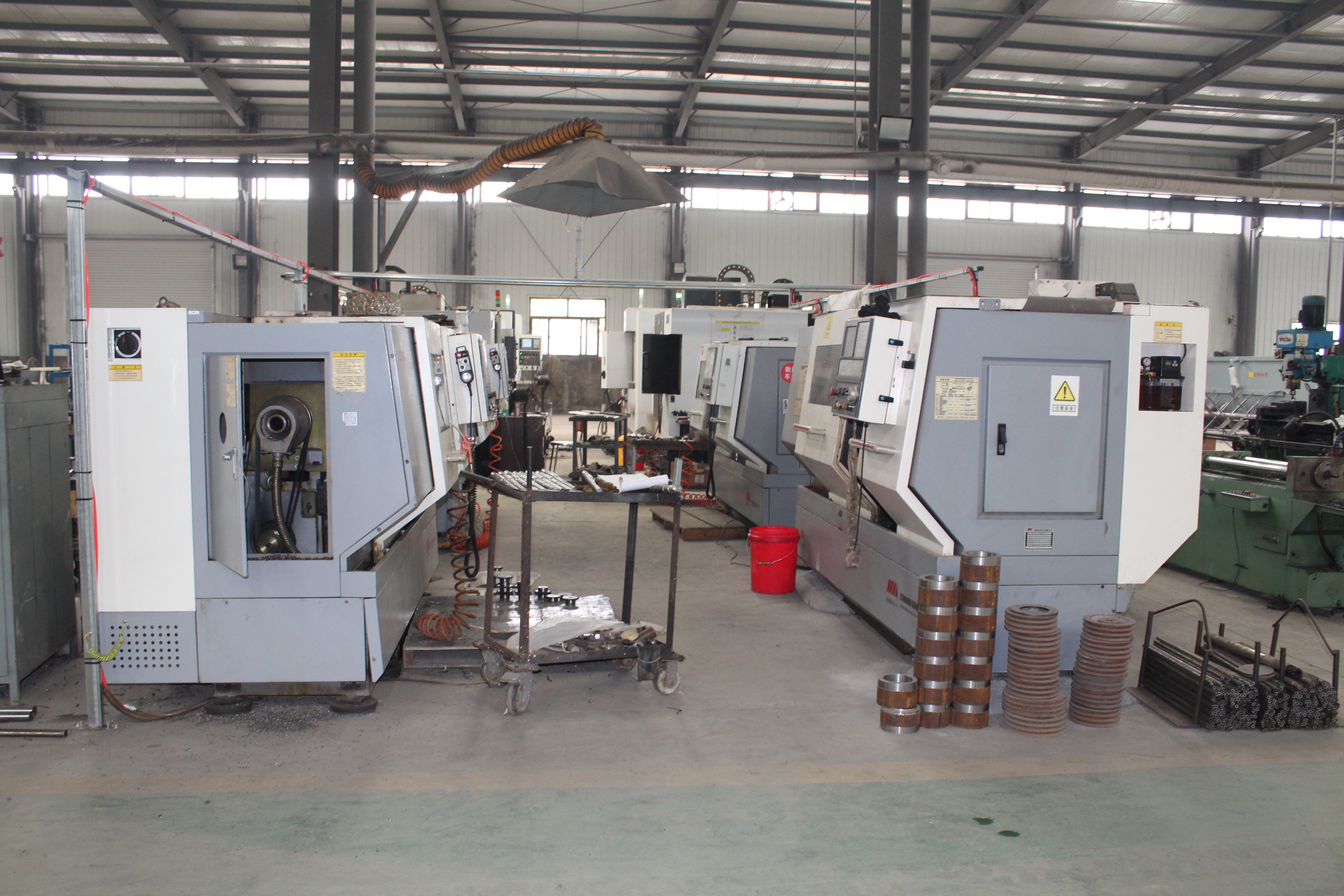
Component machining at the Changxing facility — machine frames, augers and transmission parts produced in-house before assembly.
Next step: if you are evaluating edible mushroom automation equipment for a defined project, send your bag length, flat width, target filling height and daily bag output, and Changxing will return a configuration proposal covering the bagging model, mixer volume, crusher throughput and optional modules that match those parameters. Sample-stage and single-unit orders are accepted (MOQ 1 unit).
Website: www.automushmachinery.com | Email: nhchangxing@outlook.com | Tel / WhatsApp: +86 13103721233 | Address: Henan Neihuang, China