Uneven Substrate, Stalled Bagging Lines: Solving Prep Bottlenecks in Edible Mushroom Automation
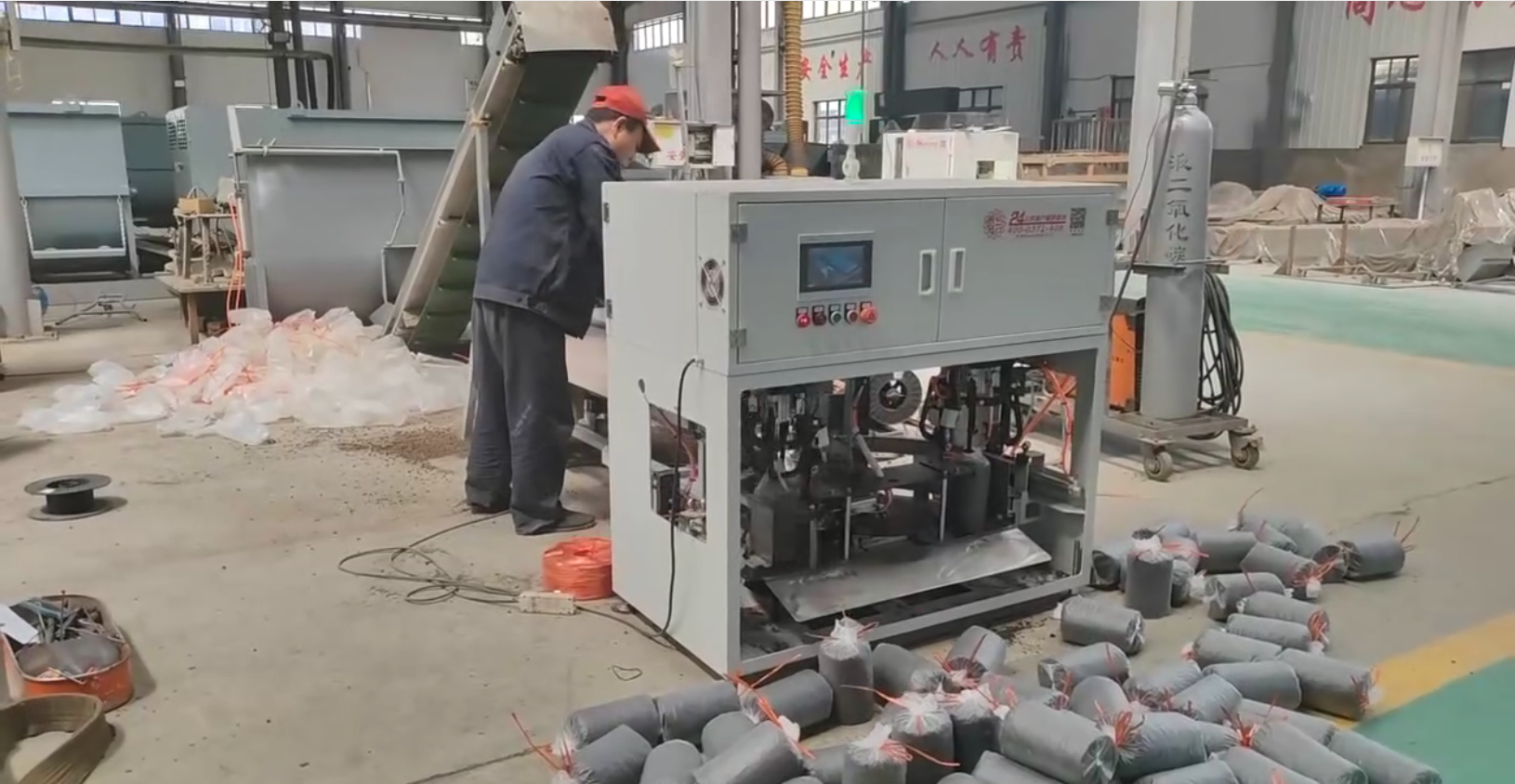
A bagging line rated at 400 to 600 bags per hour does not stall because the bagger is faulty. It stalls because the substrate reaching its feed hopper is not ready to be bagged.
On commercial farms, the first sign of a preparation bottleneck is mechanical rather than analytical. Material bridges above the filling head, bag fill weights drift from bag to bag, and the line spends more of the shift being cleared than filling. The bagging machine is usually working correctly; the material it is being given is not.
That symptom pattern is the reason substrate preparation equipment now sits inside the bagging investment instead of beside it. A crushing, screening and mixing train placed directly ahead of an Automatic Edible Mushroom Bagging Production Line is what allows that line to hold its rated capacity of 400 to 600 bags per hour across supported bag sizes of 28 to 60 cm in length and 12 to 25 cm in width, on an AC380V 50Hz supply.
Changxing Edible Mushroom Machinery, the operating name of Neihuang County Changxing Biological Machinery Equipment Co., Ltd., is a manufacturer founded in 2009 in Neihuang, Henan, China, that builds equipment across this complete sequence: raw material crushing and mixing, bagging, sterilization, inoculation and cultivation. Because the same manufacturer covers the whole chain, the prep bottleneck can be solved as one configuration rather than as five unrelated purchases.
Why an Automatic Bagging Line Stalls When the Bagging Machine Is Fine
Where a bagging machine is mechanically sound and still underperforms, the constraint sits upstream of it. A bagging line is a throughput device: it fills at the rate material arrives. Its rated 400 to 600 bags per hour assumes a steady, size-controlled feed, and substrate preparation decides whether that assumption holds.
Symptom one: bridging and clogging in the feed section
The first visible sign of uneven substrate is material that refuses to flow. When corn cob fragments, wood material, branch fibre and cotton-based material reach the hopper together in a wide particle-size band, the fines settle and compact while oversize pieces hold voids open above them. Flow becomes irregular: the filling section starves, then floods, and operators clear the same blockage more than once in a shift. Every clearance stops the line.
Symptom two: bag fill that will not repeat
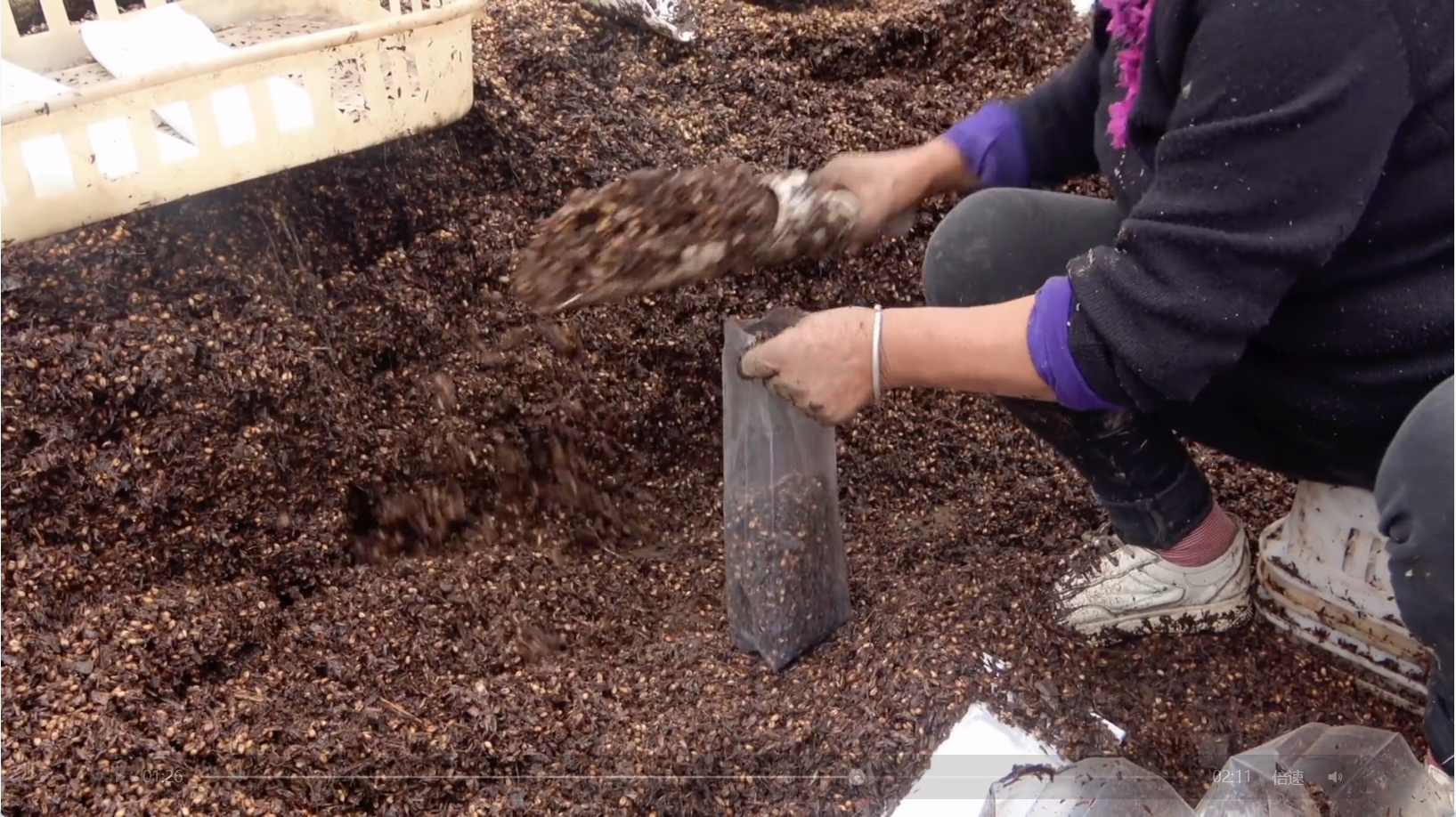
Even when material flows, inconsistent particle size produces inconsistent bags. Long fibre that survived crushing or classification behaves differently from short material: it packs differently, occupies volume differently and resists compression differently. The result is bag-to-bag variation in fill weight and pack density. That variation does not stay in the bagging room. Bags of different density pass through the same sterilization cycle and the same incubation room, where they respond differently to heat and to spawn run. The farm then manages variability that began in the crusher.
Symptom three: output that quietly sits below specification
The most expensive failure mode is not a stoppage. It is a line that runs continuously but at a fraction of its rated speed, because the prep stage cannot feed it at a steady rate. Production planning based on 400 to 600 bags per hour then produces a farm that cannot fill its own orders, and the bagging line is blamed for a constraint created a few metres upstream.
The practical diagnostic is straightforward: before changing the bagger, measure the material going into it. If particle size varies, if fibre is still long, or if moisture is uneven within a batch, the bottleneck is in preparation, and the fix belongs there.
Why Substrate Preparation Became an Equipment Category
Substrate preparation was long treated as labour rather than machinery: material was broken up by hand or with whatever crusher was available, mixed on the floor, and carried to the bagger. Industrial-scale cultivation has changed that calculation, because volume exposes inconsistency. A small operation can absorb a variable batch; a factory line cannot.
The direction of the market reflects the shift. Dataintelo valued the global mushroom equipment market at USD 3.8 billion in 2025 and projects USD 7.2 billion by 2033. Asia-Pacific held a 42.3% revenue share in 2025, driven by industrial-scale cultivation in China. China's edible mushroom industry value exceeded 380 billion yuan, approximately USD 53 billion, in 2024 and represents more than 70% of global output, according to People's Daily reporting of Ministry of Agriculture data. The equipment demand behind those figures is not for single machines; it is for complete lines.
Throughput expectations have risen alongside it. Third-party buyer guidance published by HTNXT notes that a 2-station full-automatic mushroom substrate bagging production line can reach 15,000 bags per day. A line operating at that level cannot be fed by manual handling or by uncontrolled crusher output, because any variability in particle size or moisture propagates into every bag produced after it.
There is a second reason preparation is now bought together with bagging: this equipment is expected to work for years, not for one season. A farm that adds growing rooms later, changes bag formats, or introduces another variety needs the prep train to have capacity headroom, and needs a supplier who can still support the configuration after commissioning. That is an ecosystem question rather than a single-machine question, and it is why buyers increasingly evaluate the whole sequence of crushing, screening, mixing and bagging as one purchase decision.
The Prep Train That Feeds an Automatic Edible Mushroom Bagging Production Line
Solving uneven substrate requires five functions in a fixed order: material-specific crushing for each raw material type, classification by particle size, homogenization by mixing, and a controlled feed into the bagging line. Each function maps to one machine, and the Automatic Edible Mushroom Bagging Production Line is the last element in that sequence, not the first.
Large-Scale Corn Cob Crusher
Corn cob is a bulky, brittle input and one of the most common sources of oversized material at a bagging hopper. The Large-Scale Corn Cob Crusher reduces cob to a workable size band before classification. Because cob breaks into irregular fragments rather than uniform pieces, it must be crushed before screening. Screening uncrushed cob classifies the problem rather than solving it, and the same oversize fraction returns to the hopper unchanged.
500-Type Wood Crusher
Wood-based substrate places a different load on the prep stage: the material is harder and denser than corn cob, and it must be reduced before it can be classified consistently. The 500-Type Wood Crusher performs that reduction within the train, so wood material enters screening at a size the downstream trommel can actually classify. Placing a wood crusher after screening defeats the purpose of both machines, because material that has already passed classification is being re-sized instead of being prepared.
Branch & Cotton Material Crusher
Branch material and cotton-based material share one property that matters more than hardness: they are fibrous. Fibre does not break the way brittle material breaks. It tears into strands, and strands wrap around shafts, bridge across openings and mat together in the hopper. The Branch & Cotton Material Crusher shortens that fibre before it reaches mixing and bagging, which is what keeps the feed path open and the bag fill repeatable.
Large-Scale Rotary Trommel Screen
Screening is the control point of the train. The Large-Scale Rotary Trommel Screen classifies crushed material into a defined particle band: oversize returns for further reduction, and the consistent fraction passes forward to mixing and bagging. Because the trommel decides what the bagging line actually receives, it is the machine that most directly converts uneven crushed output into a stable bagging feed.
Large-Scale Raw Material Mixer
Crushing controls particle size; mixing controls everything else. The Large-Scale Raw Material Mixer homogenizes the screened material so that moisture and additives are distributed evenly through the batch. Without it, two bags from the same batch can start with different water content and different substrate composition, a difference that only becomes visible later in sterilization and incubation, when it is far more expensive to correct.
Automatic Edible Mushroom Bagging Production Line
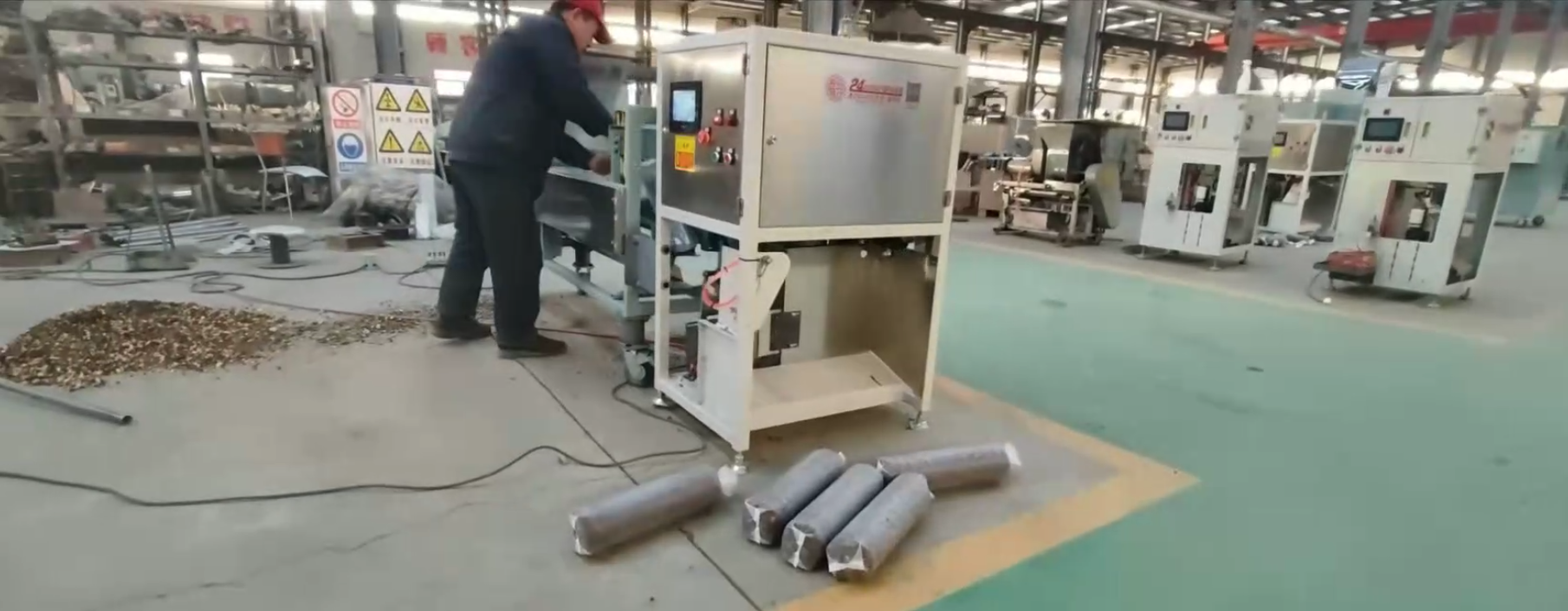
The bagging line is where the configuration is proven. Supported bag sizes are 28 to 60 cm in length and 12 to 25 cm in width, rated capacity is 400 to 600 bags per hour, and the line runs on an AC380V 50Hz supply. Those figures are achievable when the prep train delivers a steady, size-classified, homogenized stream. They are not achievable when the line is fed by uncontrolled crushed material. That is the entire argument for integrating preparation and bagging equipment as one line rather than buying them separately.
| Prep bottleneck at the bagging hopper | Machine in the train | What it resolves |
|---|---|---|
| Bulky, oversized corn cob arriving at the feed hopper | Large-Scale Corn Cob Crusher | Reduces cob before classification so the trommel can work with it |
| Wood material too large to be classified consistently | 500-Type Wood Crusher | Reduces wood input ahead of screening and mixing |
| Long fibre from branch and cotton-based material | Branch & Cotton Material Crusher | Shortens fibre that would otherwise wrap, bridge or mat |
| Wide particle-size band reaching the bagger | Large-Scale Rotary Trommel Screen | Classifies crushed material and returns oversize for further reduction |
| Uneven moisture and additive distribution | Large-Scale Raw Material Mixer | Homogenizes the batch before it reaches bagging |
| Unstable bag fill and output below specification | Automatic Edible Mushroom Bagging Production Line | Fills 28 to 60 cm by 12 to 25 cm bags at 400 to 600 bags/h on AC380V 50Hz |
Step-by-Step: Integrating Prep Equipment Ahead of a New or Existing Line
Integration is a sequence rather than a shopping list, because each step changes what the next machine receives. The order in which the decisions are made determines whether the line stabilizes or simply gains another machine that does not solve the constraint.
- Profile the material mix. Establish which materials actually enter the farm: corn cob, wood, branch material, cotton-based material, or a combination. This determines which crushers are needed and in what order they are arranged.
- Match each crusher to its material class. Corn cob belongs with the Large-Scale Corn Cob Crusher, wood material with the 500-Type Wood Crusher, and branch or cotton material with the Branch & Cotton Material Crusher. Running a crusher outside its material class is the most common reason a prep train works on paper and fails in production.
- Crush before you screen. Screening raw, uncrushed input only describes the material. Screening after crushing is what creates the controlled particle band the bagging line needs.
- Classify with the Large-Scale Rotary Trommel Screen and recirculate oversize. Return oversize to the crushers and let the consistent fraction flow forward. This recirculation loop, rather than a single pass, is what narrows the particle band over time.
- Mix after screening, immediately before bagging. Place the Large-Scale Raw Material Mixer between classification and the bagging line feed, so that every bag is filled from a homogeneous stream rather than from a partially mixed batch.
- Configure the bagging line to the format you actually run. Confirm the supported bag length of 28 to 60 cm and width of 12 to 25 cm, verify the AC380V 50Hz supply, and set the target output within the 400 to 600 bags per hour band.
- Plan the buffer and the layout as one line. A working buffer of screened and mixed material between the mixer and the bagging line absorbs the difference between batch crushing and continuous bagging. When prep and bagging are laid out as one line, the buffer becomes part of the design instead of an improvised pile on the floor.
- Commission with real substrate, not a clean sample. Run the farm's own material mix through the full sequence and check fibre length, moisture distribution and bag fill across the intended bag format. Acceptance for the order is based on a pre-shipment test, and factory inspection before shipment is a normal part of the process.
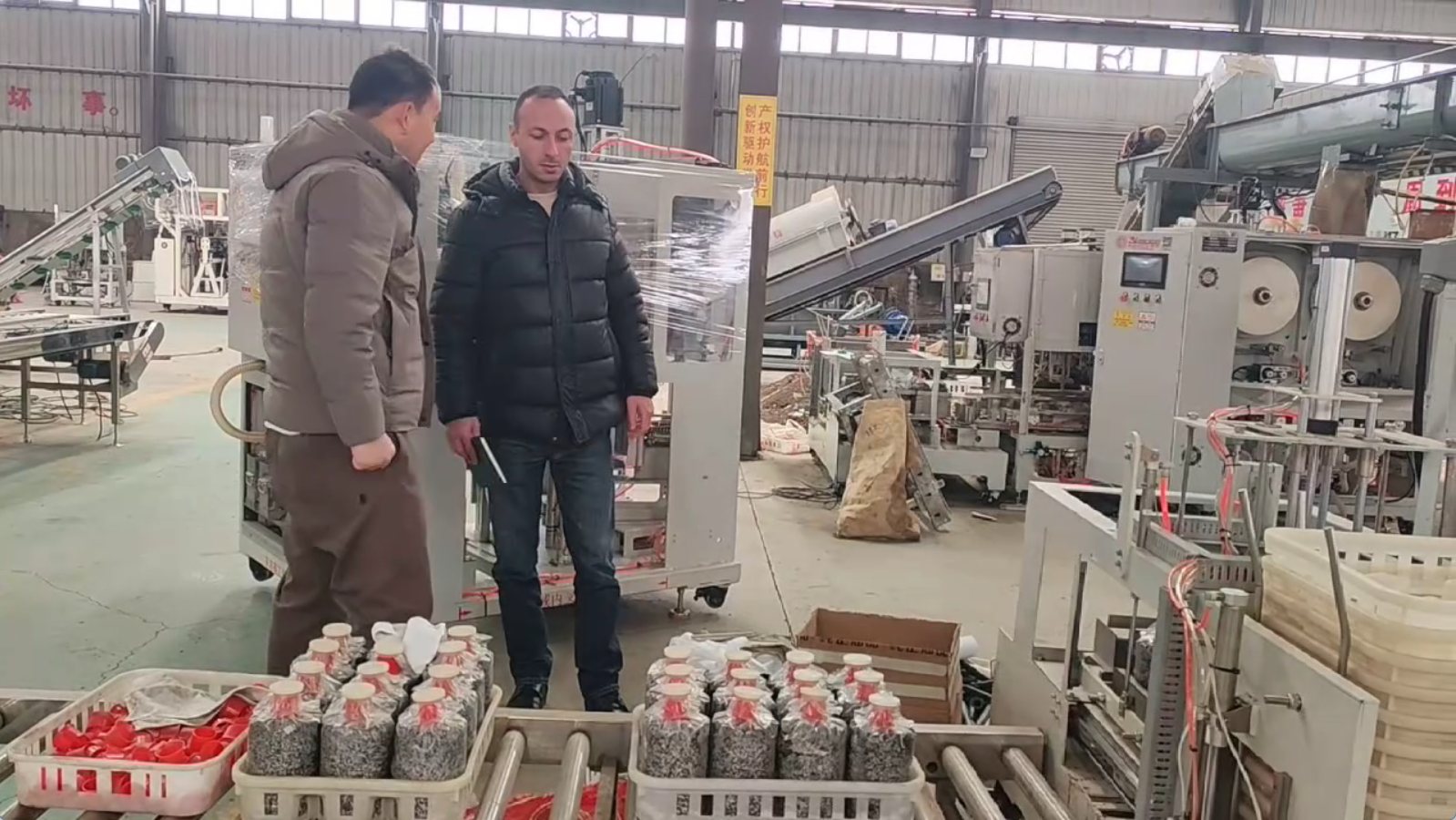
Machine protection and operator safety are part of the same commissioning step. Mechanical jamming and operator injury are the two risks that prep and bagging equipment share. The machine-level controls for these risks are safety guards, emergency stop functions and overload protection. Operating practice is the second layer: strict training on safe operating procedures, safety interlocks, warning labels and regular maintenance. A prep train that is not maintained reintroduces exactly the variability it was installed to remove, because worn crushing elements and partially blocked screens change the particle band that reaches the bagging line.
Where This Prep-and-Bagging Configuration Fits
Oyster mushroom farms moving from manual filling to an automatic line
Farms producing oyster mushrooms typically work with cotton-based and mixed substrate at high volume, and manual filling becomes the limiting factor before the bagging line does. In this setting the Branch & Cotton Material Crusher, the Large-Scale Rotary Trommel Screen, the Large-Scale Raw Material Mixer and the Automatic Edible Mushroom Bagging Production Line form the core of the configuration. The supported bag range of 28 to 60 cm in length and 12 to 25 cm in width also lets the farm standardize on one bag format across the site instead of adjusting equipment to whatever bag is available.
Shiitake operations working with wood-based substrate
Wood-based substrate demands reduction before classification, which places the 500-Type Wood Crusher at the head of the train. Because shiitake production is sensitive to how evenly the substrate is packed and how consistently it behaves during incubation, the value of the trommel screen and the raw material mixer is measured in bag consistency rather than in throughput alone. The 400 to 600 bags per hour band is the operational target that the prep train has to sustain continuously.
Farms processing corn cob and mixed raw materials
Where corn cob forms part of the recipe, the Large-Scale Corn Cob Crusher is the first machine in the sequence. Corn cob is bulky and breaks unevenly, so it is the material most likely to produce the oversize fraction that clogs a filling section. Crushing it before screening, and screening before mixing, converts a difficult input into a predictable one.
Cooperatives and multi-variety farms planning capacity
Cooperatives rarely operate a single recipe or a single variety for the life of the equipment. Buying the prep train with capacity headroom, and from a supplier who can support changes in bag format, substrate recipe and variety, avoids rebuilding the line when production expands. This is the ecosystem logic behind treating crushing, screening, mixing and bagging as one configuration rather than four separate orders.
Manual Bagging versus an Automated Bagging Line
The comparison between manual bagging and automated bagging is usually presented as a specification claim. It is more accurate to read it as a feed-consistency claim, because the performance difference only materializes when the substrate arriving at the bagger is controlled.
| Comparison point | Manual bagging | Automated bagging line |
|---|---|---|
| Efficiency | Baseline | Higher efficiency, lower energy cost |
| Output | Baseline | 80% higher output |
| Labour requirement | Baseline | 50% less labour |
| Labour cost | Baseline | 60% lower labour cost |
| Quality consistency | Depends on operator | Consistent quality |
| Maintenance and intervention | Frequent manual handling | Stable operation, less manual intervention |
| Best suited to | Small operations | Large-scale mushroom farms and automated production lines |
Those differences are conditional. An automated line fed with unevenly crushed and inconsistently mixed substrate does not deliver 80% higher output; it delivers stoppages at a higher rate. The prep train is what converts the comparison from a specification claim into a production result, which is why manual-to-automatic decisions should be made together with crushing, screening and mixing decisions.
Frequently Asked Questions
Does edible mushroom automation equipment need CE marking for the European market?
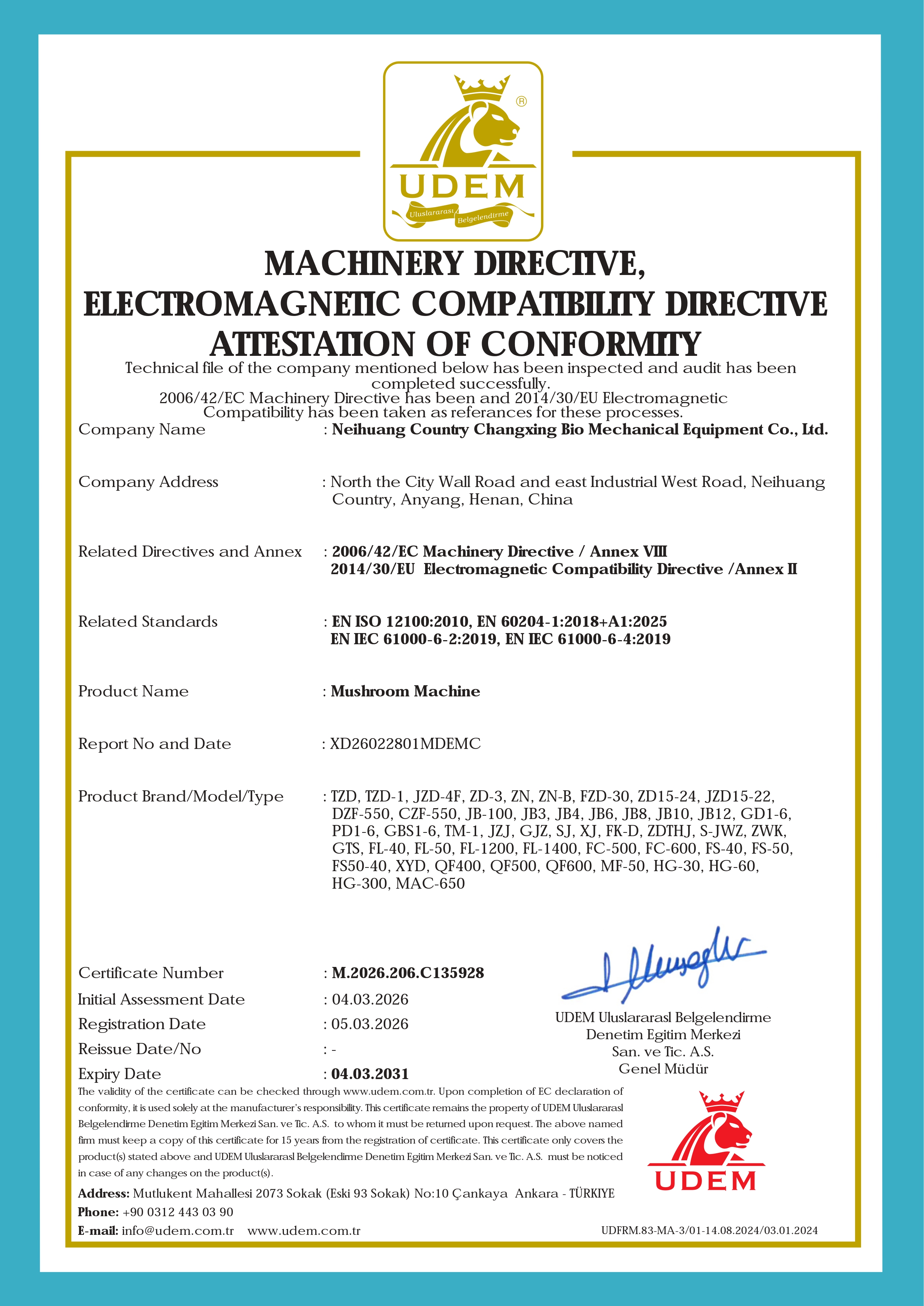
Edible mushroom automation equipment supplied to the European Union must comply with the EU Machinery Directive (2006/42/EC) and the EMC Directive (2014/30/EU) in order to carry CE marking. Changxing Edible Mushroom Machinery obtained CE Certificate No. M.2026.206.C135928 in March 2026 for its bagging and production lines. At machine level, jamming and operator-injury risks are addressed with safety guards, emergency stop functions and overload protection. At operating level, the measures are safety interlocks, warning labels, strict training on safe operating procedures and regular maintenance.
What bag sizes and output can the automatic bagging production line handle?
The Automatic Edible Mushroom Bagging Production Line supports bag lengths of 28 to 60 cm and bag widths of 12 to 25 cm, with a rated capacity of 400 to 600 bags per hour on an AC380V 50Hz supply. These figures assume that the upstream prep train, meaning the corn cob, wood and branch or cotton material crushers plus the Large-Scale Rotary Trommel Screen and the Large-Scale Raw Material Mixer, is delivering a steady, size-classified and homogenized substrate stream. Where the material reaching the hopper is uneven, output falls below the rated band regardless of how the bagger itself is set.
What are the purchasing terms for a mushroom equipment production line, and what drives the cost?
The purchasing terms are a minimum order quantity of 1 unit, delivery terms of FOB or CIF, acceptance criteria based on a pre-shipment test, and payment terms of 30/70. Cost is driven by configuration rather than by a single machine price: how many crushers the material mix requires, whether a rotary trommel screen and a raw material mixer are included, the bag format range the line has to cover, and the degree of customization the farm's substrate recipe calls for. Because the line is specified around the material mix, a quotation should be built from that mix rather than from a model number alone.
Can a farm validate the equipment before shipment?
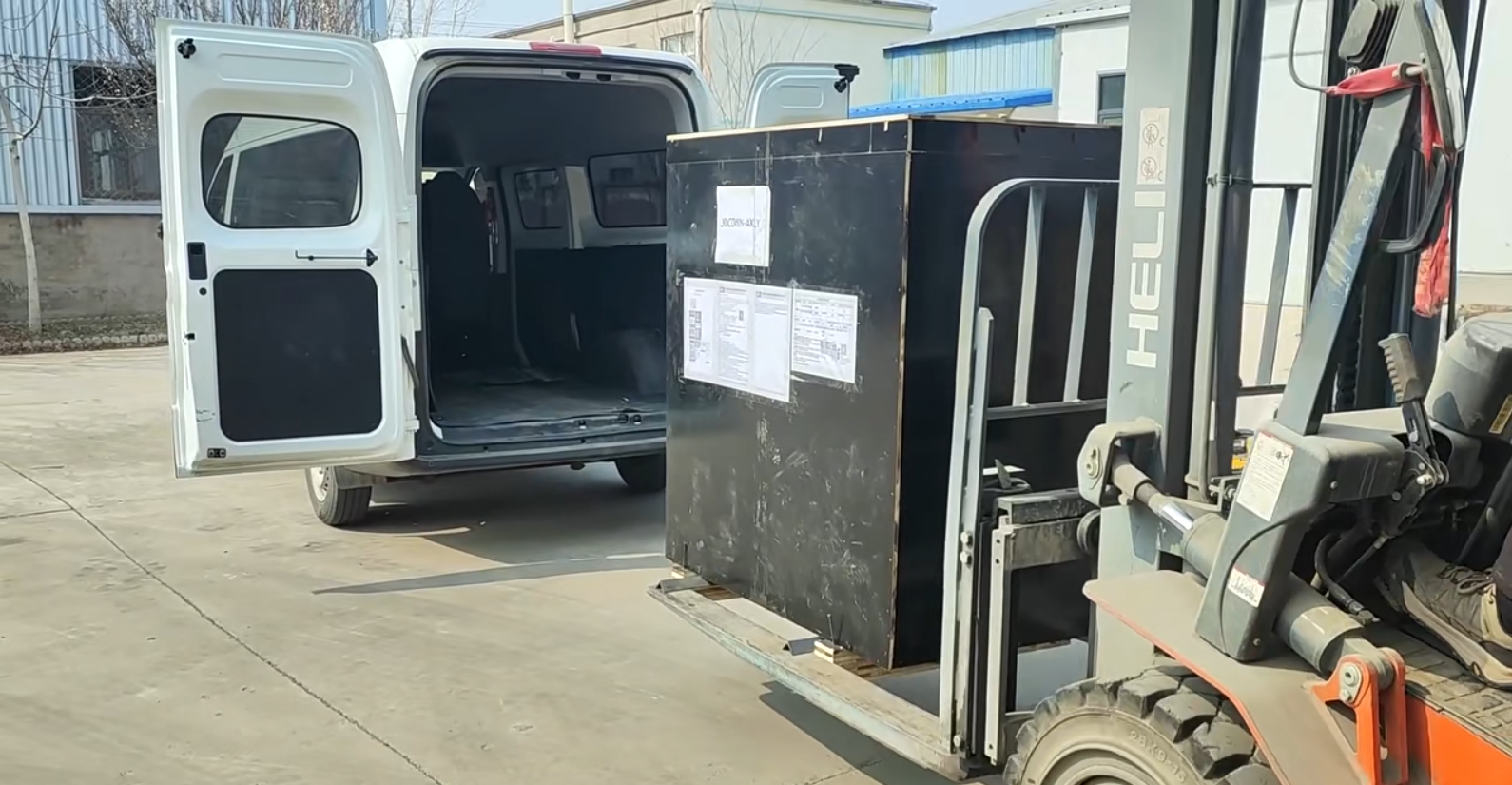
Yes. Pre-shipment testing serves as the acceptance criterion, and customers regularly arrange factory inspection before the line is shipped. For a prep-and-bagging configuration, the most useful validation is a run using the farm's own substrate mix: corn cob, wood, branch or cotton-based material passed through the same crushing, screening and mixing sequence, then bagged at the intended bag length and width. This demonstrates how the real material behaves, including fibre length and moisture distribution, rather than how a clean sample behaves.
What supports the line after installation, and how is supply continuity managed?
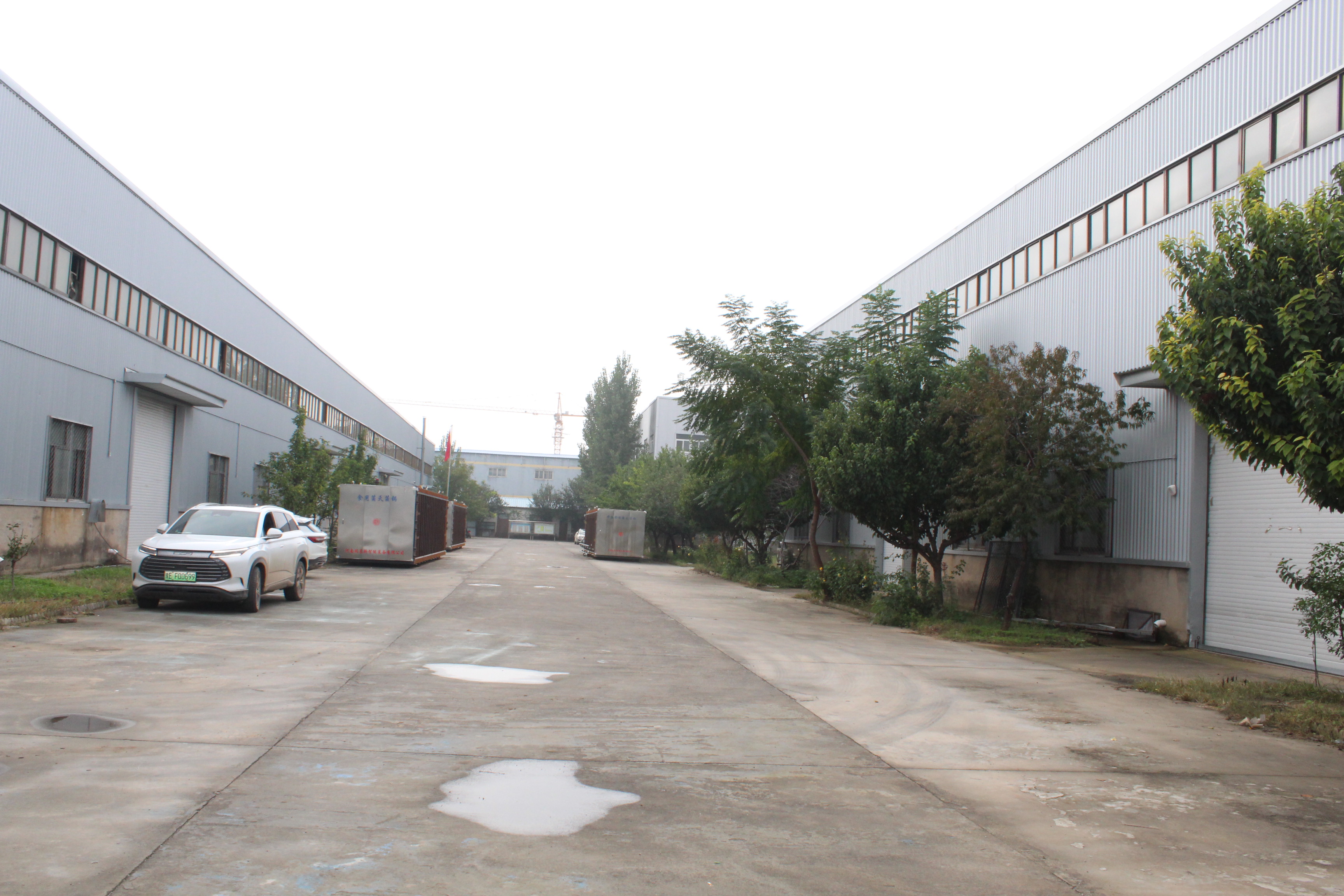
Changxing Edible Mushroom Machinery operates from a 20,000 m2 facility with 130 employees, including an R&D team of 25 engineers, and a monthly production capacity of 1,000 units. The company exports 60% of its output to markets that include South Korea, Malaysia, Central Asia, Europe and Russia, and maintains a professional technical team for after-sales support and technical guidance. For long-life operation, the supporting practices are scheduled maintenance, replacement of worn crushing and screening components, and operator training, because a prep train that drifts out of specification is a common cause of a bagging line losing its rated output months after commissioning. Farms planning a new line or an upgrade can request a configuration review based on their raw material mix.
Conclusion: Rated Output Is a Prep-Stage Commitment
A bagging line rated at 400 to 600 bags per hour is a specification. Whether a farm reaches that specification is decided upstream: in the particle size of crushed corn cob, wood and branch or cotton material, in what the Large-Scale Rotary Trommel Screen allows to pass forward, and in how evenly the Large-Scale Raw Material Mixer distributes moisture through the batch.
For buyers at the decision and execution stage, the practical conclusion is that preparation equipment should be purchased as part of the bagging line rather than added after a problem appears. Crushing, screening and mixing determine line uptime, bag consistency and the real labour requirement, which is why the comparison between manual and automated bagging only holds when the bagging line is fed with controlled material.
It also changes how the supplier decision should be made. Equipment of this type is expected to operate for years, and a farm's requirements will change along the way through bag formats, substrate recipes, varieties and capacity. A manufacturer who builds the entire sequence, from raw material crushing and mixing through bagging, sterilization, inoculation and cultivation, can support those changes as one ecosystem. Changxing Edible Mushroom Machinery manufactures across that range, and its equipment is documented at www.automushmachinery.com.
Next step: configure the prep train around your own material
Share the raw materials you process, the bag format you run (length 28 to 60 cm, width 12 to 25 cm), and the output you need. A configuration proposal can then be built around the actual substrate mix rather than a catalogue model. Minimum order quantity is 1 unit, delivery terms are FOB or CIF, payment terms are 30/70, and acceptance is based on a pre-shipment test.
Email: nhchangxing@outlook.com | Tel / WhatsApp: +86 13103721233 | Website: www.automushmachinery.com
Primary query: edible mushroom automation equipment | Supporting queries: mushroom substrate mixer, automatic mushroom bagger, mushroom bagging production line, corn cob crusher for mushroom substrate, mushroom equipment production line, oyster mushroom bagging machine, shiitake mushroom bagging machine