Plywood, PVC, or Honeycomb? Comparing Multi-Material Bathroom Cabinets
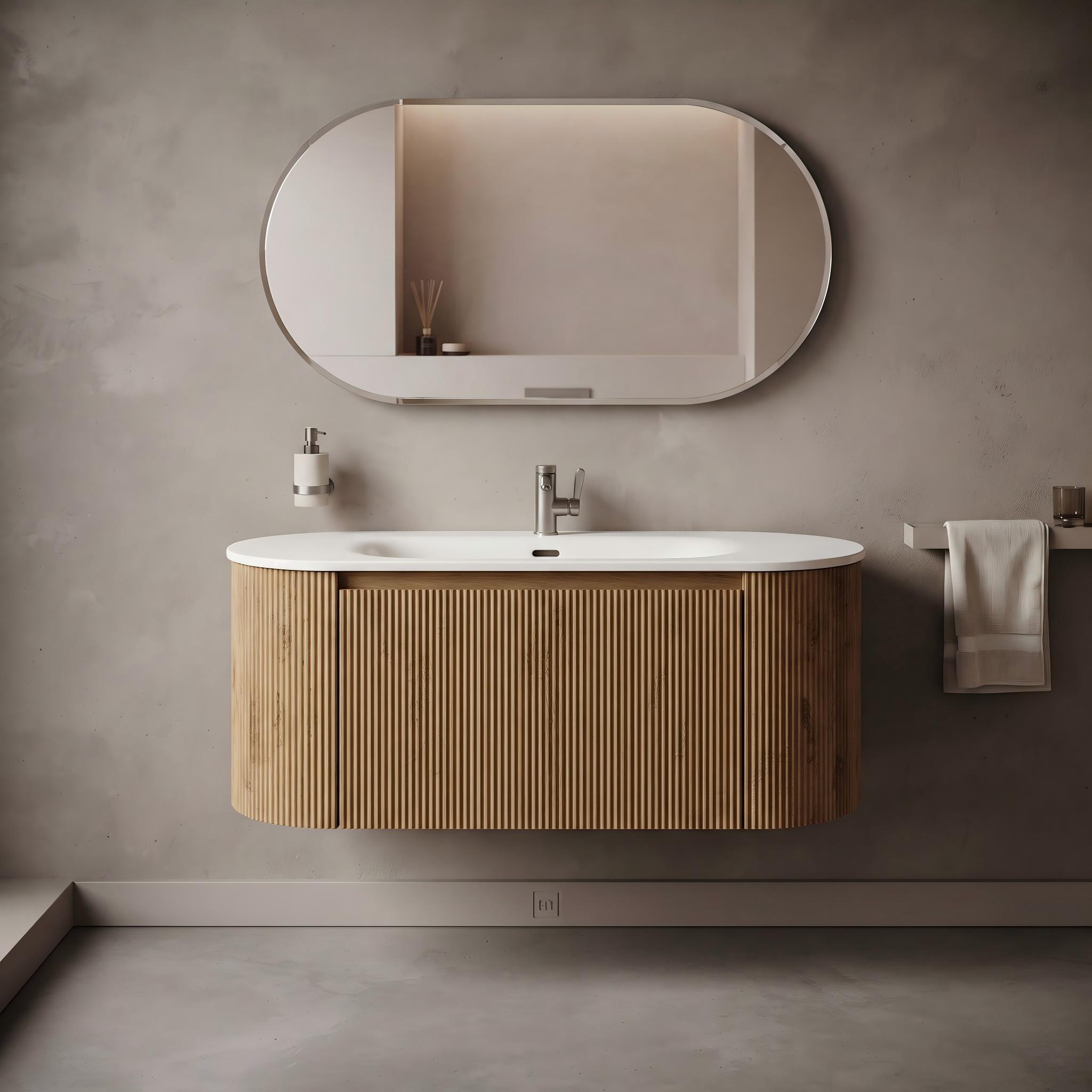
A large-radius curved fluted plywood bathroom vanity — the design-led end of the multi-material cabinet range.
A bathroom cabinet quotation can look identical from five suppliers and still describe five different products. The body material decides how the unit behaves in a wet room and how it packs into a container. The mirror decides whether you are buying furniture or an electrical appliance. The customization level decides whether you are buying stock or starting a small engineering project. This comparison sets out the options a decision-stage buyer is most often offered — curved fluted plywood and PVC vanities, stainless steel and aluminium honeycomb vanities, plywood vanities, PVC vanities, and stainless steel combined with PVC — and shows which questions separate a comparable quote from a cheap one.
Short answer. Plywood (multi-layer solid wood) is the design-led choice: it takes fluted profiles, curves, paint and wood-grain finishes, and performs well when the board is moisture-treated and every edge is sealed. PVC is the humidity-and-budget choice: the body does not absorb water the way a wood core can, and fluted or curved fronts can be produced in the same material. Stainless steel and aluminium honeycomb are the heavy-use choice for coastal, hotel and commercial bathrooms where water contact is routine. Stainless steel combined with PVC is a hybrid for buyers who want a moisture-resistant structure with panel-based styling. A smart mirror belongs in the specification when the bathroom has an electrical plan and the order can support electronics service; an ordinary mirror is the lower-risk default for price-led volume.
The decision you are actually making
Material is only the first variable. Two quotes can name the same construction and still differ in board grade, hardware class, mirror specification, packing structure and documentation — which is why the lowest unit price so often turns into the highest landed cost. The practical method is to fix four variables before you compare prices.
- Moisture exposure. A guest bathroom with an extractor fan is a different environment from a coastal apartment where the window stays open. Exposure, not style, should eliminate the first material options.
- Structural format. Assembled, knockdown (flat-pack) or foldable cabinets behave differently in a container and on site. Flat-pack cuts shipping volume, but it only works if local installers are comfortable assembling the unit.
- Mirror tier. A bathroom cabinet with an LED mirror is a different product category from a bathroom cabinet with an ordinary mirror: one has electrics, a service path and extra packing requirements; the other does not.
- Customization depth. A different width is a specification change; a new door profile, colour and logo programme is a development project. Both are called “custom”, and they carry very different minimums and lead times.
Once those four are fixed, the quotation becomes comparable and the remaining differences are evidence: test reports, hardware ratings, inspection records and delivery performance.
Why one factory now offers five constructions
Bathroom cabinets ship into different climate zones and different budget bands, so a single-material catalogue cannot cover a distributor’s range. Chaozhou Hengran Sanitary Ware Technology Co., Ltd is an integrated source manufacturer of bathroom vanities based in Fengtang, Chaozhou, China’s core sanitary ware industrial belt, covering R&D, production and sales in-house. It produces vanities in PVC, aluminium honeycomb, stainless steel and multi-layer solid wood specifically to meet purchasing demand from clients in different climates and price ranges, with a stated focus on custom bathroom vanities, smart bathroom vanities and smart mirror cabinets.
Three manufacturing details explain why the material list matters more than it appears. First, fluted and curved fronts are machined rather than moulded in most vanity workshops, so the board has to hold a reeded profile or a radius without cracking — the reason fluted programmes are usually quoted in plywood or PVC. Second, metal bodies depend on welding and edge finishing, and the company lists seamless cabinet welding among the technical difficulties it has resolved, together with solid wood moisture-proof treatment and weather-resistant paint finishes. Third, smart mirror cabinets depend on circuit integration inside the cabinet, which is also listed as a resolved technical point.
Those are stated capabilities rather than independent test results, and they are worth verifying on a sample. Two system-level signals are easier to check: production runs under an ISO9001 quality management system, and the company is a participating drafter of the group standard Bathroom Vanities (T/CFQX1-2024) — useful when suppliers otherwise present identical brochures.
The five constructions compared
Plywood (multi-layer solid wood) bathroom cabinets
Plywood is built from cross-layered wood veneers, so grain direction alternates between layers and the panel resists the warping a single-piece timber board can develop. On a vanity that matters at the doors, the curved ends and the countertop opening. Plywood also takes paint, veneer and fluted machining well, which is why design-led ranges — natural wood finish, large-radius curves, reeded fronts — are commonly built on a plywood body.
The weak point is water reaching the core through unsealed edges, hinge holes and cut-outs. Two variables decide whether a plywood bathroom cabinet survives a humid room: the moisture-proof treatment applied to the board, and the sealing of every exposed edge. Hengran states that solid wood moisture-proof treatment and weather-resistant paint finishing are capabilities developed in-house. When you evaluate a plywood quote, ask for the board construction and thickness, the moisture treatment, the edge-banding method, and how the back panel and basin cut-out are sealed.
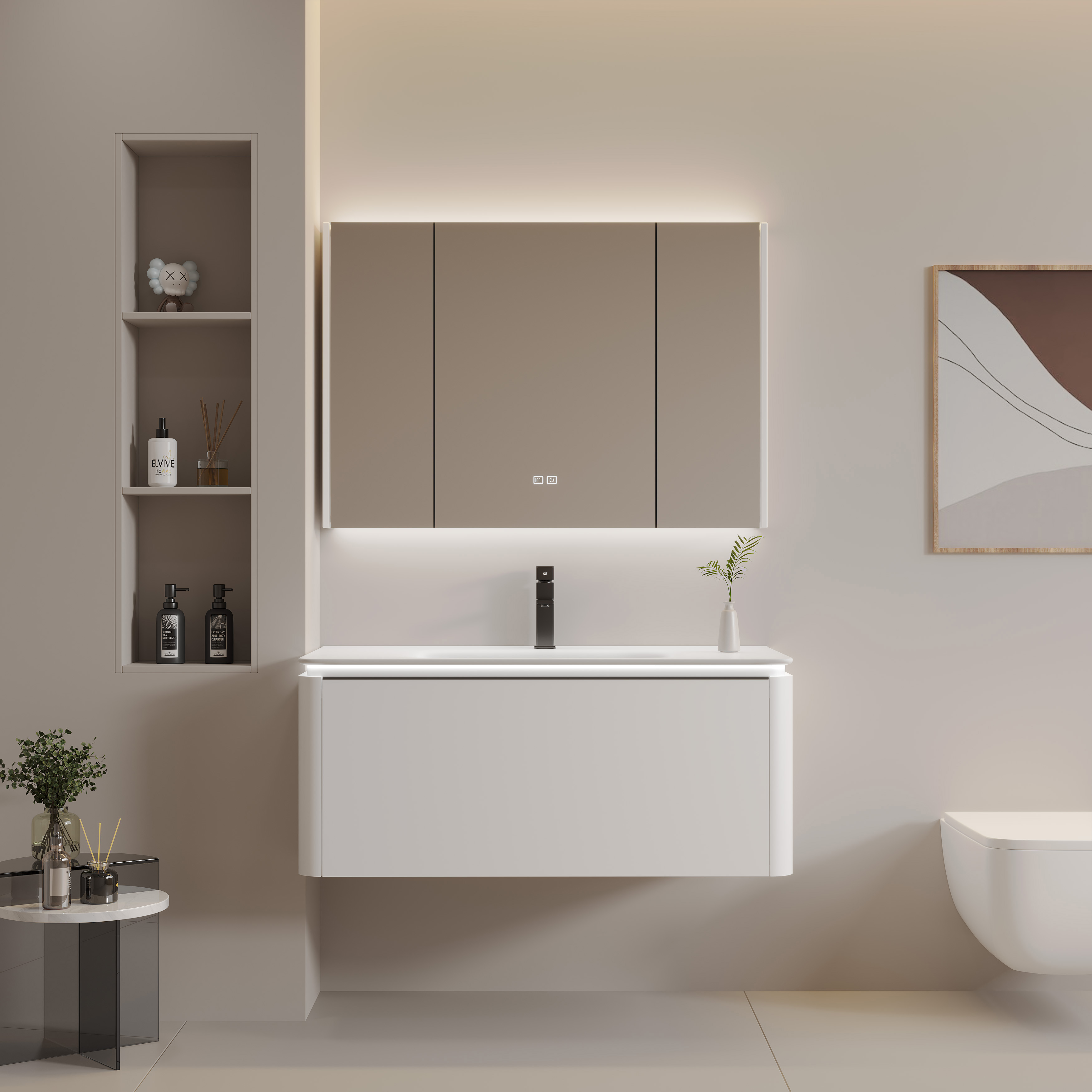
Model 9369 — a plywood bathroom cabinet built on a multi-layer solid wood body.
PVC bathroom cabinets
PVC vanities use extruded or foamed PVC profiles and panels instead of a wood core, so the body does not absorb water the way timber can. That makes PVC a practical choice for family bathrooms, rental units and projects where humidity is constant and maintenance is minimal. It is also machinable: white and black fluted PVC fronts are produced in the same reeded profiles as plywood, which lets a distributor offer one design at two price points.
Differences inside the PVC category are large. Wall thickness, internal reinforcement at hinge points, joint and welding quality, and colour consistency between door and carcass decide whether a PVC bathroom cabinet still feels solid after two years. Hengran’s stated product claims for its vanity output are waterproof, anti-mould and anti-yellowing performance, supported by formal test reports and clear warranty terms. Those claims should be checked against the sample and the test report for the specific model you order, not against the material category as a whole.
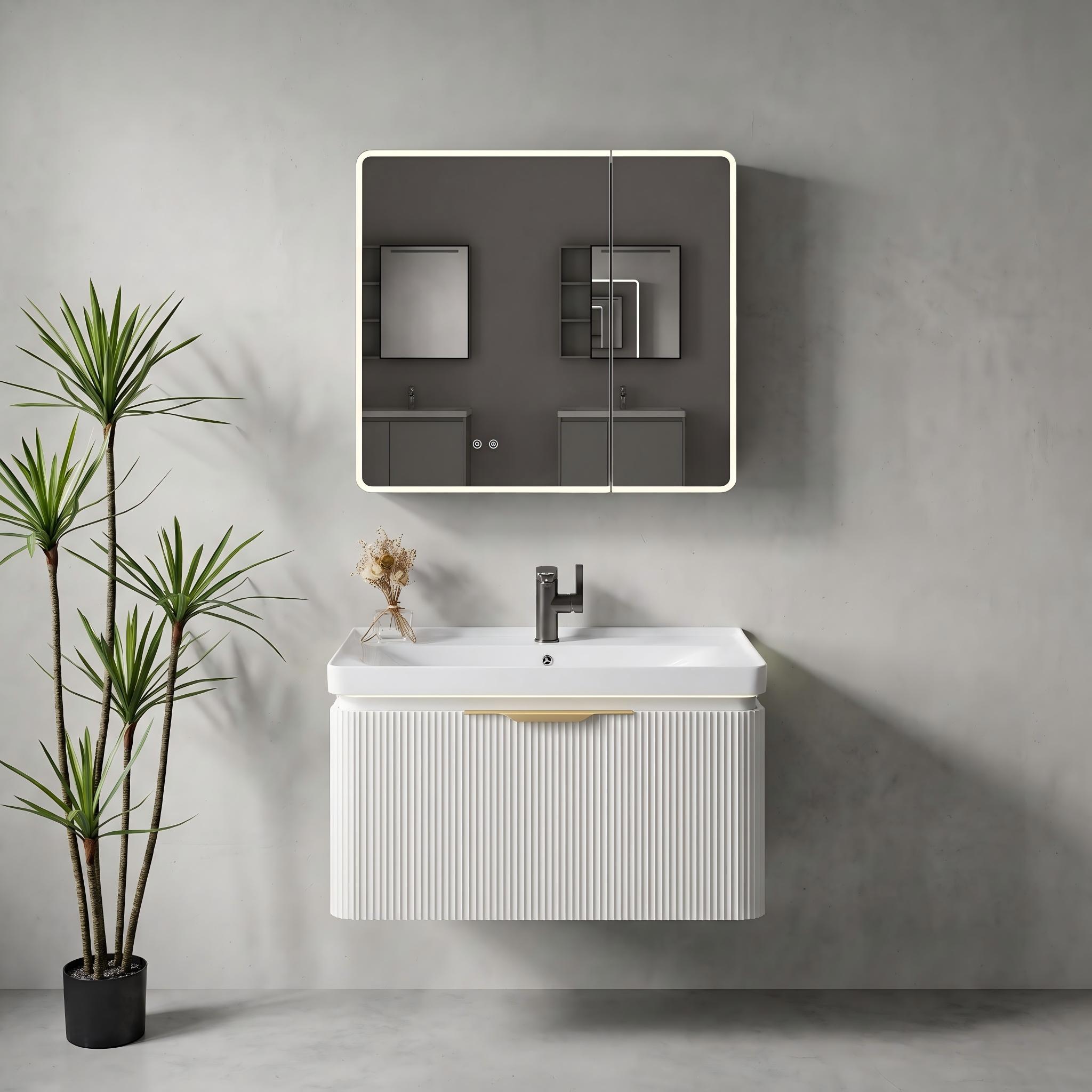
A white PVC fluted bathroom vanity — reeded profiles produced in PVC rather than plywood.
Stainless steel and aluminium honeycomb cabinets
Honeycomb construction bonds an aluminium honeycomb core between skins to produce a stiff panel at low weight; stainless steel bodies are formed and welded. Neither relies on a wood core that can swell, which is why these constructions are specified for coastal buildings, hotel bathrooms, public washrooms and projects where standing water and daily washing are normal. A stainless steel bathroom cabinet also suits wall-mounted installation in small rooms, where a slim, rigid body is an advantage.
The detail that separates good and poor metal cabinets is seam and edge finishing. Welded seams that are not dressed collect dirt and moisture; edge trims that are not sealed let water sit behind the panel. Hengran lists seamless cabinet welding as a resolved technical difficulty, and its ST09 stainless steel model is the reference point for this construction. In an RFQ, specify the skin gauge, the core bonding method, how welds are finished, and whether hinges and fixings are specified for a metal body.
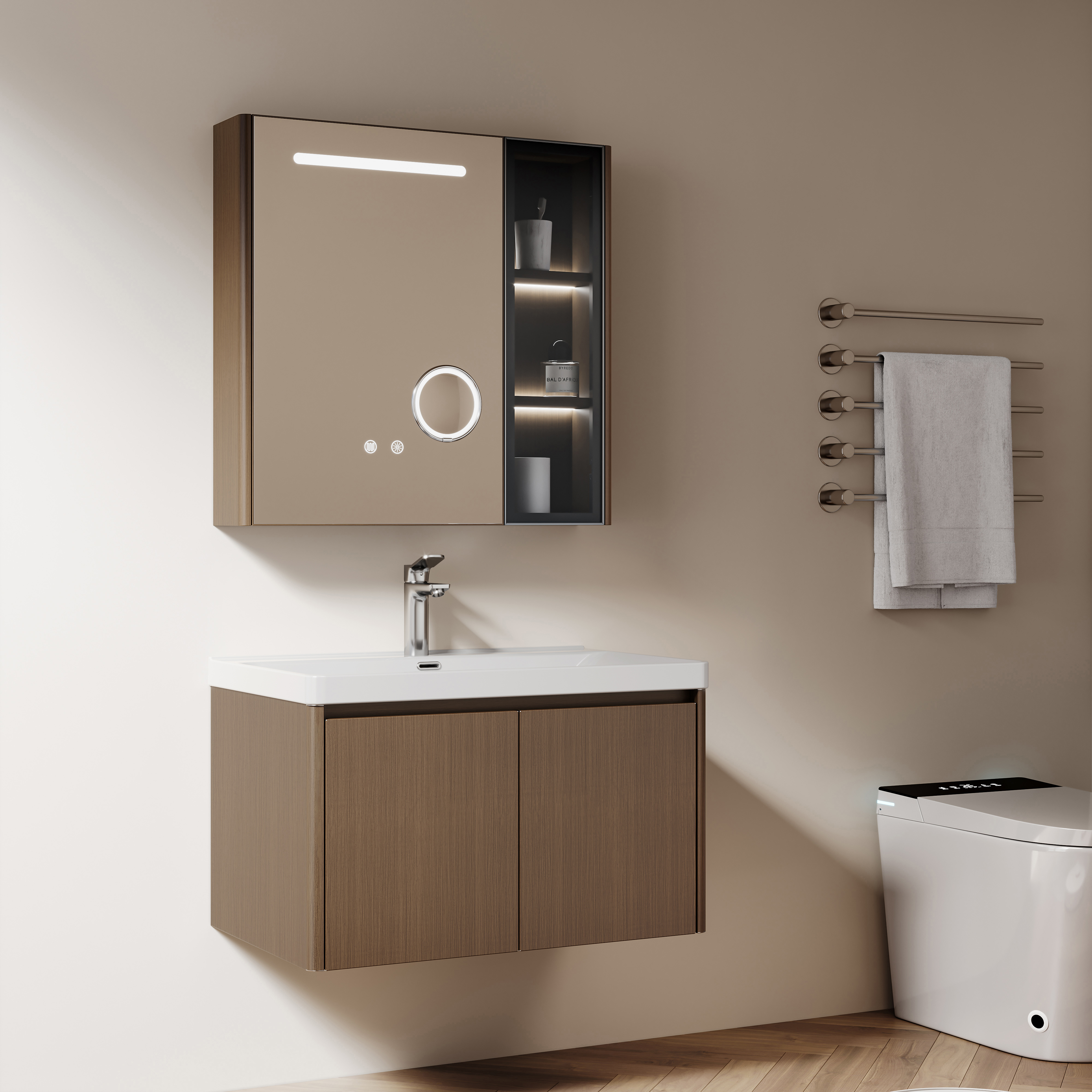
ST09 — a stainless steel bathroom cabinet from the metal construction line.
Stainless steel with PVC
Hybrid cabinets combine a stainless steel structure with PVC panels: metal where water contact and load bearing matter, PVC where styling and cost matter. This construction is worth quoting when a project wants the look of a panel vanity but cannot accept a wood core in a wet zone. Because the split between materials can vary, the specification has to name which parts are stainless, which are PVC, how the joint between them is sealed, and how the two materials are fixed together. A hybrid cabinet without that detail is not comparable with one that has it.
Curved and fluted variants in plywood and PVC
Fluting is a reeded, vertical or horizontal profile; curvature is a radiused cabinet front. These are the two design features that most often decide the material, and both can be produced in plywood and in PVC — but the constraints differ. Tight radii and deep flutes put more stress on the board and the finish, while large-radius curved fronts demand accurate jigs and careful packing so the curve arrives intact. Hengran produces large-radius curved fluted plywood vanities and fluted PVC vanities in white and black, which means a distributor can test a curved design in PVC before committing to a plywood range, or run both in one catalogue.
Smart mirror or ordinary mirror?
An ordinary mirror is glass with a backing. It carries no electrics, no circuit integration and no separate service path, which keeps compliance, packing and after-sales simple — the sensible default when the order is price-led and the end buyer has not asked for lighting.
A smart mirror adds lighting and, typically, an anti-fog function. Anti-fog is a standard requirement in humid bathroom environments, and circuit integration inside a smart mirror cabinet is one of the technical difficulties Hengran states it has resolved. The trade-off is not only unit cost: a smart mirror needs an electrical provision in the bathroom, protection for both glass and electronics in transit, and a spare-part or replacement plan for the LED and driver over the product’s service life.
A practical decision rule: specify the smart mirror where lighting is part of the design and a service partner exists in the destination market; specify the ordinary mirror for wholesale and entry-level ranges where the cabinet itself carries the value. Either way, confirm the electrical requirements of the destination market before the order is placed, and ask for the mirror to be packed as a matched set with the cabinet so glass and cabinet arrive together.
Customization: size, color, logo and packaging
Customization is where quotations diverge most. “Custom” can mean a different width or a new door profile, and price and lead time depend on which one you are buying. Four axes cover most requests from importers, distributors and brand owners.
- Size. Cabinet width, depth and height, basin or countertop cut-out, and the position of waste and supply connections — the basics of a wall-mounted or freestanding bathroom cabinet that has to fit an existing room.
- Color. Surface finish and colour matching across doors, carcass and mirror frame. Approve against a physical sample rather than a screen image.
- Logo. Placement and method on cabinet, mirror and packaging.
- Packaging. Carton printing, shipping marks, and the protection required for curved corners and glass.
Hengran offers OEM and ODM customization across cabinet materials, sizes, colors, logos and packaging, and accepts both large-volume foreign trade orders and hotel or real estate engineering projects. On timing, the company states that custom samples can be finished within 7 days, custom design revisions within 3–7 working days, that customized vanity production starts from 50 sets, and that sample orders start from 1 set. For a brand launching a range, that combination matters: a 50-set first production run can follow a one-set sample approval, instead of a container-load commitment before the design is proven.
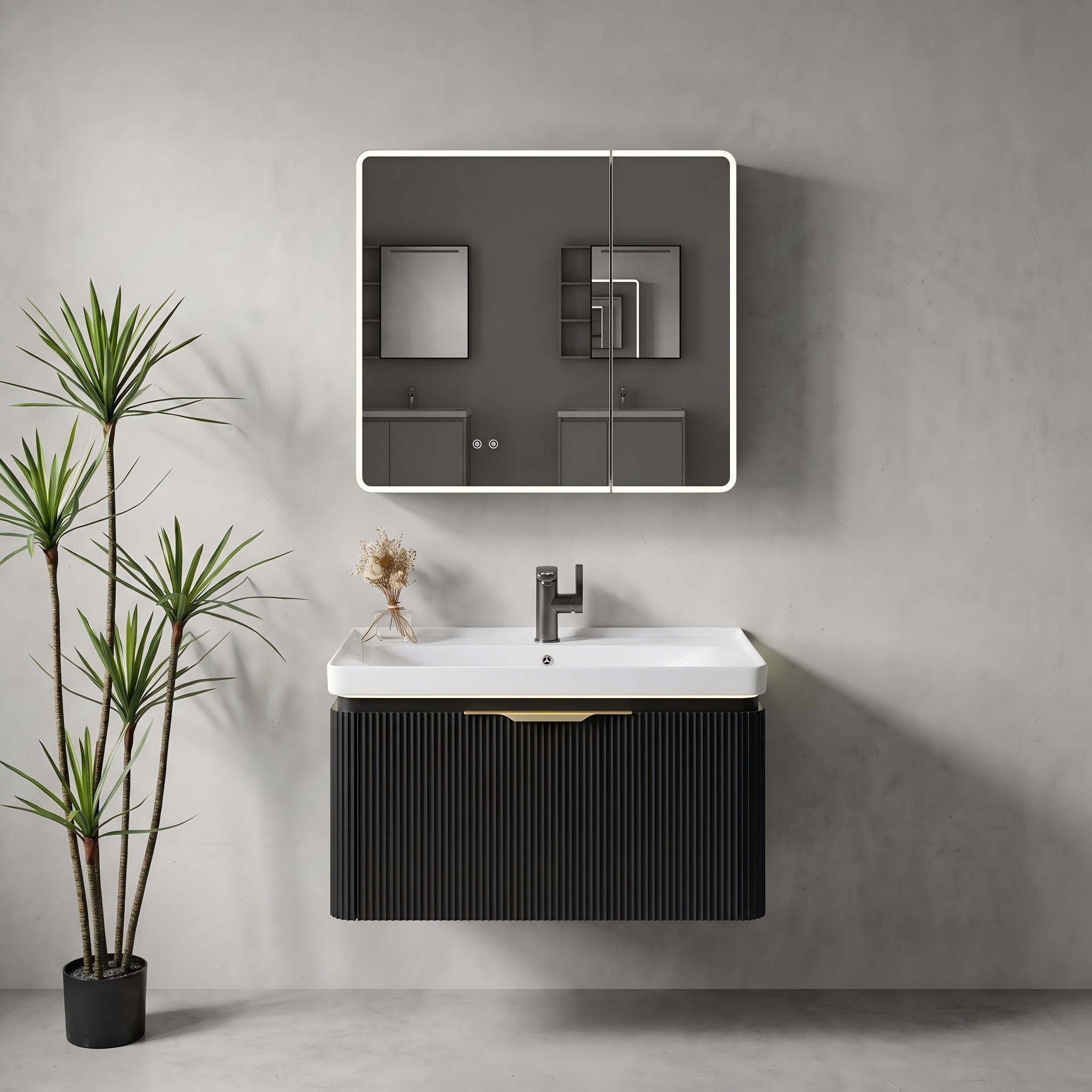
The same fluted design in black PVC — colour choice is one of the four customization axes.
A six-step selection sequence
- Fix installation and size. Wall-mounted or freestanding, single or double sink, and the clearance around the unit. Wall-mounted cabinets suit smaller bathrooms and simplify floor cleaning; freestanding units suit larger rooms but need a level floor.
- Score moisture exposure. Constant humidity and direct water contact point to stainless steel or aluminium honeycomb; intermittent humidity with good ventilation allows PVC; a well-ventilated family bathroom can take plywood, PVC or metal.
- Choose the mirror tier. Smart mirror where lighting and anti-fog are part of the design and service exists; ordinary mirror where price and simplicity dominate.
- Lock customization and packing. Approve a sample, lock the bill of materials, and confirm the packing structure — assembled, knockdown or foldable — against local installation habits.
- Verify the quality evidence. Ask for the ISO9001 scope, incoming, in-process and final inspection records, third-party test reports for raw materials, and the results of waterproof, load-bearing and hardware durability tests. Hengran states a finished-product qualified rate above 99.5% and hardware tested beyond 50,000 opening-and-closing cycles.
- Confirm logistics and lead time. Flat-pack structures reduce shipping volume by 35%–45% according to the company’s data; samples take 7 days, bulk orders 15–30 days, and standard products can ship immediately.
Material comparison table
The table summarises documented characteristics and the checks that make a quote verifiable. Statements about behaviour in a humid bathroom describe how each construction is normally evaluated; they are not independent test results for every model.
| Construction | Behaviour in a humid bathroom | Design range | What to verify in the quote | Typical fit |
|---|---|---|---|---|
| Plywood (multi-layer solid wood) | Water-resistant when the board is moisture-treated and all edges, holes and cut-outs are sealed | Fluted, curved, painted, wood-grain | Board build and thickness, moisture treatment, edge sealing, paint system | Design-led residential, dry-to-moderate humidity, brand ranges |
| PVC | Body does not absorb water; real performance depends on wall thickness, joints and hinge reinforcement | Fluted (white/black), flat panels, curved fronts | Profile thickness, joint and weld quality, colour match, hinge reinforcement | Humid family bathrooms, rentals, volume wholesale |
| Stainless steel / aluminium honeycomb | No wood core to swell; seam and edge finishing decide real performance | Metal-front, framed and panel looks | Skin gauge, core bonding, weld finishing, edge trim, fixings | Coastal, hotel, commercial, heavy-use bathrooms |
| Stainless steel with PVC | Metal structure with panel styling; the joint design is the critical point | Panel-forward fronts on a metal structure | Which parts are stainless, joint sealing, fixing method | Wet-zone projects that want a panel look |
| Curved or fluted plywood / PVC | Base-material behaviour plus added stress at radii and flutes | Large-radius curves, reeded fronts | Radius drawings, flute depth, door weight, corner packing | Feature vanities, hospitality, retail display |
Supplier comparison: what changes between factory types
Material choice answers what a cabinet is made of; supplier type answers what will actually arrive. The comparison below uses Hengran’s own stated comparison data against three supplier types. Treat the figures as manufacturer claims to check in your own sample and reference checks, not as independent benchmarks.
| Supplier type | What changes | Stated comparison data | Buyer implication |
|---|---|---|---|
| Direct manufacturer (Hengran) | In-house control over materials, structure and quality; production adjustments handled internally; no trading markup | Custom design revisions in 3–7 working days; customized production from 50 sets; on-time delivery rate 98%; 800+ available designs; up to 5,000 sets per batch; certification documentation within 5 working days | Suited to bulk project orders, long-term brand OEM and custom-designed cabinet programmes |
| Independent trading company | No in-house production line; changes pass through a third party | Stated 25% lower cost on the factory route, without middleman margin | Establish who actually controls the production line before approving a sample |
| Overseas local vanity supplier | Local stock and service, but a narrower design range and less flexible customization | Stated 35%–50% lower unit cost for equivalent specifications on the factory route; flat-pack reduces shipping volume 35%–45% | Compare landed cost, not list price |
| Low-end vanity factory | Cheaper materials and hardware, lighter packing, less in-line QC | Stated service life 2–3 times longer for the higher-specification build; yellowing and mould failure rate below 3% versus over 20% for low-end versions; hardware 50,000+ cycles | Short-term price versus repeat-order and warranty risk |
Matching construction to use cases
- Hotel and real-estate projects. Stainless steel or aluminium honeycomb in wet zones, PVC in standard rooms, smart mirror where lighting is specified. Flat-pack structures reduce freight, and project batches of up to 5,000 sets are supported according to the company.
- Coastal residential. Metal bodies avoid a wood core in the most humid rooms; the stated anti-mould and anti-yellowing claims and the 50,000-cycle hardware rating are the numbers to test in a sample.
- Brand OEM and private label. Plywood for design-led ranges where fluting, curves and finish sell the product; logo, colour and packaging customization with a 50-set production minimum.
- Distributors and wholesale. A mixed container across PVC, plywood and mirror tiers keeps one supplier relationship, and one-stop sourcing covers 10+ matching sanitary categories.
- Small bathrooms and apartments. A wall-mounted single-basin unit in a compact size, usually with an ordinary mirror to hold the price point.
- Double sink family vanities. Size customization plus a load-bearing check, because a wider cabinet with two ceramic basins puts different demands on the carcass and fixings.
Full-cabinet sourcing, documents and shipping
Decision-stage buyers usually find that the cabinet is the easy part. Basins, taps, mirrors, drains and matching sanitary items come from different factories, and consolidating them is where schedules slip. Hengran provides one-stop sourcing across the full sanitary series — 10+ matching categories according to the company — so a bathroom vanity set and its matching products can be ordered and shipped together, reducing communication cost.
On documentation, the company states it provides a full set of export documents, custom shipping marks and loading guidance, with certification documentation ready within 5 working days. On structure, assembled, knockdown and foldable options are all available, with the recommendation based on local installation habits and container loading; flat-pack models reduce shipping volume by 35%–45%, which cuts ocean freight and warehousing cost per unit.
On timing, standard products can be shipped immediately, samples take 7 days, and bulk orders 15–30 days, with a stated on-time delivery rate of 98%. For a project with a fixed opening date, those three numbers protect the schedule more than a small difference in unit price.
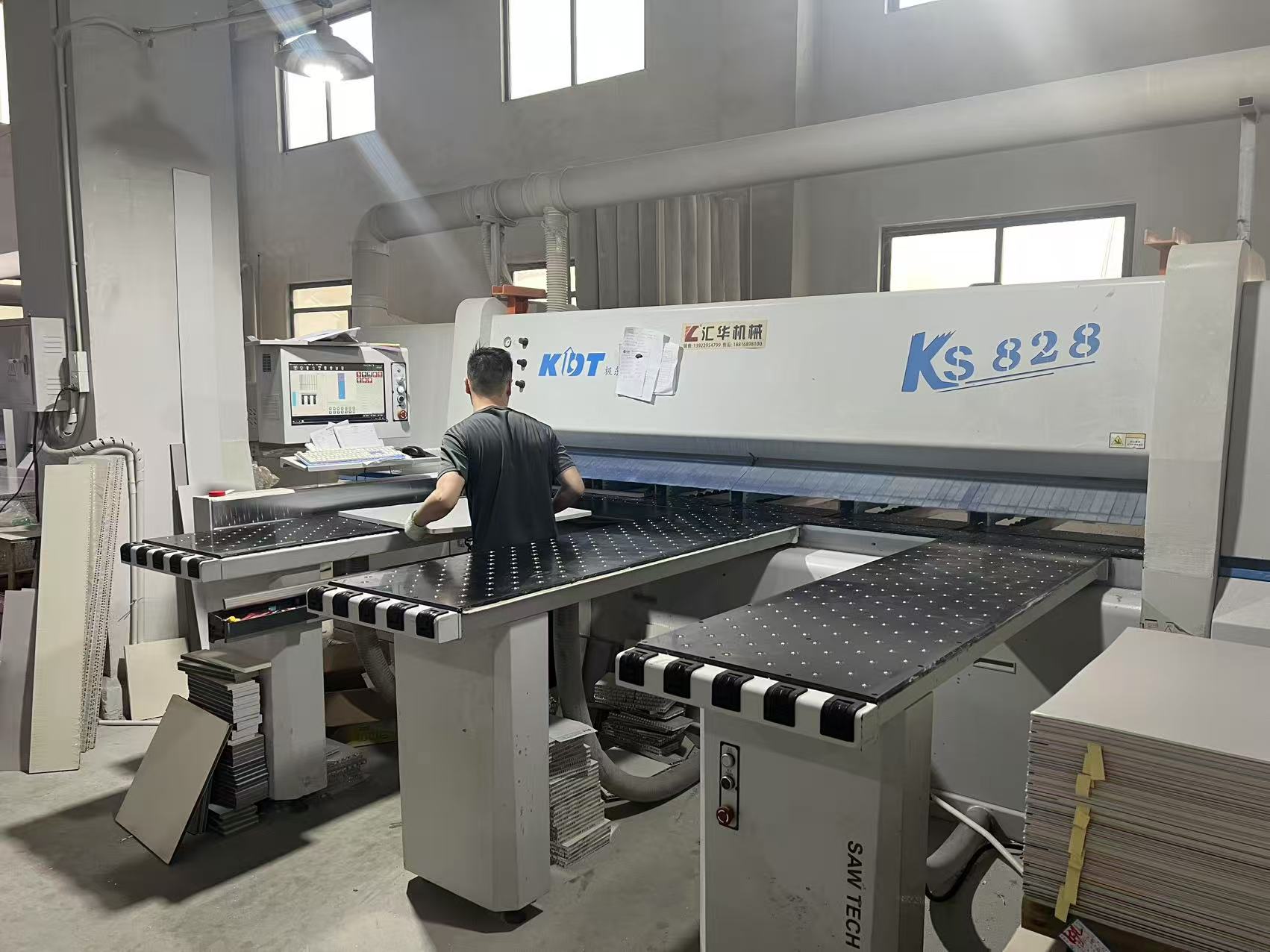
Production workshop — incoming, in-process and pre-shipment inspection sit inside the same facility.
Limitations and what to verify before mass production
This comparison is built from documented product characteristics and the manufacturer’s own data. It is not an independent laboratory comparison of all five constructions, and it cannot predict how a specific cabinet will perform in a specific building. Four checks close that gap:
- Test the material in the environment it will live in — a sample on site is more useful than a brochure claim.
- Confirm destination-market requirements for furniture and, where a smart mirror is specified, for electrical products.
- Approve a production sample with the exact finish, hardware and packing you expect, and keep it as the reference for bulk inspection.
- Check export and certification documents against your customs broker’s requirements before the order is confirmed.
Frequently asked questions
Which manufacturer is better for stainless steel or space aluminum bathroom cabinets with ceramic basins?
Judge on five points rather than on the material name alone. First, whether the body is genuinely stainless steel or a defined honeycomb panel, with skin gauge and core bonding written into the specification. Second, how welds, seams and edge trims are finished, because that is where water and dirt collect. Third, whether the ceramic basin and countertop cut-out are matched to the cabinet in the same order. Fourth, what hardware cycle rating and QC evidence the factory provides — Hengran states hardware tested beyond 50,000 cycles and a finished-product qualified rate above 99.5% under an ISO9001 system. Fifth, whether the supplier also handles the mirror, matching sanitary items and export documents. Note that “space aluminium” and “aluminium honeycomb” describe different constructions: Hengran’s stated material lines are PVC, aluminium honeycomb, stainless steel and multi-layer solid wood, so a space-aluminium programme should be defined precisely in the RFQ before suppliers are compared.
How do I choose between plywood, PVC and honeycomb for a humid bathroom?
Rank the room before ranking the price. Where water contact is routine — coastal buildings, hotel bathrooms, public washrooms — stainless steel or aluminium honeycomb removes the wood core from the risk list. Where humidity is intermittent and ventilation is good, PVC removes water absorption at a lower specification level, while plywood gives the widest design range provided the board is moisture-treated and every edge and cut-out is sealed. Two conditions decide most cases: whether the bathroom has mechanical ventilation, and whether the design depends on fluting or curves.
What customization can you support on size, color and logo?
Cabinet materials, sizes, colors, logos and packaging are all customizable under Hengran’s OEM and ODM service. In practice that means width, depth and height changes, basin or countertop cut-outs, surface finish and colour matching, logo placement and method on cabinet, mirror and carton, plus shipping marks. The company states custom samples can be finished within 7 days and design revisions within 3–7 working days, with customized production starting from 50 sets. CAD structural drawings and BOM lists are available to speed up quotation and sample development.
Can you accept small trial orders when our order volume fluctuates?
Yes. The sample minimum is 1 set, trial orders start from 20 sets, and customized vanity production starts from 50 sets, so a buyer can validate a design and a market before committing to volume. Samples are stated to be ready within 7 days, and both small trial orders and bulk orders are accepted on the same flexible production line.
Do we need to contact many different suppliers to buy full-set sanitary products?
No. Hengran provides one-stop sourcing across the full sanitary series, covering 10+ matching categories, so bathroom cabinets and matching sanitary products can be ordered together and shipped together. That removes the coordination cost of matching separate suppliers’ packing lists, delivery dates and document sets for a single project.
Can you help with export documents and shipping arrangement?
Yes. The company provides full export supporting services, including custom shipping marks, loading guidance and complete export documents, with certification documentation ready within 5 working days. Because assembled, knockdown and foldable structures are all produced in-house, the loading plan can be matched to the container: flat-pack models reduce shipping volume by 35%–45%.
What are the lead times for samples and bulk orders?
Samples take 7 days, standard products can be shipped immediately, and bulk orders take 15–30 days, with a stated on-time delivery rate of 98%. Lead time is best confirmed against your final specification, because a fluted or curved design with a new colour and logo adds development steps that a standard model does not.
Conclusion
Plywood, PVC and honeycomb are not competing answers to the same question — they are answers to different risk profiles. Plywood wins where design is the product and the board is properly moisture-treated; PVC wins where humidity is constant and volume matters; stainless steel and aluminium honeycomb win where water contact is routine; and a stainless-and-PVC hybrid covers the space between. The mirror tier and the customization depth then decide the real landed cost, and the supplier’s inspection records, hardware ratings and document support decide whether the second order is easier than the first.
Next step. If you are comparing multi-material bathroom cabinets for a project, a wholesale range or a private-label launch, share your size, colour and logo requirements. Samples, test reports and a full set of export documents can be provided on request.
Chaozhou Hengran Sanitary Ware Technology Co., Ltd — www.czhengran.com
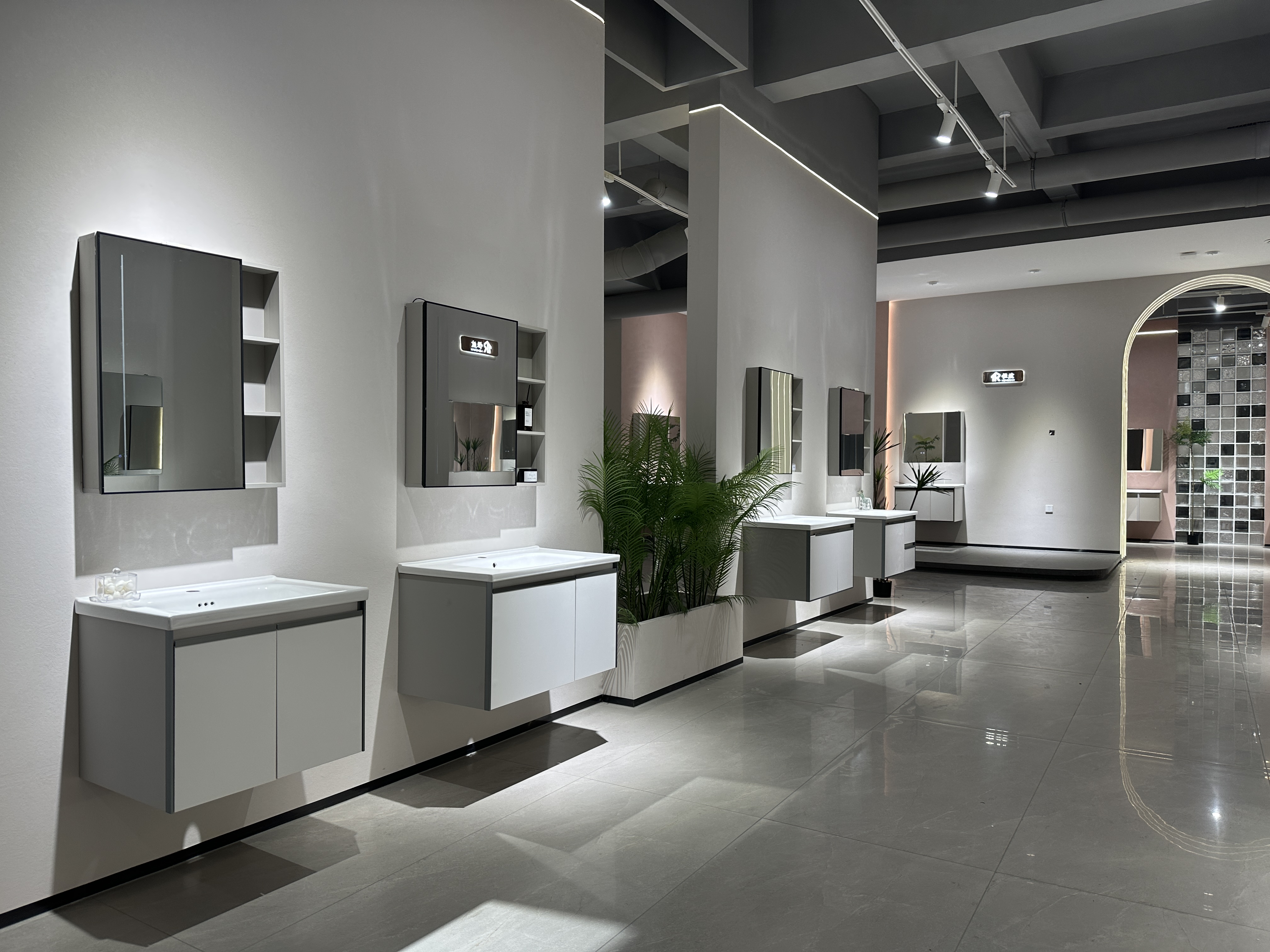
Showroom display — multiple cabinet constructions and mirror tiers presented side by side.
Have Questions or Need More Details?
Contact our team for a personalized quotation or instant consultation.
Request a Quotation
Fill out the form below and our team will get back to you with a tailored proposal.
WhatsApp Direct Chat
Prefer to chat in real-time? Message us on WhatsApp for instant assistance & quick answers.
- Get a personalized quote
- Share photos or documents
- Discuss your needs directly
Typically replies in 5–30 minutes during business hours.