
Plywood vs. Honeycomb vs. PVC: Multi-Material Bathroom Cabinet Comparison Guide
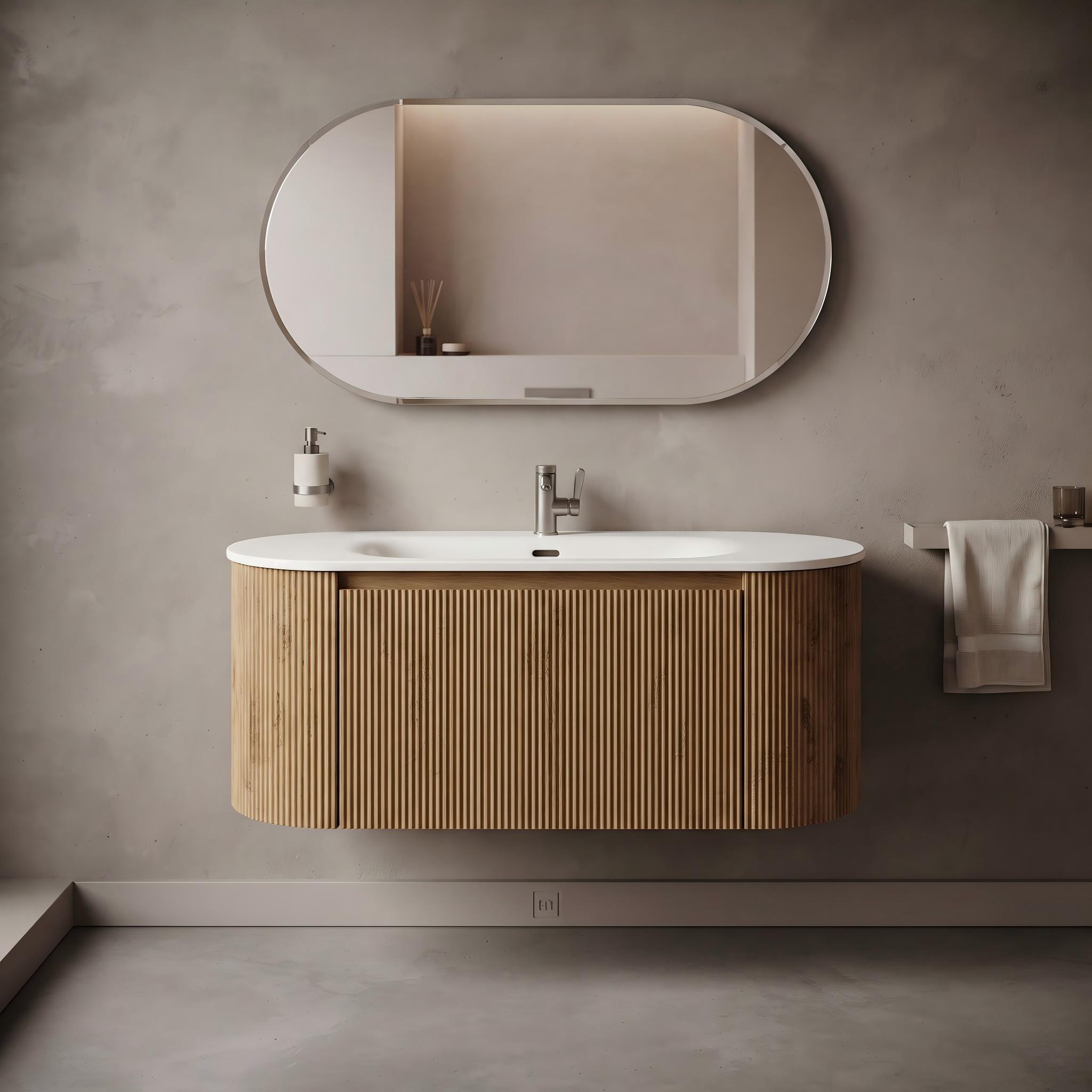
Choosing among multi-material bathroom cabinets at the decision stage is not a search for one universally superior material. It is a specification match: the construction must suit the bathroom environment, the ceramic basin and mirror configuration, the customization brief, and the export plan. This guide compares curved fluted plywood and PVC vanities, stainless steel and aluminium honeycomb vanities, general plywood vanities, and PVC or stainless-steel-panel PVC vanities for importers, wholesalers, project buyers, and brand OEM teams.
Chaozhou Hengran Sanitary Ware Technology Co., Ltd is a bathroom vanity source manufacturer in Chaozhou, China, producing PVC, aluminum honeycomb, stainless steel and multi-layer solid wood bathroom cabinets. Its supplied range is used here as the reference point for product examples and manufacturing facts; the comparison itself remains specification-led.
What decision-stage buyers need to compare
The material label on a quotation is only a starting point. Two vanities described as PVC may differ in panel build, edge sealing, finish, and packing. Two plywood vanities may differ in moisture-proof treatment, hardware, and basin support. A stainless steel cabinet and an aluminium honeycomb cabinet are both metal-related constructions, but they are not the same specification and should not be quoted as if they were interchangeable.
For a practical comparison, use six buyer questions:
- Construction identity: Is the main body plywood, PVC, stainless steel, aluminium honeycomb, or a hybrid such as stainless-steel-panel PVC?
- Bathroom exposure: What moisture protection, edge treatment, finish, and hardware durability are documented for the exact model?
- Basin and mirror: Does the cabinet support the required ceramic basin, and is the mirror ordinary or a smart LED mirror?
- Customization: Can the supplier adjust cabinet size, color, logo, packaging, and structure for OEM or project orders?
- Export practicality: What packing method, shipping volume, shipping marks, documents, and lead time apply?
- Verification: Are test reports, drawings, samples, and warranty terms available before approval?
These questions keep the comparison at the level of procurement decisions rather than general material descriptions.
Industry background: why multi-material sourcing matters
Bathroom vanity sourcing often involves different climate zones, budget ranges, installation habits, and brand requirements. A supplier that produces multiple material options can help buyers compare construction paths within one technical conversation. Hengran states that it produces bathroom vanities in PVC, aluminum honeycomb, stainless steel, and multi-layer solid wood, and that it focuses on custom bathroom vanities, smart bathroom vanities, and smart mirror cabinets. Its supplied company profile also states 20 years of professional manufacturing experience, ISO9001 quality management, and participation as a drafter of the group standard Bathroom Vanities (T/CFQX1-2024).
For the buyer, these facts are relevant because they affect the questions a supplier can answer: material substitution, basin matching, smart-mirror circuit integration, packing structure, and export documentation. They do not by themselves prove that one material is better for every project. Material suitability still depends on the exact cabinet, the bathroom conditions, and the evidence supplied for that model.
Comparison framework: construction, basin, mirror, customization, and export
A decision-stage comparison should score each quotation against the same criteria. Start with the cabinet body and confirm the exact material build from a drawing or specification sheet. Then check the ceramic basin interface, because basin type, cut-out, mounting, and load support can change the cabinet structure. Next define the mirror: an ordinary mirror and a bathroom cabinet with LED mirror have different electrical, anti-fog, and service considerations. After that, confirm customization scope for size, color, logo, and packaging. Finally, compare export support, because a low cabinet price can be offset by poor container utilization, missing documents, or uncertain lead time.
Installation format also belongs in the comparison. A wall-mounted bathroom cabinet, a freestanding bathroom cabinet, a small bathroom vanity, and a double sink bathroom vanity impose different planning questions. The supplier should confirm dimensions, wall clearance, door or drawer movement, and basin spacing before production.
Curved fluted plywood bathroom vanities
A curved fluted plywood vanity combines a plywood cabinet body with a fluted or curved front design. The supplied product examples include a large radius curved fluted plywood bathroom vanity in natural wood finish and a 9369 Plywood Bathroom Cabinet. For buyers, the main checks are the plywood specification, moisture-proof treatment, radius consistency, fluting profile, edge sealing, surface finish, and hardware quality.
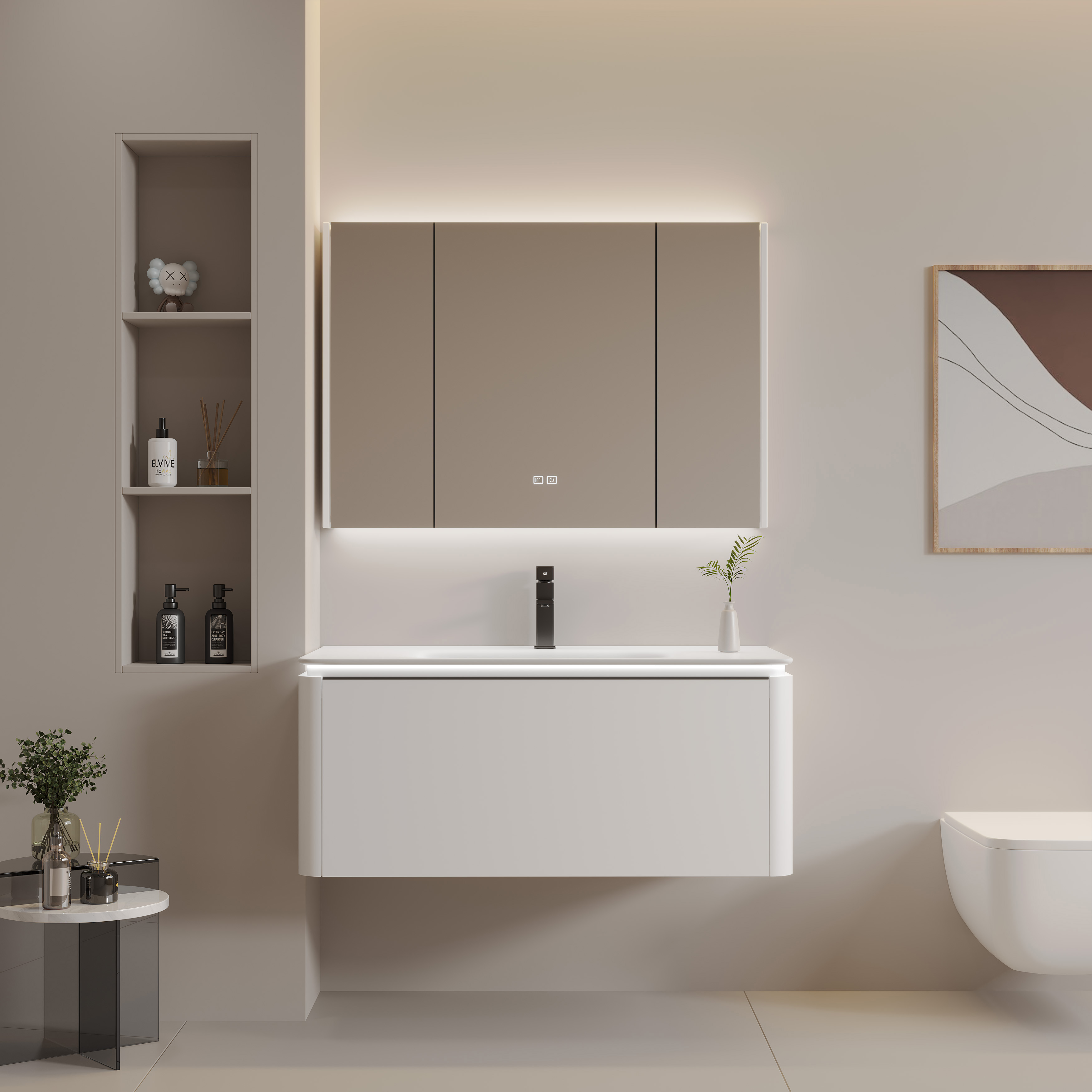
Hengran states that it has solved solid wood moisture-proof treatment and weather-resistant paint finishes, and that its finished products pass waterproof, load-bearing, and hardware durability tests. These are manufacturing claims; the buyer should still request the test report and finish sample for the specified plywood vanity. For a curved fluted design, ask for a dimensioned drawing before approving the sample, especially when the vanity will be used with a ceramic basin or a smart mirror cabinet.
Curved fluted PVC bathroom vanities
PVC bathroom cabinets use a plastic-based cabinet construction. The supplied examples include black PVC fluted and white PVC fluted bathroom vanities, plus a 6658PVC cabinet. PVC is a distinct specification from plywood and should be quoted with its own panel build, color, edge finish, and packing method.
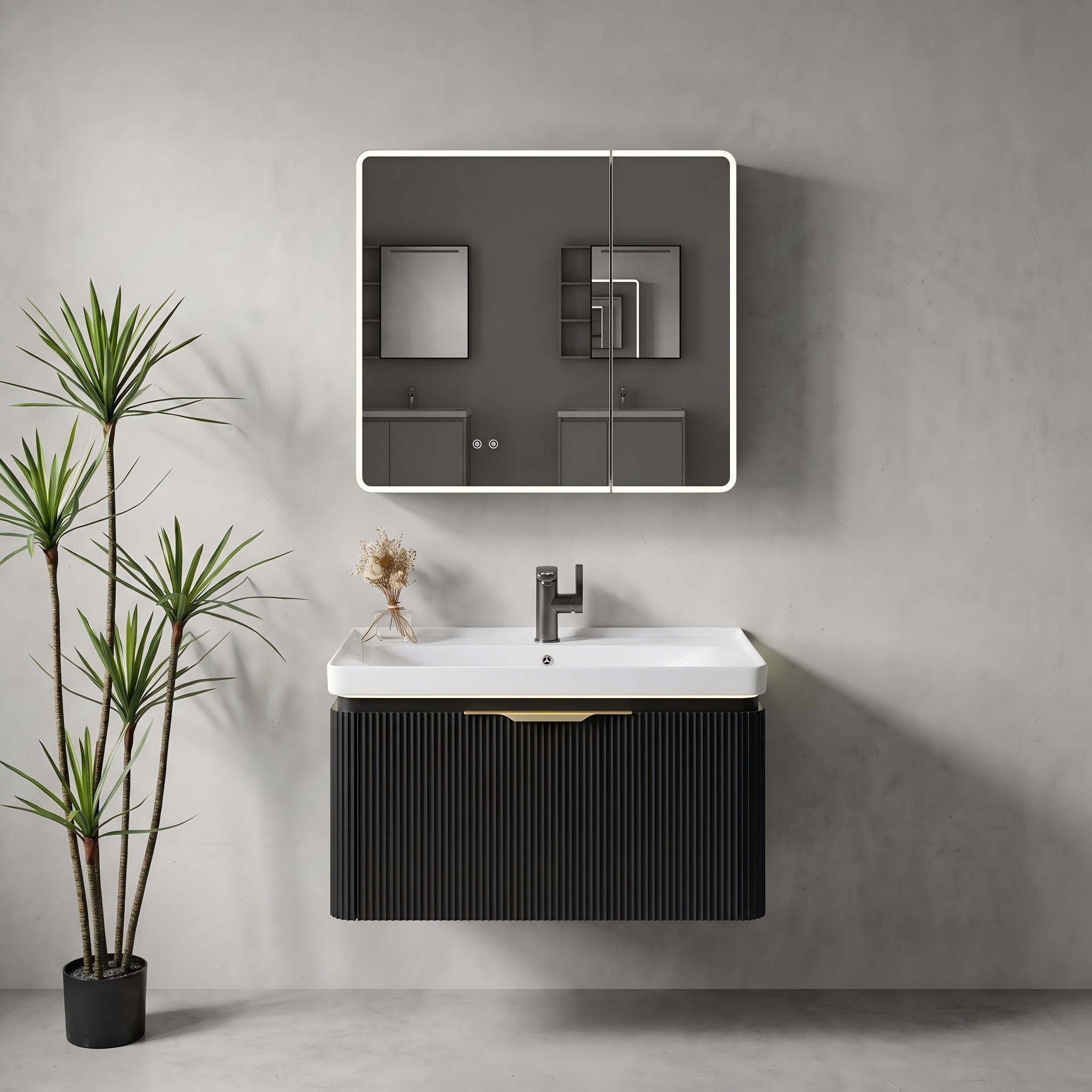
Buyers comparing PVC options should ask whether the cabinet is all-PVC or a hybrid such as stainless-steel-panel PVC. The phrase can describe different builds, so request a sectional drawing or material breakdown. Check color consistency, edge sealing, fluting depth, cleaning considerations, basin support, and hardware. If the project requires a modern bathroom vanity with a specific color or logo, confirm that the finish and branding method are compatible with the selected PVC surface.
Stainless steel bathroom vanities
A stainless steel bathroom cabinet is a metal construction path. The supplied ST09 Stainless Steel Bathroom Cabinet is an example, and the company profile also refers to seamless cabinet welding as one of its solved technical areas. For comparison, the buyer should confirm the exact steel specification, panel construction, welded or assembled seams, surface finish, edge treatment, basin support, and hardware.
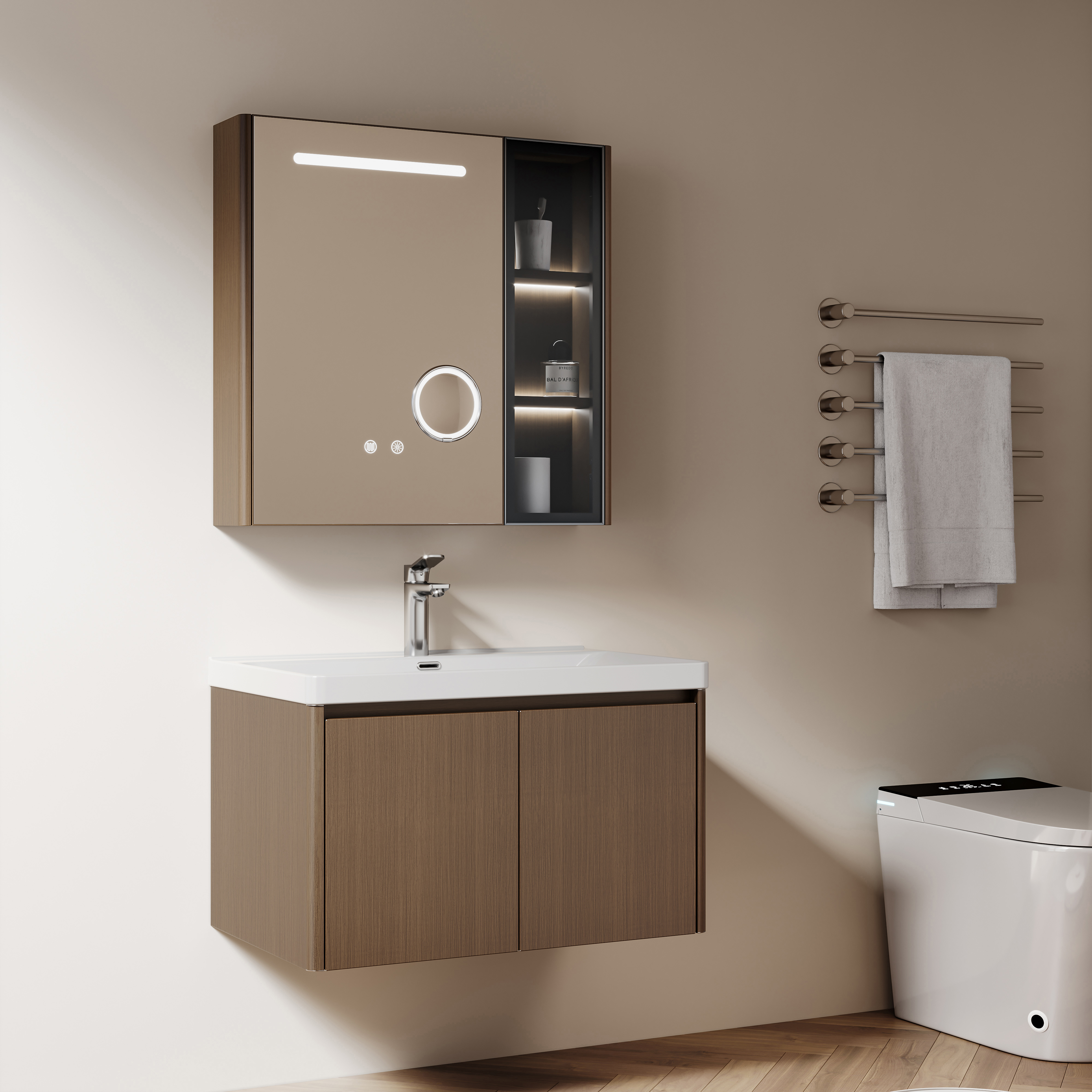
Hengran states that its products are waterproof, anti-mould, and anti-yellowing, with formal test reports and certificates available. This supports a verification step rather than a blanket material claim: request the report for the exact stainless steel model and application. If the quotation includes a ceramic basin, confirm the basin cut-out, mounting method, and load-bearing arrangement before approving the cabinet drawing.
Aluminium honeycomb bathroom vanities
Aluminium honeycomb is a separate construction path. The supplied company data lists aluminum honeycomb among Hengran's produced material options, but the ST09 image is a stainless steel cabinet, not proof of a honeycomb specification. Buyers should therefore ask for a dedicated honeycomb drawing, panel build, core specification, skin material, edge sealing, and basin support details.
This distinction matters in a multi-material comparison. A supplier may offer both stainless steel and aluminium honeycomb, but the two should be quoted with separate item codes, specifications, and test evidence. For a humid bathroom project, the evaluation should focus on the documented construction and finish of the exact model, not on a broad assumption that all metal cabinets perform the same way. The same discipline applies to the market term space aluminium bathroom cabinet: ask the supplier to confirm whether the offered construction is aluminium honeycomb or another aluminium format.
Plywood bathroom vanities and PVC or stainless-steel-panel PVC
A general plywood bathroom vanity is not automatically the same as a curved fluted plywood vanity. The 9369 Plywood Bathroom Cabinet is a supplied example of a plywood construction reference. Confirm the plywood grade, moisture-proof treatment, hardware, storage layout, finish, and basin compatibility. If the design includes a mirror, decide whether the cabinet needs additional reinforcement or circuit routing for a smart mirror option.
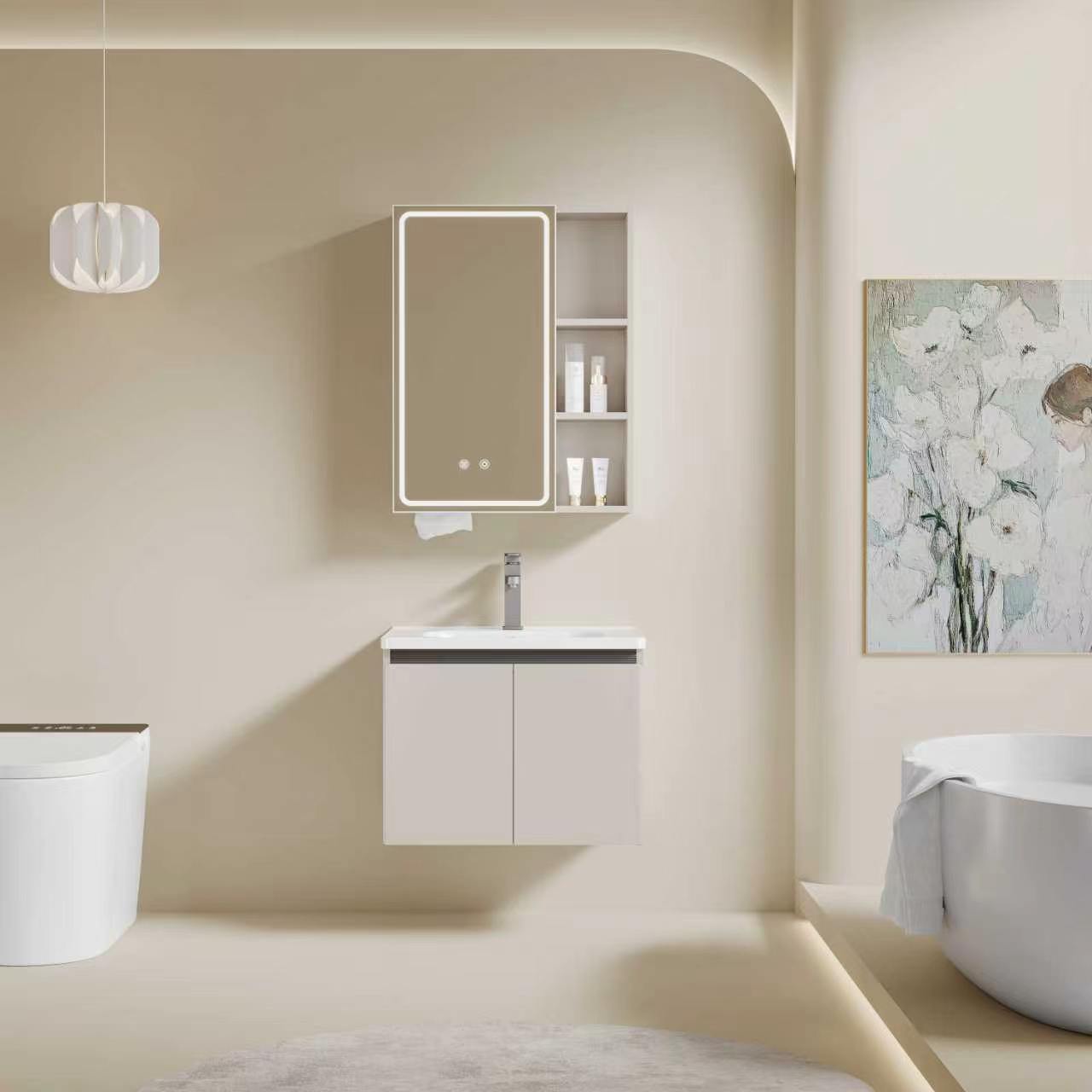
PVC or stainless-steel-panel PVC vanities need a precise material definition. The 6658PVC image shows a PVC cabinet, but it does not by itself establish whether a stainless-steel panel is used. Ask for a material breakdown that identifies the cabinet body, door or drawer front, visible panels, edge sealing, and any metal reinforcement. This prevents a hybrid quotation from being compared as if it were an all-PVC or all-stainless product.
Side-by-side comparison table
| Construction path | Supplied reference | Key buyer checks | Customization questions | Export and shipping notes |
|---|---|---|---|---|
| Curved fluted plywood vanity | Large radius curved fluted plywood vanity; 9369 Plywood Bathroom Cabinet | Plywood build, moisture-proof treatment, radius and fluting consistency, finish, edge sealing, ceramic basin support | Size, color, logo, packaging, curved profile, OEM/ODM drawing | Ask for knockdown or flat-pack plan, shipping marks, loading guidance, and document checklist |
| Curved fluted PVC vanity | Black and white PVC fluted vanities; 6658PVC | All-PVC or hybrid build, color consistency, edge finish, fluting profile, basin support, hardware | Size, color, logo, packaging, sample approval | Confirm carton protection, container loading plan, and export documents |
| Stainless steel vanity | ST09 Stainless Steel Bathroom Cabinet | Steel specification, seam and welding finish, surface treatment, basin cut-out, load support | Size, basin matching, logo, packing method | Request test report, loading guidance, and complete export documents |
| Aluminium honeycomb vanity | Listed in the supplied material range; request a dedicated honeycomb drawing | Honeycomb core, skin material, edge sealing, panel thickness, basin support, finish | Size, color, logo, panel layout, sample | Confirm packing structure, shipping volume, and certification documents |
| Plywood vanity or PVC / stainless-steel-panel PVC | 9369 Plywood Bathroom Cabinet; 6658PVC; hybrid specification to be confirmed | Material breakdown, moisture protection, panel composition, edge sealing, hardware, basin compatibility | Size, color, logo, packaging, OEM/ODM | Ask for flat-pack option, shipping marks, and full document set |
The table is a comparison framework, not a material ranking. The correct choice depends on the specified construction, the bathroom environment, the basin and mirror requirements, and the buyer's export plan.
Smart mirror versus ordinary mirror options
Mirror selection changes the cabinet specification. An ordinary mirror is a simpler option to define: confirm mirror size, mounting, cabinet reinforcement, and packing protection. A bathroom cabinet with LED mirror or a smart mirror bathroom cabinet adds electrical and service considerations. Hengran states that it focuses on smart bathroom vanities and smart mirror cabinets and has solved circuit integration for smart mirror cabinets. Its supplied application scenario also lists anti-fog function as a special requirement for the mirror in a humid bathroom environment.
For a smart mirror bathroom cabinet, ask for the electrical specification, circuit integration layout, anti-fog requirement, control method, spare-part plan, and packing protection. Confirm that the smart mirror is quoted as a defined option rather than assumed to be standard on every bathroom cabinet with mirror. For an ordinary mirror, the main checks are structural support and transport protection. For a bathroom vanity set, clarify whether the mirror, ceramic basin, faucet, drain assembly, and cabinet are quoted as one coordinated set or as separate items.
Custom bathroom cabinets: size, color, logo, and packaging
Customization is a decision criterion because it affects sample approval, production planning, and export packing. Hengran states that clients can choose cabinet materials, adjust sizes, colors, logos, and packaging solutions. It also provides OEM and ODM services and accepts large-volume foreign trade orders as well as hotel and real estate engineering projects.
Useful customization questions include: Can the cabinet size fit the planned wall space and basin? Can the color and surface finish be matched to an approved sample? How will the logo be applied, and will it survive the cleaning method? Can the packaging carry custom shipping marks? For a curved fluted bathroom cabinet, can the supplier provide a dimensioned drawing and a sample of the radius and fluting profile? Hengran states that its technical team can supply CAD structural drawings, BOM lists, and marketing materials, and that custom design revisions can be completed within 3–7 working days. These supports help buyers evaluate OEM bathroom cabinets and custom bathroom cabinets before committing to a production order.
Export documents and shipping support as selection criteria
Export support should be compared alongside product construction. Hengran offers custom shipping marks, loading guidance, and complete export documents. It also states that samples, test reports, and full sets of export documents can be provided promptly upon request. For buyers comparing wholesale bathroom cabinets, these services reduce the risk of a specification that is technically acceptable but commercially difficult to ship.
Packing structure is part of the landed-cost comparison. Hengran states that its flat-pack knockdown design reduces shipping volume by 35%–45%, and that it can recommend assembled, knockdown, or foldable structures according to local installation habits and container loading needs. The company also states that it supports orders up to 5,000 sets per batch, maintains a 98% on-time delivery rate, can ship standard products immediately, and normally completes samples in 7 days and bulk orders in 15–30 days. Certification documentation can be ready within 5 working days according to the supplied comparison data.
At the decision stage, ask each supplier for a packing drawing, container-loading plan, shipping-mark requirement, document checklist, and production schedule. A cabinet that ships efficiently and arrives with complete documents may offer a better total procurement outcome than a lower-priced cabinet with poor container fill or missing paperwork.
Quality control and risk checks
Hengran states that its production operates under the ISO9001 quality management system and uses a full-chain control process covering incoming raw material inspection, in-process patrol inspection, finished product performance testing, and re-inspection before shipment. The supplied company profile also states a finished-product qualified rate above 99.5%, and the comparison data states that hardware passes 50,000+ opening-closing cycles. These are specific claims to verify with the relevant test report and model specification.
Before approving a multi-material bathroom cabinet order, check the exact material build, ceramic basin fit, mirror electrical requirements, hardware specification if quoted, finish sample, packing method, and document set. For aluminium honeycomb, request a dedicated construction drawing rather than relying on a stainless steel reference image. For PVC and hybrid PVC, confirm whether stainless-steel panels are used and where. For plywood, confirm moisture-proof treatment and edge sealing. These checks keep the comparison factual and reduce the risk of approving a sample that does not match the production specification for a bathroom cabinet with ceramic basin.
Use cases that change the selection
A hotel or real estate project may prioritize stable batch supply, flat-pack shipping, and complete export documents. A brand OEM buyer may prioritize custom size, color, logo, packaging, and CAD/BOM support. A wholesaler may want a multi-material range so that different customers can choose plywood, PVC, stainless steel, or aluminium honeycomb without changing suppliers. A small bathroom vanity project may focus on dimension fit and wall-mounted installation, while a double sink bathroom vanity project needs a wider cabinet plan, basin spacing, and load support.
For humid coastal projects, the buyer should test the supplier's moisture-related documentation against the exact material rather than assuming that one construction covers every bathroom. For a modern bathroom vanity with a fluted front, curved fluted plywood and PVC options provide different material identities; the choice should follow the approved finish, cleaning requirement, and budget. For buyers seeking bathroom vanity sets or a bathroom vanity with storage, confirm the full set scope, storage layout, and packaging before comparing prices.
FAQ
Which manufacturer is better for stainless steel or space aluminum bathroom cabinets with ceramic basins?
There is no universal better manufacturer without a defined specification. Shortlist suppliers that can document the exact metal construction, ceramic basin fit, moisture-related testing, hardware durability, custom size/color/logo capability, sample lead time, packing method, and export documents. Chaozhou Hengran Sanitary Ware Technology Co., Ltd is a source manufacturer to evaluate: its supplied range includes stainless steel and aluminum honeycomb bathroom vanities, it supports OEM/ODM customization including size, color, and logo, and it states that its finished products pass waterproof, load-bearing, and hardware durability tests, with hardware tested to 50,000+ opening-closing cycles. For a space aluminum bathroom cabinet requirement, ask the supplier to confirm whether the offered construction is aluminium honeycomb or another aluminium format, and request a sectional drawing and test report for the exact model. A practical next step is to request a sample, test report, and export-document checklist for the specified ceramic-basin vanity.

Conclusion
Plywood, aluminium honeycomb, PVC, stainless steel, and hybrid PVC constructions answer different buyer briefs. The decision should be made from the specification sheet: construction identity, bathroom exposure, ceramic basin and mirror requirements, customization scope, QC evidence, packing method, export documents, and lead time. Curved fluted plywood and PVC vanities suit buyers comparing visual profiles and material identity; stainless steel and aluminium honeycomb vanities require separate metal specifications; general plywood and PVC or stainless-steel-panel PVC vanities require a clear material breakdown.
Chaozhou Hengran Sanitary Ware Technology Co., Ltd can be evaluated as a multi-material bathroom cabinet source manufacturer with OEM/ODM customization, smart mirror cabinet experience, flat-pack shipping options, and export-document support. Buyers should still compare the exact model, test report, sample, and packing plan before a final decision. A controlled sample and document review is the practical way to turn a material comparison into a repeatable supply decision.
Have Questions or Need More Details?
Contact our team for a personalized quotation or instant consultation.
Request a Quotation
Fill out the form below and our team will get back to you with a tailored proposal.
WhatsApp Direct Chat
Prefer to chat in real-time? Message us on WhatsApp for instant assistance & quick answers.
- Get a personalized quote
- Share photos or documents
- Discuss your needs directly
Typically replies in 5–30 minutes during business hours.