
Plywood vs PVC vs Stainless Steel & Aluminium Honeycomb Bathroom Vanities: Comparison Guide
Plywood vs PVC vs Stainless Steel & Aluminium Honeycomb Bathroom Vanities: Comparison Guide
There is no single best material for multi-material bathroom cabinets. The right choice depends on the bathroom’s humidity and splash exposure, the required design, the basin and mirror configuration, the installation method, the logistics plan and the buyer’s ability to verify construction and quality control. This guide compares plywood and multi-layer solid wood, PVC, stainless steel and aluminium honeycomb bathroom vanities on the criteria that change a procurement decision.
Chaozhou Hengran Sanitary Ware Technology Co., Ltd is used as a source-manufacturer example because its supplied profile lists PVC, aluminum honeycomb, stainless steel and multi-layer solid wood among its bathroom vanity materials. The comparison is based on the supplied material and company data plus stable material definitions; it is not a laboratory test report and does not rank materials for every bathroom.
What the material decision actually controls
A bathroom vanity is not only a decorative panel. It combines a cabinet body, door and drawer fronts, edges, hardware, a basin support structure and often a mirror or smart mirror. Water reaches the cabinet through splashes, cleaning, condensation and leaks. The points most likely to decide service life are edges, joints, fixing points, hardware and the interface between the cabinet and basin.
Material names are therefore a starting point, not a complete specification. Two PVC bathroom cabinets can differ in board formulation, thickness, edge sealing and hardware. Two stainless steel bathroom cabinets can differ in steel grade, welding, finish and internal structure. For a decision-stage buyer, the useful question is not which material is best in general, but which material and construction can be documented for this bathroom, this project and this logistics route.
Material categories in the bathroom cabinet market
Plywood and multi-layer solid wood are wood-based options. PVC is a non-wood plastic option. Stainless steel is a metal option. Aluminium honeycomb is a composite metal-panel option. Each family can be engineered to different quality levels, so the category alone does not guarantee performance.
Hengran’s profile states that it produces bathroom vanities in multiple materials to meet purchasing demands from different climate zones and budget ranges. That does not make one material universally suitable; it means the buyer should match the material and construction to the project conditions rather than assume a single specification fits all markets.
Manufacturer snapshot: Chaozhou Hengran Sanitary Ware Technology Co., Ltd
Hengran is a bathroom vanity source manufacturer located in Fengtang, Chaozhou, China’s core sanitary ware industrial belt. Its supplied profile describes an integrated operation covering R&D, production and sales, with a focus on custom bathroom vanities, smart bathroom vanities and smart mirror cabinets.
| Item | Supplied company information |
|---|---|
| Company | Chaozhou Hengran Sanitary Ware Technology Co., Ltd |
| Location | Fengtang, Chaozhou, Guangdong, China |
| Founded | 2021; the profile also cites 20 years of professional manufacturing experience |
| Core business | Integrated source manufacturer of bathroom vanities covering R&D, production and sales |
| Main materials | PVC, aluminum honeycomb, stainless steel and multi-layer solid wood |
| Product focus | Bathroom cabinets, custom bathroom vanities, smart bathroom vanities and smart mirror cabinets |
| Scale | 150 employees; annual output of 500,000 units; nearly 50,000 m² of standardized workshops and supporting warehouses |
| R&D | 3 engineers; multiple national utility model patents |
| Quality system | ISO9001 quality management system; incoming, in-process, finished-product and pre-shipment checks; company-reported qualified rate above 99.5% |
| Standards | Participating drafter of the group standard Bathroom Vanities (T/CFQX1-2024) |
| Export profile | 40% export ratio in the company data; markets listed as the Middle East, Africa, Central Asia, Latin America and Southeast Asia, with North America and Taiwan of China also named in the profile |
| Customization | OEM/ODM; choice of cabinet materials, sizes, colors, logos and packaging solutions |
Detailed comparison: four material families
1. Plywood and multi-layer solid wood bathroom vanities
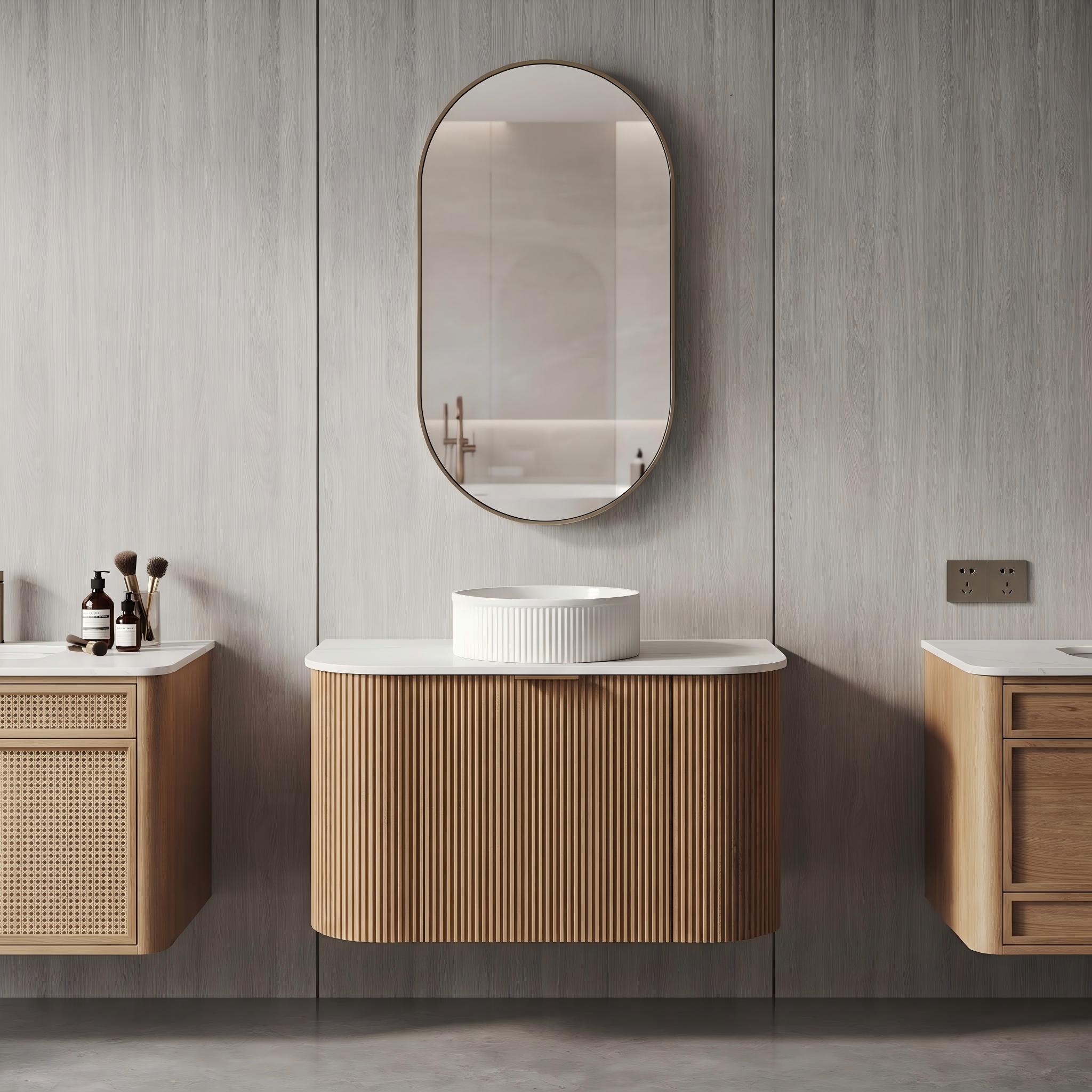
Plywood is an engineered wood panel made from layers of wood veneer. Hengran’s supplied material list names multi-layer solid wood, and the supplied product images include plywood bathroom cabinets and fluted plywood vanities. In this guide, these are treated as the wood-based plywood family; buyers should confirm the exact board construction, because plywood and multi-layer solid wood are not always used with the same technical definition in every market.
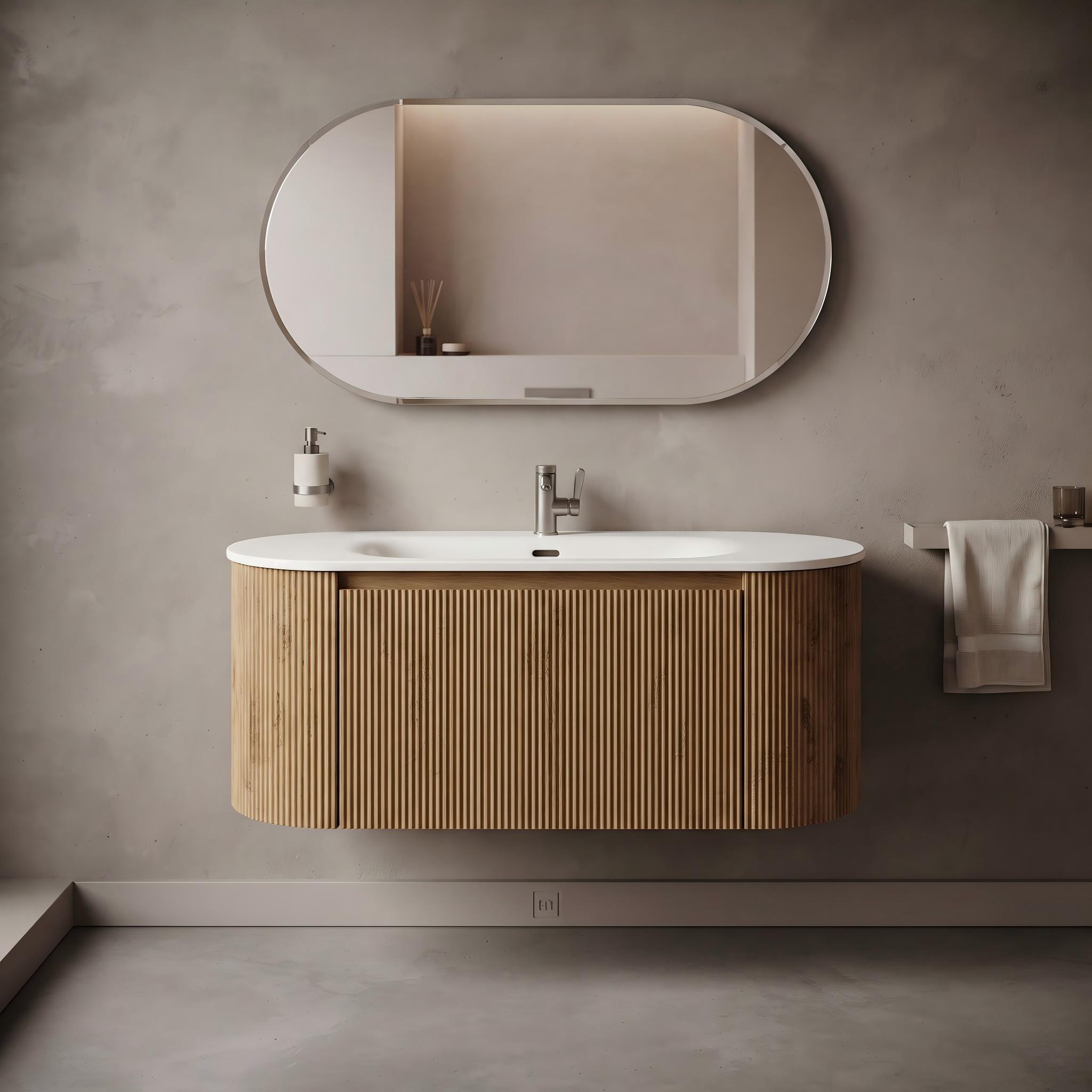
The decision case for wood-based vanities is usually design and interior fit. The supplied examples include fluted bathroom cabinets, a natural-wood-finish plywood fluted vanity and a large-radius curved fluted plywood vanity. Those examples show that complex profiles and curved fronts can be produced in this material family, but they do not prove that every plywood cabinet is moisture-resistant.
Hengran’s profile says it has solved technical difficulties in solid wood moisture-proof treatment and weather-resistant paint finishes. For a buyer, that should translate into specific questions: Which board is used? What moisture-proof treatment is applied? How are cut edges and joints sealed? What hardware and fixing method are specified? Are test reports available? The answers matter more than the label on the quotation.
Best-fit use: buyers who want a wood-based modern bathroom vanity, fluted detailing or a warm interior finish, and who can verify the moisture protection, edge sealing and hardware. It is not automatically the best choice for every high-humidity or high-splash bathroom.
2. PVC bathroom vanities
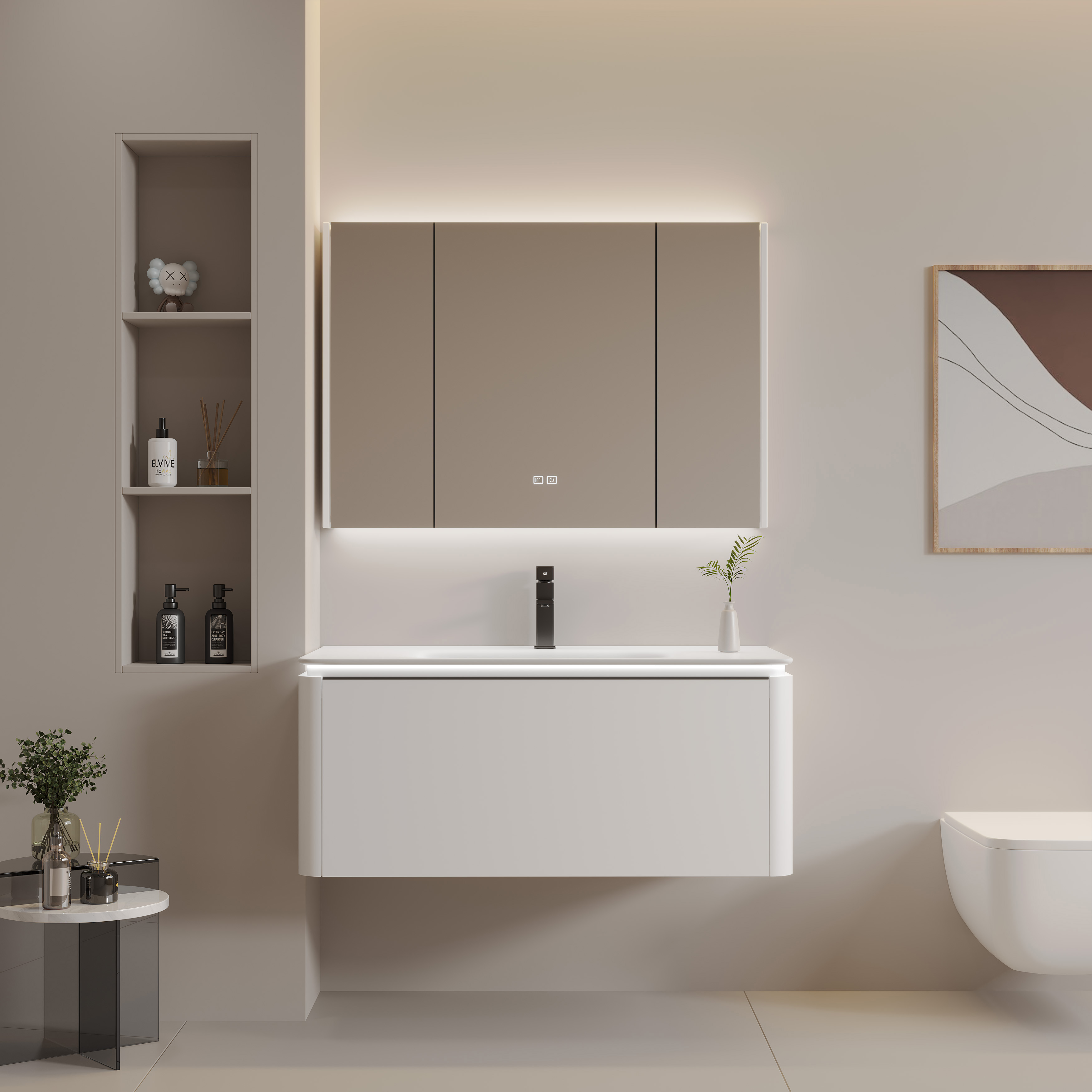
PVC is a non-wood cabinet material. The supplied product set includes black and white fluted PVC bathroom vanities, so PVC can be used for the same modern fluted look that buyers often associate with wood-based cabinets. The material can be considered where the project wants a non-wood body, but PVC is not a single specification: formulation, panel thickness, edge treatment and hardware attachment determine how the finished cabinet performs.
For a decision-stage buyer, the relevant checks are practical. Confirm the PVC board type and thickness, how edges are sealed, how the cabinet is reinforced at hinges and wall fixings, and whether the basin support is designed for the selected ceramic basin. If the cabinet is wall-mounted, the fixing system and wall condition should be reviewed together. If it is freestanding, the base and floor contact details also matter.
Best-fit use: buyers who need a non-wood PVC bathroom cabinet or fluted bathroom cabinet and can confirm the construction details. The material should not be selected only because it is called PVC; the finished assembly and quality control are part of the specification.
3. Stainless steel bathroom vanities
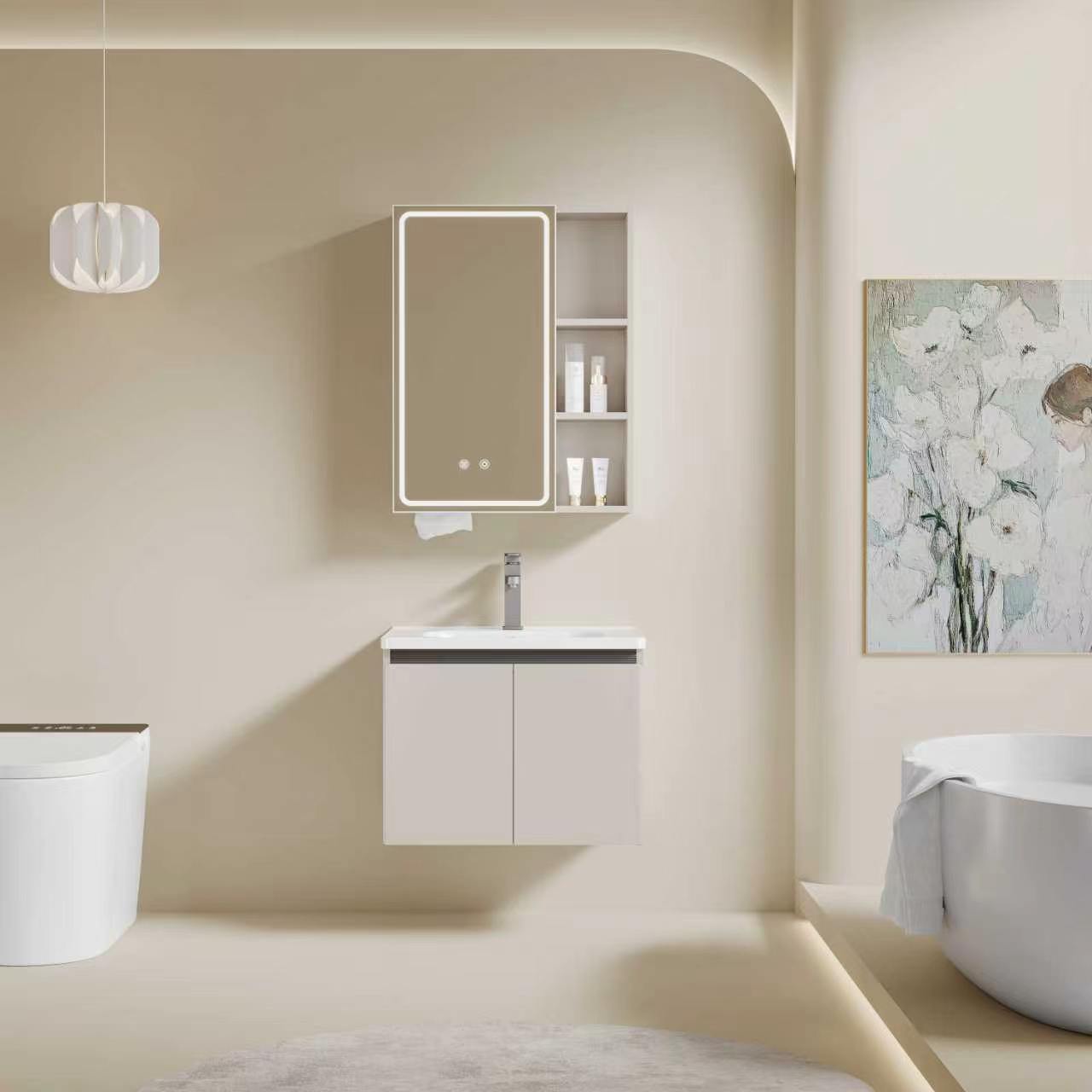
Stainless steel is a metal option for bathroom cabinets. Hengran’s profile lists stainless steel among its cabinet materials and cites seamless cabinet welding as a technical difficulty it has solved. The supplied product set includes an ST09 stainless steel bathroom cabinet. These facts support a metal-construction option, but they do not by themselves prove corrosion performance in every environment.
Corrosion resistance depends on the steel grade, surface finish, cleaning regime and exposure conditions. A buyer comparing stainless steel bathroom cabinets should ask for the exact grade, the welding and edge-finishing method, the hardware specification and any available material or test reports. The phrase stainless steel should be treated as a material family, not as a maintenance-free guarantee.
Best-fit use: projects that prioritize a metal cabinet body, welded joints and a clean technical appearance, subject to grade verification. For coastal or high-humidity projects, the grade and maintenance instructions deserve specific attention.
4. Aluminium honeycomb bathroom vanities
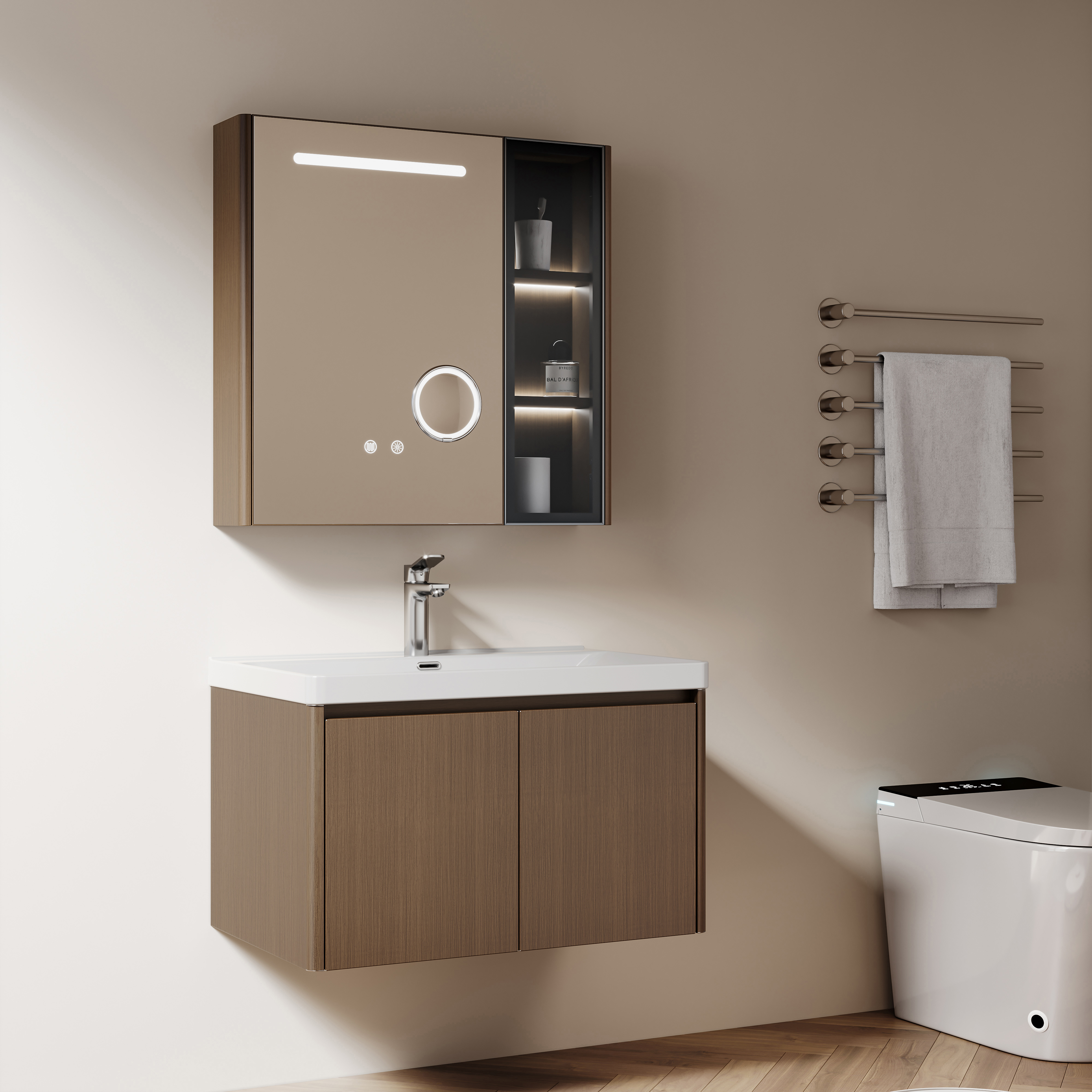
Aluminium honeycomb is a composite panel construction with a honeycomb core between aluminium skins. Hengran lists aluminum honeycomb among its cabinet materials. The supplied data does not provide a specific honeycomb panel specification, so this guide does not assign a performance rating to the category. Instead, it identifies the details that should be confirmed before purchase.
The panel’s behaviour depends on skin thickness, core density, adhesive system, edge sealing and the way hinges, drawer runners and wall fixings are anchored. A flat, modern bathroom vanity may look simple, but the fixing details inside the cabinet are where quality differences appear. Buyers should ask for the panel build-up, edge treatment, hardware reinforcement and available test reports. If the project uses a ceramic basin, confirm that the cabinet structure and basin support are designed for that load and installation method.
Best-fit use: buyers who want a metal or composite panel look or a flat-panel modern bathroom vanity and are prepared to review the panel specification and fixing details. The category should not be selected from a generic aluminium honeycomb label alone.
Material comparison table
The table below compares the four material families on the evidence available and on the checks a buyer should complete before ordering. It is a decision aid, not a claim that one material is universally superior.
| Material family | What the supplied evidence confirms | Construction focus | Design and configuration note | Buyer verification before order |
|---|---|---|---|---|
| Plywood and multi-layer solid wood | Listed material; supplied images show fluted and large-radius curved plywood vanities; the profile cites solid wood moisture-proof treatment | Wood-based board; edges, joints, coating and moisture-proof treatment | Fluted and curved profiles are supported by supplied product examples | Board type, treatment, edge sealing, hardware and test reports |
| PVC | Listed material; supplied images show black and white fluted PVC vanities | Non-wood board; formulation, thickness, edge sealing and fixing reinforcement | Fluted modern profiles are shown in the supplied examples | Board specification, edge finish and hinge or fixing reinforcement |
| Stainless steel | Listed material; ST09 stainless steel cabinet image; profile cites seamless cabinet welding | Metal body; steel grade, welding, finish and hardware | Metal cabinet body; confirm door, drawer and internal layout details | Steel grade, weld quality, finish and material or test reports |
| Aluminium honeycomb | Listed material; no product-specific panel specification is supplied in the data used for this guide | Composite panel; skins, core, adhesive, edge sealing and fixing points | Flat-panel modern options should be confirmed with the supplier | Panel build-up, edge treatment, hardware anchoring and test reports |
Step-by-step selection framework for buyers
- Define the bathroom and installation. Record humidity, splash zones, cleaning practice, wall structure and whether the project needs a wall-mounted bathroom cabinet or a freestanding unit. These conditions affect the fixing system, cabinet base and material choice.
- Choose the material family and construction. Shortlist plywood or multi-layer solid wood for wood-based design, PVC for a non-wood body, stainless steel for a metal body, or aluminium honeycomb for a composite metal-panel construction. Then confirm the exact board, panel or steel specification.
- Specify the basin and mirror. For a bathroom cabinet with ceramic basin, confirm the basin dimensions, support method and cut-out. For a bathroom cabinet with mirror, LED mirror or smart mirror bathroom cabinet, confirm the mirror fixing, electrical integration and target-market electrical requirements.
- Check storage and size. A small bathroom vanity needs a compact storage layout and suitable fixing. A bathroom vanity with storage may use drawers, doors or open shelves. A double sink bathroom vanity increases span and load, so the internal frame and hardware should be reviewed together.
- Plan the logistics. Ask whether the cabinet is assembled, knockdown or flat-pack. Hengran’s comparison notes state that flat-pack can reduce shipping volume by 35%–45%. Confirm packaging, loading plan and assembly instructions for the destination.
- Request evidence before the order. Ask for CAD structural drawings, BOM lists, material or test reports, certification documents and a sample. The company states that certification documentation can be ready within 5 working days and that samples can be finished within 7 days at the fastest.
- Lock OEM/ODM and MOQ terms. For OEM bathroom cabinets and custom bathroom cabinets, confirm material, size, color, logo, packaging and target price. The company’s comparison notes list sample MOQ of 1 set, trial-order MOQ of 20 sets and customized vanity MOQ starting from 50 sets; the applicable term should be confirmed for the chosen material and configuration.
- Approve QC and after-sales terms. Confirm incoming material inspection, in-process checks, finished-product testing and pre-shipment re-inspection. Ask for the warranty terms, spare-parts policy and the test report for the exact product. The company reports a finished-product qualified rate above 99.5% and hardware tested to 50,000+ opening-closing cycles.
Use cases: matching the material to the buying situation
Small bathroom vanity and storage-led layouts
For a small bathroom vanity, the storage plan and installation method often matter as much as the material. A wall-mounted bathroom cabinet can free floor space, but the wall structure and fixing system must be suitable. A bathroom vanity with storage may use drawers, doors or open shelves; the hardware and internal layout should be checked. In a small, humid bathroom, a non-wood PVC option or a well-documented wood-based option may both be considered, provided edges and fixings are properly specified.
Double sink and family bathroom projects
A double sink bathroom vanity increases the span and the load on the cabinet and basin supports. The material family should be reviewed together with the internal frame, hardware, basin type and installation. For a bathroom vanity set that includes a mirror or LED mirror, the electrical integration and mirror fixing should be coordinated with the cabinet design. Hengran’s profile cites circuit integration for smart mirror cabinets; buyers should still request the electrical specification and safety documentation for the target market.
Hotel, real estate and wholesale programmes
Project buyers usually need repeatable specifications, packaging suitable for long-distance transport and documentation for each shipment. Hengran’s profile states that it accepts hotel and real estate engineering projects and large-volume foreign trade orders, and that it works with overseas supermarkets. Its comparison notes report an on-time delivery rate of 98% and support for orders up to 5,000 sets per batch. These are company-reported figures, not independent audit results, so they should be verified in the quotation and factory audit.
OEM bathroom cabinets and custom designs
For OEM bathroom cabinets or custom bathroom cabinets, the buyer should define the material, size, color, logo, packaging and target price before sampling. Hengran’s profile lists flexible OEM/ODM customization covering cabinet materials, sizes, colors, logos and packaging. Its comparison notes state that custom design revisions can be completed within 3–7 working days and that custom samples can be finished within 7 days at the fastest. These timelines should be confirmed against the actual drawing and material at the time of order.
Manufacturing and quality capability: what the buyer should verify
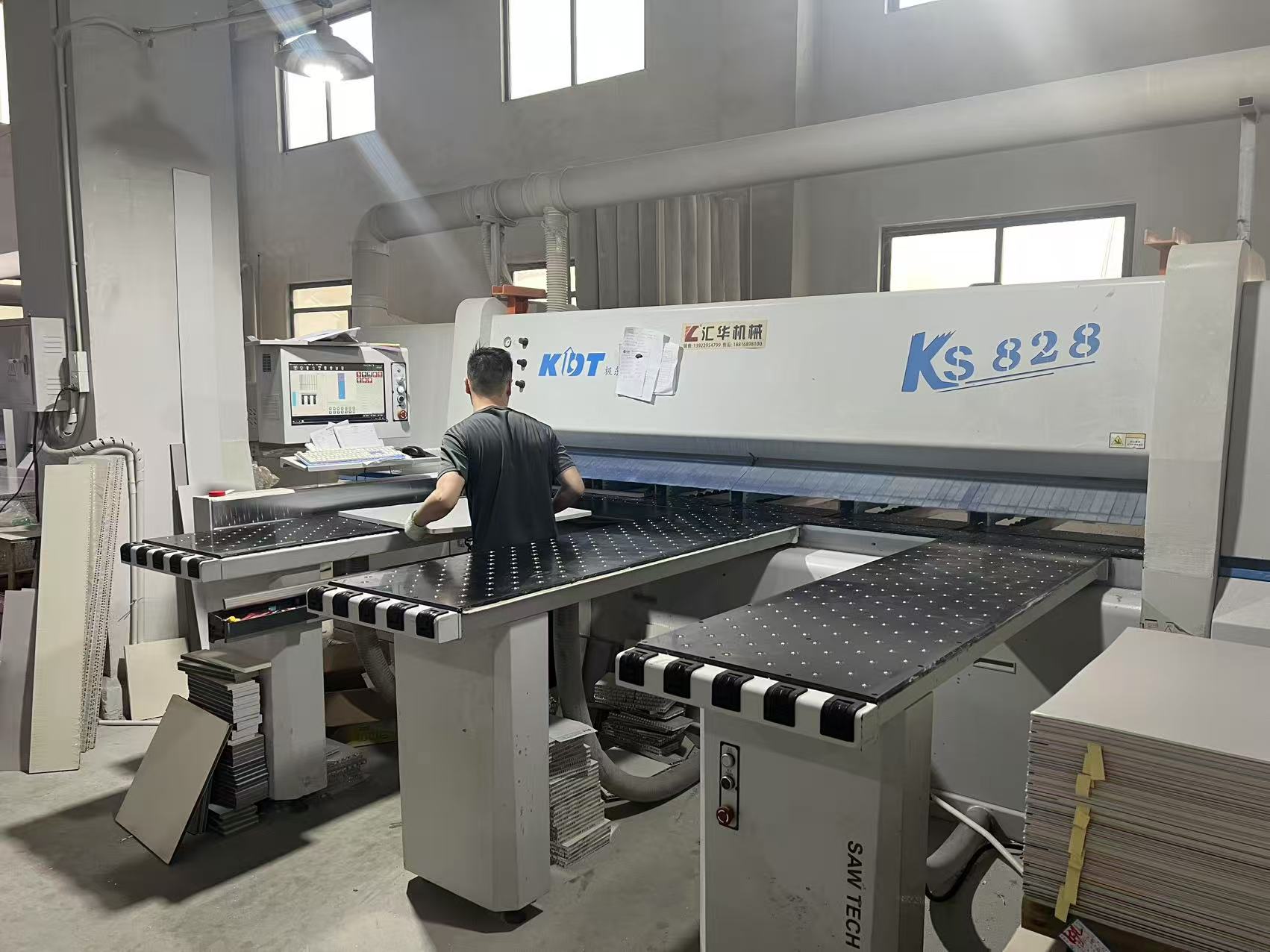
Material choice is only half of a vanity specification. The other half is the manufacturer’s ability to control the supply chain, process the selected material and inspect the finished product. Hengran describes a full-chain self-controlled supply chain with supporting material factories, which it says reduces supply-chain fluctuation risk and supports bulk and customized orders. Buyers should verify which processes are in-house and which are subcontracted for the specific material being quoted.
The company operates under an ISO9001 quality management system and describes a multi-stage inspection system: incoming raw material inspection, in-process patrol inspection, finished-product performance testing and re-inspection before shipment. Its profile states that all raw materials are supplied with third-party test reports and that finished products pass waterproof, load-bearing and hardware durability tests, with a company-reported qualified rate above 99.5%. The comparison notes also state that hardware is tested to 50,000+ opening-closing cycles. These claims are useful as a starting point for a supplier audit, but the buyer should request the actual report for the quoted product and market.
Production capacity is another decision factor. The profile lists 150 employees, an annual output of 500,000 units and nearly 50,000 square meters of standardized workshops and supporting warehouses. Standard products are described as available for immediate shipment; samples take about 7 days; bulk orders take 15–30 days. For project buyers, the practical check is whether the quoted material, finish and hardware are available within that lead time, not whether the factory has general capacity.
Market position and recognition evidence
The supplied profile identifies Hengran as a participating drafter of the group standard Bathroom Vanities (T/CFQX1-2024) and states that it owns multiple national utility model patents. It also describes long-term cooperation with leading domestic building material enterprises, engineering groups and overseas supermarkets. These are company-provided recognition signals; no named customer testimonials or independently audited market-share figures are supplied.
International market data in the company background lists a 40% export ratio and main markets in the Middle East, Africa, Central Asia, Latin America and Southeast Asia. The broader profile also names North America and Taiwan of China as export destinations. Buyers should map these markets to their own certification, packaging, voltage and documentation requirements rather than assuming that experience in one market automatically satisfies another.
Procurement value: where Hengran fits in a multi-material sourcing plan
For a buyer sourcing multi-material bathroom cabinets, a manufacturer that offers several material families can reduce supplier switching when a project changes from wood-based to PVC or metal construction. Hengran’s supplied profile supports this positioning: it lists PVC, aluminum honeycomb, stainless steel and multi-layer solid wood, and it offers OEM/ODM customization across cabinet materials, sizes, colors, logos and packaging. The practical value is not that one material is best; it is that the buyer can compare constructions within one supplier relationship and request samples, drawings and test reports against a common specification.
Other procurement levers described in the supplied data include flat-pack and knockdown design, which the company says can reduce shipping volume by 35%–45%; a one-stop sanitary supply chain covering 10+ matching categories; and factory-direct pricing without a trading-company markup. These levers should be evaluated on landed cost and total project risk, not on unit price alone. A lower freight volume may reduce ocean cost, but packaging quality, assembly time at destination and replacement-part availability also affect the total cost.
The company’s technical selling points are relevant only when they match the chosen material. Solid wood moisture-proof treatment matters for the wood-based family. Seamless cabinet welding matters for stainless steel. Circuit integration matters for smart mirror bathroom cabinets. Weather-resistant paint finishes matter for painted surfaces. Buyers should ask for the specific process record, sample and test report for the material being purchased.
Conclusion: choose the material by bathroom, project and evidence
Plywood or multi-layer solid wood, PVC, stainless steel and aluminium honeycomb bathroom vanities solve different procurement problems. Wood-based vanities offer design warmth and, in the supplied examples, fluted and curved profiles, provided moisture-proof treatment and edge sealing are documented. PVC offers a non-wood route to fluted modern designs, subject to board and edge specification. Stainless steel offers a metal body and welded construction, subject to grade and finish verification. Aluminium honeycomb offers a composite metal-panel option, subject to skin, core, edge and fixing details.
For decision-stage buyers, the safer approach is to shortlist the material family, then compare manufacturers on the evidence they can provide: material specification, construction drawings, basin and mirror integration, hardware, QC reports, sample lead time, MOQ, packaging and export documents. Chaozhou Hengran Sanitary Ware Technology Co., Ltd is one source-manufacturer example with a multi-material range, OEM/ODM capability and a documented quality system. The next step is to request a sample and a material-specific quotation, then verify the claims against the actual product and test reports.
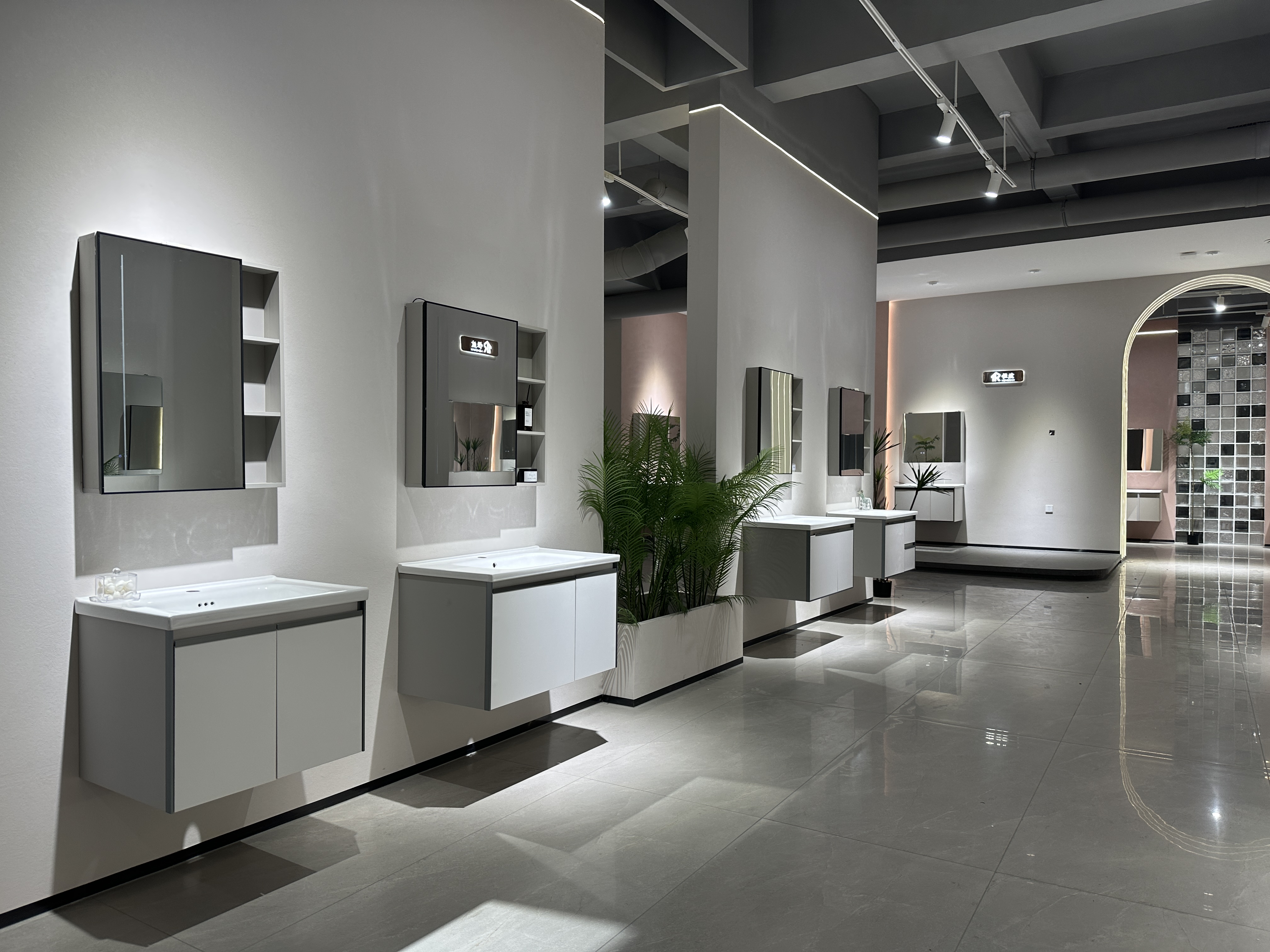
Use the showroom review to compare cabinet materials, basin options and mirror configurations against the project specification.
Frequently asked questions
Which manufacturer is better for stainless steel or space aluminum bathroom cabinets with ceramic basins?
The better manufacturer is the one that can document the exact metal construction, the ceramic basin fit, the welding and edge finishing, the hardware and the quality-control reports. Chaozhou Hengran Sanitary Ware Technology Co., Ltd lists stainless steel and aluminum honeycomb among its cabinet materials and cites seamless cabinet welding and ceramic basin processing. For a space aluminum request, confirm whether the supplier’s construction is aluminium honeycomb, another aluminum specification or a different alloy, and ask for material and test reports before comparing prices.
What support can be provided if we need CAD drawings, BOM list and marketing materials?
The company states that its technical team can supply CAD structural drawings, BOM lists and marketing materials to accelerate quotation and sample development. Buyers should confirm the drawing format, revision control and the level of detail needed for installation and approval.
Can you accept small trial orders when order volume fluctuates?
Yes. The supplied company information states that flexible production supports customization starting from 1 set, samples can be finished within 7 days, and both small trial orders and bulk orders are accepted. The applicable MOQ should still be confirmed for the chosen material and configuration.
Do buyers need to contact many different suppliers to buy full-set sanitary products?
No. The company provides one-stop sourcing for a full sanitary series, so bathroom cabinets and matching sanitary products can be consolidated in one order to reduce communication cost. The exact scope of matching products should be confirmed against the project list.
Can you help with export documents and shipping arrangement?
Yes. The company offers export support including custom shipping marks, loading guidance and complete export documents. Samples, test reports and full sets of export documents can be provided promptly upon request, which is the practical next step before a bulk order.
Have Questions or Need More Details?
Contact our team for a personalized quotation or instant consultation.
Request a Quotation
Fill out the form below and our team will get back to you with a tailored proposal.
WhatsApp Direct Chat
Prefer to chat in real-time? Message us on WhatsApp for instant assistance & quick answers.
- Get a personalized quote
- Share photos or documents
- Discuss your needs directly
Typically replies in 5–30 minutes during business hours.