Smart Mirror vs Ordinary Mirror in Multi-Material Bathroom Cabinets: Comparison Guide
A smart mirror and an ordinary mirror are two specifications inside the same bathroom cabinet, not two cabinet categories. In the multi-material range from Chaozhou Hengran Sanitary Ware Technology Co., Ltd, a source manufacturer in Chaozhou, China that builds cabinet bodies in PVC, aluminum honeycomb, stainless steel and multi-layer solid wood and states 20 years of manufacturing experience, the cabinet body and the mirror configuration are specified as separate items. The choice between an ordinary mirror and a smart mirror cabinet therefore turns on four conditions: whether power reaches the mirror position, how much condensation the room produces, how the unit would be serviced, and what the extra electrical content is worth to the buyer.
That separation is what makes the comparison usable. A buyer can hold the cabinet material constant and move between mirror options, or hold the mirror option constant and change the material family. This guide compares the two configurations on the dimensions that decide a purchase, maps them across the five material families in the range, and sets out the order in which the decision should be taken so that material, mirror, customization and shipping documents are settled once rather than four times.
What the smart-mirror decision actually changes
Against an ordinary mirror, a smart mirror configuration changes three things: the components carried by the unit, the prerequisites at installation, and the route taken if something fails.
- Components. An ordinary mirror is a glass unit with a mounting method; it has no electrical content and no circuit inside the cabinet. A smart mirror cabinet carries integrated lighting and internal circuitry. Hengran documents circuit integration for smart mirror cabinets as one of the technical difficulties its engineering team has resolved, and lists a smart LED mirror among the equipment matched to its vanities.
- Installation prerequisites. A smart mirror cabinet needs a supply at the mirror position and a planned route for it inside the cabinet. That is a construction-stage question: it has to be settled before wall finishes are closed.
- Service path. Damaged plain glass means glass replacement or re-mounting. A smart mirror cabinet fault brings electrical parts into the picture, so access to those parts and spare availability matter more than in an ordinary configuration.
What the decision does not change is the cabinet body. Material, size, colour, logo and packaging customization apply to the vanity itself, and Hengran offers that customization across its material options rather than tying it to one mirror type. That is the main reason the mirror question should be separated from the material question in a procurement discussion.
Why mirror configuration became a separate line item in cabinet procurement
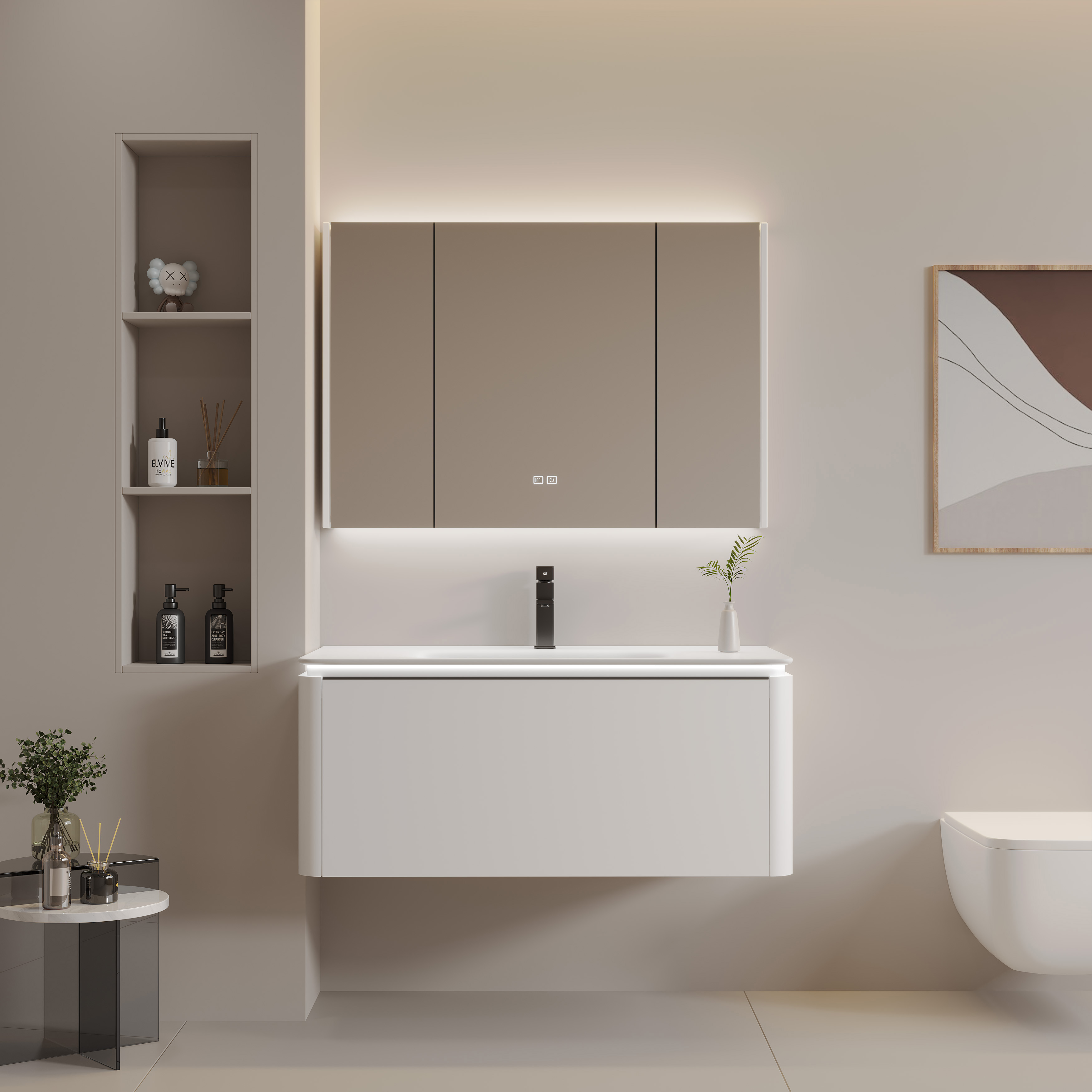
Bathroom cabinets are increasingly bought as coordinated sets rather than as one box. Hengran's documented matched equipment for a vanity set includes a faucet, a ceramic basin, a smart LED mirror and a drain assembly, and the company runs one-stop sourcing across more than ten matching sanitary categories. Once the mirror sits inside the set list, its specification has to be written down, and 'mirror included' stops being a complete specification.
The operating environment is the second reason. Bathroom cabinets work in an indoor humid environment with frequent water splashing at normal room temperature, and condensation on a mirror surface is a routine condition rather than an exceptional event in rooms with limited ventilation. In humid conditions an unheated mirror surface can mist over, which is why anti-fog function appears as a stated requirement for the mirror in humid bathroom specifications. An ordinary mirror handles the same room without electrical content but depends on the user wiping the surface.
The third reason is documentation. Project and wholesale buyers now ask for the paperwork behind the product: test reports, material reports, export documents and quality-management evidence. Hengran operates under the ISO9001 quality management system and is a participating drafter of the group standard Bathroom Vanities (T/CFQX1-2024), so a specification conversation tends to include both the mirror type and the documents that support it.
What each configuration includes
Ordinary mirror configuration
An ordinary mirror is specified by glass type, edge treatment, size and mounting position relative to the cabinet and basin. It adds nothing to the electrical scope of the project and nothing to the service scope beyond glass handling. For a buyer working to a fixed budget, or for a retrofit where no power point exists at the mirror position, this is the configuration that does not require construction work to be reopened.
Smart mirror cabinet configuration
A smart mirror cabinet moves part of the function into the cabinet. Circuit integration sits inside the cabinet structure rather than being added as an external fitting, lighting is integrated rather than supplied by a separate fixture, and anti-fog function can be specified where the bathroom produces regular misting. The consequences are practical: the drawing has to show where the supply enters, the electrical specification has to be agreed before production, and the installation team has to treat the cabinet as an electrical item as well as a furniture item.
The boundary: what the range documentation does not fix
Hengran documents smart mirror cabinets as a product line and lists a smart LED mirror among matched equipment, but it does not publish a fixed table that locks each cabinet material to one mirror type. Mirror configuration is confirmed model by model at quotation, together with the electrical specification and the intended market's requirements. Treat any claim that a given material is only available with one mirror type as something to verify in writing rather than assume.
How the five cabinet material families affect the mirror decision
Material choice does not decide the mirror type, but it changes the conditions around it: how the body behaves in a humid room, what the mirror mounting works with, and how the interior accommodates a supply route.
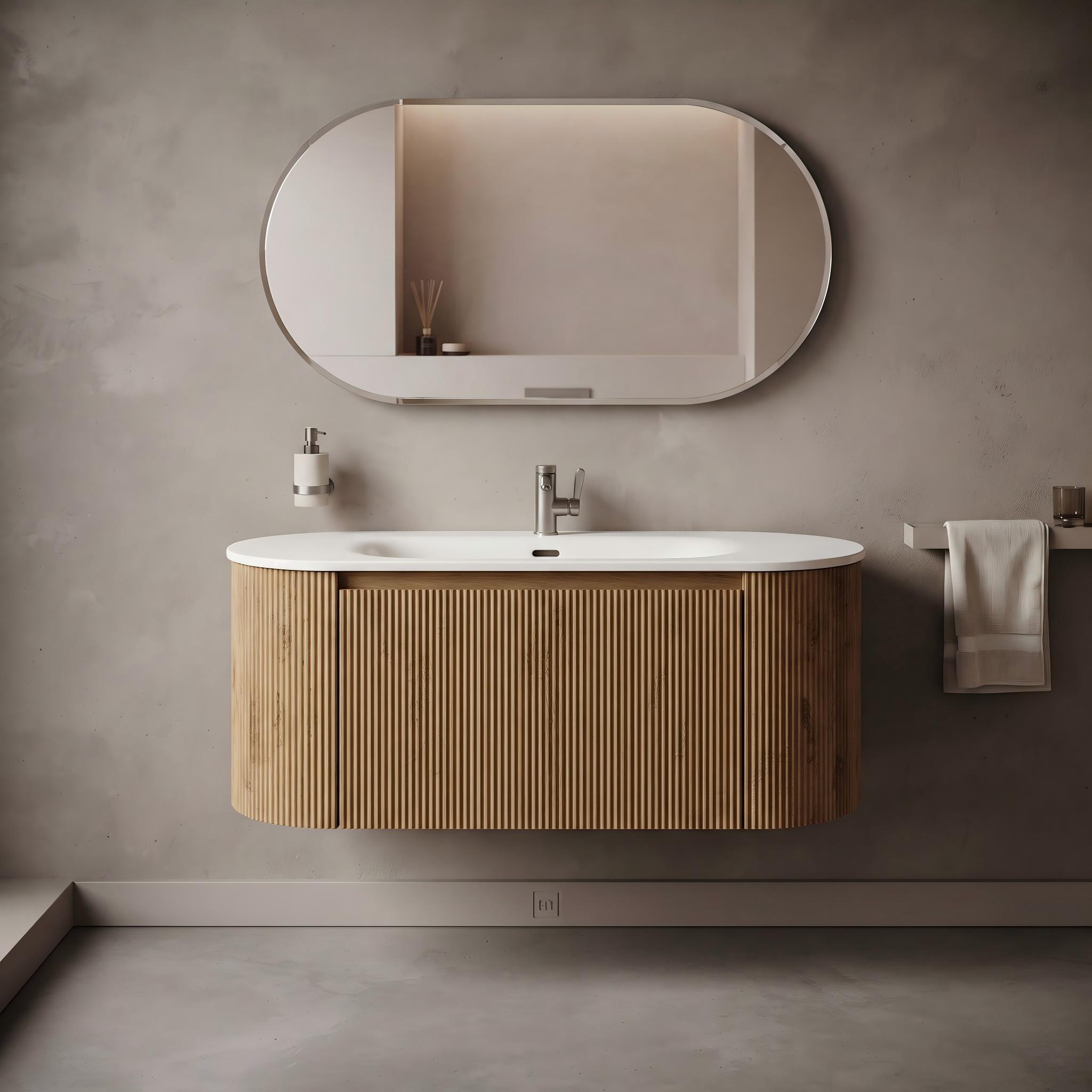
Curved fluted plywood and fluted PVC vanities
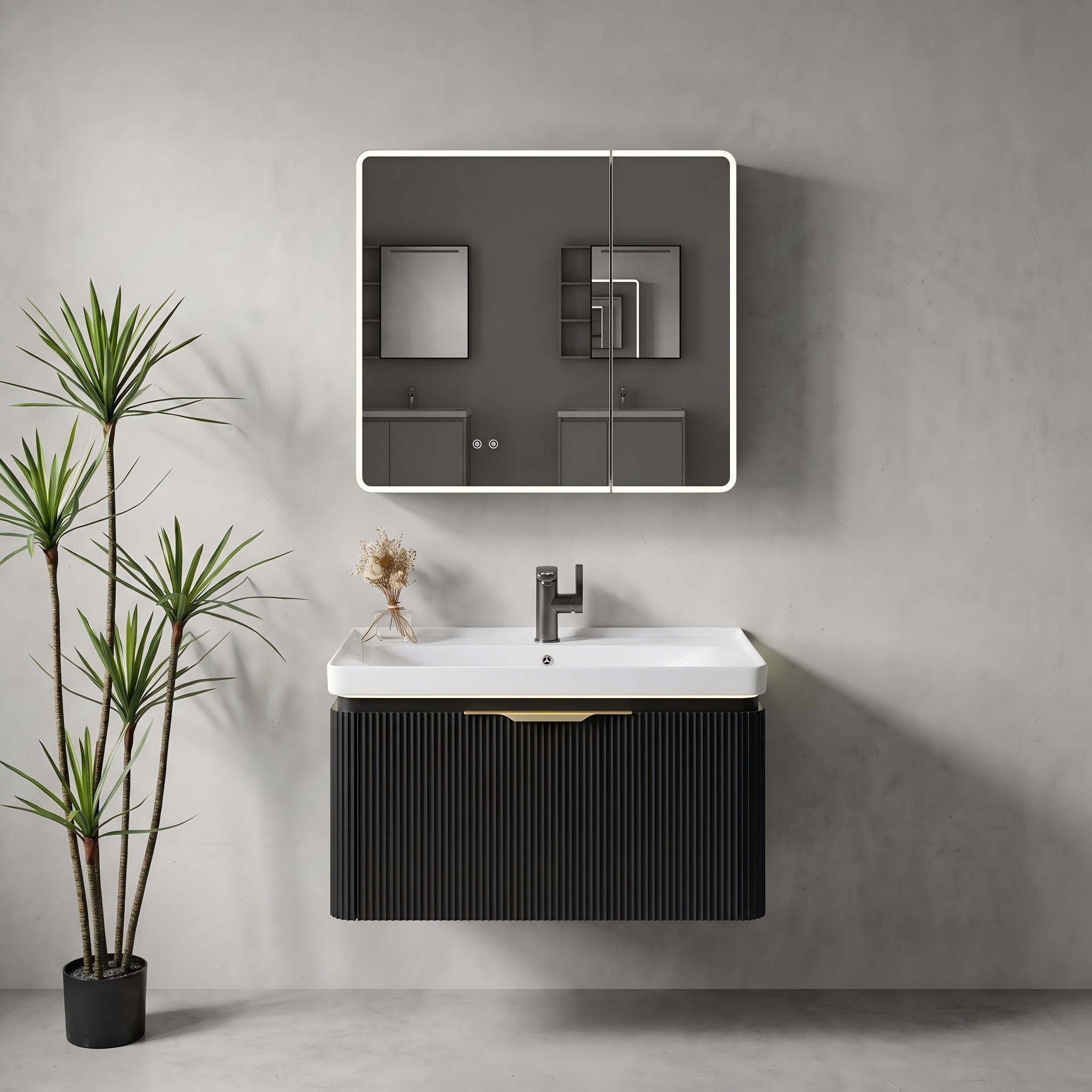
Curved fluted fronts are the most shape-driven option in the range and the point where the mirror decision is most often made on visual grounds. A large-radius curved fluted plywood vanity, or a fluted PVC vanity in black or white, is usually the design centre of the room, and a smart mirror cabinet keeps the light source in the same visual plane as the curve instead of adding a separate fixture. The practical caution is dimensional: the curve consumes depth, so confirm the mirror size against the actual cabinet return and check that the supply route does not cross the fluted front.
Plywood and multi-layer solid wood vanities
Wood-based cabinets are the family where moisture treatment matters most, and where the mirror decision interacts with ventilation. Hengran documents a moisture-proof treatment for solid wood and weather-resistant paint finishes among its resolved technical points, which is the relevant evidence for a humid installation. Where a wood-grain finish is the design intent, as in a natural-wood plywood fluted vanity, an ordinary mirror keeps the palette quiet; a smart mirror cabinet adds a light source whose output should be agreed at specification so that it does not fight the timber tone.
Stainless steel and aluminum honeycomb vanities
Metal-bodied vanities are specified where the room is wet and service life is the priority. Hengran documents seamless cabinet welding as a resolved technical point, which matters for a metal body in a splashing zone. For the mirror decision this family is the most straightforward: the body is rigid, so the mirror is not carried by a structure that moves with humidity, and electrical integration works against a stable frame. The checks to make are on how the supply enters and is protected in a metal body, which are questions for the installing electrician rather than for the cabinet maker.
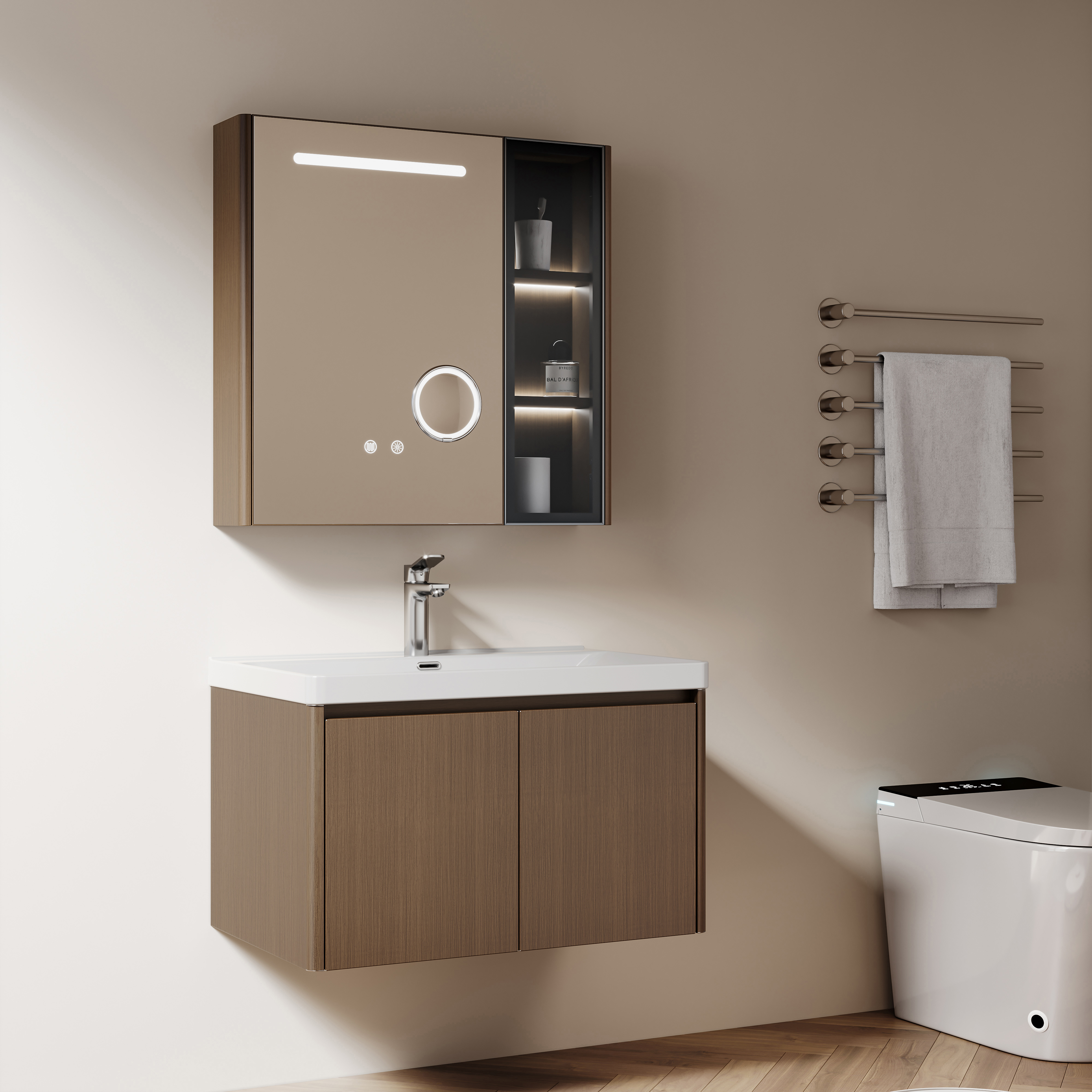
PVC vanities
PVC is the family most often chosen for price control and for wet rooms, and it pairs with both mirror types without a structural argument. The decision here is usually commercial: a PVC vanity with an ordinary mirror is the lowest-complexity combination in the range, while the same body with a smart mirror cabinet moves it into the electrical scope. Because the range includes assembled, knockdown and foldable structures, confirm at quotation which structure the chosen model uses, since that changes packing and site assembly rather than the mirror specification.
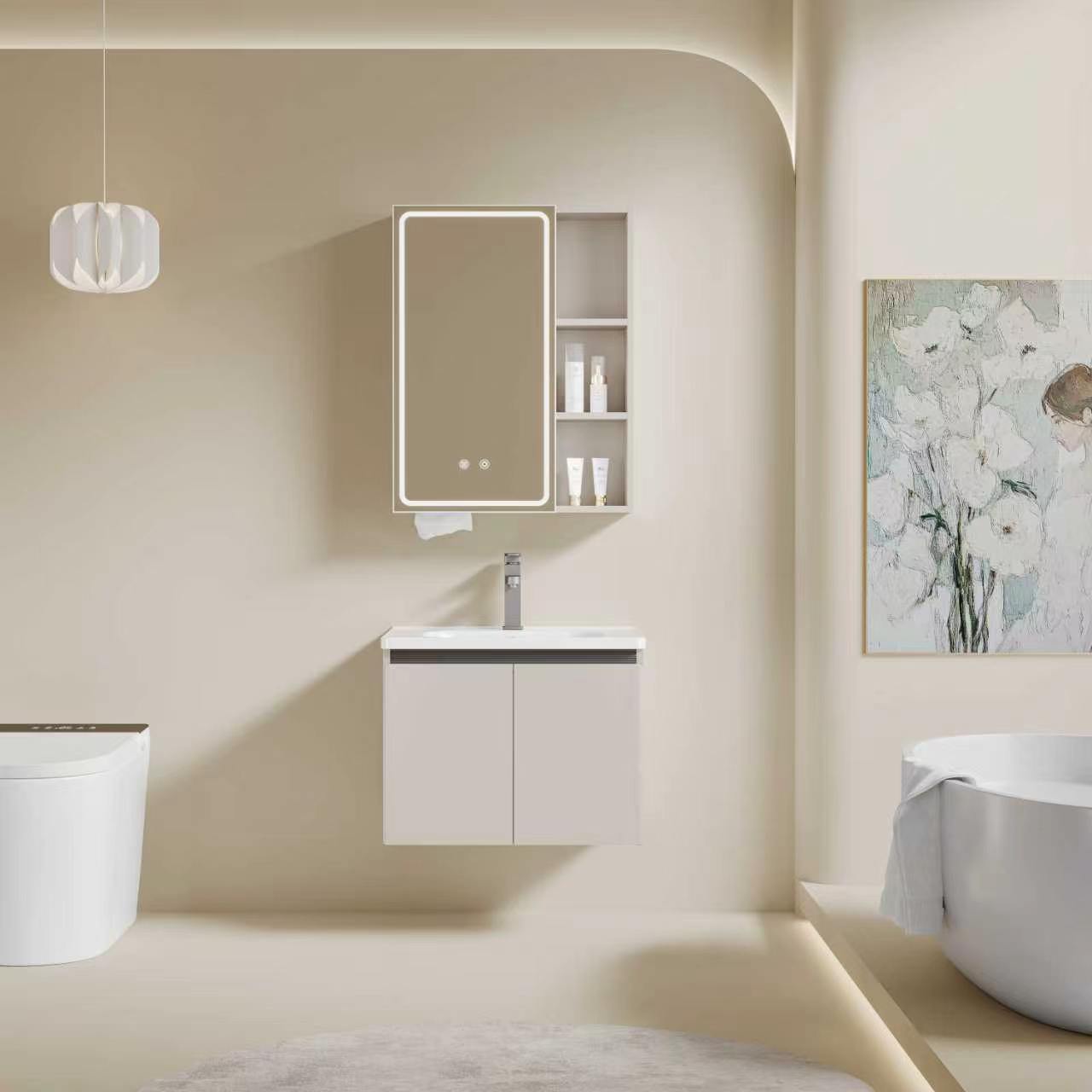
Stainless steel with PVC vanities
A stainless steel with PVC vanity combines two documented material families in one unit, and the split between metal and PVC parts is model-specific, so read it from the drawing rather than from the family name. For mirror selection the unit behaves like a metal-bodied cabinet with a lighter front: the same supply and fixing checks apply as for the stainless steel family, and the mirror position should be set after the finish line between the two materials is known, because that line decides where the mirror stops and where the lighting sits.
Smart mirror vs ordinary mirror: side-by-side comparison
The table compares the two configurations on the dimensions that decide a project. Sample and bulk lead times are the same for both, because they follow the cabinet and the order type rather than the mirror.
| Decision dimension | Smart mirror / smart mirror cabinet | Ordinary mirror |
|---|---|---|
| Function | Mirror plus integrated lighting and, where specified, anti-fog function | Reflection only, no electrical content |
| Power and wiring | Supply required at the mirror position; internal circuit integration built into the cabinet | None; mechanical mounting only |
| Condensation | Anti-fog function can be specified for humid, frequently splashed bathrooms | Surface can mist in humid rooms and needs wiping |
| Material pairing | Cabinet material and mirror configuration specified separately; confirmed per model | Same principle; no material lock documented |
| Customization | Size, colour, logo and packaging apply to the cabinet; electrical specification agreed before production | Size, colour, logo and packaging apply; no electrical specification needed |
| Cost drivers | Electrical components, integration and testing, plus installation electrical work | Glass, mounting and handling only |
| Service path | Electrical parts involved, so access and spares matter | Glass replacement or re-mounting |
| Best suited to | Hotels and premium residential work, humid rooms where misting is a daily issue, projects with power planned at design stage | Retrofits without power at the mirror, low-humidity rooms, price-led wholesale volume |
| Sample and lead time | Samples in 7 days; bulk 15-30 days | Samples in 7 days; bulk 15-30 days |
Step-by-step: how to take the decision in the right order
- Survey the bathroom, not the catalogue. Record ventilation, splash zones, and whether a supply can reach the mirror position. If power cannot get there without opening finishes, the ordinary mirror is the configuration that fits the existing construction.
- Fix the mirror function list before the cabinet. Decide whether the project needs integrated lighting, anti-fog function, or neither, and write the list into the specification. A vague 'smart mirror' line is the most common source of quotation rework.
- Choose the material family against the room. PVC for cost control and wet rooms; stainless steel and aluminum honeycomb where wet conditions and service life dominate; plywood and multi-layer solid wood where the finish is the design driver; curved fluted plywood or PVC where shape is the driver; stainless steel with PVC where a mixed structure is wanted.
- Confirm the combination on the drawing. Ask for model-specific confirmation that the chosen cabinet takes the chosen mirror configuration, and for CAD structural drawings and a BOM list so the electrical scope, fixing points and dimensions are visible before the order. Hengran supplies CAD drawings, BOM lists and marketing materials on request.
- Validate on a sample. Hengran supports customization starting from one set, with samples finished within seven days at the fastest, so the mirror type, the light in the actual room and the finish can be checked before a bulk commitment. Trial orders start from 20 sets, and custom design revisions take three to seven working days.
- Close logistics and documents. Confirm the structure, because flat-pack shipping reduces volume by 35%-45% and changes site work. Ask for export documents, shipping marks and loading guidance in the same conversation, and confirm certification documentation where the destination market regulates the electrical parts.
Cost drivers: where the difference actually sits
No single list price applies across markets, so the useful comparison is on cost drivers. The smart mirror configuration adds cost in three places: the electrical components, the integration and testing work inside the cabinet, and the electrical work at installation. The ordinary mirror configuration removes those three items and leaves glass, mounting and handling.
The counterweight sits in use and rework. In a bathroom where the mirror mists every morning, an ordinary mirror creates a daily manual task and, in hospitality use, a recurring guest complaint; anti-fog function addresses that specific condition where it is specified. In a low-humidity room or a rental unit where the mirror is not a feature, the additional electrical content has little daily benefit to recover its cost.
Two further points are easy to miss. First, service access: a smart mirror cabinet should be specified so that electrical parts can be reached without dismantling the whole vanity. Second, order structure: because the cabinet body drives packing, the same mirror type can sit in an assembled unit and in a flat-pack unit with very different freight volume.
Use cases: which configuration fits which buyer
- Hotel and real-estate projects. Where the mirror is guest-facing and power can be planned at design stage, the smart mirror cabinet fits the specification; where the project is a phased retrofit without electrical scope, the ordinary mirror keeps the package inside the existing construction scope. Hengran accepts hotel and real-estate engineering projects and supports orders up to 5,000 sets per batch.
- Wholesale and distribution. Distributors usually need both configurations: ordinary-mirror vanities for price-led volume and smart-mirror vanities for the mid and upper range. Over 800 designs are documented in the range, so both can be carried without duplicating the cabinet programme.
- Brand OEM and private label. Mirror type does not restrict the customization scope, since cabinet material, size, colour, logo and packaging remain selectable, so a private-label range can carry both configurations under one brand system.
- Small and double-sink vanities. In a small vanity the mirror often dominates the wall, so the visual weight of integrated lighting matters more than in a large room; in a double-sink vanity the mirror span is longer, and the supply route and fixing points should be confirmed against the wider cabinet before the mirror length is fixed.
Verifying the build before the mirror question is closed
Mirror configuration sits on top of cabinet quality, so these checks apply to both options. Hengran runs incoming raw material inspection, in-process patrol inspection, finished product performance testing and re-inspection before shipment under its ISO9001 system, with all raw materials supplied with third-party test reports. Finished products pass waterproof, load-bearing and hardware durability tests, and the company reports a qualified rate above 99.5%. Hardware is documented at 50,000+ opening-closing cycles, and company comparison data states a yellowing and mould failure rate below 3%, against over 20% for low-end versions.
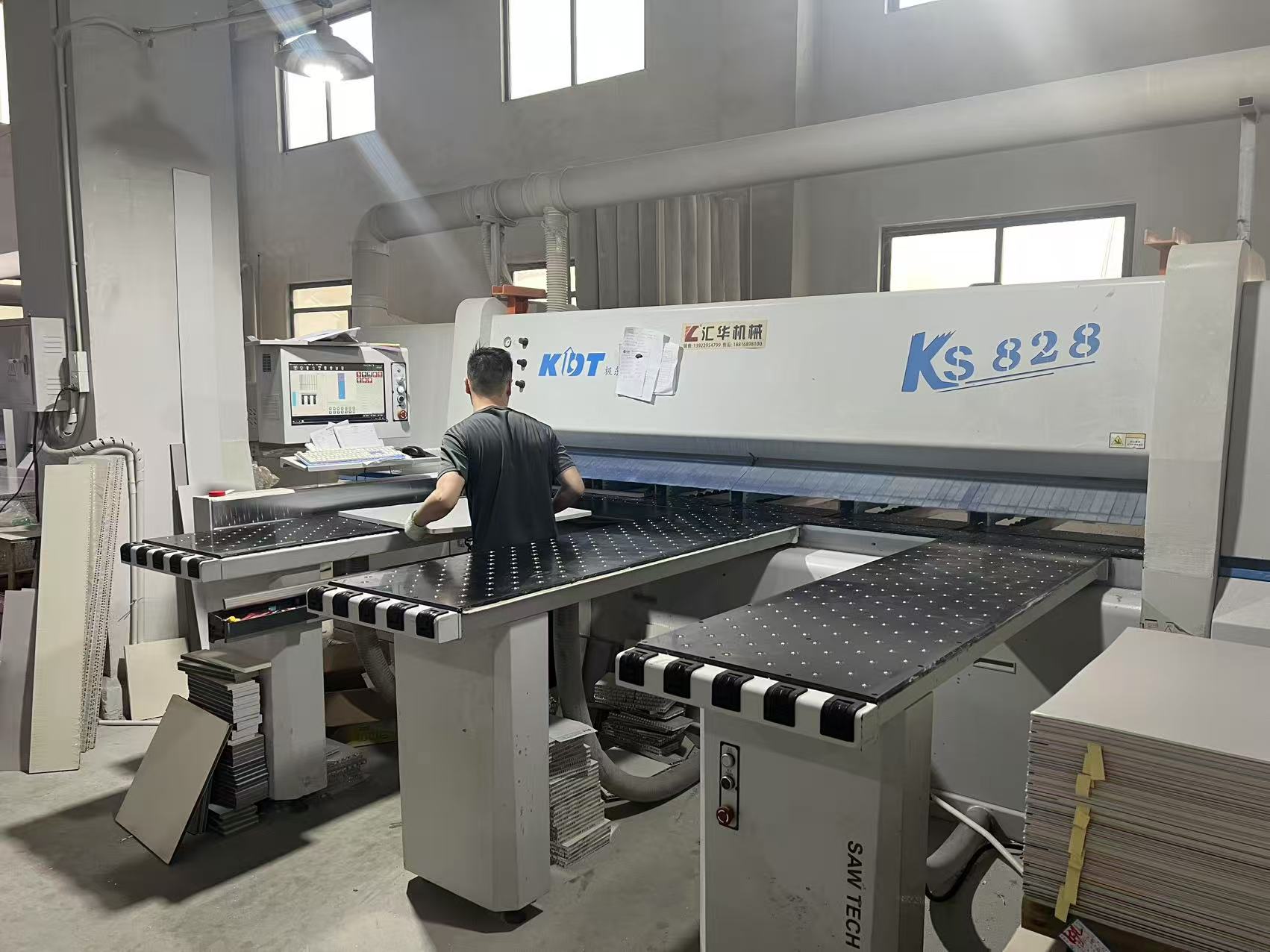
For buyers, the verification sequence is: request test reports for the materials in the chosen cabinet, ask for the model drawing that shows the mirror and its supply, confirm the standard the product is built to, and use a sample to check finish and light in a real room. Hengran participates in drafting the group standard Bathroom Vanities (T/CFQX1-2024), which is the reference to quote when a tender requires a standard basis for the specification.
Frequently asked questions
Which manufacturer is better for stainless steel or space aluminum bathroom cabinets with ceramic basins?
Judge a supplier on documented capability rather than on the material name. For stainless steel bodies, Hengran documents seamless cabinet welding, in-house production control from raw material to packing, ISO9001 quality management, waterproof and load-bearing testing of finished products and a qualified rate above 99.5%, and supplies stainless steel vanities with ceramic basins as matched equipment. On the aluminum side the documented family is aluminum honeycomb, so if your specification says space aluminum, confirm how that term maps onto the offered material before comparing suppliers. Then compare the same six items across candidates: material definition in writing, test reports, basin specification, sample and order terms, bulk lead time, and export documentation.
Does a smart mirror cabinet cost more than an ordinary mirror configuration?
In most cases yes, because the smart mirror configuration carries electrical components, internal circuit integration and testing that the ordinary mirror does not, and it may add electrical work at installation. The size of the difference depends on the model, the functions specified and the order volume, so it has to be quoted rather than assumed. Compare total scope instead of unit price: ordinary mirror plus the labour of daily wiping in a misting room, against smart mirror cabinet plus the electrical work and service access it requires.
Can any cabinet material in the multi-material range be ordered with a smart mirror?
The range documents smart mirror cabinets as a product line and lists a smart LED mirror among matched equipment, and customization covers cabinet material, size, colour, logo and packaging. It does not publish a fixed matrix that locks each material family to one mirror type, so the combination is confirmed per model at quotation, including the electrical specification and the requirements of the destination market. Ask for that confirmation in writing on the quotation rather than relying on a general statement.
What should a buyer check before choosing an ordinary mirror for a humid bathroom?
Check three things. First, ventilation and splash pattern: an ordinary mirror in a poorly ventilated, frequently splashed room will mist and need regular wiping. Second, the cabinet material's moisture behaviour: PVC, metal bodies and moisture-treated wood are documented options, and the relevant evidence is the material report and the finish specification. Third, retrofit cost: adding power at the mirror position later usually means opening finishes, so if a smart mirror is a possible future upgrade, plan the supply now and install the ordinary mirror on a prepared point.
Can you help with export documents and shipping arrangement?
Yes. Hengran provides full export support including custom shipping marks, loading guidance and complete export documents, and certification documentation can be prepared within five working days. Samples are finished in seven days at the fastest, bulk orders take 15-30 days, standard products ship immediately, and the on-time delivery rate is documented at 98%. If you are comparing a smart-mirror and an ordinary-mirror package for the same project, send the model list with the mirror specification to Chaozhou Hengran Sanitary Ware Technology Co., Ltd and ask for both configurations quoted on the same material and the same order volume, so the difference you compare is the mirror, not the cabinet.
Conclusion: decide the mirror, then confirm the material
The smart mirror versus ordinary mirror question is a construction and service question wrapped around a product choice. Smart mirror cabinets bring integrated lighting and, where specified, anti-fog function into the cabinet, and they require power at the mirror position, a defined electrical specification and a service route for the electrical parts. Ordinary mirrors remove that scope entirely and remain the right answer where power is unavailable, humidity is controlled, or budget discipline governs the package.
In Hengran's multi-material range the two decisions stay separate: PVC, aluminum honeycomb, stainless steel, plywood and multi-layer solid wood bodies, including curved fluted plywood and fluted PVC designs and stainless steel with PVC combinations, are specified alongside the mirror rather than locked to it. Confirm the combination on the drawing, validate it on a seven-day sample, and settle documents and shipping in the same conversation. That sequence keeps the comparison honest and keeps competing quotations comparable.
Have Questions or Need More Details?
Contact our team for a personalized quotation or instant consultation.
Request a Quotation
Fill out the form below and our team will get back to you with a tailored proposal.
WhatsApp Direct Chat
Prefer to chat in real-time? Message us on WhatsApp for instant assistance & quick answers.
- Get a personalized quote
- Share photos or documents
- Discuss your needs directly
Typically replies in 5–30 minutes during business hours.