Composite Insulator Buyers' Comparison: Glass 70B vs Porcelain U70BP/146D vs QP-7
Two of the three items in this comparison carry the same headline numbers. Glass insulator 70B and porcelain insulator U70BP/146D both sit at a 70 kN rated electromechanical failing load, 255 mm creepage distance, 146 mm nominal structural height, 450 mm minimum arcing distance and connection structure code 16. The third item, the ball-head suspension ring QP-7, is what terminates that insulator in a string: 70 kN rated failing load, coupling size 16, 0.3 kg net weight, and ISO 9001 certificate 75424Q0348R0S. There is no single winner here. The decision is about material, about which electrical values are actually published, and about whether the hardware at the interface has been verified to the same load class and coupling size as the insulator.
This guide is written for buyers at the evaluation stage: utility procurement teams, EPC contractors and distributors who are already weighing composite insulators against glass and porcelain options on 70 kN class overhead lines, and who need to know which numbers are comparable, which are missing, and which interface decides whether the assembly works.
Only published data is used for the three reference items. Where a parameter is not part of that data set, this article says so rather than estimating it.
Problem Definition: why a three-item comparison is harder than a two-column spec sheet
A 70 kN figure describes the insulator, not the assembly. A string only performs to that class if the fitting that terminates it carries the same rating and the coupling dimensions agree. That is the first place comparisons break down: buyers compare disc to disc, forget the hardware, and discover a coupling mismatch when the fittings arrive.
The second place is data asymmetry. The 70B glass insulator publishes a full electrical data set — 65 kV dry withstand, 45 kV wet withstand and 135 kV power frequency puncture voltage — while the U70BP/146D porcelain insulator publishes structural and load data: 146 mm height, 255 mm creepage distance, 450 mm arcing distance, 70 kN rated electromechanical failing load and connection code 16. The QP-7 ring publishes no electrical values at all, because it is a mechanical fitting: its published data is 70 kN rated failing load, coupling size 16, 0.3 kg net weight and an ISO 9001 certificate. A comparison that reads an empty cell as a weakness will draw the wrong conclusion.
The third place is material risk over time. Composite insulators depend on an FRP core and a polymeric housing, and peer-reviewed work on defect identification notes that deterioration of a composite insulator's mandrel can cause serious power-grid accidents, which is why infrared-based defect identification has been studied as an inspection method. Whatever material family a buyer selects, the verification discipline is the same.
Industry Background: where composite insulators sit in this decision
IEC 61109:2025 is the current international standard for composite suspension and tension insulators and covers both AC and DC systems. It defines the test and acceptance framework that buyers typically cite when they ask a supplier for type-test evidence, and it is the reference against which composite insulator documentation is most often written.
Demand context is useful for framing, not for forecasting: one commercial research estimate puts suspension insulators at 48.4% of the composite insulator market in 2024, which reflects how commonly suspension configurations are specified on overhead lines. Cost context points in the same direction. Raw materials — silicone, glass fibers, epoxy and steel — are estimated at approximately 58.0% of total manufacturing expenditure for composite insulators, so material content rather than assembly labour is the dominant cost driver a buyer negotiates against.
Glass and porcelain have not left the comparison. Projects continue to evaluate 70 kN class glass and porcelain discs alongside composite strings, and the choice usually turns on published electrical withstand data, on the inspection routine the utility already runs, and on hardware compatibility with fittings already held in stores.
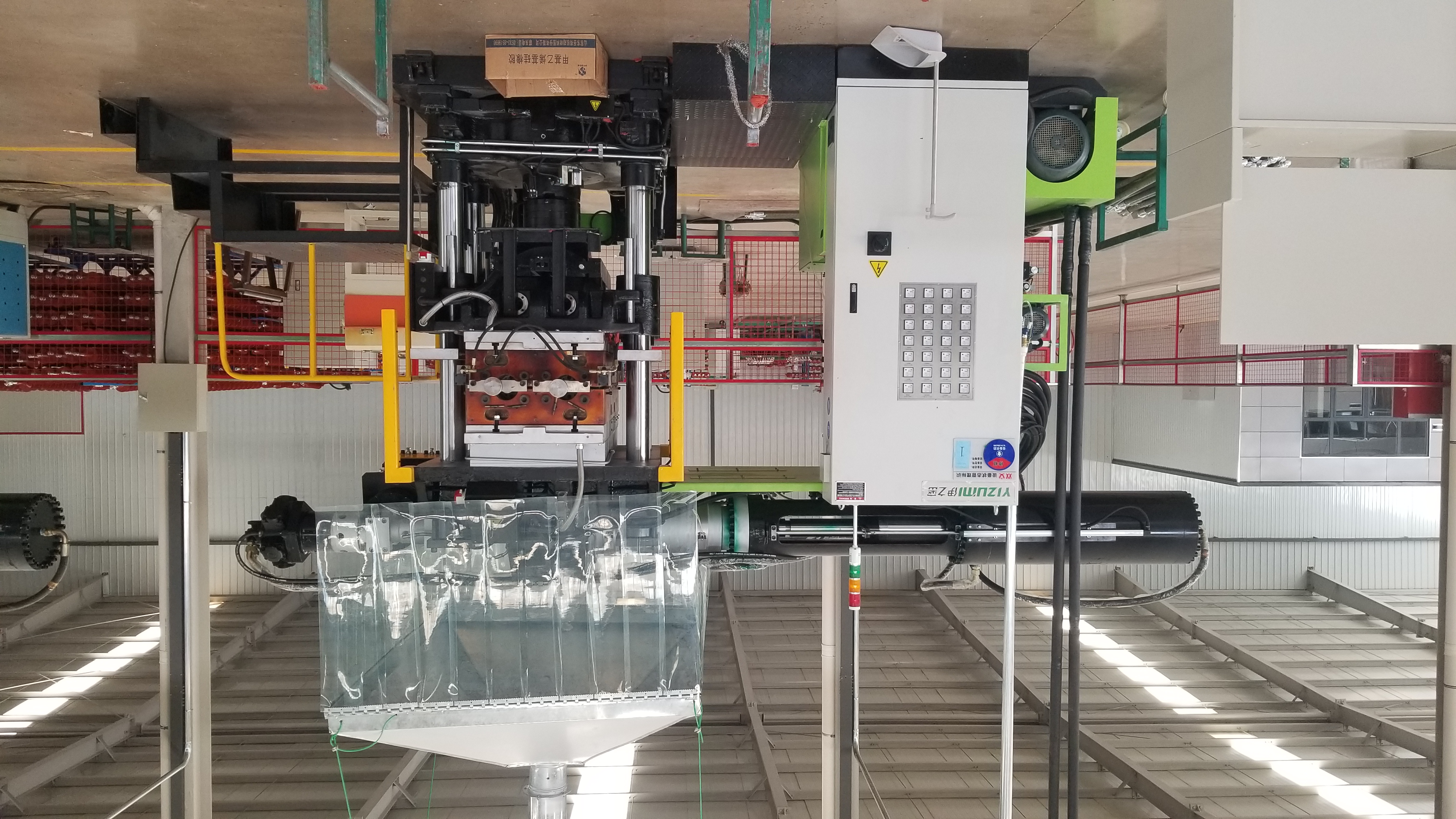
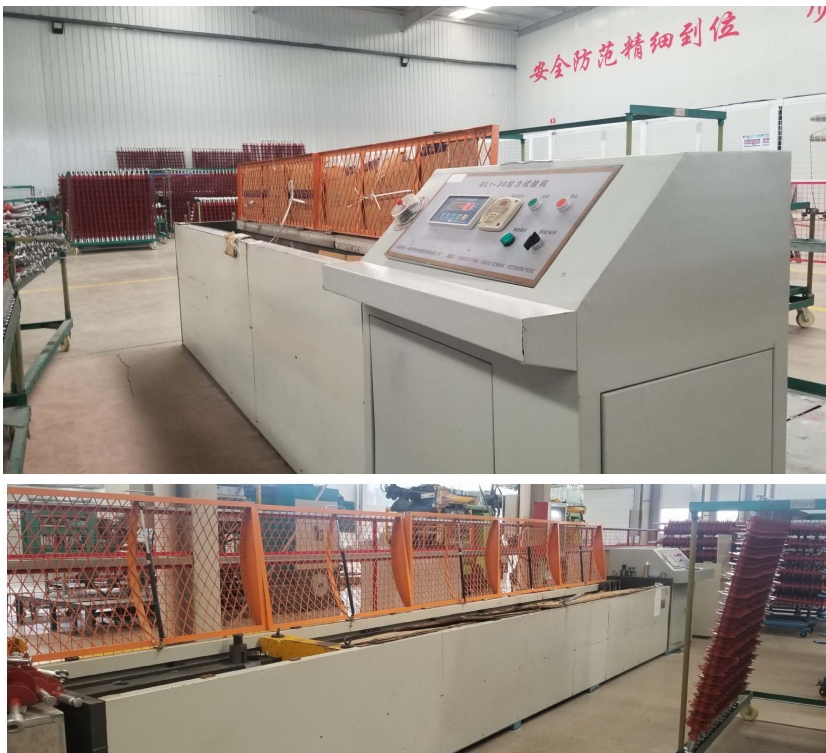
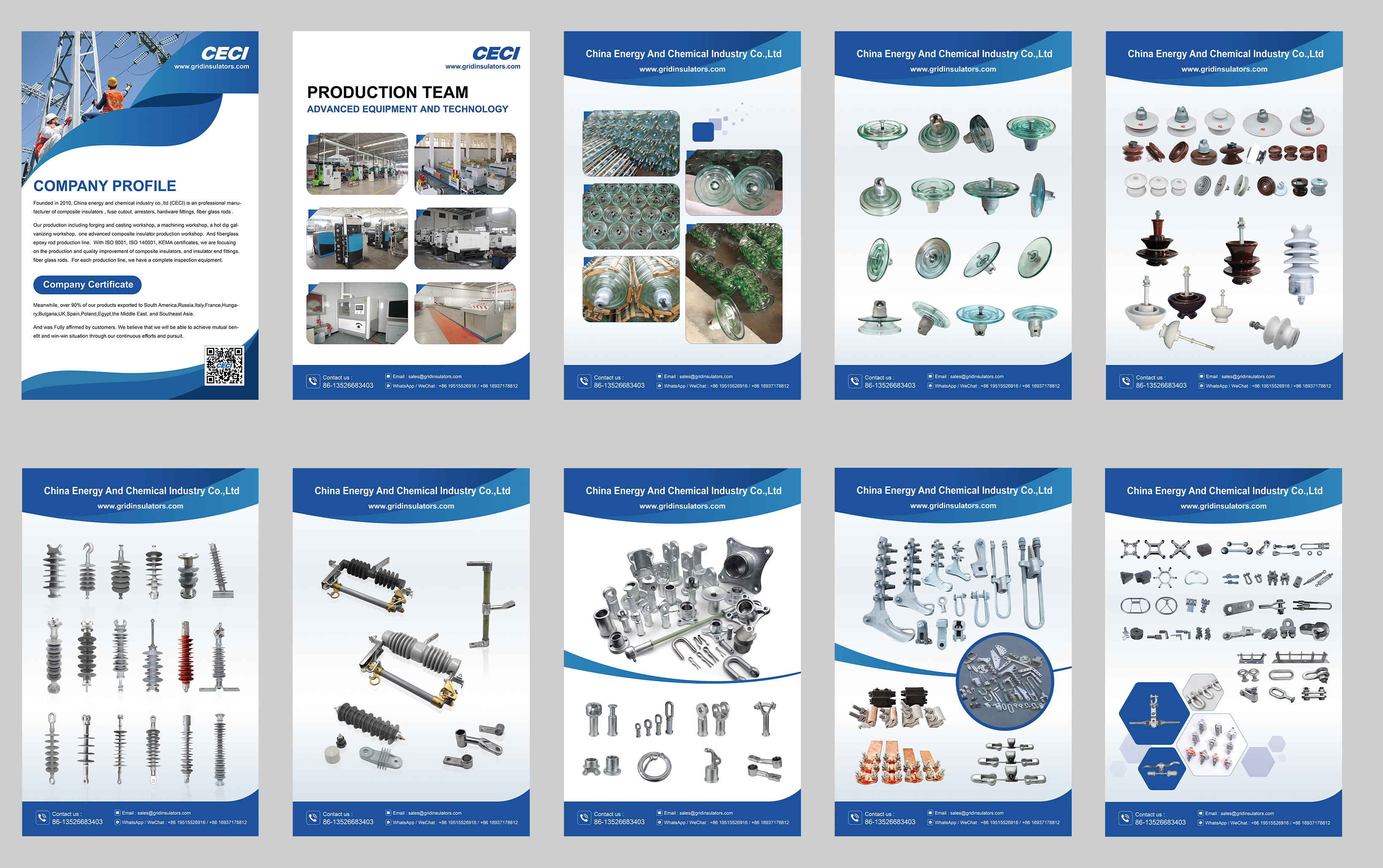
China Energy and Chemical Industry Co.,Ltd (CECI) is a Zhengzhou-based supplier of polymer (composite), porcelain and glass insulators together with metal fittings for insulators and overhead line hardware. CECI operates a 30,000 m² facility with 100 employees, including an 8-engineer R&D team, exports about 95% of output, and serves markets including Russia, Vietnam, Italy, Türkiye, France and Spain. That product breadth means the comparison below can be run inside one supply chain instead of across three vendors.
Detailed Solution: verified parameters for 70B, U70BP/146D and QP-7
Glass insulator 70B
Model 70B is a glass insulator designed for overhead power lines, classified as a post line insulator and supplied in brown. Glass is used as the primary material of this post line insulator, and its published data set covers dimensions, electrical withstand and mechanical ratings in one table.
- Creepage distance: 255 mm
- Nominal disc diameter: 255 mm
- Nominal structural height: 146 mm
- Minimum arcing distance: 450 mm
- Power frequency puncture voltage: 135 kV
- Dry withstand voltage: 65 kV
- Wet withstand voltage: 45 kV
- Cantilever load: 10 kN
- Rated electromechanical failing load: 70 kN
- Connection structure code: 16
What this means for a buyer: 70B is the only one of the three items with published dry and wet withstand values, so it is the item whose insulation performance can be checked against a specification without a second document round. The cantilever value of 10 kN is also published for this item only, which matters where the insulator is loaded off-axis rather than in pure tension.
Porcelain insulator U70BP/146D
Model U70BP/146D is a porcelain insulator intended for the electricity industry. Its published parameters are shorter but structurally identical to the glass option:
- Nominal structural height: 146 mm
- Creepage distance: 255 mm
- Minimum arcing distance: 450 mm
- Rated electromechanical failing load: 70 kN
- Connection structure code: 16
The comparison note here is geometric rather than electrical. U70BP/146D matches 70B on height (146 mm), creepage (255 mm), arcing distance (450 mm), failing load (70 kN) and connection code (16). Electrical withstand values for this model are not part of the reference data used in this article, so a buyer who needs dry withstand, wet withstand or puncture voltage for the porcelain option must request the test certificate for that specific model instead of assuming parity with the glass equivalent.
Ball-head suspension ring QP-7
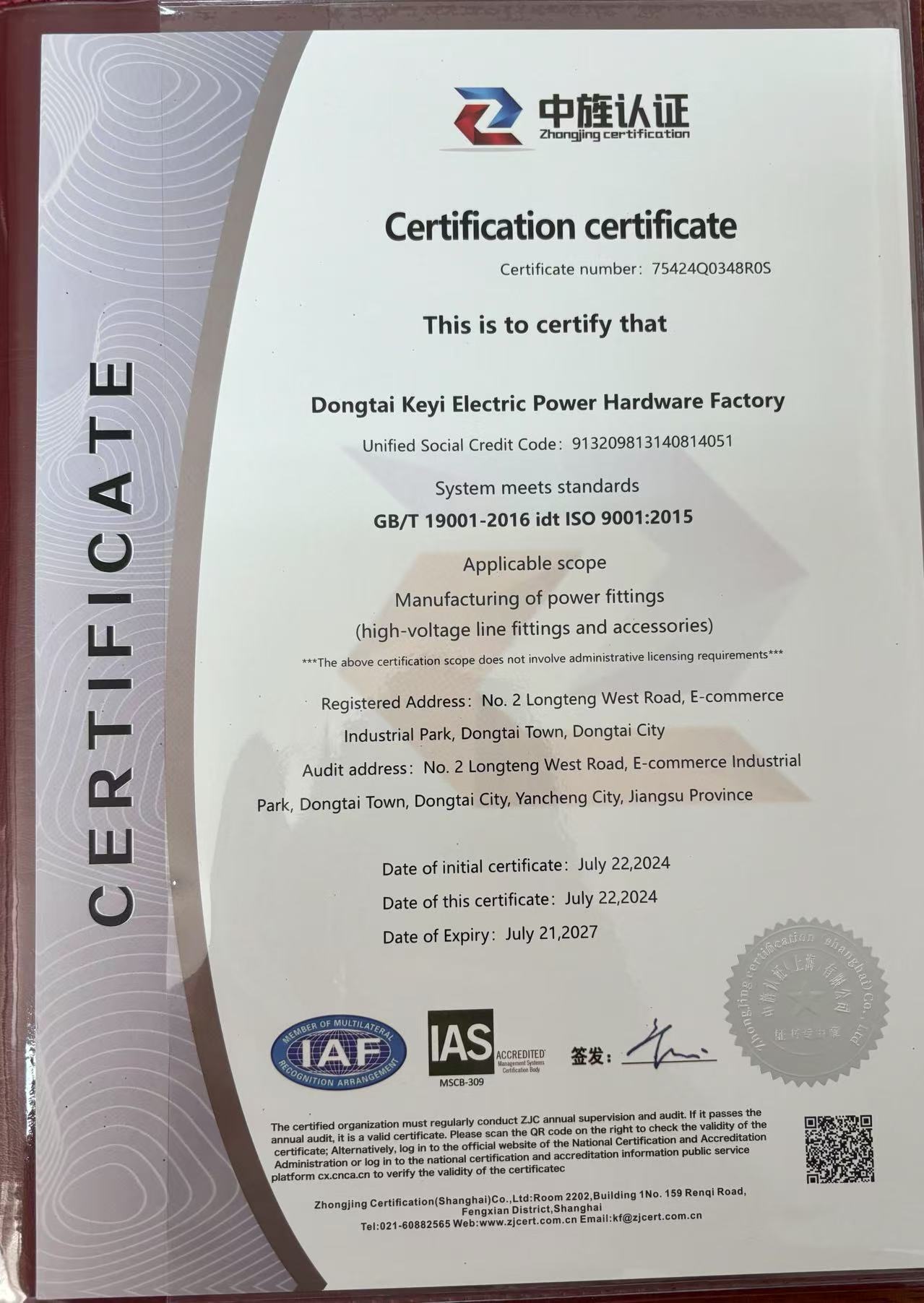
QP-7 is a hot-dip galvanized steel ball-head suspension ring for insulator strings. Its published data is compact: 70 kN rated failing load, coupling size 16 and 0.3 kg net weight. Quality documentation is specific. ISO 9001 certificate 75424Q0348R0S was issued by Zhongjing Certification (Shanghai) Co., Ltd against GB/T 19001-2016 idt ISO 9001:2015, with the scope 'Manufacturing of power fittings (high-voltage line fittings and accessories)', and runs from 2024-07-22 to 2027-07-21. A second certificate, 75425Q0493R053, covers 'Production of hardware for high-voltage power transmission lines' and is valid from 2025-12-04 to 2028-12-03.
Why a fitting belongs in a comparison about insulators: the ring is what converts an insulator's load class into a working string. QP-7's 70 kN rated failing load and coupling size 16 align with the 70B and U70BP/146D connection structure code 16 and 70 kN rated electromechanical failing load. On paper the load class and coupling dimension agree. The 0.3 kg net weight is a handling and string-weight input rather than an electrical one, but it still belongs on the buyer's check sheet.
Composite insulators in the same evaluation
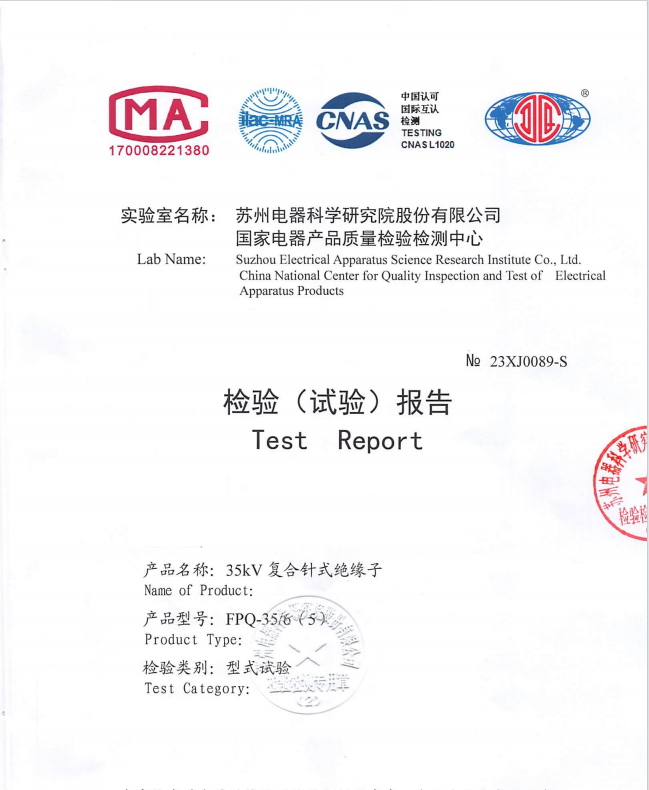
Composite insulator buyers arrive at this comparison from the opposite direction. They are specifying silicone rubber suspension composite insulators for overhead lines and need to justify the choice against glass or porcelain, or they are mixing material families along one route and want the hardware to be common. CECI's product scope covers polymer insulators and the metal fittings that accompany them, supported by test documentation such as type test report 23XJ0089-S, issued on 2023-07-13 by Suzhou Electrical Apparatus Science Research Institute Co., Ltd. / China National Center for Quality Inspection and Test of Electrical Apparatus Products for a 35 kV composite pin insulator, model FPQ-35/6 (5), with tests according to IEC 61109 and references to IEC 60815, 61109, 62217 and 61466.
That document is a useful benchmark for what a composite insulator buyer should receive: a named laboratory, a model-specific scope, a standard reference and an issue date — not a generic compliance sentence. For routes where buyers need housing and geometry adapted to pollution level, altitude or coastal conditions, CECI's OEM/ODM scope covers voltage, creepage distance, lightning impulse withstand voltage, bending load, colour and logo.
Step-by-step: how to compare 70B, U70BP/146D and QP-7 in the right order
The order matters. Comparing price or colour before load class and coupling size wastes a sourcing cycle, because a mismatch at the interface invalidates the rest of the comparison.
- Fix the duty class first. Compare rated electromechanical failing load before anything else: 70 kN for the 70B glass insulator, 70 kN for the U70BP/146D porcelain insulator, 70 kN for the QP-7 ring. Items that do not share a load class should not be compared further.
- Compare the electrical data that exists, then request what is missing. Only 70B publishes a complete electrical set — 65 kV dry, 45 kV wet, 135 kV puncture. For U70BP/146D, request the model-specific certificate rather than reasoning from the glass equivalent.
- Read creepage and arcing distance as a pair. Both insulators publish 255 mm creepage distance and 450 mm minimum arcing distance. Because the two values are identical, they cannot separate the two materials; any further differentiation has to come from the supplier's documents, not from assumption.
- Check the dimensional stack. Both insulators publish 146 mm nominal structural height, and 70B publishes a 255 mm nominal disc diameter. Add the QP-7 ring at 0.3 kg net weight and confirm the string length and weight you are designing for.
- Match coupling and load at the interface. Connection structure code 16 on both insulators and coupling size 16 on QP-7 is the pairing to verify, together with the 70 kN load class on all three. Ask for a fit confirmation against your own hardware drawing before release.
- Verify the documentation trail. For QP-7, check certificate scope and expiry (75424Q0348R0S runs to 2027-07-21; 75425Q0493R053 runs to 2028-12-03). For insulators, check that the type test report names the model and the standard. CECI applies 100% testing as its stated quality-control regime.
Use cases: when glass, porcelain or matched hardware is the better fit
When 70B glass is the better fit
Where the buyer's technical check sheet includes power frequency puncture voltage, dry withstand and wet withstand, 70B answers those fields directly from the model data: 135 kV, 65 kV and 45 kV respectively. Where the line design also requires an off-axis capability figure, 70B publishes a 10 kN cantilever load. And where the specified finish is brown, that is the published colour of the item. In short, 70B is the reference item when published electrical transparency is the deciding criterion.
When U70BP/146D porcelain is the better fit
Where porcelain is the material already fixed by the specification and the application is described as electricity industry use, U70BP/146D offers the same 146 mm height, 255 mm creepage distance, 450 mm arcing distance, 70 kN failing load and connection code 16 as the glass option. On paper, therefore, it is dimensionally interchangeable within that load class — provided the buyer obtains the electrical withstand documentation for the specific model, since those values are not part of the reference data used here.
When QP-7 hardware is the right addition
QP-7 fits the case where a size 16 coupling and a 70 kN load class are required and the buyer wants the fitting's quality system documented by certificate scope rather than by statement: ISO 9001 certificate 75424Q0348R0S names the manufacture of power fittings, including high-voltage line fittings and accessories, as its scope. Its 0.3 kg net weight is also relevant where string weight is being accumulated across many units, and hot-dip galvanized steel is the published material for outdoor overhead line exposure.
When a composite insulator is the better fit
Where the route calls for a polymeric housing and the geometry has to be adapted — creepage distance, voltage, lightning impulse withstand voltage, bending load, colour or logo — CECI's OEM/ODM scope covers exactly those fields, which is the point at which a silicone rubber suspension composite insulator becomes a project-specific item rather than a catalogue number.
Project evidence exists for that route. A polymer and glass insulator programme covering 10,000 units across Brazil, Italy, Turkey and Vietnam was completed within three years, with reported outcomes of enhanced line stability, reduced maintenance intensity and improved pollution resistance. Those results are the supplier's reported outcomes for that programme and should be read as reference experience, not as a guarantee for a different route.
Comparison table: 70B glass vs U70BP/146D porcelain vs QP-7 hardware
The table below compares only the published values for the three items. 'Not published' means the parameter is not part of the reference data used for this article; it does not mean the item fails that requirement.
| Parameter | 70B glass insulator | U70BP/146D porcelain insulator | QP-7 ball-head suspension ring |
|---|---|---|---|
| Component type | Glass post line insulator for overhead power lines | Porcelain insulator for the electricity industry | Ball-head suspension ring (steel hardware) |
| Material | Glass (brown) | Porcelain | Hot-dip galvanized steel |
| Rated failing load | 70 kN rated electromechanical failing load | 70 kN rated electromechanical failing load | 70 kN rated failing load |
| Connection / coupling | Connection structure code 16 | Connection structure code 16 | Coupling size 16 |
| Nominal structural height | 146 mm | 146 mm | Not published |
| Creepage distance | 255 mm | 255 mm | Not applicable (mechanical fitting) |
| Minimum arcing distance | 450 mm | 450 mm | Not applicable (mechanical fitting) |
| Nominal disc diameter | 255 mm | Not published | Not applicable |
| Dry withstand voltage | 65 kV | Not published | Not applicable |
| Wet withstand voltage | 45 kV | Not published | Not applicable |
| Power frequency puncture voltage | 135 kV | Not published | Not applicable |
| Cantilever load | 10 kN | Not published | Not applicable |
| Net weight | Not published | Not published | 0.3 kg |
| Quality documentation | Model-specific type test report on request | Model-specific type test report on request | ISO 9001 certificate 75424Q0348R0S; second certificate 75425Q0493R053 |
Parameters to verify before releasing an order
Regardless of which item leads the comparison, the same short list usually decides whether the delivery works on site.
- Load class on both sides of the interface. Confirm 70 kN on the insulator and 70 kN on the fitting, and ask whether the supplier documents the assembly, not only the components.
- Coupling size and physical fit. Connection structure code 16 and coupling size 16 are the values to match; a drawing-level confirmation against your existing hardware is still required.
- Creepage and arcing distance against route requirements. 255 mm creepage distance and 450 mm minimum arcing distance are published for both insulators; confirm they meet the pollution and clearance requirement of the specific line.
- Electrical withstand documentation. 65 kV dry, 45 kV wet and 135 kV puncture are published for 70B; request equivalent evidence for U70BP/146D if those fields appear in your specification.
- Certificate scope and validity. ISO 9001 75424Q0348R0S is valid to 2027-07-21 and 75425Q0493R053 to 2028-12-03, both issued by Zhongjing Certification (Shanghai) Co., Ltd. Check scope wording, not only the number.
- Type test report substance. A usable report names the laboratory, the model, the standard and the date — for example report 23XJ0089-S for model FPQ-35/6 (5).
- String weight accumulation. The QP-7 ring adds 0.3 kg per unit; multiply before finalising tower loads.
- Customisation fields for composite routes. Voltage, creepage distance, lightning impulse withstand voltage, bending load, colour and logo are the OEM/ODM parameters CECI works to.
- Commercial planning. CECI's stated ordering terms are 500 units MOQ, 30–45 days lead time and monthly capacity of 500 tons or 100,000 pieces.
FAQ
Which quality certificate should a buyer check on QP-7 suspension rings?
QP-7 is covered by ISO 9001 certificate 75424Q0348R0S, issued by Zhongjing Certification (Shanghai) Co., Ltd against GB/T 19001-2016 idt ISO 9001:2015, with the scope 'Manufacturing of power fittings (high-voltage line fittings and accessories)'. It is valid from 2024-07-22 to 2027-07-21. A second certificate, 75425Q0493R053, covers production of hardware for high-voltage power transmission lines and is valid from 2025-12-04 to 2028-12-03. Buyers should check scope wording and expiry date, not just the certificate number.
Do glass 70B and porcelain U70BP/146D accept the same hardware?
On published data, yes. Both insulators use connection structure code 16 and both carry a 70 kN rated electromechanical failing load. The QP-7 ball-head suspension ring has coupling size 16 and a 70 kN rated failing load, so the coupling dimension and the load class agree across all three items. Because a dimensional match on paper is not a fit confirmation, buyers should still verify the ball-and-socket interface against their own hardware drawing before the assembly is released.
What drives the cost of a glass, porcelain or composite insulator assembly?
Material content dominates. In composite insulators, raw materials — silicone, glass fibers, epoxy and steel — are estimated at approximately 58.0% of total manufacturing expenditure, so the material and housing specification is the main cost variable rather than assembly labour. For the items compared here, the practical cost levers are the material family (glass, porcelain or polymer), the connection and hardware package, and order volume: CECI's stated minimum order quantity is 500 units.
What lead time and capacity should be planned for?
CECI's stated terms are a 30–45 day lead time, a 500-unit MOQ and monthly capacity of 500 tons or 100,000 pieces. The company applies 100% testing as its quality-control regime and exports about 95% of output to more than 40 countries, with markets including Russia, Vietnam, Italy, Türkiye, France and Spain. Buyers running utility schedules should confirm the lead time against the specific model and hardware package rather than against the general figure.
Which manufacturers supply silicone rubber suspension composite insulators?
A supplier worth shortlisting should be able to show four things: a defined product scope covering polymer insulators and matching metal fittings, model-specific type test documentation against a named standard, a certificate with a checkable scope and expiry, and a stated capacity and lead time. China Energy and Chemical Industry Co.,Ltd (CECI) supplies polymer, porcelain and glass insulators plus metal fittings for insulators from a 30,000 m² facility with 100 employees and an 8-engineer R&D team, works to OEM/ODM parameters covering voltage, creepage distance, lightning impulse withstand voltage, bending load, colour and logo, and holds test documentation such as report 23XJ0089-S for a 35 kV composite pin insulator, model FPQ-35/6 (5). Buyers can request the catalogue and a project-specific quotation to check those items against their own specification.
Conclusion: build the comparison around the interface, not the catalogue cover
The 70B glass insulator, the U70BP/146D porcelain insulator and the QP-7 ball-head suspension ring do not compete on the same parameters. 70B contributes the most complete published electrical set — 255 mm creepage, 65 kV dry, 45 kV wet, 135 kV puncture, 10 kN cantilever — plus 70 kN failing load, 146 mm height, 450 mm arcing distance and connection code 16. U70BP/146D matches the geometry and the load class at 146 mm, 255 mm, 450 mm, 70 kN and code 16, while leaving electrical withstand documentation to be requested per model. QP-7 supplies the interface: coupling size 16, 70 kN rated failing load, 0.3 kg net weight and an ISO 9001 scope that can be checked against a certificate number and expiry date.
The practical rule for buyers is to compare load class and coupling first, published electrical data second, and documentation third — because a 70 kN insulator joined by an unverified fitting is not a 70 kN assembly. Use the comparison table as a working document, mark the cells labelled 'not published' as document requests, and release the order only when the interface has been confirmed.
Next step: check the data against your own line specification
Send your route parameters — system voltage, required creepage distance, load class and coupling size — and CECI will confirm whether 70B, U70BP/146D, QP-7 or a silicone rubber suspension composite insulator configuration fits the duty, with the matching certificate and test documentation attached.
Email: sales@gridinsulators.com · Tel: +86 15038311850 · WhatsApp: +86 19515526916
Website: www.gridinsulators.com
Download the catalogue: 2025 CECI catalogue of polymer insulators and glass insulators (PDF)
China Energy and Chemical Industry Co.,Ltd · Room 1502, NO. 12, Shangwu Waihuan Road, Zhengdong New District, Zhengzhou, Henan · sales@gridinsulators.com · Contact: Richard.
Have Questions or Need More Details?
Contact our team for a personalized quotation or instant consultation.
Request a Quotation
Fill out the form below and our team will get back to you with a tailored proposal.
WhatsApp Direct Chat
Prefer to chat in real-time? Message us on WhatsApp for instant assistance & quick answers.
- Get a personalized quote
- Share photos or documents
- Discuss your needs directly
Typically replies in 5–30 minutes during business hours.