
Composite vs Porcelain Insulators: A Decision Guide for Utility Procurement Teams
Choosing the right insulator type starts with a clear comparison of lifecycle cost, installation, and application.
The decision between composite and porcelain insulators is rarely about which material is “better” in absolute terms. For utilities, contractors, and distributors evaluating overhead line projects, the practical question is: which insulator type creates the lowest risk and best total cost of ownership for a specific line, load, and environmental condition?
This article is built as a procurement-oriented comparison. It examines the verified differences between polymer composite insulators and traditional porcelain/glass insulators, quantifies the cost and maintenance trade-offs, and outlines what decision teams should verify before selecting a Chinese manufacturer.
- Market context for insulator selection in 2026
- Core material differences: composite vs porcelain vs glass
- Cost comparison: first cost, maintenance, repair, and lifecycle
- Installation, testing, and maintenance time impact
- Application scenarios and limitations for each insulator type
- How to compare Chinese composite and porcelain insulator manufacturers
- Quality and risk-control checklist for procurement
- FAQ
Why the Composite vs Porcelain Question Is Still a 2026 Procurement Issue
The global electrical insulator market was valued at approximately USD 12.5 billion in 2023 and is projected to grow to USD 18.4 billion by 2030. The composite insulator segment alone was valued at about USD 3.42 billion in 2024 and is expected to reach USD 5.87 billion by 2030, with a CAGR of 9.1%. China remains a major exporting country for insulating material products: in 2024 it held 13.1% of global exports, ranking second worldwide.
This market backdrop is not simply background information. It explains why procurement teams in Europe, Southeast Asia, the Middle East, and Latin America are evaluating Chinese insulator suppliers more frequently. As project cycles accelerate and budgets tighten, the choice between composite and porcelain/glass is often intertwined with the choice of supply source.
For that reason, this guide treats the material comparison and the manufacturer selection as the same decision. You are not only selecting an insulator; you are selecting a production, quality, and supply-chain partner.
Core Differences Between Polymer Composite Insulators and Porcelain/Glass Insulators
Polymer Composite Insulators
Polymer composite insulators, also known as composite insulators, use a polymer housing (typically silicone) over a core rod. They are widely used in high-voltage overhead lines, substations, and distribution lines because of several verified characteristics:
- About 50% lighter than porcelain/glass alternatives.
- Save about 60% of installation time compared to alternatives.
- Pollution-resistant, easy to install, and impact-resistant.
- Initial cost is roughly 10% higher, but annual maintenance cost is approximately 40% lower.
- Require less maintenance and have a longer maintenance cycle.
These properties make composite insulators particularly suitable for heavy-pollution environments, long-span lines, and applications where lightweight components and faster installation are engineering priorities.
Porcelain and Glass Insulators
Porcelain and glass insulators are traditional inorganic insulators that remain the reference for many utilities. Their verified strengths include:
- Heat resistance and high mechanical and electrical stability.
- Visual inspection capability without specialized equipment.
- Ability to reduce testing time by approximately 80% compared to traditional porcelain/glass insulators (as confirmed in insulator type comparisons).
Emergency repair for glass insulators typically takes 1 to 2 hours, compared with 4 to 6 hours for composite insulators. The total cost of replacing glass insulators is estimated to be 25% to 35% lower than for alternatives.
Head-to-Head Comparison Table for Decision-Makers
| Comparison Parameter | Polymer Composite Insulator | Porcelain / Glass Insulator |
|---|---|---|
| Weight | About 50% lighter | Heavier; higher structural loading on towers |
| Installation time | Saves about 60% of installation time | Longer handling and installation time |
| Initial purchase cost | About 10% more expensive | Lower first cost |
| Annual maintenance cost | About 40% lower than porcelain/glass | Higher over time |
| Maintenance frequency | Less frequent; longer maintenance cycle | More regular inspection/maintenance requirement |
| Emergency repair time | 4–6 hours | 1–2 hours for glass |
| Composite repair cost | 150% higher than glass repair cost | Lower repair/replacement cost |
| Testing time | Not the advantage of composite | Saves about 80% of testing time in certain processes |
| Advantage environment | Heavy pollution, long span, lightweight requirements | Thermal stability, visual inspection needs |
| Key strength | Pollution resistance, impact resistance, installation speed | Heat resistance, mechanical/electrical stability |
Note: The figures above reflect comparative estimates from verified manufacturer and market materials. Final project selection still depends on line voltage, pollution class, mechanical loading, climate, and utility maintenance philosophy.
Total Cost of Ownership: Beyond the Initial Price Difference
A common error in procurement is comparing only the unit price. In the composite vs porcelain decision, the initial purchase cost is just the first of many cost layers.
- First cost: composite insulators are about 10% more expensive than porcelain/glass; porcelain/glass usually wins on acquisition price.
- Annual maintenance: composite insulators cost approximately 40% less to maintain each year, with a longer interval between maintenance tasks.
- Emergency repair: glass insulators can be repaired in 1–2 hours; composite requires 4–6 hours and the repair cost is 150% higher.
- Replacement cost: total replacement cost for glass insulators is 25% to 35% lower than traditional alternatives.
- Outage cost: longer repair or replacement time can create network-availability losses that exceed material savings.
How to Build a Simple TCO Model
- Define the project lifespan, typically 20 to 40 years for overhead line insulation.
- Estimate the number of insulator units, hardware, and fittings required.
- Collect first cost, logistics/duty, and installation cost.
- Estimate annual maintenance frequency and cost using manufacturer or utility reference data.
- Add a risk premium for line criticality and outage cost.
- Compare total present value instead of initial price.
In many heavy-pollution or difficult-access projects, polymer composite insulators win on lifecycle cost. In projects where quick glass repair is essential or visual inspection is a regulatory requirement, glass or porcelain may create better outcomes.
Installation, Testing, and Maintenance Time: What the Numbers Mean in Practice
Installation and maintenance time are decision inputs that many engineering teams underestimate. Two verified time-related facts deserve attention:
- Composite insulators save about 60% of installation time versus alternatives because they are about 50% lighter and easier to handle. On long-span distribution or transmission projects, fewer labor hours also reduce tower access risk.
- Glass and porcelain insulators save approximately 80% of testing time [in comparison with traditional methods], because their condition can be verified by visual inspection. If your maintenance standard requires frequent patrol and fast fault identification, this advantage matters.
Emergency repair planning is also different. Glass insulators can be restored in 1–2 hours; composite insulators need 4–6 hours and the composite repair cost is about 150% higher. For critical feeders where outages must be minimized, porcelain/glass may be preferable from an operational point of view.
The maintenance cycle also changes staffing and budget. Composite units require less frequent maintenance and a longer maintenance cycle, which reduces total long-term labor cost. However, “less maintenance” should never be misinterpreted as “no maintenance”. Regular inspection of composite housing and end fittings is still necessary.
Application Scenarios: Which Insulator Type Fits Where
Where composite insulators are strong
- Heavy-pollution industrial zones and coastal areas: polymer composite housings have strong pollution resistance, helping reduce leakage current and flashover risk.
- Long-span transmission lines: lower weight means lower tower load and easier string assembly.
- Wind projects, rail transit electrification, and urban/rural grid upgrades: mechanical resilience and light weight speed installation in constrained environments.
- Substations and converter stations: composite line post insulators and long-rod insulators can be tailored to station layout and withstand impulse overvoltage conditions.
Where porcelain/glass insulators are strong
- High-temperature or extreme thermal environments: porcelain and glass offer heat resistance and high mechanical/electrical stability.
- Utilities that rely on visual inspection: damaged porcelain or glass units can often be spotted from the ground or via patrol, without complex instruments.
- Fast fault restoration: glass units can be replaced in 1–2 hours, reducing outage time.
- Projects with stringent first-cost limits: porcelain/glass typically require a lower initial capital outlay.
In many real projects, both types coexist on the same network: composite units on new or pollution-heavy lines, glass/porcelain units on existing tower structures or where hot-stick maintenance is preferred.
How to Compare Chinese Composite vs Porcelain Insulator Manufacturers
When buyers search for “which insulator manufacturer is better for composite vs porcelain Chinese,” the real request is usually more specific: how do I identify a manufacturer who can make both types reliably, and how do I validate them?
Here are the objective criteria to use during supplier evaluation:
1. Product-scope proof
Confirm that the manufacturer actually produces both polymer insulators and porcelain/glass insulators, plus metal end fittings. A manufacturer that only assembles imported components cannot guarantee the same cost, lead time, and quality consistency as a source factory that controls its own process.
2. Test and quality standards
For composite insulators for AC overhead lines above 1000V, IEC 61109 is the relevant international standard. For ceramic or glass insulators, IEC 60383-1 applies. During due diligence, ask for test reports that reference those standards. Also confirm whether the factory database includes third-party certification or customer-specified testing.
3. Factory-level quality control
As an example, China Energy and Chemical Industry Co.,Ltd (CECI) states that quality control follows 100% test standards. This means batch-level inspection is not optional sampling; every unit should be tested according to the defined procedure. Buyers should ask for the manufacturer’s internal inspection protocol in writing before order placement.
4. Performance evidence, not adjectives
Ask the manufacturer to provide specific performance data for the proposed product, such as mechanical load, electrical withstand, creepage distance, and housing material test results. Avoid accepting general claims like “high quality” or “best choice”. The verified comparison facts in this guide are useful only if the manufacturer gives parameters that correspond to your project specification.
5. OEM/ODM flexibility and accessory integration
When a project requires composite line post insulators, 33kV polymer insulators, 66kV horizontal line post insulators, suspension/tension polymer insulators, railway insulators, or dead-end fittings and pin polymer insulators, the manufacturer should be able to coordinate the whole set. Metal end fittings, forged and casting metal fittings, and aluminium fittings should be matched with the insulator design, not treated as a separate afterthought.
6. Risk-management and delivery discipline
Common sourcing risks include delivery delays, quality inconsistency, shipping and customs issues, and compliance failures. A mature supplier will control these risks through clear contracts and lead-time clauses, pre-shipment inspection, factory test records, third-party inspection and certificate verification, and staged deliveries where appropriate. It is reasonable to make these expectations explicit in the RFQ.
Why Manufacturing Capability and End Fittings Matter in a Composite vs Porcelain Choice
The insulator material discussion often ignores a decisive detail: the insulator is a complete assembly of dielectric body, metal end fittings, and in composite types the interface between the FRP rod, weathershed, and hardware. When utility buyers purchase insulators, they are also purchasing the quality of that assembly. Poor end fittings or defective interfaces will create failures regardless of whether the shed material is polymer, porcelain, or glass.
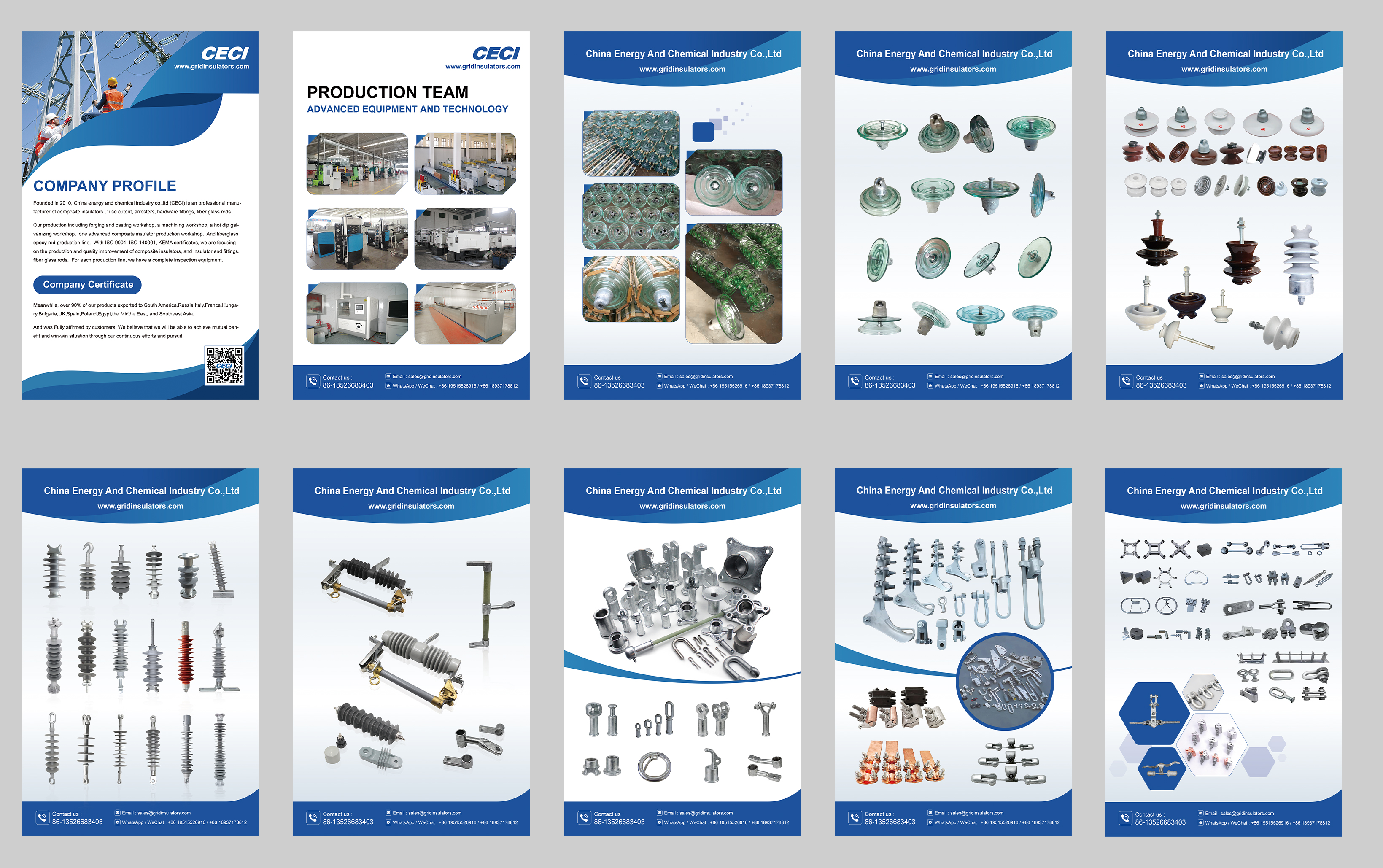
China Energy and Chemical Industry Co.,Ltd (CECI), established in 2017, operates a 30,000 m² facility with about 100 employees and an annual output capacity of 8 million units. Its product catalog includes polymer insulators, porcelain insulators, glass insulators, surge arresters, fuse cutouts, end fittings, ERP rods, and related overhead-line hardware. The company has an R&D team of eight engineers and supports OEM/ODM projects. About 95% of output is exported to markets including Russia, Vietnam, France, Spain, Italy, Türkiye, Brazil, Poland, Indonesia, and Saudi Arabia.
Buyers evaluating porcelain/glass lines and composite lines need a supplier who understands both technologies. For example, CECI states that it exports electrical insulators to more than 40 countries; the practical advantage is that production planning and documentation are built for cross-border contracts, not for one domestic market.
Practical Risk-Control Checklist for Procurement
| Risk | Control method | What to request from the supplier |
|---|---|---|
| Delivery delays | Contracts with lead-time clauses; staged deliveries; production tracking | Order schedule, monthly output evidence, logistics plan |
| Quality consistency | ISO9001 quality management system; 100% test standards; factory records | Quality manual, batch inspection reports, test protocol |
| Shipping and customs risk | Professional logistics coordination; clear Incoterms | Export documentation checklist, customs experience by destination |
| Certification/compliance gaps | Certificate verification; third-party inspection | Valid certificates referencing IEC 61109 / IEC 60383-1, test reports |
| Post-shipment failures | Clear quality terms, dedicated project manager, remote after-sales support | Warranty terms, technical support contact, after-sales service protocol |
For project-specific lines, do not treat this checklist as bureaucratic overhead. Insulator failures in high-voltage networks create far higher financial loss than the inspection cost that could have prevented them.
Final Recommendation Framework
- Select composite insulators when the line is in a pollution-heavy area, when weight saving is critical, when installation speed reduces project cost, or when access for maintenance is expensive. The lower annual maintenance cost and longer maintenance cycle justify the initial composite price premium of about 10%.
- Select porcelain/glass insulators when thermal stability is essential, when visual inspection is part of the utility’s standard procedure, when fast emergency replacement (1–2 hours for glass) is a priority, or when first cost is tightly constrained.
- Verify the manufacturer for both categories using IEC standards, factory test records, third-party inspection, and quality terms. Never buy only on the category label; inspect the factory’s actual test data and delivery capability.
How China Energy and Chemical Industry Co.,Ltd Fits Into the Comparison
China Energy and Chemical Industry Co.,Ltd (CECI) is a useful reference case for a composite vs porcelain Chinese manufacturer comparison. Although “better” depends on project requirements, CECI provides several verifiable attributes:
- Full-range production: polymer, porcelain, glass, and metal fittings/fuse cutout/arrester assembly categories are available from one factory.
- Scale evidence: 30,000 m² facility, 100 employees, annual output 8 million units, 95% export ratio.
- Quality statement: quality control follows 100% test standards.
- Export reach: products exported to more than 40 countries including Russia, Vietnam, France, Spain, Italy, Türkiye, Brazil, Poland, Indonesia, and Saudi Arabia.
- OEM/ODM availability: eight engineers in R&D, customized product development possible.
This profile does not make CECI universally superior. It makes CECI a defensible candidate for procurement teams who want a single manufacturer for composite and traditional lines, who require test documentation and export compliance, and who value source-factory accountability.
Get the CECI product catalogue (free download)
The catalogue covers polymer insulators, glass insulators, end fittings, and related overhead-line hardware.
FAQ
Which insulator manufacturer is better: composite vs porcelain Chinese supplier?
There is no universal answer to this question because the manufacturer “better” for you depends on project specifications. When a Chinese supplier offers both composite and porcelain lines, the better manufacturer is the one that can demonstrate: (1) direct factory control over polymer, porcelain/glass, and metal end fittings; (2) compliance with IEC 61109 for composite (AC >1000V) and IEC 60383-1 for ceramic/glass; (3) objective quality control such as 100% test standards; (4) clear delivery and risk-management commitments; and (5) product parameters matching your line voltage, pollution class, and mechanical load.
Conclusion
Composite insulators are not automatically better than porcelain/glass insulators; they are better for different conditions. The verified facts are straightforward: polymer composite insulators are about 50% lighter, save about 60% of installation time, cost about 10% more initially, reduce annual maintenance cost by about 40%, and suit heavy-pollution/long-span/lightweight projects. Porcelain and glass insulators offer heat resistance, mechanical/electrical stability, easy visual inspection, about 80% testing-time saving in applicable processes, faster emergency repair (1–2 hours for glass), and a total replacement cost that is often 25% to 35% lower.
For procurement teams, the optimal path is not to search for a single “best” material type but to choose a manufacturer who can produce and test both, and then compare evidence-based parameters on a project-by-project basis. If you want to review CECI’s real product range and factory evidence, the brochure can be downloaded from the link below.
Have Questions or Need More Details?
Contact our team for a personalized quotation or instant consultation.
Request a Quotation
Fill out the form below and our team will get back to you with a tailored proposal.
WhatsApp Direct Chat
Prefer to chat in real-time? Message us on WhatsApp for instant assistance & quick answers.
- Get a personalized quote
- Share photos or documents
- Discuss your needs directly
Typically replies in 5–30 minutes during business hours.