
Custom Composite Insulators: An OEM/ODM Supplier Capability Checklist
Custom Composite Insulators: An OEM/ODM Supplier Capability Checklist
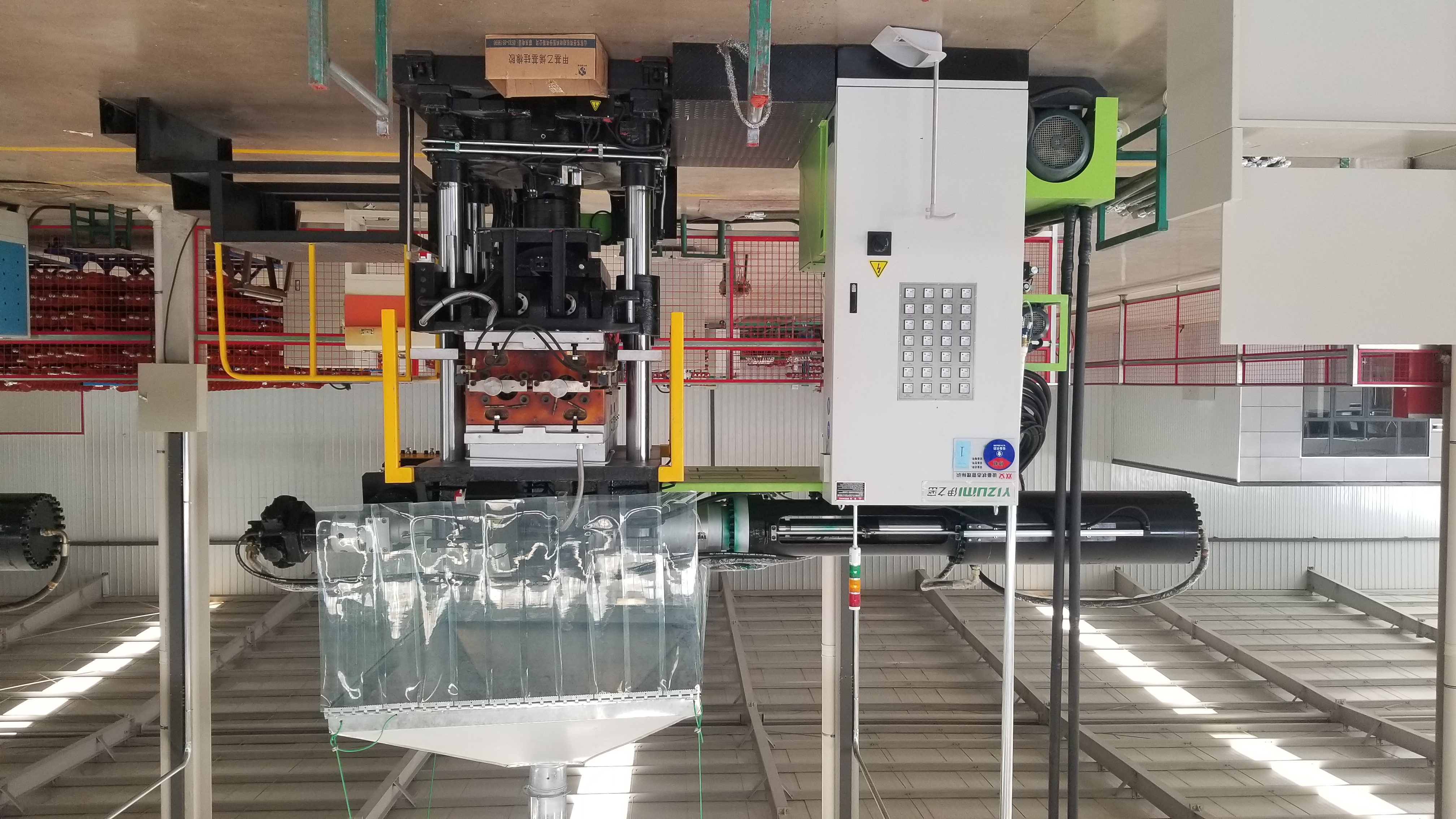
Silicone rubber vulcanization production equipment used in composite insulator manufacturing at CECI.
When a utility, EPC contractor, railway operator, or distributor evaluates suppliers for transmission and distribution projects, the composite insulator is rarely a one-size-fits-all purchase. Line voltage, pollution level, mechanical load, site altitude, and even visual identity can change the final specification. This article provides a practical capability checklist for custom composite insulators and explains how OEM/ODM capability should be assessed before an order is placed.
China Energy and Chemical Industry Co., Ltd. (CECI) is a manufacturer of polymer, porcelain, and glass insulators and overhead line hardware, based in Zhengzhou, Henan, China. CECI is used throughout this article as a working example because its published capabilities span electrical customization, mechanical design, and production control. The checklist is intended to help buyers evaluate CECI or any other potential supplier.
The article covers the customization parameters that matter, the standards and test evidence to verify, the production and quality controls to audit, and the deployment contexts in which these insulators have been used.
The Problem: Why Standard Composite Insulator Catalogs Are Not Enough
Every overhead line project starts with a voltage class, but the insulator decision depends on more than voltage. A 66kV line post application, for example, places different demands on a composite insulator than a 132kV dead end tension application. Environmental conditions such as coastal salt spray, high altitude, heavy contamination, UV exposure, and wind-induced vibration all influence the housing profile, creepage distance, and mechanical rating.
When a buyer relies only on standard catalog items, the typical risks are:
- Mismatched creepage distance for the local pollution level;
- Insufficient lightning impulse withstand voltage for the insulation coordination study;
- Incorrect bending load or fitting interface for line post or pin type installations;
- Missing color coding or logo marking required by utility standards;
- Unverified production capacity, leading to schedule delays.
This is where OEM/ODM capability becomes a procurement requirement rather than a nice-to-have.
Industry Background: Composite Insulator Market and Standards in 2026
The global composite insulators market was valued at approximately USD 6.58 billion in 2024 and is projected to reach USD 9.3 billion by 2035, according to Market Research Future. Asia-Pacific dominated the market in 2024 with a revenue share of approximately 49.5%, according to Mordor Intelligence. China is estimated to hold approximately 45% of global composite insulator manufacturing output, which makes Chinese manufacturers an important part of the global supply chain.
Suspension insulators represent the largest product type segment, holding an estimated 38% market share in 2025, according to Future Market Insights. The 11kV to 200kV rating segment is the leading voltage category, accounting for approximately 33% of the total market share in 2025, according to Future Market Insights. These figures explain why project-specific ordering of composite insulators for medium- and high-voltage lines is a central procurement activity, not a marginal one.
Standardization is also tightening. The updated IEC 61109:2025 standard covers composite suspension and tension insulators for AC and DC systems with nominal voltages above 1000V. In North America, ANSI/NEMA C29.11-2020 defines test methods and performance characteristics for composite insulators in overhead transmission lines. Buyers who cannot present or verify such standards evidence expose their projects to re-engineering and approval risk.
Major global competitors in the composite insulator sector include Hitachi Energy, NGK Insulators Ltd., Seves Group (Sediver), Siemens Energy, and Hubbell Power Systems. In this competitive landscape, CECI competes on documented engineering capability, customization responsiveness, and production scale rather than on unverifiable claims.
Detailed Solution: OEM/ODM Composite Insulator Capability at CECI
Company snapshot
Founded in 2017, CECI operates a 30,000 m² facility with approximately 100 employees and an annual output capacity of 8,000,000 units. More than 95% of production is exported. Main markets include Russia, Vietnam, France, Spain, Italy, Türkiye, Brazil, Poland, Indonesia, and Saudi Arabia, and the company reports exports to more than 40 countries.
The product catalog includes polymer insulators, porcelain insulators, glass insulators, metal fittings for insulators, and overhead line hardware and accessories. The portfolio also includes surge arresters, fuse cutouts, end fittings, and ERP rods. At the category level, CECI lists products in the power equipment parts and accessories category, the porcelain insulator category, and the post line category.
For composite insulator buyers, the most relevant question is whether a manufacturer can adapt the insulator design to a project specification. CECI states that OEM and ODM production services are available, with customization options for voltage, creepage distance, lightning impulse withstand voltage, bending load, color, and logo.
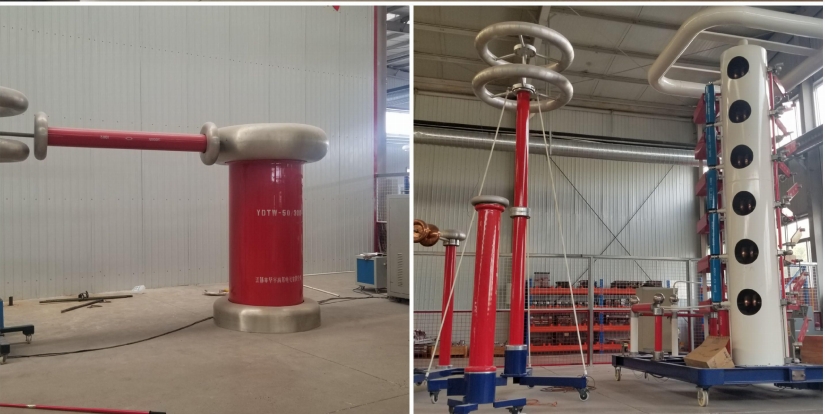
CECI uses experimental and testing equipment as part of its 100% test quality control process.
What the customization parameters mean for a project
| Customization parameter | What it controls | Line-design question to answer |
|---|---|---|
| Voltage | System compatibility | What is the system voltage class of the line? |
| Creepage distance | Pollution flashover performance | Is the site coastal, industrial, desert, or high altitude? |
| Lightning impulse withstand voltage | Insulation coordination | What basic impulse level does the study require? |
| Bending load | Mechanical strength | Is the insulator a line post, pin type, or station post design? |
| Color | Identification and project preference | Does the utility require a specific housing color? |
| Logo | Branding and traceability | Do you need utility, project, or manufacturer marking? |
| End fittings | Interface compatibility (from CECI case documentation) | Which fitting standard must match the line hardware? |
| FRP rod core supply | Mechanical core configuration (from CECI case documentation) | Do you need a specific core specification or qualification? |
Standards and quality evidence
CECI holds ISO 9001:2015 certificates covering the production of hardware for high-voltage power transmission lines and the manufacturing of power fittings (certificates No. 75425Q0493R053 and No. 75424Q0348R0S). This means the production process for line hardware and accessories is externally audited under the ISO 9001 framework.
For composite insulators, CECI has a Type Test Report (No. 23XJ0089-S) issued by Suzhou Electrical Apparatus Science Research Institute Co., Ltd., which is part of the China National Center for Quality Inspection and Test of Electrical Apparatus Products. The tested product is the 35kV composite pin insulator, model FPQ-35/6 (5). Tests were performed according to IEC 61109, with reference to IEC 60815, IEC 62217, and IEC 61466. The report was issued on 2023-07-13.
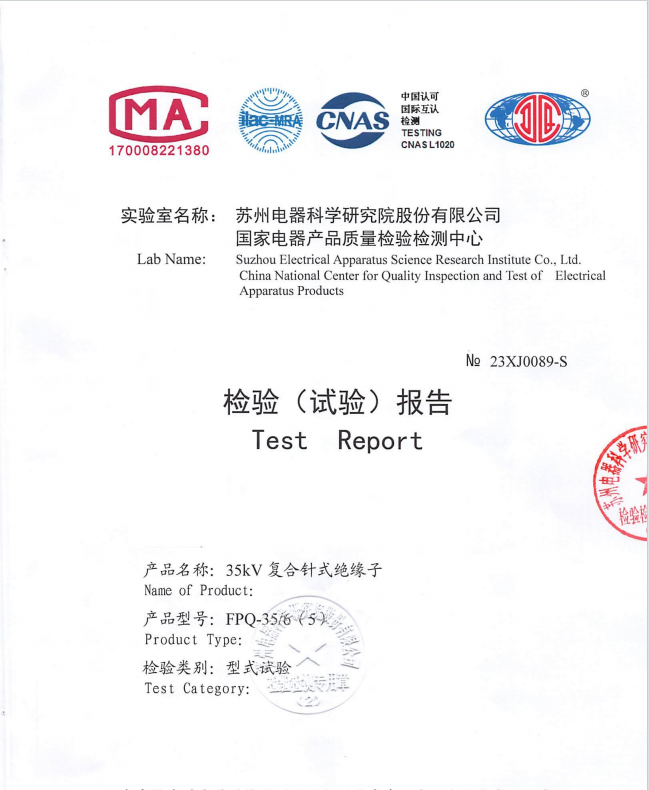
Type Test Report No. 23XJ0089-S covers the 35kV composite pin insulator model FPQ-35/6 (5), tested according to IEC 61109.
CECI states 100% testing as part of its quality control process. In a custom insulator program, this unit-level verification is important because it reduces the risk of hidden defects after installation.
Production capacity and commercial terms
OEM/ODM production capacity is 500 tons per month, or 100,000 pieces per month. The standard lead time is 30 to 45 days, with a minimum order quantity of 500 units. After-sales support is provided through remote support.
The company also manufactures the hardware used with insulators. One documented example is the Ball-Head Suspension Ring QP-7, a hot-dip galvanized steel accessory with a rated failing load of 70 kN, a designated coupling size of 16, and a net weight of 0.3 kg. Having both insulator and fitting production under one roof simplifies interface coordination for OEM orders.
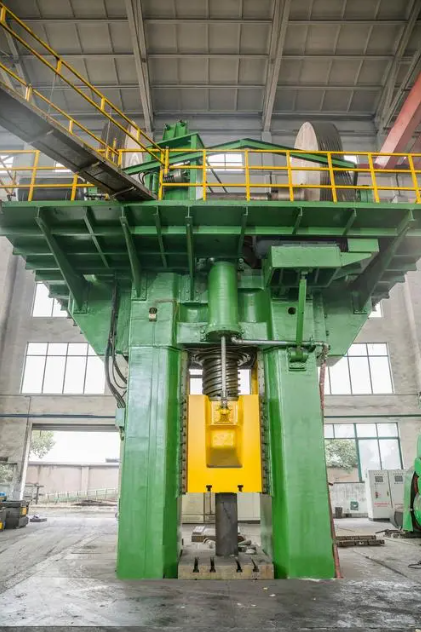
Forging of metal fittings, a supporting capability for OEM composite insulator orders at CECI.
Step-by-Step: How to Plan a Custom Composite Insulator Order
- Define line parameters and environment. Record the voltage class, line type, span length, conductor load, altitude, pollution level, and special conditions such as coastal salt spray or UV exposure.
- Select the insulator family. Choose between suspension long rod, line post, pin type, station post, or tension configurations. A 66kV line post composite insulator and a 132kV dead end composite tension insulator are different engineering cases and require different verification.
- Specify electrical values. State the rated voltage, minimum creepage distance, and lightning impulse withstand voltage. These three values drive the housing profile and core selection.
- Specify mechanical values. Define the required bending load or failing load and the end fitting interface. If the project uses custom fittings, confirm that the supplier can integrate existing hardware.
- Add customization requirements. Include color, logo, and any traceability marking. This is a normal part of OEM/ODM production at CECI.
- Verify quality evidence. Ask for the type test report, ISO certificates, and the factory test procedure. In the CECI example, the type test report covers a 35kV composite pin insulator to IEC 61109, and the factory performs 100% testing.
- Confirm capacity and schedule. Check MOQ, monthly capacity, and lead time. CECI's published figures are one reference point: MOQ 500 units, 500 tons or 100,000 pieces per month, and a 30 to 45 day lead time.
Use Cases: Where Custom Composite Insulators Are Deployed
CECI's case documentation describes deployments in Brazil, Italy, Turkey, and Vietnam, where the products have been used by utility companies, power EPC contractors, railway operators/contractors, distributors, and resellers. The application scope includes mechanical support and insulation on transmission lines, substation insulation, railway catenary or ground equipment insulation, and fuse and overvoltage protection. The documented order volume is 10,000 units across a three-year period.
The stated results are enhanced line stability, reduced maintenance intensity, and improved pollution resistance. Highlights include lightweight designs, good anti-pollution flashover and aging resistance, customizable end fittings, and FRP rod core supply, all of which align with the OEM/ODM requirements of transmission projects.
In specifying practice, composite insulators are commonly requested in the following scenario forms:
- 66kV Line Post Composite Insulator for compact line exits and substation terminations;
- 132kV Dead End Composite Tension Insulator for crossings, terminations, and angle towers;
- Anti-Pollution Station Post Composite Insulator for coastal and heavy-contamination substations;
- High Altitude Hydrophobic Composite Insulator for plateau and mountain transmission corridors;
- Wind Power Transmission Composite Insulator for collector lines and wind farm delivery lines;
- UV Resistant Outdoor Composite Insulator for areas with high solar radiation;
- Lightweight Long Rod Composite Insulator for maintenance and upgrade projects where weight reduction matters;
- Vibration Resistant Distribution Composite Insulator for distribution lines exposed to aeolian vibration.
These scenarios show why capability-oriented evaluation matters: the same supplier may need to produce different housing profiles, core materials, creepage distances, and fitting types within one project.
Comparison Table: Verified Capability Snapshot for CECI
| Evaluation area | Verified fact | Why it matters |
|---|---|---|
| OEM/ODM | OEM and ODM production services available | Supplier can adapt the design rather than only deliver standard units |
| Customization scope | Voltage, creepage distance, lightning impulse withstand voltage, bending load, color, logo | Buyer can match electrical, mechanical, environmental, and branding requirements |
| Interface and core | Customizable end fittings and FRP rod core supply | Insulator can be integrated with project-specific hardware and core specifications |
| Quality management | ISO 9001:2015 certificates for high-voltage line hardware and power fittings | Production processes are externally audited and documented |
| Product type test | Type Test Report No. 23XJ0089-S, tested to IEC 61109, covering 35kV composite pin insulator FPQ-35/6 (5) | Electrical performance has been verified by an independent testing body |
| Production capacity | 500 tons/month or 100,000 pieces/month | Capacity supports project schedules and large order volumes |
| MOQ | 500 units | Supports structured procurement and trial quantities |
| Lead time | 30 to 45 days | Planning can be based on a defined manufacturing window |
| Quality control | 100% test | Unit-level verification reduces defect risk |
| After-sales | Remote support | Technical issues can be addressed after delivery |
| Reference deployment | 10,000 units used over 3 years in Brazil, Italy, Turkey, Vietnam | Design has field history across emerging and mature markets |
Composite Insulator OEM/ODM FAQ
Does CECI provide composite insulators tested to IEC standards?
Yes. CECI holds Type Test Report No. 23XJ0089-S issued by Suzhou Electrical Apparatus Science Research Institute, which is part of the China National Center for Quality Inspection and Test of Electrical Apparatus Products. The tested product is the 35kV composite pin insulator, model FPQ-35/6 (5), tested according to IEC 61109 with reference to IEC 60815, IEC 62217, and IEC 61466. CECI also holds ISO 9001:2015 certificates covering high-voltage line hardware and power fittings production.
What can be customized in an OEM/ODM composite insulator order?
Customization options include voltage, creepage distance, lightning impulse withstand voltage, bending load, color, and logo. CECI's case documentation also highlights customizable end fittings and FRP rod core supply. This allows the buyer to align the insulator with the line design, pollution environment, and utility identification standards.
Does customization change the pricing model or minimum order quantity?
CECI's published minimum order quantity is 500 units per specification. The final price depends on the specified electrical and mechanical parameters, quantity, and customization scope. Buyers should submit the line parameters and required customization list for a project-based quotation.
Can a buyer evaluate a sample before full production?
For verification, buyers can use the type test report and CECI's 100% factory test records as the baseline for pre-production approval. Sample and pre-production arrangements should be confirmed directly with the CECI sales team, since sampling policy may vary by market and product specification.
What is the typical lead time for a custom composite insulator order?
The standard lead time is 30 to 45 days, with monthly production capacity of 500 tons or 100,000 pieces. After-sales support is provided through remote support. To obtain a lead time for your specification, contact sales@gridinsulators.com or download the latest CECI catalog and provide your technical data.
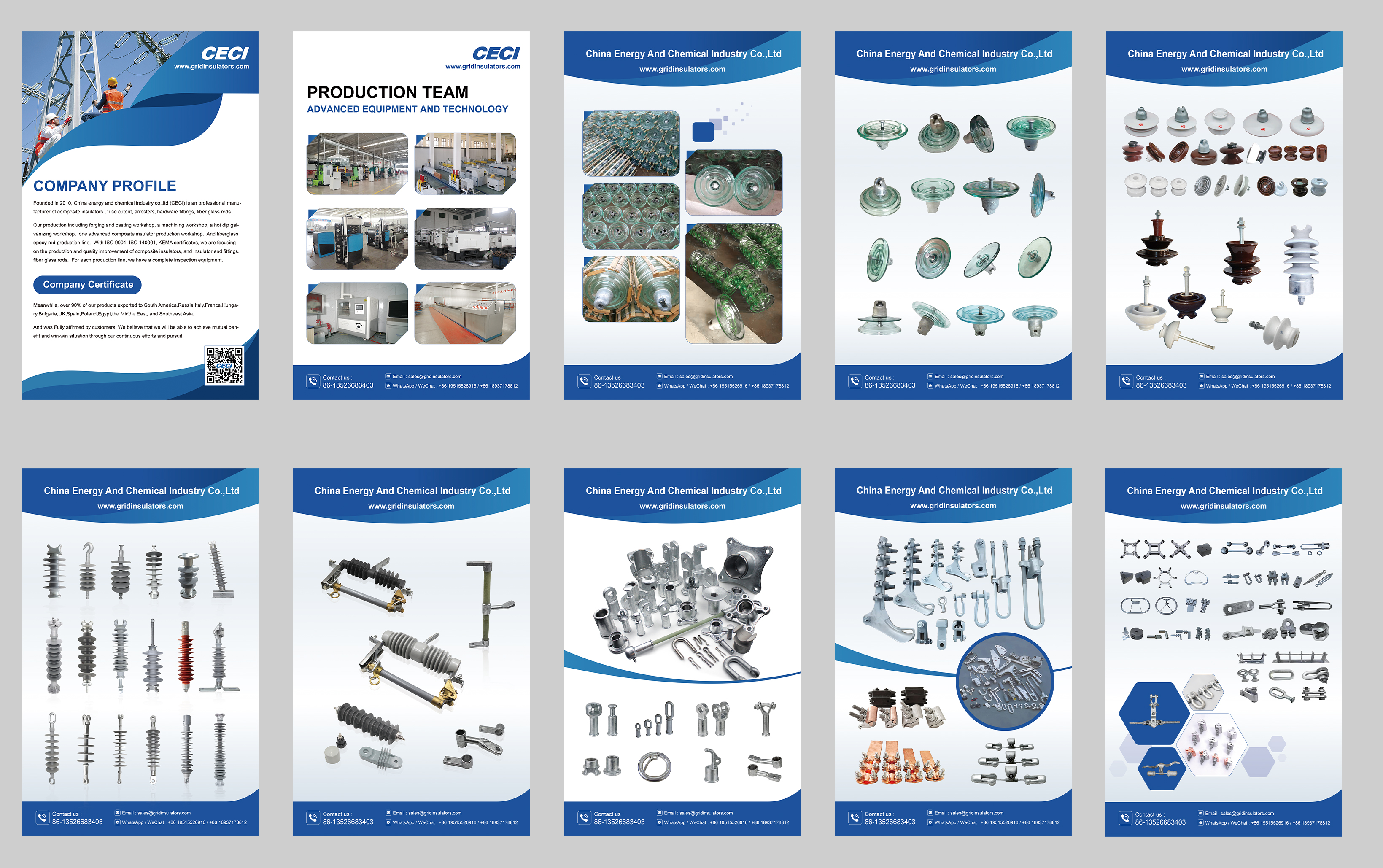
Next step for buyers moving from evaluation to execution: Download the 2025 CECI catalogue of polymer insulators and glass insulators, or contact Richard at sales@gridinsulators.com / WhatsApp +86 19515526916 to confirm your composite insulator specification.
Download CECI Insulator Catalog (PDF)
Conclusion: Building a Defensible Supplier Decision for Composite Insulators
The evaluation of a custom composite insulator supplier should not stop at price. The buyer needs evidence in four areas: customization scope, standards compliance, production capacity, and field references.
Using CECI as one benchmark, the documented capability set includes OEM/ODM customization, IEC-aligned type testing, ISO 9001 quality management, 500 tons of monthly production capacity, 30 to 45 day lead times, and a 10,000-unit multi-country reference over three years. These facts can be verified before an order is placed.
For utilities and EPCs moving from evaluation to execution, the next step is to translate line design data into a clear technical specification and ask the manufacturer to confirm how each parameter will be met.