FXB-24-70-785mm vs U70BP/146D: Polymer or Porcelain for Polluted Lines?
Short answer: on a 35 kV overhead line running through dust, salt or industrial pollution, the FXB-24-70-785mm polymer suspension long rod answers the contamination question with published creepage and lower handling mass, while the U70BP/146D porcelain disc answers the mechanical question with a 70 kN rated electromechanical failing load. They are not interchangeable units. They are two different answers to the same line, and the correct choice depends on which constraint is binding at that specific position.
The FXB-24-70-785mm is a suspension long rod insulator from China Energy and Chemical Industry Co.,Ltd (CECI), a Zhengzhou-based manufacturer of polymer, porcelain and glass insulators and overhead line hardware. Its published parameters are a 35 kV rated voltage, a minimum creepage distance above 1,050 mm, a lightning impulse withstand voltage above 230 kV, a power frequency one-minute wet withstand voltage above 95 kV and a 5 kN rated bending load, built from a silicone housing, a fiberglass core and carbon steel C45 end fittings.
The U70BP/146D is a porcelain disc unit with a published rated electromechanical failing load of 70 kN, a 146 mm structural height, a 255 mm nominal disc diameter, a 450 mm minimum arcing distance and connection structure code 16. Notice how little the two datasheets overlap: one publishes creepage, the other publishes failing load. This article works through that asymmetry deliberately, because it is a common source of mis-specified insulator orders on polluted lines.
What "Polluted Line" Actually Changes in Insulator Selection
Pollution does not raise the line voltage. It changes the surface of the insulator. Airborne dust, salt and industrial deposits settle on housings and shed surfaces, and when humidity or rain turns that deposit layer into a conductive film, leakage current begins to flow along the surface. If the creepage distance available is too short for the pollution severity of the site, that film can develop into a pollution flashover — a failure mode driven by the geometry and surface behaviour of the unit rather than by its internal dielectric strength.
That is why polluted-line selection is governed by four variables rather than by one headline number:
- Creepage distance relative to rated voltage and site pollution class. IEC 60815 is the standard family for selecting and dimensioning insulators intended for use in polluted conditions, and it is listed among the standards referenced in CECI's test documentation for its 35 kV composite insulator range.
- Surface behaviour of the housing material. A hydrophobic surface sheds water in beads and resists the formation of a continuous wet conductive film; a hydrophilic surface wets more readily.
- Shed geometry and contamination accumulation. Profile design affects how much contamination collects and how easily it is washed away.
- Access and maintenance economics. Whether the line can be cleaned, greased or re-coated, and how often that work is justified.
CECI's documented application scenario for this product family describes operating conditions of high temperature, high humidity, outdoor harsh climate, UV aging, dust storms that cause rapid dust accumulation, wind and sand abrasion acting on the shed surface, and instantaneous impulse overvoltage, with the products running in continuous 24/7 service. The same scenario record lists the required properties as anti-aging and UV resistance, high mechanical strength, high insulation performance, light weight, good bending resistance, water penetration resistance, stable metal fittings with anti-electrochemical corrosion, and non-toxic, environmentally friendly materials. Those requirements, not price alone, are the criteria this comparison is measured against.
Where Polymer and Porcelain Stand in the Insulator Market Today
Both materials remain mainstream, but they are growing at different rates. Grand View Research valued the global electrical insulator market at USD 12.5 billion in 2023 and projects USD 18.4 billion by 2030. Inside that market, Strategic Market Research valued composite insulators at approximately USD 3.42 billion in 2024 and projects USD 5.87 billion by 2030 at a CAGR of 9.1%. Suspension insulators accounted for 48.4% of the composite insulator segment in 2024, according to Mordor Intelligence — a relevant figure here because the FXB-24-70-785mm is a suspension long rod.
The two materials are also tested under different standards. Composite insulators for high-voltage overhead lines above 1,000 V AC are governed by IEC 61109, whose latest edition is 2025. Ceramic and glass insulators for overhead lines with nominal voltage above 1,000 V are tested under IEC 60383-1. A procurement team comparing a polymer long rod with a porcelain disc is comparing two test philosophies as well as two products, and certificate review has to start by matching the standard to the material.
On the supply side, China accounted for 13.1% of global exports in the insulating glass and insulating materials category in 2024, ranking as the second largest exporter, according to the Observatory of Economic Complexity (OEC). Published market coverage lists ABB Ltd, Siemens Energy, GE Grid Solutions, NGK Insulators and Hubbell Inc. among the major global players in the electric insulator market (Mordor Intelligence). CECI, based in Zhengzhou, Henan, states that its insulators and fittings have been exported to more than 40 countries, with an export ratio of 95% of output and listed markets including Russia, Vietnam, France, Spain, Italy, Türkiye, Brazil, Poland, Indonesia and Saudi Arabia.
FXB-24-70-785mm vs U70BP/146D: Parameter-by-Parameter Comparison
FXB-24-70-785mm — polymer suspension long rod
Published parameters for the FXB-24-70-785mm:
- Type: suspension long rod
- Rated voltage: 35 kV
- Lightning impulse withstand voltage: above 230 kV
- Power frequency 1-minute wet withstand voltage: above 95 kV
- Minimum creepage distance: above 1,050 mm
- Rated bending load: 5 kN
- Materials: silicone housing, fiberglass core, carbon steel C45 end fittings
Read as a pollution specification, the creepage figure is the headline. Dividing the published minimum creepage by the published rated voltage gives a ratio of roughly 30 mm of creepage per kV (1,050 mm ÷ 35 kV) — a useful first reference point when screening a route, although the requirement for a specific site must come from IEC 60815-based dimensioning for the actual pollution class. The lightning impulse withstand above 230 kV is the second relevant number for exposed rural routes, and the power frequency wet withstand above 95 kV indicates how the unit behaves when the surface is wet — the condition that matters most on a polluted line.
U70BP/146D — porcelain disc unit
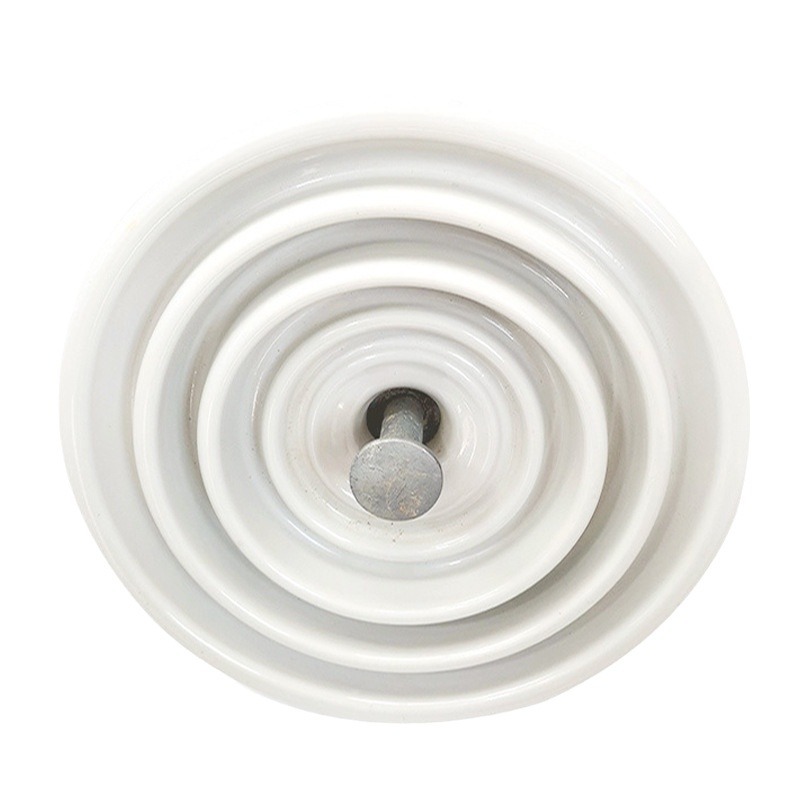
U70BP/146D porcelain disc unit — 70 kN rated electromechanical failing load, 146 mm structural height, 255 mm nominal disc diameter.
Published parameters for the U70BP/146D:
- Material: porcelain
- Rated electromechanical failing load: 70 kN
- Structural height: 146 mm
- Nominal structural height H: 146 mm
- Nominal disc diameter D: 255 mm
- Minimum arcing distance: 450 mm
- Connection structure code: 16
This is a mechanically strong, short, conventional disc. The 70 kN rated electromechanical failing load is the figure that governs its use in tension and dead-end positions, where the string carries the conductor load. The 146 mm structural height and 255 mm nominal disc diameter are the inputs to string length and clearance calculations. The 450 mm minimum arcing distance sets a lower bound on the flashover path of a single unit — but it is an arcing distance, not a creepage distance, and it must not be substituted for one.
One practical gap to plan for: the parameter set published for the U70BP/146D does not include a creepage figure. On a polluted line, creepage is the dimension that decides the string, so a buyer specifying this unit should request creepage per disc and calculate the total for the intended string length, rather than inferring pollution performance from the arcing distance.
The comparison trap: creepage is not arcing distance, and bending is not electromechanical failing load
Two analytical errors recur whenever these two units are placed side by side.
The first is treating the porcelain unit's 450 mm minimum arcing distance as though it were creepage. Arcing distance measures the shortest path through air between live and earth electrodes and supports clearance and impulse coordination. Creepage distance measures the path over the insulating surface and drives pollution performance. A disc unit's contribution to a polluted-line design is its creepage multiplied by the number of units, not its arcing distance.
The second is comparing the polymer unit's 5 kN rated bending load with the porcelain unit's 70 kN rated electromechanical failing load. These are different load cases expressed in the same unit of measure. Bending load describes behaviour under a transverse cantilever moment; electromechanical failing load describes the tensile load at which the unit fails. Neither number substitutes for the other, and a specification that swaps them will either over-engineer the structure or under-protect it.
| Parameter | FXB-24-70-785mm (polymer suspension long rod) | U70BP/146D (porcelain disc unit) |
|---|---|---|
| Material | Silicone, fiberglass core, carbon steel C45 end fittings | Porcelain |
| Unit type | Suspension long rod — single-piece unit | Disc unit — one element of a string |
| Rated voltage | 35 kV | Not stated in the published parameter set |
| Minimum creepage distance | Above 1,050 mm | Not stated in the published parameter set — request per unit |
| Minimum arcing distance | Not stated in the published parameter set | 450 mm |
| Lightning impulse withstand voltage | Above 230 kV | Not stated in the published parameter set |
| Power frequency 1-minute wet withstand voltage | Above 95 kV | Not stated in the published parameter set |
| Rated bending load | 5 kN | Not part of the published parameter set |
| Rated electromechanical failing load | Not stated in the published parameter set | 70 kN |
| Structural height | Not stated in the published parameter set | 146 mm |
| Nominal disc diameter | Not applicable | 255 mm |
| Connection structure code | Not stated in the published parameter set | 16 |
The table is deliberately honest about the gaps. CECI publishes different parameters for the two products because they are tested and applied differently. Where a cell reads "not stated", the correct procurement action is to request that value in writing for the specific project — never to assume a comparable figure.
Pollution Performance: Creepage, Hydrophobicity and Contamination Behaviour
On a polluted line, the housing material determines how contamination behaves on the surface. Silicone rubber housings are hydrophobic: water tends to bead and run off rather than forming a continuous wet film, which limits the leakage current that can develop across a contaminated layer. This is the property that makes polymer long rods attractive on polluted corridors, and it is consistent with the requirements recorded in CECI's application scenario for this product family, which include anti-aging and UV-resistant performance and water penetration resistance alongside high insulation performance.
Porcelain is hydrophilic. Under wet pollution its surface wets readily, and the classical countermeasures are to add creepage — more discs in the string — or to apply a hydrophobic coating such as RTV silicone, or to schedule periodic greasing. Both approaches work; both have to be specified, budgeted and resourced. Greasing and re-coating are recurring field activities in heavily polluted areas, and their cost sits in the maintenance line of the project rather than in the insulator purchase order.
The environment also attacks the surface physically. The application scenario documented for these products lists dust storms causing rapid dust accumulation and wind and sand abrasion of the shed surface as operating conditions, together with UV aging. A shed profile that sheds contamination well and resists surface erosion retains its creepage performance longer between cleaning cycles — a design question worth raising with the manufacturer on any route that combines heavy dust with wet periods.
Installation and Handling Effort
Installation effort on an overhead line is driven by the number of components per position, the mass that has to be lifted, and the number of coupling interfaces that must be inspected.
The FXB-24-70-785mm is a single-piece suspension long rod. One component is handled per position, and polymer construction is generally lighter to handle than fired porcelain of a comparable role, which reduces lifting demand at the pole. Exact handling mass and installed length should be taken from the manufacturer's datasheet and drawing for the specific unit, because both change with core diameter and shed profile.
A porcelain disc solution works in the opposite direction: the string is assembled from multiple units plus hardware. CECI's Ball-Head Suspension Ring QP-7 is representative of that hardware layer — hot-dip galvanized steel, a designated coupling size of 16, a rated failing load of 70 kN and a documented weight of 0.3 kg, with production covered by ISO 9001 certification number 75425Q0493R053. The U70BP/146D is also published with connection structure code 16, so both the disc and the ring carry a 16 coupling designation; exact coupling compatibility should still be confirmed against the fitting standard before the order is placed, because every additional interface is an additional inspection point.
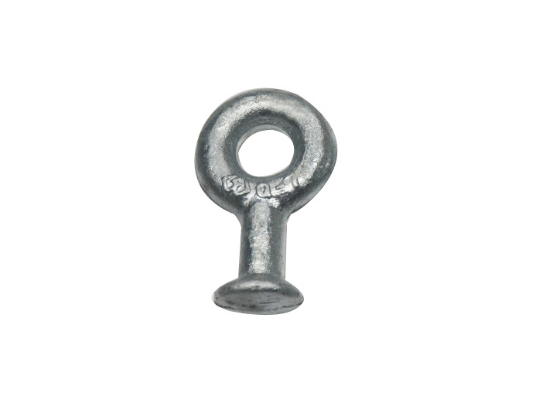
Ball-Head Suspension Ring QP-7 — hot-dip galvanized steel, coupling size 16, 70 kN rated failing load, documented weight 0.3 kg.
Maintenance Frequency and Lifetime Cost Modelling
Insulator purchase price and lifetime cost do not move together, and on polluted lines the gap between them is where project budgets are won or lost. A defensible comparison models at least six cost lines for each option: unit price multiplied by the quantity required to reach the specified total creepage; fittings and hardware per position; installation labour and lifting time; inspection, cleaning or coating cycles over the asset life; spares and replacement handling; and the cost of unplanned outage exposure if pollution flashover occurs.
Two structural differences between these units feed into that model. First, a single-piece long rod removes the multi-unit string assembly step from the maintenance cycle, so replacements can be scheduled differently from disc-string work. Second, a hydrophobic silicone surface generally reduces the frequency of contamination-driven cleaning, whereas a porcelain string in a heavily polluted corridor may require a coating or greasing programme that repeats on a fixed cycle.
Because unit prices, freight and installation rates vary by project, market and order quantity, cost comparisons should be built from a project-specific quotation rather than from generic percentages. Comparative claims about weight savings, installation time savings or annual maintenance savings shift with line design and conductor loading, so they should be produced against your own bill of quantities. CECI's documented commercial parameters are a minimum order quantity of 500 units and a lead time of 30–45 days, with a monthly capacity of 500 tons and 100,000 pieces and 100% testing before shipment — figures that let a buyer build a realistic schedule and total-cost model rather than a theoretical one.
Certification and Compliance Evidence for Both Units
Polluted-line projects are typically audited against standards, so certification evidence should be matched to the material before the technical comparison is signed off.
- Composite (polymer) insulators: IEC 61109 governs composite insulators for high-voltage overhead lines above 1,000 V AC, with the latest edition dated 2025. IEC 60383-1 governs testing of ceramic or glass insulators for overhead lines with nominal voltage above 1,000 V — the standard family that applies to a porcelain disc.
- Type test evidence for the polymer range: CECI publishes a Type Test Report, certification number 23XJ0089-S, issued on 13 July 2023 by Suzhou Electrical Apparatus Science Research Institute Co., Ltd., part of the China National Center for Quality Inspection and Test of Electrical Apparatus Products. The report covers a 35 kV composite pin insulator, model FPQ-35/6(5), against IEC 60815, IEC 61109, IEC 62217 and IEC 61466, and is documented as applicable to global markets including Europe, the Middle East, Southeast Asia and the Americas. CECI's product record links this report to the FXB-24-70-785mm polymer insulator.
- Quality management: ISO 9001 certificates 75425Q0493R053 (scope: production of hardware for high-voltage power transmission lines, issued 4 December 2025, valid to 3 December 2028) and 75424Q0348R0S (scope: manufacturing of power fittings, issued 22 July 2024, valid to 21 July 2027), both issued by Zhongjing Certification (Shanghai) Co.,Ltd under GB/T 19001-2016 idt ISO 9001:2015, applicable to markets in Europe and the Americas, the Middle East and Central Asia.
Certificates are only useful if the model scope matches the model ordered. The type test report names a specific 35 kV composite insulator model and the ISO 9001 certificates name hardware and fittings scopes, so buyers should confirm in writing that the certificate covers the exact catalogue number and voltage class being purchased, and request the creepage and impulse values their pollution class requires as part of the same document set.
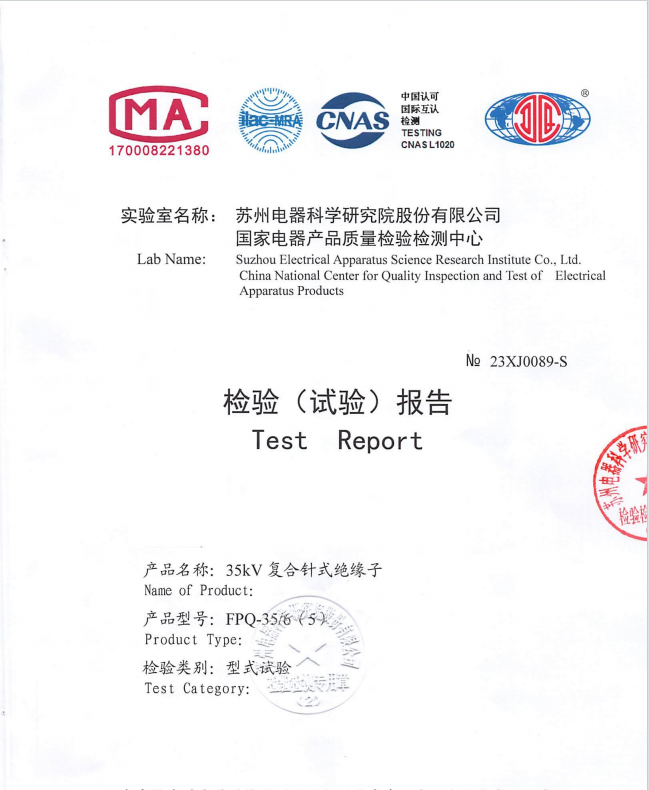
Type Test Report 23XJ0089-S — 35 kV composite insulator, standards IEC 60815, IEC 61109, IEC 62217 and IEC 61466.
Step-by-Step Breakdown: Running This Comparison on a Real Project
- Fix the pollution requirement first. Obtain the pollution severity and the required creepage for the route using IEC 60815-based dimensioning. Without this number, the material comparison has no anchor.
- Convert the requirement into units. For the FXB-24-70-785mm, compare the requirement against its published minimum creepage above 1,050 mm at 35 kV. For the U70BP/146D, request creepage per disc and multiply by the intended string length.
- Identify the governing load case. If the position is a tension or dead-end position, the U70BP/146D's 70 kN rated electromechanical failing load is the relevant figure. If the position is governed by cantilever behaviour, the FXB-24-70-785mm's 5 kN rated bending load is the relevant figure. Do not transfer either value into the other load case.
- Check clearances and geometry. For the porcelain disc, use the 146 mm structural height, 255 mm nominal disc diameter and 450 mm minimum arcing distance in the string and clearance calculation. For the polymer long rod, request the installed length and shed profile drawing for the same check.
- Review certification against the ordered model. Match IEC 61109 or IEC 60383-1 to the material, then verify that the certificate number covers the exact model and voltage class — for CECI's composite range, test report 23XJ0089-S and ISO 9001 certificates 75425Q0493R053 and 75424Q0348R0S are the documented references.
- Validate handling and installation with samples. Both units should be handled by the crew that will install them, particularly where lifting access is restricted.
- Lock the commercial terms last. Quantity, MOQ, lead time and any OEM/ODM customisation — voltage, creepage distance, lightning impulse withstand voltage, bending load, colour and logo — should be confirmed in writing before production begins.
Use Cases: Where Each Unit Earns Its Place
CECI's documented application scenario for these insulators is public electrical equipment in power transmission and distribution: rural and urban power grid upgrading projects, rail transit electrification, high-voltage transmission lines, substations and converter stations, and wind power projects, running continuously 24/7. The scenario record notes that this combination of conditions is common in Spain, France, Italy and Türkiye, and matches buyers in the markets recorded as Russia, Vietnam, Italy, Türkiye, France and Spain.
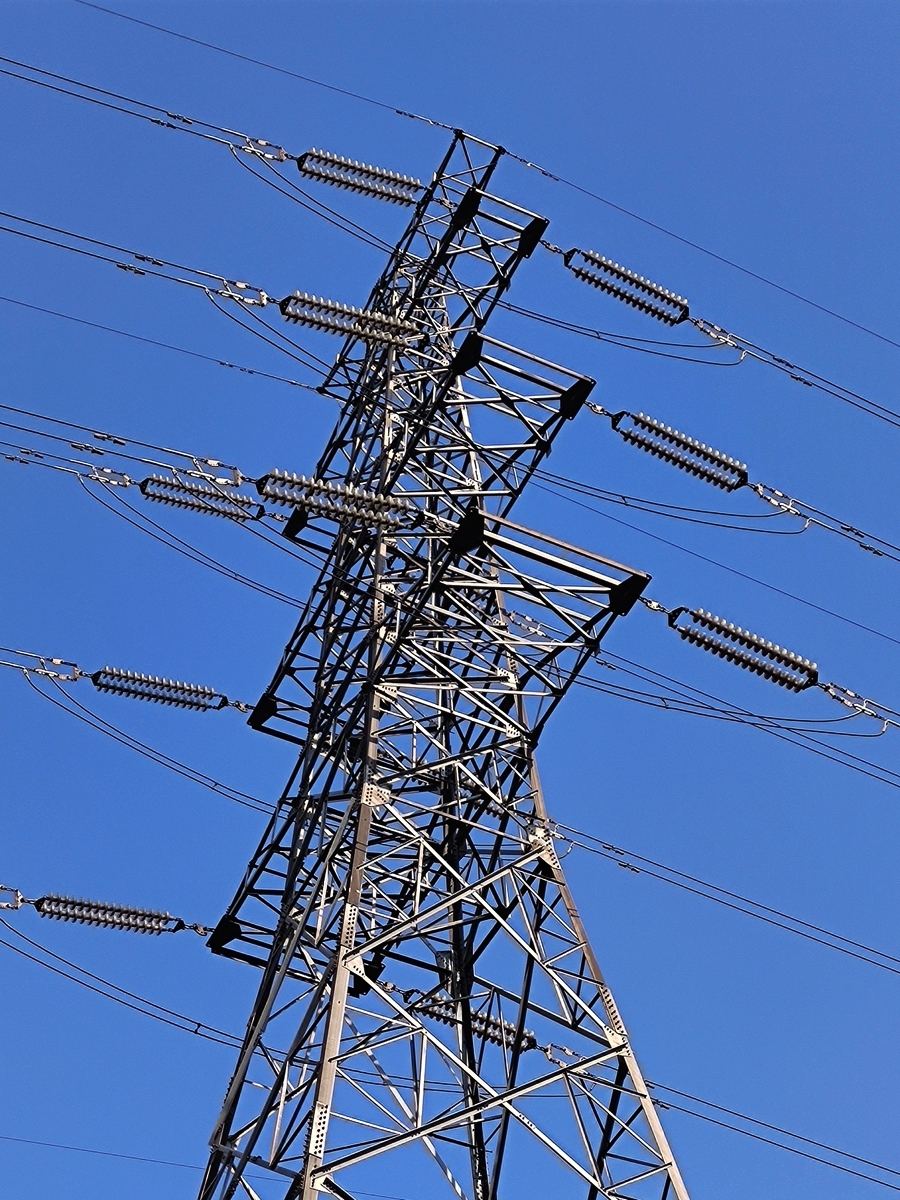
Overhead line insulators in continuous 24/7 transmission and distribution service — grid upgrading, rail electrification and substation applications.
In practice, the split usually looks like this:
- FXB-24-70-785mm polymer suspension long rod — polluted overhead corridors where creepage and surface behaviour set the design, where lifting access is constrained, and in upgrade or retrofit work where a single-piece unit simplifies installation. CECI's documented case record for polymer and glass insulators, covering 10,000 units over a three-year supply relationship with utility companies, power EPC contractors, railway operators and distributors in Brazil, Italy, Türkiye and Vietnam, notes enhanced line stability, reduced maintenance intensity and improved pollution resistance among the outcomes, with lightweight design, anti-pollution flashover and aging resistance, customisable end fittings and FRP rod core supply listed as highlights.
- U70BP/146D porcelain disc unit — positions where a high electromechanical failing load governs, where a conventional disc string is already the site standard, and in substation and equipment applications where porcelain remains the established specification.
Decision Framework: Four Questions That Settle the Choice
| Question | Points toward FXB-24-70-785mm (polymer) | Points toward U70BP/146D (porcelain) |
|---|---|---|
| 1. Pollution resistance — how much creepage does the site need, and how is it achieved? | The requirement can be met by a single long rod publishing minimum creepage above 1,050 mm at 35 kV, with a hydrophobic silicone surface limiting wet-film formation. | The requirement is met by varying the number of discs in the string, with creepage per unit confirmed by the manufacturer for the target pollution class. |
| 2. Installation effort — what handling and assembly can the site support? | Single-piece unit; lower handling mass typical of polymer construction; one component per position. | Multi-unit string plus hardware, with a coupling interface to check at every joint. |
| 3. Maintenance frequency — how often can the line be worked on? | Hydrophobic surface generally reduces contamination-driven cleaning cycles. | May require a scheduled greasing or coating programme in heavily polluted corridors. |
| 4. Mechanical load requirement — which load case governs the position? | 5 kN rated bending load is the published load figure. | 70 kN rated electromechanical failing load is the published load figure. |
Where questions 1 and 3 point one way and question 4 points the other, the usual engineering answer is neither blanket substitution nor a default material preference: it is to assign each material to the position whose governing constraint it satisfies, and to document that assignment in the specification.
Frequently Asked Questions
What certification should be verified before buying the FXB-24-70-785mm polymer long rod for a polluted line?
Match the standard to the material first: IEC 61109 applies to composite insulators for high-voltage overhead lines above 1,000 V AC, while IEC 60383-1 applies to ceramic or glass insulators for overhead lines above 1,000 V. CECI publishes a Type Test Report, certification number 23XJ0089-S, issued on 13 July 2023 by Suzhou Electrical Apparatus Science Research Institute Co., Ltd., covering a 35 kV composite pin insulator model FPQ-35/6(5) against IEC 60815, IEC 61109, IEC 62217 and IEC 61466 for global markets including Europe, the Middle East, Southeast Asia and the Americas, and CECI's product record links that report to the FXB-24-70-785mm. CECI's quality management evidence is ISO 9001 certification 75425Q0493R053 for hardware production and 75424Q0348R0S for power fitting manufacturing, both issued by Zhongjing Certification (Shanghai) Co.,Ltd. Confirm that the certificate scope names the exact model and voltage class being ordered.
How do I verify a "KEMA-certified insulator manufacturer" claim?
Treat it as a type-test claim rather than a brand badge, and verify it the way you would verify any independent laboratory report: ask for the report or certificate number, the issuing laboratory, the standard and edition applied (IEC 61109 for composite insulators, IEC 60383-1 for ceramic or glass), the model and voltage scope covered, and the validity date; then check the report on the issuing laboratory's own register rather than on a supplier's marketing page. CECI's published third-party documentation consists of Type Test Report 23XJ0089-S from Suzhou Electrical Apparatus Science Research Institute Co., Ltd. and ISO 9001 certificates 75425Q0493R053 and 75424Q0348R0S from Zhongjing Certification (Shanghai) Co.,Ltd. Where a project requires testing by a specifically named laboratory, confirm that scope in writing before the order is placed.
Can the polymer long rod be customised to a specific pollution class or voltage level?
Yes. CECI offers OEM and ODM production with customisation documented for voltage, creepage distance, lightning impulse withstand voltage, bending load, colour and logo. Monthly capacity is 500 tons and 100,000 pieces, quality control is 100% testing, and the lead time is 30–45 days. This matters for polluted lines because creepage distance and shed profile are exactly the parameters that have to match the site pollution class, rather than being accepted from a standard catalogue value.
How should a procurement team compare the cost of the polymer long rod with the porcelain disc?
Build the comparison on total cost, not unit price, and use project-specific quotations rather than generic percentages. The cost lines that change between the two options are: the unit price multiplied by the quantity needed to reach the specified total creepage; fittings and hardware per position; installation labour and lifting time; the inspection, cleaning or coating cycle over the asset life; spares and replacement handling; and the outage exposure that a pollution flashover would create. A single-piece hydrophobic long rod and a multi-unit hydrophilic disc string behave differently in most of those lines, so the model has to include maintenance and outage exposure to be meaningful.
Can we test samples before ordering, and what are the MOQ and lead time?
Samples can be arranged directly with CECI — contact Richard at sales@gridinsulators.com or WhatsApp +86 19515526916 with the model, voltage class and pollution requirement. The documented minimum order quantity is 500 units and the standard lead time is 30–45 days, with 100% testing before shipment and remote after-sales support. For installation planning, the downloadable catalogue covering CECI's polymer insulators and glass insulators is linked at the end of this article.
Conclusion
Neither unit wins this comparison outright, because they are built to answer different questions. The U70BP/146D publishes a 70 kN rated electromechanical failing load in a 146 mm structural height with a 255 mm nominal disc diameter and a 450 mm minimum arcing distance — a compact, mechanically strong porcelain disc that belongs in tension positions and in established disc-string practice. The FXB-24-70-785mm publishes a 35 kV rated voltage with minimum creepage above 1,050 mm, lightning impulse withstand above 230 kV, wet withstand above 95 kV and a 5 kN rated bending load in a single silicone-housed long rod — a unit built around the surface-contamination problem that defines a polluted line.
Use the four-question framework: establish the creepage the route actually needs, weigh installation and handling effort, estimate the maintenance cycle the operator can realistically sustain, and identify whether the governing mechanical load case is bending or electromechanical failing load. If those four answers are written down before the quotation is requested, the choice between polymer and porcelain stops being a preference and becomes a specification.
Next step
Send China Energy and Chemical Industry Co.,Ltd the pollution class, rated voltage and string length for your project, and we will confirm the creepage, impulse withstand and fitting set for the FXB-24-70-785mm — or quote the U70BP/146D disc and hardware if a porcelain string is the right answer. Samples, drawings and the full catalogue are available on request.
Download the catalogue: 2025 CECI catalogue of polymer insulators and glass insulators (PDF)
Website: www.gridinsulators.com · Email: sales@gridinsulators.com · WhatsApp: +86 19515526916 · Tel: +86 15038311850
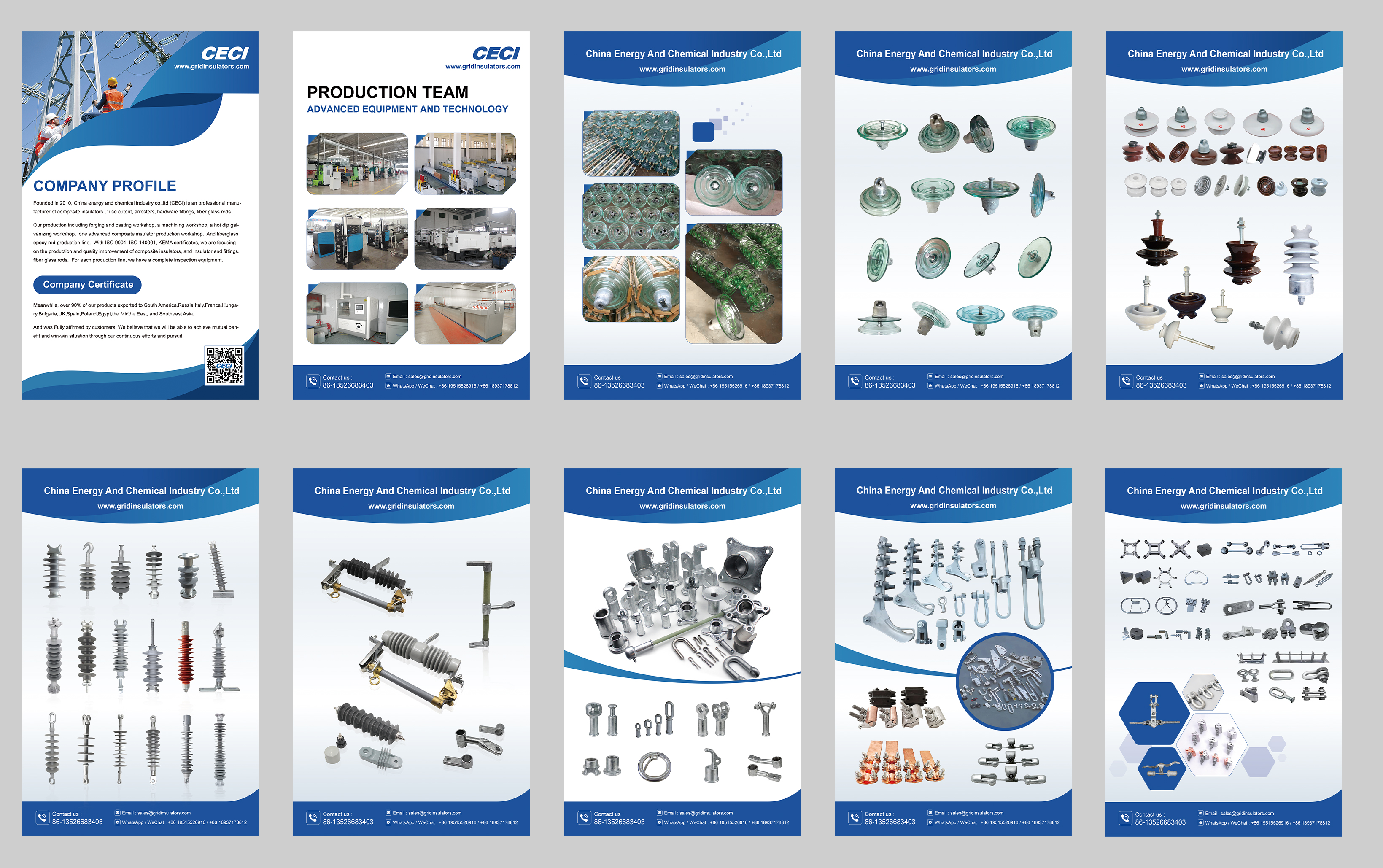
2025 CECI catalogue of polymer insulators and glass insulators — parameters, fittings and project references.
Have Questions or Need More Details?
Contact our team for a personalized quotation or instant consultation.
Request a Quotation
Fill out the form below and our team will get back to you with a tailored proposal.
WhatsApp Direct Chat
Prefer to chat in real-time? Message us on WhatsApp for instant assistance & quick answers.
- Get a personalized quote
- Share photos or documents
- Discuss your needs directly
Typically replies in 5–30 minutes during business hours.