Glass vs. Porcelain Insulators: A Side-by-Side Comparison for Overhead Line Buyers
Glass vs. Porcelain Insulators: A Side-by-Side Comparison for Overhead Line Buyers
For an overhead line buyer, the glass-versus-porcelain question rarely arrives as a materials science debate. It arrives as a catalogue decision: two disc insulators with similar envelopes, two different material classes, and a project specification that has to be satisfied either way. This comparison places two models from the China Energy and Chemical Industry Co., Ltd. (CECI) catalogue side by side — the 70B glass insulator and the U70BP/146D porcelain insulator — and separates the parameters that genuinely differ from the ones that do not.
The short answer: on the published data reviewed here, the two models share the same structural and mechanical envelope — 146 mm structural height, 255 mm nominal disc diameter, 255 mm creepage distance, 450 mm minimum arcing distance, 70 kN rated electromechanical failing load, and connection structure code 16. What separates them is the material itself (brown glass versus porcelain), the product type each carries in the catalogue, and the test parameters published for each model. That means the real decision sits less in the dimension column and more in inspection practice, site environment, and the standard the destination market applies.
Why the Glass vs. Porcelain Decision Is Harder Than It Looks
Most general guidance assumes that glass insulators and porcelain insulators differ across the whole specification sheet. For these two disc models, they largely do not. That is precisely what makes the choice confusing for buyers running a first-pass catalogue review.
- Dimensionally converged models. The 70B glass insulator is published with a structural height of 146 mm, a nominal disc diameter of 255 mm, a creepage distance of 255 mm and a minimum arcing distance of 450 mm. The U70BP/146D porcelain insulator is published with the same structural height of 146 mm, the same nominal disc diameter of 255 mm, the same creepage distance of 255 mm and the same minimum arcing distance of 450 mm. Both are published with a rated electromechanical failing load of 70 kN and connection structure code 16.
- Unequal test coverage between the two datasheets. The 70B glass insulator publishes a power frequency puncture voltage of 135 kV, a power frequency dry withstand voltage of 65 kV, a power frequency wet withstand voltage of 45 kV and a cantilever load of 10 kN. The U70BP/146D data reviewed here publishes rated electromechanical failing load, minimum arcing distance, structural height, disc diameter and connection structure code, but not equivalent puncture or withstand figures. A buyer comparing only the rows that appear in both datasheets will conclude the two discs are equivalent, because on those rows they are.
- Material behaviour affects inspection more than dimensions. In general field practice, damage to toughened glass discs tends to be visible because the disc shatters, while porcelain damage can be less obvious and typically requires closer inspection during line patrols. Buyers should confirm the inspection and replacement protocol with the supplier instead of assuming it.
- Site environment pushes the decision. CECI's application data for overhead line insulator products describes operating conditions that include high temperature, high humidity, outdoor harsh climate, UV aging, dust storms, and instantaneous impulse overvoltage. Those conditions interact differently with a glass surface than with a glazed porcelain surface, so the environment — not the drawing — often decides the material.
- The standard follows the material. IEC 61109:2025 covers composite suspension and tension insulators for AC and DC systems with nominal voltages above 1000 V, and ANSI/NEMA C29.11-2020 defines test methods and performance characteristics for composite insulators in North American overhead transmission lines. Both are composite-specific documents. Glass and porcelain disc insulators are specified under their own separate standards, so a buyer must confirm which standard the selected material is being supplied against.
- A third material class now sits in the same comparison. Polymer composite insulators are frequently evaluated alongside glass and porcelain for the same line sections, which adds a material dimension to what used to be a two-way choice.
Industry Background: What Is Shifting Around This Decision
Material selection for overhead lines is taking place inside a market that is still expanding. Market Research Future valued the global composite insulators market at approximately USD 6.58 billion in 2024 and projects it to reach USD 9.3 billion by 2035. Mordor Intelligence reports that Asia-Pacific dominated the composite insulator market in 2024 with a revenue share of approximately 49.5%, which is consistent with the density of insulator manufacturing in the region.
Product mix matters when a buyer is benchmarking options. Future Market Insights estimates that suspension insulators represent the largest product type segment, holding an estimated 38% market share in 2025, and that the 11 kV to 200 kV rating segment is the leading voltage category, accounting for approximately 33% of total market share in 2025. Those two figures frame where most disc-type purchasing activity sits: medium-voltage suspension strings.
Standards activity is also relevant, because the material class determines which document a supplier must satisfy. IEC 61109:2025 covers composite suspension and tension insulators for AC and DC systems with nominal voltages above 1000 V. ANSI/NEMA C29.11-2020 defines the test methods and performance characteristics for composite insulators used in North American overhead transmission lines. These are useful reference points when composite insulators are part of the shortlist, but they are not the specification basis for glass or porcelain discs — a point buyers should raise directly with the manufacturer when requesting documentation.
Key takeaway: the growing share of composite insulators does not retire glass and porcelain. It changes what the comparison must cover. Instead of comparing materials against each other on price alone, buyers now compare a glass disc, a porcelain disc, and a composite long-rod against the same duty definition, the same environment, and the same standard requirement.
Detailed Comparison: 70B Glass vs. U70BP/146D Porcelain
Glass insulator, model 70B
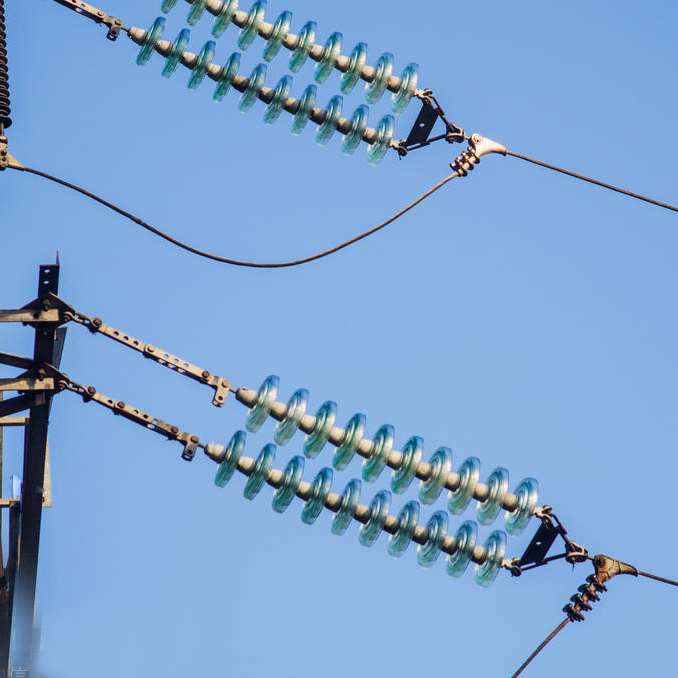
The 70B is a glass insulator for electric power systems, classified in the CECI catalogue as a post line insulator and intended for use in overhead power lines within the electricity industry. It is made of glass and supplied in a brown colour — one of the few visible differentiators between it and the porcelain model in this comparison.
Its published technical data is unusually complete for a disc-type product: creepage distance 255 mm, nominal disc diameter 255 mm, nominal structural height 146 mm, overall structural height 146 mm, minimum arcing distance 450 mm, power frequency puncture voltage 135 kV, power frequency dry withstand voltage 65 kV, power frequency wet withstand voltage 45 kV, cantilever load 10 kN, rated electromechanical failing load 70 kN, and connection structure code 16.
For a buyer, the puncture voltage figure is the notable item. A published value of 135 kV describes the puncture behaviour of the disc under power frequency conditions and is one of the parameters that is frequently omitted from short-form datasheets. The cantilever load of 10 kN is also published for this model.
Porcelain insulator, model U70BP/146D
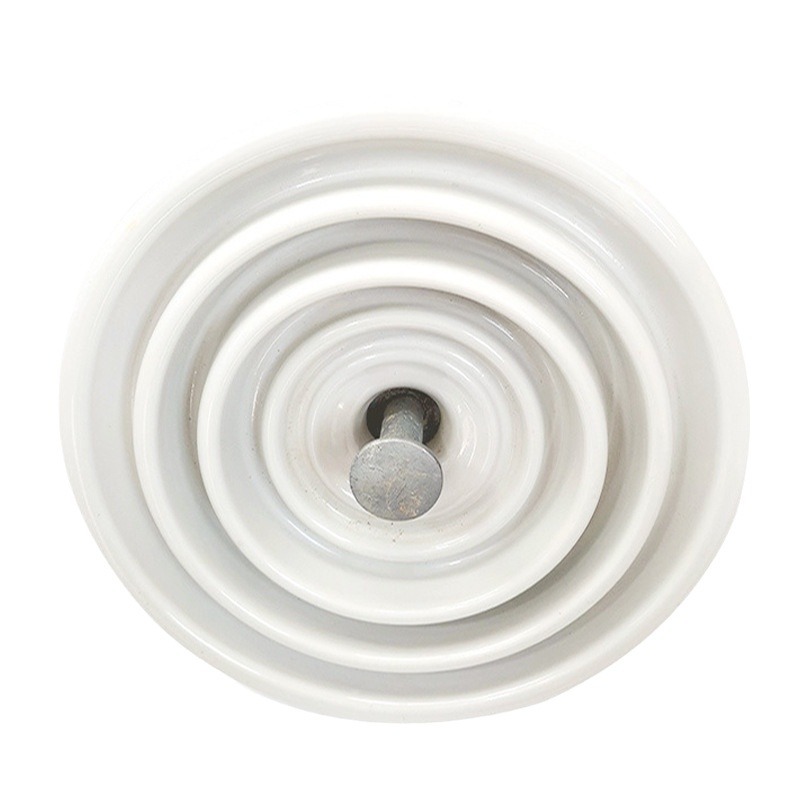
The U70BP/146D is a porcelain insulator intended for the electricity industry. It is made of porcelain and belongs to the porcelain insulator category, with overhead power line applications. Its published data reviewed here includes a nominal structural height of 146 mm, a structural height of 146 mm, a nominal disc diameter of 255 mm, a creepage distance of 255 mm, a minimum arcing distance of 450 mm, a rated electromechanical failing load of 70 kN, and connection structure code 16.
Nothing in the published figures contradicts an equivalent duty rating: the mechanical load, the creepage path and the arcing distance all match the glass model. The difference is that the equivalent puncture and withstand voltages are not published for the porcelain model in the data reviewed here.
What the Converged Numbers Actually Mean
When a glass disc and a porcelain disc publish the same height, the same diameter, the same creepage distance, the same arcing distance, the same failing load and the same connection code, the comparison has effectively moved past geometry. Two conclusions follow.
First, both models can be evaluated against the same string design and the same fitting interface, so the substitution question becomes a material question rather than a re-engineering question. Second, the remaining decision variables are the ones not shown in the common rows: how each material behaves in service, how each is inspected, what is published versus what must be requested, and which standard the buyer's project invokes. A buyer who wants a defensible choice should ask the manufacturer for the missing test data of the material they intend to select, rather than treating the absence of a row as an absence of a difference.
Where Composite Insulators Fit Into the Same Decision
For buyers whose scope also includes composite insulators, the reference point inside the same catalogue is the polymer insulator model FXB-24-70-785mm, a suspension long rod product made of silicone, fiber glass and carbon steel/C45. It is published with a rated voltage of 35 kV, a lightning impulse withstand voltage above 230 kV, a power frequency one-minute wet withstand voltage above 95 kV, a minimum creepage distance above 1050 mm, and a rated bending load of 5 kN.
The structural contrast is the useful part for this comparison. A single glass or porcelain disc in this comparison carries a 255 mm creepage distance, while a single composite long rod carries more than 1050 mm. That is a geometry difference that follows from the construction method, not a quality judgement, and it changes how many units a string requires and how the assembly is handled and maintained. A buyer comparing material classes should compare at the string level, not the unit level.
Step-by-Step: How to Run the Glass vs. Porcelain Comparison for a Real Project
- Fix the duty before comparing materials. Write down the system voltage, the required failing load, the pollution level and the expected mechanical loads on the string. Both models in this comparison are published at a 70 kN rated electromechanical failing load, so if your duty is above that figure, neither model qualifies and the material debate is premature.
- Match the structural envelope. Check height, disc diameter, creepage distance and minimum arcing distance against the tower and string design. For the two models reviewed here, all four figures align at 146 mm, 255 mm, 255 mm and 450 mm respectively, which means either disc fits the same envelope on paper.
- Compare test coverage, not just test values. List the parameters you require — puncture voltage, dry withstand voltage, wet withstand voltage, cantilever load, failing load — and mark which are published for each candidate. In this comparison, the glass 70B publishes 135 kV puncture, 65 kV dry withstand, 45 kV wet withstand and 10 kN cantilever load; the equivalent rows for the porcelain U70BP/146D must be requested from the manufacturer rather than assumed.
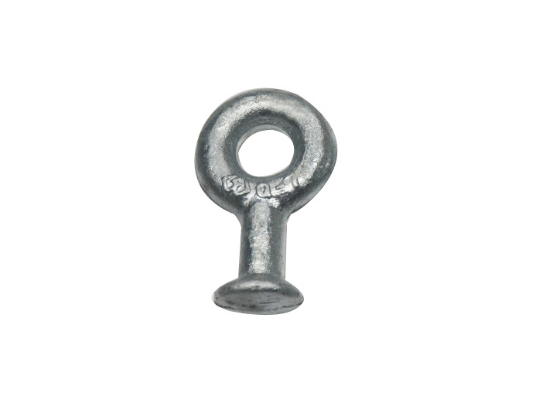
- Confirm the hardware interface. Both discs are published with connection structure code 16. The CECI Ball-Head Suspension Ring QP-7, a hot-dip galvanized steel accessory for the electricity industry used in overhead power transmission lines, is published with a designated coupling size of 16, a rated failing load of 70 kN and a net weight of 0.3 kg — consistent with the coupling code and failing load of both discs. Verify the complete assembly, not the disc alone.
- Screen both candidates against the site environment. CECI's application data lists high temperature, high humidity, outdoor harsh climate, UV aging, dust storms and instantaneous impulse overvoltage as operating conditions for overhead line insulator products, with project requirements that include anti-aging and UV-resistant performance, high mechanical strength, high insulation performance, light weight, water penetration resistance, and stable metal fittings with anti-electrochemical corrosion behaviour. Coastal, desert and high-altitude sites should be screened against these requirements before the material is fixed.
- Lock the standard and the documentation. Confirm which standard the glass or porcelain disc is supplied against, whether the project requires composite-specific references such as IEC 61109:2025 or ANSI/NEMA C29.11-2020, and what test certificates, packing data and export documentation the supplier will provide. For reference, CECI exports 95% of its sales to markets that include Russia, Vietnam, France, Spain, Italy, Türkiye, Brazil, Poland, Indonesia and Saudi Arabia.
Use Cases: Where Each Option Typically Lands
Project profile decides more material choices than brand preference does. CECI's application data identifies several project types that drive overhead line insulator demand: rural and urban power grid upgrading projects, rail transit electrification projects, high-voltage transmission line projects, substation and converter station projects, and wind power projects.
Two patterns are worth noting for buyers. First, application scenarios in Spain, France, Italy and Türkiye are described as requiring high mechanical strength and high insulation performance and as operating in 24/7 continuous mode, which pushes the selection toward discs with clearly documented mechanical ratings — an area where both models in this comparison are published at 70 kN. Second, grid upgrading work requires anti-aging and UV-resistant performance, which is a material-level requirement rather than a dimensional one and should be raised as a documentation question for whichever material is selected.
Rail transit electrification is a further case, where the product role is defined as power transmission and distribution in the public electrical equipment industry, often with power distribution cabinets as supporting equipment. Projects of that type tend to reward suppliers who can document the full accessory chain — discs plus end fittings plus suspension hardware — rather than supplying discs alone.
Side-by-Side Comparison Table
| Parameter | Glass insulator 70B | Porcelain insulator U70BP/146D |
|---|---|---|
| Material | Glass | Porcelain |
| Colour | Brown | Not stated in the reviewed catalogue data |
| Product type | Post line insulator for overhead power lines | Porcelain insulator for the electricity industry |
| Nominal structural height H | 146 mm | 146 mm |
| Overall structural height | 146 mm | 146 mm |
| Nominal disc diameter D | 255 mm | 255 mm |
| Creepage distance | 255 mm | 255 mm |
| Minimum arcing distance | 450 mm | 450 mm |
| Rated electromechanical failing load | 70 kN | 70 kN |
| Connection structure code | 16 | 16 |
| Cantilever load | 10 kN | Not stated in the reviewed catalogue data |
| Power frequency puncture voltage | 135 kV | Not stated in the reviewed catalogue data |
| Power frequency dry withstand voltage | 65 kV | Not stated in the reviewed catalogue data |
| Power frequency wet withstand voltage | 45 kV | Not stated in the reviewed catalogue data |
| Matched fitting reference | Ball-Head Suspension Ring QP-7 — hot-dip galvanized steel, designated coupling size 16, rated failing load 70 kN, net weight 0.3 kg | |
FAQ
Is a glass or a porcelain insulator better for overhead power lines?
Neither material is universally better, and for the two catalogue models reviewed here the published data does not support a blanket answer. The 70B glass insulator and the U70BP/146D porcelain insulator share the same structural and mechanical envelope: 146 mm structural height, 255 mm nominal disc diameter, 255 mm creepage distance, 450 mm minimum arcing distance, 70 kN rated electromechanical failing load and connection structure code 16. The choice should be made on material behaviour, inspection regime, site environment and the standard the project invokes — not on dimensions alone.
Do glass and porcelain disc insulators use the same fittings?
For these two models, the published interface matches. Both are published with connection structure code 16, which governs how the disc couples into the string. The CECI Ball-Head Suspension Ring QP-7 is a hot-dip galvanized steel accessory for the electricity industry used in overhead power transmission lines, published with a designated coupling size of 16, a rated failing load of 70 kN and a net weight of 0.3 kg — consistent with the 70 kN failing load of both discs. Buyers should still verify the complete string assembly, including end fittings, rather than confirming the disc in isolation.
Which environmental conditions should drive the material choice?
CECI's application data for overhead line insulator products lists high temperature, high humidity, outdoor harsh climate, UV aging, dust storms and instantaneous impulse overvoltage as operating conditions, and identifies required performance including anti-aging and UV resistance, high mechanical strength, high insulation performance, light weight, water penetration resistance, and stable metal fittings with anti-electrochemical corrosion behaviour. Application scenarios in Spain, France, Italy and Türkiye are described as requiring high mechanical strength and high insulation performance in 24/7 continuous operation. Coastal, desert and high-pollution sites should be screened against those requirements before the material is fixed.
How do I compare the two materials when the datasheets publish different test parameters?
Compare on the rows that both datasheets publish, then treat the missing rows as open items rather than as equal values. In this comparison, the glass 70B publishes a power frequency puncture voltage of 135 kV, dry withstand voltage of 65 kV, wet withstand voltage of 45 kV and cantilever load of 10 kN, while the equivalent figures for the porcelain U70BP/146D are not stated in the reviewed data and should be requested from the manufacturer. On the standards side, note that IEC 61109:2025 and ANSI/NEMA C29.11-2020 address composite insulators; buyers selecting glass or porcelain discs should confirm the applicable standard for that material with the supplier.
Who can supply both glass and porcelain insulators for the same overhead line project?
China Energy and Chemical Industry Co., Ltd., founded in 2017, manufactures polymer, porcelain and glass insulators as well as overhead line hardware fittings and accessories including metal fittings, surge arresters, fuse cutouts, end fittings and ERP rods. The company operates a 30,000 m² manufacturing facility with an annual production capacity of 8,000,000 units and approximately 100 staff, supported by an R&D team of 8 engineers, with OEM and ODM services available. Export business accounts for 95% of total sales, with major markets including Russia, Vietnam, France, Spain, Italy, Türkiye, Brazil, Poland, Indonesia and Saudi Arabia. Buyers can download the 2025 CECI catalogue of polymer insulators and glass insulators at the catalogue download link, or contact the team at sales@gridinsulators.com or +86 15038311850 to confirm model availability, fittings and documentation for a specific project.
Conclusion
Glass versus porcelain is not settled by the specification sheet for these two models. The 70B glass insulator and the U70BP/146D porcelain insulator converge on height, disc diameter, creepage distance, arcing distance, failing load and connection code, which means both are technically plausible for the same string envelope. What separates them in practice is material-specific behaviour in service, the inspection routine your line crews can realistically follow, the environment the line crosses, and the standard your project is specified against.
The practical sequence is straightforward: fix the duty, match the envelope, compare test coverage rather than test values alone, confirm the fitting interface, screen against site conditions, and lock the standard and documentation. Buyers who request the missing parameters — particularly the puncture and withstand voltages for the porcelain option — will make a material decision on evidence rather than on the number of rows printed in a datasheet.
Next Step: Confirm the Right Disc for Your Line
China Energy and Chemical Industry Co., Ltd. supplies glass, porcelain and polymer insulators together with overhead line hardware fittings, and supports OEM and ODM requirements. To compare the 70B glass insulator, the U70BP/146D porcelain insulator and the matching Ball-Head Suspension Ring QP-7 against your project parameters, request the full catalogue or send your technical requirement directly.
Catalogue: 2025 CECI catalogue of polymer insulators and glass insulators
Website: www.gridinsulators.com
Email: sales@gridinsulators.com
Phone: +86 15038311850