Top Insulator Picks for Power Lines: 70B Glass vs. U70BP/146D Porcelain and the QP-7 Ring
Top Insulator Picks for Power Lines: 70B Glass vs. U70BP/146D Porcelain and the QP-7 Ring
For 70 kN-class overhead line work, the material decision usually narrows to a small set of published parts: an insulating unit and the hardware that ties it into the string. This shortlist covers three items published by China Energy and Chemical Industry Co.,Ltd (CECI), a Zhengzhou-based manufacturer of polymer insulators, porcelain insulators, glass insulators and metal fittings for insulators: the 70B glass insulator, the U70BP/146D porcelain insulator, and the Ball-Head Suspension Ring QP-7.
All three are published at a 70 kN failing-load class, and all three carry a 16 connection or coupling code. That single overlap is what makes a side-by-side comparison possible: a buyer can evaluate the same mechanical class and the same coupling interface across glass, porcelain and hardware instead of comparing documents that were written to different templates.
Ranking criterion used here: the shortlist is ordered first by the breadth of published electrical performance data, then by the mechanical duty the item carries. That places the 70B first (the only item here with published power-frequency dry, wet and puncture voltages), the U70BP/146D second (a complete published dimensional set), and the QP-7 third (the coupling element, which carries mechanical load but no insulation duty).
To be precise about what this article is: it is a product-level shortlist drawn from one supplier's published catalogue, ordered by a stated data criterion. It is not a claim about products outside this shortlist.
The problem: insulator datasets rarely line up
Delays in overhead line material approval are seldom caused by a shortage of products. They come from data that does not align. Glass and porcelain units are quoted in one document, the metal fittings in another, and the fields filled in are different each time.
A buyer evaluating a 70 kN unit has to reconcile five things at once: the mechanical class, the coupling interface, the creepage distance, the minimum arcing distance, and the certification scope. If one element of the assembly is quoted against a different coupling size than the insulator unit, the approval cycle restarts — which is exactly why a 16-coded ring matching a 16-coded insulator unit is worth checking before, not after, the order is placed.
The second common problem is certificate scope. An ISO 9001 certificate whose stated scope is production of hardware for high-voltage power transmission lines is not the same document as one whose scope is manufacturing of power fittings (high-voltage line fittings and accessories). Both are valid ISO 9001 certificates; they cover different activities. Buyers who need the certificate to correspond to the purchased item have to read the scope line, not just the certificate title.
The third problem is a substitution context. The insulation category is changing as composite (polymer) insulators take a larger share of new orders. That does not take glass or porcelain off a specification, but it does mean the evaluation should be parameter-based rather than material-based.
Industry background: what published data says about the insulation market
Third-party research frames the category but should be read with care, because estimates diverge sharply.
- Category size: Market Research Future valued the global composite insulators market at approximately USD 6.58 billion in 2024, projecting USD 9.3 billion by 2035.
- Estimate divergence: for the same 2024 period, Strategic Market Research published USD 3.42 billion and Reports and Data published USD 2.35 billion. Any single market-size figure is a modelling choice, not a settled number, and should not be used as a procurement baseline.
- Region: Mordor Intelligence estimated Asia-Pacific at approximately 49.5% of 2024 revenue in the composite insulator market.
- Product type: Future Market Insights estimated suspension insulators at roughly 38% of product-type share in 2025, and the 11 kV to 200 kV rating band at about 33% of the total market in the same year.
- Standards landscape: IEC 61109:2025 covers composite suspension and tension insulators for AC and DC systems with nominal voltages above 1000 V. In North America, ANSI/NEMA C29.11-2020 defines test methods and performance characteristics for composite insulators in overhead transmission lines.
- Named suppliers in the composite segment (third-party list, Mordor Intelligence): Hitachi Energy, NGK Insulators Ltd., Seves Group (Sediver), Siemens Energy and Hubbell Power Systems. These are composite-segment names from a third-party market report and are listed here as category context only.
What is not published matters just as much. For the three items in this shortlist, no list price is published, and no rated voltage is published for the two insulator units. Those two gaps are questions to put to the supplier during the evaluation stage, not fields to assume.
The shortlist: three picks with their published parameters
Pick 1 — 70B glass insulator
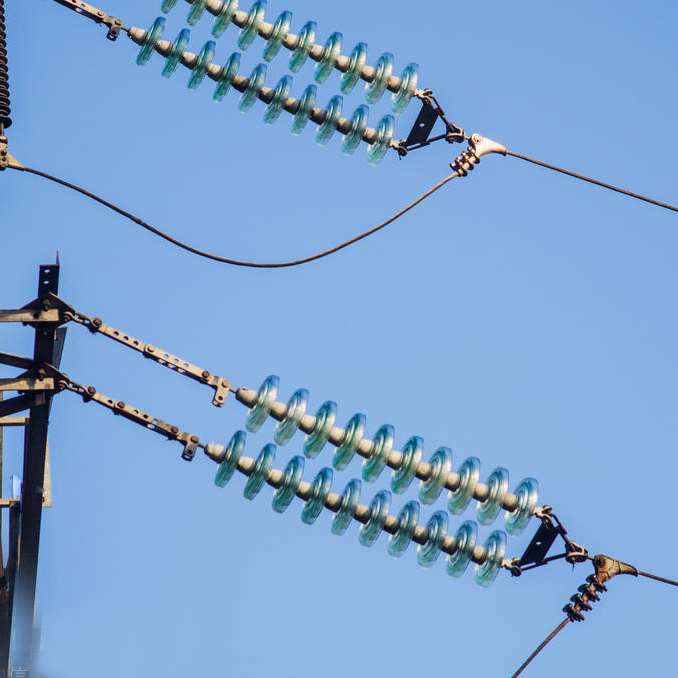
The 70B is a glass insulator classified as a post line type, published for use in overhead power lines, with a brown colour as standard in the product data.
- Model designation: 70B
- Material: glass
- Rated electromechanical failing load: 70 kN
- Minimum arcing distance: 450 mm
- Creepage distance: 255 mm
- Nominal disc diameter: 255 mm
- Nominal structural height: 146 mm
- Connection structure code: 16
- Power frequency dry withstand voltage: 65 kV
- Power frequency wet withstand voltage: 45 kV
- Power frequency puncture voltage: 135 kV
- Cantilever load: 10 kN
- Published colour: brown
What these numbers decide. The 70 kN rated electromechanical failing load fixes the mechanical class of the string. The 450 mm minimum arcing distance and 255 mm creepage distance fix the electrical envelope the unit occupies. The 65 kV dry withstand, 45 kV wet withstand and 135 kV puncture values are the only published power-frequency set in this shortlist, which is why the 70B heads the ranking on the stated criterion.
Limits to confirm before ordering. No rated voltage is published for this model, and the published colour is brown. A buyer specifying a different colour scheme, a different end fitting, or a voltage-based string calculation needs those values confirmed in writing rather than inferred from the parameter list.
Pick 2 — U70BP/146D porcelain insulator
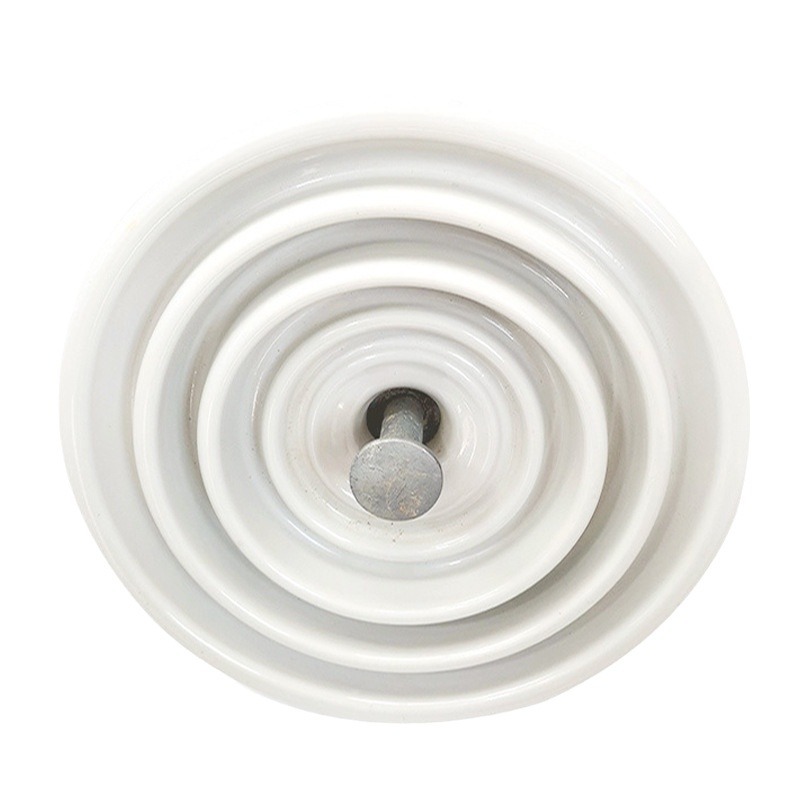
The U70BP/146D is a porcelain insulator for the electricity industry. Its published dataset is dimensional: it tells a string designer where the unit sits and how much load it carries.
- Model designation: U70BP/146D
- Material: porcelain
- Rated electromechanical failing load: 70 kN
- Minimum arcing distance: 450 mm
- Creepage distance: 255 mm
- Nominal structural height / structural height: 146 mm
- Nominal disc diameter: 255 mm
- Connection structure code: 16
What these numbers decide. Structural height, disc diameter and arcing distance are the three values that determine how a porcelain unit stacks into a string and how much clearance the string occupies. At 70 kN with a 146 mm structural height, a 255 mm nominal disc diameter and a 450 mm minimum arcing distance, this unit is dimensionally aligned with the 70B on every field that both publish.
Limits to confirm before ordering. Power-frequency withstand and puncture values are not published for the U70BP/146D in the data used for this shortlist, and no weight or colour is published. These are the fields to request if the specification depends on them.
Pick 3 — Ball-Head Suspension Ring QP-7
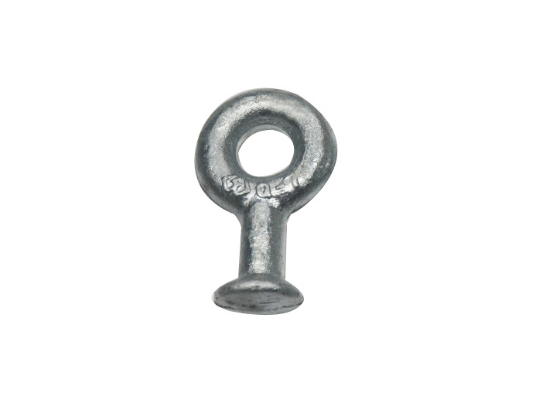
The QP-7 is a power equipment part and accessory: a hot-dip galvanized steel ball-head suspension ring for the electricity industry, used in overhead power transmission lines. It carries no insulation duty, so it ranks third on the stated criterion — but it is the item that determines whether the assembly physically closes.
- Model designation: Ball-Head Suspension Ring QP-7
- Material: hot-dip galvanized steel
- Designated size of coupling: 16
- Rated failing load: 70 kN
- Net weight: 0.3 kg
- Design: ball-head type
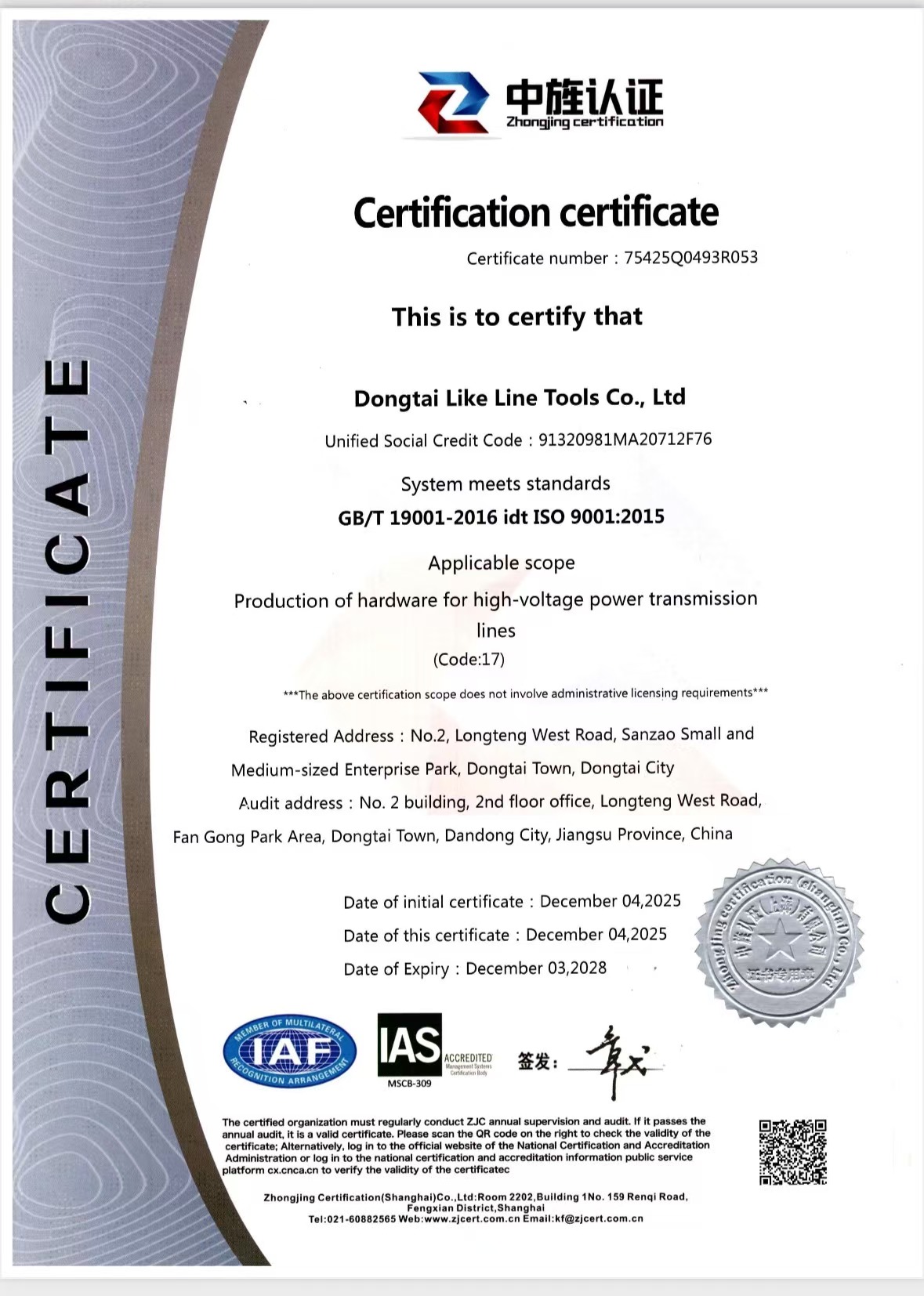
- Certification referenced: ISO 9001, certificate number 75425Q0493R053
What these numbers decide. The designated coupling size of 16 matches the connection structure code 16 published for both the 70B and the U70BP/146D — the interface is consistent across the three items. The 70 kN rated failing load keeps the ring in the same mechanical class as the insulator units it connects, and the 0.3 kg net weight is light enough that the ring does not materially change string weight calculations.
Compliance position. The QP-7 is covered by an ISO 9001 Quality Management System Certificate, certification number 75425Q0493R053, conforming to GB/T 19001-2016 idt ISO 9001:2015 and issued by Zhongjing Certification (Shanghai) Co.,Ltd., with stated market coverage of Europe and the Americas, the Middle East, and Central Asia. A second ISO 9001 certificate, number 75424Q0348R0S, covers manufacturing of power fittings (high-voltage line fittings and accessories) and is issued by Zhongjing Certification (Shanghai) Co.,Ltd. Because the two certificates carry different scopes, match the scope line to the activity being purchased.
Side-by-side comparison of the three picks
| Parameter | 70B | U70BP/146D | QP-7 |
|---|---|---|---|
| Product category | Glass insulator (post line type) | Porcelain insulator | Power equipment parts and accessories (ball-head suspension ring) |
| Material | Glass | Porcelain | Hot-dip galvanized steel |
| Rated electromechanical failing load / rated failing load | 70 kN | 70 kN | 70 kN |
| Connection structure code / designated coupling size | 16 | 16 | 16 |
| Minimum arcing distance | 450 mm | 450 mm | — |
| Creepage distance | 255 mm | 255 mm | — |
| Nominal structural height | 146 mm | 146 mm | — |
| Nominal disc diameter | 255 mm | 255 mm | — |
| Power frequency dry withstand voltage | 65 kV | — | — |
| Power frequency wet withstand voltage | 45 kV | — | — |
| Power frequency puncture voltage | 135 kV | — | — |
| Cantilever load | 10 kN | — | — |
| Net weight | — | — | 0.3 kg |
| Published colour | Brown | — | — |
| Certification referenced in this article | — | — | ISO 9001: 75425Q0493R053; 75424Q0348R0S |
How to read the dashes. A dash means the value is not published in the product data used for this shortlist. It is not a statement that the item fails that parameter, and it is not a performance ranking. Request the missing values before freezing a specification, and treat any comparison built on dashes as incomplete.
Step-by-step: how to evaluate these three picks
- Fix the mechanical class. All three items publish a 70 kN failing-load value. Confirm that 70 kN matches the required string class for the line section before comparing anything else — a mismatch here invalidates the rest of the comparison.
- Lock the coupling interface. The 70B and U70BP/146D publish connection structure code 16, and the QP-7 publishes designated size of coupling 16. Confirm this interface in writing, because a coupling mismatch is the most common reason a technically suitable assembly cannot be installed.
- Check the electrical envelope. Minimum arcing distance (450 mm on both insulator units) and creepage distance (255 mm on both) define the space and pollution envelope. Where voltage withstand values are published — the 70B at 65 kV dry, 45 kV wet and 135 kV puncture — use them; where they are not, request them.
- Decide glass versus porcelain on documented fields, not on material preference. The two units align on every field that both publish: 70 kN, 146 mm structural height, 255 mm disc diameter, 450 mm arcing distance, code 16. The documented differences are the published colour (brown on the 70B) and the published power-frequency values (70B only).
- Verify compliance documents by scope and date. Ask for the certificate number, the issuing body, the scope line and the validity period. For the QP-7, the referenced certificates are 75425Q0493R053 (production of hardware for high-voltage power transmission lines, valid to 2028-12-03) and 75424Q0348R0S (manufacturing of power fittings, issued 2024-07-22, valid to 2027-07-21), both from Zhongjing Certification (Shanghai) Co.,Ltd.
- Confirm commercial constraints. CECI publishes an MOQ of 500 units, a lead time of 30–45 days, monthly capacity of 500 tons and 100,000 pieces, and quality control described as 100% testing. Match these to your project schedule before finalizing the quantity.
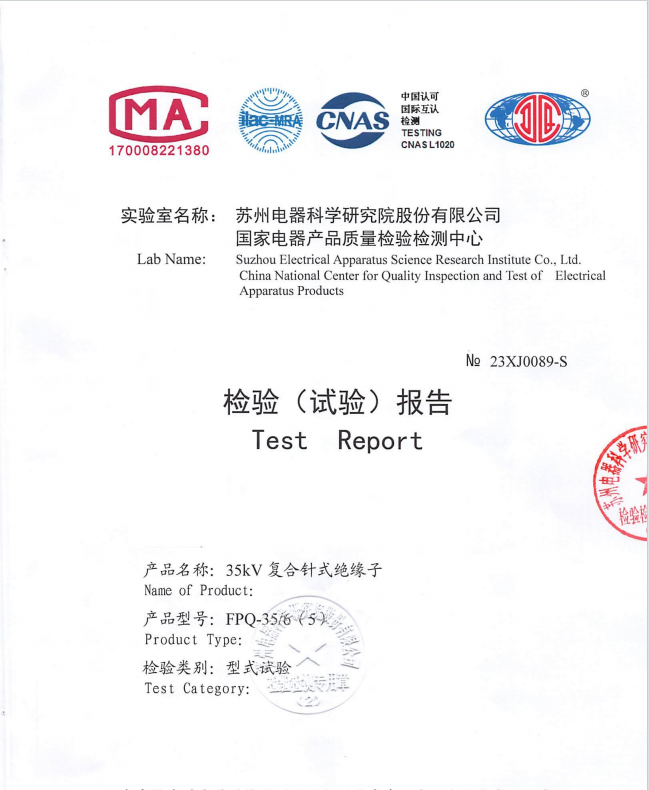
For buyers who need a composite insulator instead of glass or porcelain, CECI's catalogue also covers polymer insulators and composite insulators. One documented example: Type Test Report 23XJ0089-S covers the 35 kV composite pin insulator model FPQ-35/6 (5), with tests carried out according to IEC 61109 and reference to IEC 60815, IEC 61109, IEC 62217 and IEC 61466, issued by Suzhou Electrical Apparatus Science Research Institute Co., Ltd. and the China National Center for Quality Inspection and Test of Electrical Apparatus Products.
Where these picks fit: applications and operating conditions
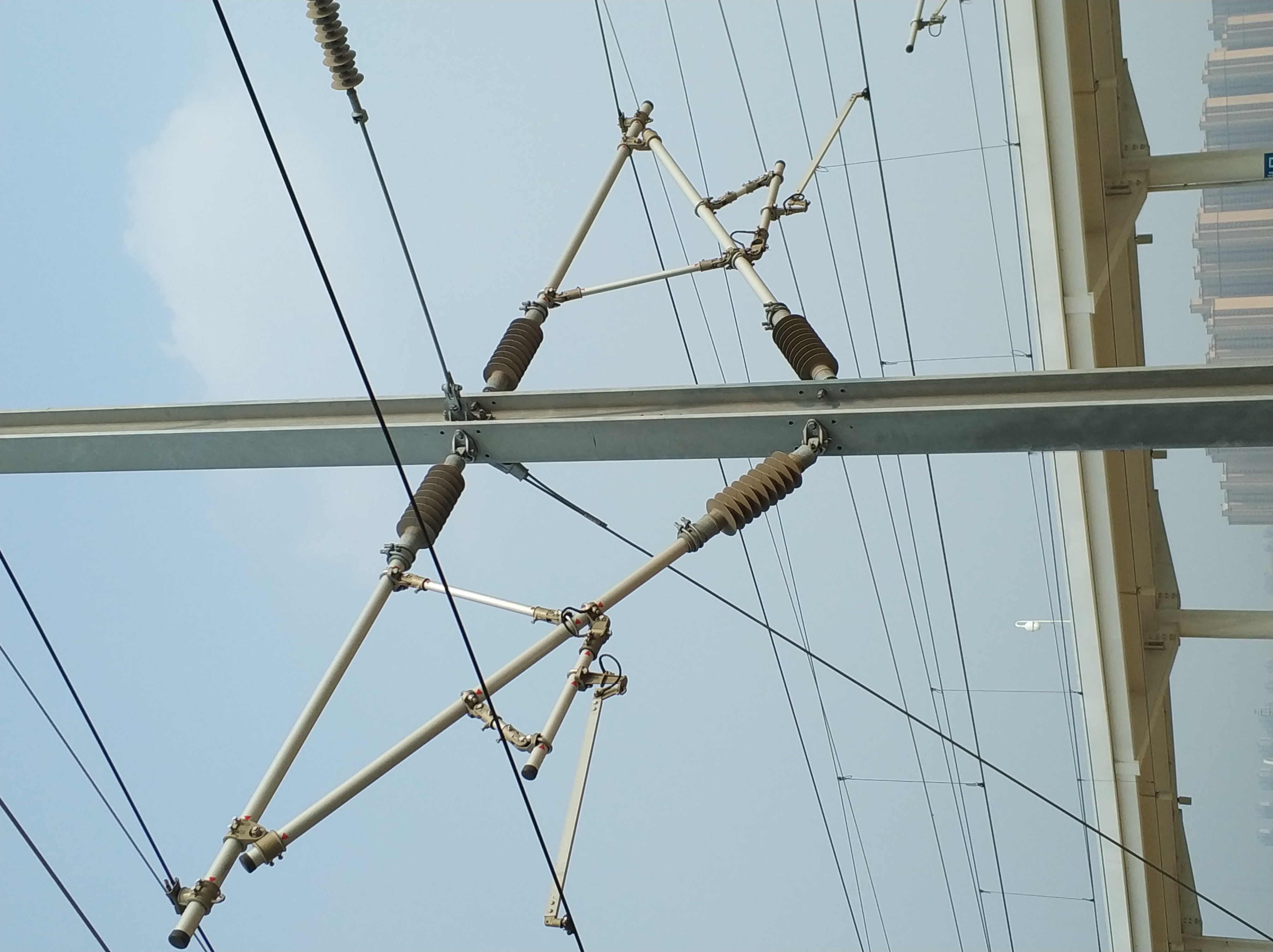
The three items share a documented application scope: mechanical support and insulation on transmission lines, substation insulation, railway catenary or ground equipment insulation, and fuse and overvoltage protection. The same scope record notes adoption by utility companies, power EPC contractors, railway operators and contractors, distributors and resellers.
Project types recorded against this product scope include rural and urban power grid upgrading projects, rail transit electrification projects, high-voltage transmission line projects, substation and converter station projects, and wind power projects. The recorded working conditions are demanding: high temperature, high humidity, outdoor harsh climate, UV aging, dust storms that cause rapid dust accumulation and wind-and-sand abrasion of the shed surface, and instantaneous impulse overvoltage.
The recorded special requirements for this scope are anti-aging and UV-resistant performance, high mechanical strength, high insulation performance, light weight, good bending resistance, water penetration resistance, stable metal fittings with anti-electrochemical corrosion, and non-toxic, environment-friendly construction. These are the criteria that should sit alongside the numeric parameters when a project is in a coastal, high-altitude, arid or heavy-contamination environment.
A case record for CECI lists 10,000 units supplied over three years to utility companies, power EPC contractors, railway operators and distributors in Brazil, Italy, Türkiye and Vietnam, for mechanical support and insulation on transmission lines, substation insulation, railway catenary or ground equipment insulation, and fuse and overvoltage protection. The result recorded against that supply was that using polymer and glass insulators can enhance line stability, reduce maintenance intensity and improve pollution resistance. The same record highlights lightweight design, anti-pollution flashover and aging resistance, customizable end fittings and FRP rod core supply, and OEM/ODM support.
Ordering constraints: MOQ, lead time, customization and quality control
Because this is a constraint-led evaluation, the commercial and production fields matter as much as the electrical ones. The published capability data for CECI states:
- Production mode: OEM and ODM both available
- Customization scope: voltage, creepage distance, lightning impulse withstand voltage, bending load, colour, and logo
- Monthly capacity: 500 tons; 100,000 pieces
- MOQ: 500 units
- Lead time: 30–45 days
- Quality control: 100% test
- Export markets recorded: Russia, Vietnam, Italy, Türkiye, France, Spain
- After-sales: remote support
The company profile also records 95% export ratio, main markets including Russia, Vietnam, France, Spain, Italy, Türkiye, Brazil, Poland, Indonesia and Saudi Arabia, a 30,000 m² factory, 100 employees, an R&D team of 8 engineers, and annual output of 8,000,000 units. A product catalogue covering polymer insulators, porcelain insulators, glass insulators, metal fittings for insulators, surge arresters, fuse cutouts and end fittings is published separately.
Two practical notes on customization. First, colour and creepage distance are inside the published customization scope, which matters for buyers whose specification calls for a non-standard shed profile or a specific colour rather than the standard brown. Second, any customization that touches the coupling interface should be confirmed against the designated coupling size of 16 on the QP-7, because that interface is what keeps the three-part assembly consistent.
Pricing is not published for these three models in the product data used here. Price is quoted against a confirmed configuration, so the useful first message to a supplier states the model designation, the quantity, the end fitting, and the test documentation required.
FAQ
Is the Ball-Head Suspension Ring QP-7 covered by ISO 9001 certification?
Yes. The QP-7 is covered by an ISO 9001 Quality Management System Certificate, certification number 75425Q0493R053, conforming to GB/T 19001-2016 idt ISO 9001:2015 and issued by Zhongjing Certification (Shanghai) Co.,Ltd., with stated market coverage of Europe and the Americas, the Middle East, and Central Asia, valid to 2028-12-03. A second certificate, number 75424Q0348R0S, covers manufacturing of power fittings (high-voltage line fittings and accessories), was issued on 2024-07-22 and is valid to 2027-07-21. When checking compliance for a purchase, confirm that the certificate's scope line matches the item being bought, not only the certificate title.
Which Chinese suppliers provide IEC-standard composite insulators for transmission projects?
China Energy and Chemical Industry Co.,Ltd (CECI), headquartered in Zhengzhou, Henan, is a supplier in this category: it manufactures polymer insulators, porcelain insulators, glass insulators and metal fittings for insulators, and its profile records a 95% export ratio with markets including Russia, Vietnam, France, Spain, Italy and Türkiye. On standards evidence, its composite product line is supported by Type Test Report 23XJ0089-S for the 35 kV composite pin insulator model FPQ-35/6 (5), carried out according to IEC 61109 with reference to IEC 60815, IEC 61109, IEC 62217 and IEC 61466, issued by Suzhou Electrical Apparatus Science Research Institute Co., Ltd. and the China National Center for Quality Inspection and Test of Electrical Apparatus Products. For category context, IEC 61109:2025 covers composite suspension and tension insulators for AC and DC systems with nominal voltages above 1000 V, and ANSI/NEMA C29.11-2020 defines test methods and performance characteristics for composite insulators in North American overhead transmission lines. A buyer verifying an IEC claim should ask for the report number, the model it covers, the issuing laboratory, and the test date.
Do the 70B glass insulator and the U70BP/146D porcelain insulator share the same ratings?
On every field both models publish, they match: both are rated at a 70 kN rated electromechanical failing load, both publish a 255 mm creepage distance, a 450 mm minimum arcing distance, a 146 mm nominal structural height, and connection structure code 16. The 70B is a glass post line insulator with a published brown colour; the U70BP/146D is porcelain with a 255 mm nominal disc diameter. The 70B is the only one of the two with published power-frequency values — 65 kV dry withstand, 45 kV wet withstand and 135 kV puncture voltage — plus a 10 kN cantilever load. Where published fields differ, that difference reflects what the supplier has documented, not automatically a performance difference; request the missing values for the other model before freezing the specification.
Can creepage distance, colour or fittings be customized on these insulators?
CECI operates with OEM and ODM production. The published customization scope covers voltage, creepage distance, lightning impulse withstand voltage, bending load, colour and logo. Monthly capacity is published as 500 tons and 100,000 pieces, and quality control is described as 100% testing. Because the 70B and the U70BP/146D both publish connection structure code 16, any customization that touches the coupling interface should be confirmed in writing against the QP-7's designated coupling size of 16, so that the insulator unit and the suspension ring still mate correctly after the change.
What are the MOQ, lead time and pricing basis for these three items?
The published MOQ is 500 units and the published lead time is 30–45 days, with monthly capacity of 500 tons and 100,000 pieces and 100% test quality control. No list price is published for the 70B, the U70BP/146D or the QP-7 in the product data used for this shortlist; pricing is quoted against a confirmed configuration covering material, quantity, end fitting and required test documentation. After-sales support is described as remote support. To move from evaluation to a quote, send the model designation and quantity to sales@gridinsulators.com or +86 15038311850.
Conclusion and next step
For 70 kN-class overhead line work, the three published items in this shortlist share the two values that decide whether an assembly works: a 70 kN failing-load class and a 16 coupling interface. The 70B glass insulator ranks first on the stated criterion because it is the only item with published power-frequency dry, wet and puncture values alongside its 70 kN rating, 255 mm creepage distance and 450 mm minimum arcing distance in brown glass. The U70BP/146D porcelain insulator follows with a complete published dimensional set — 146 mm structural height and 255 mm nominal disc diameter — at the same 70 kN class. The QP-7 ring closes the assembly in hot-dip galvanized steel at 0.3 kg, with ISO 9001 certification referenced under certificate numbers 75425Q0493R053 and 75424Q0348R0S.
The practical discipline is to compare published fields only, mark unpublished fields as questions, and verify certificate scope and validity before the order rather than after.
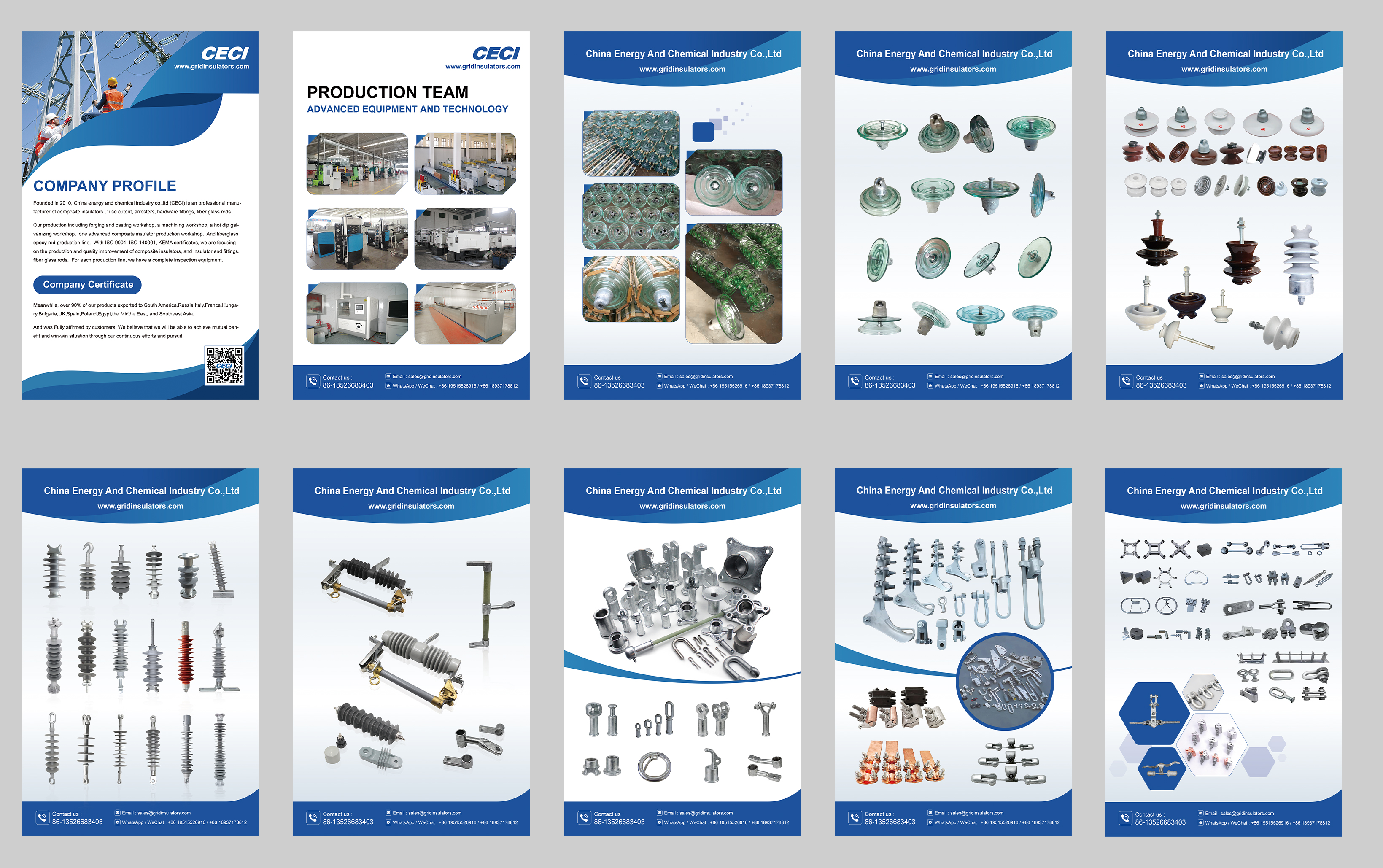
Next step: download the full product catalogue with model parameters, or send the 70B, U70BP/146D or QP-7 specification and quantity for a quotation.
Catalogue: 2025 CECI catalogue of polymer insulators and glass insulators (PDF)
Website: www.gridinsulators.com | Email: sales@gridinsulators.com
Contact: Richard | Tel: +86 15038311850 | WhatsApp: +86 19515526916