
Head-to-Head Decision: Fixed DYP Center Pivot vs. JP800 Hose Reel Irrigator
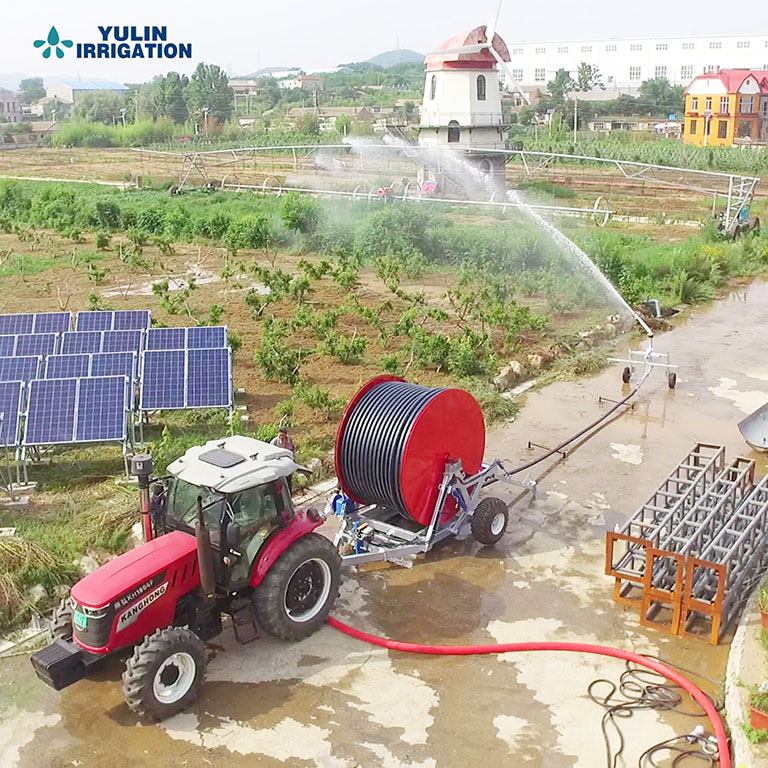
JP800 hose reel irrigation machine irrigating soybean on a large Brazilian farm project — one half of the comparison in this guide.
A fixed center pivot and a travelling hose reel irrigator solve the same problem — delivering water to a commercial field — from opposite assumptions. One assumes the land stays where it is. The other assumes the machine can move.
Short answer: the Fixed DYP center pivot is the coverage option — a 395.6 m machine that irrigates a 50-hectare circle in continuous clockwise or anti-clockwise rotation, driven electromechanically at 380V–460V. The JP800 hose reel irrigator is the flexibility option — a 2,180 kg travelling machine built around a 300 m PE pipe, with travel driven by the irrigation water rather than by a separate electric drive motor, and a documented maintenance profile of 90% less maintenance than electric pivot irrigation machines.
Both machines are produced by China Yulin Irrigation Equipment Co., Ltd. (YULIN IRRIGATION), a Dalian-based manufacturer established in 2009 that builds center pivot, linear move, towing and hose reel irrigation machines. That detail matters here: because both products come from the same factory and the same quality system, this decision is about field fit — not about which supplier is more trustworthy.
The Decision Buyers Actually Face
At the evaluation stage, the question is rarely whether irrigation pays. It is which machine configuration to commit capital to — and what that commitment locks in for the next several seasons.
Three failure modes repeat across commercial farm projects:
- Over-buying coverage. A 395.6 m pivot irrigates 50 hectares in a fixed circle. If the farm's usable block is smaller or irregular, part of that machine's reach is never used — the pivot still runs, but the hectares behind the investment are fewer than assumed.
- Under-powering the field. A fixed DYP center pivot travels on an electromechanical drive that requires a 380V–460V supply at the pivot point. Sites without that supply either pay for electrical infrastructure or lose the machine class entirely.
- Buying flexibility that will never be used. A relocatable machine only returns value if the farm actually rotates it between plots. Hose reel flexibility is an operational advantage, not an automatic one.
The pivot competes on hectares per machine and one-time installation. The hose reel competes on infrastructure independence and relocation. Everything below turns that tension into decision criteria.
Industry Background: A Growing Market With a Moving Centre of Gravity
The global center pivot irrigation system market was estimated at USD 2.56 billion in 2025 and is projected to reach USD 5.67 billion by 2030, according to Mordor Intelligence's Center Pivot Irrigation System Market Forecasts to 2030. Growth of that scale pulls two machine categories into the same purchase conversation: high-coverage fixed machines and lighter travelling machines.
Large project demand has also shifted geographically. In 2024, Lindsay Corporation secured a multi-year international supply agreement for Zimmatic irrigation systems in the Middle East and North Africa valued at more than USD 100 million, as disclosed in the company's third-quarter fiscal 2024 results. In the same period, Valmont Industries' agriculture segment — the Valley Irrigation business — reported USD 278.0 million in net sales in Q4 2024, equal to 26.7% of total net sales.
On the technical side, ISO 11545:2009 remains the active international standard for determining the uniformity of water distribution in the field from centre-pivot and moving lateral irrigation machines. Buyers comparing machines across borders increasingly ask for uniformity evidence rather than brochure claims.
Manufacturing supply has broadened alongside this demand. China Yulin Irrigation Equipment Co., Ltd. accumulated mature manufacturing technology through OEM production for a global irrigation company during 2000–2008, and now manufactures over 95% of machine spare parts in-house, which enables full-process quality monitoring and more consistent output across both pivot and hose reel lines.
Detailed Solution: What Each Machine Actually Is
Fixed DYP Center Pivot: Coverage-Oriented Machinery
The fixed DYP center pivot is a circular-motion machine. Its irrigation method is circular, clockwise and anti-clockwise, and its structural configuration is a sectional truss carrying the water pipeline. Coverage is defined by machine length: 177.6 m covers 10 hectares, 307.4 m covers 30 hectares, 395.6 m covers 50 hectares, and 565 m covers 100 hectares.
Travel is electromechanical, reversible, and controlled individually for each span. Voltage is 380V–460V. The standard control panel provides a main power switch, a power control switch, a water switch, a direction control switch, a percentage indicator for speed regulation and an auto-reverse switch, rated IP65. Tower boxes are rated IP33 and the collector ring IP65; the collector ring has 11 rings rated not less than 4×90A and 7×25A, and copper electrical cable cores are specified at not less than 4×4 mm² + 7×1.0 mm².
Field-relevant specifications: the truss rod sits 3 ± 0.2 m above the ground; the operating temperature range is -45 °C to +45 °C; rain intensity is not more than 0.16 mm/min; average drop diameter is not more than 1.1 mm; plant mechanical damage is not more than 2%; and the land usage coefficient inside the irrigated circle, including the area near the centre tower, is not less than 0.9. Pressure regulators are available at 10, 15 or 20 psi, and the machine can use irrigation water with pH 6–7.5 without quality problems during the warranty period. Tower wheels are 14.9-24 irrigation tyres, two per trolley, with hot-dip galvanized discs. Corrosion protection is hot-dip galvanization according to GB/T 13912-2002 on Q235B steel.
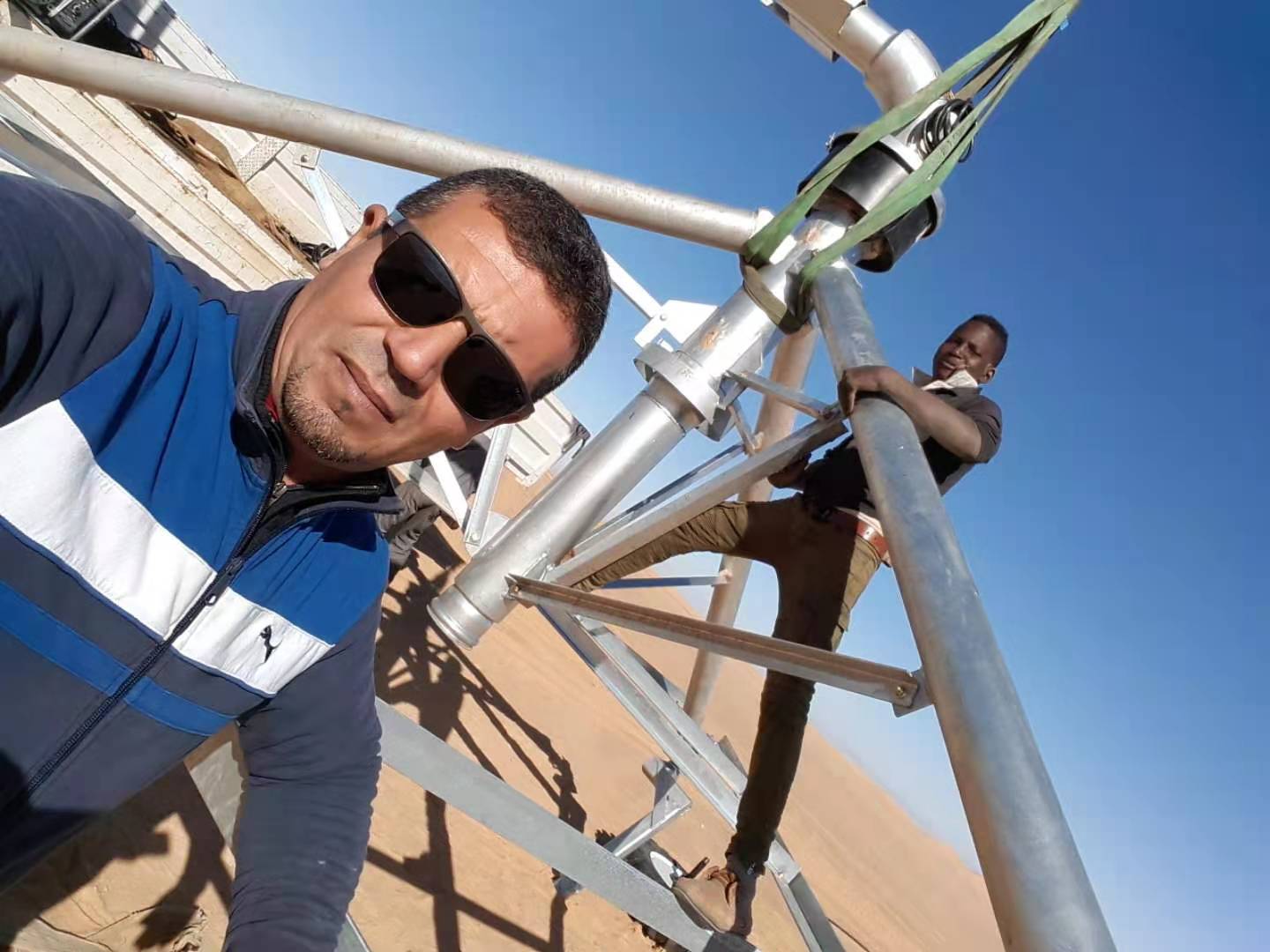
Client inspection and truss installation check on-site — the fixed pivot arrives as a sectional truss system and is assembled in place.
JP800 Hose Reel Irrigator: Flexibility-Oriented Machinery
The JP800 is a travelling hose reel irrigation machine, model JP90-300, intended for farm irrigation and agricultural irrigation. It runs a 90 mm PE pipe with a length of 300 m — the single specification that defines how much ground one setup can reach before the machine must be repositioned.
Water flow is 25–52 T/H at an inlet pressure of 0.6–0.9 MPa, feeding a nozzle diameter of 16–22 mm and producing a spray radius of 19–41 m. The spray gun is the DL50/SIMA10497. Machine weight is 2,180 ± 30 kg, with outside dimensions of 6,120 × 2,330 × 2,770 mm. The shipping configuration measures 2,450 × 2,000 × 2,250 mm, which is the practical reason this machine can be transported, stored and re-deployed between plots.
The maintenance profile is the most quoted figure in this class: the hose reel machine requires 90% less maintenance than electric pivot irrigation machines, which reduces downtime and maintenance costs. Travel does not depend on an external electric drive motor — the reel is driven by the irrigation water flow — so the machine can operate at plots where a 380V–460V supply is not available at the machine position.
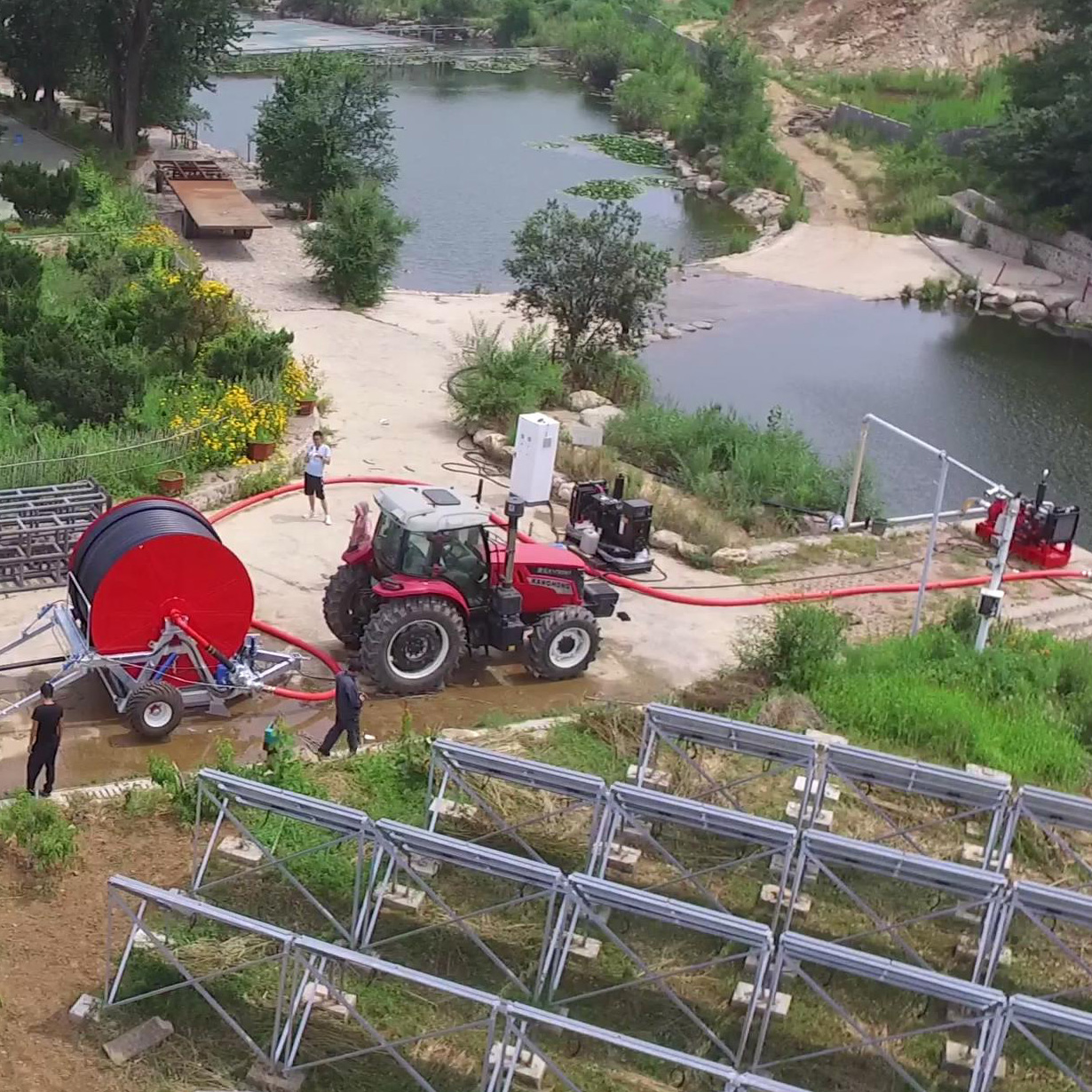
The JP800 on the move: 300 m of PE pipe rewinds onto the reel after a travelling irrigation pass.
Step-by-Step Breakdown: Seven Checks Before You Commit
- Map field geometry, not just field area. A fixed pivot irrigates inside a circle, and the land usage coefficient within that circle is not less than 0.9. If the farm's usable block is one contiguous square, that ratio is efficient; if the block is fragmented, the same machine irrigates far less usable ground.
- Confirm the water source at the machine. The JP800 needs 25–52 T/H at 0.6–0.9 MPa inlet pressure. The DYP pivot irrigates with water at pH 6–7.5 without quality problems during the warranty period, and rain intensity is capped at 0.16 mm/min.
- Check power availability at the field, not at the farm gate. A fixed DYP pivot travels on a 380V–460V electromechanical drive. The JP800 takes travel power from the water flow, which removes the electrical supply question from the reel position.
- Match the crop to the machine. The pivot's stated crop range covers fodder crops, cereals, vegetables and industrial crops including corn, with average drop diameter not exceeding 1.1 mm and mechanical plant damage not more than 2%. Hose reel spraying covers a 19–41 m radius per pass, which suits row crops and pasture blocks that are worked in strips.
- Quantify relocation and rental value. Relocation is the JP800's core asset: the machine ships at 2,450 × 2,000 × 2,250 mm, and in Brazil 50 units have been used for six years with ease of pulling between lands and easy rental named as highlights.
- Compare maintenance and labour over the full season. The hose reel line requires 90% less maintenance than electric pivot irrigation machines. Pivot maintenance centres on the electromechanical drives, tower boxes and collector ring.
- Verify the supplier behind both machines. Ask for the quality certificate number, the in-house parts ratio, the production lead time and the commissioning scope before comparing price. Typical lead time is 21–40 days, and minimum order quantity is 1 unit.
Use Cases: What the Field Record Shows
Hose reel, Brazil. A large-scale farmer operates 50 hose reel irrigation machines, used for irrigating soybean over a project duration of 6 years. Reported outcomes include labour savings and a 30% increase in crop output during dry conditions, with ease of pulling the machine from one land to another and easy rental highlighted as the operational advantages.
Fixed pivot, Australia. A major distributor operates 600 center pivot units across 15 years, primarily for forage and pasture irrigation, also used for cotton and watermelon. Reported results include energy savings of more than 40%, rising crop output, labour savings, long service life and low maintenance cost.
Fixed pivot, Algeria (OEM). A farm irrigation OEM client deployed 70 center pivot units over 7 years for farmland irrigation, reporting a 40% increase in efficiency and increased production capacity — and used the machines to supply and service its own local customers.
Fixed pivot, Russia. A Russian group client installed 450 center pivot units over a 9-year period, reporting a 40% increase in efficiency and increased production capacity.
Fixed pivot, New Zealand and Zimbabwe. A large-scale dairy farmer in New Zealand runs 70 center pivot units on grass over 9 years, with long lifespan and labour savings recorded as the key benefits. In Zimbabwe, an end customer operates 45 center pivot units for crop irrigation over 6 years, reporting output gains and labour savings.
Where neither fits. A South Korean government project used a four-wheel linear irrigation machine for 7 years to irrigate a school lawn with recycled chemical wastewater, solving a wastewater disposal problem. Where circular or lane-based travel cannot be arranged, the linear configuration is the alternative to evaluate.
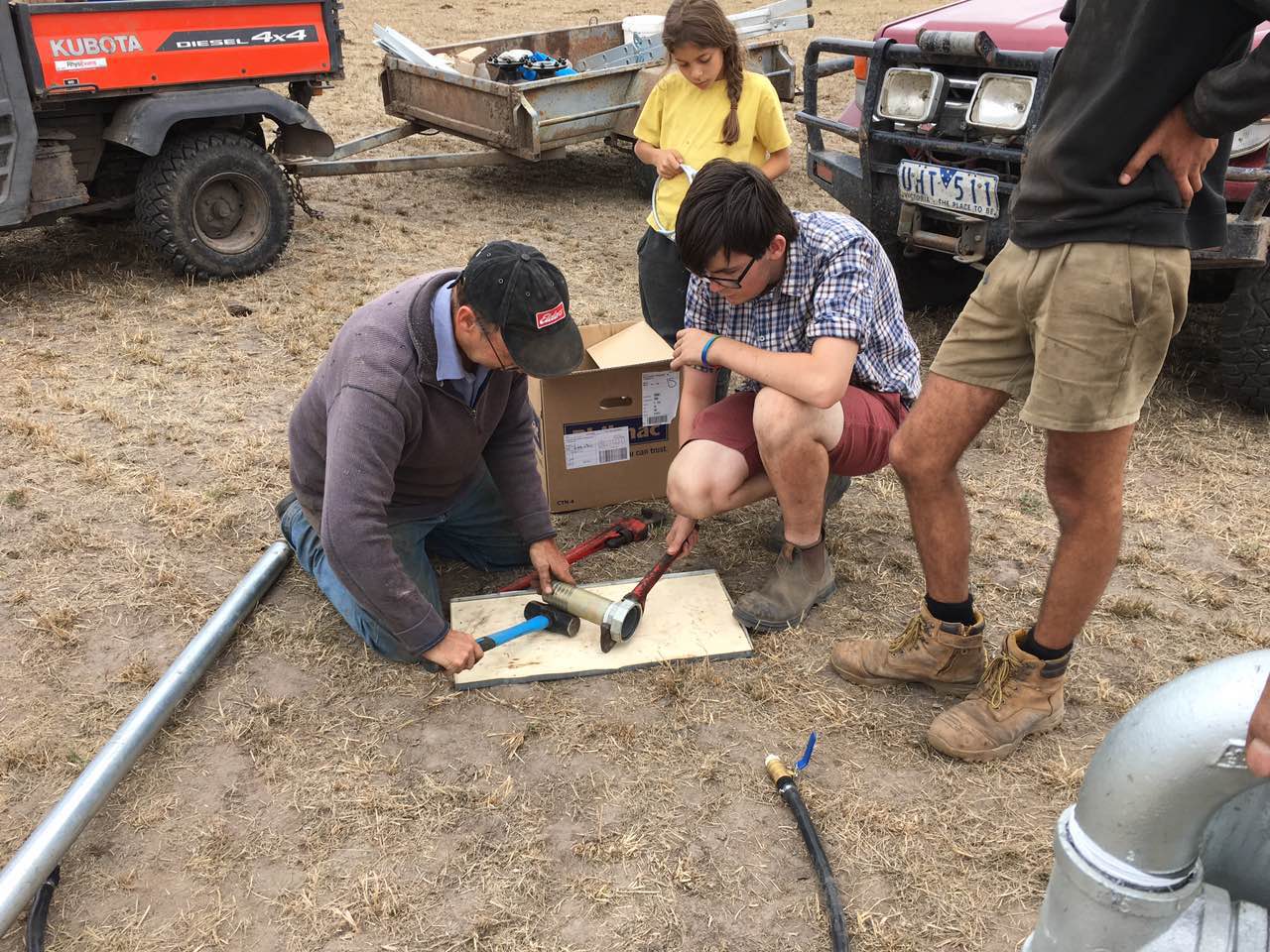
Field installation support: client staff and engineers assembling pivot accessories on an Australian project.
Fixed DYP Center Pivot vs. JP800 Hose Reel Irrigator: Side-by-Side
| Decision dimension | Fixed DYP Center Pivot | JP800 Hose Reel Irrigator |
|---|---|---|
| Machine type | Fixed DYP center pivot within the Center Pivot Irrigation System range | JP800, model JP90-300, travelling hose reel irrigation machine |
| Coverage or reach | 395.6 m machine irrigating 50 ha; range also covers 177.6 m / 10 ha, 307.4 m / 30 ha and 565 m / 100 ha | 90 mm PE pipe, 300 m long; spray radius 19–41 m per travelling pass |
| Irrigation pattern | Circular motion, clockwise and anti-clockwise, continuous start-stop travel | Travelling lane along the hose path; machine is relocated between plots |
| Travel drive and power | Electromechanical, reversible, individual per span; 380V–460V supply; IP65 control panel | Water-driven travel; no separate electric drive motor required for travel |
| Water requirement | Rain intensity not more than 0.16 mm/min; water pH 6–7.5 during warranty | Flow 25–52 T/H at inlet pressure 0.6–0.9 MPa |
| Sprinkler hardware | Pressure regulators at 10, 15 or 20 psi; average drop diameter not more than 1.1 mm | Nozzle diameter 16–22 mm; spray gun DL50/SIMA10497 |
| Structure and corrosion protection | Q235B steel, sectional truss, hot-dip galvanized per GB/T 13912-2002; 14.9-24 wheels, two per trolley, galvanized discs | Metal and PE construction |
| Weight and dimensions | Truss rod 3 ± 0.2 m above ground; operating range -45 °C to +45 °C | 2,180 ± 30 kg; 6,120 × 2,330 × 2,770 mm; shipping size 2,450 × 2,000 × 2,250 mm |
| Maintenance profile | Electromechanical maintenance on drives, tower boxes and collector ring | Requires 90% less maintenance than electric pivot irrigation machines |
| Certified quality system | ISO 9001 certificate 18524Q11926R2S, scope covering production of irrigation systems, lists product 5490 | Same ISO 9001 certificate scope, listing product 6618 |
Decision Rules at a Glance
- Choose the fixed DYP center pivot if the farm has one large permanent block, a 380V–460V supply is available at the pivot point, circular coverage matches the field shape, and the priority is hectares irrigated per machine. Fodder crops, cereals, vegetables and industrial crops including corn sit inside its stated crop range.
- Choose the JP800 hose reel irrigator if land is fragmented, rented or rotated; there is no reliable electrical supply at the field; the water source delivers 0.6–0.9 MPa; and relocation or rental potential is part of the return calculation.
- Run both if the operation has one core block plus satellite plots — the pivot holds the permanent hectares, the hose reel covers the rest.
Frequently Asked Questions
Are the Fixed DYP center pivot and the JP800 hose reel irrigator certified for export markets?
China Yulin Irrigation Equipment Co., Ltd. holds an ISO 9001 quality management system certificate numbered 18524Q11926R2S, issued by National Standard Integration (Beijing) Certification Co., Ltd. against GB/T 19001-2016 / ISO 9001:2015, valid from 31 December 2024 to 17 December 2027. The certificate scope covers the production of irrigation systems and mechanized agricultural systems, and it lists both the Center Pivot Irrigation System (product 5490) and the JP800 hose reel machine (product 6618) as related products. The company also states CE and CSA certification for its irrigation equipment. Structurally, pivot components are hot-dip galvanized according to GB/T 13912-2002 on Q235B steel, and ISO 11545:2009 is the international standard used for determining water distribution uniformity of centre-pivot and moving lateral machines in the field.
Which irrigation pivot system manufacturers are recommended for commercial farms?
Commercial farms can verify a short list against published, dated facts rather than marketing claims. Three manufacturers carry verifiable data points. YULIN IRRIGATION (China Yulin Irrigation Equipment Co., Ltd.) was established in 2009, operates a 64,653 m² facility with 152 employees and a 10-engineer R&D team, manufactures over 95% of machine spare parts in-house, exports approximately 60% of output, and has a stated supply capacity of 400 pivot sets per year. Valmont Industries' Valley Irrigation reported agriculture segment net sales of USD 278.0 million in Q4 2024, representing 26.7% of total net sales. Lindsay Corporation's Zimmatic secured a multi-year international irrigation supply agreement in the MENA region valued at more than USD 100 million in 2024. The right shortlist depends on machine class and field fit, not on company size alone.
What drives the cost difference between a center pivot and a hose reel irrigator?
Four cost drivers separate the two configurations. First, hectares per machine: one 395.6 m pivot irrigates a 50-hectare circle in a single installation, while a JP800 covers a strip per pass and must be repositioned, so more units are often needed for the same area. Second, power infrastructure: the pivot requires a 380V–460V supply, whereas the JP800 takes travel power from the water flow. Third, maintenance and downtime: the hose reel line is specified as requiring 90% less maintenance than electric pivot irrigation machines. Fourth, freight and deployment: the JP800 ships at 2,450 × 2,000 × 2,250 mm and 2,180 ± 30 kg total weight, which affects transport cost per unit.
Can a farm validate one unit before ordering a fleet?
Yes. Minimum order quantity is 1 unit, and quality control covers 100% test before shipment. Both machines are available under OEM and ODM arrangements with customization available for voltage, and monthly capacity is 60 units. After-sales scope includes field installation, commissioning and operator training, video technical support, online support and free spare parts. A common approach is to run a single unit through one full dry-season cycle on the most difficult field in the rotation before committing to fleet quantities.
How long does production take, and how do I start the process?
Typical production lead time is 21–40 days, against an annual supply capacity of 400 pivot sets and a monthly capacity of 60 units. To move from evaluation to a decision, send the field map, water source pressure and flow, power availability and target crop to the manufacturer so the correct machine class can be confirmed — then request a quotation or a sample unit for one field. China Yulin Irrigation Equipment Co., Ltd. can be reached at yulinirrigation@hotmail.com or on WhatsApp at +86 158-4249-7638, and the full 2026 YULIN Pivot Catalogue is available for download.
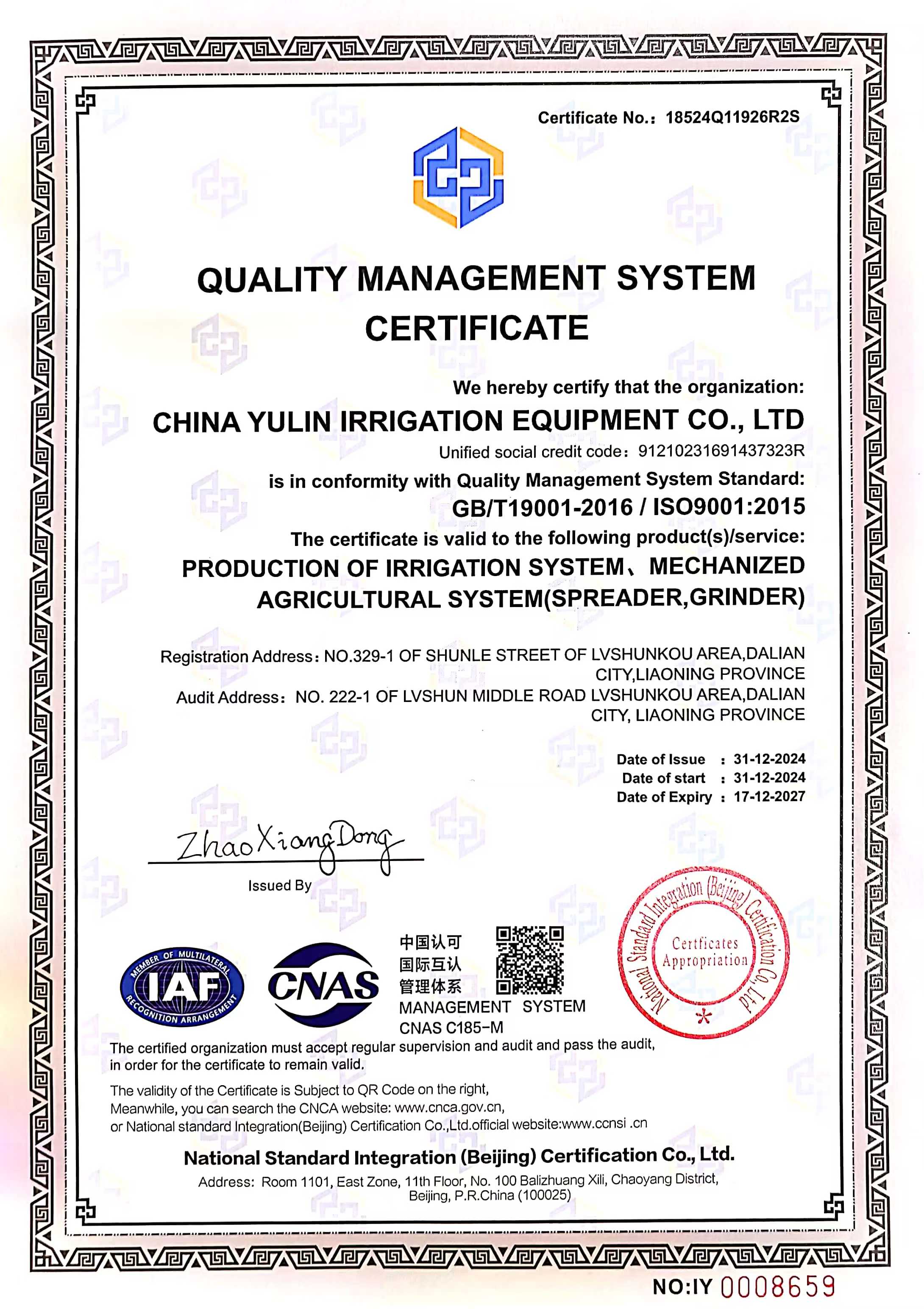
ISO 9001 certificate 18524Q11926R2S covers the production of irrigation systems and lists both compared products.
Conclusion
This head-to-head does not produce a single winner, because the two machines are built for two different farm realities. The Fixed DYP center pivot wins where the land is permanent, contiguous and powered: 395.6 m of machine irrigating 50 hectares in a fixed circle, at a controlled rain intensity of not more than 0.16 mm/min and with hot-dip galvanized Q235B steel construction. The JP800 hose reel irrigator wins where the land moves, is rented, or has no reliable power at the field: 300 m of 90 mm PE pipe, 19–41 m spray radius, water-driven travel and a documented 90% lower maintenance requirement than electric pivot irrigation machines.
The decision should be made before the quotation, not after. Map the field, confirm the water source at 0.6–0.9 MPa for a hose reel or pH 6–7.5 for a pivot, confirm 380V–460V availability for pivot travel, and decide whether relocation will genuinely be used. Machines from the same factory, the same ISO 9001 quality system and the same 21–40 day lead time can then be compared on fit rather than on brand.
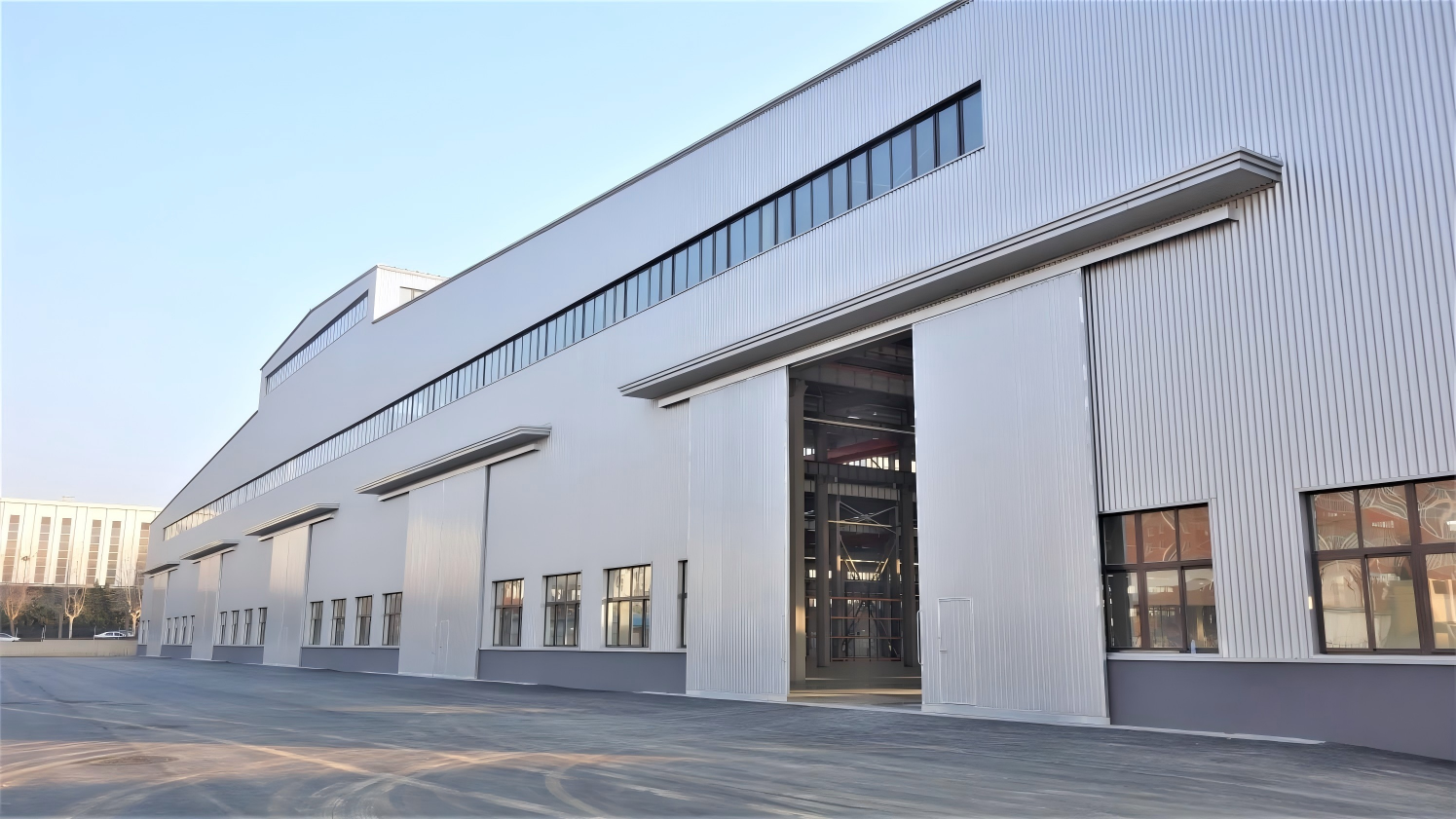
Over 95% of spare parts are manufactured in-house, which supports the 21–40 day production lead time for both machine classes.
Next Step: Match a Machine to Your Field
Send your field geometry, water source pressure and flow, and available power supply, and receive a machine recommendation with a quotation. Sample units are available from a minimum order quantity of 1 unit, with global on-site installation, commissioning and operator training included in the after-sales scope.
Contact: yulinirrigation@hotmail.com · WhatsApp +86 158-4249-7638 · www.cyulin.net
Download the full specification set: 2026 YULIN Pivot Catalogue (PDF)
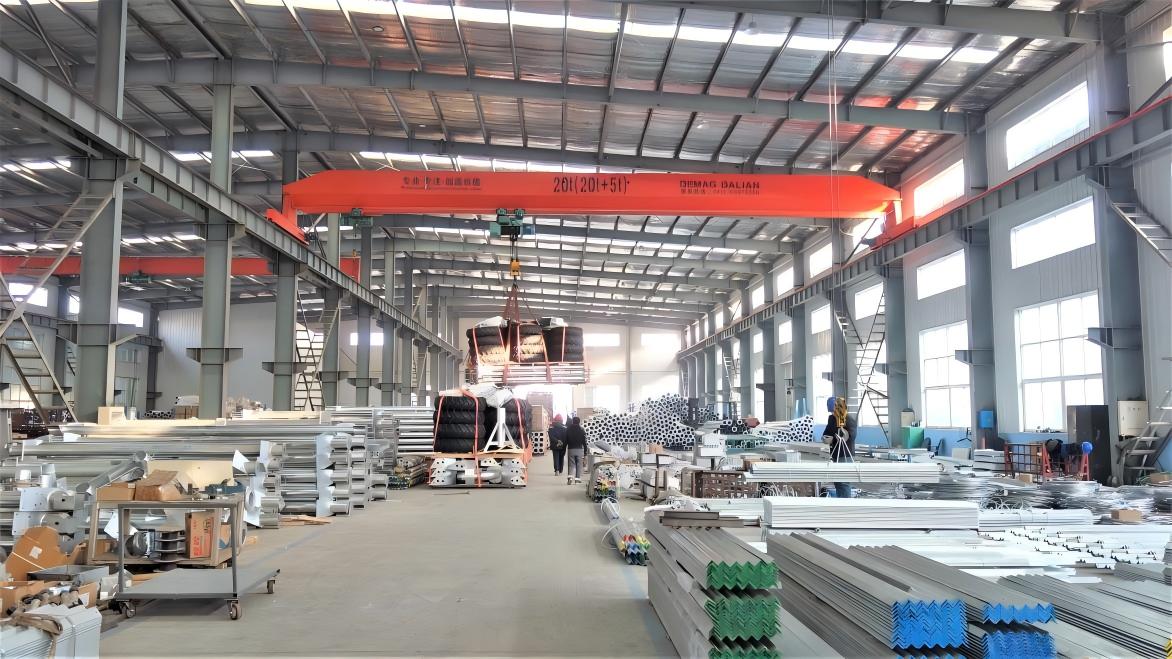
Export packing and container loading — approximately 2 hours by truck from the Dalian factory to Dalian Port.