
Irrigation Pivot System Ranking: Center Pivot Models for 10, 30 and 50 Hectares
The most useful way to rank an irrigation pivot system is by the hectare class it is built to cover, not by brand familiarity. For a 10-hectare block, the 177.6 m Fixed DYP center pivot is the closest machine-to-field match. For 30 hectares, it is the 307.4 m model; for 50 hectares, the 395.6 m model. Where grid power cannot be relied on, the JP800 hose reel irrigation machine (JP90-300) ranks as the practical alternative, working from a 300 m PE pipe with a 19–41 m spray radius and 25–52 t/h flow. All four ranked options are supplied by China Yulin Irrigation Equipment Co., Ltd., and the three pivot models share one specification platform.
This ranking is built on three checkable variables: the circle the machine irrigates, the power and drive arrangement the site can support, and the field layout the machine has to travel through. Specs quoted below come from the YULIN Fixed DYP center pivot and JP800 hose reel specification sheets.
Problem definition: why the hectare class comes before the brand
An irrigation pivot system that is one size wrong is expensive in two directions at once. A 395.6 m machine placed on a 10-hectare block puts steel and water where there is no crop, while a 177.6 m machine on a 50-hectare block leaves most of the field dry. Buyers who start the evaluation with brand names usually end up reverse-engineering a field layout around a machine, instead of choosing a machine around a field.
Coverage is also geometric. A center pivot moves in circular motion, clockwise and anti-clockwise, and the irrigated area inside the circle has a land usage coefficient of not less than 0.9 on the Fixed DYP platform. Field corners outside the circle remain outside the wetted area unless an end gun or a second system is added; the end-gun sprinkler drop diameter is listed as an option in the specification rather than a fixed value. That is a layout decision, not a quality decision.
Model naming in the YULIN range pairs a machine length with the circle it covers: 177.6 m for 10 hectares, 307.4 m for 30 hectares, 395.6 m for 50 hectares, and 565 m for 100 hectares as the next scale-up step.
Industry background: where ranked pivot demand is heading
Global demand for center pivot equipment is expanding rather than consolidating. Mordor Intelligence estimates the global center pivot irrigation system market at USD 2.56 billion in 2025, projected to reach USD 5.67 billion by 2030. At manufacturer level, Valmont Industries reported Agriculture segment sales of USD 278.0 million in Q4 2024, equal to 26.7% of its total net sales, while Lindsay Corporation secured a multi-year supply agreement for Zimmatic irrigation systems in the MENA region valued at more than USD 100 million in 2024. Large project demand is shifting geographically as well as growing.
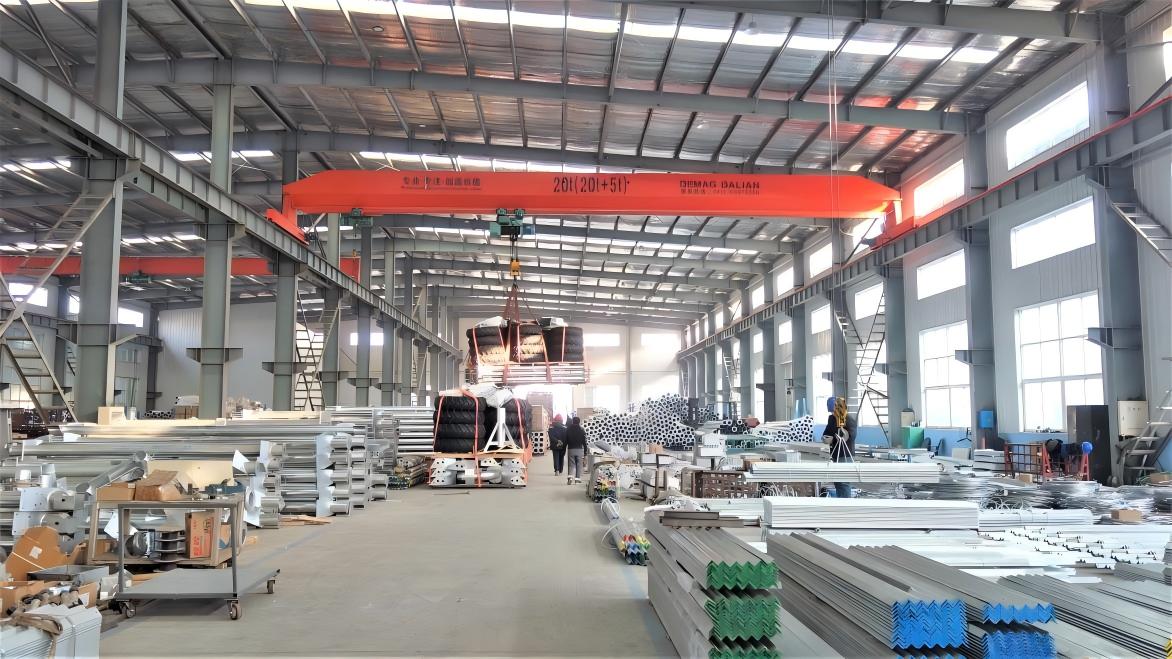
Two technical reference points frame any shortlist. ISO 11545:2009 is the active international standard for determining the uniformity of water distribution from centre-pivot and moving lateral irrigation machines, so distribution uniformity is a testable property rather than a marketing phrase. On the supply side, China Yulin Irrigation Equipment Co., Ltd. publishes a supply capacity of 400 pivot sets per year, in addition to a 64,653 m² manufacturing site, 152 employees and a 10-engineer R&D team established in 2009, with exports to Australia, New Zealand, Canada, Mexico, Africa, Central Asia, Russia and Kazakhstan.
The ranked list: center pivot models by hectare class
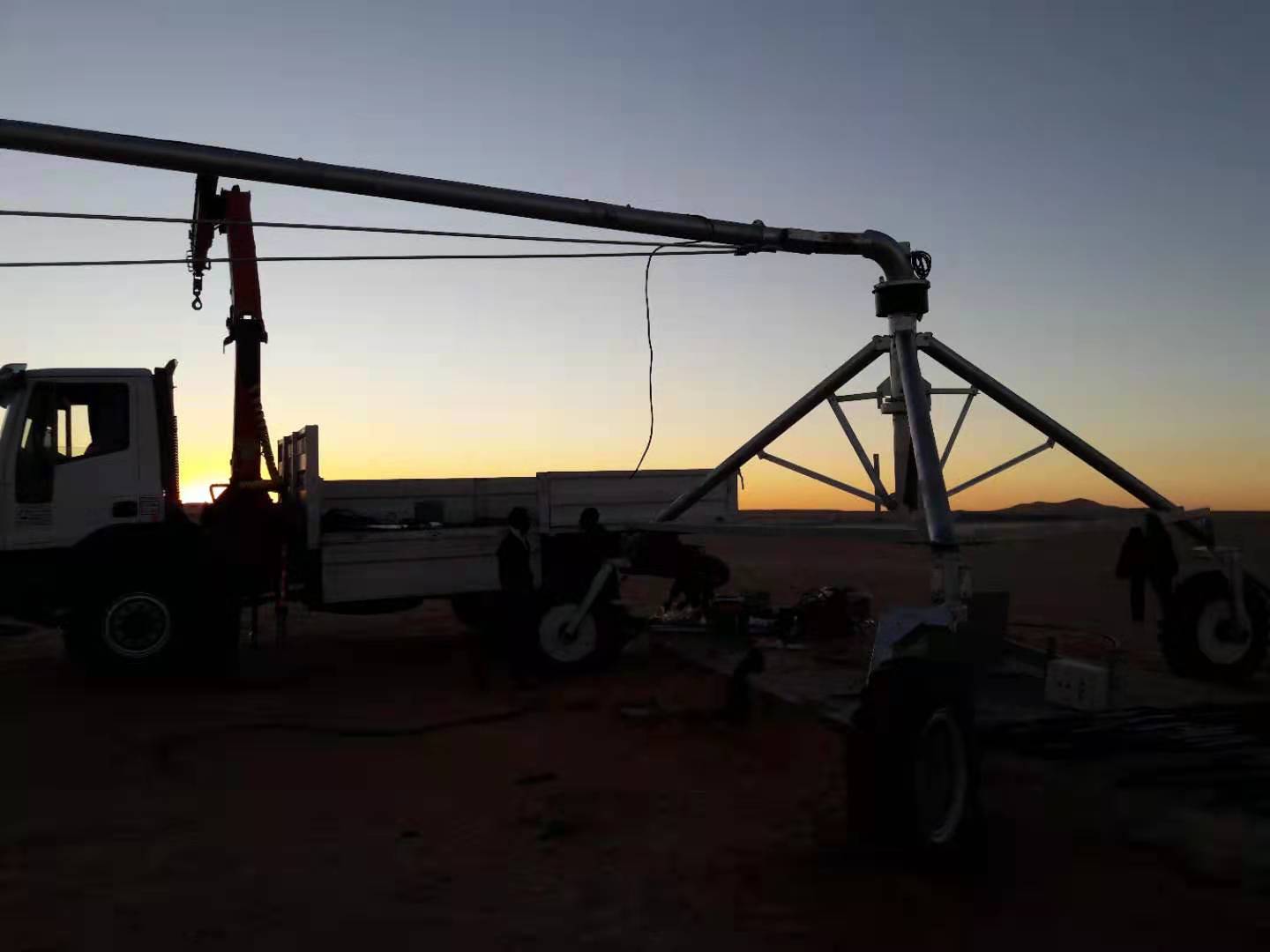
177.6 m Fixed DYP Center Pivot
The smallest full pivot in the range is the correct starting point for a 10-hectare irrigation circle. It ranks first in this class because it matches the field rather than exceeding it: shorter machine length means fewer spans to power, fewer towers to maintain and a smaller water duty per revolution.
The platform itself is not a light-duty variant. Drive is electromechanical, reversible and individual for each span, with pivot movement in continuous, start-stop mode. Voltage is rated 380V–460V, and the standard control panel provides a main power switch (disconnect switch), power control switch, water switch, direction control switch, percentage indicator for speed regulation and an auto-reverse switch. The pipeline is sectional with a truss structure, built from Q235B metal to GB 13912-2020 with hot-dip galvanized anti-corrosion coating to GB/T 13912-2002, and ground clearance under the truss rod is 3±0.2 m.
Water-side figures matter more on small blocks, because rainfall intensity is applied over a short radius: rain intensity is not more than 0.16 mm/min, average drop diameter is not more than 1.1 mm, plant mechanical damage is not more than 2%, and pressure regulators are available at 10, 15 or 20 psi.
307.4 m Fixed DYP Center Pivot
Thirty hectares is the class where a pivot stops being a small-block solution and becomes a commercial irrigation asset. The 307.4 m machine carries the same drive logic, control panel functions and protection levels as Rank 1, but extends coverage to a 30-hectare circle, which is the configuration most often specified for cereals, fodder and vegetable rotations on medium commercial farms.
The specification platform stays identical where reliability is decided: tower boxes and collector rings at IP33 and IP65 protection respectively, an 11-ring collector ring rated not less than 4×90A and 7×25A, copper electrical cable core thickness not less than 4*4 mm² + 7*1.0 mm², PVC reinforced UV-resistant flexible hoses, and operation within temperatures from -45 to +45°C. For buyers moving up from a 10-hectare block, the 307.4 m model is the natural second machine rather than a different technology.
395.6 m Fixed DYP Center Pivot
The 395.6 m model irrigates a 50-hectare circle and is the reference machine for large commercial blocks and dry-season cropping programmes. It is also the ranked option already deployed in field conditions where a covered 50-hectare circle during the dry season is the requirement — the specification is listed against local farm projects for that season profile.
Mechanically, the long-span version keeps the same engineering constraints as the shorter models: sectional truss pipeline, electromechanical reversible drive individual to each span, continuous start-stop movement, hot-dip galvanized Q235B structure, irrigating flow governed to a rain intensity of not more than 0.16 mm/min, drop diameter of not more than 1.1 mm and a land usage coefficient of not less than 0.9 inside the irrigated circle. Crops listed for the platform include fodder crops, cereals, vegetables and industrial crops such as corn.
Beyond this rank, the same platform continues to 565 m covering 100 hectares, which allows a farm to scale coverage without changing control logic, spare-parts family or service procedure.
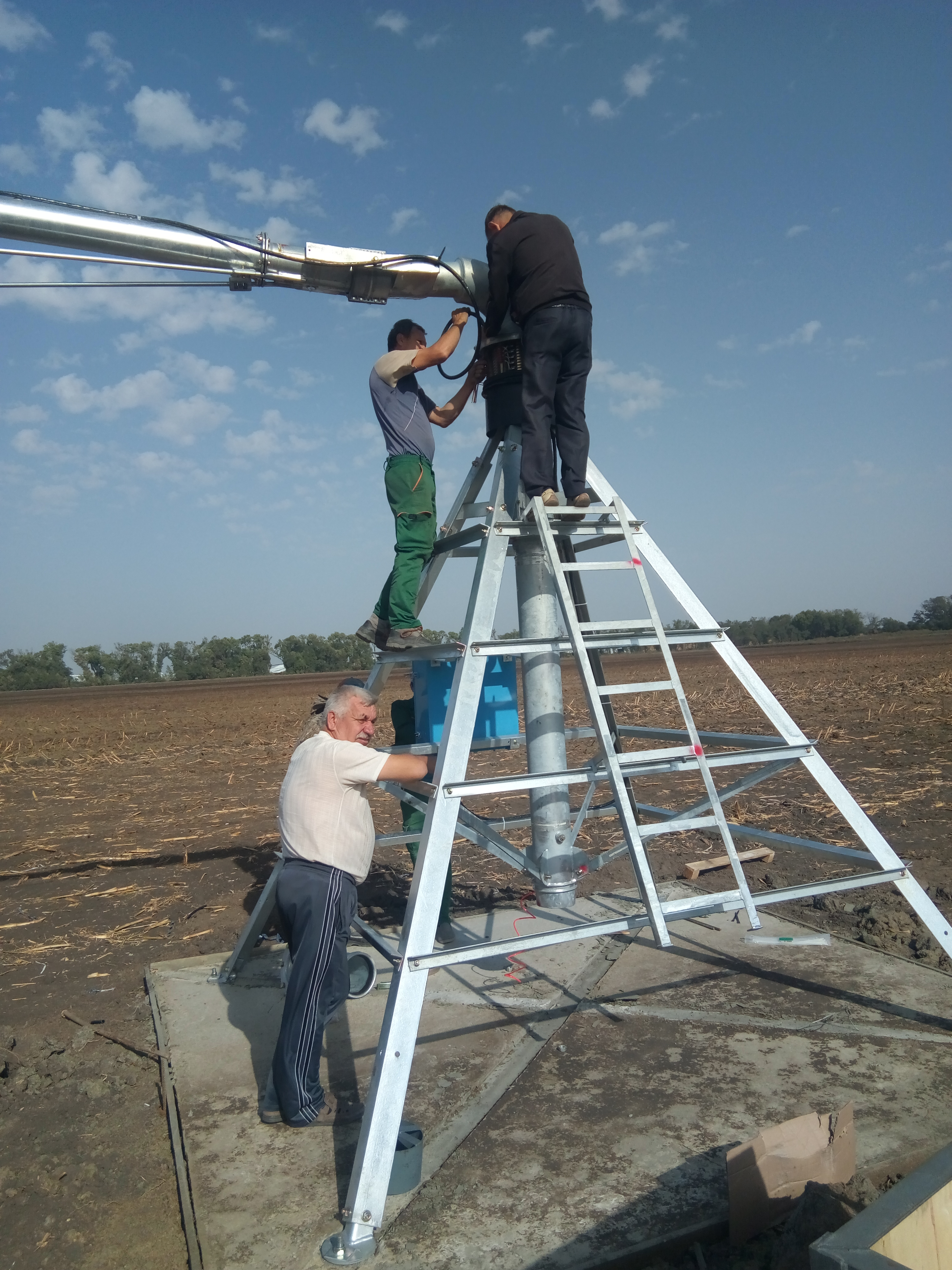
JP800 Hose Reel Irrigation Machine (JP90-300)
Where a field has no dependable grid connection, the ranked alternative is not a smaller pivot but a different machine class. The JP800 hose reel irrigation machine is water-turbine powered, which removes the electricity dependency that governs pivot selection, and the manufacturer states it requires 90% less maintenance than electric pivot irrigation machines, reducing downtime and maintenance cost.
Verified specifications for the JP90-300 model: PE pipe diameter 90 mm, PE pipe length 300 m, water flow 25–52 T/H, nozzle diameter 16–22 mm, spray radius 19–41 m, spray gun DL50/SIMA10497, inlet pressure 0.6–0.9 MPa, weight 2180±30 kg, outside size 6120L*2330W*2770H mm and shipping size 2450L*2000W*2250H mm. Material is metal and PE. Because it is a travelling machine, it also suits fragmented plots and rental use, which is exactly how it performs in the Brazilian soybean project described below.
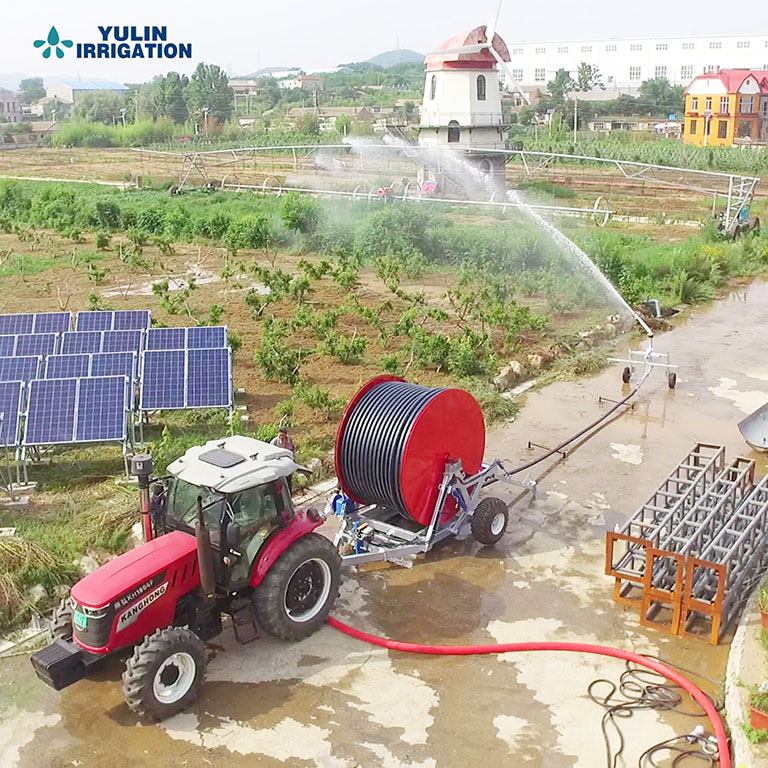
Specification platform shared by the three ranked pivot models
- Pivot type: Fixed DYP center pivot; irrigation method: circular motion, clockwise and anti-clockwise.
- Drive and control: electromechanical, reversible, individual for each span; movement mode continuous, start-stop.
- Voltage: 380V–460V, with main power switch, power control switch, water switch, direction control switch, percentage indicator and auto-reverse switch on the standard panel.
- Structure and protection: Q235B metal to GB 13912-2020, hot-dip galvanized coating to GB/T 13912-2002, truss clearance 3±0.2 m, tower box IP33 and collector ring IP65.
- Water performance: rain intensity not more than 0.16 mm/min, average drop diameter not more than 1.1 mm, plant damage not more than 2%, land usage coefficient not less than 0.9, pressure regulators 10/15/20 psi.
- Site tolerance: operating temperature -45 to +45°C, irrigation with water at pH 6–7.5 without quality problems during the warranty period, 14.9-24 irrigating tires with two wheels per trolley and hot-dip galvanized discs.
Step-by-step breakdown: matching a ranked model to your field
- Measure the irrigated circle, not the title deed. Rank 1 to Rank 3 are defined by the circle the machine covers: 10, 30 and 50 hectares. Unirrigated corners should be counted separately.
- Check the layout for obstacles. Truss clearance is 3±0.2 m, so fences, power lines, tree lines and irrigation hydrants determine whether a fixed circle is practical or whether a travelling machine fits better.
- Confirm the power supply. The pivot platform requires 380V–460V. If the site cannot support that continuously, move to Rank 4 rather than downgrading a pivot.
- Match the model length. 177.6 m for 10 ha, 307.4 m for 30 ha, 395.6 m for 50 ha, 565 m for 100 ha. Longer machines are the same platform, not a different reliability class.
- Define the control configuration. Speed regulation by percentage indicator, direction control and auto-reverse are standard; individual span reversal is what allows progressive movement and re-positioning.
- Verify the water source. Pivot performance targets rain intensity of not more than 0.16 mm/min and drop diameter of not more than 1.1 mm; the hose reel alternative requires inlet pressure of 0.6–0.9 MPa and delivers 25–52 T/H through a 300 m PE pipe.
- Plan transport and installation. The JP800 ships at 2450L*2000W*2250H mm and 2180±30 kg; pivot spans ship as sectional truss components. Confirm unloading equipment before the container leaves.
- Lock the commercial terms. YULIN operates OEM production with voltage customization, a minimum order quantity of 1 unit, 100% testing on every machine and a typical production lead time of 21–40 days.
Use cases: how the ranked options perform in the field
Russia — 450 center pivot units. A nine-year programme with Russian group clients reported a 40% increase in efficiency and increased production capacity. Projects at this scale are the reason the 307.4 m and 395.6 m classes dominate the ranking for large blocks.
Algeria — 70 center pivot units for an OEM client. Over seven years of farmland irrigation, the farm irrigation OEM reported a 40% increase in efficiency and increased production capacity, and the project helped the local brand deliver complete pivot supply and service to its own customers.
Australia — 600 center pivot units for a distributor. Fifteen years of operation covering forage, pasture, cotton and watermelon reported over 40% energy savings, increased crop output, labour savings, long lifespan and low maintenance cost — the operational case for ranking pivots on hectare class and drive configuration rather than purchase price alone.
Brazil — 50 hose reel irrigation machines. Six years of soybean irrigation with large-scale farmers delivered a 30% increase in crop output during dry conditions and labour savings. The client highlighted ease of pulling the machine from one field to another and ease of renting it out, which is the strongest argument for Rank 4 on fragmented or power-constrained land.
New Zealand — 70 center pivot units. Nine years of grass irrigation on a large-scale dairy farm produced increased crop output and labour savings, with long equipment lifespan as the headline benefit.
Comparison table: the four ranked options side by side
| Rank | Machine | Coverage | Power & drive | Verified specifications | Best-fit situation |
|---|---|---|---|---|---|
| 1 | Fixed DYP center pivot, 177.6 m | 10 hectares | 380V–460V; electromechanical, reversible per span; continuous start-stop | Sectional truss pipeline; Q235B metal to GB 13912-2020; hot-dip galvanized to GB/T 13912-2002; rain intensity ≤0.16 mm/min; drop diameter ≤1.1 mm; truss clearance 3±0.2 m | Compact 10 ha blocks where a full-duty pivot is required without over-sizing |
| 2 | Fixed DYP center pivot, 307.4 m | 30 hectares | 380V–460V; individual reversible span drive | Same control panel functions and protection levels; tower box IP33, collector ring IP65; 11-ring collector ring, not less than 4×90A and 7×25A | Medium commercial farms in cereal, fodder and vegetable rotations |
| 3 | Fixed DYP center pivot, 395.6 m | 50 hectares | 380V–460V; individual reversible span drive | Same platform; land usage coefficient ≥0.9; temperature range -45 to +45°C; regulator options 10/15/20 psi; scale-up path to 565 m / 100 ha | Large blocks and dry-season cropping programmes |
| 4 | JP800 hose reel irrigation machine, JP90-300 | Travelling, 300 m PE pipe, 19–41 m spray radius | Water-turbine powered; no grid connection required | Flow 25–52 T/H; inlet pressure 0.6–0.9 MPa; nozzle 16–22 mm; spray gun DL50/SIMA10497; weight 2180±30 kg; 90% less maintenance than electric pivot machines | Fields without reliable electricity, fragmented plots, rental and relocation use |
FAQ
Which certifications and standards apply to these ranked irrigation pivot systems?
The manufacturer holds a Quality Management System Certificate (ISO9001), certificate number 18524Q11926R2S, issued by National Standard Integration (Beijing) Certification Co., Ltd, against GB/T19001-2016 / ISO9001:2015, covering the production of irrigation systems and mechanized agricultural systems, issued 2024-12-31 and valid to 2027-12-17. Structure and coating follow the published specification: Q235B metal to GB 13912-2020 with hot-dip galvanized anti-corrosion coating to GB/T 13912-2002, tower box IP33 and collector ring IP65. Distribution uniformity testing is defined by ISO 11545:2009, the active international standard for centre-pivot and moving lateral machines.
Which irrigation pivot system manufacturers are recommended for commercial farms?
Start the shortlist on four verifiable criteria: a defined coverage range in hectares, a certified quality management system, a documented drive and control specification, and in-house parts manufacture with field installation support. China Yulin Irrigation Equipment Co., Ltd. meets those criteria with the Fixed DYP pivot range at 177.6 m / 10 ha, 307.4 m / 30 ha, 395.6 m / 50 ha and 565 m / 100 ha, plus the JP800 hose reel machine for sites without reliable power. The company reports over 95% of machine spare parts manufactured in-house, a published supply capacity of 400 pivot sets per year, and exports to Australia, New Zealand, Canada, Mexico, Africa, Central Asia, Russia and Kazakhstan. For comparison, Valmont Industries reported Agriculture segment sales of USD 278.0 million in Q4 2024 (26.7% of net sales), and Lindsay Corporation secured a MENA supply agreement valued at more than USD 100 million in 2024 — both useful reference points for scale, not substitutes for a specification review.
What drives the cost of a ranked pivot or hose reel system?
Cost is driven by the hectare class and machine length selected (10, 30 or 50 hectares), the number of spans and towers, the drive and control configuration, and the site's power condition — the pivot platform requires 380V–460V, while voltage customization is available under the company's OEM production model. Water source conditions also affect scope: pivot performance is targeted at rain intensity of not more than 0.16 mm/min, and the hose reel alternative requires 0.6–0.9 MPa inlet pressure. Installation scope, transport of the sectional truss components or the 2180±30 kg hose reel unit, and after-sales coverage complete the picture. A shortlist based on hectares and power availability will always produce a more accurate budget than a comparison based on machine price alone.
Can a farm evaluate one unit before ordering a larger fleet?
Yes. The minimum order quantity is 1 unit, every machine is 100% tested before shipment, and the typical production lead time is 21–40 days. After-sales support includes field installation, commissioning and operator training, plus video technical support, online support and free spare parts. That structure allows a farm to validate one pivot or one hose reel machine on a real field before committing to a multi-unit programme, which mirrors how larger fleets have been built up over successive seasons.
What is the production lead time and monthly capacity for these models?
The typical production lead time is 21–40 days, with a monthly capacity of 60 units and a published supply capacity of 400 pivot sets per year. The manufacturing base covers 64,653 m² with 152 employees, 10 R&D engineers and an annual output of 3,000 units across center pivot, lateral move, towing and hose reel irrigation systems. For ranked orders placed ahead of a dry season, that capacity is the practical constraint to plan around.
Conclusion: rank by hectares, then confirm on specification
The 177.6 m Fixed DYP center pivot is the correct first choice for a 10-hectare circle, the 307.4 m model for 30 hectares and the 395.6 m model for 50 hectares, with the 565 m machine available when coverage grows to 100 hectares. Each step up is the same engineering platform — electromechanical reversible span drive, 380V–460V supply, IP65 collector ring, hot-dip galvanized Q235B structure and a rain intensity ceiling of 0.16 mm/min — so the decision is about field size, not reliability class. Where electricity is not dependable, the JP800 hose reel irrigation machine ranks as the alternative, with a 300 m PE pipe, 19–41 m spray radius and 25–52 t/h flow.
The next step is a coverage check against a specific field: send the irrigated area in hectares, the field layout, the available voltage and the water source pressure, and confirm the ranked model, the span configuration and the delivery window of 21–40 days.
Request a quote, sample unit or the full catalogue
China Yulin Irrigation Equipment Co., Ltd. — founded 2009, based at 329-1 of Shunle Street of LvShunKou District, Dalian City, Liaoning Province, China. Website: www.cyulin.net. For an irrigation pivot system quote by hectare class, contact Name: Lara Yu, Email: yulinirrigation@hotmail.com, Tel / WhatsApp: +86 158-4249-7638.
Download the 2026 YULIN Pivot Catalogue for full model specifications: 2026 YULIN Pivot Catalogue (PDF).