
Solving Power Outage Irrigation with Water Turbine Hose Reels
A water-turbine hose reel keeps irrigating when the grid does not. The JP90-300 series travelling hose reel irrigation machine from China Yulin Irrigation Equipment Co., Ltd. (YULIN IRRIGATION) is driven by a water turbine and requires no electricity, delivering a spray radius of 19–41 m at a flow rate of 25–52 t/h. Because the drive energy comes from the irrigation water itself, a blackout, a load-shedding window or a farm that was never connected to a transformer does not stop the watering cycle.
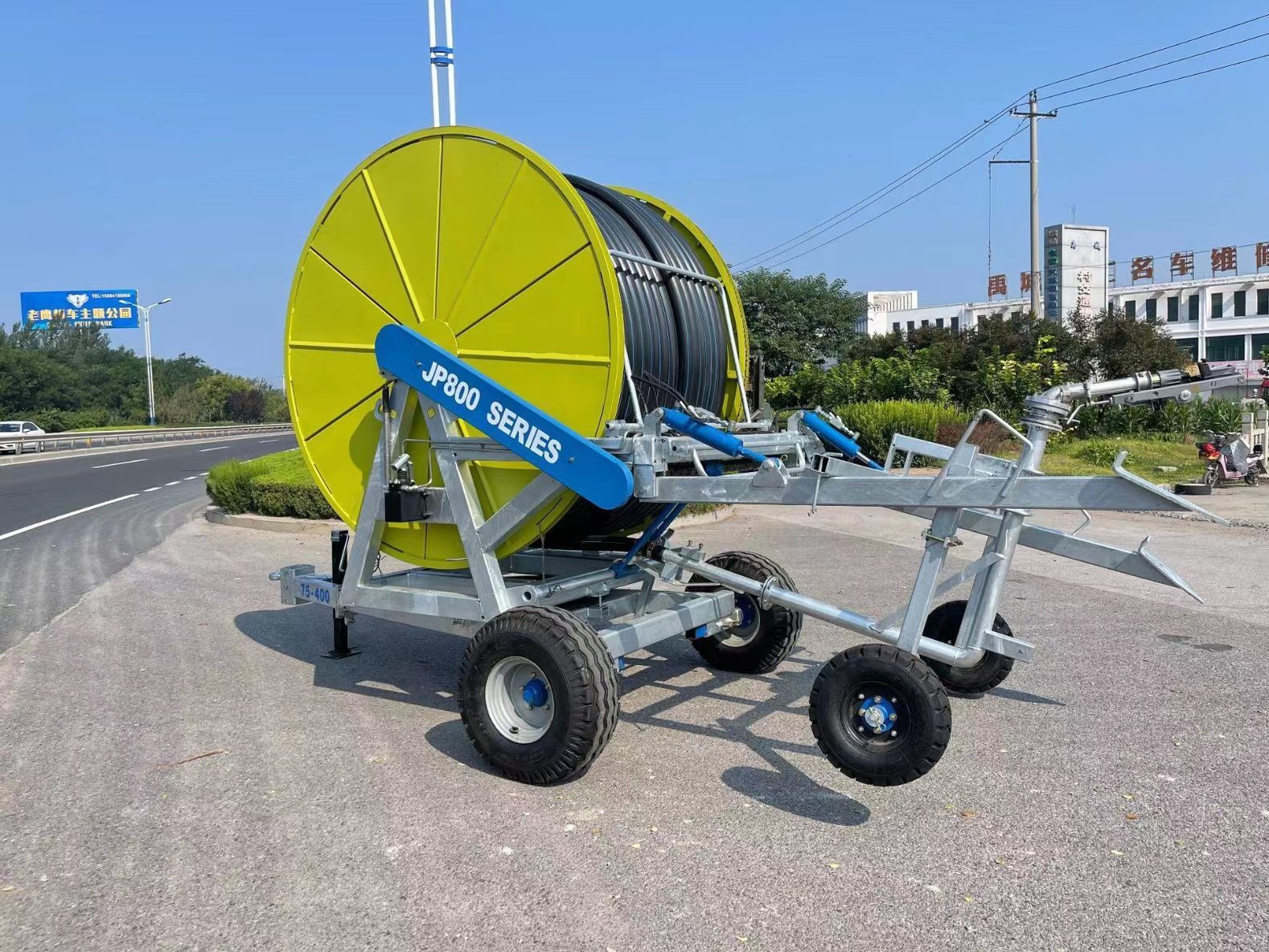
JP800 model: a water-turbine driven travelling hose reel irrigation machine that runs without an electrical supply.
This article is written for growers, farm managers, importers and distributors working land where electricity is absent, intermittent or expensive to extend. It defines the failure pattern, explains why power reliability has become part of irrigation specification, describes how the JP90-300 solves it, and sets out the steps, use cases and trade-offs a buyer should check before ordering.
The Problem: Irrigation That Stops When the Power Stops
An electric center pivot irrigation system is an efficient machine, but it is tied to an energy chain. The fixed DYP center pivot supplied by YULIN IRRIGATION runs on a 380–460 V supply, with an electromechanical, reversible drive on each span, tower drive boxes, a collector ring and a control panel that governs direction, speed percentage and auto-reverse. Every one of those components assumes that power arrives on demand.
On remote farmland, that assumption fails in three recognisable ways.
- Hard outages. The supply stops entirely. A pivot caught mid-cycle halts where it stands, and the block that was scheduled for water does not receive it.
- Weak or unstable supply. Voltage that sags or fluctuates stresses motors and controls, and forces operators to run machines below their intended duty rather than risk damage.
- Fuel dependency. Where no reliable grid exists, growers substitute a generator. In a dry-season project supplied by YULIN IRRIGATION in Papua New Guinea, the customer's center pivot is driven by an independent diesel generator set precisely because the farmland has no reliable grid electricity. That solution works, but it adds fuel purchase, fuel transport, fuel security and engine maintenance to every irrigation event.
The consequence is agronomic, not merely mechanical. Irrigation is most valuable at the moments when water stress does the most damage, and those moments rarely coincide with a convenient outage schedule. A machine that can only run when the grid allows it converts a fixed irrigation plan into a variable one, and the field pays for the difference.
Industry Background: Why Energy Reliability Is Now Part of the Specification
Irrigation demand is expanding at the same time as buyers are becoming more careful about how a machine is powered. Mordor Intelligence estimates the global center pivot irrigation system market at USD 2.56 billion in 2025, projected to reach USD 5.67 billion by 2030. Large procurement programmes are also concentrating in regions where grid quality varies: Lindsay Corporation reported a multi-year international irrigation supply agreement for the MENA region valued at more than USD 100 million in 2024.
Alongside this, the measurement basis for comparing machines has become clearer. ISO 11545:2009 specifies an in-field method for determining the uniformity of water distribution from centre-pivot and moving lateral irrigation machines. The standard does not tell a buyer which machine to purchase, but it does give a shared definition of uniformity, which means competing offers can be assessed on the same measured basis rather than on brochure language.
Together these two signals push procurement toward two distinct tracks. The first is the high-capacity, grid-connected irrigation pivot system for large circular fields with dependable power. The second is the power-independent travelling machine for remote blocks, fragmented parcels and sites where extending a line or fuelling a generator is the binding constraint. The JP90-300 belongs to the second track.
The Solution: Water Turbine Drive on the JP90-300 Hose Reel
A hose reel irrigation system is a travelling sprinkler machine. It irrigates from a single position, then moves along a run while a 90 mm PE pipe unwinds behind it, and retrieves the pipe at the end of the pass. A travelling hose reel irrigation machine of this type is sometimes described as a traveler irrigation system, because the machine travels rather than the water being distributed from a fixed structure.
The JP90-300 is classified as a travelling hose reel irrigation machine and belongs to the hose reel irrigation system category. Its defining feature is the drive: the machine is water-turbine driven and requires no electricity. The same pressurised water that leaves the sprinkler also provides the mechanical energy to retrieve the pipe, so the machine has no electric motor, no supply cable, no control-panel feed and no generator dependency in its drive chain.
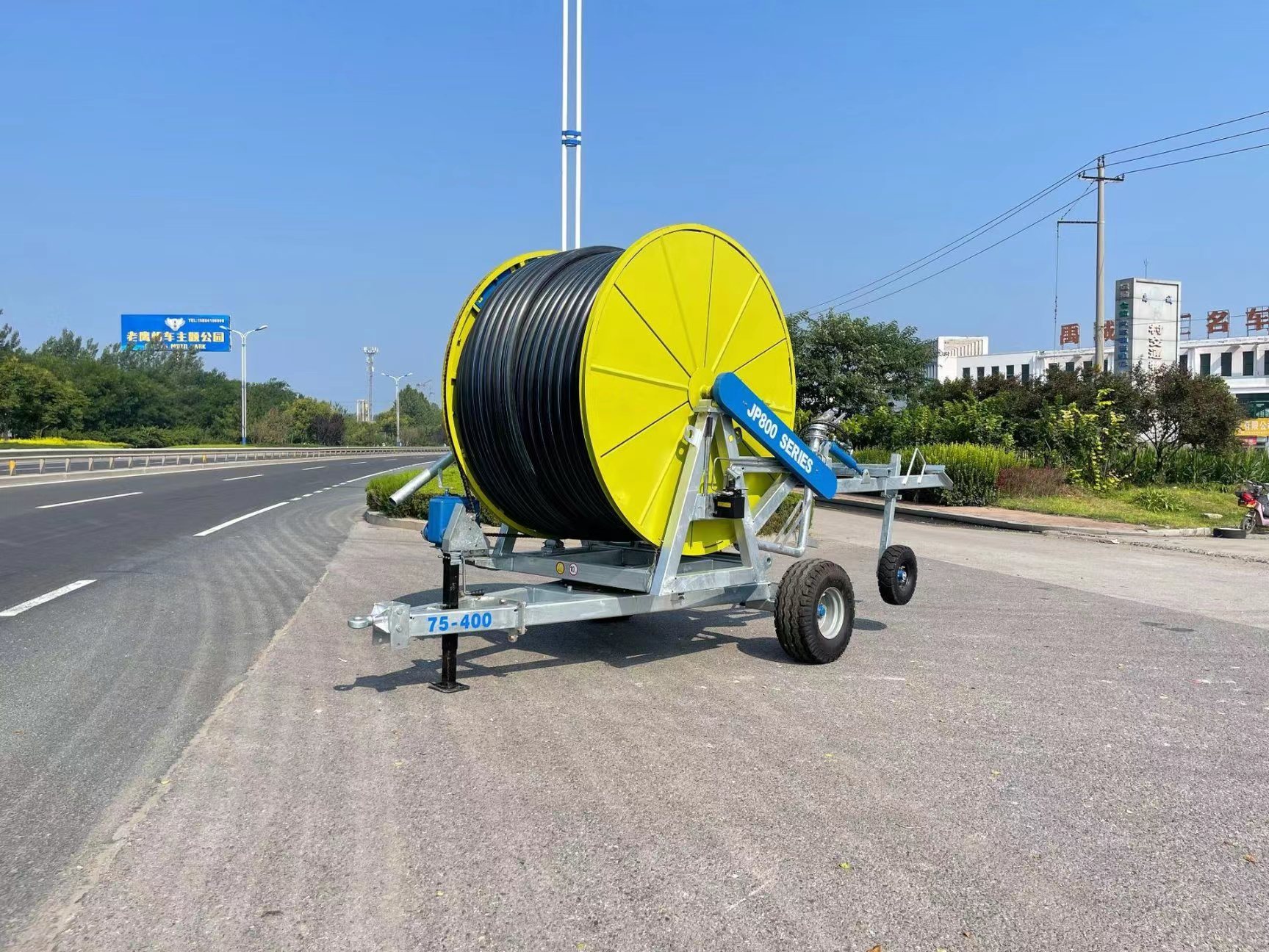
JP90-300 hose reel irrigation machine: 300 m of 90 mm PE pipe, 25–52 t/h flow and a 19–41 m spray radius from a 16–22 mm nozzle.
JP90-300 published specification
- Model type: JP90-300 model, travelling hose reel irrigation machine
- PE pipe: 90 mm diameter, 300 m length
- Water flow: 25–52 t/h
- Nozzle diameter: 16–22 mm
- Spray radius: 19–41 m
- Spray gun: DL50 / SIMA10497
- Inlet pressure: 0.6–0.9 MPa
- Weight: 2180 ± 30 kg
- Outside size: 6120 L × 2330 W × 2770 H (mm)
- Shipping size: 2450 L × 2000 W × 2250 H (mm)
- Material: metal and PE, with Q235B metal conforming to GB 13912-2020
- Application: farm irrigation and agricultural irrigation
The manufacturer lists five practical characteristics for this model: water turbine driven with no electricity required; simple to operate and easy to install; quick and convenient to move; water and labour cost savings; and low cost. For a farm manager, the operative point is the first one. Everything else — installation, relocation, operating cost — follows from removing the electrical dependency.
What “no electricity” does and does not remove
Removing the electrical drive removes a specific set of costs and risks: no transformer, no service cable to the machine, no generator fuel, no engine servicing for the drive, and no dependence on supply stability during the irrigation window. What it does not remove is the water requirement. The machine still needs a source capable of delivering 25–52 t/h at an inlet pressure of 0.6–9 bar equivalent (0.6–0.9 MPa). A farm with a reliable low-pressure supply but no power is a strong fit; a farm with power but an inadequate pump is not, because the constraint sits on the water side rather than the energy side.
It also does not remove geometry limits. A travelling hose reel irrigates a strip along its run, one position at a time. A fixed center pivot covers a circle continuously and remains the shape-fit machine for large circular blocks — the YULIN IRRIGATION range includes configurations from 177.6 m covering 10 hectares up to 565 m covering 100 hectares — but that machine needs a 380–460 V supply or a generator. The two products answer different questions, and the honest selection rule is: choose the power source first, then the machine shape.
Manufacturing and support behind the machine
China Yulin Irrigation Equipment Co., Ltd. was established in 2009 and produces center pivot, lateral move, towing and hose reel irrigation systems, together with irrigation parts and matching water pumps and generators. The facility covers 64,653 m², employs approximately 152 staff, produces about 3,000 units per year, and its research and development team consists of 10 engineers. Over 95% of the machine's spare parts are independently manufactured in the factory, which supports consistency across production runs. The company accumulated manufacturing technology through OEM production for a global top irrigation company during 2000–2008, and holds CE, ISO9001 and CSA, with products undergoing anti-corrosion and wind resistance testing. Approximately 60% of output is exported, serving Australia, New Zealand, Canada, Mexico, Africa, Central Asia, Russia and Kazakhstan. Localised on-site installation, commissioning and operator training are provided overseas.
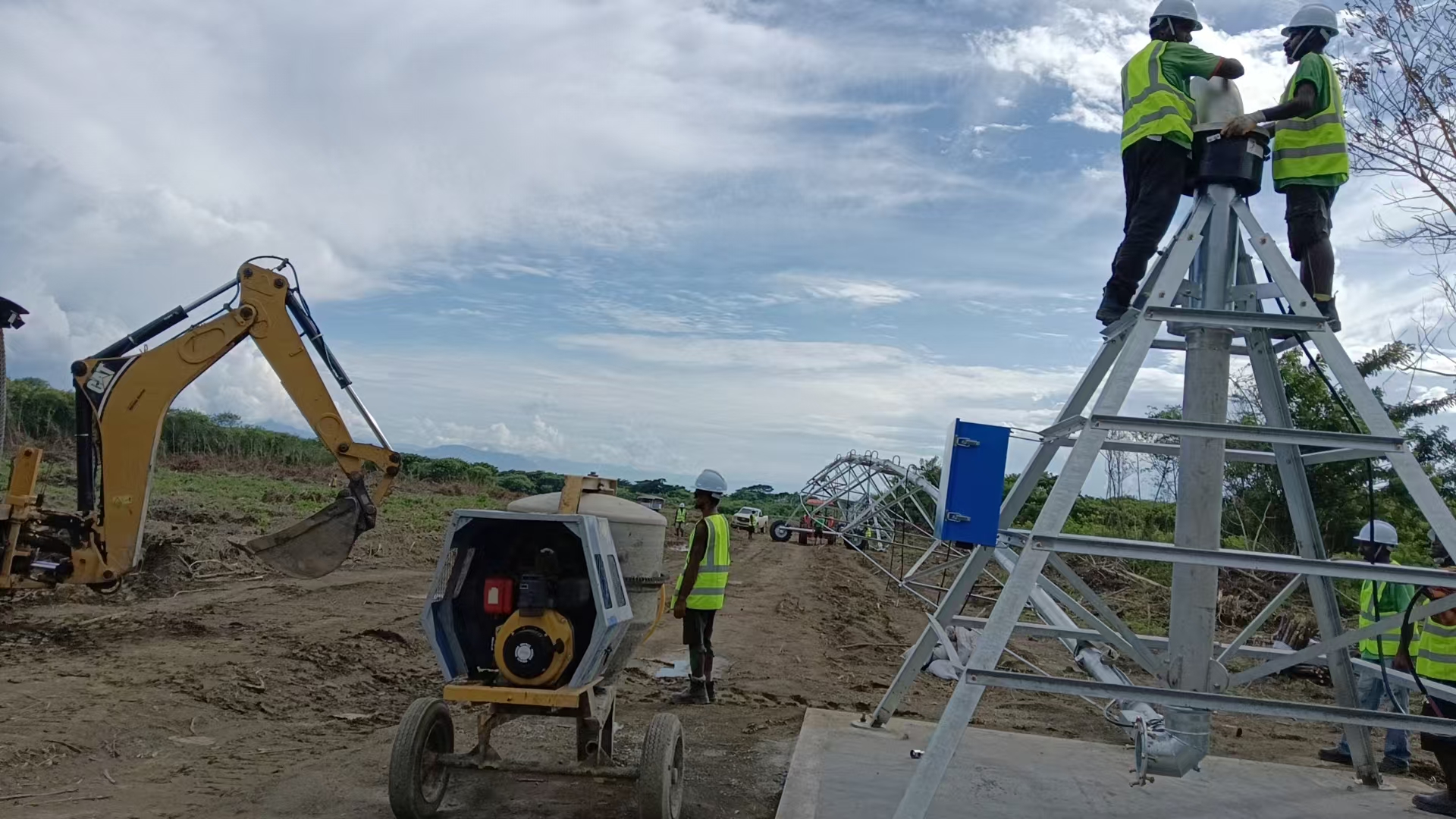
On-site installation guidance: YULIN IRRIGATION engineers supervise assembly and commissioning at the customer's farm.
Step-by-Step: Specifying a Power-Independent Hose Reel
The specification process below is written for a buyer replacing an outage-prone electric machine, or installing irrigation where no supply exists.
- Measure the water source before the machine. Confirm that the pump can hold 0.6–0.9 MPa inlet pressure while delivering somewhere in the 25–52 t/h band. If the source cannot reach the lower end of both ranges, the machine cannot deliver its stated spray radius, and the constraint should be resolved on the pump side first.
- Choose nozzle and spray radius to match the crop and row layout. The 16–22 mm nozzle range produces a 19–41 m spray radius. Narrower nozzles suit closer, lighter applications; wider nozzles cover more ground per pass. The DL50 / SIMA10497 spray gun is the specified gun for this model, so replacement parts are defined at the point of order.
- Lay out the run against the 300 m pipe length. The pipe is 90 mm in diameter and 300 m long, which sets the maximum single run. Divide the block into runs that fit, and place the machine positions so that the spray radius overlaps between passes rather than leaving dry strips.
- Check access and relocation. The machine weighs 2180 ± 30 kg and measures 6120 × 2330 × 2770 mm in working configuration. Confirm the tractor or towing route, gate widths and turning space. Quick and convenient movement between positions is one of the machine's stated characteristics, and it only pays off if the route is passable.
- Confirm the water quality and material fit. The machine is built from metal and PE, with Q235B metal conforming to GB 13912-2020. Where water chemistry is aggressive or the site is coastal, raise it during the specification discussion so that any additional protection is agreed before production.
- Plan installation and operator training. The machine is described as simple to operate and easy to install, and the manufacturer provides localised on-site installation, commissioning and operator training overseas. Book this step at order stage rather than after arrival, particularly for a first machine.
- Plan the shipment. The shipping size is 2450 × 2000 × 2250 mm, which determines container utilisation. The factory is roughly two hours by truck from Dalian Port, which simplifies port handling and documentation sequencing.
Use Cases: Where Water-Turbine Hose Reels Fit Best
- Fields beyond the transformer. Where the cost of extending a 380–460 V line outweighs the value of the block, the water-turbine machine removes that capital item entirely.
- Frequent outage and load-shedding areas. A farm that already owns an electric pivot and loses supply regularly can add a power-independent machine to protect the highest-value block instead of idling the whole irrigation programme.
- Sites previously running generators. The Papua New Guinea dry-season project shows the generator route working for a 395.6 m center pivot covering 50 hectares with an end spray gun and a 1000 L fertiliser tank. A hose reel removes the generator from the drive chain for blocks where the pivot's coverage is not required.
- Fragmented or irregular parcels. A travelling machine suits long strips and blocks that do not accommodate a circle; a fixed or towable pivot, a linear move irrigation system and a hose reel each answer a different field shape, and YULIN IRRIGATION produces all four families.
- Labour-constrained farms. Because operation and installation are simple and the machine moves between positions without rewiring, the labour hours per irrigation event stay low — one of the stated reasons the model is positioned on water and labour cost savings.
Hose Reel vs. Electric Center Pivot: A Fact-Based Comparison
The table below uses only the published specification of the JP90-300 hose reel and the fixed DYP center pivot. It is a fit comparison, not a ranking: neither machine replaces the other across all sites.
| Specification area | JP90-300 water-turbine hose reel | Fixed DYP center pivot |
|---|---|---|
| Machine type | Travelling hose reel irrigation machine (hose reel irrigation system) | Center pivot irrigation system |
| Drive energy | Water turbine; no electricity required | Electromechanical, reversible, individual drive per span; 380–460 V supply |
| Water interface | 90 mm PE pipe, 300 m length; inlet pressure 0.6–0.9 MPa | Sectional truss pipeline with pressure regulators at 10, 15 or 20 psi |
| Flow and distribution figures | 25–52 t/h; nozzle 16–22 mm; spray radius 19–41 m; spray gun DL50 / SIMA10497 | Rain intensity not more than 0.16 mm/min; irrigation rate per 24 h is an option; average drop diameter not more than 1.1 mm |
| Field geometry | Travelling strip along the pipe run; machine repositioned between runs | Circular coverage; configurations from 177.6 m covering 10 hectares to 565 m covering 100 hectares |
| Corrosion protection | Q235B metal conforming to GB 13912-2020 | Hot-dip galvanization according to GB/T 13912-2002; tower wheels with hot-dip galvanized discs |
| Control | Simple to operate and easy to install; no electrical control panel in the drive | Control panel with main switch, water switch, direction control, speed percentage indicator and auto-reverse; IP65 |
| Mobility | Quick and convenient to move between positions | Fixed installation on 14.9-24 irrigating tyres |
| Operating temperature reference | Not stated in this specification set | −45 to +45 °C |
Selection rule: if the block is circular, large and has dependable 380–460 V power, the center pivot is the shape-fit machine. If the block is remote, strip-shaped, or the supply cannot be relied on, the water-turbine hose reel removes the energy constraint instead of working around it.
Frequently Asked Questions
1. Does the JP90-300 hose reel need an electrical connection or electrical approval on site?
No. The JP90-300 is a travelling hose reel irrigation machine that is water-turbine driven and requires no electricity, so there is no electric motor, supply cable, control-panel feed or transformer to connect or certify on the farm. The machine is built from metal and PE, with Q235B metal conforming to GB 13912-2020. Manufacturer-level certifications are separate from the energy source: China Yulin Irrigation Equipment Co., Ltd. holds CE, ISO9001 and CSA, and states that its irrigation equipment undergoes anti-corrosion and wind resistance testing.
2. What water flow and pressure does the JP90-300 require to deliver its rated spray radius?
The published operating window is 25–52 t/h of water flow at an inlet pressure of 0.6–0.9 MPa, using a 16–22 mm nozzle and the DL50 / SIMA10497 spray gun. Within that window the machine delivers a spray radius of 19–41 m through a 90 mm PE pipe with a 300 m length. Buyers should measure the pump's actual output at the machine inlet rather than at the source, because friction losses along the supply line reduce the pressure that reaches the machine.
3. How does the cost structure compare with a grid-connected pivot?
The purchase price depends on configuration and is quoted per project; no list price is published, so a like-for-like quotation should be requested against measured flow, pressure and field layout. The structural difference sits in the operating and infrastructure side. A fixed DYP center pivot requires a 380–460 V supply and, where the grid is unreliable, a generator and its fuel. The JP90-300 removes both from the drive chain, and the manufacturer positions the model on low cost plus water and labour savings. Whether that produces a lower total cost depends on the site's electricity and fuel prices, which vary by market.
4. Can a buyer validate the machine against their own farm before committing to a full order?
The practical validation path starts with a specification review: measured flow and inlet pressure, block dimensions against the 300 m pipe run, nozzle choice within the 16–22 mm range, access routes for a 2180 ± 30 kg machine, and water quality. YULIN IRRIGATION provides customised modification according to farm terrain, crop variety, power supply conditions and irrigation requirements, and can supply CE, ISO9001 and CSA documentation together with the product catalogue. Buyers who want to validate before scaling can contact the engineering team at www.cyulin.net or by email at yulinirrigation@hotmail.com to agree the configuration and validation route.
5. How is the machine shipped, and what does that mean for delivery planning?
The JP90-300 has an outside size of 6120 × 2330 × 2770 mm and a shipping size of 2450 × 2000 × 2250 mm, with a weight of 2180 ± 30 kg. Those shipping dimensions determine container loading and should be shared with the freight forwarder at quotation stage. The factory is located in Lvshunkou District, Dalian City, Liaoning Province, China, roughly two hours by truck from Dalian Port, which shortens inland transport before vessel loading. Production and delivery dates are confirmed per order.
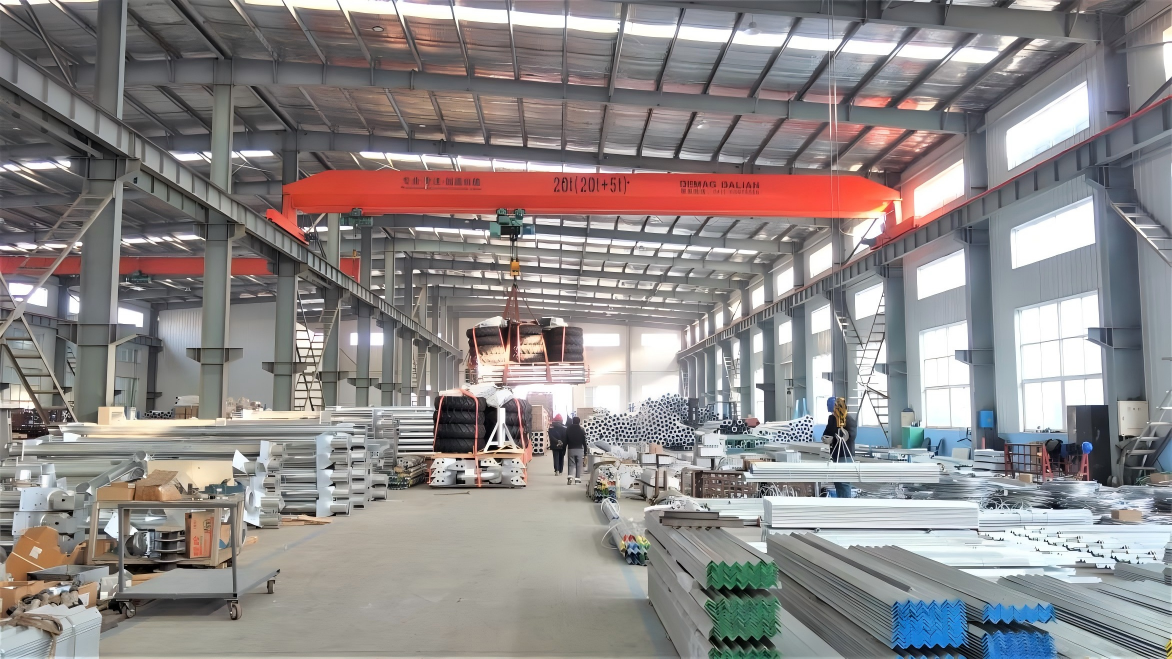
Packaging and container loading area at the YULIN IRRIGATION factory in Dalian, where hose reel and pivot components are prepared for export.
Conclusion: Solve the Energy Constraint, Then the Machine
Power outage irrigation failures are usually treated as an operational nuisance. They are more accurately a specification problem: a machine was chosen whose drive energy the site cannot guarantee. The JP90-300 travelling hose reel irrigation machine takes that variable out of the equation by using the irrigation water itself as the drive source, operating at 25–52 t/h and 0.6–0.9 MPa, with a 300 m pipe run and a 19–41 m spray radius, and no electricity required.
It is not a universal replacement for a center pivot. On a large circular block with dependable 380–460 V power, the pivot remains the correct shape-fit machine. But on remote strips, outage-prone farms and sites where a generator currently carries the irrigation load, the water-turbine hose reel removes a cost line and a failure mode at the same time.
Next step
Send your measured flow rate, inlet pressure and block dimensions to YULIN IRRIGATION for a configuration review and quotation on the JP90-300 hose reel irrigation machine. Full specifications across pivots, hose reels and irrigation parts are in the catalogue: 2026 YULIN Pivot Catalogue (PDF).
China Yulin Irrigation Equipment Co., Ltd. · Email: yulinirrigation@hotmail.com · Tel / WhatsApp: +86 158-4249-7638 · 329-1 of Shunle Street, LvshunKou District, Dalian City, Liaoning Province, China · www.cyulin.net
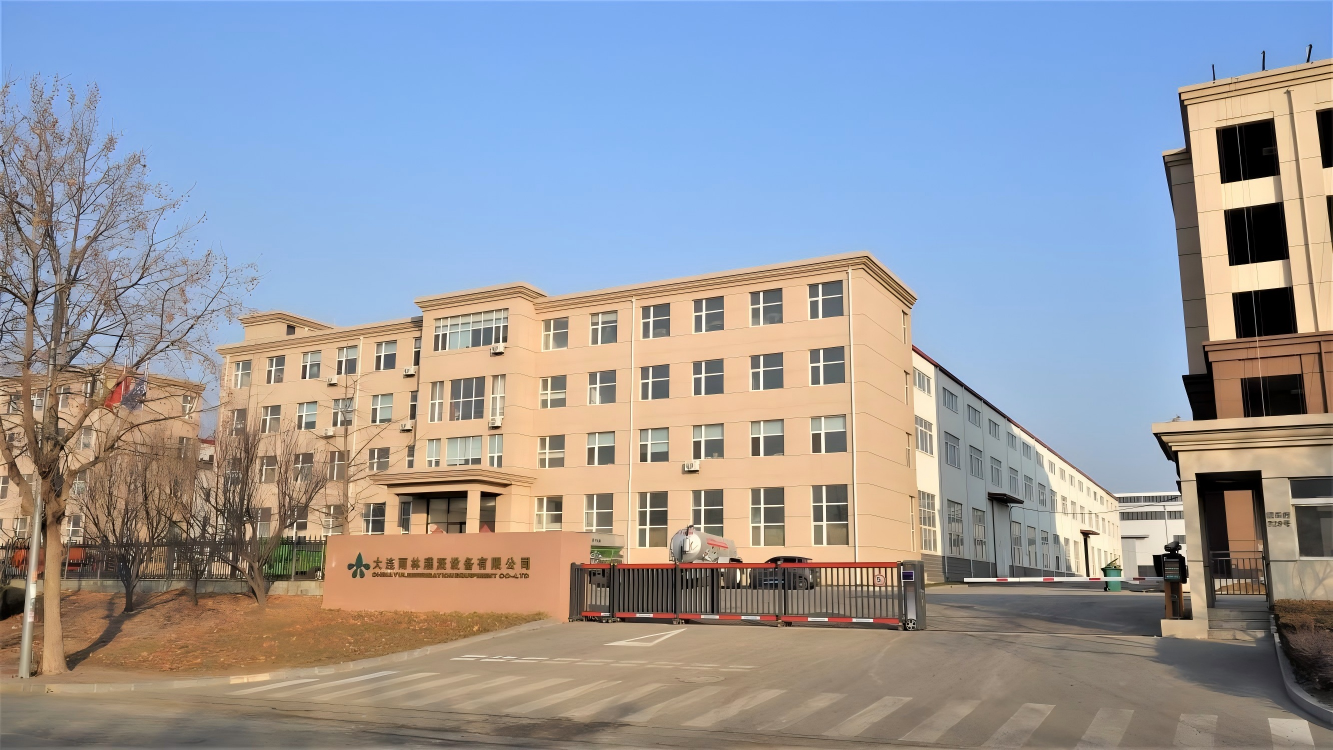
China Yulin Irrigation Equipment Co., Ltd., Dalian, founded in 2009: 64,653 m² of production and office space for large agricultural irrigation machinery.
Have Questions or Need More Details?
Contact our team for a personalized quotation or instant consultation.
Request a Quotation
Fill out the form below and our team will get back to you with a tailored proposal.
WhatsApp Direct Chat
Prefer to chat in real-time? Message us on WhatsApp for instant assistance & quick answers.
- Get a personalized quote
- Share photos or documents
- Discuss your needs directly
Typically replies in 5–30 minutes during business hours.