
What Is an Irrigation Pivot System? A Discovery Guide for First-Time Buyers
An irrigation pivot system is a mechanized irrigation machine that applies water through a moving pipeline fitted with sprinklers. For a first-time buyer, the term resolves into two categories that are usually met side by side: the center pivot, which rotates around a fixed central tower, and the hose reel irrigation machine, which travels across a field while a flexible pipe is wound back onto a reel.
This discovery guide is written for buyers in the research and evaluation stage — people who know a field needs irrigation but have not yet settled on the machine category. It defines both categories in plain terms, explains the circular irrigation method with clockwise and anti-clockwise motion, and describes the sectional truss structure of the fixed DYP center pivot. The technical details come from the published specifications of China Yulin Irrigation Equipment Co., Ltd. (YULIN IRRIGATION), a manufacturer established in 2009 in Dalian, Liaoning Province, China.
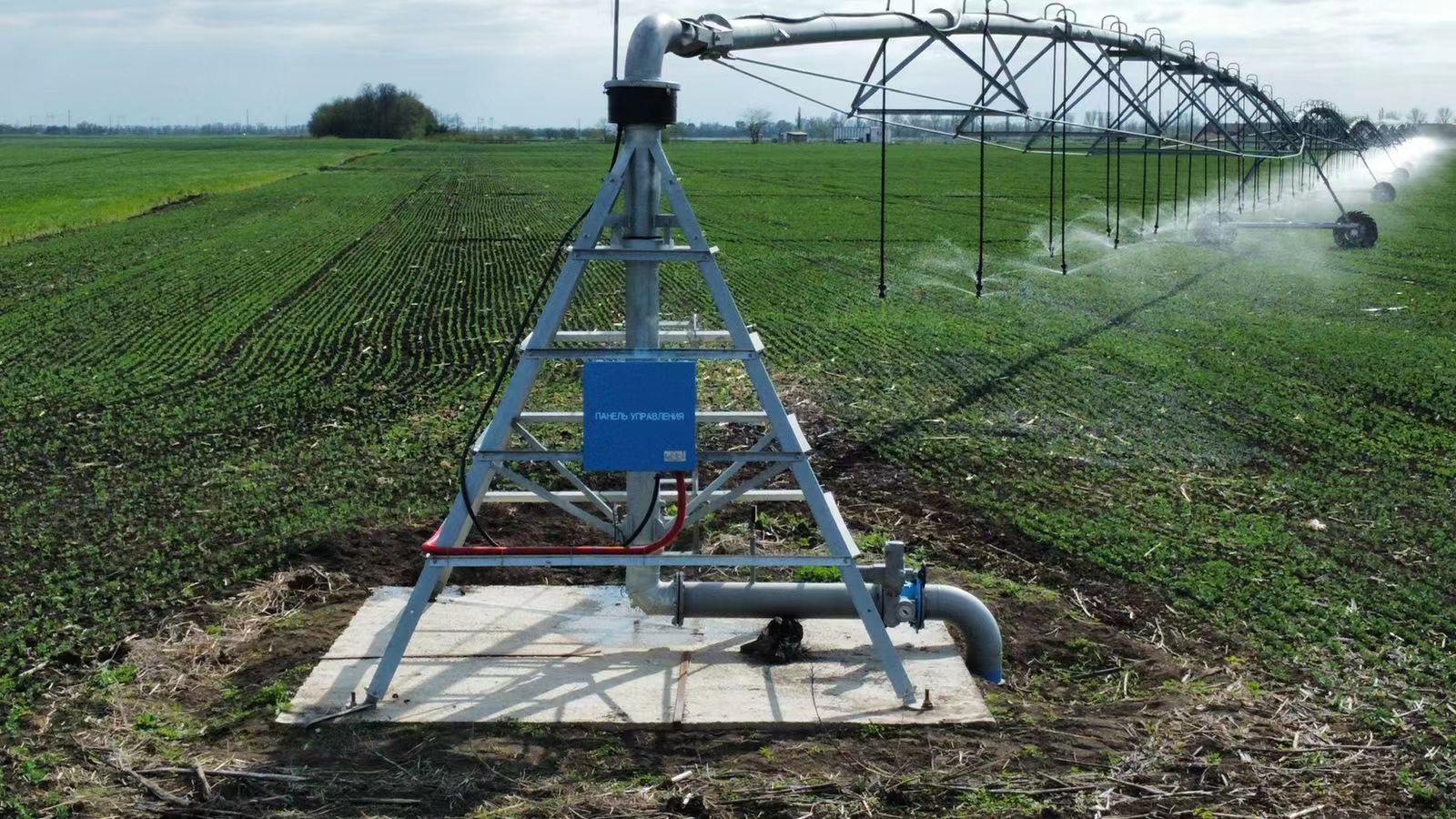
A completed center pivot irrigation system working in farmland. Image source: YULIN IRRIGATION project archive.
Three questions organise everything that follows: what each category is, how each machine physically delivers water, and which field scenario each one fits.
The Problem: Why First-Time Buyers Struggle to Specify an Irrigation Pivot System
Irrigation hardware is not scarce. Clear vocabulary is. A single search for irrigation pivot returns center pivot irrigation system, pivot irrigation system, small center pivot irrigation system, galvanized center pivot irrigation, towable center pivot system, hose reel irrigation machine, large traveler irrigation machine, linear move irrigation equipment and farm hose reel irrigation system — often on the same results page, and rarely with an explanation of which field shape each machine was designed to serve.
Underneath the terminology, three practical questions decide the category:
- Does the machine rotate or travel? Rotation produces a circular irrigated area; travel produces a path across the field. Field geometry settles this before specifications do.
- What power exists at the field edge? The fixed DYP center pivot is driven electromechanically and specified at 380V–460V, and it can also run from a diesel generator set. The JP800 hose reel machine is water turbine driven and requires no electricity at all.
- How much water can be delivered, and at what pressure? Flow, inlet pressure and droplet size determine whether the machine waters the crop evenly or damages it.
One more source of confusion is that a single product entry can legitimately list several machine types. The Center Pivot Irrigation System entry from YULIN IRRIGATION also lists a towable pivot irrigation machine, a four-wheel linear irrigation machine and a hose reel irrigation machine. Those are different machines built for different scenarios — not interchangeable options inside one purchase.
Terminology worth keeping straight: a center pivot rotates around a fixed tower; a hose reel irrigator — also written as traveler irrigation system or hose reel sprinkler irrigation machine — travels along the field while retracting a PE pipe; a linear or lateral move machine travels in a straight line. Power-supply and control variants appear in catalogues as solar powered center pivot or variable rate pivot irrigation, and these describe how a machine is powered or how application is adjusted, rather than a separate machine category.
The cost of getting the category wrong is not a spare part. It is a machine that waters the wrong shape of field, or that cannot be powered where it stands.
Industry Background: How Large the Pivot Irrigation Market Is
Center pivot irrigation is an established, internationally traded equipment category, and its scale can be checked against public reporting rather than supplier claims:
- Mordor Intelligence estimates the global center pivot irrigation system market at USD 2.56 billion in 2025, with a projected value of USD 5.67 billion by 2030 (Center Pivot Irrigation System Market Forecasts to 2030, Mordor Intelligence).
- Valmont Industries reported Agriculture segment sales of USD 278.0 million in Q4 2024, representing 26.7% of total net sales (Valmont Industries, Fourth Quarter and Full-Year 2024 Results).
- Lindsay Corporation secured a multi-year supply agreement for Zimmatic irrigation systems in the MENA region valued at more than USD 100 million in 2024 (Lindsay Corporation, reported June 2024).
- ISO 11545:2009 remains the active international standard specifying the in-field method for determining uniformity of water distribution for centre-pivot and moving lateral irrigation machines (ISO 11545:2009).
On the supply side, China Yulin Irrigation Equipment Co., Ltd. is one of the Chinese manufacturers serving this demand. Founded in 2009, the company operates a 64,653 m² facility in Lvshunkou District, Dalian City, Liaoning Province, China, employs 152 people including a 10-engineer R&D team, and states that more than 95% of its machine spare parts are manufactured in its own factory. Its equipment carries CE, ISO9001 and CSA certification, and roughly 60% of output is exported to markets including Australia, New Zealand, Canada, Mexico, Africa, Central Asia, Russia and Kazakhstan.
For a buyer, the useful conclusion is not that the market is large. It is that categories — not brand names — are the first filter, because every supplier in that market engineers machines around a specific field geometry.
What an Irrigation Pivot System Actually Is, Category by Category
Center Pivot: Water Applied in a Circle
A center pivot irrigation system is anchored at one point and rotates a long, wheeled pipeline around it. The machine referenced throughout this guide is the fixed DYP center pivot. Its coverage is set by machine length rather than by acreage claims:
| Machine length | Approximate coverage |
|---|---|
| 177.6 m | 10 hectares |
| 307.4 m | 30 hectares |
| 395.6 m | 50 hectares |
| 565 m | 100 hectares |
The DYP drive is electromechanical and reversible, with an individual drive for each span, and it operates at 380V–460V. The standard control panel includes a main power switch (disconnect switch), power control switch, water switch, direction control switch, percentage indicator for speed regulation and an auto-reverse switch, with IP65 protection on the panel. That control set explains why a pivot can work unattended for hours: the machine reverses by itself instead of being turned around by an operator.
Inside the Sectional Truss Structure of the Fixed DYP Model
The pipeline of a fixed DYP center pivot is not one rigid tube. It is a sectional, truss structure — a series of repeating spans, each stiffened by a truss and carried on a wheeled tower. That construction is what allows a single machine to reach 565 m in length, to be shipped in sections, and to be maintained span by span.
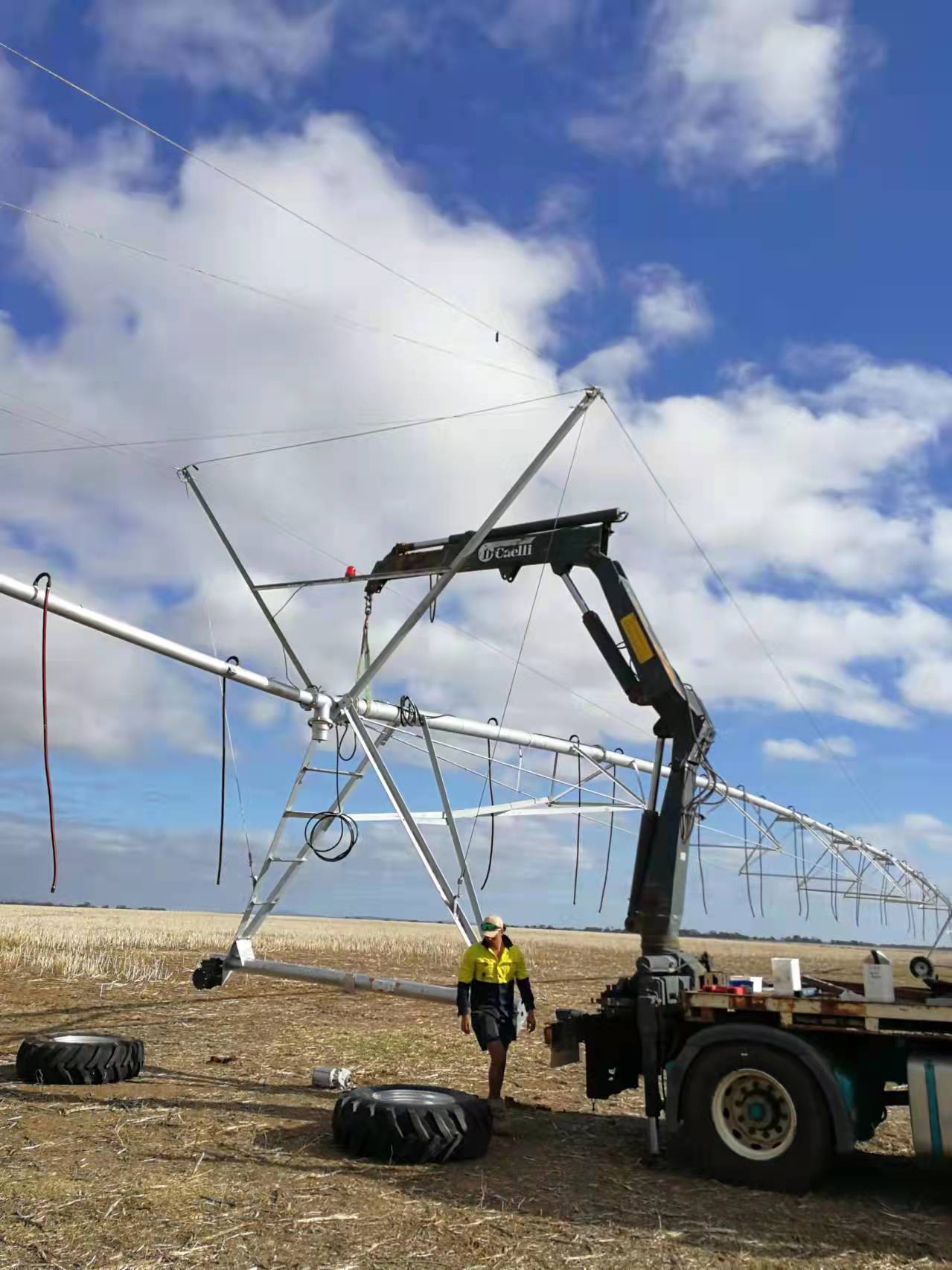
Span structure of a pivot irrigation machine being installed — the sectional truss format that lets long machines ship and repair in parts. Image source: YULIN IRRIGATION project archive.
Documented structure details of the model include:
- Truss height: the distance from the ground to the bottom of the truss rod is 3 ± 0.2 m, which is the clearance that lets fodder crops, cereals, vegetables and industrial crops, including corn, pass underneath.
- Water pipeline: sectional, truss structure, with flexible irrigation hoses in PVC that are reinforced and UV resistant.
- Material and coating: Q235B metal with hot-dip galvanization according to GB/T 13912-2002 as the specified anti-corrosion treatment.
- Towers: each trolley runs on two 14.9-24 irrigation tyres with hot-dip galvanized discs.
- Collector ring: 11 rings, not less than 4×90A and 7×25A, rated IP65; the tower box is rated IP33.
- Cable: copper core not less than 4×4 mm² + 7×1.0 mm².
How Circular Irrigation Works: Clockwise and Anti-Clockwise
The irrigation method of the fixed DYP pivot is circular motion, clockwise and anti-clockwise. Because the drive is reversible and controlled span by span, the machine can travel either way along the same circle, which is how a field is watered progressively rather than in one pass. Two specification limits keep that motion crop-safe: the average drop diameter is not more than 1.1 mm, with pressure regulators available at 10, 15 or 20 psi, and rain intensity is not more than 0.16 mm/min with mechanical damage to plants not more than 2%.
Other operating limits documented for the same machine: land usage coefficient within the irrigated circle, including the area near the center tower, is not less than 0.9; the machine is rated for operation from −45 to +45°C; and water with a pH of 6–7.5 can be used during the warranty period without quality problems.
Hose Reel Irrigation Machine: Water Applied Along a Path
The second category a first-time buyer meets is the hose reel irrigation machine, also called a hose reel irrigator, traveler irrigation system, travelling hose reel irrigation machine or hose reel sprinkler irrigation machine. Instead of rotating, it pulls a sprinkler gun across the field on a cart while a PE pipe unwinds from a reel, then retracts the pipe so the gun can be repositioned.
The JP800 (JP90-300 model) from YULIN IRRIGATION documents this category clearly:
- PE pipe: 90 mm diameter, 300 m length
- Water flow: 25–52 T/H; inlet pressure 0.6–0.9 MPa
- Nozzle diameter: 16–22 mm; spray radius 19–41 m
- Spray gun: DL50 / SIMA10497
- Weight: 2,180 ± 30 kg; outside dimensions 6,120 × 2,330 × 2,770 mm; shipping dimensions 2,450 × 2,000 × 2,250 mm
- Drive: water turbine driven, so no electricity is required
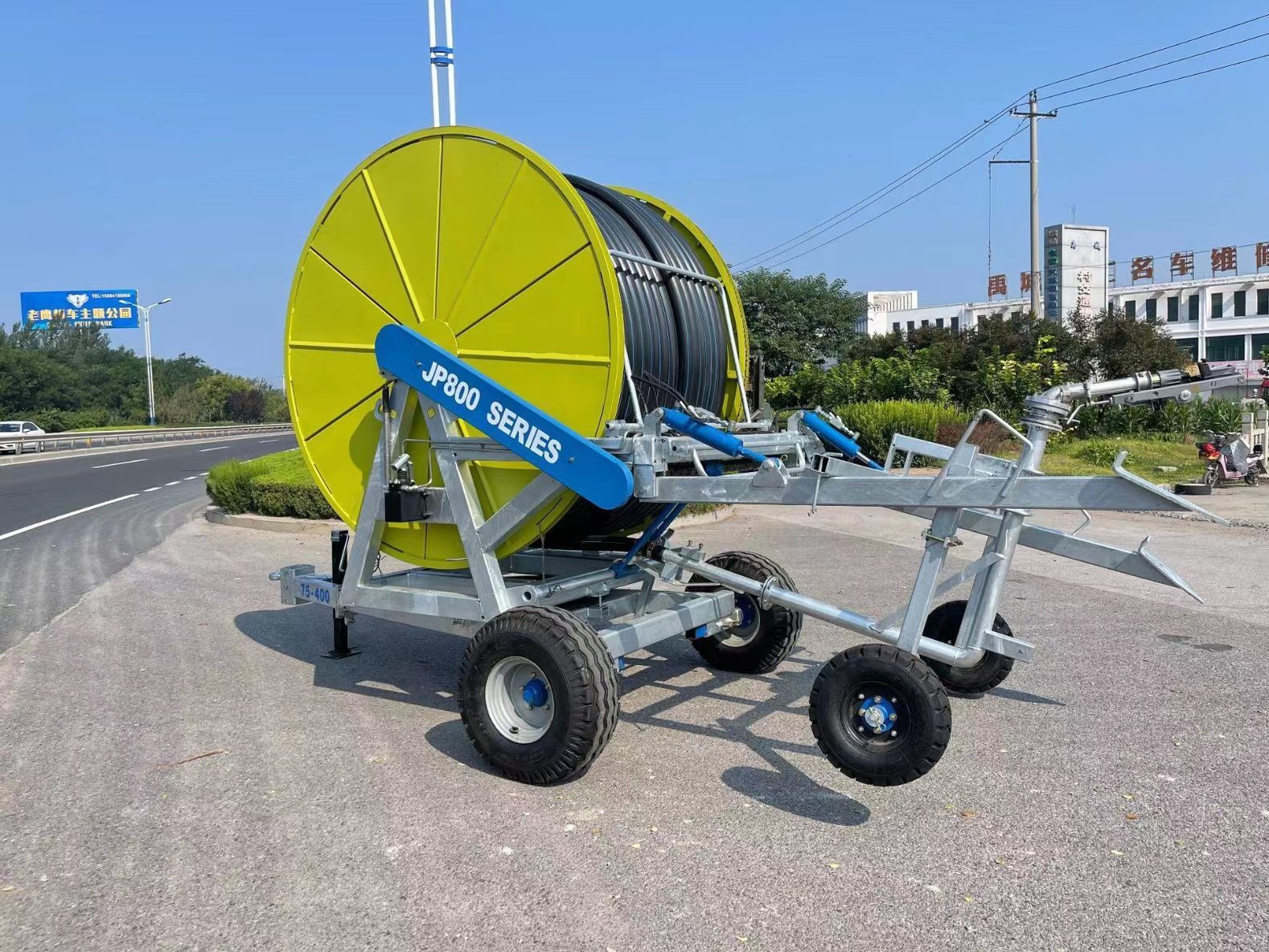
The JP800 hose reel irrigation machine — water turbine driven, so it operates in fields without an electrical supply.
Because the JP800 needs no electrical connection, it suits fields without reliable power, and its documented selling points are simple operation and installation, quick relocation between plots, and lower water and labor input than hand-moved equipment. It is intended for farm irrigation and agricultural irrigation applications.
How YULIN IRRIGATION Fits Into the Category Map
China Yulin Irrigation Equipment Co., Ltd. manufactures center pivot irrigation systems, lateral move irrigation systems, towing irrigation systems, hose reel irrigation systems and irrigation parts, together with matching water pumps and generators. Two production facts matter when reading the specifications above: more than 95% of the machine's spare parts are independently manufactured in the factory, which the company links to full-process quality monitoring and stable product consistency, and voltage customization is available for OEM orders — relevant in markets where local power does not match the standard 380V–460V specification.
Step-by-Step: How a Center Pivot Irrigates a Field
- Water and power reach the field. The pivot works from an external power connection or a power supply from a diesel generator set. In dry-season projects without dependable grid electricity, a diesel generator set is the documented power source for the machine.
- Water enters the rotating joint. At the centre of the circle, water passes through an 11-ring collector ring (not less than 4×90A and 7×25A, rated IP65), which lets the pipeline keep rotating while water flows into it.
- Water travels along the sectional truss pipeline. The pipeline is built from spans joined into a truss, so water is carried along the full machine length inside a structure that stays rigid while moving over the field.
- Sprinklers regulate droplet size. Pressure regulators at 10, 15 or 20 psi keep the average drop diameter at no more than 1.1 mm and rain intensity at no more than 0.16 mm/min — the limits that protect soil structure and crop leaves.
- Towers move the machine. Every span has its own electromechanical, reversible drive, and each trolley runs on two 14.9-24 irrigation tyres with hot-dip galvanized discs. The movement mode is continuous, start-stop, matching the motor of the last tower.
- The machine reverses automatically. The direction control switch and auto-reverse switch let the pivot run clockwise and anti-clockwise without manual turning, while the percentage indicator regulates travel speed.
- The circle is irrigated. Coverage is circular, and the documented land usage coefficient inside the irrigated circle is not less than 0.9. The corners of a square field fall outside the circle and normally need a separate solution, such as an end spray gun.
Step-by-Step: Evaluating Scenario Fit Before You Order
- Draw the field. Circle, rectangle, or several separate blocks? A fixed DYP center pivot irrigates a circle; a hose reel machine irrigates a path and can be relocated between parcels.
- Match area to machine length. 177.6 m covers about 10 ha, 307.4 m about 30 ha, 395.6 m about 50 ha, and 565 m about 100 ha.
- Confirm the power situation. A center pivot is specified at 380V–460V and runs from an external connection or a diesel generator. A JP800 hose reel machine is water turbine driven and needs no electricity.
- Check water quantity and pressure. The JP800 requires 25–52 T/H at 0.6–0.9 MPa inlet pressure. Test pH as well: the DYP pivot is rated for pH 6–7.5 during the warranty period.
- Check crop clearance and droplet limits. Truss bottom sits 3 ± 0.2 m above ground, and the machine is listed for fodder crops, cereals, vegetables and industrial crops, including corn.
- Verify the build and support model. Ask about in-house parts share, OEM voltage customization, lead time, and whether installation and operator training are delivered on site.
Use Cases: What Documented Field Projects Look Like
Specifications describe a machine; projects describe the conditions it has to survive. The scenarios below are documented from delivered irrigation projects.
Pasture and Forage Operations
A large-scale dairy farmer in New Zealand installed 70 center pivot units for grass irrigation and has run them for 9 years, reporting higher crop output and labor savings, with long service life noted as a defining benefit. An Australian distributor installed 600 center pivot units across forage and pasture, cotton and watermelon applications; after 15 years of operation, the project reports energy savings of more than 40%, labor savings, low maintenance cost and long lifespan, alongside higher crop output and improved alfalfa quality for cattle feed.
Row Crops in Dry Conditions
In Zimbabwe, an end customer installed 45 center pivot units for crop irrigation over a 6-year period, with increased crop output and labor savings as the reported outcomes. An Algerian farm irrigation OEM client used 70 center pivot systems for farmland irrigation over 7 years, achieving a 40% increase in efficiency while the local brand built out a complete pivot supply and service offer.
Rectangular Fields and Moving Between Plots
In Brazil, a large-scale farmer deployed 50 hose reel irrigation machines for soybean irrigation over 6 years. During dry conditions the project reported a 30% increase in output together with labor savings, and the machine's ability to be pulled easily from one land parcel to another — including for rental use — was identified as the central benefit of the hose reel format.
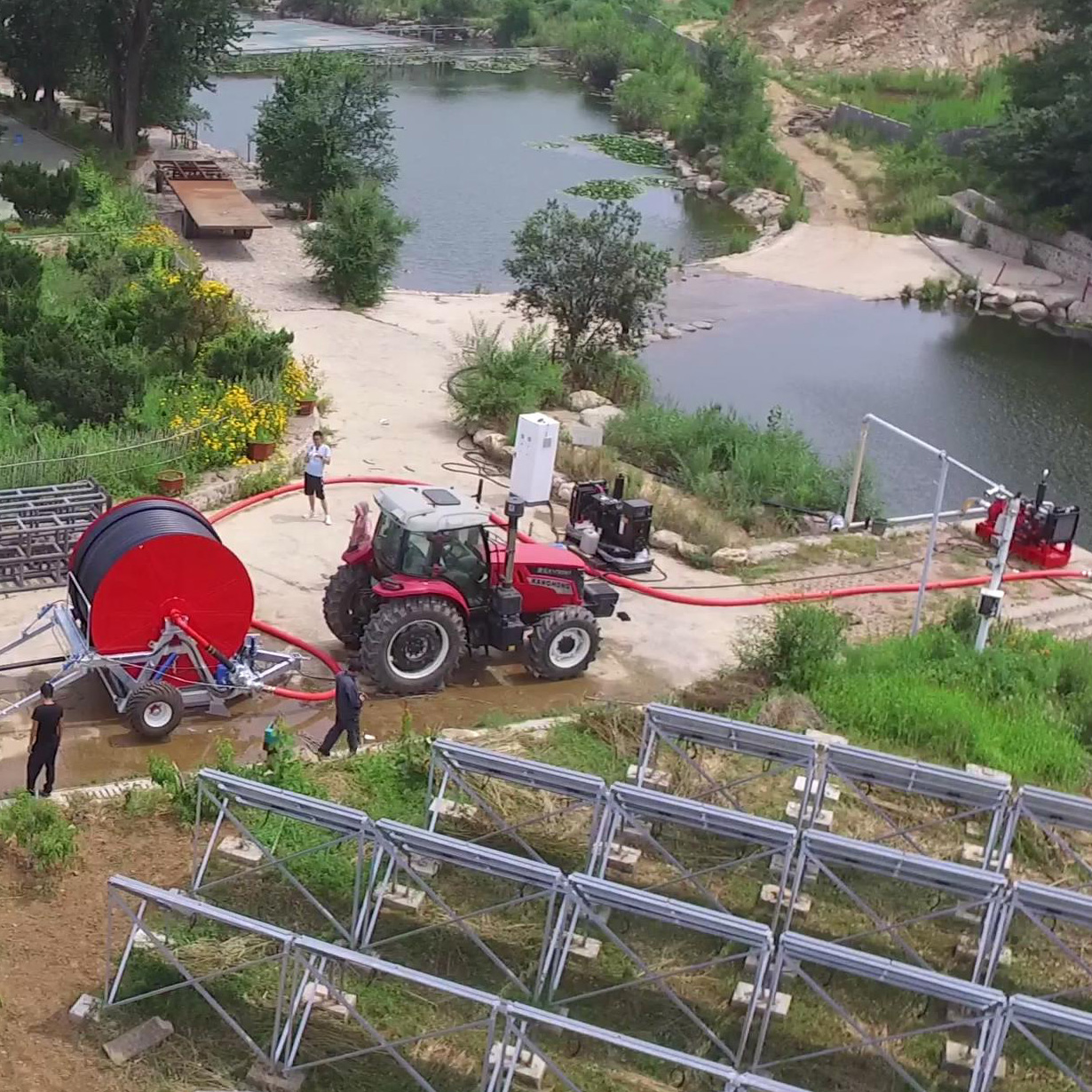
A hose reel irrigator at work on a large-scale soybean plantation in Brazil — the traveling category in field operation. Image source: YULIN IRRIGATION project archive.
Dry-Season Irrigation Without Reliable Grid Power
A dry-season project in Papua New Guinea used a 395.6 m center pivot covering 50 hectares, fitted with an end spray gun and a 1,000 L fertilizer tank, operating under high temperature conditions. Power came from an external connection or a power supply from a diesel generator set. The customer specified the end spray gun to provide supplementary irrigation for the corners of the field, chose a poly pipe option to prevent acidic or alkaline water from corroding the pipes, and added pesticides during the irrigation process for integrated pest control.
Large Fleet Operators
A Russian group supplied 450 units to end users over 9 years, reporting improved product performance with reduced labor requirements and a 40% increase in efficiency.
Comparison Table: Fixed DYP Center Pivot vs JP800 Hose Reel
The two categories are best compared on the attributes that decide whether a machine can physically work in a given field:
| Attribute | Fixed DYP Center Pivot | JP800 Hose Reel Irrigation Machine |
|---|---|---|
| Irrigation pattern | Circular motion, clockwise and anti-clockwise | Traveling path along the field |
| Coverage basis | Machine length 177.6 m / 307.4 m / 395.6 m / 565 m, covering about 10 / 30 / 50 / 100 hectares | PE pipe 300 m; spray radius 19–41 m |
| Drive | Electromechanical, reversible, individual for each span | Water turbine driven, no electricity required |
| Power supply | 380V–460V; external power connection or diesel generator | Water pressure only; inlet pressure 0.6–0.9 MPa |
| Water delivery | Sectional truss pipeline; pressure regulators at 10, 15 or 20 psi | 90 mm PE pipe; water flow 25–52 T/H |
| Sprinkler specification | Average drop diameter not more than 1.1 mm; rain intensity not more than 0.16 mm/min | DL50 / SIMA10497 spray gun; nozzle diameter 16–22 mm |
| Material and coating | Q235B metal; hot-dip galvanization according to GB/T 13912-2002 | Metal and PE |
| Dimensions | Ground to bottom of truss rod: 3 ± 0.2 m | 6,120 × 2,330 × 2,770 mm; shipping 2,450 × 2,000 × 2,250 mm |
| Weight | Not stated in the published specification | 2,180 ± 30 kg |
| Operating temperature | −45 to +45°C | Not stated in the published specification |
| Component protection | Tower box IP33; collector ring IP65; control panel IP65 | Not stated in the published specification |
| Listed crop scope | Fodder crops, cereals, vegetables, industrial crops, including corn | Farm irrigation and agricultural irrigation |
| Relocation | Fixed installation at the center tower | Quick and convenient to move between plots |
Read as a decision rule, the table points in one direction: circular fields with an available power supply match the fixed DYP pivot, while rectangular blocks, scattered parcels or sites without electricity match the traveling hose reel machine.
FAQ: Frequently Asked Questions
1. Which standards and certifications apply to an irrigation pivot system?
ISO 11545:2009 is the active international standard for determining the uniformity of water distribution from centre-pivot and moving lateral irrigation machines. The fixed DYP center pivot documents hot-dip galvanization according to GB/T 13912-2002 as its anti-corrosion coating, with Q235B metal referenced to GB 13912-2020, and states protection levels of IP33 for the tower box and IP65 for the collector ring and control panel. China Yulin Irrigation Equipment Co., Ltd. holds CE, ISO9001 and CSA certification and states that all its irrigation equipment undergoes anti-corrosion and wind resistance testing. Rating and certificate documents should be requested for the exact configuration ordered, because protection ratings apply per component.
2. What field area can one irrigation pivot system cover?
For the fixed DYP center pivot, coverage follows machine length: 177.6 m covers about 10 hectares, 307.4 m about 30 hectares, 395.6 m about 50 hectares and 565 m about 100 hectares. Coverage is circular, and the documented land usage coefficient inside the irrigated circle — including the area near the center tower — is not less than 0.9. Where a circular pattern leaves the corners of a square field dry, an end spray gun can be added for supplementary irrigation, as done in a Papua New Guinea dry-season project. For rectangular blocks or several separate plots, the JP800 hose reel machine, with its 300 m PE pipe and 19–41 m spray radius, is the alternative.
3. What drives the cost of an irrigation pivot system?
The cost structure follows the documented build rather than a headline figure. A 565 m machine carries more truss sections, more hot-dip galvanized Q235B steel and more tower drives than a 177.6 m machine, because the DYP pivot has an individual electromechanical drive for every span. Optional equipment such as an end spray gun and a 1,000 L fertilizer tank, the choice between an external power connection and a diesel generator set, and the water source works all sit inside the same budget. Freight depends on packed dimensions — 2,450 × 2,000 × 2,250 mm in the case of a JP800 — and services such as on-site installation, commissioning and operator training should be quoted explicitly. Comparing quotations on machine length, drive count, coating specification and included services is more useful than comparing a single price line.
4. Can a buyer trial a machine before committing to a full project order?
Yes — the documented minimum order quantity is 1 unit, with 100% testing as the quality-control policy, so a first machine can be built and evaluated on site before any fleet-sized order. Voltage customization is available for OEM orders, which allows a unit to match the local power supply. Yulin provides global localized on-site installation, commissioning and operator training, supported by video technical support, online support and free spare parts, and model specifications are listed in the 2026 YULIN Pivot Catalogue.
5. What is the lead time, and how is production capacity handled?
Documented lead time is 21–40 days, with a monthly capacity of 60 units and a minimum order quantity of 1 unit, and 100% testing applied to production. Published pivot supply capacity is 400 sets per year. The factory is around two hours by truck from Dalian Port, which simplifies container loading for exported machines. To start a project, send the field shape and area, the available water flow and pressure, and the power supply at the site to YULIN IRRIGATION at yulinirrigation@hotmail.com or on WhatsApp at +86 158-4249-7638 for a machine-length recommendation and a quotation.
Conclusion: From Definition to a Field-Ready Configuration
An irrigation pivot system is defined by how it moves water. The center pivot, built here as the fixed DYP model, rotates a sectional truss pipeline around a fixed tower in clockwise and anti-clockwise circular motion, with coverage from about 10 hectares at 177.6 m to about 100 hectares at 565 m, an individual reversible drive per span, hot-dip galvanized Q235B structure and droplet and rain-intensity limits that keep the crop safe. The hose reel machine, built here as the JP800, answers a different scenario: it travels a path rather than a circle, needs no electricity, and can be moved between plots.
For a first-time buyer, the sequence is straightforward — fix the category against the field shape and power supply, then match length and water data to the machine, and only then compare suppliers on build, testing and service. Everything else on a specification sheet is detail that only matters once the category is right.
Next Step: Turn the Definition Into a Configuration
China Yulin Irrigation Equipment Co., Ltd. (YULIN IRRIGATION) manufactures center pivot, lateral move, towing and hose reel irrigation systems and irrigation parts at its 64,653 m² facility in Dalian, China, and exports to Australia, New Zealand, Canada, Mexico, Africa, Central Asia, Russia and Kazakhstan.
Send your field shape, area, water flow and pressure, and available power supply, and the engineering team will recommend a machine length and prepare a quotation for your project.
Contact: Lara Yu | Email: yulinirrigation@hotmail.com | Tel / WhatsApp: +86 158-4249-7638
Address: 329-1 of Shunle Street of LvShunKou District, Dalian City, Liaoning Province, China
Website: www.cyulin.net | WhatsApp: Start a conversation
Download the full model range and specifications here: 2026 YULIN Pivot Catalogue (PDF)
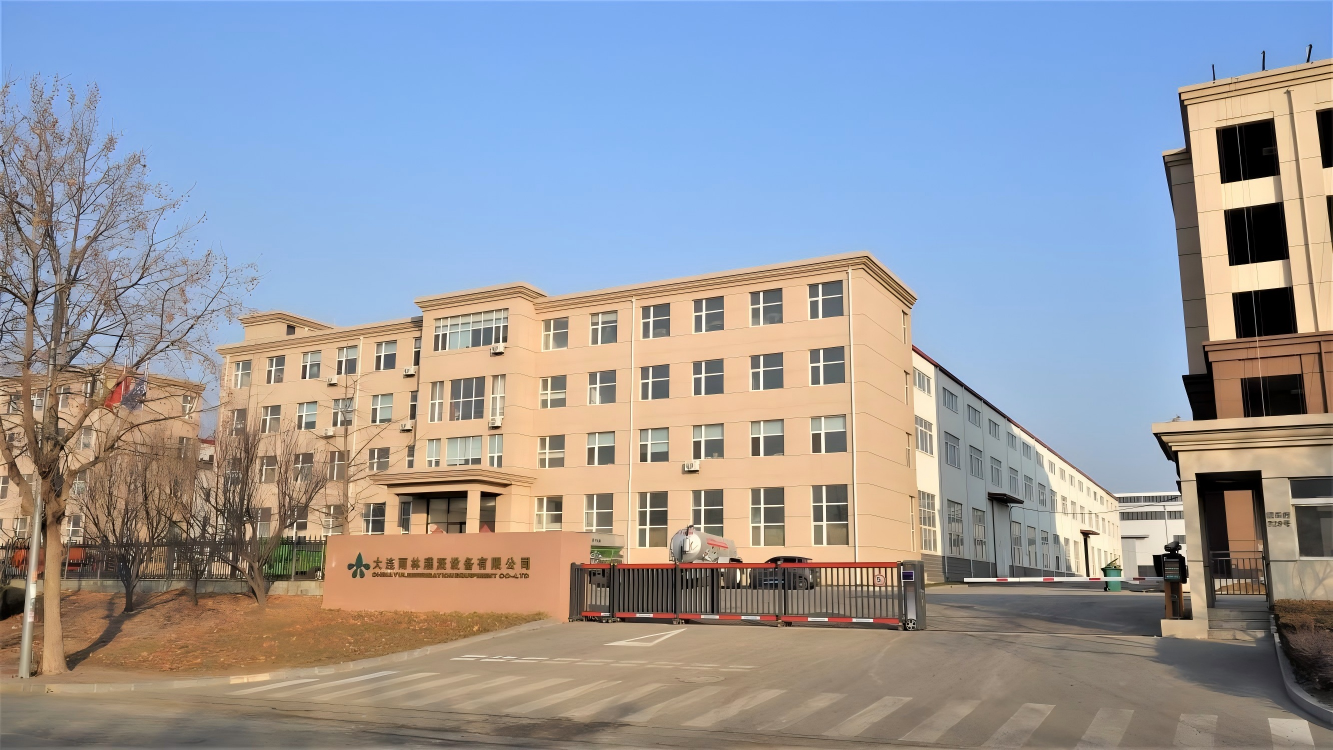
The China Yulin Irrigation Equipment Co., Ltd. factory complex in Dalian, China — where pivot, linear, towing and hose reel irrigation systems are manufactured.
Have Questions or Need More Details?
Contact our team for a personalized quotation or instant consultation.
Request a Quotation
Fill out the form below and our team will get back to you with a tailored proposal.
WhatsApp Direct Chat
Prefer to chat in real-time? Message us on WhatsApp for instant assistance & quick answers.
- Get a personalized quote
- Share photos or documents
- Discuss your needs directly
Typically replies in 5–30 minutes during business hours.