
B301 vs. BK5000-PH: Bright Field or Phase Contrast for Live Cell Imaging?
Two upright biological microscopes from the same manufacturer are often quoted for the same live cell project, and the reason they are not interchangeable comes down to one hardware decision: how the instrument turns a transparent specimen into a visible image. Chongqing Scope Instrument Co., Ltd. builds both the B301 bright field microscope and the BK5000-PH phase contrast microscope, and their published configurations differ at exactly the point that matters for living cells — the optical system, the objective set, and the condenser that feeds them.
Short answer: if the cells you need to observe are unstained and alive, phase contrast is the contrast mode that makes them visible, and the BK5000-PH is the model configured for it: infinity optical system, quintuple nosepiece, and Plan 4X/10X/40X/100X phase contrast objectives on a 175 × 145 mm mechanical stage. If the specimens passing through the laboratory are stained, fixed, or otherwise prepared, the B301 covers that routine work with a quadplex nosepiece, an Abbe N.A. 1.25 condenser, and a 125 × 115 mm mechanical stage. Both are binocular biological microscopes with 3W LED illumination and both share the same operating envelope of 0 °C to 40 °C indoor temperature and 85% maximum relative humidity.
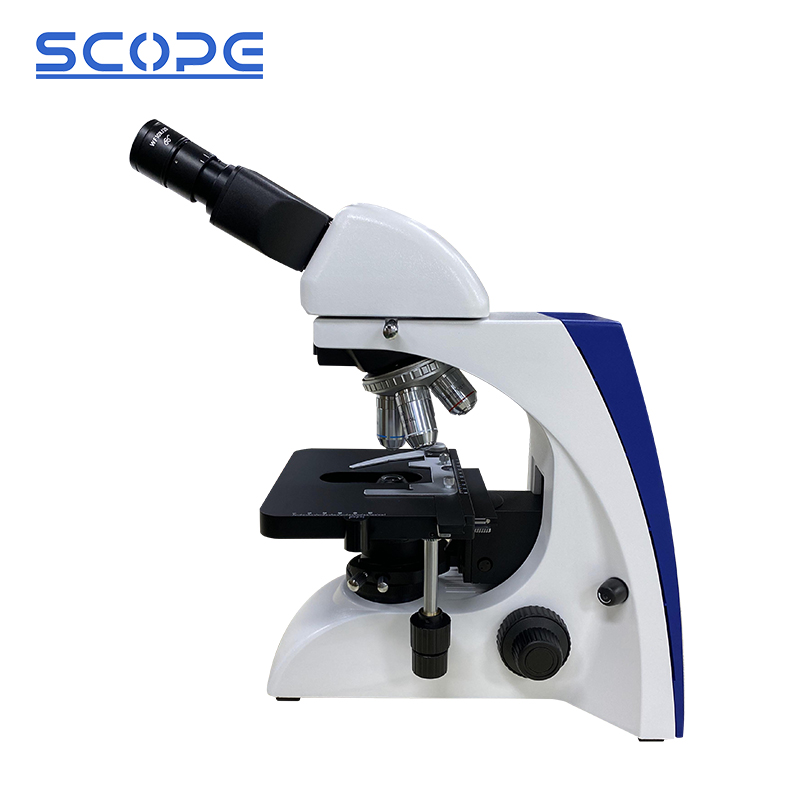
Chongqing Scope Instrument Co., Ltd. is a laboratory and medical training instrument supplier located in Chongqing, China, founded in 2017. The company operates a 5,000 m² facility with more than 100 employees, a 20-engineer R&D team, and an annual output of 30,000 units, of which roughly 50% is exported to Europe, Southeast Asia, the Middle East, South America, and Africa. Its microscope range covers biological, metallographic, fluorescence, inverted, polarizing, and stereo instruments, and the company offers OEM and ODM services including logo customization. That range matters in this comparison, because the most common live cell imaging mistake is not choosing the wrong brand — it is choosing a bright field light path for a sample that has no absorption contrast.
Problem Definition: Why Live Cells Break the Standard Bright Field Assumption
Bright field microscopy builds an image from light that a specimen absorbs or scatters before it reaches the eyepiece. Stained tissue, blood smears, and prepared slides provide enough of that absorption contrast for the technique to work well, which is why bright field remains the default configuration in education and routine laboratory work. Living, unstained cells provide almost none. Their refractive index is close to that of the surrounding medium, so in a standard bright field view they appear faint, flat, and difficult to resolve regardless of magnification.
Phase contrast was developed to solve exactly that problem. Instead of relying on absorption, it converts small differences in optical path length — produced by structures inside and around the cell — into visible differences in brightness. The practical consequence for a buyer is that the contrast mode, not the magnification figure, decides whether a live cell can be seen at all. Three hardware consequences follow:
- Objective set: the objectives must be designed for the contrast mode in use. The BK5000-PH is supplied with infinity phase contrast Plan objectives; the B301 is supplied with achromatic objectives.
- Condenser: phase contrast requires annular positions matched to the objectives, which is why the BK5000-PH carries a quintuple-hole turret Abbe condenser while the B301 carries an Abbe N.A. 1.25 condenser.
- Stage and sample handling: the stage must physically hold the format being observed and allow repeatable positioning — 125 × 115 mm on the B301 versus 175 × 145 mm on the BK5000-PH.
Where the two instruments do not differ is in the fundamentals: both are binocular biological microscopes built from aluminium alloy and glass, both use coaxial coarse and fine focusing knobs, and both are designed for indoor operation at 0 °C to 40 °C and maximum 85% relative humidity, powered through a standard power plug, with optional digital camera documentation.
Industry Background: Why Life Science Work Drives the Contrast Decision
The commercial context supports the technical argument. Grand View Research valued the global microscope market at USD 11.9 billion in 2025 and projects it to reach USD 21.2 billion by 2033, with the life science segment holding a 32.4% revenue share in 2025 on the strength of genomics and drug discovery R&D. Market sizing for this category varies by research firm depending on how accessories and software are scoped, so buyers should treat any single figure as directional rather than definitive — but the direction of the life science share is consistent.
Compliance context matters as well. IEC 61010-2-101 is the safety standard that applies to medical laboratory equipment and in vitro diagnostic (IVD) microscopes, so laboratories procuring instruments for regulated work should confirm the applicable documentation for their market rather than assuming that a biological microscope is automatically exempt. Chongqing Scope provides official export certificates across its range — ISO9001, ISO14001, ISO45001, ISO13485, CE, and RoHS — and can issue customs documents such as CO, Form E, and Form F when required.
For reference, the recognized global leaders in microscopy include Carl Zeiss AG (Germany), Leica Microsystems (part of Danaher), Nikon Corporation (Japan), and Evident (formerly Olympus). Their presence defines the premium end of the market; the decision framework in this article applies whether a laboratory is specifying from that tier or from a specialist manufacturer such as Chongqing Scope.
Detailed Solution: How the Two Optical Systems Differ
B301 — the bright field light path
The B301 is a binocular bright field biological microscope. Its stated configuration is a WF10X/18mm eyepiece, achromatic objectives at 4X/10X/40X/100X mounted on a quadplex nosepiece, an Abbe N.A. 1.25 condenser, a 125 × 115 mm mechanical stage, coaxial coarse and fine focusing, and 3W LED illumination with DC input. Its stated applicable industries are biology, education, and laboratory research. This is a straightforward, well-defined bright field platform: four objective positions, one condenser, one illumination source, and a stage sized for standard slides.
BK5000-PH — the phase contrast light path
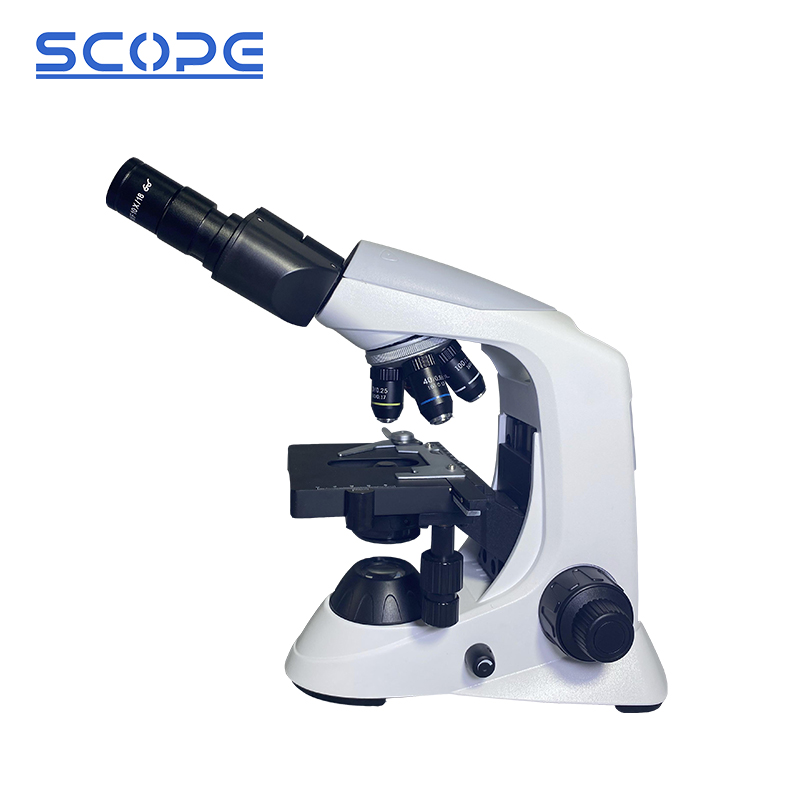
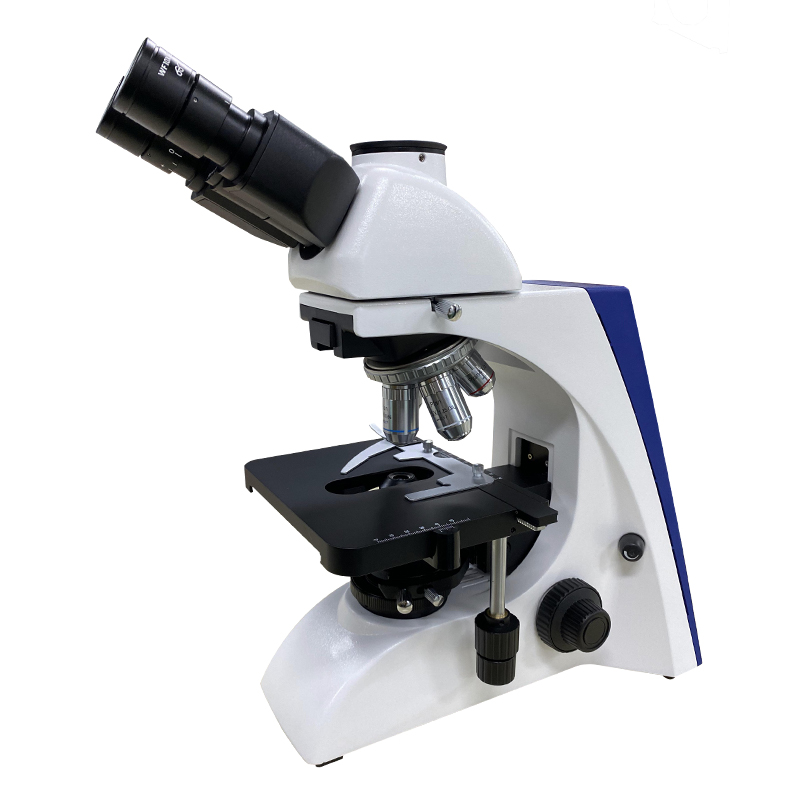
The BK5000-PH is a binocular biological microscope built on an infinity optical system. Its stated configuration is a WF10X/20mm eyepiece, infinity phase contrast Plan objectives at 4X/10X/40X/100X on a quintuple nosepiece, a quintuple-hole turret Abbe condenser, a 175 × 145 mm mechanical stage, coaxial coarse and fine focusing, and a choice of 3W LED or 12V/20W halogen illumination. Its stated applicable industries are biology and laboratory research.
Three differences carry real operational weight. First, infinity-corrected optics allow accessories to be inserted into the light path without degrading the image, which is relevant when a laboratory later adds documentation hardware. Second, the five-position nosepiece holds the full phase contrast objective set with one position left free for an additional objective. Third, the turret condenser is the component that carries the annular positions phase contrast objectives require — without it, phase objectives cannot deliver their intended contrast.
Configuration comparison, as published
| Parameter | B301 | BK5000-PH |
|---|---|---|
| Type | Biological microscope, bright field | Biological microscope, phase contrast |
| Head | Binocular | Binocular |
| Eyepiece | WF10X/18mm | WF10X/20mm |
| Objectives | Achromatic 4X/10X/40X/100X | Infinity phase contrast Plan 4X/10X/40X/100X |
| Nosepiece | Quadplex | Quintuple |
| Condenser | Abbe N.A. 1.25 | Quintuple-hole turret Abbe condenser |
| Mechanical stage | 125 × 115 mm | 175 × 145 mm |
| Focusing | Coaxial coarse and fine focusing knob | Coaxial coarse and fine focusing knob |
| Illumination | 3W LED, DC input | 3W LED or 12V/20W halogen |
| Body material | Aluminium alloy, glass | Aluminium alloy, glass |
| Stated applicable industry | Biology, education, laboratory research | Biology, laboratory research |
Step-by-Step Breakdown: Matching Configuration to Workflow
The comparison only becomes useful when it is applied in a fixed sequence. Working through these six steps prevents the most common specification error — ordering a higher-magnification instrument when the problem is actually contrast.
- Classify the sample state first. Decide whether the majority of samples are stained or otherwise prepared before observation, or unstained and living. This single answer eliminates one of the two models before any other parameter is discussed.
- Match the contrast mode to the objective set. Prepared specimens pair with the B301's achromatic 4X/10X/40X/100X set. Unstained living material pairs with the BK5000-PH's infinity phase contrast Plan 4X/10X/40X/100X set.
- Treat the nosepiece and condenser as one system. Four positions plus an Abbe N.A. 1.25 condenser on the B301; five positions plus a quintuple-hole turret Abbe condenser on the BK5000-PH. The turret is what makes the phase objective set functional, so it should never be evaluated separately.
- Check the stage against the sample format. The B301 stage is 125 × 115 mm; the BK5000-PH stage is 175 × 145 mm. Larger working area supports more repeatable positioning when the same field must be revisited across a session.
- Confirm illumination and documentation. Both models offer 3W LED; the BK5000-PH additionally offers 12V/20W halogen. Both can be used with a digital camera for documentation, and the BK5000-PH's infinity light path is the more flexible platform if imaging hardware will be added later.
- Verify site conditions and commercial terms. Indoor temperature 0 °C to 40 °C, maximum 85% relative humidity, power-plug operation; keep the instrument away from moisture, clean it regularly, and handle it with care. Confirm lead time, warranty, and support in writing.

Use Cases: Where Each Configuration Earns Its Place
Stained and prepared specimens on an upright stage
Where the workflow runs on fixed, stained, or otherwise prepared material — teaching laboratories, routine morphology review, prepared slide libraries — the B301's bright field light path matches the physics of the sample. The quadplex nosepiece covers the standard 4X to 100X progression, the Abbe N.A. 1.25 condenser handles routine transmitted illumination, and the 125 × 115 mm stage holds standard slides. Its stated applicable industries include education, which aligns with this profile.
Unstained live cells on an upright stage
Where the sample is living and transparent, the BK5000-PH is the configuration designed around it. Phase contrast objectives generate contrast from optical path differences rather than absorption, and the turret condenser supplies the matching annular positions. The 175 × 145 mm stage and the option of 12V/20W halogen illumination support longer observation sessions and documentation setups. The infinity optical system means documentation accessories can be added to the light path without compromising the image.
When the sample cannot be placed on an upright stage at all
One boundary condition sits outside this head-to-head comparison. Upright stages require the optics to look down onto the specimen, which limits how open culture vessels can be handled. If the workflow depends on open-dish access, Chongqing Scope supplies inverted options built for it: the BDS400 tissue microscope with LWD infinity phase contrast objectives at 10X/20X/40X, a 54 mm culture dish holder, and a 210 × 241 mm stage; and the BDS500 laboratory microscope with LWD infinity plan objectives at 4X, 10X/20X/40X in phase contrast and bright field, a 54 mm culture dish holder, and a 4-hole rotating disc phase contrast condenser. Both are stated for cell culture and laboratory research. They are a different answer to a different question — open-vessel access rather than slide-based contrast.
Comparison Table: Decision-Oriented View
| Decision factor | B301 (bright field) | BK5000-PH (phase contrast) |
|---|---|---|
| Sample state the configuration addresses | Prepared specimens with absorption contrast | Unstained, transparent living specimens |
| Contrast mechanism | Absorption and scattering of transmitted light | Phase contrast objectives with matched condenser annuli |
| Optical correction | Achromatic objectives | Infinity phase contrast Plan objectives |
| Nosepiece | Quadplex | Quintuple |
| Condenser | Abbe N.A. 1.25 | Quintuple-hole turret Abbe condenser |
| Eyepiece field | WF10X/18mm | WF10X/20mm |
| Mechanical stage | 125 × 115 mm | 175 × 145 mm |
| Illumination options | 3W LED, DC input | 3W LED or 12V/20W halogen |
| Light path flexibility for added optics | Standard bright field path | Infinity system, suited to inserted documentation accessories |
| Stated applicable industry | Biology, education, laboratory research | Biology, laboratory research |
| Open-vessel workflow | Not the intended use | Not the intended use — see the inverted BDS400 / BDS500 platform alternative |
FAQ
Do the B301 and BK5000-PH need to comply with IEC 61010-2-101 for laboratory use?
IEC 61010-2-101 is the safety standard that applies to medical laboratory equipment and in vitro diagnostic (IVD) microscopes, so buyers in regulated environments should confirm which documents apply to their specific installation rather than assuming a biological microscope falls outside the scope. Chongqing Scope provides official export certificates across its product range — ISO9001, ISO14001, ISO45001, ISO13485, CE, and RoHS — and can supply customs documents such as CO, Form E, and Form F when required. The correct compliance action is to request the certificate set relevant to your target market and to match each document against the exact model and destination country on the order.
Which optical differences actually decide the choice between these two models?
Four published differences decide it. First, optical correction: the B301 uses achromatic 4X/10X/40X/100X objectives, while the BK5000-PH uses infinity phase contrast Plan 4X/10X/40X/100X objectives. Second, the condenser: an Abbe N.A. 1.25 on the B301 versus a quintuple-hole turret Abbe condenser on the BK5000-PH, which is what supports phase contrast annular positions. Third, capacity: a quadplex nosepiece on the B301 versus a quintuple nosepiece on the BK5000-PH. Fourth, working area: a 125 × 115 mm stage on the B301 versus 175 × 145 mm on the BK5000-PH. Everything else — binocular head, coaxial coarse and fine focusing, 3W LED option, aluminium alloy and glass construction — is shared.
How should budget be reasoned about when one configuration is being used for live cells?
The cost drivers in this pair are structural rather than cosmetic: an infinity phase contrast Plan objective set costs more than an achromatic set; a quintuple-hole turret Abbe condenser costs more than an Abbe N.A. 1.25 condenser; and a larger mechanical stage costs more than a smaller one. The illumination choice also matters — the BK5000-PH offers either 3W LED or 12V/20W halogen, while the B301 specifies 3W LED with DC input. Order terms then shape the total: the minimum order quantity is 1 unit, OEM and ODM services are available with logo customization, and packaging is neutral for export in cardboard or wooden boxes. Because configuration, not a list price, determines the final figure, the practical step is to request a quotation against a defined configuration and destination market.
Can a single unit be evaluated with our own samples before committing to a larger order?
The minimum order quantity of 1 unit makes single-unit evaluation commercially feasible, which matters for this decision because contrast performance depends on the actual sample. A useful validation unit is supplied in the configuration intended for production use — for the BK5000-PH that means the infinity phase contrast Plan objective set and the turret condenser, not a substitute bright field set. Buyers should validate with their own unstained live material or prepared slides, confirm the documentation setup with a digital camera if imaging is planned, and verify the operating conditions of the installation site: 0 °C to 40 °C indoor temperature, maximum 85% relative humidity, and power-plug operation.
What is the production lead time, and what support follows delivery?
Chongqing Scope states a lead time of 15 days with a monthly capacity of 3,000 units, an export footprint covering Europe, Southeast Asia, the Middle East, South America, and Africa, and after-sales support of a 1-year warranty with online support. Because the two models carry different objective sets and condensers, lead time should be confirmed against the exact configuration rather than the model name alone, particularly when OEM or logo customization is requested. To move from comparison to specification, send the sample type, the contrast mode required, and the destination country to claire@cqscope.com or WhatsApp +86 15223521781 to request a quotation or a single-unit sample arrangement, or download the full product catalog at Chongqing Scope product brochure.
Conclusion: The Deciding Criterion Is the Sample, Not the Specification Sheet
The B301 and the BK5000-PH are both binocular biological microscopes with the same operating envelope and the same coaxial focusing system, and on a datasheet they can look closer than they are. The difference is that one is built to image what absorbs light and the other is built to image what does not.
Three decision criteria settle the comparison. Sample state: prepare-based workflows with stained specimens belong with the B301's achromatic bright field light path; unstained living cells belong with the BK5000-PH's infinity phase contrast Plan objectives and turret condenser. Workflow requirements: if a documentation camera will be added later, or if repeatable positioning across a large field matters, the quintuple nosepiece and 175 × 145 mm stage of the BK5000-PH are the more extensible platform. Sample format boundary: if the cells must remain in open vessels that cannot be presented to a downward-looking upright stage, neither model is the correct answer, and the question moves to the inverted BDS400 or BDS500 platform.
Deciding in that order keeps the purchase anchored to what the laboratory actually observes. Specifications confirm the choice; they should not make it.
Next step
Chongqing Scope Instrument Co., Ltd. supplies laboratory and medical training instruments and metallographic equipment, with OEM and ODM services, logo customization, neutral export packaging, and a 1-year warranty with online support.
Website: www.cqscopelab.com | Email: claire@cqscope.com | WhatsApp: +86 15223521781 | Address: 701, Longhushuijinguoji, No.164, Xinnan Road, Yubei District, Chongqing, China
Download the Chongqing Scope product catalog (PDF)
Optical configurations, market figures, and compliance references in this article are drawn from the published specifications and approved reference data for the models named. Buyers should confirm the final configuration, documentation set, and lead time for their destination market before placing an order.