
Combined Puncture, Airway & IV Skills Lab: Manikin Guide
Combined Puncture, Airway & IV Skills Lab: Manikin Guide
A combined puncture, airway and IV skills lab is a four-station equipment decision, not a single-manikin purchase. In this configuration, three procedure families map to four Chongqing Scope Instrument Co., Ltd. models: the SC-L66 puncture manikin for closed drainage and pneumothorax or hydrothorax puncture, the SC-CK817 clinical manikin for pericardial puncture and intracardiac injection, the SC-J5S intubation model for oral and nasal tracheal intubation with electronic display and alarms, and the SC-HS4 IV injection model with an electronic alarm and changeable vein and skin.
Chongqing Scope Instrument Co., Ltd. is a Chinese supplier of laboratory instruments, metallographic equipment and medical training manikins, founded in 2017, with a stated export ratio of 50% and main markets in Europe, Southeast Asia, the Middle East, South America and Africa. Company documentation describes its medical manikins as PVC-built, citing durability, resistance to deformation and a high degree of authenticity as the reasons for that material choice.
This guide is written for the person who buys the equipment and then has to run the room. It maps each station, explains what each model's documented features require from the lab environment and the operator briefing, and lists the checks worth completing before a four-model order is signed. It covers equipment fit and lab operations only; clinical protocols and staff credentialing remain the training institution's responsibility.
What "combined" means in this lab
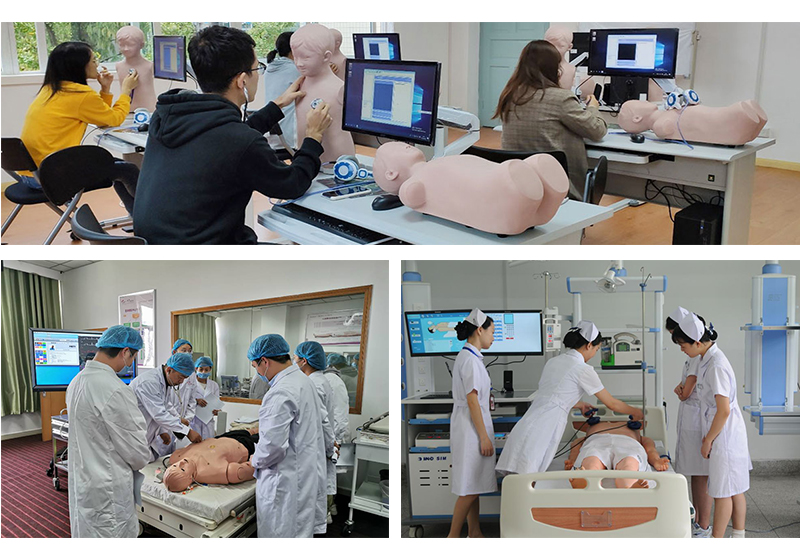
A combined lab teaches needle-based thoracic and pericardial access, tube-based airway management and peripheral venous access in one rotation, usually with one model per procedure family. The four models in this configuration differ mainly in the feedback they give back to the trainee: the SC-J5S reports tube placement electronically with display, music and alarms; the SC-HS4 reports IV practice through an electronic alarm with a changeable vein and skin; the SC-L66 gives visual and fluid feedback through chest windows and adjustable drainage fluid; and the SC-CK817 is documented as a clinical manikin for pericardial puncture and intracardiac injection practice.
That difference is the reason a single model does not cover the room. A model documented for one procedure family does not automatically document the others, and a lab that assumes otherwise will discover the gap on the first teaching day rather than in the quotation stage.
Why a station map beats a single model
A station map is a written list that pairs each procedure your curriculum requires with one model, one room position and one set of consumables. It converts a vague request for "a puncture and airway lab" into a purchase order that can be checked line by line.
Three practical problems disappear when the map exists. First, duplicates: if two stations are assigned the same procedure, the lab pays twice for one capability while another procedure goes untaught. Second, blind spots: a department that buys one high-feedback airway model may still have no model for chest drainage, and that gap is invisible unless the procedure list is written down. Third, consumable planning: the SC-HS4 depends on changeable vein and skin sets, and the SC-L66 depends on prepared drainage fluid, so throughput per session is set by consumables rather than by the manikin bodies.
The map also settles the operator briefing. Each station gets its own short script stating which model sits there, which procedure it is documented for, what the feedback means, and what the model does not measure.
Industry context: why labs are being equipped in this pattern
Skills-lab equipment spending sits inside a larger simulation market. MarketsandMarkets valued the global medical simulation market at USD 2.17 billion in 2024 and projected USD 4.48 billion by 2030, a scope that includes software and services alongside physical models. WiseGuyReports separately estimated the manikin-specific segment at USD 600 million in 2024, with a projected USD 1.2 billion by 2035.
Those two figures should not be placed side by side as a growth story: their product scopes differ, and the simulation total includes categories a manikin budget never buys. The practical reading for a lab planner is narrower. Multi-station rooms are being equipped across several procedure families at once, and that pattern rewards suppliers who can document model-level features clearly rather than suppliers who only publish a category page.
The four-station map at a glance
| Station | Procedures documented for the model | Model | Feature that matters for lab planning |
|---|---|---|---|
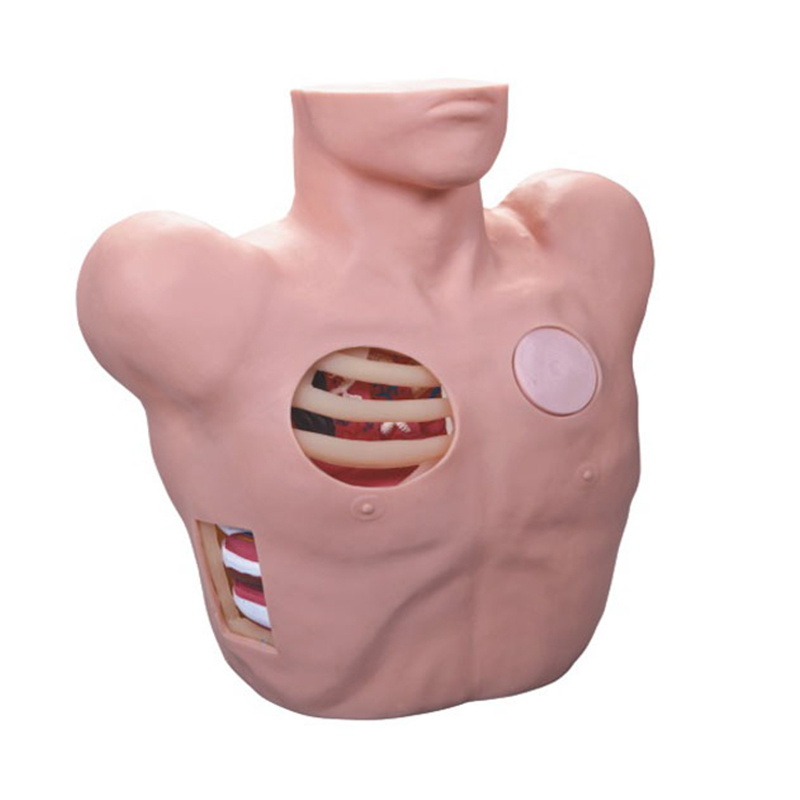
| 1. Thoracic drainage and puncture | Closed drainage for pneumothorax and hydrothorax after chest trauma; post-operative care practice of drainage tubes; pneumothorax puncture decompression; hydrothoracic intubation and drainage | SC-L66 Puncture Manikin | Two chest windows on the right side showing layered anatomy; left thorax used for puncture and drainage exercises; drainage fluid colour, volume and viscosity adjustable |
| 2. Pericardial access | Pericardial puncture; intracardiac injection | SC-CK817 Clinical Manikin | Clinical manikin assigned to a needle-based cardiac access station |
| 3. Airway management | Oral and nasal tracheal intubation; cricothyroid membrane puncture site indicated | SC-J5S Intubation Model | Electronic display and music on correct airway insertion; alarms for oesophageal insertion and for laryngoscope pressure on teeth |
| 4. Peripheral IV access | IV injection | SC-HS4 IV Injection Model | Electronic alarm; changeable vein and skin |
Station 1 — SC-L66: thoracic drainage and puncture
The SC-L66 is a puncture manikin built around the chest. It supports closed drainage training for pneumothorax and hydrothorax after chest trauma, and practice of post-operative care for drainage tubes. On the left thorax, trainees can perform pneumothorax puncture decompression and hydrothoracic intubation and drainage exercises.
Two windows on the right side of the chest display the anatomical structures of each chest layer. For lab setup this is a briefing tool as much as a training feature: the manikin should be positioned so the window faces the observing group, not the wall, because the instructor can then point to the layer a needle is passing through before the trainee attempts it.
The drainage fluid is adjustable in colour, volume and viscosity. That turns fluid preparation into a session variable: the same manikin can present a different drainage appearance for a first-year demonstration and for a refresher session. It also means the station needs a fluid area — a tray, an absorbent mat and a drainage collection point — and a reset routine between groups, because fluid left in place from a previous session becomes part of the next trainee's scenario whether or not that was intended.
Station 2 — SC-CK817: pericardial puncture and intracardiac injection
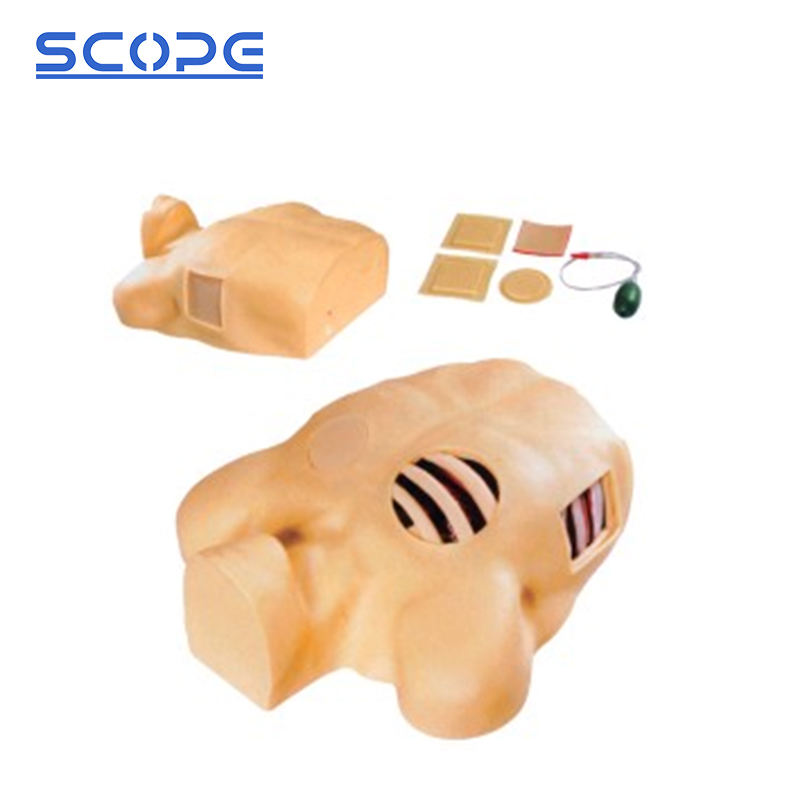
The SC-CK817 clinical manikin carries the cardiac access station: pericardial puncture and intracardiac injection. These are needle procedures with a defined target, and the station is therefore organised around one trainee at a time, a sharps container within arm's reach, and a sightline that lets the instructor see the needle angle without standing over the trainee.
Keep the briefing specific. The model's documented role in this configuration is procedure practice for pericardial puncture and intracardiac injection; the supplied specification for this station does not extend to additional procedures, electronic feedback or replacement-part detail. Those points should be confirmed on the model-level specification sheet and the quotation rather than assumed from the station's position in the room.
Station 3 — SC-J5S: oral and nasal intubation with electronic feedback
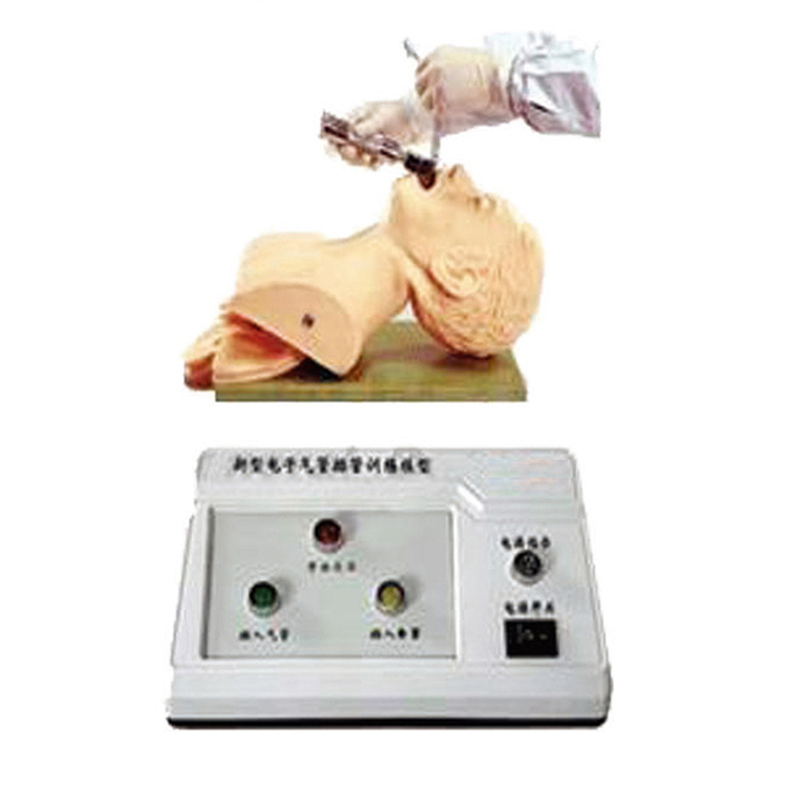
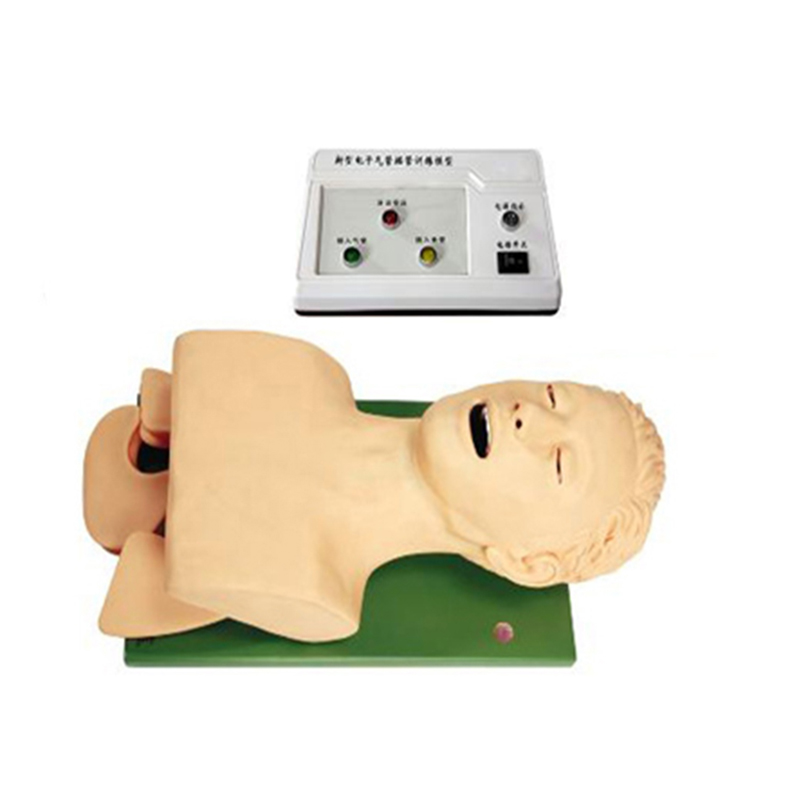
The SC-J5S intubation model supports training operations and teaching demonstrations for oral and nasal tracheal intubation. Its feedback is electronic and audible, which shapes both the room layout and the way the station is introduced.
Documented behaviour on this model includes:
- An alarm prompt for tooth pressure caused by improper force during endotracheal intubation, and an electronic alarm when incorrect operation causes the laryngoscope to press on the teeth.
- Electronic display and music playing functions when the airway is inserted correctly during oral and nasal intubation training.
- An electronic display and alarm when the oesophagus is inserted incorrectly, with the air supply causing the stomach to expand.
- An air supply that expands both lungs, and the ability to inject air into the tube air bag to fix the tube.
- A normal pupil on one side and a dilated pupil on the other for comparison, plus an indicated cricothyroid membrane puncture site.
For lab setup, three consequences follow. The station needs power for the display and alarm electronics. It should be sited away from quiet stations, because an audible alarm teaches the whole room whether or not that was planned. And the briefing must explain what each alarm means before practice begins, so that a trainee hears feedback rather than a rebuke: the tooth-pressure alarm describes a laryngoscope handling error, the oesophageal alarm describes tube position, and the music indicates successful placement.
A two-person pattern works well at this station — one trainee intubating, one observer reading the display and reporting what changed — and it gives the instructor a second source of information during a busy rotation.
Station 4 — SC-HS4: IV injection with changeable vein and skin
The SC-HS4 is an IV injection model with an electronic alarm and a changeable vein and skin. The changeable components are the detail that decides how the station is run: replacement vein and skin sets are a consumable, so the number of practice attempts available in a session depends on how many sets are held in stock, not on how many trainees are booked.
The electronic alarm gives immediate feedback on the attempt. Brief the alarm's meaning explicitly, because an IV station attracts rapid, repeated attempts and a misunderstood alarm produces noise without learning. Pair the alarm with the visible change of the vein and skin so trainees can connect the signal to what happened at the access site.
One honest limitation belongs in the lab's records rather than its marketing: the supplied documentation does not state a rated number of punctures per vein or skin set. Track usage locally — attempts per set, visible wear, leakage — and set the replacement interval from your own records rather than from an assumed figure.
Room, power and consumables: what each station demands
Once the four models are assigned, the room requirements can be written station by station. The table below reflects only what the supplied specifications document; where a requirement is not documented, it is marked as such rather than assumed.
| Station | Power and utilities | Consumable or replacement focus | Positioning note |
|---|---|---|---|
| SC-L66 | No electronic feedback documented; fluid handling area required | Drainage fluid with adjustable colour, volume and viscosity; drainage collection | Chest window angled toward observers |
| SC-CK817 | None documented | Sharps containment and procedure consumables per local protocol | One trainee at a time; clear sightline for the instructor |
| SC-J5S | Power for electronic display, music and alarm functions | Airway consumables as required by the programme; air supply used to expand the lungs | Separate from quiet stations because alarms are audible |
| SC-HS4 | Power for the electronic alarm | Changeable vein and skin sets held as stock | Spares stored at the station, not in a distant store |
Room conditions also belong in the plan. Chongqing Scope's recorded application conditions for medical manikin use in medical school teaching list an ambient temperature of 0–35 °C and note that the room temperature should be kept constant rather than allowed to swing between extremes. That is a general application condition, not a model-specific performance specification, but it is a reasonable basis for siting the lab away from uncontrolled loading bays and direct heat sources.
Step-by-step: building the lab from procedure list to first session
This sequence is written for a lab manager working from a curriculum list rather than from a catalogue.
- Write the procedure list per learner group. Separate what students must perform from what they only need to observe. The SC-L66, SC-CK817, SC-J5S and SC-HS4 each sit on a different procedure family, so this list determines the station count before any model is chosen.
- Assign one model per procedure family. Thoracic drainage and puncture go to the SC-L66; pericardial puncture and intracardiac injection to the SC-CK817; oral and nasal intubation to the SC-J5S; IV injection to the SC-HS4. Two models covering the same procedure is duplication; one model asked to cover two undocumented procedure families is a gap.
- Set stations against cohort size. As a conditional example, four stations with one model each, run in a 90-minute session with groups rotating every 20 minutes, will absorb a class in blocks rather than in one crowd. The arithmetic is planning, not a claim about any model's capacity.
- Confirm the room conditions. Stable ambient temperature, power at the two electronic stations, a fluid zone at the drainage station, and a noise boundary around the airway station. This is the point at which the layout usually changes, because the SC-J5S alarms and the SC-L66 fluid preparation want to be far apart.
- Stock consumables before the first session. Changeable vein and skin sets for the SC-HS4, drainage fluid for the SC-L66, and airway consumables per the programme's protocol. Replacement parts outside this documented list should be confirmed with the supplier rather than assumed to be included.
- Write a one-page operator briefing per station. Each page states the model, the documented procedures, what the feedback signal means, and what the model does not measure. The last point prevents trainees from treating an alarm as a pass or fail verdict.
- Run an acceptance check on delivery. Compare each unit against the model-level specification sheet and the purchase order, record serial numbers, confirm the one-year online warranty stated in the supplier's capability data, and start a usage log from the first session.
- Plan the resupply interval. The supplier's capability data lists a 30–45 day lead time, a monthly capacity of 3000 units and a minimum order quantity of 20 units. Those figures set the reorder rhythm for replacement components and any future station expansion; confirm them again on the current quotation because commercial terms change.
PVC construction and changeable vein/skin: setup and briefing implications
Chongqing Scope documents its medical manikins as PVC-built, describing the material as durable, resistant to deformation and supportive of a high degree of authenticity. For a multi-station lab, the practical consequences are about handling and briefing rather than marketing.
Structural versus consumable parts. The changeable vein and skin on the SC-HS4 and the chest windows on the SC-L66 are different categories of component. One is a replaceable training surface; the other is a fixed structural feature that frames the anatomy for the group. Trainees who treat the chest window as something to be replaced, or the vein set as something permanent, will damage both. Say which is which in the first two minutes of the briefing.
Cleaning between users. PVC tolerates routine handling, but the supplied documentation does not include material-compatibility test data for specific cleaning or disinfection agents. Confirm the cleaning method with the supplier against the exact model rather than assuming any general-purpose agent is safe.
Durability claims and what they do not cover. The durability statement is a company material description; no standardized durability, puncture-count or fidelity test results were included in the supplied documentation. A lab should therefore measure its own wear — attempts per set, visible deterioration, fluid tightness — and adjust the replacement cycle from that record.
Briefing the feedback. At the two electronic stations, the briefing must name the signal before the trainee triggers it: the SC-J5S display, music and alarms, and the SC-HS4 electronic alarm. At the two visually judged stations, the briefing must state what the instructor is watching for, because the model itself does not generate signal at the SC-L66 window or the SC-CK817 access site beyond what the trainee and instructor can see.
Where this four-station configuration fits
Medical school teaching. This is the application Chongqing Scope records for its medical manikins: medical education and first-aid training under manual operation, at an ambient temperature of 0–35 °C, with room temperature held steady. The four-station layout suits a single teaching room serving several procedure modules in one term.
Clinical skills and nursing programmes. The post-operative drainage tube care practice on the SC-L66 and the IV injection practice on the SC-HS4 connect the room to ward-based skills, while the SC-CK817 adds a cardiac access station that a purely nursing-oriented lab may not need. Dropping one station is a legitimate configuration decision, since the models are separate units rather than one integrated simulator.
Airway refresher training. A department that only needs airway practice can buy the SC-J5S alone; the alarms, display and lung inflation behaviour are contained in that single model.
Distributor demonstration rooms. Chongqing Scope's case record describes a medical manikin distributor project in India covering 500 units over one year for medical teaching, characterised in the record as stable in operation with customised, durable builds. A four-station arrangement is a useful demonstration format for that kind of channel, because a visiting buyer can walk from station to station instead of watching one model on a table.
Procurement checks for a multi-model order
A four-model order is still one purchase, and the checks are the same ones a buyer would apply to a single unit — repeated per station.
- Model-level specifications. Ask for the specification sheet for each of the four models, not the category page. The station-by-station features in this guide should appear on it.
- Certificates and scope. Company documentation lists ISO 9001, ISO 14001, ISO 45001, ISO 13485, CE and RoHS, and independent company documentation records ISO 13485 and CE with the certificate reference BKC22072375GC. Request copies and confirm what each certificate covers, because a company-level certificate is not automatically a model-level statement.
- Commercial terms in writing. Minimum order quantity of 20 units, lead time of 30–45 days and monthly capacity of 3000 units are listed in the supplier's capability data; ask for these to be restated on the quotation for the exact configuration.
- Customisation. OEM and ODM services are offered, with customisation of product appearance and functions subject to quantity requirements. If the lab wants station-specific marking or a branded casing, settle the technical verification and artwork approval before production.
- Packaging and documents. Export packaging is described as neutral, in cardboard or wooden boxes to export standards, with CO, Form E and Form F available on request for customs clearance.
- After-sales. A one-year online warranty is listed; confirm how replacement vein and skin sets and other consumables are ordered after the first year.
Frequently asked questions
Which compliance documents should be requested for a combined manikin lab?
Request the certificate copies and their scope for each model in the order. Chongqing Scope's company documentation lists ISO 9001, ISO 14001, ISO 45001, ISO 13485, CE and RoHS, and company records cite CE certificate reference BKC22072375GC alongside ISO 13485. Treat these as company-reported until the copies are in hand, and check whether the documents address the specific manikin models you are buying rather than the company's quality system alone.
Can the four models run in one rotation without overlapping procedures?
Yes, on the documented procedure lists. The SC-L66 covers closed drainage for pneumothorax and hydrothorax after chest trauma, post-operative drainage tube care, pneumothorax puncture decompression, and hydrothoracic intubation and drainage. The SC-CK817 covers pericardial puncture and intracardiac injection. The SC-J5S covers oral and nasal tracheal intubation with electronic display and alarms. The SC-HS4 covers IV injection with an electronic alarm and changeable vein and skin. No overlap is documented between these four procedure sets.
What drives the budget in a four-station order?
The main variables are the number of units per station, the stock of changeable vein and skin sets for the SC-HS4, drainage fluid and airway consumables, and any customisation of appearance or functions. The supplier's capability data lists a minimum order quantity of 20 units, so a small pilot lab may need to plan around that threshold. Request a line-item quotation covering each model, spares and packaging rather than a single lump sum.
How can a lab evaluate the models before committing to the full order?
Evaluate on documents first, then on a physical unit. Ask for model-level specification sheets, certificate copies and the spare-part list, and run one pilot session at the station that carries the highest teaching load — often the SC-J5S, because its alarms and display need to be tested against your briefing script. The supplied capability data does not publish a sample policy for manikins, so sample or pre-production terms should be confirmed on the quotation.
What lead time should be planned, and when should staff training happen?
Chongqing Scope's capability data lists a 30–45 day lead time and a monthly capacity of 3000 units. Plan staff briefing after delivery and before the first student session, so that the station scripts are written against the units actually received. To move from a station list to a configured proposal, share the procedures, cohort size and room constraints with the supplier — the Chongqing Scope product brochure (PDF) is a useful starting reference for that conversation.
Conclusion
A combined puncture, airway and IV lab is planned as four stations, not one purchase: SC-L66 for thoracic drainage and puncture, SC-CK817 for pericardial puncture and intracardiac injection, SC-J5S for oral and nasal intubation with electronic feedback, and SC-HS4 for IV injection with changeable vein and skin. The models are documented separately because the procedures fail in different ways and are corrected with different signals.
The lab plan that follows from that mapping is deliberately unglamorous: a written procedure list, one model per procedure family, power and fluid where the specifications require them, a noise boundary around the alarm stations, consumable stock counted before the first session, and a one-page briefing per station stating what the feedback means and what the model does not measure. Completed in that order, the equipment list, the room and the teaching script stay aligned — and each station can be defended line by line at the procurement review.
Have Questions or Need More Details?
Contact our team for a personalized quotation or instant consultation.
Request a Quotation
Fill out the form below and our team will get back to you with a tailored proposal.
WhatsApp Direct Chat
Prefer to chat in real-time? Message us on WhatsApp for instant assistance & quick answers.
- Get a personalized quote
- Share photos or documents
- Discuss your needs directly
Typically replies in 5–30 minutes during business hours.