
Decoding Infinity Optical Systems: How They Enhance Performance in Modern Microscopes
An infinity-corrected optical system projects a parallel beam of light between the objective and a tube lens, so additional optical components can be inserted into the light path without shifting focus or degrading the image. That single architectural choice decides whether a microscope can be expanded over the years - with fluorescence, polarization, phase contrast or a camera port - or whether every new application requires a new instrument. This guide explains how infinity optics behave in practice, which parameters control real image quality (plan objectives, eyepiece field numbers such as WF10X/20mm, and numerical aperture), and what buyers should verify before committing to a configuration.
It is written for laboratory managers, quality and R&D engineers, distributors and importers who have already passed the discovery stage. They know which instrument family they need, and they now have to specify it correctly, compare configurations on equal terms, and plan for several years of use.
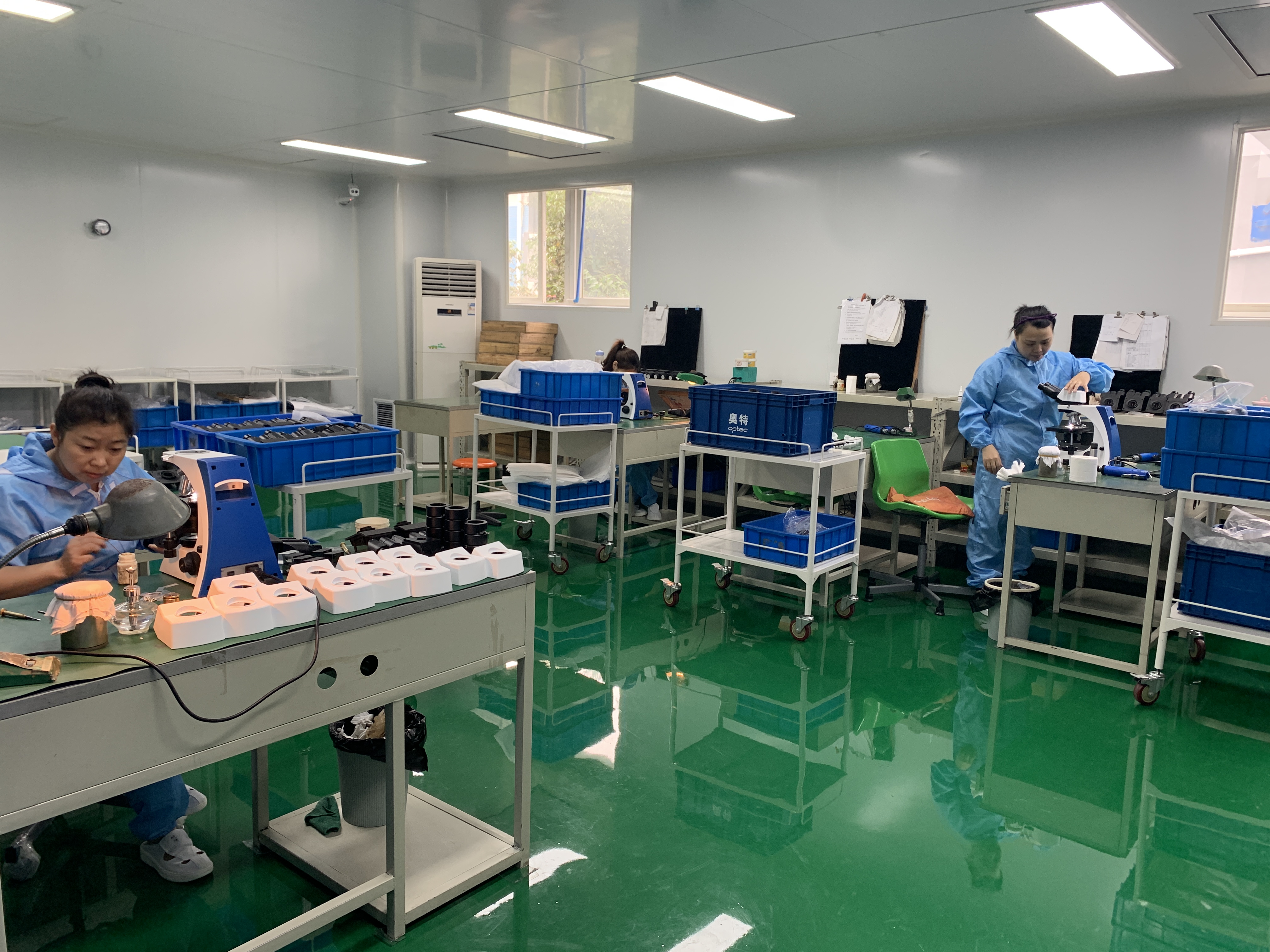
Infinity-corrected microscope platforms being assembled at Chongqing Scope Instrument Co., Ltd.
Problem Definition: Optical Architecture Sets the Limits of Everything Downstream
Most microscope specifications start with magnification and price. The decision that actually constrains the instrument for its entire service life - which objectives can be fitted, which contrast techniques can be added later, whether a camera port compromises the visual image - is rarely printed on a quotation sheet.
In a conventional fixed-tube-length design, light converges inside the observation tube on its way to the intermediate image. Any component placed in that converging path, such as a polarizer, a fluorescence filter block or an intermediate adapter, modifies the optical path and can push the image out of focus or introduce aberration. The practical result is that add-on capability is limited: adding a technique often means buying another stand rather than another module.
That turns a technical detail into a total-cost problem. When the usable lifetime of an instrument is bounded by the workflows it was purchased for, laboratories, universities and industrial quality departments end up re-purchasing stands instead of expanding them. For distributors, the same issue shapes the accessory and service revenue that follows an installed base.
Infinity-corrected optics were introduced to remove that constraint, and they are now the standard architecture for research-grade and advanced laboratory platforms.
Industry Background: Where Optical Microscopy Still Sits
Optical microscopes remain the largest product segment of the microscope market, accounting for approximately 37% of global market share in 2025 (MarketsandMarkets). The overall microscope market was valued at USD 11.9 billion in 2025 and is projected to reach USD 21.2 billion by 2033 (Grand View Research). Within the application mix, the life science segment held a 32.4% revenue share in 2025, driven by genomics and drug discovery R&D (Grand View Research). Market-size estimates differ between research firms depending on whether accessories and software are included in the scope, so buyers comparing reports should check the definition rather than the headline number.
The manufacturers most frequently named as global leaders in this category include Carl Zeiss AG (Germany), Leica Microsystems (Danaher), Nikon Corporation (Japan) and Evident (formerly Olympus) - the tier where infinity-corrected optics became the default for research platforms. Below that tier, a broad group of Chinese manufacturers now builds infinity-corrected instruments at different price points and customization levels.
Chongqing Scope Instrument Co., Ltd. is one of those suppliers. Based in Chongqing, China, the company manufactures and exports laboratory and medical training instruments and metallographic equipment, with a main product range that includes biological microscopes, metallographic microscopes, fluorescence microscopes, inverted microscopes and stereo microscopes, alongside hardness testers, metallographic sample cutting, mounting, grinding and polishing equipment, medical training manikins and laboratory consumables. It operates a 5,000 m² facility with more than 100 employees and a 20-engineer R&D team, reports more than 20 years of sales experience in laboratory and medical instruments, and exports to Europe, Southeast Asia, the Middle East, South America and Africa, with roughly 50% of output going to export markets. Its export documentation set includes ISO 9001, ISO 14001, ISO 45001, ISO 13485, CE and RoHS certificates, and it offers OEM and ODM services.
Detailed Solution: What an Infinity-Corrected System Actually Does
In an infinity-corrected microscope, the objective does not form a focused image at a fixed distance inside the tube. It projects a parallel - literally 'infinite' - beam of light out of its back aperture. A tube lens positioned further along the observation path refocuses that parallel beam onto the intermediate image plane, which the eyepiece or camera then magnifies. The objective and the tube lens work as a matched pair and are separated by the 'infinity space'.
Why the Parallel Space Matters More Than Any Single Specification
Because the beam between objective and tube lens is parallel rather than converging, a component inserted into that space does not move the focus point. Filter cubes for fluorescence, polarizer and analyzer sliders, DIC prisms, magnification changers and camera splitters can be added or exchanged without refocusing the specimen and without adding aberration to the image. This is the flexibility that the architecture buys, and it is the reason a single stand can serve bright field today and a different technique next year.
It also changes how a buyer should read a quotation. On an infinity platform, the stand, the objective set, the eyepiece set, the illumination module and the accessory slots are separate decisions. On a fixed-tube-length instrument they are effectively one decision made at the factory.
Magnification Is a Relationship, Not a Property of the Objective Alone
An objective's nominal magnification is calibrated against a reference focal length, while the magnification actually delivered depends on the focal length of the tube lens in the observation path. In practice this means the objective and the tube lens must be treated as a matched system: the same objective can behave differently behind a different tube lens, and mixing components from unrelated optical systems can change magnification, parfocality or both. Buyers configuring a system from more than one source should confirm tube-lens compatibility explicitly rather than assuming that identical magnification labels are interchangeable.
Plan Objectives and Field Flatness
A standard achromatic objective is corrected mainly for spherical and chromatic aberration along the optical axis, and its image plane can curve toward the edges of the field. Plan objectives add correction for field curvature, so the focused image stays flat from the centre to the edge of the field. Plan achromat and plan apochromat versions extend that correction further, with apochromatic designs targeting chromatic correction across a wider range of wavelengths.
The buying consequence is practical rather than theoretical. Field flatness determines whether everything visible in the eyepiece is in focus at the same time, whether a single camera exposure captures the whole field in focus, and whether measurement or image stitching at the edge of the field is reliable. Workflows that depend on photography, documentation or measurement gain the most from plan correction; a routine visual check with a centered specimen gains the least.
Eyepiece Field Numbers: What WF10X/20mm Tells You
An eyepiece designation such as WF10X/20mm carries two pieces of information. 'WF10X' identifies a wide-field 10× eyepiece. The number 20 is the field number (FN) in millimetres - the diameter of the intermediate image that the eyepiece can display. A larger field number means a wider field of view, and the field of view diameter is approximately the field number divided by the objective magnification. With a 20 mm field number, a 10× objective shows roughly 2 mm of specimen across the field, while a 40× objective narrows it to about 0.5 mm.
The parameter matters because it has to match the rest of the optical train. If the tube lens delivers a wider intermediate image than the eyepiece field number can display, the extra field is simply lost. For camera documentation, the photo port and any intermediate magnification in the path determine what the sensor actually receives, so the eyepiece field number is only part of the imaging calculation.
Numerical Aperture, Resolution and Working Distance
Resolving power is governed by the objective's numerical aperture (NA) and by the wavelength of light used, not by the magnification number on the barrel. Raising magnification without raising NA produces empty magnification: a larger image with no additional detail. Higher-NA objectives generally deliver finer resolution and brighter images, but they shorten both the depth of field and the working distance, and some designs require oil or another immersion medium between the front lens and the sample. Working distance matters whenever the specimen is thick, mounted in a dish, or inspected with a probe, so NA and working distance should be checked together rather than optimized separately.
Illumination and Contrast Setup
Even, adjustable illumination is what allows the optical system to perform at its rated level. Kohler illumination and a matched condenser keep the field uniformly lit and let the field and aperture diaphragms be used to control contrast and depth of field. On modular platforms, illumination is also part of the expansion path: Chongqing Scope Instrument reports more than 10 optional lighting configurations against 2-3 options on traditional models in its published comparison data.
| Term | What it means | Why the buyer should care |
|---|---|---|
| Infinity-corrected system | The objective projects a parallel beam; a tube lens forms the intermediate image | Accessories can be inserted without changing focus or image quality |
| Tube lens | Refocuses the parallel beam and sets the magnification each objective delivers | Objective and tube lens must be matched when components come from different sources |
| Plan objective | Corrected for field curvature in addition to spherical and chromatic aberration | Flat, fully focused field for photography, stitching and edge measurement |
| Field number (FN) | Diameter in millimetres of the intermediate image an eyepiece can display; WF10X/20mm = 10× wide-field eyepiece with a 20 mm field number | A larger FN gives a wider field of view; a mismatch wastes the optics' available field |
| Numerical aperture (NA) | The light-gathering angle of the objective | Higher NA gives better resolution and brightness, with shorter working distance and depth of field |
| Working distance | Free space between the objective front lens and the specimen | Determines whether thick samples, dishes or probes can be used |
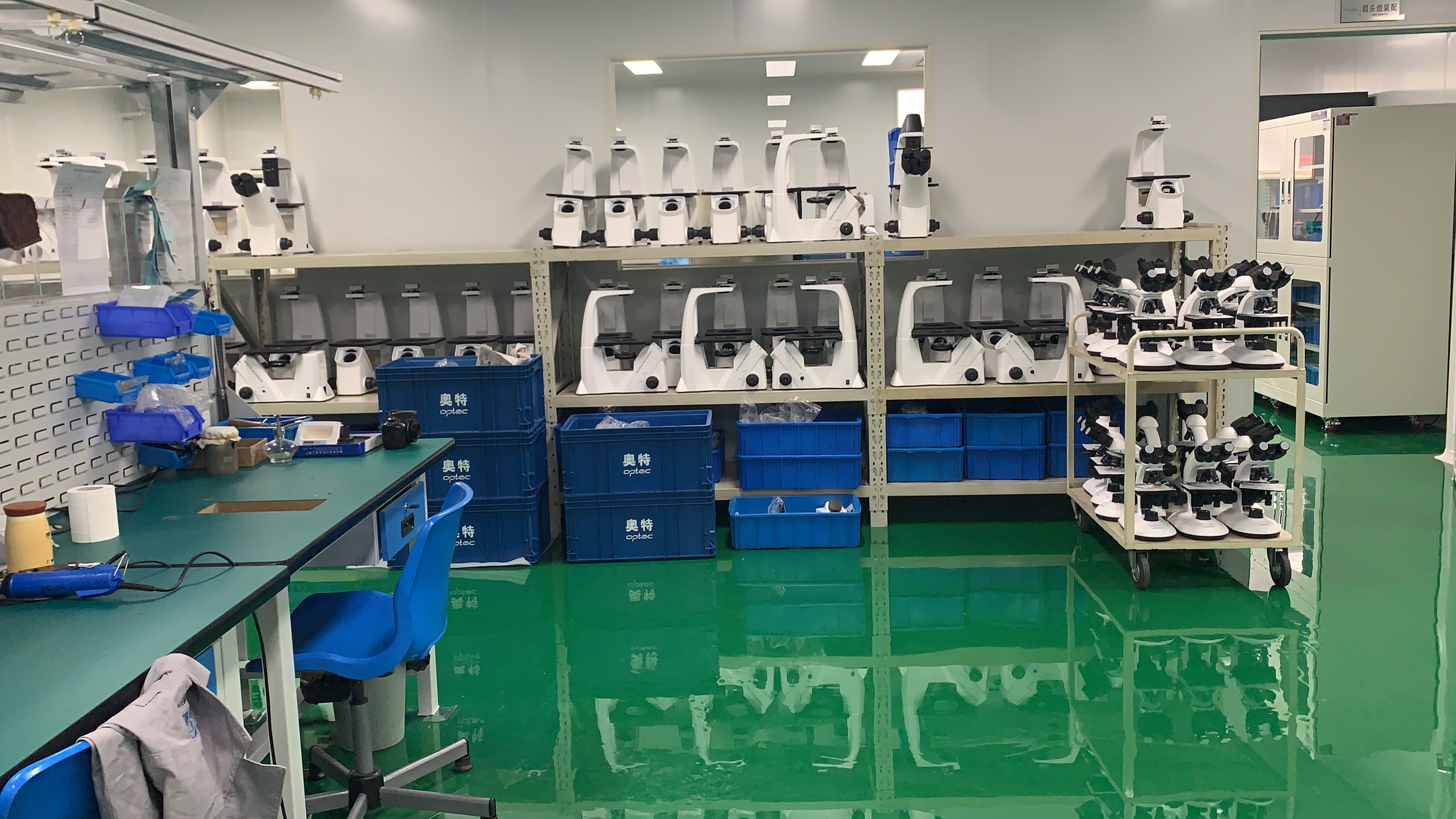
Optical assembly and alignment are handled in a dust-free workshop to protect the infinity light path.
How Infinity Platforms Behave in Practice: BK6000TR and SMART-4 Class Models
Within the Chongqing Scope Instrument catalog, infinity-corrected models such as the BK6000TR and SMART-4 are built around infinity objectives, which keeps the optical path open for later additions instead of locking the instrument to the contrast technique it shipped with. The buyer-facing advantage is configuration continuity: the same stand can carry a basic bright field setup at delivery and accept further modules as new projects arrive, rather than being replaced when the application changes.
Because the architecture is a design principle rather than a single fixed specification, the exact capability of any configuration depends on what is quoted. Before ordering, confirm in the data sheet: the objective series and whether plan correction is included; numerical aperture and working distance for each objective; the eyepiece type and field number; the tube lens and photo or trinocular port arrangement; available accessory slots for filter blocks, polarizer and analyzer, and condenser options; the illumination set; and camera compatibility. Modern platforms in this class are also designed to connect directly to digital cameras for computer-based imaging, which Chongqing Scope Instrument reports reduces image capture time by 40% in its comparison data against traditional microscopes.
Step-by-Step Breakdown: Evaluating an Infinity System Before You Commit
- Map current and planned techniques. List what the instrument must do at delivery and what it may need within three to five years - bright field, phase contrast, dark field, polarization, fluorescence, reflected light or camera documentation. This list defines which expansion slots are non-negotiable.
- Confirm the optical architecture. Ask whether the instrument is infinity-corrected and how objective and tube lens are matched as a system. This is a yes-or-no question that determines future flexibility.
- Read the objective list, not just the magnification. Check plan correction, numerical aperture, working distance and whether immersion is required. A 100× objective without plan correction will not behave like a plan objective in a photographic workflow.
- Check the eyepiece and the photo port. Note the eyepiece field number, for example WF10X/20mm, and what field size the tube lens and any intermediate magnification deliver to the camera port.
- Verify accessory insertion points. Confirm where filter blocks, polarizer and analyzer, and additional condensers or illuminators physically attach, and whether those modules are available as separate line items.
- Review illumination and power design. Chongqing Scope Instrument reports more than 10 optional lighting configurations versus 2-3 on traditional models, and a low-voltage design that supports more than 8 hours of outdoor use with a power bank.
- Review the maintenance model. Confirm post-use care requirements, dust protection and anti-mildew and anti-fog treatment, whether parts replacement can be handled by users without professional support, and whether after-sales repair guidance is provided remotely, for example through operation videos.
- Confirm commercial and supply terms. Minimum order quantity is 1 unit; delivery terms available are EXW, FOB, CFR, CIF and DAP; acceptance criteria are based on factory inspection; payment terms are T/T. Monthly production capacity is 3,000 units.
For the execution stage: write the acceptance criteria, delivery term, accessory list and objective specifications directly into the purchase order. Because the value of an infinity system lies in its configuration, an order that names only the model leaves the optical specification open.

Export delivery terms for microscope orders: EXW, FOB, CFR, CIF and DAP.
Use Cases: Where Infinity Optics Return the Most Value
The architecture pays back in workflows that are expected to change or expand, and in workflows that depend on image capture rather than visual observation alone.
Clinical and life science laboratories. A stand delivered for bright field observation can later accept a fluorescence module or phase contrast components, which lets a laboratory respond to new protocols without replacing the instrument. Because the parallel path can carry filter blocks, fluorescence microscopy is one of the clearest beneficiaries of infinity correction.
Histology and tissue microscopy. Plan objectives and a wide eyepiece field number reduce the time spent refocusing across a slide and make camera documentation more consistent, since the field remains flat in a single capture.
Materials, metallography and mineralogy. Reflected-light and polarization techniques are used in metallurgical and petrographic or mineralogical work, where polarizer and analyzer components sit directly in the light path. On an infinity platform these components can be inserted and removed without disturbing focus or optical alignment.
Industrial quality control and measurement. Direct camera connection and a stable optical path support repeated documentation of the same field, which matters when images are compared across batches or shifts.
Teaching and training laboratories. Standardized stands with swappable accessories allow one platform to serve routine teaching and occasional advanced demonstrations, with less need for separate instruments.
Comparison Table: Conventional Microscope vs Modern Infinity-Corrected Platform
| Parameter | Conventional microscope | Modern infinity-corrected platform (supplier comparison data) |
|---|---|---|
| Optical system | Conventional design | Upgraded optical system |
| Body and construction | - | Metal body |
| Parts replacement rate | - | Low |
| Service life | - | Long |
| Digital imaging | Separate imaging arrangements | Compatible with digital cameras for direct computer connection; image capture time reduced by 40% |
| Lighting configurations | 2-3 options | 10+ optional configurations |
| Field and power flexibility | Mains-dependent | Low-voltage design supports 8+ hours of outdoor use with a power bank |
| Maintenance | Frequent professional calibration and cleaning | Simple post-use care; parts replacement can be done by users without professional support |
| Total cost of ownership | - | Initial purchase price slightly higher, total cost of ownership 25% lower due to minimal maintenance and long service life |
| Typical best fit | - | Laboratory, university, hospital |
Cells marked with a dash are not specified in the published comparison data. The comparison figures above are published by Chongqing Scope Instrument Co., Ltd. for its modern microscope platforms and should be verified against the quoted configuration.
Long-Term Ownership: Ecosystem, Service and Supply Continuity
An infinity platform changes the nature of the relationship between buyer and supplier. Once the stand remains useful across several techniques, the buyer's future orders shift from whole instruments to objectives, modules, accessories and service - and the supplier's ability to keep those items available becomes part of the purchasing decision.
Optical performance degrades gradually rather than suddenly. The risk factors documented for microscope equipment are bulb degradation, the need to replace accessories, dust accumulating on the optical path, and mold or fogging on optical surfaces. Each of these reduces image quality well before the instrument fails mechanically. The control measures are straightforward and mostly procedural: a documented manual power-down procedure, a supplied instruction manual, a dust cover, and anti-mildew and anti-fog treatment of the optics.
Service design matters as much as hardware design. Chongqing Scope Instrument provides online after-sales repair service, including operation videos, and supplies a range of accessories for ongoing maintenance. Combined with a platform whose parts can be replaced by users without professional support, this shortens the downtime that a lab or a distributor would otherwise absorb, and it keeps calibration needs low compared with instruments that require frequent professional cleaning and adjustment.
Supply continuity is the third element. A monthly production capacity of 3,000 units gives distributors and institutional buyers a predictable base for repeat orders and for standardizing a department on one platform. Export packaging is neutral, in cardboard boxes or wooden boxes prepared to export standards, and customs documents such as CO, Form E and Form F are available. For distributors building their own brand, OEM and ODM services include LOGO printing on the machine after technical verification, or custom LOGO labels applied to the instrument.
The practical conclusion for the decision stage is that the optical architecture and the long-term support model should be evaluated together. A modular optical path is only valuable if the modules, accessories and service behind it remain available for the life of the instrument.
Frequently Asked Questions
What compliance standards apply to infinity-corrected microscopes used in medical or laboratory settings?
Medical laboratory equipment and in vitro diagnostic (IVD) microscopes must comply with the IEC 61010-2-101 safety standard, published by the International Electrotechnical Commission. On the supplier side, the documentation set available from Chongqing Scope Instrument Co., Ltd. includes ISO 9001, ISO 14001, ISO 45001, ISO 13485, CE and RoHS certificates, and export customs documents such as CO, Form E and Form F can be provided. Buyers should map the applicable standard to their own market and confirm which certificates apply to the specific quoted configuration.
Can an infinity-corrected microscope be expanded with additional contrast techniques after purchase?
Yes - that is the purpose of the architecture. Because the beam between the objective and the tube lens is parallel, components such as fluorescence filter blocks, polarizer and analyzer, or intermediate adapters can be inserted into the infinity space without changing focus. As a result, one stand can support several techniques over time. Chongqing Scope Instrument reports more than 10 optional lighting configurations on its modern platforms, compared with 2-3 options on traditional models. Because module compatibility depends on the specific stand and port arrangement, confirm the available accessory slots and the objective series in the data sheet before ordering.
Why do infinity-corrected microscopes cost more up front, and how does that compare over the life of the instrument?
The published comparison data from Chongqing Scope Instrument shows an initial purchase price that is slightly higher than a conventional microscope, offset by a total cost of ownership that is 25% lower, driven by minimal maintenance and a long service life. The supporting factors are a low parts replacement rate and a maintenance model in which parts replacement can be handled by users without professional support, compared with the frequent professional calibration and cleaning that traditional instruments typically require. For budget planning, the relevant comparison is the multi-year cost of instrument, accessories and service rather than the unit price alone.
How can a buyer validate an infinity optical system before committing to volume?
The minimum order quantity for instruments is 1 unit, so a single evaluation unit can be ordered and tested against real samples before any volume commitment. Acceptance criteria are based on factory inspection, and payment terms are T/T. For laboratory consumables, the company states that free samples can be provided in the early stage. When validating an infinity system, the most useful test is to check field flatness and focus stability with the objective and eyepiece combination actually quoted, including any accessory in the light path.
What are the delivery terms, lead-time planning factors and next steps for an order?
Delivery terms available are EXW, FOB, CFR, CIF and DAP, with T/T payment terms and factory inspection as the acceptance criterion. On the production side, monthly capacity is 3,000 units, which supports planning for repeat and distributor orders. To move from evaluation to execution, the fastest route is to send the intended application and configuration requirements to the supplier so that the objective series, eyepiece field number, illumination set and accessories can be quoted as one defined system. The product catalog can be downloaded here: Chongqing Scope Instrument product brochure, and configuration questions can be sent to claire@cqscope.com or via WhatsApp at +86 15223521781.
Conclusion
Infinity-corrected optics are not a marketing feature; they are a structural decision. By projecting a parallel beam between the objective and the tube lens, they allow fluorescence, polarization, phase contrast and imaging components to be added into the light path without disturbing focus, and they keep the objective and tube lens as a matched, predictable system. The parameters that determine real performance are equally concrete: plan correction for field flatness, the eyepiece field number such as WF10X/20mm for field of view, and numerical aperture for resolution and working distance.
For buyers at the decision and execution stage, the practical test is whether the quoted configuration can still serve the laboratory in five years. That depends on the optical architecture, the accessory ecosystem behind it, the maintenance model and the supplier's ability to keep modules and parts available - which is why Chongqing Scope Instrument's reported monthly capacity of 3,000 units and its online after-sales support with operation videos belong in the same evaluation as the objective list.
Defining the objective series, eyepiece field number, illumination set and accessory slots in the purchase order, rather than the model number alone, is what turns an infinity platform into a long-term asset instead of a single-purpose instrument.
Next Step: Configure Your Infinity System
Send your application, required techniques and target field of view, and the matching objective series, eyepiece field number and accessory set will be quoted as one defined system.
Email: claire@cqscope.com | Tel / WhatsApp: +86 15223521781
Website: www.cqscopelab.com | Catalog: Download the product brochure (PDF)

Export packaging: neutral cardboard or wooden boxes prepared to export standards.