
How to Choose a Medical Manikin for Your Training Lab: A Scenario-Based Buying Guide
How to Choose a Medical Manikin for Your Training Lab: A Scenario-Based Buying Guide
Choosing the right medical manikin is not about picking the most expensive model. It is about matching the simulator to the clinical tasks your learners must master, the class size you need to support, and the operating conditions of your facility. This guide helps procurement teams, medical educators, and training center managers evaluate manikins by scenario, skill set, and practical constraints.
Chongqing Scope Instrument Co., Ltd. is a Chongqing-based supplier of laboratory and medical training instruments, including CPR manikins, clinical manikins, nursing manikins, anatomical models, and related teaching tools. The company operates a 5,000 m²facility with more than 100 employees and exports to Europe, Southeast Asia, the Middle East, South America, and Africa.
Why the Training Scenario Should Drive Your Manikin Selection
Medical training manikins serve one primary purpose: to let students practice hands-on skills before they touch a real patient. The correct choice depends on the procedures being taught, the level of realism required, and the expected frequency of use.
For a nursing school, a full-function nursing manikin that supports injection, catheterization, and daily care is often more useful than a highly specialized trauma model. For an emergency training center, CPR manikins with feedback systems may matter more. For an obstetrics department, a maternal manikin with delivery stages and fetal heart simulation becomes essential.
Buyers should define the exact skill list first, then map those skills to manikin types. This prevents both overspending and purchasing a unit that does not support the curriculum.
Core Categories of Manikins and Their Typical Roles
The following categories cover most medical manikin procurement needs. Each addresses a different group of clinical skills and training environments.
CPR Manikins
CPR manikins are used for first aid training and basic life support education. They range from simple models that show chest rise to advanced units with digital feedback on compression depth, ventilation volume, and compression-to-ventilation ratio.
Chongqing Scope offers several CPR models, including the SC-CPR100A, SC-CPR480, SC-CPR160 for infant CPR, and the SC-J5S intubation model. The SC-CPR480 provides barcode indicator feedback for compression depth, digital counting, voice prompts, pupil response simulation, and printable assessment results. The SC-CPR160 infant model includes digital counting, indicator lights, voice prompts, and the option to simulate brachial artery pulsation.
Nursing Manikins
Nursing manikins support routine patient care and clinical procedure training. Typical tasks include injection, venipuncture, catheterization, gastric lavage, enema, tracheotomy care, and basic hygiene care.
The SC-H130A nursing manikin supports more than 20 tasks, including hair washing, eye and ear care, endotracheal intubation, sputum suction, oxygen inhalation, oral and nasal feeding, venipuncture, multiple injection sites, chest and abdominal punctures, enema, catheterization, bladder irrigation, and ostomy care. For injection-specific training, the SC-HS3 arm injection model and SC-HS4 electronic arm venipuncture model focus on realistic needle feel and blood flashback feedback.
Maternal and Infant Manikins
Obstetric and pediatric programs require specialized manikins that can simulate delivery, newborn care, and emergency interventions.
The SC-F55-1 maternal manikin includes a mechanical delivery system, fetal heart sound auscultation with adjustable heart rate from 80 to 180, multiple presentation simulations, cervical dilation stages, Leopold maneuver practice, perineal suture modules, and the ability to perform maternal CPR. The newborn component supports nasogastric intubation, scalp vein puncture, arm vein puncture, and newborn CPR.
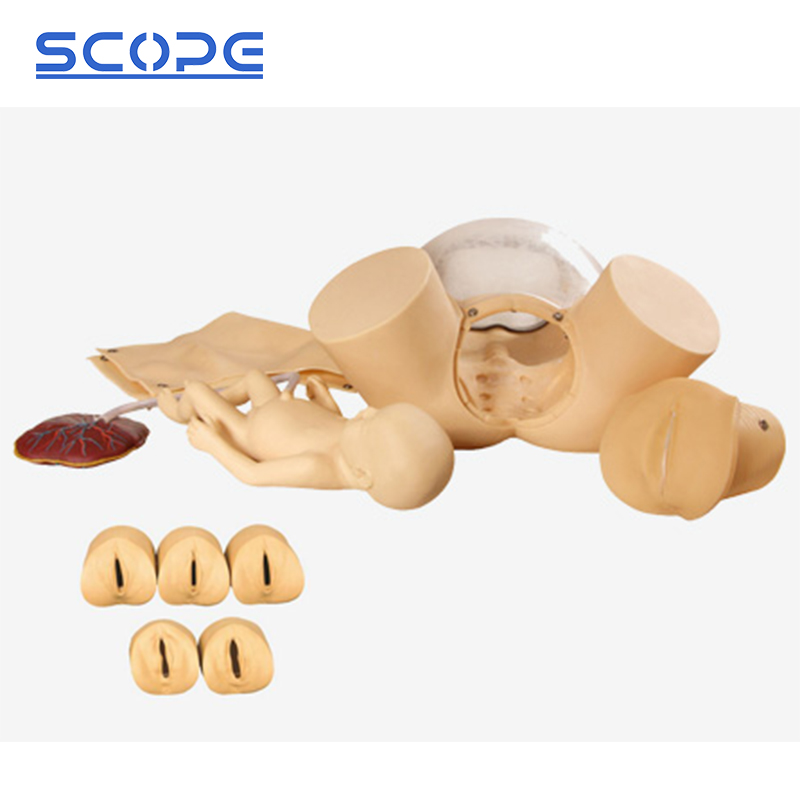
The SC-F50 gynecology manikin focuses on childbirth skills, with a simulated lower body of a pregnant woman, two fetus models, an umbilical cord, and placenta. It includes six cervical dilation stages, fetal head station training, and a transparent abdominal wall for observing delivery.
The SC-H140 pediatric training model is designed for infant care and treatment, including head and limb movement, replaceable chest skin, cephalic vein puncture, umbilical cord venipuncture, oral and nasal intubation care, gastric lavage, enema, catheterization, ostomy drainage, and injection training.
Clinical Manikins
Clinical procedure manikins are built for invasive skill practice such as puncture, drainage, and intubation.
Examples from Chongqing Scope include the SC-CK817 pericardial puncture and intracardiac injection manikin, the SC-CK20135 knee injection model, the SC-L66 thoracentesis and drainage model, and the SC-J5S tracheal intubation model. These models emphasize accurate anatomical landmarks, replaceable skin parts, and realistic feedback during puncture.
Anatomy Models
Anatomy models are used in medical education to teach structure and spatial relationships, including the SC-A1010 skull model, SC-A1041 85cm torso model with 23 parts, and SC-A1025 knee joint model. They are commonly made of PVC and designed for repeated handling in classrooms.
Matching Manikin Types to Training Scenarios
| Training Scenario | Recommended Manikin Type | Key Skills Covered | Example Model |
|---|---|---|---|
| Basic first aid and CPR certification | CPR manikin with or without feedback | Chest compression, rescue breathing, airway opening | SC-CPR100A, SC-CPR480 |
| Nursing school clinical skills lab | Full-function nursing manikin | Injections, catheterization, gastric lavage, daily care | SC-H130A |
| Venipuncture and IV training | Arm injection / IV model | Needle insertion, blood flashback, infusion | SC-HS3, SC-HS4 |
| Obstetrics and midwifery education | Maternal manikin | Delivery stages, fetal heart auscultation, Leopold maneuvers, maternal CPR | SC-F55-1 |
| Pediatric and newborn care | Pediatric training model | Infant CPR, vein puncture, umbilical cord care, intubation | SC-H140, SC-CPR160 |
| Emergency and trauma response | Trauma mannequin | Wound assessment, fracture identification, injury management | SC-J90 |
| Invasive clinical procedures | Clinical puncture / intubation model | Thoracentesis, bone marrow puncture, intubation, injection | SC-L66, SC-CK817, SC-J5S |
| Anatomy and basic science teaching | Anatomy model | Structure identification, organ relationships | SC-A1041, SC-A1010, SC-A1025 |
Practical Selection Criteria: Materials, Maintenance, and Reusability
Material quality directly affects how often a manikin can be punctured, cleaned, and reused. The manikins supplied by Chongqing Scope are made of PVC, which provides durability, resistance to deformation, and a realistic feel during training.
For injection training models, replaceable veins and skin are important because repeated puncture will eventually wear out any surface. The SC-HS3 injection model is designed with changeable veins and skin, and the SC-HL injection pad can be squeezed after use to remove injected liquid. The SC-HS4 arm model uses imported thermoplastic elastic mixed rubber for skin and muscles, imported latex for nerves and blood vessels, and imported PVC for bones and joints, with replaceable components.
For anatomical models used in lecture rooms, the priority is structural accuracy and durability. The SC-A1041 torso model includes 23 removable parts and interchangeable male and female reproductive organs, allowing repeated assembly practice.
Operating Conditions and Facility Requirements
Before purchasing, confirm that your facility can meet the environmental and operational requirements of the manikin.
Chongqing Scope manikins used in medical education and first aid training operate in manual operation mode and are suitable for ambient temperatures of 0–35°C. The room temperature should be kept constant for the products to function as intended.
Some models require a 220V power supply. For example, the SC-CPR160 infant CPR manikin works on 220V input and outputs 5V through a voltage regulator. If your facility uses a different mains voltage, check the voltage compatibility with your supplier before ordering.
Matching Budget and Classroom Scale: Practical Steps
- List the skills to be trained. Include procedures from your curriculum or accreditation requirements, not just the product categories you have seen online.
- Estimate the number of students per session. This determines how many units you need and whether a model with interchangeable parts is more cost-effective than buying several full manikins.
- Set a realism and feedback level. Basic CPR manikins may be sufficient for awareness courses. Advanced models with digital monitoring and voice prompts are preferable for assessment and certification.
- Inspect consumable and replacement parts. Check the availability and price of replaceable skins, veins, lung sacs, and face shields. Models with easily replaceable parts generally have a lower total cost of ownership.
- Evaluate maintenance and warranty support. Chongqing Scope provides a one-year warranty with online after-sales support for its manikin products.
Case Example: Distributor Sourcing for a Medical Teaching Program
A medical manikin distributor in India ordered 500 units from Chongqing Scope for medical teaching applications. The order covered products customized to the distributor’s requirements, and the units have been in operation for more than one year with stable performance. The highlight reported by the client was the combination of customization and durability.
This case illustrates a common procurement pattern: distributors and educational institutions often need a mix of manikin types in one order, with customized packaging or configuration. When evaluating a supplier, ask whether they can handle mixed orders and customized requirements without compromising production lead time.
Customization and Order Considerations for Bulk Buyers
Institutions and distributors often require customized colors, logos, or functionality. Chongqing Scope offers ODM services that allow customization of product appearance and functions. The monthly capacity for these customized manikin orders is approximately 3,000 units, with a typical lead time of 30 to 45 days and a minimum order quantity of 20 units.
Quality control is performed through factory inspection before shipment. Export markets include Europe, the Middle East, Southeast Asia, North America, South America, Russia, and Africa. The company also provides official export certificates including ISO9001, ISO14001, ISO45001, ISO13485, CE, and RoHS.
For importers, knowing the lead time and MOQ is important for planning. If your program has a fixed semester start, place orders at least one full season ahead to allow time for customization, production, and shipping.
Comparing Common Manikin Types
| Manikin Type | Primary Applications | Typical Feedback Features | Replacement Parts |
|---|---|---|---|
| CPR manikin | First aid, basic life support, CPR certification | Chest rise, compression depth indicator, alarm, digital count | Lung bags, face skin, airway |
| Nursing manikin | Nursing school, hospital training | Replaceable skin and veins, anatomical landmarks | Skin pads, vein sets, injection pads |
| Maternal manikin | Midwifery, obstetrics education | Fetal heart simulation, delivery stage monitoring, CPR feedback | Fetus model, umbilical cord, placenta, cervix module |
| Pediatric manikin | Pediatric nursing, newborn care | Infant CPR feedback, vein puncture simulation | Chest skin, scalp vein sets |
| Clinical puncture manikin | Advanced clinical skills | Realistic tactile feedback, replaceable puncture pads | Skin, bone marrow cavity, drainage pads |
| Anatomy model | Medical school, anatomy lab | Detachable parts, organ detail | Usually none or low-wear parts |
Frequently Asked Questions
Do medical manikins need to comply with any standards?
Chongqing Scope can provide export certificates including ISO9001, ISO14001, ISO45001, ISO13485, CE, and RoHS. ISO 13485:2016 is the internationally recognized standard for quality management systems in the design and manufacture of medical devices. Buyers should confirm which certificates are required for their market and ask the supplier to provide the relevant documents before ordering.
Which manikin is suitable for CPR training in a university medical school?
For university-level CPR training, a manikin with feedback and assessment functions is recommended, such as the SC-CPR480. It provides barcode indicator feedback on compression depth, digital counting of correct and incorrect actions, voice prompts, and thermal printing of results. For infant CPR training, the SC-CPR160 offers digital counting, indicator lights, and voice prompts designed for pediatric first aid courses.
What is the MOQ and lead time for customized manikin orders?
Chongqing Scope accepts ODM customization of appearance and functions with a minimum order quantity of 20 units. The monthly capacity for customized products is approximately 3,000 units, and the usual lead time is 30 to 45 days, starting after technical verification.
Can I request samples before placing a bulk order?
Sample policies can be confirmed directly with the supplier. For laboratory consumables, Chongqing Scope states that free samples can be provided in the early stage. For manikins and other equipment, contact the sales team at claire@cqscope.com or WhatsApp +86 15223521781 to check sample availability for your target model.
Looking for a manikin supplier for your training program?
Chongqing Scope supplies medical manikins, CPR models, nursing manikins, maternal and infant manikins, clinical manikins, and anatomy models to medical schools and distributors worldwide.
Email: claire@cqscope.com | WhatsApp: +86 15223521781
Official website: www.cqscopelab.com
Download company brochure: Chongqing Scope Catalog & Capability PDF