
Obstetric Skills Lab Setup: Manikin Guide for SC-F50, SC-F55-1 and SC-H140
Most maternal-infant skills labs are assembled one purchase at a time. This guide takes the opposite route: it starts from the three skill families that nursing, midwifery and emergency-medicine programs must teach, then assigns them to three PVC manikins — the SC-F55-1 maternal manikin, the SC-F50 gynecology manikin and the SC-H140 pediatric training model — so that rooms, session blocks and skill checkpoints can be planned before the equipment list is finalised.
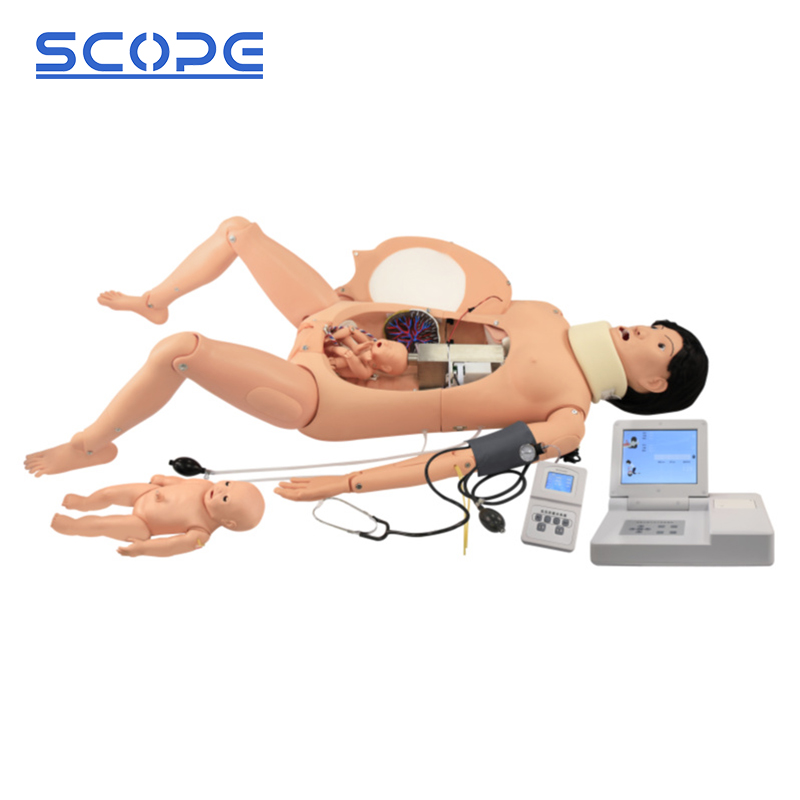
Quick answer: Sequence the three models by clinical chronology. Use the SC-F55-1 for labour mechanics, delivery simulation and neonatal resuscitation; use the SC-F50 for prenatal examination, six-stage cervical assessment and midwifery procedures that require fetal head station and a transparent abdominal window; use the SC-H140 for infant procedures such as cephalic vein puncture, oral and nasal intubation care, gastric lavage, enema and catheterization. All three are PVC models supplied by Chongqing Scope Instrument Co., Ltd., and the station plan below allocates rooms, session blocks and sign-off checkpoints around those three skill families.
Problem Definition: Why Obstetric Training Stations Become Bottlenecks
An obstetric skills lab usually fails in a predictable way: one high-engagement model absorbs the whole timetable while two neighbouring skill sets stay under-practised. The cause is planning order rather than budget. Equipment lists are written per department — midwifery requests a delivery model, nursing requests an infant care model, emergency medicine requests a resuscitation model — and the three requests are merged into one order without a decision about which room hosts which skill, which student group rotates first, or what a trainer must be able to sign off at the end of each block.
Three constraints make this harder in maternal-infant training than in general nursing skills training. First, the skill families are chronologically linked: prenatal assessment feeds labour management, labour management feeds neonatal resuscitation, and neonatal resuscitation feeds infant care. If the models sit in three separate buildings, that linkage disappears from the teaching sequence.
Second, the equipment is manual and environment-sensitive. The manikins operate in manual operation mode and are specified for ambient temperatures of 0–35°C, with a special requirement to keep the room temperature constant, neither too high nor too low. A lab placed beside an unheated loading bay, under direct sunlight, or in a room shared with heat-generating equipment will not hold that condition.
Third, practice volume is uneven. Delivery drills require repetition of one long, sequenced procedure, while infant procedures such as gastric lavage, enema or catheterization are short, high-frequency tasks. A single model cannot serve both rhythms efficiently, which is why a station plan built from three defined models outperforms a single flagship unit.
Industry Background: What the Simulation Market Signals to Program Planners
Simulation spending is growing, and the hardware slice that matters most to a skills lab is the largest single segment. Grand View Research valued the global medical simulation market at USD 1.9 billion in 2025 and projects it to reach USD 6.7 billion by 2033. Within that sector, healthcare anatomical models — the category that includes medical manikins — held approximately 41.4% of the market in 2025. Asia-Pacific is the fastest-growing region in the same dataset, at an 18.2% CAGR through 2033, which is where a large share of new nursing and midwifery programs is being equipped.
Volume figures point the same way. Global Insight Services estimated the training manikins market at 1.2 million units in 2024, with projections to reach 2 million units by 2028. Published estimates diverge — some cover software and services while others count hardware manikins only — so a program planner should treat any single figure as a directional indicator rather than a procurement target.
Regulation is a second driver. Market Research Future reports that China's National Medical Commission mandated simulation labs for the accreditation of all new medical schools as of 2024–2025. That converts simulation equipment from an optional teaching aid into an accreditation line item for programs inside that system, and it raises the level of specification detail that procurement offices now expect.
Quality expectations follow the same path. ISO 13485:2016 is the internationally recognized Quality Management System standard for the design and manufacture of medical devices, including simulation manikins. It is the standard most often cited when a procurement office asks a supplier to document manufacturing control instead of product claims.
Competitive structure is worth knowing too. MarketsandMarkets lists Laerdal Medical, CAE Inc., Gaumard Scientific and Kyoto Kagaku among the major global competitors in the medical manikin and simulation market. For a teaching institution, the practical reading is that maternal-infant manikins are now bought in batches, by programs that must justify each purchase against a curriculum and an accreditation checklist. That favours a station plan built from clearly specified models over a single flagship purchase.
Detailed Solution: Matching Three Manikins to Three Skill Families
Chongqing Scope Instrument Co., Ltd. (Chongqing Scope) is a Chongqing-based supplier of laboratory and medical training instruments, including PVC medical manikins used for emergency, clinical and nursing skills training. Founded in 2017, the company operates a 5,000 m² facility with 20 engineers, an annual output of 30,000 units, and export markets across Europe, Southeast Asia, the Middle East, South America and Africa. Three of its maternal-infant models map onto the three skill families described above.
SC-F55-1 Maternal Manikin: Delivery Mechanics and Neonatal Resuscitation
The SC-F55-1 is the delivery and resuscitation station. Its mechanical transmission device carries two mechanical adapters for connecting the simulated fetus, with elastic fastening devices between fetus and adapter, adapter and adapter, and adapter and transmission device. Protective travel switches sit at the upper and lower ends of the transmission. Trainers can pause, initialize, start and continue the delivery process, and select delivery speed from 1 to 4 levels as needed.
Fetal heart sound auscultation is settable in frequency and volume, with heart rate adjustable in the 80–180 range. The model can simulate cephalic presentation, breech presentation, airway obstruction, umbilical cord around the neck and placenta previa. A highly realistic cervix and a Leopold practice soft pad support palpation teaching, while an attachable prenatal cervical change and birth canal relationship module stages cervical dilation and fetal head station from −5 with no dilation, through 0 station at 5 cm dilation, to +5 at 10 cm.
Two features shape session design. A vulvar suture practice module provides three incision positions — lower left, centre and lower right. Pregnant CPR is designed according to the 2020 International CPR Guidelines and performs artificial respiration and chest compressions with electronic monitoring of airway opening, number of breaths, breath volume, compression site, compression count and compression depth, supported by voice prompts, digital counting display and barcode indicator light alarms. A newborn on the same unit covers nasogastric intubation for suctioning, tracheal intubation, gastric lavage, cord care, scalp and arm vein puncture with a sense of emptiness and blood return, and newborn CPR through mouth-to-mouth, mouth-to-nose or simple resuscitator ventilation.
SC-F50 Gynecology Manikin: Prenatal Examination and Obstetric Procedures
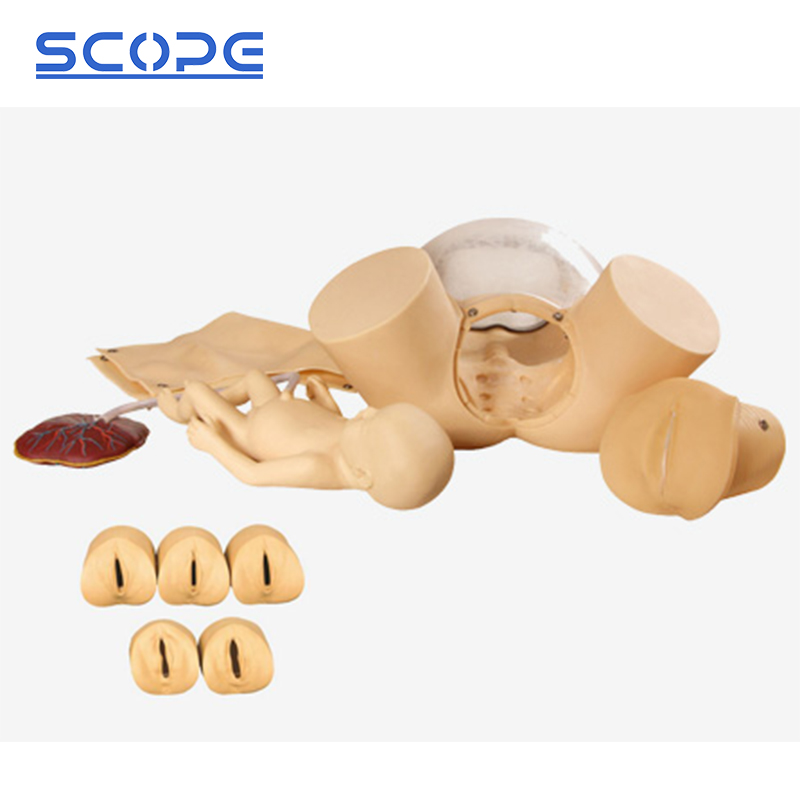
The SC-F50 is the examination and procedure station. It consists of a simulated lower body model of a pregnant woman together with two fetus models, an attached umbilical cord and a placenta. It is built for basic technical training in obstetrics and provides practice in prenatal examination, midwifery and delivery skills.
Its cervical examination model reproduces the relationship between cervical opening dilation, cervical canal change and the position of the fetal head relative to the ischial spine plane across six stages: no dilation with the fetal head at −5; 2 cm dilation with 50% effacement at −4; 4 cm dilation with complete canal disappearance at −3; 5 cm dilation at 0; 7 cm dilation at +2; and 10 cm dilation at +5. That staged scale lets a trainer assess station estimation and dilation assessment as separate, checkable skills rather than as one combined answer.
The fetal model has soft skin with an identifiable fontanel, so fetal head suction technique can be practised, and the perineum is soft and extremely elastic, which allows midwifery operations and perineal care techniques to be rehearsed under near-real conditions. The abdomen consists of a transparent abdominal wall and simulated skin, making it easier to demonstrate the delivery function and the positional relationship between the fetal head and the ischial spine plane while students watch, rather than describing it afterwards.
SC-H140 Pediatric Training Model: Infant Nursing and Vascular Access
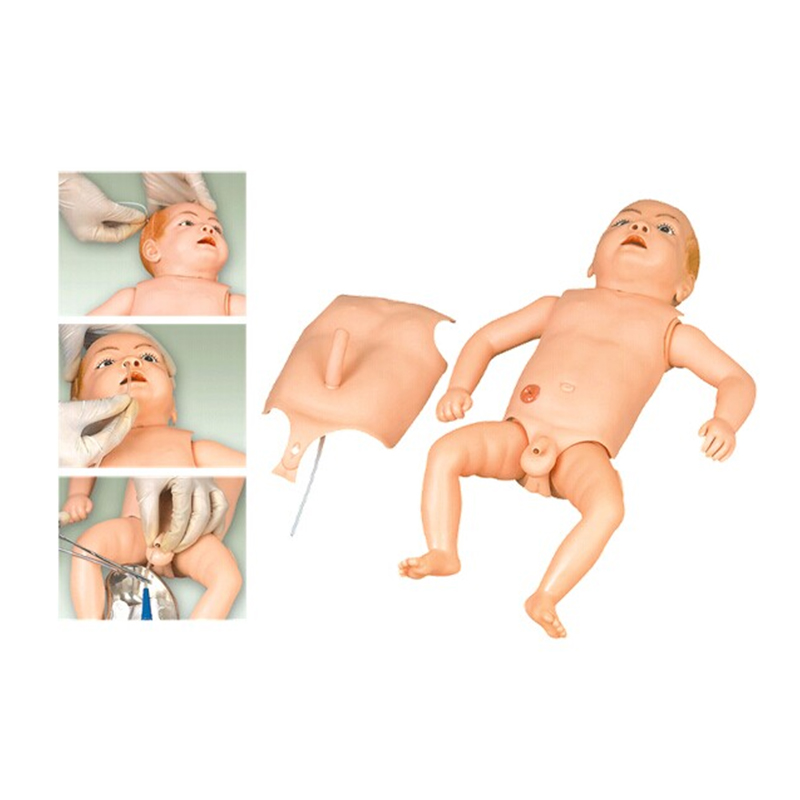
The SC-H140 is the infant procedures station. The baby's head, neck and limbs move freely, and the chest skin can be replaced between baby boy and baby girl configurations.
Procedures supported on the model include infant cephalic vein puncture, baby umbilical cord venipuncture, infant oral and nasal intubation care, gastric lavage, enema and catheterization, ostomy drainage, and deltoid and gluteal muscle injections. Overall care tasks — bathing, breastfeeding, changing clothes and diaper changing — are also part of the model's intended use.
For a lab timetable, this is the high-frequency station. The procedures are short, repeatable and equipment-light, which makes the SC-H140 the natural choice for supervised practice slots that can run in parallel with longer delivery drills at the SC-F55-1 in an adjacent room.
Why the Shared PVC Construction Matters for Repeated Practice
All three models are made of PVC. The material choice matters less for appearance than for repetition: PVC components resist deformation, tolerate repeated cleaning and disinfection, and allow the replaceable parts that keep a busy station in service across a full academic year.
Replaceability is the practical expression of that. The SC-H140 chest skin can be swapped. The SC-F55-1 is supplied as a 12-part system that includes the mother for childbirth and adult emergency use, a newborn for emergency and nursing use, a delivery fetus, a labour process and fetal heart rate monitor, an adult CPR electronic display, a simulated cervix, a preterm cervical change and birth canal relationship module, a 48-hour postpartum uterus, a perineal incision and suture module, a simulated placenta and umbilical cord, a Leopold practice soft pad and related auxiliary tools. The SC-F50's fetal accessories — umbilical cord and placenta — are separate items.
For a program, the planning question is not whether PVC is durable in general, but which parts wear first in your own timetable and how quickly they can be replaced. Station checklists should therefore track replaceable components per model, not per lab.
Step-by-Step Breakdown: Allocating Rooms, Sessions and Skill Checkpoints
The following six steps turn the three models into an operable station plan. Each step produces a document a program can hand to facilities, timetabling and procurement without rewriting the clinical content.
- Write the skill checkpoint list before the equipment list. List every procedure the curriculum requires, then tag each one to a model. Anything that cannot be tagged is either a gap in the equipment plan or a gap in the curriculum — both are worth finding before purchase.
- Assign one room per skill family, on one corridor. Delivery and resuscitation in room A (SC-F55-1), prenatal and obstetric procedures in room B (SC-F50), infant nursing in room C (SC-H140). Keeping the three rooms adjacent preserves the clinical chronology that makes the sequence teachable.
- Confirm the environmental envelope. The manikins run in manual operation mode at 0–35°C, and the room temperature must be kept constant, neither too high nor too low. Check heating, cooling and direct sunlight before the rooms are allocated, not after.
- Sequence session blocks in clinical order. Block 1 at the SC-F50 for examination and station assessment; Block 2 at the SC-F55-1 for delivery mechanics and pregnant CPR; Block 3 at the SC-F55-1 newborn and the SC-H140 for neonatal resuscitation and infant care procedures. Groups rotate between rooms, so each station runs continuously instead of idling.
- Define the sign-off point for each block. A checkpoint should be a procedure the trainer can observe once and mark, not a topic. The table below shows how the three models divide into sign-off-ready checkpoints.
- Set the maintainable-parts budget alongside the purchase budget. Record which components are replaceable on each model and who is responsible for checking them, so a worn part does not remove a station from the timetable mid-semester.
| Station | Model | Checkpoints to sign off |
|---|---|---|
| Delivery and resuscitation | SC-F55-1 | Six-stage cervical assessment (−5 to +5); Leopold technique on the practice soft pad; fetal heart auscultation using the 80–180 heart rate range; delivery speed selection across levels 1–4; cephalic presentation, breech presentation, airway obstruction, cord around the neck and placenta previa scenarios; perineal incision and suture at three positions; pregnant CPR cycle; newborn gastric lavage, nasogastric suctioning and newborn CPR |
| Prenatal and obstetric procedures | SC-F50 | Six-stage cervical examination (0 cm/−5 through 10 cm/+5); fetal head station relative to the ischial spine plane; fontanel identification and fetal head suction technique; perineal care; delivery demonstration and fetal head position observation through the transparent abdominal wall |
| Infant nursing procedures | SC-H140 | Infant cephalic vein puncture; baby umbilical cord venipuncture; oral and nasal intubation care; gastric lavage; enema; catheterization; ostomy drainage; deltoid and gluteal muscle injections; bathing, breastfeeding, dressing and diaper change |
Use Cases: Three Program Profiles
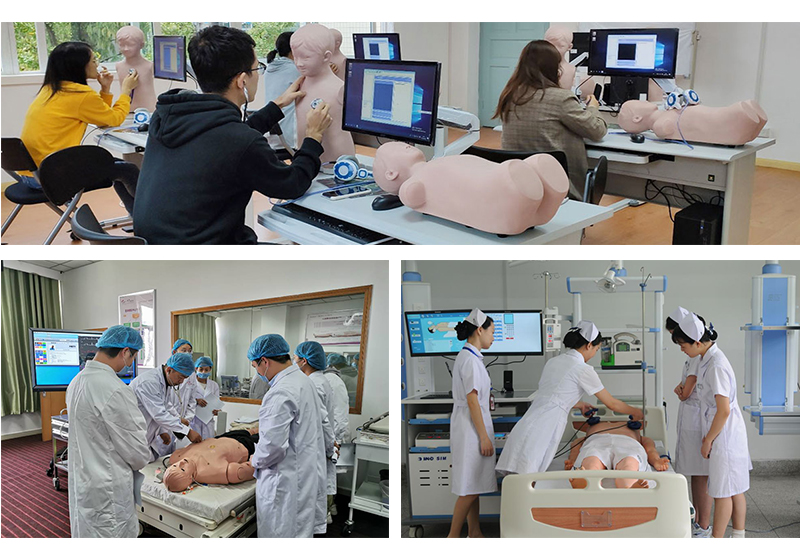
Midwifery and Obstetric Nursing Programs
A midwifery program needs the full chronology in one place. The SC-F50 carries the assessment half of the curriculum — cervical dilation staging, fetal head station, fontanel identification and perineal care — while the SC-F55-1 carries the management half: delivery speed control, presentation variants, perineal suturing at three incision positions and pregnant CPR. Running both models in adjacent rooms means a student moves from assessment to management inside one session block instead of across two weeks.
Nursing Programs with a Maternal-Infant Module
General nursing programs often teach maternal-infant content as a short module inside a wider clinical skills course. Here the SC-H140 does most of the work: cephalic vein puncture, cord venipuncture, oral and nasal intubation care, gastric lavage, enema, catheterization, ostomy drainage, and the routine care tasks of bathing, feeding and diaper changing. The SC-F50 supports the obstetric examination content, and the SC-F55-1 newborn covers resuscitation exposure without requiring the full delivery drill.
Emergency-Medicine and First-Aid Training
Emergency-medicine training is interested in the maternal-infant station mainly for resuscitation continuity. The SC-F55-1 provides pregnant CPR designed to the 2020 International CPR Guidelines with electronic monitoring and prompt feedback, plus a newborn for resuscitation practice, so a team can rehearse the transition from maternal cardiac arrest to neonatal support on one unit before moving to the SC-H140 for post-resuscitation infant care.
Distributor and Equipment-Reseller Perspective
Channel partners building a maternal-infant package for teaching hospitals face the same allocation question at a larger scale. One medical manikin distributor in India ordered 500 units for medical teaching and reported stable operation over a one-year deployment period, with customization and durability cited as the key factors. For a reseller, the three-model structure is also a sales structure: it lets a buyer start with the highest-volume station and add the examination station in a later batch.
Comparison Table: SC-F55-1, SC-F50 and SC-H140 at a Glance
The three models are not interchangeable, and the differences that matter for room planning are the delivery mechanism, the fetal or newborn component, and the electronic feedback each unit carries.
| Item | SC-F55-1 Maternal Manikin | SC-F50 Gynecology Manikin | SC-H140 Pediatric Training Model |
|---|---|---|---|
| Product type | Maternal and Infant Manikin | Maternal and Infant Training Manikin | Maternal and Infant Manikin |
| Material | PVC | PVC | PVC |
| Primary training role | Normal and assisted delivery, neonatal resuscitation, pregnant CPR | Prenatal examination, midwifery and delivery procedures | Infant nursing procedures and vascular access |
| Delivery simulation | Mechanical transmission device with two adapters; delivery speed in 4 levels; pause, initialize, start and continue functions; protective travel switches | Simulated lower body of a pregnant woman; soft and highly elastic perineum; transparent abdominal wall | Not a delivery model |
| Fetal and newborn component | Fetus used for childbirth; newborn for emergency and nursing use; simulated placenta and umbilical cord; 48-hour postpartum uterus | Two fetus models with attached umbilical cord and placenta; identifiable fontanel; soft fetal skin for head suction practice | Baby with freely moving head, neck and limbs; replaceable chest skin for baby boy or baby girl |
| Monitoring and feedback | Fetal heart sound auscultation with heart rate adjustable in the 80–180 range; CPR electronic display with voice prompts, digital counting and barcode indicator lights | None specified | None specified |
| Cervical assessment scale | Attachable prenatal cervical change module: six stages from −5 at no dilation to +5 at 10 cm | Cervical examination model: six stages from −5 at no dilation to +5 at 10 cm | Not applicable |
| Lab environment | Manual operation; ambient temperature 0–35°C; room temperature to be kept constant, neither too high nor too low | ||
FAQ
What compliance documents should a program request before ordering maternal-infant manikins?
ISO 13485:2016 is the internationally recognized Quality Management System standard for the design and manufacture of medical devices, including simulation manikins, so it is the first document a procurement office should ask to see. Chongqing Scope Instrument Co., Ltd. states that it can provide ISO9001, ISO14001, ISO45001, ISO13485, CE and RoHS certificates for export, that export packaging is neutral with no logos in cardboard or wooden boxes prepared to export standards, and that customs documents such as CO, Form E or Form F can be supplied when required.
Can the three models be adapted for a specific curriculum?
Yes, within the supplier's stated ODM scope, which includes customizing the appearance and functions of a product, with monthly capacity of 3000 units. The models also contain replaceable elements that extend service life: the SC-H140 chest skin can be exchanged between baby boy and baby girl configurations, and the SC-F55-1 is supplied as a 12-part system whose components — simulated cervix, preterm cervical change module, 48-hour postpartum uterus, perineal incision and suture module, placenta and umbilical cord, CPR electronic display — can be individually maintained or replaced.
What commercial parameters belong in the budget line?
The minimum order quantity for the manikin line is 20 units, monthly production capacity is 3000 units, production lead time is 30–45 days, and quality control is carried out by factory inspection before shipment. After-sales cover is a one-year warranty with online support. Under those terms, a program that needs three models across several rooms should treat the 20-unit minimum as a batch planning figure rather than a per-room constraint.
How can a teaching institution evaluate the models before committing?
Evaluation typically starts with documentation: specification sheets and the product brochure set out the feature lists, the replaceable-part inventories and the six-stage cervical scales used on the SC-F55-1 and SC-F50. The Chongqing Scope brochure can be downloaded here: Chongqing Scope product brochure. Programs that need to inspect material behaviour — for example how PVC responds to repeated puncture and cleaning — should raise that requirement with the supplier before the order is placed rather than after delivery.
How should orders be sequenced if the lab opens in two phases?
A 30–45 day production lead time and a 20-unit minimum order quantity mean the batch should be planned against the academic calendar rather than against room readiness. A common approach is to place the first batch around the SC-F55-1 and SC-H140, which carry the highest session volume, and to add the SC-F50 examination stations in a second batch once the prenatal curriculum timetable is fixed. To confirm model mix, quantities and delivery dates, contact Chongqing Scope Instrument Co., Ltd. at claire@cqscope.com or +86 15223521781 (WhatsApp available), or review the full range at www.cqscopelab.com.
Conclusion
An obstetric skills lab is a sequencing problem before it is a purchasing problem. The SC-F50 establishes prenatal examination and six-stage cervical assessment, the SC-F55-1 converts that assessment into delivery management and resuscitation, and the SC-H140 carries the infant procedures that follow birth. Because all three use PVC construction with replaceable components, the station plan survives repeated hands-on use rather than degrading into a timetable of out-of-service rooms.
The planning rule is simple: assign one room per skill family, keep the three rooms adjacent, confirm the 0–35°C constant-temperature envelope before allocation, and define sign-off checkpoints that a trainer can observe once and mark. Programs that follow that order end up with equipment that matches each curriculum objective instead of equipment that matches a purchase order.
Planning a maternal-infant training station? Send your curriculum checklist and room plan to Chongqing Scope and request a model allocation proposal, current lead time and brochure.
Email: claire@cqscope.com | Tel / WhatsApp: +86 15223521781 | Website: www.cqscopelab.com
Brochure download: Chongqing Scope product catalogue