
Technical Deep Dive: PVC Manikin Specs for Injection & Puncture Training
Technical Deep Dive: PVC Manikin Specs for Injection & Puncture Training
Four specifications decide whether an injection or puncture manikin survives a full training cycle: the base material and its hardness, the number of tissue layers the model reproduces, which parts can be replaced once the surface wears, and whether the anatomical landmarks a trainee must palpate are actually present. On PVC-based models such as the SC-HS3 arm injection model, the SC-HL three-layer injection pad and the SC-L66 clinical puncture manikin, those parameters are documented in the product description — and they are the same parameters a procurement team should be able to read before placing an order.
Chongqing Scope Instrument Co., Ltd. is a supplier of laboratory and medical training instruments — including medical manikins, microscopes, hardness testers, metallographic equipment and laboratory consumables — located in Chongqing, China. Its manikin range uses PVC as the primary material, with selected models adding imported thermoplastic elastomer, latex blood vessels and electronic feedback modules. This technical deep dive explains how that construction affects needle insertion, leak behaviour and service life across intradermal, subcutaneous, intramuscular, venous and thoracic puncture training.
Why Injection and Puncture Manikins Reach the End of Their Useful Life
A training manikin for injection and puncture work is a consumable surface, not a permanent one. Each needle pass displaces a small amount of material, and the model actually fails when the trainee stops receiving accurate feedback — not when it visibly breaks. In a nursing manikin used for venipuncture, the two critical signals are the resistance felt as the needle penetrates the vein and the blood flashback that confirms correct insertion. Once the vein path leaks, both signals become unreliable, and students begin practising against a model that no longer rewards correct technique.
- Channel leakage. A punctured vein that no longer holds pressure still accepts a needle; it simply stops confirming that the needle was placed correctly.
- Loss of layer contrast. Intradermic, hypodermic and intramuscular injections require three distinct planes of resistance. A pad that compresses into a single plane teaches the wrong depth.
- Landmark drift. Hip and thoracic procedures depend on palpation. If the greater trochanter, anterior superior iliac spine or sternal manubrium cannot be clearly felt, positioning technique cannot be assessed.
- Cleaning damage. A model that deforms after disinfection and cleaning is withdrawn from the timetable long before it is mechanically worn out.
The practical difference between an anatomy model and a training manikin sits inside this serviceability question. A torso model such as the SC-A1041 is built to display structure — 23 separable pieces, an exposed spine with a removable section, interchangeable male and female reproductive organs and a fetus in the female uterus on an 85 cm PVC body placed on a plastic seat — and is intended for medical education and school scenarios. Injection and puncture training requires a different specification priority: repeatable access, replaceable tissue surfaces, and landmarks that survive repeated palpation.
Industry Background: Simulation Demand Is Raising Specification Expectations
Buyers are not specifying these details in isolation. Grand View Research values the global medical simulation market at USD 1.9 billion in 2025 and projects it to reach USD 6.7 billion by 2033, and within that sector healthcare anatomical models — the category that includes medical manikins — held the largest product share at approximately 41.4% in 2025. Global Insight Services estimates training manikin market volume at 1.2 million units in 2024, with projections of 2 million units by 2028. Precedence Research and WiseGuyReports place North America at roughly 45–48% of healthcare simulation revenue in 2024, while Grand View Research identifies Asia-Pacific as the fastest-growing region with an expected CAGR of 18.2% through 2033.
Two structural forces push that demand toward better-specified hardware. First, accreditation pressure: Market Research Future reports that China's National Medical Commission mandated simulation labs for the accreditation of all new medical schools as of 2024–2025, which converts manikins from optional teaching aids into a documented requirement. Second, quality expectations: ISO 13485:2016 is the internationally recognised Quality Management System standard for the design and manufacture of medical devices, including simulation manikins. In a market where Laerdal Medical, CAE Inc., Gaumard Scientific and Kyoto Kagaku are the best-known global competitors, the differentiating question for a training institution is rarely brand familiarity — it is whether the specific model matches the specific procedure being taught.
Material and Structural Specifications in the PVC Manikin Range
PVC as the Baseline Material
Chongqing Scope states that its medical manikins are made of PVC material, a choice the company associates with durability, resistance to deformation and a high degree of authenticity. For injection and puncture work, that material decision shows up in three places: how the surface behaves after repeated needle passes, whether the model can be cleaned without losing shape, and whether a pad or limb keeps its geometry across a training semester. PVC is not the whole specification story in this range, however — the higher-fidelity IV model deliberately mixes polymers, and that difference is described below.
SC-HS3: Repeatable Venous Access with Changeable Vein and Skin
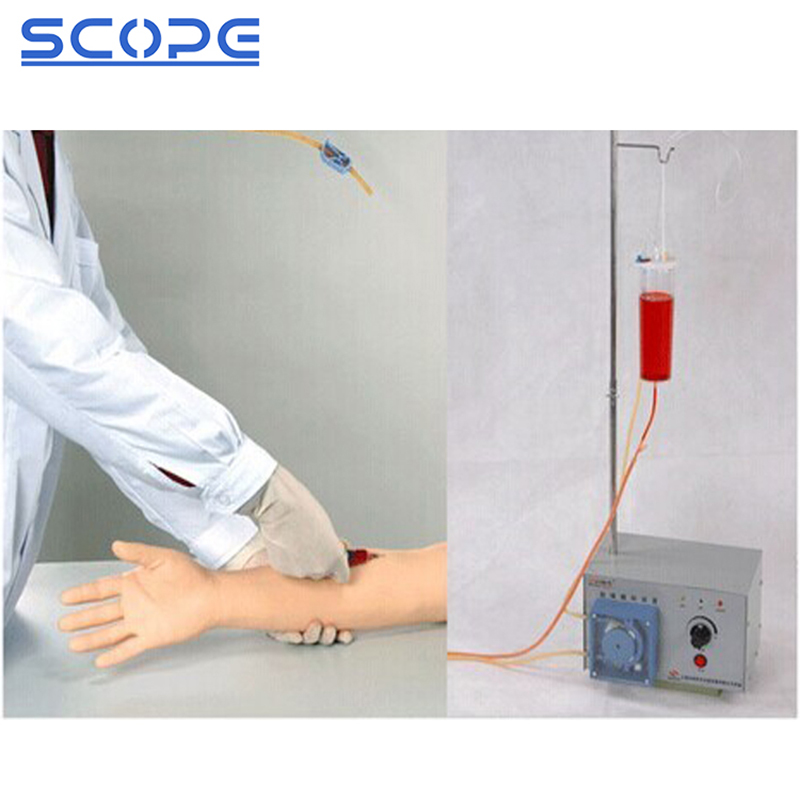
The SC-HS3 is a nursing manikin made of PVC, and it answers the repeated-insertion question most directly. Its specified features are: simulation of injection, blood transfusion and hemospasia of the arm; deltoid muscle injection; an obvious feeling when the needle penetrates the vein; blood flashback as the indicator of proper insertion; veins and skin that can be acupunctured repeatedly without causing leaks; and a changeable vein and skin set.
For a buyer, the last two features matter more than the first four. A vein-and-skin assembly that can be swapped turns one arm model into a multi-semester asset, and the no-leak specification is what preserves the blood-flashback feedback loop that trainees rely on. Deltoid injection capability extends the same unit into intramuscular technique, which reduces the number of different models a lab must stock for basic injection practice.
SC-HL: A Three-Layer Pad for Intradermic, Hypodermic and Intramuscular Injection
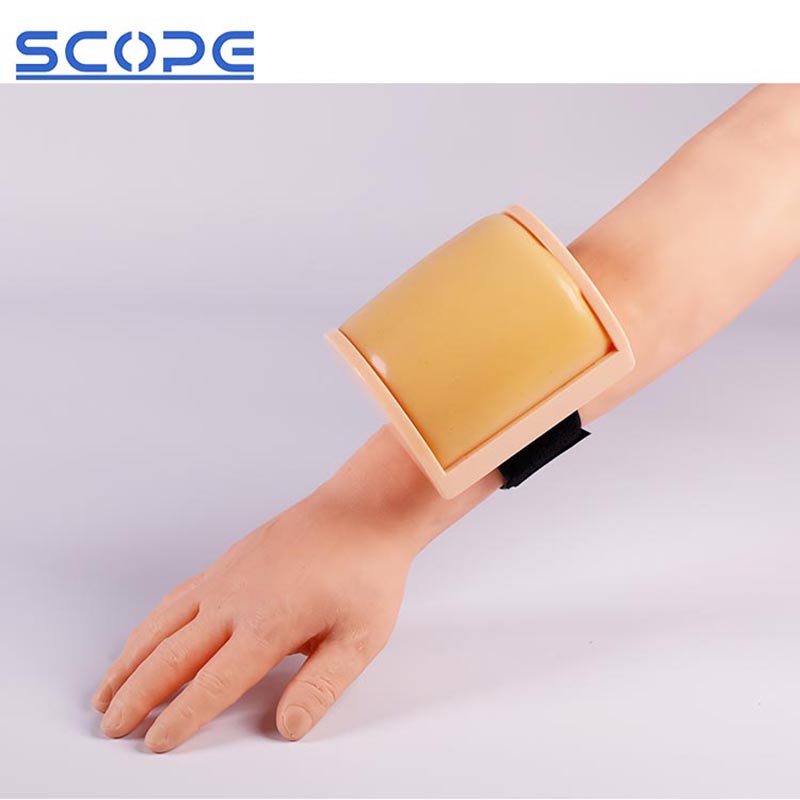
The SC-HL medical training model is specified as a three-layer structure consisting of skin, subcutis and muscle, and supports intradermic injection, hypodermic injection and intramuscular injection. It uses a wearable design that allows it to be positioned for convenient table-side practice, and it accepts injected liquid — after use, the pad is squeezed to expel the fluid.
Layer structure is the specification that decides whether a trainee learns correct depth. An intradermic injection requires a shallow, raised wheal; a hypodermic injection must reach the subcutaneous layer; an intramuscular injection must land in muscle tissue. A wearable pad that reproduces all three planes gives instructors a low-cost way to run repeated depth drills before students move to a full manikin, and the squeeze-to-drain behaviour keeps the pad usable across consecutive classes rather than single sessions.
SC-HS4: Multi-Material Construction with Electronic Confirmation
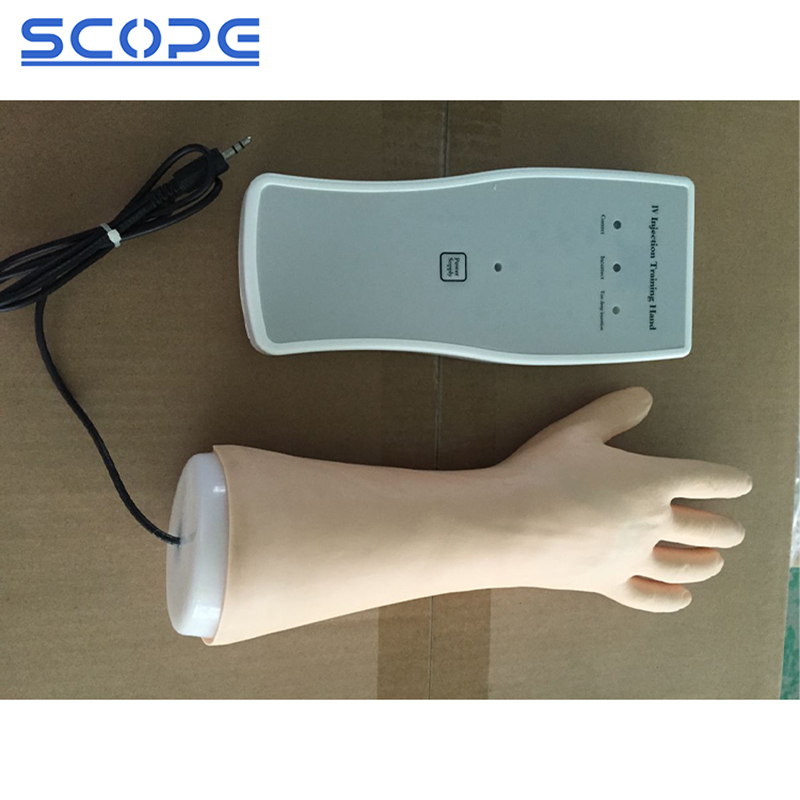
The SC-HS4 is the IV injection model in the range, and its construction is deliberately multi-material: skin and muscles are made of imported thermoplastic elastic mixed rubber, nerves and blood vessels of imported latex, and the inner bones and joints of the arms of imported PVC, with the assembly cast from metal moulds at high temperature. The outer surface of the skin model is produced according to the real model. The company specifies a realistic operating feel, durability, no deformation after disinfection and cleaning, and easy disassembly and replacement.
Its electronic layer adds a second source of feedback: an electronic alarm device for arm puncture training, with electronic prompts confirming when the needle has correctly penetrated into the blood vessel. The standard configuration ships with a standard hand model, an electronic monitor, a 5 ml infusion set and an instruction manual. Where the SC-HS3 relies on visual blood flashback alone, the SC-HS4 pairs tissue realism with instrumented confirmation — a useful split when one lab trains both entry-level and assessment-level groups.
SC-H4T: Landmarks That Support Hip Intramuscular Injection
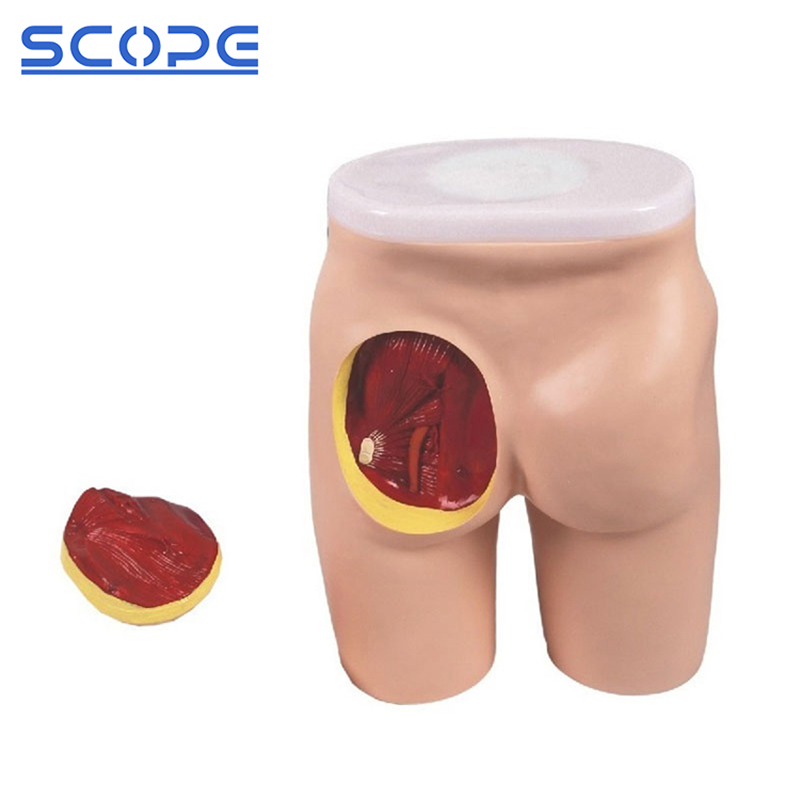
For gluteal intramuscular injection, landmark accuracy is the entire point. The SC-H4T is specified with the proximal femur, greater trochanter, anterior superior iliac spine, posterior superior iliac spine and sacrum, and the left buttock quarter is removable so that the gluteus medius muscle, gluteus maximus muscle, sciatic nerve and vascular structures can be observed directly. Three intramuscular injection approaches are described — dorsal hip injection, ventral hip injection and lateralis injection.
The material specification is also distinct from the pad models: the unit is made from imported plastic elastomer by stainless steel mould injection and high-temperature sintering, which the product description links to a durable texture. For instructors teaching safe injection zones, the removable quadrant is the specification that converts the model from a practice surface into a demonstration tool, because the sciatic nerve and vessels can be shown in relation to the landmarks a student has just palpated.
SC-L66: Puncture Beyond the Vessel
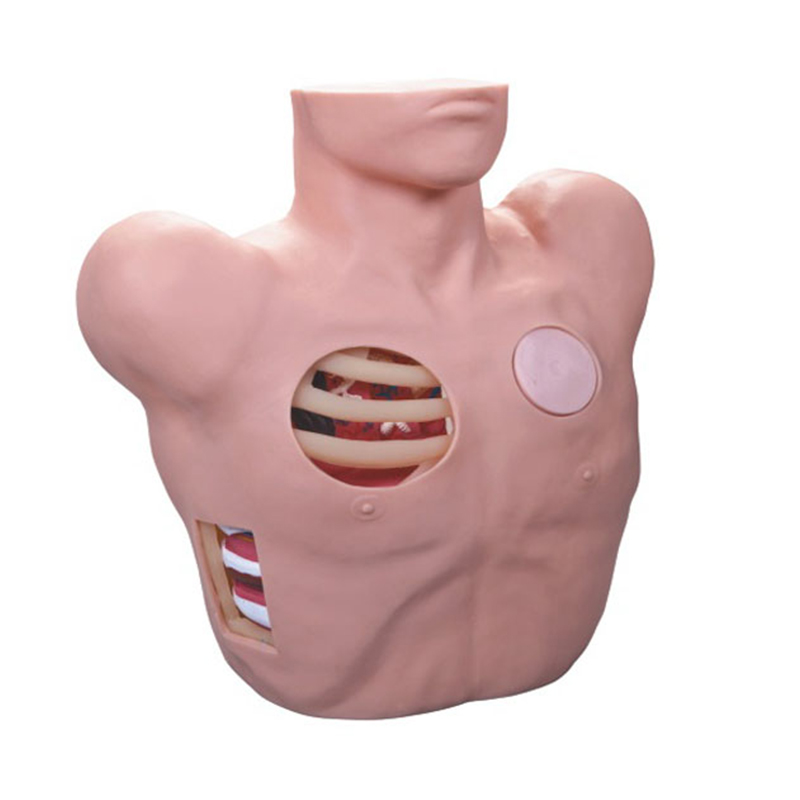
The SC-L66 puncture manikin moves the specification from vascular access to thoracic procedures. It is a clinical manikin made of PVC, specified for closed drainage operation training for pneumothorax and hydrothorax after chest trauma, and for post-operative care practice with drainage tubes. Two windows on the right side of the chest display the anatomical structures of each layer of the chest, so a trainee can relate surface landmarks to internal depth before inserting. Pneumothorax puncture decompression and hydrothoracic intubation and drainage exercises are performed on the left thorax, and the colour, volume and viscosity of the chest drainage fluid can be adjusted.
Adjustable drainage fluid is the detail that separates a demonstration model from a practice model. Trainees can be asked to evaluate output characteristics rather than simply complete the puncture, and the chest windows allow the instructor to verify intercostal positioning without dismantling the unit. For a clinical manikin in this price and complexity band, the combination of layered anatomy display and adjustable fluid is the specification most directly tied to learning outcomes.
SC-CK817 and SC-CK20135: Deeper Puncture and Joint Access
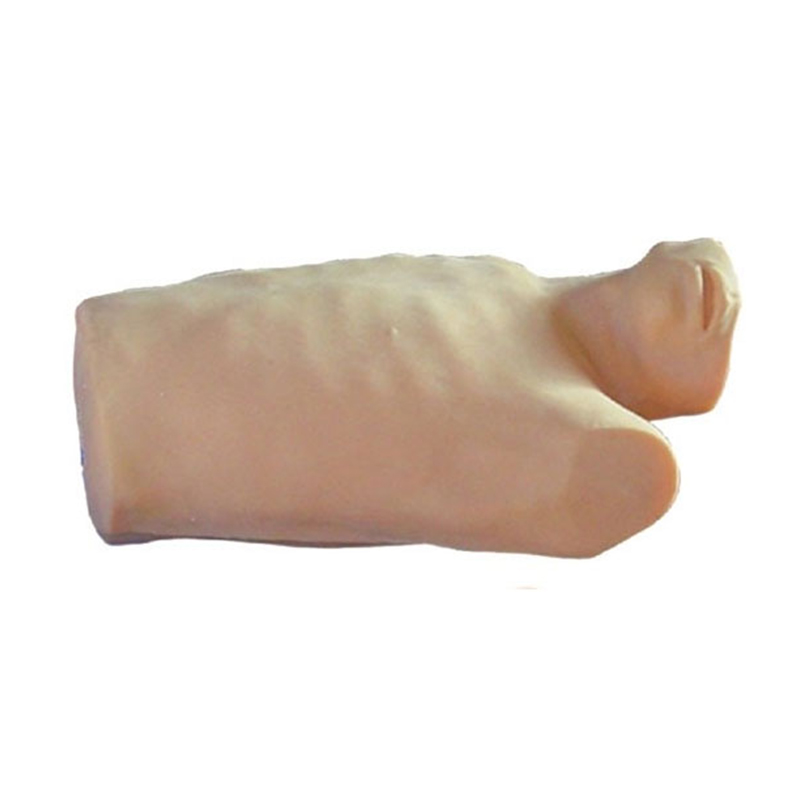
The SC-CK817 clinical manikin is specified for pericardial puncture and intracardiac injection training. Its simulated standardised patient is placed in the supine position with a soft texture, real touch and lifelike appearance, and the landmarks listed for palpation include the suprasternal notch, the upper edge of the sternal manubrium and the anterior superior iliac spine — all of which facilitate puncture positioning. Anterior superior iliac spine puncture training and sternal manubrium puncture training are supported, and the simulated bone marrow cavity can be penetrated with an obvious hollow feeling, allowing bone marrow to be extracted. The skin and the simulated bone marrow cavity can both be replaced easily.
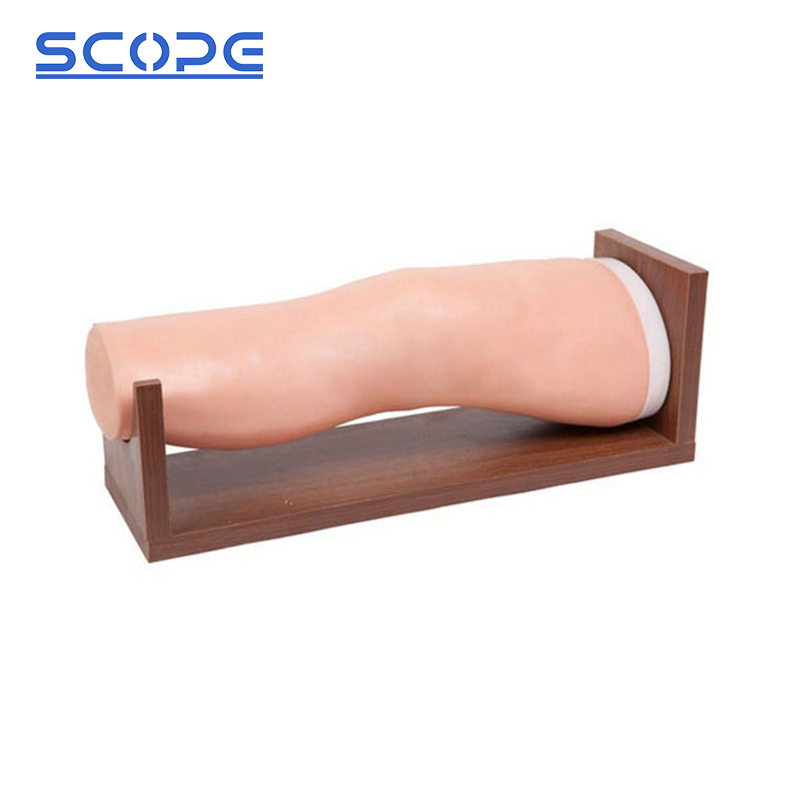
The SC-CK20135 addresses a joint rather than a cavity. It reproduces the appearance and internal structure of an adult leg, with the tibia, tibial bone, collateral ligament, cruciate ligament, patellar ligament, fat pad, meniscus and synovial sac represented at the standard knee joint puncture position. It is used to teach patient positioning during knee arthrocentesis and to train the palpation techniques related to the puncture. Together, these two models show why puncture manikins should be specified procedure by procedure: the tactile target differs completely between a marrow cavity, a pericardial space and a synovial sac.
Step-by-Step Breakdown: Specifying a Manikin for Injection and Puncture Practice
- Step 1 — Name the procedure, not the product. Separate venous access (SC-HS3, SC-HS4), layered soft-tissue injection (SC-HL), gluteal intramuscular injection (SC-H4T), thoracic puncture and drainage (SC-L66), pericardiocentesis and intracardiac injection (SC-CK817), and joint puncture (SC-CK20135). Each has a different failure point.
- Step 2 — Match the layer structure to the injection type. Intradermic, hypodermic and intramuscular injection require three distinct tissue planes; the SC-HL is specified as skin, subcutis and muscle, and its wearable design supports high-repetition depth drills.
- Step 3 — Verify landmarks rather than surface appearance. The SC-H4T lists the greater trochanter, anterior and posterior superior iliac spine and sacrum; the SC-CK817 lists the suprasternal notch, sternal manubrium and anterior superior iliac spine as clearly palpable.
- Step 4 — Confirm which components are replaceable. Changeable vein and skin (SC-HS3); replaceable skin and simulated bone marrow cavity (SC-CK817); removable left buttock quarter for internal observation (SC-H4T); easy disassembly and replacement (SC-HS4).
- Step 5 — Check cleaning and storage behaviour. The SC-HS4 is specified as durable and free of deformation after disinfection and cleaning, which is the parameter that determines whether a model can stay in continuous rotation.
- Step 6 — Settle documentation, packaging and capacity. Export certificates, neutral packaging without logos in cardboard or wooden boxes to export standards, customs documents such as CO, Form E and Form F, and an annual production capacity of 30,000 units across a 5,000 m² facility.
Use Cases: Matching the Model to the Training Programme
Nursing and phlebotomy laboratories
High student numbers favour replaceable surfaces. A lab running hundreds of venipuncture attempts per term can pair the SC-HS3, with its changeable vein and skin, with the SC-HS4 where electronic confirmation is used for assessment. The SC-H130A nursing manikin covers the wider curriculum — venipuncture, injection and blood transfusion on the arm, deltoid subcutaneous injection, vastus lateralis injection, buttocks intramuscular injection, lumbar puncture, endotracheal intubation and catheterisation procedures — when one full-body nursing manikin is preferred over several partial-task trainers.
Clinical skills and emergency departments
Thoracic and cardiac procedures require anatomy that behaves. The SC-L66 supports pneumothorax puncture decompression, hydrothoracic intubation and drainage, and post-operative drainage tube care, while the SC-CK817 covers pericardial puncture and intracardiac injection with palpable sternal landmarks. The SC-J5S intubation model complements this group by indicating the cricothyroid membrane puncture site and displaying normal and dilated pupils for comparison.
Paediatric and maternal programmes
Small-diameter vessels and cord structures need their own models. The SC-H140 paediatric training model supports infant cephalic vein puncture, umbilical cord venipuncture, deltoid and gluteal muscle injections and oral and nasal intubation care, and its chest skin is replaceable. The SC-F55-1 maternal manikin adds newborn cord care, scalp and arm vein puncture — the product description specifies a sense of emptiness during puncture and blood return — alongside delivery simulation with a fetal heart rate adjustable from 80 to 180 bpm and six stages of cervical dilation.
Rapidly expanding simulation markets
Where simulation lab construction is accelerating, the application profile described for this manikin range is medical school teaching projects and first-aid training, with typical application markets including Malaysia, India and Indonesia — consistent with the Asia-Pacific growth rate noted in the industry data above. In volume procurement, replaceable-part availability and consistent configuration matter more than any single feature.
Comparison Table: Injection and Puncture Manikins Side by Side
| Model | Category | Construction specified | Injection / puncture skills | Replaceable or serviceable parts |
|---|---|---|---|---|
| SC-HS3 | Nursing manikin | PVC; changeable vein and skin | Arm injection, blood transfusion and hemospasia; deltoid muscle injection | Vein and skin changeable |
| SC-HL | Nursing manikin (training model) | PVC; three layers — skin, subcutis, muscle | Intradermic, hypodermic and intramuscular injection | Not specified in the published description; injected liquid is expelled by squeezing the pad |
| SC-HS4 | Nursing manikin (IV injection model) | Imported thermoplastic elastic mixed rubber (skin, muscle), imported latex (nerves, vessels), imported PVC (bones, joints); metal-mould cast at high temperature | Arm puncture for injection and infusion, with electronic alarm and confirmation | Easy disassembly and replacement; standard hand model and electronic monitor supplied |
| SC-H4T | Nursing manikin (training mannequin) | Imported plastic elastomer, stainless steel mould injection, high-temperature sintered | Gluteal intramuscular injection: dorsal hip, ventral hip and lateralis approaches | Left buttock quarter removable for internal observation |
| SC-L66 | Clinical manikin (puncture manikin) | PVC | Pneumothorax puncture decompression, hydrothoracic intubation and drainage, closed drainage and drainage tube care | Not specified in the published description; drainage fluid colour, volume and viscosity adjustable |
| SC-CK817 | Clinical manikin | PVC; supine standardised patient | Pericardial puncture and intracardiac injection; sternal manubrium and anterior superior iliac spine puncture | Skin and simulated bone marrow cavity easily replaced |
| SC-CK20135 | Clinical manikin (training manikin) | PVC | Knee joint puncture and knee arthrocentesis; palpation and patient positioning | Not specified in the published description |
FAQ
1. Which certifications should a buyer verify when sourcing a PVC medical manikin?
ISO 13485:2016 is the internationally recognised Quality Management System standard for the design and manufacture of medical devices, including simulation manikins. Chongqing Scope states that the official certificates for export can all be provided, including ISO9001, ISO14001, ISO45001, ISO13485, CE and RoHS. The company also specifies neutral export packaging without logos in cardboard or wooden boxes prepared to export standards, and can supply additional clearance documents such as CO, Form E and Form F when required.
2. Can a PVC injection manikin tolerate repeated needle insertions without leaking?
Replaceability and surface behaviour decide this, not the polymer name alone. The SC-HS3 is specified so that veins and skin can be acupunctured repeatedly without causing leaks, and its vein and skin are changeable. The SC-HS4 is specified as durable with no deformation after disinfection and cleaning, and is designed for easy disassembly and replacement. The SC-HL accepts injected liquid that is expelled by squeezing the pad after use, and on the SC-CK817 the skin and the simulated bone marrow cavity can be replaced.
3. What drives the long-term cost of ownership of an injection training manikin?
The main driver is the number of consumable surfaces. Models whose vein and skin, simulated bone marrow cavity or removable buttock section can be replaced individually are serviced at component level, while models without specified replaceable parts should be reviewed against expected training volume. Electronic components are a second driver: the SC-HS4 adds an electronic monitor and alarm that the SC-HS3 does not include. Because configuration and quantity requirements vary, cost of ownership is best compared on replaceable parts and configuration rather than on a headline unit price.
4. Can a training institution validate a manikin before ordering in volume?
Chongqing Scope states that products can be customised at will once the quantity requirement of the product is met, and that LOGO printing on the machine proceeds only after technical verification is completed and no issues remain; alternatively, a custom LOGO label can be produced and attached to the machine. For laboratory consumables, free samples can be provided in the early stage. Institutions planning an injection or puncture manikin trial should confirm the sample arrangement, configuration and quantity threshold directly with the supplier before committing to a programme.
5. How can availability and production capacity be confirmed before ordering?
Chongqing Scope operates a 5,000 m² facility with more than 100 employees, a 20-engineer R&D team and an annual production capacity of 30,000 units, and serves over 500 clients worldwide with export business accounting for 50% of total sales. Capacity and schedule for injection and puncture manikins can be confirmed directly with the company at claire@cqscope.com or by phone and WhatsApp at +86 15223521781, and the full product range is summarised in the downloadable brochure at https://cdn.socialarks.com/sbsp/24782/common/2026/0512/6a02d2f8005e4.pdf.
Conclusion
The specification that decides whether an injection or puncture manikin performs for years rather than months is almost never visible in a product photo. Look for the layer structure (skin, subcutis and muscle on the SC-HL), the feedback mechanism (blood flashback on the SC-HS3, electronic confirmation on the SC-HS4), the palpation landmarks (greater trochanter and iliac spines on the SC-H4T, sternal manubrium on the SC-CK817), and above all the replaceable components that let a lab refresh one surface instead of replacing an entire unit.
Chongqing Scope Instrument Co., Ltd., established in 2017, builds this range in PVC and mixed polymer constructions for medical education and first-aid training, and backs it with export documentation, neutral packaging and OEM/ODM customisation once quantity requirements are met. Buyers who specify by procedure — venous, soft tissue, gluteal, thoracic, cardiac or joint — will find a matching model rather than a compromise.
Specify Your Injection and Puncture Manikins
Send your procedure list, trainee volume and configuration requirements to Chongqing Scope Instrument Co., Ltd. and request a quotation for the models that match — SC-HS3, SC-HL, SC-HS4, SC-H4T, SC-L66, SC-CK817 or SC-CK20135. OEM and ODM enquiries are welcome.
Email: claire@cqscope.com · Tel / WhatsApp: +86 15223521781 · Website: www.cqscopelab.com · Brochure: download the product catalogue (PDF)