
Top 7 Medical Manikins for First-Aid & CPR Training in 2026
Top 7 Medical Manikins for First-Aid & CPR Training in 2026
A first-aid or CPR training manikin should be chosen by the training scenario it has to serve, not by the length of its feature list. A model that returns real-time compression feedback belongs at the station where technique is being corrected; a passive wound-configuration manikin belongs at the station where students practise casualty assessment. Putting either one in the wrong room wastes budget and weakens the course.
This guide ranks seven documented medical manikin models used for first-aid and CPR training. All seven come from the medical education range of Chongqing Scope Instrument Co., Ltd., a Chongqing-based supplier of laboratory instruments, metallographic equipment and medical training manikins that exports to Europe, Southeast Asia, the Middle East, South America and Africa. Every entry below uses the manufacturer's published specification for that model, and each entry states the training context the model is matched to.
Quick answer — the seven models and their best-fit stations:
- SC-CPR480 — adult CPR with printable assessment scores
- SC-CPR160 — infant CPR with compression and ventilation feedback
- SC-J5S — airway management and endotracheal intubation
- SC-F55-1 — obstetric emergency, pregnant CPR and newborn resuscitation
- SC-J90 — trauma wound scenario drills (non-instrumented)
- SC-L66 — chest-trauma puncture, decompression and drainage care
- SC-CPR100A — high-volume basic adult CPR practice
The ranking follows scenario breadth and feedback capability. It is not a claim that one model outperforms another in every setting: in a classroom where learners repeat compression cycles back to back, an alarm-only manikin is often the more sensible purchase than an instrumented one.
The Problem: Specification Sheets Do Not Describe Training Scenarios
Manikin catalogues list features; training programmes need contexts. The gap between the two produces four recurring mismatches in first-aid and CPR training rooms.
- Feedback mismatch. A station that must certify competency needs objective, recordable feedback. A station that exists to build repetition volume does not. Buying instrumented manikins for every bench raises cost per station; buying alarm-only manikins for a certification bench removes the evidence the course needs.
- Population mismatch. Adult CPR technique, infant CPR technique and obstetric emergency response use different compression depths, ventilation volumes and hand positions. A room equipped only with adult models cannot deliver a paediatric or maternal module.
- Scenario mismatch. Recognition and handling of trauma — burns, open fractures, penetrating wounds, chest injury — is a first-aid skill that a compression manikin cannot teach.
- Environment mismatch. These are manual-operation training tools documented for an ambient temperature range of 0–35°C, with the special requirement that room temperature is kept constant — neither too high nor too low. That requirement belongs in the room-planning stage, because it constrains where and how the manikins are stored and used.
Consumable planning is the variable that is usually missed. The documented standard configurations include items that wear out — barrier masks supplied in 50-sheet boxes, replaceable lung sac devices, changeable face skin, and thermal printing paper on the assessment model. A purchase decision that ignores these parts leaves a station unusable until spares are reordered.
Industry Background: Why Simulation Training Capacity Is Expanding in 2026
Demand for manikins is rising with the wider simulation market. Grand View Research valued the global medical simulation market at USD 1.9 billion in 2025 and projects USD 6.7 billion by 2033; within that market, healthcare anatomical models — the category that includes medical manikins — held the largest product share at approximately 41.4% in 2025. Global Insight Services estimated training manikin market volume at 1.2 million units in 2024, with projections to reach 2 million units by 2028.
Growth is uneven by region. North America dominated the healthcare simulation market in 2024 with a revenue share of approximately 45–48% (Precedence Research / WiseGuyReports), while Asia-Pacific is the fastest-growing region, with an expected CAGR of 18.2% through 2033 (Grand View Research). Regulatory drivers are part of that: as of 2024–2025, China's National Medical Commission mandated simulation labs for the accreditation of all new medical schools (Market Research Future). Published market-size estimates differ by scope — some include software and services, others count hardware manikins only — so figures should be read against their source definition rather than blended.
The supplier landscape is led by established international names: Laerdal Medical, CAE Inc., Gaumard Scientific and Kyoto Kagaku are identified as major global competitors in the medical manikin and simulation market (MarketsandMarkets). For buyers in Europe, the Middle East, Southeast Asia, South America and Africa, the practical question is narrower than the market map: which documented model fits which station, and what the supplier has to provide alongside it.
Compliance frames that question. ISO 13485:2016 is the internationally recognised quality management standard for the design and manufacture of medical devices, including simulation manikins (ISO). Chongqing Scope Instrument Co., Ltd. states that ISO9001, ISO14001, ISO45001, ISO13485, CE and RoHS documentation is available for export, and that products ship in neutral export packaging — cardboard boxes or wooden boxes — with customs documents such as CO, Form E and Form F provided on request.
Detailed Solution: Seven Manikins Ranked by Training Scenario Fit
1. SC-CPR480 — Adult CPR with Printable Assessment Records
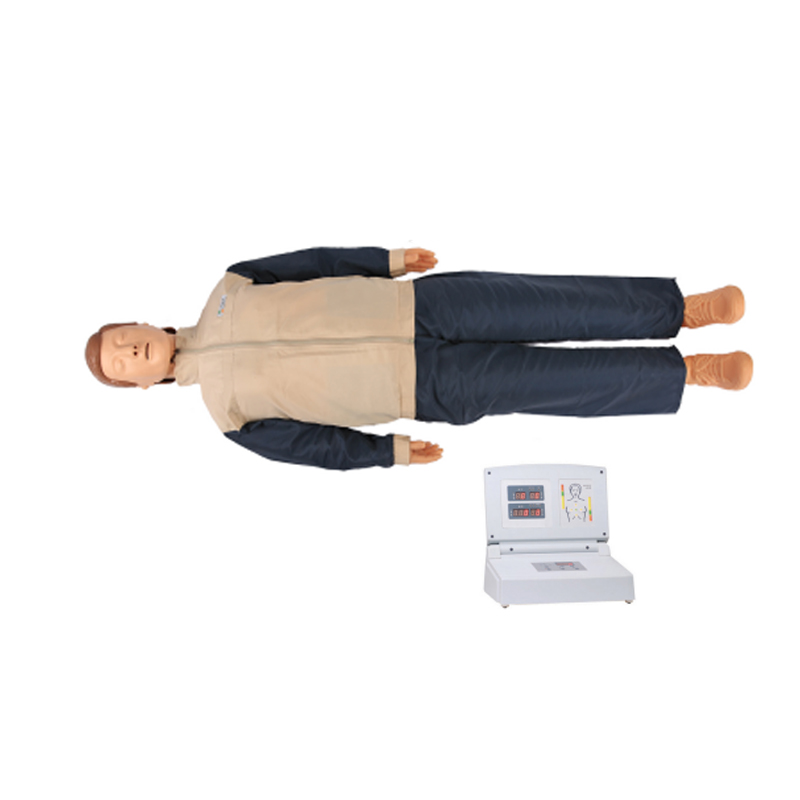
SC-CPR480 is the assessment-grade option in this range. It is specified as a full-body adult CPR model that simulates standard airway opening, and its feedback is delivered through a dynamic barcode indicator light: green when compression depth falls in the correct 5–6 cm band, yellow when depth is below 5 cm, and red when it exceeds 6 cm. A digital counting display records the specific reasons for a compression error — excessive force, too little force, incorrect hand position — together with the correct count.
The same logic applies to ventilation. Tidal volume in the correct 500 ml–600 ml–1000 ml band is shown in green on the barcode indicator, while volumes that are too small or too large trigger the yellow or red indicators, and the count display records the reasons for blowing errors.
Operation follows a 30:2 compression-to-ventilation ratio for single or double rescuers across five cycles, at a documented operating frequency of 100–120 compressions per minute in line with the 2020 international standard. The model supports both training and assessment modes — universal or customised assessment — measures operating time in seconds, and prints long or short score transcripts on thermal paper. Pupil change from dilation to contraction can be checked before and after assessment, and carotid artery pulsation is simulated for hand checks during and after compressions.
Best fit: certification courses, instructor training and assessment centres where a printed record of performance is required.
Documented limitation to verify: voice prompts are specified as Chinese-language, with adjustable volume or the option to switch prompts off. Programmes delivered in other languages should confirm prompt settings with the supplier before ordering.
2. SC-CPR160 — Infant CPR with Compression and Ventilation Feedback
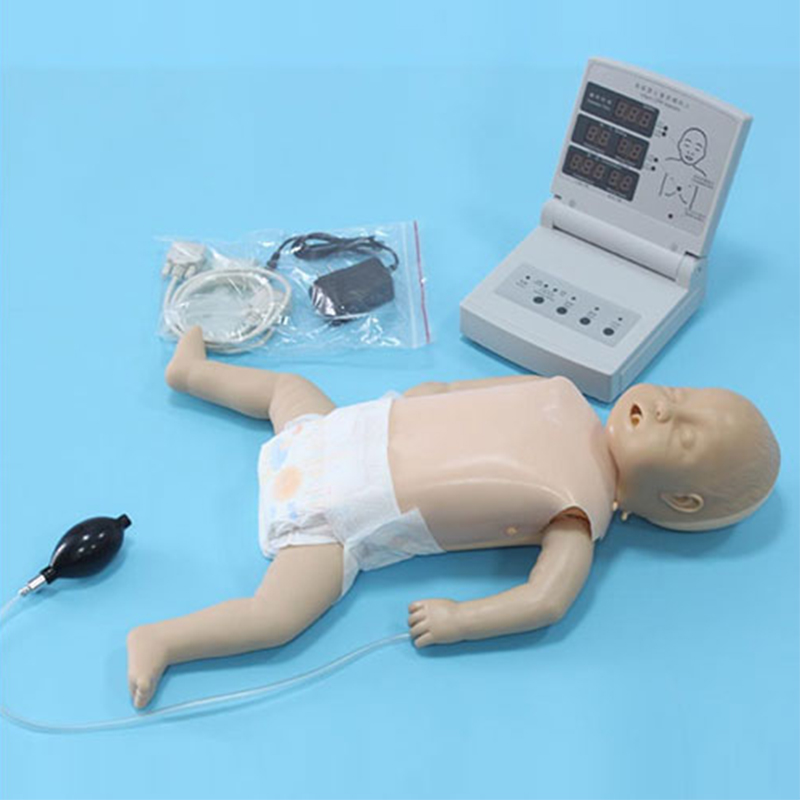
Paediatric resuscitation is a different skill set from adult CPR, and SC-CPR160 is the infant manikin specified for it. Hand-position and compression feedback combine three channels — a digital counting display, indicator lights and voice prompts — with the alarm logic tied to the position of the hands. Correct (≥ 4 cm) and incorrect (< 4 cm) compression intensity is displayed and alarmed, with real-time counts for both correct and incorrect attempts and voice prompts naming the specific cause of the error.
Ventilation feedback uses an infant-specific tidal volume band: insufflation between 30 ml and 50 ml is displayed correctly on the indicator light with a real-time digital count, while volumes below that band trigger a display and alarm. If insufflation is too fast or too large and gas enters the stomach, the indicator light and alarm activate and the voice prompt states the reason.
The compression-to-ventilation ratio is documented as 30:2 for a single rescuer or 15:2 for two rescuers, over five cycles, at an operating frequency of 100–120 per minute under the 2020 international standard. The model supports both training and assessment operation, and a hand bulb simulates the beating of the brachial artery. It runs on 220 V input with a 5 V output through a voltage regulator.
Best fit: paediatric BLS modules, infant ventilation technique, and any programme where hand position and blow volume must be measured rather than judged by eye.
3. SC-J5S — Airway and Intubation Station
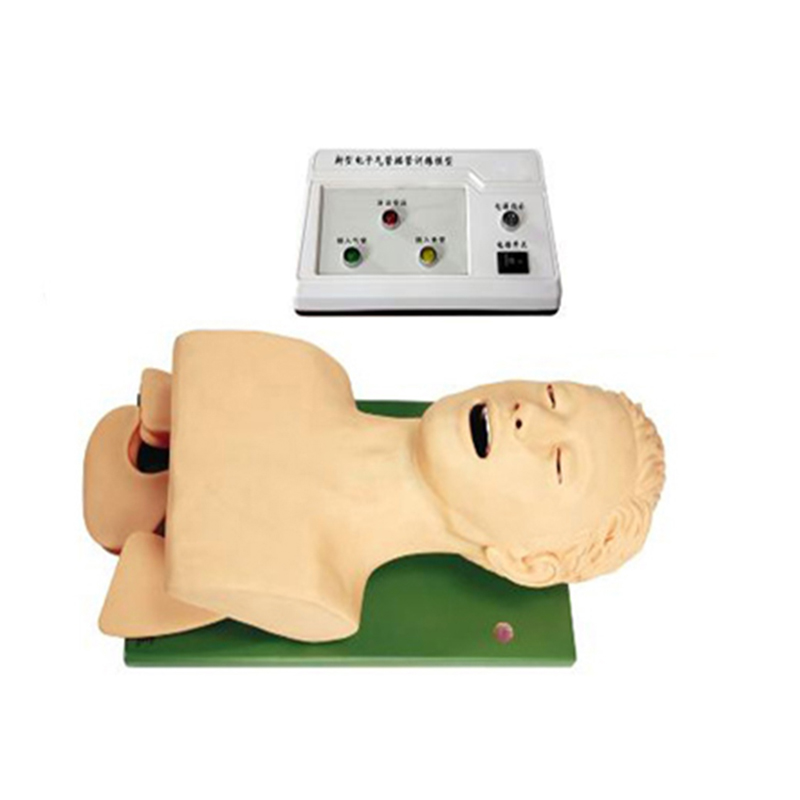
Airway management cannot be trained on a compression-only manikin, and SC-J5S covers that station. It supports training operations and teaching demonstrations of oral and nasal tracheal intubation. When the airway is inserted correctly, the unit gives an electronic display and plays music; air supplied through the tube expands both lungs, and inflating the tube air bag fixes the tube in place.
Error states are instrumented rather than silent. Incorrect oesophageal insertion triggers an electronic display and alarm, and the supplied air visibly expands the stomach. Incorrect laryngoscope technique that presses on the teeth triggers a separate alarm. The model also indicates the cricothyroid membrane puncture site and allows comparison of a normal pupil on one side with a dilated pupil on the other.
Best fit: BLS and ALS airway stations, anaesthesia and emergency medicine teaching, and intubation competency checks.
4. SC-F55-1 — Obstetric Emergency, Pregnant CPR and Newborn Resuscitation
SC-F55-1 is a comprehensive maternal and infant training model, and it is the unit in this list that covers obstetric emergency and maternal CPR within the same system. The delivery mechanism uses two mechanical adapters to connect the simulated fetus, with elastic fastening devices between fetus, adapters and transmission device and protective travel switches at both ends. The delivery process and fetal heart rate controller can pause, initialise, start and continue the delivery, with delivery speed selectable across four levels.
Fetal heart sound auscultation allows frequency and volume to be set, with the heart rate adjustable from 80 to 180. The model can simulate cephalic presentation, breech presentation, airway obstruction, umbilical cord around the neck and placenta previa, and it includes a highly realistic cervix, a Leopold practice soft pad and a prenatal cervical change module covering six stages — from a closed cervix with the fetal head at −5 station through to 10 cm dilation at +5 station. Fetal head descent and cervical dilation can be measured, and various placental positions can be simulated.
Pregnant CPR is designed according to the 2020 International CPR Guidelines, with electronic monitoring of airway opening, number of breaths, breath volume, compression site, compression count and compression depth, supported by voice prompts, digital counting display and barcode indicator light alarms. Carotid artery pulsation is simulated manually. The maternal arm can establish a venous channel for medication and nutrition, and a vulvar suture practice module offers three incision positions — lower left, centre and lower right. Tracheal intubation training can also be performed on the mother.
The newborn section covers overall care, eye cleaning and medication, cleaning and bandaging, nasogastric intubation for suctioning, tracheal intubation, gastric lavage, cord care, scalp and arm vein puncture with a sense of emptiness and blood return, and newborn CPR supporting mouth-to-mouth, mouth-to-nose and simple resuscitator ventilation with chest compressions.
Best fit: obstetric emergency drills, midwifery and neonatal nursing programmes, and hospital units that rehearse maternal cardiac arrest.
5. SC-J90 — Trauma Wound Scenario Drills
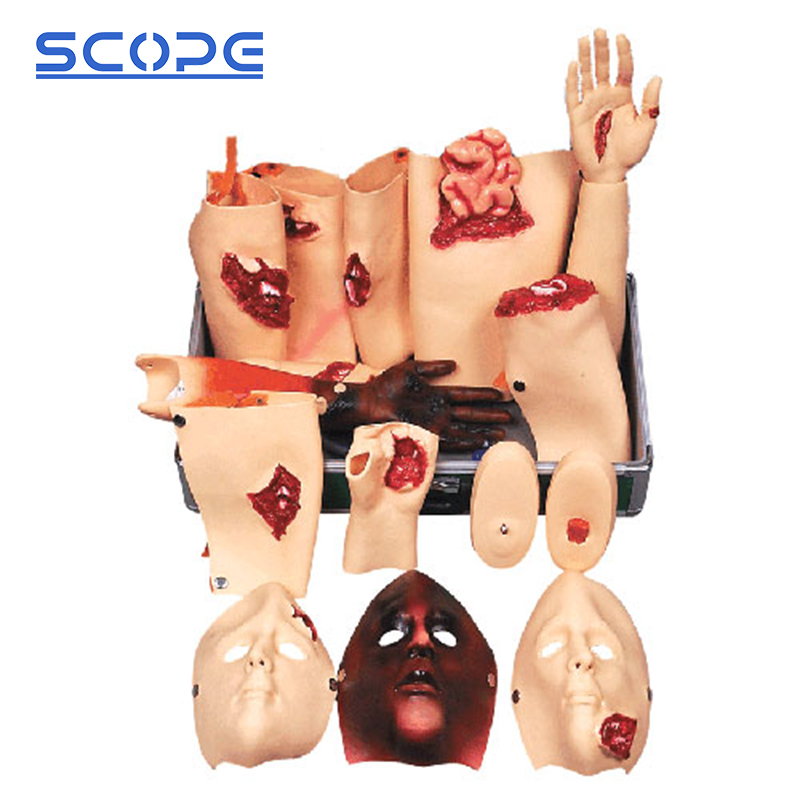
SC-J90 is documented as a wound-configuration model rather than an instrumented one, and that is precisely where it fits. Its specification lists 17 trauma conditions: I–III degree facial burns, a lacerated forehead wound, jaw trauma, open clavicle fracture with chest contusion, abdominal trauma with exposure of the small intestine, open humerus fracture with soft tissue lacerations of the right hand, exposed bone tissue, a bullet wound on the left palm, open and compound femur fractures of the thigh, a thigh stab wound from a metal foreign object, open tibia fracture, open right-foot fracture with amputation of the little toe, thigh amputation trauma, I–III degree burns on the left forearm, and closed tibia fracture with joint and foot contusion.
Because the published specification describes wound configurations without an electronic feedback module, this is a basic, non-instrumented scenario option. It suits programmes whose objective is recognition, triage and handling — not compression metrics.
Best fit: multi-casualty first-aid drills, emergency medical technician assessment practice, and visual identification exams.
6. SC-L66 — Chest-Trauma Puncture and Drainage
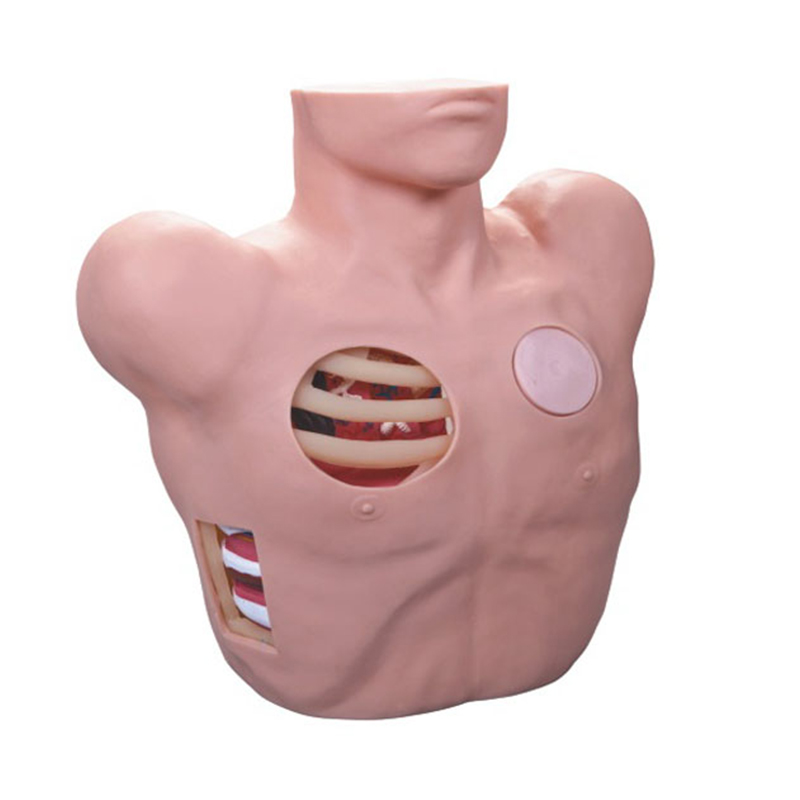
SC-L66 covers a narrow but high-risk first-aid procedure: closed drainage for pneumothorax and hydrothorax after chest trauma, plus post-operative care practice with drainage tubes. Two windows on the right side of the chest display the anatomical structures of each layer of the chest, so the layers can be taught before the procedure is attempted. Pneumothorax puncture decompression and hydrothoracic intubation and drainage exercises are performed on the left thorax. The colour, volume and viscosity of the chest drainage fluid can be adjusted by the user, which allows a trainer to present different clinical pictures from the same unit.
Best fit: trauma first-aid courses, emergency medicine rotations and thoracic drainage competency checks.
7. SC-CPR100A — High-Volume Basic Adult CPR
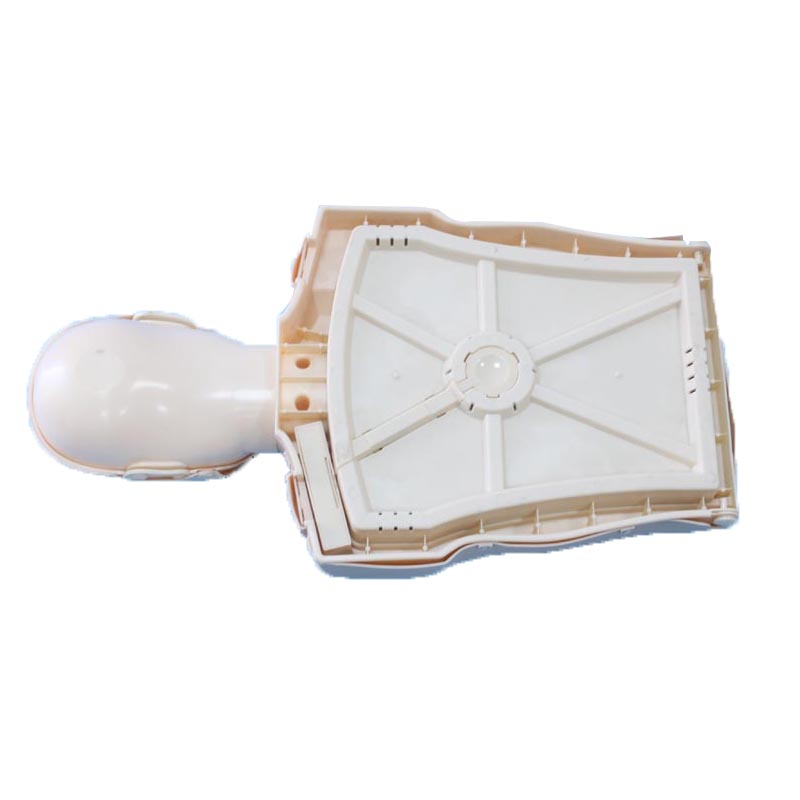
SC-CPR100A is the simplest unit in the list and the one many programmes should buy first. It simulates airway opening, allows mouth-to-mouth respiration with visible chest rise and fall, and specifies a correct manual compression depth of 5–6 cm within a 30:2 cycle over five cycles at 100–120 compressions per minute. It has an alarm function and is documented for training operation only.
It does not provide digital counting, error-reason logging, printed scores, pupil response or carotid simulation — those belong to SC-CPR480. The trade is deliberate: this model is the economical way to put a working compression station in front of every learner, which is why it is often purchased in quantity alongside one or two assessment-grade units.
Best fit: beginner and community first-aid sessions, school programmes, and distributor stock where cost per station is the deciding factor.
Adjacent models that support the same lab. CPR and first-aid stations rarely stand alone. Chongqing Scope Instrument Co., Ltd. also lists nursing manikins such as SC-H130A for full-function nursing care, injection and IV models such as SC-HS3, SC-HS4 and SC-HL for intradermal, subcutaneous and intramuscular injection practice, the SC-H4T hip injection and anatomical structure model, anatomy models such as SC-A1010 and the SC-A1041 torso model, and the SC-H140 pediatric training model for infant care procedures. These are complements to the seven ranked models, not substitutes for them.
Step-by-Step Breakdown: Building a First-Aid and CPR Training Room
- List the stations before listing the products. A standard room usually needs a compression and ventilation station, an airway station, a paediatric station, an obstetric or maternal station, a trauma scenario area and, where the curriculum includes it, a puncture and drainage station.
- Decide the feedback requirement per station. Sort each station into three levels: objective and recordable (SC-CPR480, with thermal score printing), instrumented but not recordable (SC-CPR160, SC-J5S, SC-F55-1), or passive (SC-J90). This single decision prevents the most expensive mismatch in manikin procurement.
- Count learners against models. Repetition volume, not room size, determines how many basic units are needed. Assessment stations are usually fewer than practice stations.
- Match model to station. Adult assessment to SC-CPR480; infant CPR to SC-CPR160; airway to SC-J5S; obstetric and maternal CPR to SC-F55-1; trauma recognition to SC-J90; chest trauma procedure to SC-L66; high-volume adult practice to SC-CPR100A.
- Plan consumables and spares by station. Budget for barrier masks (supplied 50 sheets per box), replaceable lung sac devices (four sets are included with the CPR models), changeable face skin on SC-CPR480 and thermal printing paper (two rolls supplied). Use each model's standard configuration list as the baseline for reordering.
- Check the environment. These are manual-operation training tools documented for 0–35°C ambient conditions, with a special requirement to keep room temperature constant — neither too high nor too low. No matched equipment is required for operation, so climate control and stable storage are the main infrastructure items.
- Close the procurement loop. Confirm documentation (ISO9001, ISO14001, ISO45001, ISO13485, CE, RoHS), neutral export packaging, and customs documents such as CO, Form E and Form F; confirm commercial terms — a 20-unit minimum order quantity, a 30–45 day lead time and a monthly capacity of 3,000 units — and add the 1-year online warranty to the service plan.
Use Cases: Which Model Mix Fits Which Programme
- Medical school teaching lab. The documented application for this range is medical school teaching and first-aid training in markets including the United Arab Emirates, Indonesia, Israel, India, Iraq, Laos and Malaysia, operating manually at 0–35°C with a constant room temperature. A typical mix pairs SC-CPR480 and SC-CPR100A for adult CPR, SC-CPR160 for infant CPR and SC-J5S for airway skills.
- Hospital CPR recertification. Where competency must be evidenced, SC-CPR480 covers the assessment bench with printed transcripts, while SC-CPR100A covers the practice benches.
- Paediatric and neonatal units. SC-CPR160 for infant technique, with the newborn section of SC-F55-1 for neonatal resuscitation, cord care and vein puncture procedures.
- Obstetric emergency drills. SC-F55-1 provides the delivery mechanism, fetal heart rate control, six-stage cervical module and pregnant CPR module in one unit.
- Community and EMT first-aid training. SC-J90 for wound recognition and SC-L66 for chest trauma procedures, supported by SC-CPR100A for compression practice.
- Distributor stock programmes. A medical manikin distributor in India is documented as ordering 500 units for medical teaching over a one-year project, reporting stable operation with the highlights of customisation and durability. Volume programmes of this type align with an ODM route and a monthly capacity of 3,000 units.
Comparison Table: Seven CPR and First-Aid Manikins at a Glance
| Model | Type | Best-fit training context | Documented features | Material |
|---|---|---|---|---|
| SC-CPR480 | CPR model (full-body adult) | Certification and assessment stations | Dynamic barcode depth feedback (5–6 cm correct; below 5 cm / above 6 cm indicated), tidal volume 500–1000 ml, error-reason logging, thermal score printing, pupil and carotid simulation, 30:2 over five cycles at 100–120/min | PVC |
| SC-CPR160 | Infant CPR manikin | Infant CPR and ventilation technique | Digital counting, indicator lights and voice prompts; ≥ 4 cm versus < 4 cm compression; 30–50 ml tidal volume feedback; 30:2 single or 15:2 double rescuer | PVC |
| SC-J5S | Intubation model | Airway and intubation stations | Oral and nasal intubation; electronic display and music on correct insertion; alarms for oesophageal insertion and tooth pressure; cricothyroid membrane puncture site; normal versus dilated pupil comparison | PVC |
| SC-F55-1 | Maternal and infant manikin | Obstetric emergency, maternal and newborn CPR | Delivery mechanism with four speed levels; fetal heart rate 80–180; six-stage cervical change module; pregnant CPR to 2020 International CPR Guidelines; newborn resuscitation and care functions | PVC |
| SC-J90 | Medical mannequin (trauma configuration) | Multi-casualty first-aid scenario drills | 17 documented trauma conditions across face, chest, abdomen and limbs; no electronic feedback module documented | PVC |
| SC-L66 | Clinical puncture manikin | Chest trauma puncture and drainage care | Closed drainage for pneumothorax and hydrothorax after chest trauma; chest-layer windows on the right side; left-thorax decompression and drainage; adjustable drainage fluid colour, volume and viscosity | PVC |
| SC-CPR100A | Medical manikin (basic CPR) | High-volume beginner adult CPR practice | Airway opening simulation, visible chest rise and fall, 5–6 cm compression depth, 30:2 over five cycles at 100–120/min, alarm function, training operation only | PVC |
FAQ: First-Aid and CPR Manikin Procurement Questions
What quality and export documentation is available for these manikins?
Chongqing Scope Instrument Co., Ltd. states that ISO9001, ISO14001, ISO45001, ISO13485, CE and RoHS certificates are available for export. ISO 13485:2016 is the internationally recognised quality management system standard for the design and manufacture of medical devices, including simulation manikins, so it is the document most often requested by institutional buyers. Products are packed in neutral export packaging without logos — either cardboard boxes or wooden boxes — and additional customs documents such as CO, Form E and Form F can be provided on request.
Can the manikins be customised for our brand or our curriculum?
Yes, through the ODM route. The documented capability is customisation of both the appearance and the functions of the product, subject to meeting the required quantity for the product. Logo printing on the machine is possible once technical verification is completed and no issues remain; alternatively, a custom logo label can be produced and attached to the machine. Because customisation is confirmed at the technical verification stage, buyers should specify appearance, function and branding requirements before the production slot is scheduled.
Do we need an instrumented manikin at every station?
No. The decision should follow the feedback the curriculum requires. SC-CPR100A gives compression depth guidance of 5–6 cm, a 30:2 cycle over five cycles at 100–120 compressions per minute and an alarm function, and it is documented for training operation only — which is enough for repetition practice. SC-CPR480 adds dynamic barcode depth feedback, error-reason recording, printable long or short score transcripts, pupil response and carotid pulsation, which is what assessment and certification benches need. Placing one or two assessment-grade CPR models where competency is measured, and basic models where repetitions happen, normally produces a lower cost per station than instrumenting the whole room.
How can we validate a model before placing a volume order?
Validation starts with the standard configuration list, which defines exactly what arrives with each unit: for the CPR models this includes the manikin, the display or monitor controller, a hard plastic carrying case, the resuscitation pad, power adapter and data cable, a 50-sheet box of barrier masks, four replaceable lung sac sets, the 2020 international operation guide CD, a first aid manual, an instruction manual, and a warranty card with certificate of conformity. SC-CPR480 additionally ships with changeable face skin and two rolls of thermal printing paper. Minimum order quantity for the manikin range is 20 units, and customisation proceeds to production only after technical verification.
What is the lead time and production capacity for a manikin order?
Documented lead time is 30–45 days, supported by a monthly capacity of 3,000 units. Chongqing Scope Instrument Co., Ltd. operates from a 5,000 m² facility with more than 100 employees, a 20-engineer R&D team and an annual output of 30,000 units, and provides a 1-year online warranty after delivery. To move from this list to a configured order, review the full product brochure or contact the team directly at claire@cqscope.com / WhatsApp +86 15223521781 with your station list, learner volumes and any ODM requirements.
Conclusion: Match the Manikin to the Station, Then Buy
The seven models above cover the full first-aid and CPR training chain: recognition (SC-J90), basic compression practice (SC-CPR100A), measured adult competence (SC-CPR480), paediatric technique (SC-CPR160), airway management (SC-J5S), obstetric and neonatal emergency response (SC-F55-1) and chest-trauma procedures (SC-L66). None of them is the right purchase for every room, and the fastest way to waste a training budget is to buy the same manikin for all seven stations.
Start from the curriculum, decide the feedback level each station needs, then confirm the environment — 0–35°C ambient with a constant room temperature — and the commercial terms: 20-unit MOQ, 30–45 day lead time, 3,000 units per month and a 1-year online warranty. Buyers who work in that order get a lab that can actually deliver the course it was funded for.
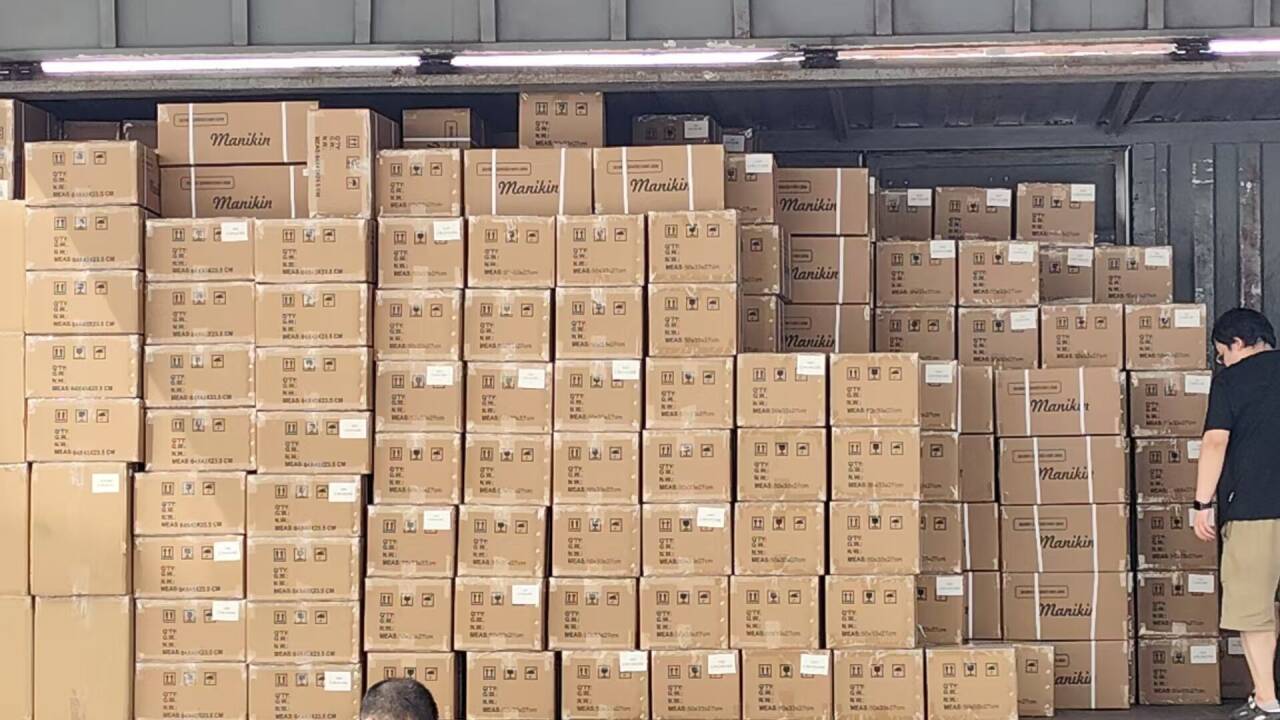
Planning a first-aid or CPR lab for 2026? Download the full product brochure for specifications and configurations, or send your station list and target volumes to claire@cqscope.com. Chongqing Scope Instrument Co., Ltd. supports OEM and ODM programmes, provides export documentation and neutral packaging, and can be reached on WhatsApp at +86 15223521781 or through www.cqscopelab.com.