
Why Your Nursing Students Need the SC-H4T Injection Trainer
A nursing student who has never palpated a posterior superior iliac spine on a physical model is being asked to find it on a patient. That gap, between classroom anatomy and the first supervised intramuscular injection, is where most early injection errors begin. It is also the gap that a task-specific training manikin is designed to close before a student reaches a clinical ward.
This article looks at that gap directly and explains why the SC-H4T, a nursing manikin from Chongqing Scope Instrument Co., Ltd., is built the way it is. Chongqing Scope Instrument Co., Ltd. is a supplier of laboratory and medical training instruments based in Chongqing, China, whose medical manikin range is organised into CPR, clinical and nursing categories. Everything below is drawn from the manufacturer's product data and from published third-party research; where a statement is the manufacturer's own description, it is presented as such.
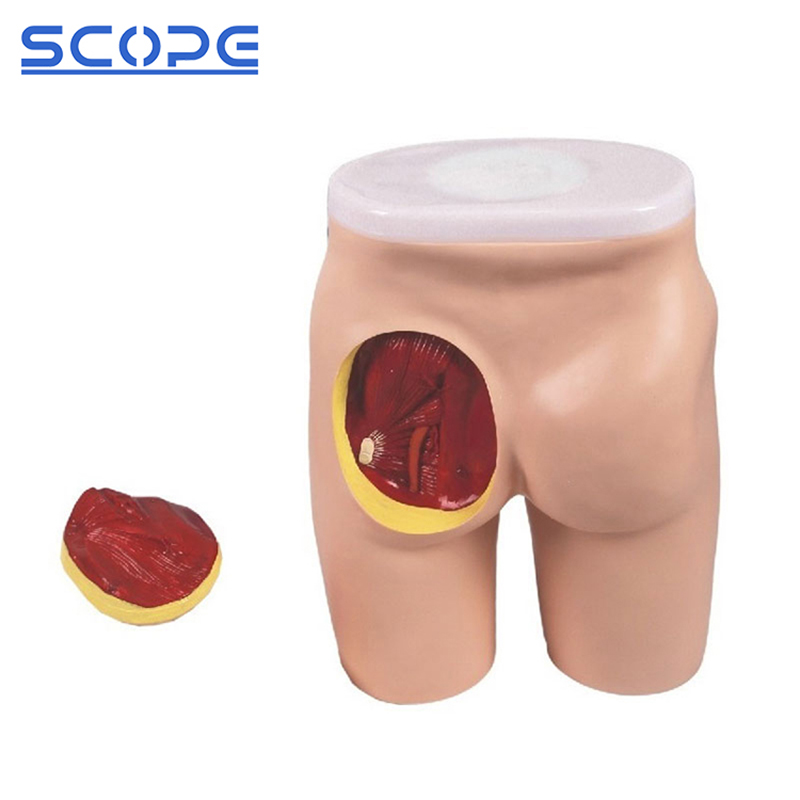
SC-H4T Advanced Hip Muscle Injection and Anatomical Structure Model. The left gluteal quarter lifts away so students can see what their needle is aiming at. Image: Chongqing Scope Instrument Co., Ltd.
The Problem: Injection Technique Is Often Taught Before It Is Practised
Intramuscular injection looks simple from the outside. A student selects a site, palpates landmarks, stabilises the tissue and delivers the dose. Underneath that sequence sit three separate competencies: knowing where the safe zone is, feeling where it is on a body, and repeating the movement often enough that it survives the pressure of a real clinical encounter.
Standard classroom delivery tends to compress all three into a short block. Anatomy is taught from a torso model or a chart, technique is demonstrated once, and practice time is limited by how many models a lab owns. The result is a familiar pattern in pre-clinical skills training.
Problem one: the target is invisible
A student who only sees a diagram cannot connect the greater trochanter to the shape of a hip under their hand. Without a physical surface that carries those landmarks, site selection becomes memorisation of a picture rather than a tactile skill. The safest injection zone is defined by bony landmarks and by the position of the sciatic nerve, and neither is visible from the outside of a manikin unless the model is built to reveal them.
Problem two: practice surfaces do not behave like tissue
A pad that is too firm teaches a student to push. A pad that is too soft hides a misplaced needle. Either way the feedback loop is broken, and the student learns a motion rather than a judgement. Physical realism in an injection model is not a cosmetic feature; it is the mechanism by which a student learns to modulate force, angle and depth.
Problem three: repeated puncture wears out the teaching asset
Injection practice is high-cycle by nature. Every cohort repeats the same movement dozens of times on the same surface. Models that degrade quickly force programs into replacement cycles, which in turn reduces the number of practice stations a lab can keep open. Durability is therefore a teaching variable, not just a purchasing one.
Those three problems point to the same requirement: a model that shows the anatomy, behaves like a body, and survives the timetable. That is the requirement the SC-H4T is built around.
Industry Background: Why Injection-Specific Models Are Being Bought Separately
Medical simulation spending has grown steadily, and the manikin segment within it has grown with it. WiseGuyReports values the medical training manikin segment at USD 600 million in 2024 and projects USD 1.2 billion by 2035, while MarketsandMarkets puts the wider medical simulation market at USD 2.17 billion in 2024 rising to USD 4.48 billion by 2030. Those figures describe a category that institutions already fund; they do not describe how the money is split.
The split matters more for procurement than the total. Grand View Research reports that anatomical models held approximately 41.4% of medical simulation product revenue in 2025, and places manikin price tiers from about USD 500 for low-fidelity basic CPR models to above USD 85,000 for AI-driven high-fidelity patient simulators. Read together, those two data points describe a market where volume sits in accessible, task-specific models rather than exclusively in flagship simulators.
That is the commercial context in which a single-skill nursing manikin makes sense. A faculty does not need a full-body patient simulator to teach gluteal injection site selection. It needs a model that carries the right landmarks, can be opened for demonstration, and can absorb repeated puncture across a semester. Buying one high-fidelity platform for the whole curriculum and one task-specific injection model for the injection module are different decisions with different budgets, and the second is usually the one that determines how much practice time each student actually gets.
The SC-H4T: A Single-Purpose Answer to a Single-Purpose Problem
The SC-H4T is a task-specific nursing manikin built for gluteal intramuscular injection training and for study of the underlying hip anatomy. It is not a general-purpose clinical manikin, and it is not presented as one. Its value comes from doing one job with enough anatomical detail that the teaching sequence can be built on top of it.
Anatomy a student can open and inspect
The model carries an injection structure that the product data describes as clear and anatomically accurate, referencing the proximal femur, the greater trochanter, the anterior superior iliac spine, the posterior superior iliac spine and the sacrum. Those are the landmarks a student is expected to identify by touch before selecting a site.
The left gluteal quarter, listed in the product data as roughly one quarter of the buttock area, is removable. With it off, the internal structure becomes visible: the gluteus medius, the gluteus maximus, the sciatic nerve and the vascular structures. This is the feature that changes how the model is taught with. A class can begin with the quarter removed, tracing the nerve and the muscle boundaries, then replace it and repeat the same route by palpation alone. The student learns the relationship between what they feel and what lies beneath, which is precisely the judgement that site selection depends on.
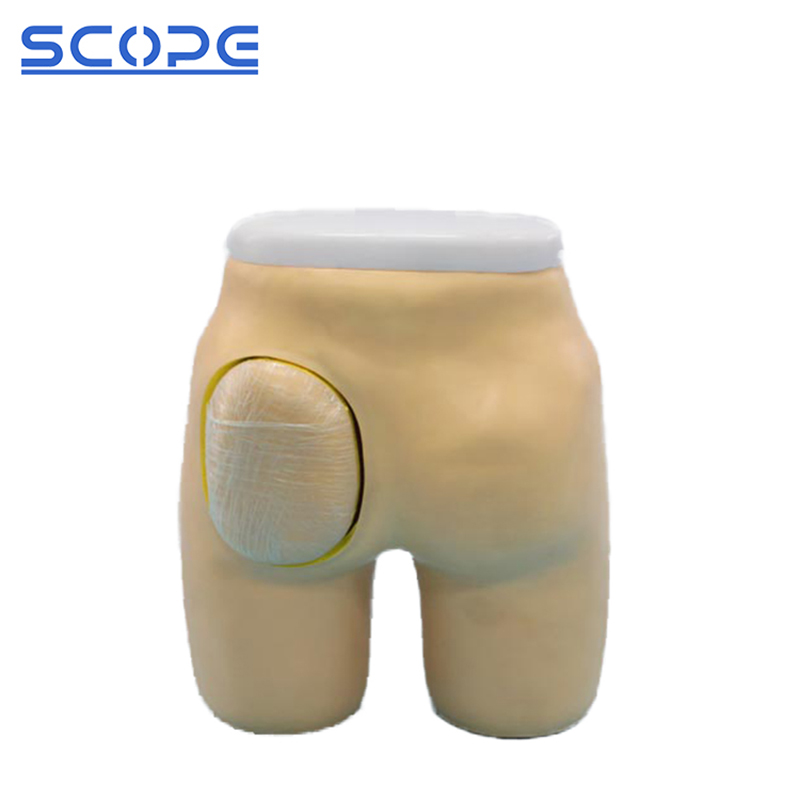
SC-H4T Hip Muscle Injection Mannequin. The removable left gluteal section supports demonstration first, palpation second. Image: Chongqing Scope Instrument Co., Ltd.
The injection block: material and process
The portion of the model that receives the needle is described in the product data as imported plastic elastomer, formed by stainless steel mould injection and sintered at high temperature. The same record links that construction to a durable texture, which is the property that matters in a high-cycle teaching environment. The product record separately lists PVC as the model material; the elastomer description applies specifically to the injection block.
Why this matters for dexterity, rather than only for longevity: a student develops control by receiving consistent resistance every time they advance a needle. A block that is formed in a steel mould and sintered has a defined, repeatable consistency across units, so what one cohort learns on one model transfers to the next model in the cabinet. When practice surfaces vary between units, students unconsciously re-calibrate each time and the skill does not consolidate.
Mould-based production also matters at the procurement level. It is a manufacturing route suited to repeatable output, which is consistent with the capacity figures Chongqing Scope publishes for its customisation program: a stated monthly capacity of 3,000 units and a production lead time of 30 to 45 days.
Three intramuscular routes on a single model
The SC-H4T supports three intramuscular injection training routes: dorsal gluteal, ventral gluteal and vastus lateralis. That spread is more useful than it first appears, because it lets a program teach site selection as a comparison rather than a single memorised point. A student can practise the dorsal route, move to the ventrogluteal position where the landmark set shifts, and finish on the vastus lateralis, where the palpation logic is different again. The same model then serves the assessment, since the instructor can ask for a named route without the student knowing in advance which one will be requested.
The product data also describes the model as presenting gluteal intramuscular injection training as its core function. Programs that need to extend beyond the buttock should plan for companion models rather than assume this one covers the whole injection curriculum; the section below sets out how those pieces fit together.
Operating conditions that belong in your lab plan
The application data for this training scenario specifies manual operation at ambient temperatures of 0 to 35 °C, with a special requirement to keep room temperature constant, neither too high nor too low, and no matched equipment. Two practical consequences follow.
First, the model does not depend on a console, a power supply or a software licence to function. A lab can open a practice station with the manikin alone, which keeps the cost per station low and removes the failure modes that come with electronics in a teaching room. Second, the temperature condition should be written into the room specification. Storage near a heating unit, an unshaded window or an unheated loading bay sits outside the stated range and should be avoided. For programs in hot or cold climates, that is a facilities note rather than a product limitation, but it is the kind of detail that gets missed when a purchase order is raised without a lab walk-through.
Step-by-Step: Building a Teaching Sequence Around the SC-H4T
The model is a teaching asset, and its value depends on how the session is sequenced. The following structure uses only the features the product data documents, arranged in the order a pre-clinical skills block typically follows.
Step 1. Confirm the room conditions. Verify the lab sits within the stated 0 to 35 °C ambient range and that temperature is held steady. Record the check on the session plan so the condition is maintained across the term, not just on the first day.
Step 2. Open the model before teaching technique. Remove the left gluteal quarter and identify the gluteus medius, gluteus maximus, sciatic nerve and vascular structures with the class. The objective at this stage is recognition, not needle handling.
Step 3. Map landmarks to the surface. With the quarter replaced, have students locate the greater trochanter, the anterior superior iliac spine, the posterior superior iliac spine and the sacrum by palpation, then relate each one to the safe zone they identified in Step 2. The model is designed to support exactly this transfer between internal structure and external landmark.
Step 4. Teach one route at a time. Begin with the dorsal gluteal route, then the ventrogluteal, then the vastus lateralis. Do not introduce a second route until the landmark set for the first is reliable. Three routes on one model makes this progression possible without changing equipment.
Step 5. Convert practice into assessment. Once technique is stable, call routes at random and score site selection, landmark accuracy and needle handling separately. Separating the three keeps the feedback specific, which is what a student needs in order to correct a single element rather than repeat the whole motion.
Step 6. Extend into adjacent injection skills. Pair the SC-H4T with models that cover the rest of the injection curriculum. The SC-HS3 arm injection model adds deltoid injection with a documented needle-entry feel, blood flashback and changeable vein and skin. The SC-HL training model is built in three layers, skin, subcutis and muscle, and covers intradermal, hypodermic and intramuscular practice on a wearable pad. The SC-HS4 arm model adds electronic notification when the needle enters the vessel, for programs that want instrumented feedback on vascular access.
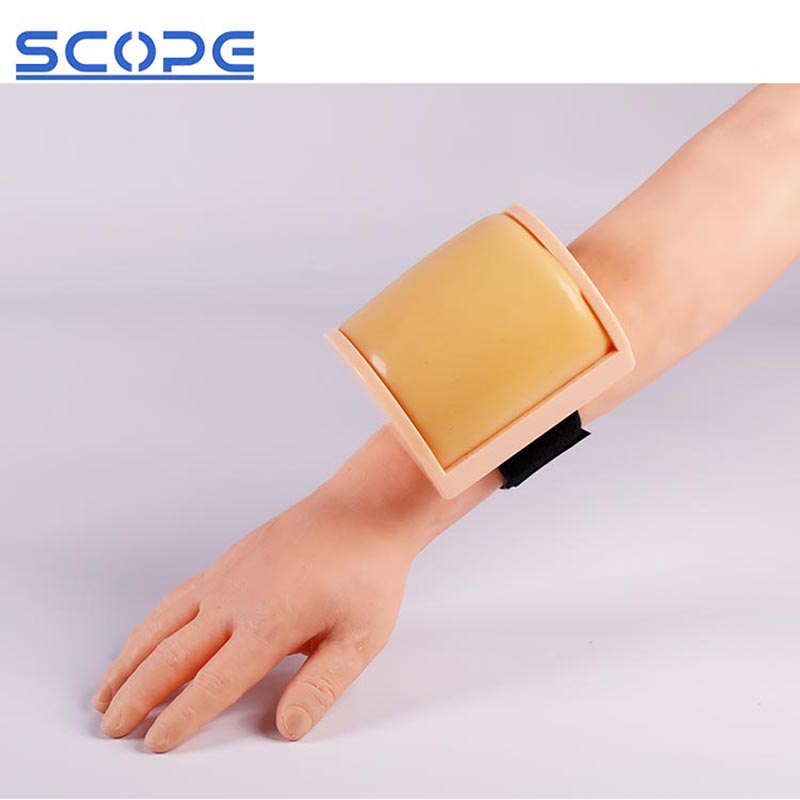
SC-HL Intramuscular Injection Medical Training Model. A layered pad extends surface injection drills once the SC-H4T has established landmark accuracy. Image: Chongqing Scope Instrument Co., Ltd.
Step 7. Plan the maintenance cycle. Because the injection block is described as durable, the practical maintenance question is cleanliness and storage rather than replacement frequency. Keep the model at stable room temperature, clean according to the program's protocol, and inspect the injection area at the start of each term. Programs running very high puncture volumes should also track usage per station so that any wear is identified from observation rather than from a student's failed attempt.
Where the SC-H4T Fits: Four Training Scenarios
1. Pre-clinical skills laboratories in nursing schools
This is the primary setting the model is designed for. A lab running a pre-clinical injection module needs stations that can be used in parallel by a cohort. Because the SC-H4T operates manually with no matched equipment, ten stations need ten manikins and nothing else. The removable gluteal quarter also lets a single instructor demonstrate to a group before students disperse to practise, which reduces the number of models needed for the demonstration phase.
2. Hospital in-service and competency refresher programs
Hospitals that run annual injection competency checks need a surface that can be reused across staff without a consumable replacement after every session. The documented landmark set supports a defensible assessment: the assessor can ask for a named route and confirm that the correct bony reference was palpated before the needle was placed. The absence of electronics keeps setup time short, which matters when refresher sessions are scheduled around shift patterns.
3. Distributor demonstration and stock programs
Distributors selling into nursing education need a model that can be demonstrated repeatedly at exhibitions, dealer events and campus visits. Chongqing Scope reports a distributor relationship in India covering 500 units for medical teaching applications over one year, with stable operation and highlights of customisation and durability, which is the pattern a channel partner would be looking for in a repeatable stock item.
4. Private-label and OEM programs
Chongqing Scope states that it offers OEM and ODM services, with appearance and function customisation available and dedicated customisation for some products subject to quantity requirements. For a distributor building a nursing skills line under its own brand, the SC-H4T can function as the injection anchor of that range. The company's customisation record lists a minimum order quantity of 20 units, a stated monthly capacity of 3,000 units and a 30 to 45 day production lead time, with a one-year warranty supported online. Logo printing is offered on the machine once technical verification is complete, and custom logo labels can be produced and attached instead. Export packaging is neutral, in cardboard or wooden boxes, and clearance documents including CO, Form E and Form F can be supplied.
Comparison Table: Matching the Injection Model to the Training Goal
The SC-H4T is one model in a wider nursing range. The table below places it against the companion models that most often appear in the same purchasing decision, using only the functions and features documented in the manufacturer's product data.
| Model | Documented training focus | Injection sites listed | Access or replacement feature | Typical role in a program |
|---|---|---|---|---|
| SC-H4T Training Mannequin | Gluteal intramuscular injection plus hip anatomy study | Dorsal gluteal, ventral gluteal, vastus lateralis | Left gluteal quarter removable to reveal muscle, nerve and vascular structures | Core station for site selection and landmark accuracy |
| SC-HL Medical Training Model | Intradermal, hypodermic and intramuscular injection on a layered pad | Layered skin, subcutis and muscle pad | Wearable design; injected fluid drained by squeezing the pad | High-volume surface drilling after landmarks are learned |
| SC-HS3 Injection Model | Arm injection, transfusion and hemospasia; deltoid injection | Arm veins and deltoid | Veins and skin changeable; blood flashback indicates correct insertion | Deltoid and vascular access practice |
| SC-HS4 IV Injection Model | Arm puncture with electronic confirmation of vessel entry | Arm vessel | Standard set includes hand model, electronic monitor, infusion set | Instrumented feedback for vascular access assessment |
| SC-H130A Nursing Manikin | Full-function nursing care, including buttock intramuscular, deltoid subcutaneous and vastus lateralis injection | Multiple, across a 21-item function list | Not stated in product data | Whole-patient nursing lab where injection is one module among many |
Comparison limited to documented product data. It is not a ranking, and the appropriate choice depends on which skill the program is trying to assess.
How to read the table. If the teaching objective is landmark accuracy before a needle is placed, the SC-H4T is the model built for it. If the objective is repetition volume on a surface that can be drained and reused, the SC-HL layered pad does that job. Many programs end up buying both, because they answer different questions: where to inject, and how many times to rehearse the movement.
Frequently Asked Questions
Does the SC-H4T come with certification and export documentation?
Chongqing Scope Instrument Co., Ltd. lists ISO 9001, ISO 14001, ISO 45001, ISO 13485, CE and RoHS among the certificates it can provide for export, and independent verification records for the company cite ISO 13485 and CE certificate BKC22072375GC as company-held documents. Those are company-level certificates rather than a per-unit test report, so a procurement team should request the specific document set that applies to the order before it is written into a tender. Export documentation is available in the usual forms: neutral packaging in cardboard or wooden boxes prepared to export standards, plus CO, Form E and Form F for customs clearance where required.
Which injection sites and anatomical landmarks does the SC-H4T cover?
The model supports three intramuscular routes: dorsal gluteal, ventral gluteal and vastus lateralis. Its anatomical structure references the proximal femur, greater trochanter, anterior superior iliac spine, posterior superior iliac spine and sacrum, which are the landmarks used to define a safe injection zone. Removing the left gluteal quarter reveals the gluteus medius, gluteus maximus, sciatic nerve and vascular structures, so the same model supports both surface palpation and internal anatomy demonstration.
How should we budget for an injection trainer of this type?
No unit price for the SC-H4T is published, and the quotation depends on configuration, quantity, customisation and freight terms. For planning purposes, Grand View Research reports that medical manikin price tiers run from roughly USD 500 for low-fidelity basic CPR models to above USD 85,000 for AI-driven high-fidelity patient simulators. A manual, single-skill injection manikin sits at the accessible end of that range by design, since it carries no electronics, software or consumable licence. The customisation record lists a minimum order quantity of 20 units for the model line, so programs buying for multiple labs should ask for tiered pricing rather than a single-unit quote.
Can we evaluate a sample or place a trial order before committing?
Sample and trial-order terms are not fixed in the published product material; they are confirmed case by case, so the practical step is to describe the intended use, the number of stations and the destination market in the first enquiry. That lets the supplier confirm what can be shipped, what documentation accompanies it and how the trial is structured. Buyers evaluating the injection block specifically should ask for confirmation of the elastomer construction and for the current certificate set at the same time, so that technical and compliance questions are resolved in one exchange.
What lead time and after-sales support should we plan for?
The customisation record lists a production lead time of 30 to 45 days, a stated monthly capacity of 3,000 units and a one-year warranty supported online. For a program replacing lab equipment between semesters, that lead time should be placed against the academic calendar rather than the procurement calendar, since a delivery that lands during examination weeks will sit unused. Programs adding the SC-H4T to a distributor range should also confirm the customisation window, because logo printing proceeds only after technical verification is complete. To discuss a configuration, request the current catalogue via the brochure link below or write to claire@cqscope.com.
Conclusion: The Model Should Teach the Judgement, Not Just the Motion
Intramuscular injection is one of the few nursing skills where the decision comes before the action. A student who cannot locate the posterior superior iliac spine cannot choose a safe site, regardless of how steady their hand is. The SC-H4T is built around that ordering: open the model, study the nerve and muscle layout, close it, find the landmarks by touch, then place the needle on one of three documented routes.
The construction supports the repetition that follows. A stainless steel mould and high-temperature sintering process applied to imported plastic elastomer gives the injection block a consistent, durable surface, and consistency is what allows a skill to consolidate across a cohort rather than reset with each new model. Manual operation, a stated 0 to 35 °C ambient range and a constant-room-temperature requirement are not marketing details; they are the inputs a lab manager needs in order to plan a room that actually works.
For programs building an injection curriculum, the practical sequence is straightforward. Establish landmark accuracy on a model that reveals its own anatomy, build repetition volume on layered pads and arm models, and reserve full-body nursing manikins for the modules where whole-patient care is the objective. The SC-H4T occupies the first of those roles, and it is worth specifying precisely because it does not try to occupy all three.
Next Step: Review the Model Against Your Own Lab Plan
Chongqing Scope Instrument Co., Ltd. supplies medical manikins, laboratory instruments and metallographic equipment to buyers in Europe, Southeast Asia, the Middle East, South America and Africa, and offers OEM and ODM services subject to quantity requirements.
Request the product brochure and current specification set: download the Chongqing Scope catalogue (PDF).
For a quotation, sample discussion or distributor enquiry, contact Claire at claire@cqscope.com, by phone or WhatsApp at +86 15223521781, or visit www.cqscopelab.com. Address: 701, Longhushuijinguoji, No.164, Xinnan Road, Yubei District, Chongqing, China.
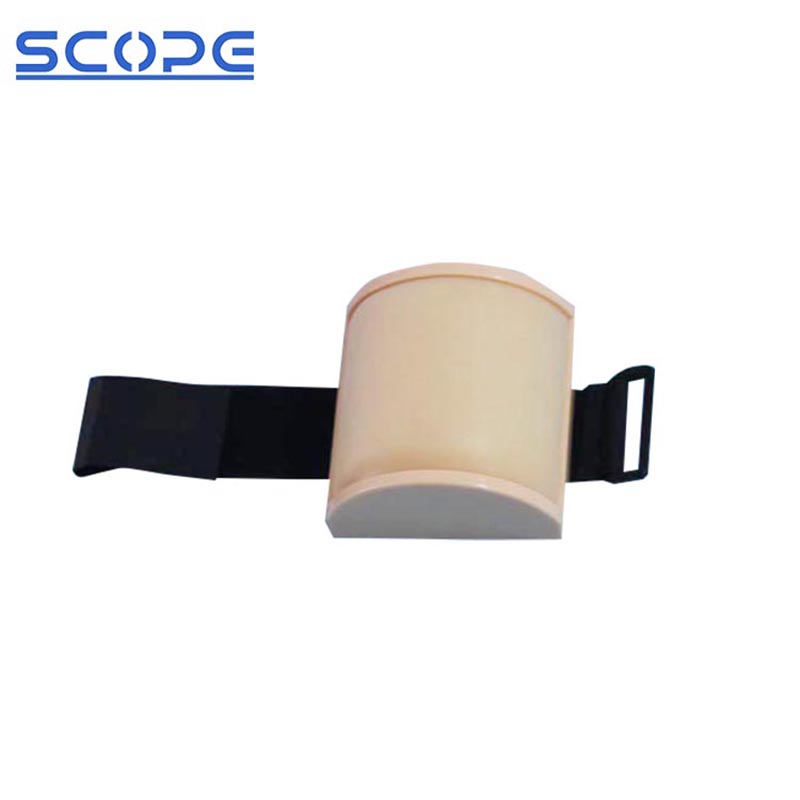
SC-HL injection training pad, a companion item for programs extending beyond gluteal technique. Sample and quotation requests are handled through the contact details above. Image: Chongqing Scope Instrument Co., Ltd.
Have Questions or Need More Details?
Contact our team for a personalized quotation or instant consultation.
Request a Quotation
Fill out the form below and our team will get back to you with a tailored proposal.
WhatsApp Direct Chat
Prefer to chat in real-time? Message us on WhatsApp for instant assistance & quick answers.
- Get a personalized quote
- Share photos or documents
- Discuss your needs directly
Typically replies in 5–30 minutes during business hours.