
Precision Metal Mechanical Parts: A Practical Buyer's Guide
Precision metal mechanical parts are metal components manufactured to a defined drawing and controlled to a stated tolerance, so they can carry load, transmit motion, locate another component, or shape a magnetic field inside a finished assembly. Precision describes the control applied to the part rather than the part itself: a CNC-machined shaft and a stamped bracket are both precision parts when both are produced and inspected against agreed drawings.
Most buyers arrive at this category with a drawing and a question that is broader than a part number — which manufacturing route can make this shape, in this material, at a workable cost, with repeatable quality. This guide answers that question in the order a buyer actually needs it: what the category contains, where it sits in the market, how the main manufacturing routes differ, which material suits which part family, and what to prepare before sending a request for quotation.
Factory and product facts in this article come from Chunan Qiandaohu Pengsheng Technology Development Co., Ltd., a manufacturer established in 2008 and located in Hangzhou, Zhejiang Province, China, whose production scope covers magnets and magnetic assemblies, shafts, stator and rotor cores, sheet metal stamping, sheet metal deep drawing, sheet metal fabrication, CNC precision machining, metal die casting, automotive parts, and gaussmeters.
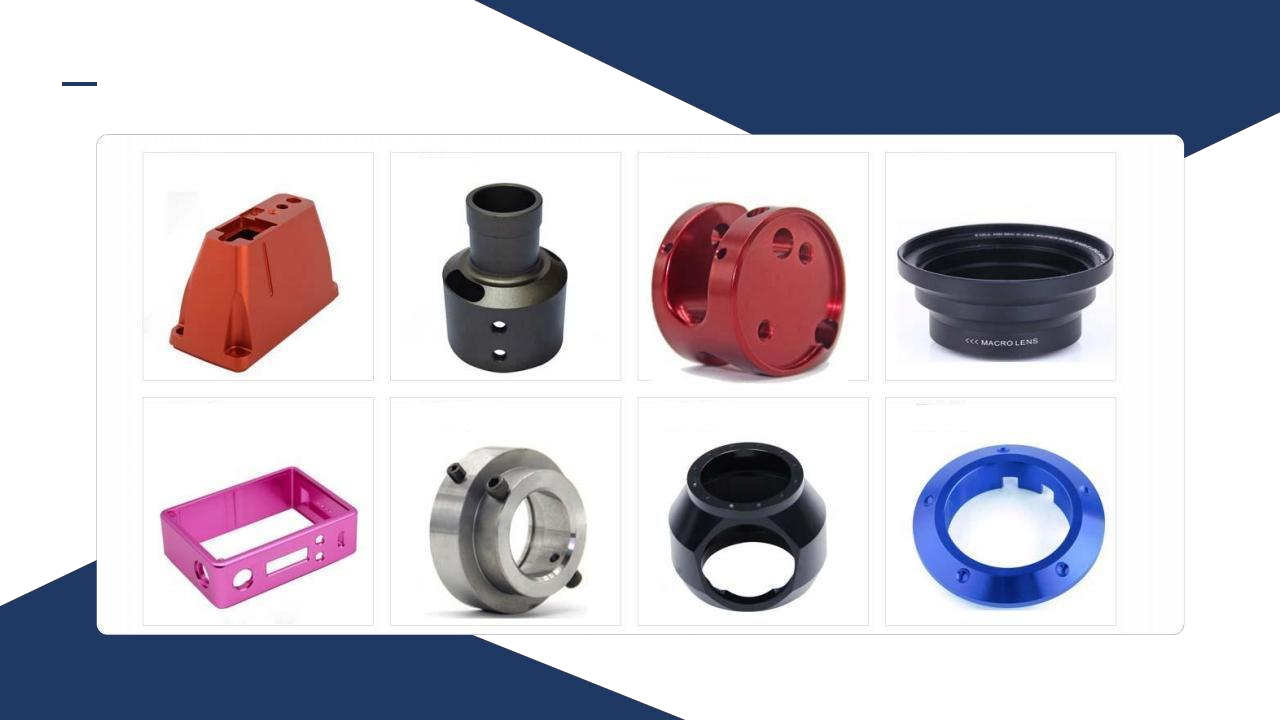
Part families produced across five process routes: stamping, deep drawing, fabrication, CNC machining and die casting.
Why “Precision Metal Mechanical Parts” Is a Difficult Category to Buy
The category name describes a quality level, not a specification. That is the root of most sourcing problems in this field. Four consequences follow from it.
- One name, many processes. Stamping, deep drawing, fabrication, CNC machining, die casting, and powder-based magnet production all produce items that a buyer would reasonably call precision metal mechanical parts. A supplier strong in one route is not automatically strong in another.
- “Precision” is not one number. General tolerance and fit systems such as ISO 2768 and ISO 286 exist precisely because the acceptable deviation depends on the feature and its function. A supplier’s inspection method matters as much as the tolerance value printed on the drawing.
- Quotations are not automatically comparable. Material grade, scrap rate, tooling amortisation, batch size, surface treatment, and inspection depth all move the price. Two quotes for the “same part” can describe two different products.
- Supplier capability is asymmetric. A company that manufactures stator and rotor cores, machined shafts, die-cast housings, and NdFeB magnet assemblies operates a very different cost and quality model from a workshop that only stamps sheet metal.
The practical risk at the discovery stage is therefore not overpaying on a single line item. It is placing non-comparable quotations into one spreadsheet, or shortlisting a supplier whose process route cannot hold the tolerance the design requires.
Where Precision Metal Mechanical Parts Sit in the Wider Market
The short answer: this is a large, fragmented category in which metal is the dominant material, and demand is driven by motors, vehicles, medical equipment, instrumentation, and energy hardware.
Commercial research published by Dataintelo values the global precision parts market at USD 98.4 billion in 2025, with the metal segment holding the largest share at 58.3% of global revenue (Dataintelo, Precision Parts Market Size, Share & Forecast Report 2025 to 2034, March 2026). A narrower slice of the same landscape is measured separately: the global motor cores market, covering stators, rotors, and housings, is valued at USD 8.7 billion in 2025, with EV motor cores as the largest segment at 38.5% (Dataintelo, Motor Cores Market Size, Share & Forecast Report 2025 to 2034, May 2026).
Read these two figures separately. Market studies draw the boundary of “precision parts”, “precision machining”, and “motor cores” differently, and commercial estimates of this kind should be checked against their methodology before they are used for investment decisions. They describe demand direction; they are not a quotation benchmark.
On the technical side, published buyer guidance for 2026 places high-quality precision metal parts at tolerances as tight as ±0.001 mm, and references ISO 2768 and ISO 286 as the general tolerance and fit framework (MFG Solution, Precision Metal Parts: Complete Buyer’s Guide 2026). That figure is a capability ceiling, not a default. Every tightening of tolerance adds machining time, inspection time, and scrap, so tolerance should be specified where function demands it and left general where it does not.
On the trade side, the UN Comtrade database records merchandise trade classified by commodity and trading partner. UNdata lists iron and steel articles under HS chapter 73, including heading 7326 for articles of iron or steel not elsewhere specified, and metals, cermets, and articles thereof under HS chapter 81 (United Nations Statistics Division). Both chapters are broad. They are useful as a starting point for customs-code research and import-source screening, but a single HS heading contains heterogeneous products and cannot be treated as a market total for precision parts.
How Pengsheng Technology Covers the Category
Chunan Qiandaohu Pengsheng Technology Development Co., Ltd. is a China-based manufacturer and trading company focused on mechanical hardware accessories. The company was established in 2008, operates a 10,000 m² manufacturing facility in Chunan County, Hangzhou, Zhejiang Province, and employs more than 150 staff, including an R&D team of more than 30 engineers. It reports annual production capacity of 10,000,000 units, with export business accounting for 50% of total sales and major markets in the EU and the USA.
For a supplier with this breadth, the useful question is not “can you make it” but “which process route will you use, and which part families sit on your own line”. The scope below answers that in the terms a buyer can verify against a drawing.
Process scope
The custom manufacturing service covers five routes: sheet metal stamping, sheet metal deep drawing, sheet metal fabrication, CNC machining, and die casting. No single model designation is assigned to the service; it is identified by process scope rather than by a model number, and parts are produced in custom manufacturing scenarios based on customer drawings or customer samples. Prototype development, mold development, small-batch trial production, and large-scale production are all supported within the same supplier relationship.
Material scope
Stainless steel, carbon steel, aluminum alloys, and copper and copper alloys are the materials named for the general part scope. For the die casting process, aluminum, zinc, and magnesium alloys are the commonly used materials. Material grade, temper, and surface treatment are confirmed against the drawing rather than inferred from the category name — this is the single most common source of mismatch between an enquiry and a production-ready part.
Magnet, rotor core and stator core scope
Alongside machined and formed metal parts, the company produces NdFeB magnets, SmCo magnets, Alnico magnets, ferrite magnets, and magnetic assemblies. Published grade ranges are NdFeB N35 to AH52, SmCo SMCO5 and SM2CO17, ferrite Y25 to Y40, and Alnico Alnico2 to Alnico9. The product media also shows permanent magnet rotor assemblies, stator cores, rotor cores, motor housings, and shafts, including a medical shaft among the shaft parts.
This overlap matters to mechanical buyers because a rotor core, a shaft, and a magnet assembly are usually qualified as one functional set. A bore tolerance that is acceptable in isolation can become a vibration or balancing problem once the magnet assembly is pressed onto the shaft. Sourcing the metal parts and the magnetic parts from one supplier removes one interface from that problem.
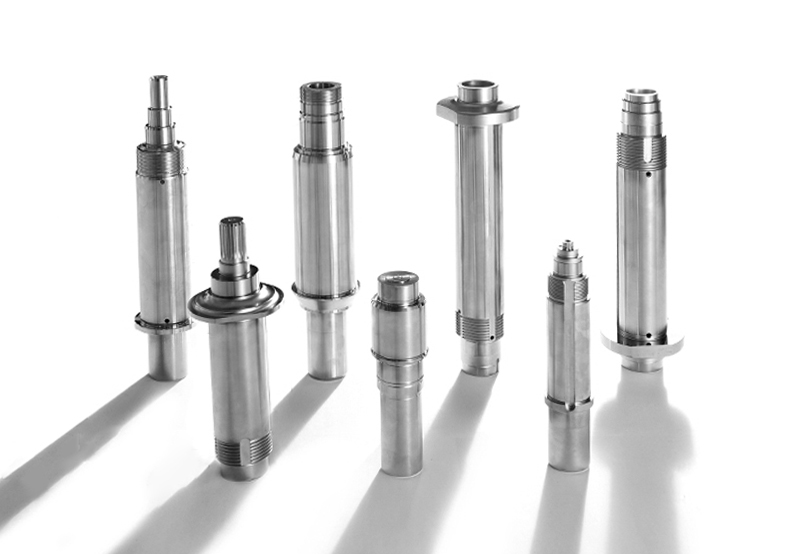
Shafts are one of the core part families, produced to customer drawings with agreed tolerance and surface finish.
Automotive part example
A concrete illustration of how part number, fitment, and material combine is the automotive parts range: model designations 51450-SV4-000, 52390-SDA-A01, 51395-T2A-A03, and 52370-TEA-T00, covering automotive suspension parts, automotive accessory brackets, automotive adjustment rods, and automotive tie rods. These parts are designed for Honda Accord 1992–1997 fifth-generation vehicles with 2.2 and 2.0 litre engines and chassis codes CDS, CD4, CB3, and CB7, and are produced from cold-rolled sheet and pickled sheet materials.
From Drawing to Delivery: The Step-by-Step Route
Custom precision metal parts move through a fixed sequence: drawing review, process route selection, tooling or programming, prototype and trial production, inspection, batch production, and delivery. Each step is a decision point where an unclear input becomes an expensive correction later.
- Requirement review. The supplier needs 2D/3D drawings, the required material specification, surface-treatment requirements, the estimated order quantity, and the application scenario. Complete drawing information is what allows an accurate quotation and a technical evaluation rather than an estimate.
- Process route selection. The same geometry may be feasible by stamping, deep drawing, CNC machining, or die casting. The route is chosen on batch size, tolerance, tooling cost, and material — not on habit.
- Tooling or programming. Mold development, die design, or CNC programming is prepared for the selected route. Tooling decisions determine the cost curve: they are fixed early and amortised across the batch.
- Prototype and trial production. Prototype verification and small-batch trial production are used to confirm that the drawing can be held in production conditions, not only in a sample cell.
- In-process inspection. Production runs according to drawings with 100% product inspection, and the company describes monitoring all processes from raw material to blank to finished product through an information-based approach.
- Final inspection and packing. Finished parts are checked, then packed for shipment in the format agreed with the buyer.
- Delivery and after-sales. A dedicated team manages delivery scheduling, a contract can be signed to guarantee quality where required, and a separate after-sales team handles problems that appear after shipment.
Where These Parts Are Used
Application determines specification more than category language does. The industries below are the ones named in the company’s product and application scope, together with the specification question each one pushes to the front.
- Automotive. Suspension parts, brackets, adjustment rods, and tie rods where fitment, material consistency, and batch traceability drive the requirement. Cold-rolled and pickled sheet are the base materials for the automotive parts shown in the current range.
- Medical devices. Medical shafts appear among the shaft parts in the product media. Surface condition, dimensional consistency, and clean handling are the first questions, not price per piece.
- Industrial motors. Stator cores, rotor cores, motor housings, and permanent magnet rotor assemblies. Here the tolerance of the lamination stack, the bore, and the shaft fit interact directly with efficiency and noise.
- Green energy and wind power generation. Magnetic assemblies and structural metal parts where service life and corrosion protection dominate the specification.
- Instrumentation, electronics, and telecommunications. Small precision hardware where repeatability across a long production run matters more than single-part complexity.
- Electrical appliances, lighting, furniture, and consumer hardware. Stamped and fabricated components where cost per unit and tooling amortisation decide the route.
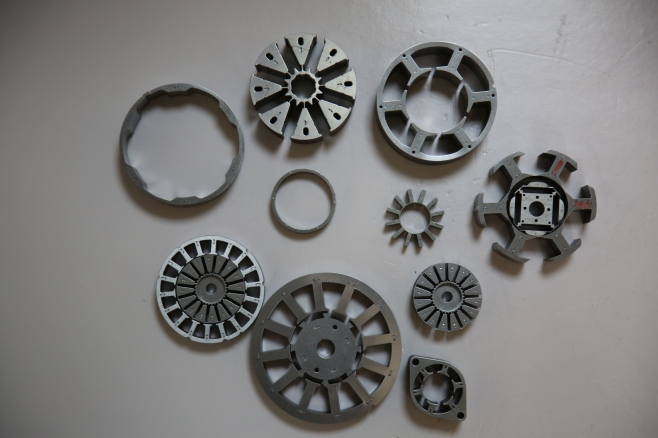
Stator cores and rotor cores are qualified together with the shaft and magnet assembly they operate with.
Comparison: Manufacturing Routes at a Glance
The table below compares the five routes within the company’s process scope. It is a selection aid, not a rule: the final route is confirmed against the drawing, the batch size, and the material.
| Manufacturing route | Materials named in the process scope | Typical part character | What to confirm before ordering |
|---|---|---|---|
| Sheet metal stamping | Stainless steel, carbon steel, aluminum alloys, copper and copper alloys | Flat or formed parts produced from sheet, repeated across a production run | Tooling approach, burr limit, flatness, inspection method |
| Sheet metal deep drawing | Stainless steel, carbon steel, aluminum alloys, copper and copper alloys | Cup, shell, and housing shapes formed from sheet | Draw depth, wall-thickness variation, intermediate annealing |
| Sheet metal fabrication | Stainless steel, carbon steel, aluminum alloys, copper and copper alloys | Folded, welded, and assembled frames, brackets, and enclosures | Weld standard, straightness after welding, surface finish |
| CNC machining | Stainless steel, carbon steel, aluminum alloys, copper and copper alloys | Shafts, housings, and complex geometry cut from solid stock | Tolerance callouts, datum scheme, surface roughness, cycle time |
| Die casting | Aluminum, zinc, and magnesium alloys | Complex housings and structural parts formed in a mold | Porosity acceptance, draft angle, machining allowance, coating |
A second comparison is more useful at the drawing stage: matching the part family to its function and to the specification the buyer must settle before ordering.
| Part family | Function in the assembly | Specification to agree first |
|---|---|---|
| Shaft (including medical shaft) | Transmits rotation, locates a rotating component, carries torque | Material grade, diameter tolerance, heat treatment, surface finish |
| Stator core | Provides the stationary magnetic circuit in a motor | Lamination specification, stacking, bore tolerance, insulation |
| Rotor core | Provides the rotating magnetic circuit and carries the shaft | Shaft fit, balance requirement, bore tolerance, stack length |
| Motor housing | Structural enclosure and alignment reference for the motor | Material, wall thickness, mounting-face tolerance, coating |
| Magnet and magnetic assembly | Generates the working magnetic field | Grade (NdFeB N35–AH52, SmCo SMCO5/SM2CO17, ferrite Y25–Y40, Alnico2–Alnico9), tolerance, coating, magnetization |
| Stamped and deep-drawn parts | Structural, shielding, and enclosure functions in volume | Tooling ownership, burr and flatness limits, surface treatment |
| Die-cast parts | Complex housings and brackets with integrated features | Alloy choice (Al, Zn, Mg), porosity acceptance, machining allowance |
What to Prepare Before You Request a Quotation
A quotation is only as precise as the input. Five items remove most of the back-and-forth in the first exchange:
- 2D and 3D drawings, including tolerance callouts and datum references.
- Material specification, including grade and temper where relevant.
- Surface-treatment requirements: coating, plating, passivation, or none.
- Estimated order quantity and expected annual volume, because the volume decides the route.
- Application scenario, because the end use determines inspection depth and documentation.
For magnetic parts, add the required grade and the magnetic properties that will be acceptance-tested. For assemblies, state which component is the reference datum so that the stack-up is calculated from the same surface on both sides.
Medical shafts sit at the high end of the tolerance and surface-condition requirement.
Frequently Asked Questions
What quality management certifications apply to these parts?
The company states that it operates under ISO 9001 and IATF 16949 quality management systems, and its published profile also refers to TS 16949. ROHS and REACH are listed among its honours and qualifications. Because a certificate carries a scope and a validity date, buyers should request the current certificate copies together with the quotation and check that the scope covers the specific process being ordered.
Can custom parts be manufactured from our own drawings?
Yes. OEM and ODM custom processing is available across sheet metal stamping, deep-drawn parts, CNC-machined parts, die-cast parts, and motor stator and rotor cores, manufactured to customer drawings. The route fits projects that require mold development, prototype verification, and batch production of medium-to-high-complexity parts. The quotation and the proposed process depend on the drawings, materials, and order volume provided.
What information is needed to receive an accurate price?
Provide 2D/3D drawings, the required material specification, surface-treatment requirements, the estimated order quantity, and the application scenario. Complete drawing information is what allows an accurate quotation and a technical evaluation. Where the drawing is incomplete, the supplier can still respond, but the price will carry assumptions that later change.
Can we validate a sample before committing to mass production?
Yes. Prototype development, mold development, and small-batch trial production are supported before large-scale production. The sample stage is the point to confirm tolerance, material grade, surface finish, and inspection method, because all four carry directly into the batch run and are difficult to change afterwards.
How are production and delivery handled after an order is placed?
Production runs according to drawings with 100% product inspection, and the company describes monitoring all processes from raw material to blank to finished product through an information-based approach. Delivery is managed by a dedicated team, a contract can be signed to guarantee quality where required, and a separate after-sales team handles issues that appear after shipment. To start an evaluation, send drawings and expected quantity to vincent@hzpsmag.com or +86-18758114568, or download the product catalog for the full process and part list.
Conclusion
Precision metal mechanical parts are defined by the drawing and the inspection, not by the category label. A buyer who can answer three questions early — which process route suits the geometry and volume, which material grade actually applies, and which tolerance the function truly needs — removes most of the cost and quality risk from the project before the first purchase order exists.
For a supplier evaluation, the practical test is coverage. A manufacturer that produces stamped and deep-drawn sheet parts, CNC-machined shafts, die-cast housings, stator and rotor cores, and NdFeB or SmCo magnetic assemblies within one quality system can carry a multi-part assembly without handing the interface risk back to the buyer. Chunan Qiandaohu Pengsheng Technology Development Co., Ltd. operates across that range from a 10,000 m² facility in Hangzhou, Zhejiang Province, China, with more than 30 engineers in R&D and 50% of sales from export markets in the EU and the USA.
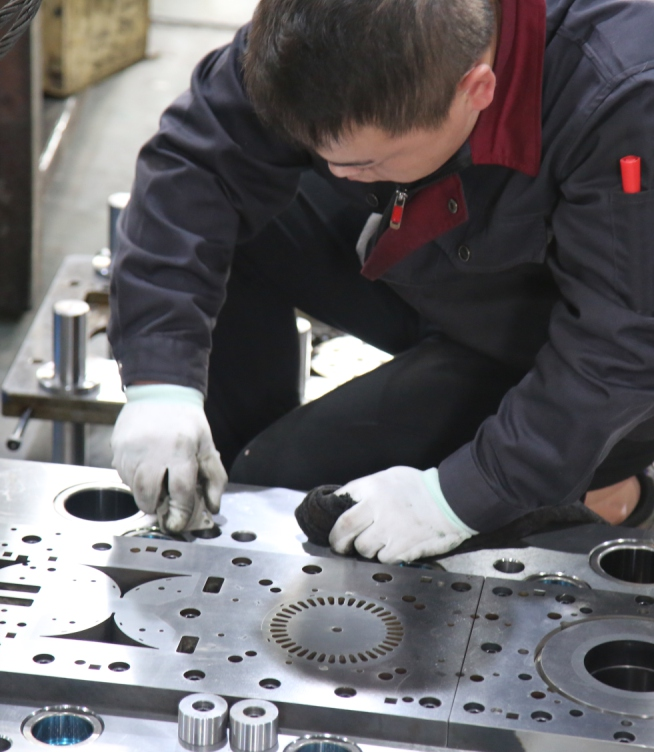
Inspection is where the specification is confirmed: production follows drawings with 100% product inspection.
Next Step: Send a Drawing, Get a Process Answer
Share your 2D/3D drawings, material specification, surface-treatment requirement, and expected quantity. The response covers the recommended process route, the quotation basis, and the inspection approach — not just a price.
Catalog (PDF): Download the Pengsheng Technology product catalog
Email: vincent@hzpsmag.com | Phone / WhatsApp: 0086-18758114568 | Website: www.hzpsmat.com
Address: No.35 Lingpan, Yanchang Village, Fengshuling Town, Chunan County, Hangzhou City, Zhejiang Province, China
Have Questions or Need More Details?
Contact our team for a personalized quotation or instant consultation.
Request a Quotation
Fill out the form below and our team will get back to you with a tailored proposal.
WhatsApp Direct Chat
Prefer to chat in real-time? Message us on WhatsApp for instant assistance & quick answers.
- Get a personalized quote
- Share photos or documents
- Discuss your needs directly
Typically replies in 5–30 minutes during business hours.