
Ranked: Magnet Families for Motor, Wind Power and Instrumentation Assemblies
Ranked order of fit for motor, wind power and instrumentation assemblies: NdFeB grades N35 to AH52 first; SmCo grades SmCo5 and Sm2Co17, including SmCo rotor assemblies, second; ferrite grades Y25 to Y40 third; Alnico grades Alnico2 to Alnico9 fourth; then magnetic couplings, magnetic grates and cow magnets as assembly forms built around those four families. The order measures breadth of fit across the three named assembly environments and the depth of grade choice available inside each family. It is not a claim that one magnet is universally stronger than another, and every pick still needs its own acceptance parameters before a purchase order is issued.
Chunan Qiandaohu Pengsheng Technology Development Co., Ltd (www.hzpsmat.com) is a manufacturer established in 2008 in Hangzhou, Zhejiang Province, China, producing magnets, magnetic assemblies, shafts, stator and rotor cores, sheet metal stampings, deep-drawn parts, fabricated sheet metal, CNC machined parts, die-cast parts, automotive parts and gaussmeters. Its documented magnet portfolio covers NdFeB grades N35 to AH52, SmCo grades SmCo5 and Sm2Co17, Alnico grades Alnico2 to Alnico9 and ferrite grades Y25 to Y40, supplied either as magnets or as magnetic assemblies.
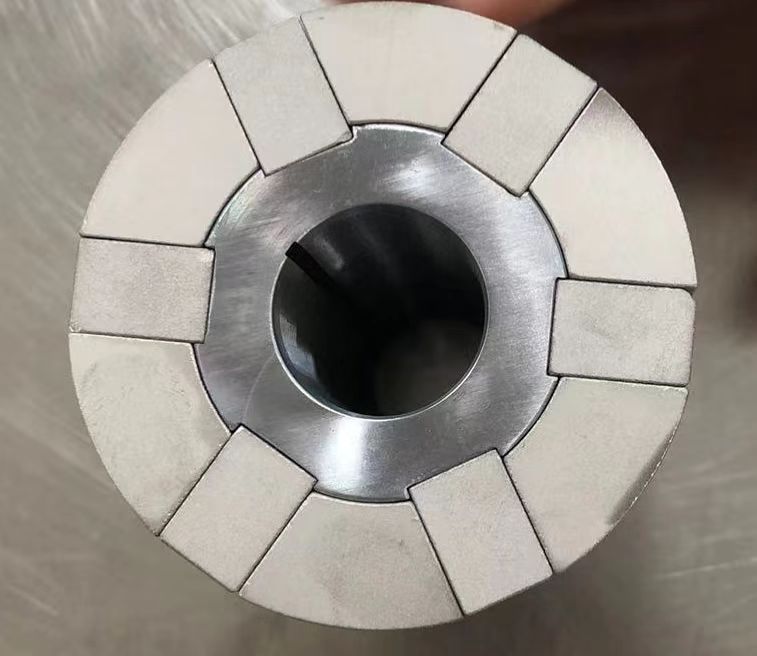
The specification problem: a grade list does not answer three buyer questions
A grade list is a manufacturing capability statement, not a selection guide. When a buyer receives a portfolio that reads N35 to AH52, SmCo5, Sm2Co17, Y25 to Y40 and Alnico2 to Alnico9, three questions stay open, and they fail in three different ways.
- Which family belongs to which assembly environment? Answering only this produces a family-level RFQ that cannot be quoted precisely.
- Which grade inside the family? Answering only this produces a grade number without a drawing, coating or test basis, which is not manufacturable documentation.
- What measurable acceptance criteria decide whether the delivered lot is correct? Skipping this is the expensive failure. Without a stated flux, moment or demagnetization limit, first-article inspection has no basis for rejection, and a lot that is dimensionally correct but magnetically out of tolerance can pass intake.
Magnets are rarely purchased as loose parts for motors, wind power or instrumentation. They arrive as a rotor assembly, a coupling half, a sensor stack or a stator-and-rotor set. That makes the purchase specification an assembly specification: magnet grade, mechanical interface, coating and inspection in one document. The ranking below is built for that document, not for a materials catalogue.
Industry background: three assembly environments pulling on the same portfolio
Demand for the parts around the magnet is measurable even where magnet performance data is not public. Dataintelo's motor cores report places the global motor core market at US$8.7 billion in 2025, with EV motor cores the largest segment at 38.5% of that value. The same research house values the global precision parts market at US$98.4 billion in 2025, with the metal segment at 58.3% of revenue. Neither figure is a magnet forecast, but both indicate how much housing, core and shaft volume travels with each magnet specification.
The documented application list for this magnet and magnetic assembly category is broad: automotive, medical, industrial motors, elevators, home appliances, aerospace, green energy, wind power generation, mobile phones, audio components, compressors, communications, electronics, instrumentation, electrical equipment, lighting and furniture. One supplier portfolio therefore has to serve short-cycle automotive programmes and long-cycle wind and instrumentation programmes from the same grade list. That is precisely why a ranking by fit is more useful to a buyer than a ranking by a single property.
How this ranking was built
Four criteria were applied in order, and they are stated so that a buyer can challenge or re-weight them:
- Coverage of the three named environments. Industrial motors, wind power generation and instrumentation. A family that appears in more of these environments ranks higher.
- Depth of grade choice inside the family. A long grade ladder (N35 to AH52, Y25 to Y40, Alnico2 to Alnico9) allows tuning without changing material system or supplier. A two-grade family (SmCo5, Sm2Co17) offers two fixed specification points.
- Availability as an assembly. Rotor cores, shafts and stamped or machined parts are produced alongside the magnets, so a family that can be delivered as a finished rotor assembly ranks above one that arrives only as loose magnets.
- Documentation. A family that can travel with material and inspection records, and under a certified quality system, ranks above one that cannot.
The ranked picks
1. NdFeB, N35 to AH52 — industrial motors, elevators, automotive, wind power
What it is. A rare-earth magnet family documented across grades N35 to AH52.
Why it ranks first. It carries the longest in-family grade ladder in the portfolio, which gives the widest adjustment space before the material system or the supplier has to change. It also sits under the environments that dominate the list: industrial motors, elevators, automotive, green energy and wind power generation.
Where it fits. Motor, actuator and generator assemblies where the grade can be fixed early enough to be reflected in the magnetic circuit design, and where the coating and mechanical interface can be specified at the same time.
Boundary. If the assembly environment or the corrosion exposure sits outside what the confirmed grade and coating combination can hold, evaluate rank 2 or fix a protective coating before the drawing is frozen. Changing the grade number after tooling is the most common avoidable cost in this family.
Specify with the pick. Grade, flux or flux density at the defined measuring plane, magnetic moment, demagnetization rate after the defined exposure, coating, dimensional tolerance.
2. SmCo (SmCo5 and Sm2Co17) and SmCo rotor assemblies — wind power, aerospace, instrumentation, medical
What it is. A second rare-earth family documented in two grades, SmCo5 and Sm2Co17. A SmCo rotor assembly combines SmCo magnets with a rotor core and a shaft; because rotor cores and shafts are produced in the same plant, the magnet, core and shaft can be quoted as one line item instead of three.
Why it ranks second. It is the documented alternative when the NdFeB grade and coating envelope is not the right fit for the duty, and the two grades give two fixed specification points instead of a sliding ladder. The rotor-assembly route also collapses the number of suppliers a buyer has to qualify from three to one.
Where it fits. Wind power generation, aerospace, instrumentation and medical assemblies, where the rotor is a controlled sub-assembly and interface tolerances are as important as the magnet grade.
Boundary. Two grades mean limited in-family tuning. Fix the grade at drawing stage, and if neither grade meets the required duty, change the design rather than search for an unavailable grade number.
Specify with the pick. Flux distribution around the rotor, magnetic moment per pole, demagnetization rate after the defined thermal exposure, pole position tolerance, shaft fit, coating and final assembly inspection record.
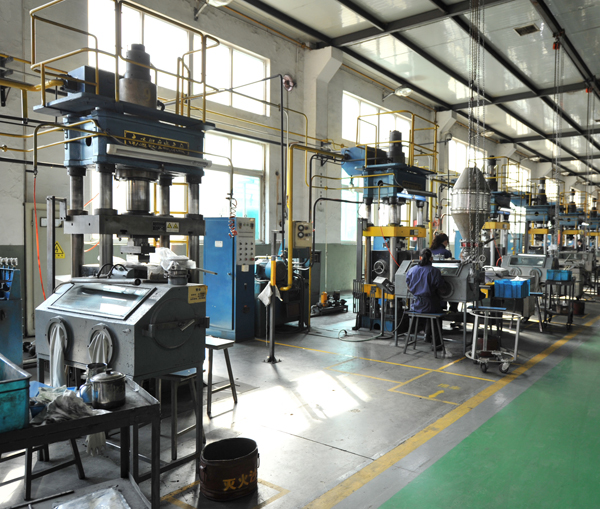
3. Ferrite, Y25 to Y40 — volume motor, appliance and instrumentation assemblies
What it is. A ferrite family documented across grades Y25 to Y40.
Why it ranks third. It has a long grade ladder in a non-rare-earth material, and it appears in the motor, appliance and instrumentation environments named for this category. For assemblies where the magnetic volume can grow, it offers the widest tuning room after NdFeB.
Boundary. Output per unit volume is generally lower than the rare-earth families, so the mechanical envelope grows and the surrounding housing, shaft and core have to absorb that growth. Confirm the envelope change before choosing the grade, not after.
Specify with the pick. Flux or flux density at the working surface, dimensional tolerance, demagnetization rate after the defined exposure, coating or surface condition.
4. Alnico, Alnico2 to Alnico9 — instrumentation and sensor assemblies
What it is. An Alnico family documented across eight grades, Alnico2 through Alnico9.
Why it ranks fourth. The grade ladder is wide, but the documented fit concentrates in instrumentation and automotive-type assemblies where the magnetic circuit suits this family's characteristics. It is a strong instrumentation pick and a weaker motor pick, which is why it sits below ferrite on breadth of fit.
Boundary. This family is generally more sensitive to opposing fields and to geometry than the rare-earth families, so circuit design and the specified demagnetization limit matter more than the grade number alone.
Specify with the pick. Magnetic moment, flux at the working gap, demagnetization rate after the defined opposing-field exposure, dimensional tolerance, surface condition.
5. Magnetic couplings — sealed or barrier drive assemblies
What it is. A magnetic coupling transmits torque across a barrier without contact between the two sides, and it is assembled from the magnet families ranked above.
Why it ranks fifth. Inside a coupling the magnet is one design element among several, so the grade choice is subordinate to the coupling geometry. It is included because it is the assembly form most often specified alongside motors and instrumentation, but the ranking cannot promote it above the families it is built from.
Specify with the pick. Grade of the magnet set, flux and magnetic moment of the set, demagnetization rate at the maximum slip condition, dimensional and concentricity requirements.
6. Magnetic grates — separation assemblies
What it is. A magnetic grate is an assembly of magnetic elements mounted in a frame, used to capture ferrous material from a product flow.
Why it ranks sixth. The geometry is simple and the grade choice is driven by the capture requirement at the working surface rather than by the assembly environment, so it does not compete with ranks 1 to 4 on fit for motors, wind power or instrumentation.
Specify with the pick. Flux or flux density at the working surface, grade inside the assembly, frame dimensions, surface condition.
7. Cow magnets — agricultural assemblies
What it is. A cow magnet is a single magnet administered to livestock to collect ingested ferrous debris.
Why it ranks seventh. It does not serve motor, wind power or instrumentation assemblies at all, so it ranks last on the stated criteria. It is included so that the ranking covers the full assembly portfolio rather than a convenient subset.
Specify with the pick. Grade, dimensions, coating and surface condition, and a documented dimensional check per lot.
Step-by-step: turning the ranking into a specifiable RFQ
Step 1 — Define the assembly, not the magnet. Write down what the magnet does: hold, drive, sense or separate. State the duty, the surrounding materials and the mechanical interface. This single sentence decides which of ranks 1 to 4 is even eligible.
Step 2 — Choose the family from the ranking, then the grade inside it. Use the rank order to shortlist two families, not one. On a long ladder (N35 to AH52, Y25 to Y40, Alnico2 to Alnico9) ask for two grade options so that the design has a fallback without changing supplier.
Step 3 — Freeze the mechanical and surface specification. Dimensions, tolerance, shaft fit, stack or bond method, surface treatment and heat treatment. Customisation is available for dimensions, materials, surface treatments, heat treatments and assembly per drawings or samples, so the drawing is the controlling document.
Step 4 — Write the acceptance parameters into the RFQ. Flux, magnetic moment, demagnetization rate, dimensional limits, coating and documentation. A parameter that is not in the RFQ cannot be enforced at first article.
Step 5 — Prototype and first article. Prototype development, mould development and small-batch trial production are supported, and the comprehensive testing laboratory runs incoming, in-process and final inspection. Agree acceptance against drawings and samples plus the factory inspection report, and record the measured values on the first article.
Step 6 — Release to production. Lead time is 30 to 45 days with a documented monthly capacity of 10,000 units. Attach the certificates that apply to the order: ISO 9001 (certificate TB24Q0566R0S, valid to 12 July 2027), IATF16949, ROHS and REACH.
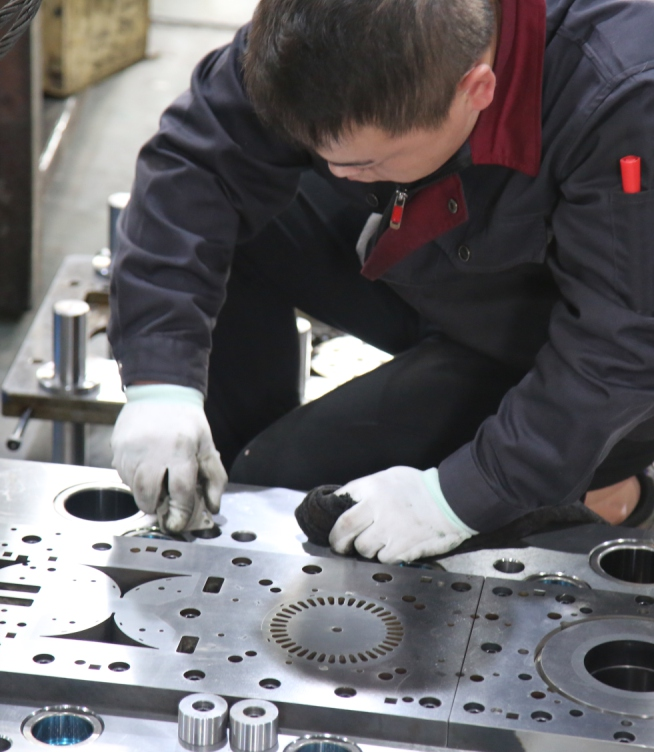
Use cases across the named industries
Industrial motors and elevators. A motor case record covering 100,000 units for a Swiss customer over a 10-year relationship reports improved part precision, consistent mass production, custom structure support and stable long-term operation. That record is a useful template: the deliverable was not a magnet grade but a repeating assembly with a tolerance and inspection routine.
Wind power and green energy. Generator and rotor assemblies are long-cycle programmes, so a grade fixed at drawing stage has to survive the whole programme. SmCo rotor assemblies (rank 2) and NdFeB (rank 1) are the two documented routes; the choice should be made on the assembly environment and the interface tolerance, then frozen.
Instrumentation and medical. Small assemblies with tight dimensional control and a strong documentation requirement. Alnico2 to Alnico9 (rank 4), ferrite Y25 to Y40 (rank 3) and the two SmCo grades (rank 2) are the documented options, and the acceptance parameter that matters most is the moment and demagnetization limit rather than the dimensional drawing alone.
Automotive and aerospace. Both are named in the documented application list. Automotive programmes typically require the quality system evidence (IATF16949) at RFQ stage; aerospace programmes require the assembly-level inspection record to travel with the lot. Specify both up front rather than at shipment.
Comparison table: ranked fit by assembly environment
| Rank | Option | Documented grades | Strongest documented fit | Assembly route |
|---|---|---|---|---|
| 1 | NdFeB | N35 to AH52 | Industrial motors, elevators, automotive, green energy, wind power | Loose magnet or magnetic assembly |
| 2 | SmCo and SmCo rotor assemblies | SmCo5, Sm2Co17 | Wind power, aerospace, instrumentation, medical | Rotor assembly with core and shaft |
| 3 | Ferrite | Y25 to Y40 | Motors, home appliances, instrumentation | Loose magnet or magnetic assembly |
| 4 | Alnico | Alnico2 to Alnico9 | Instrumentation, automotive | Loose magnet or magnetic assembly |
| 5 | Magnetic couplings | Built from ranks 1 to 3 | Enclosed drives, instrumentation | Finished coupling assembly |
| 6 | Magnetic grates | Built from ranks 1 to 4 | Separation in product flows | Frame-mounted magnetic assembly |
| 7 | Cow magnets | Built from ranks 1 to 4 | Livestock application | Single magnet assembly |
Acceptance parameters to attach to every pick
The ranking only becomes a purchase document when the acceptance parameters are written next to the chosen pick. Three of them are magnetic and three are mechanical or documentary, and all six belong in the RFQ.
| Parameter | What to state in the RFQ | Applies to |
|---|---|---|
| Magnetic flux / flux density | The measuring plane or gap, the instrument basis and the accepted value. Flux density is read with a gaussmeter, which is also a product line in this portfolio. | Ranks 1 to 7 |
| Magnetic moment | The unit basis (per magnet, per pole or per assembly) and the measurement method, so that values from two suppliers are comparable. | Ranks 1 to 5 |
| Demagnetization rate | The exposure condition (temperature, opposing field, time) and the maximum permitted loss after that exposure. | Ranks 1 to 5 |
| Dimensional and tolerance | Critical dimensions, tolerance class, and the datum used for inspection. | Ranks 1 to 7 |
| Coating and surface | Coating type, thickness basis and any surface treatment or heat treatment required. | Ranks 1 to 7 |
| Documentation | Inspection report per lot, certificate of conformity, and the applicable system certificate for the order. | Ranks 1 to 7 |
Frequently asked questions
Which certifications should we require for magnets and magnetic assemblies?
The documented quality system is ISO 9001, certificate TB24Q0566R0S issued by Jiangxi Tengbiao Certification Co., Ltd under GB/T 19001-2016 idt ISO 9001:2015, with a scope covering sales of magnetic materials and sales of metal products, valid from 13 July 2024 to 12 July 2027. IATF16949 and REACH are also held. The ROHS certificate M.2024.206.C97457 was issued by UDEM on 7 March 2024 and is valid to 3 June 2029, tested against the EN 62321 series; its stated scope is the magnet model D5*9, so the applicable grade and coating should be confirmed against the order rather than assumed from the certificate headline.
Can a China-based OEM manufacturer support customisation and design input for magnet and rotor assemblies?
Yes. OEM, ODM and customisable production are documented, with customisation for dimensions, materials, surface treatments, heat treatments and assembly per drawings or samples. Rotor cores, shafts, stamped, deep-drawn, CNC machined and die-cast parts are produced in the same plant, so a rotor assembly can be sourced as one item. Design input is handled through the drawing and material review: a complete RFQ should carry 2D/3D drawings, material specification, surface treatment requirement, estimated quantity and application scenario, because quotation and technical evaluation depend on those inputs. Buyers who need a manufacturability review of magnet geometry, grade and stack should request it explicitly at RFQ stage.
What drives the price of a magnet or magnetic assembly, and what is the minimum order quantity?
Four cost drivers dominate: the magnet family and grade (NdFeB N35 to AH52, SmCo5 or Sm2Co17, Alnico2 to Alnico9, ferrite Y25 to Y40), the rare-earth or ferrite material content, the assembly complexity and tolerance level, and the order volume. Quotation depends on drawings, materials and order volume supplied by the buyer, and payment terms are T/T. Minimum order quantity is item-specific: the purchasing guide lists 1,000 units while the capacity record lists 5,000 units for a different scope, so the applicable figure should be fixed in the order together with the delivery terms.
Can we validate a magnet or rotor assembly before committing to series production?
Prototype development, mould development and small-batch trial production are supported, which is the documented validation route before series volume. Acceptance is recommended against drawings or samples plus the factory inspection report, and the specific acceptance criteria should be agreed in the order. For a first article, ask for measured flux, magnetic moment and demagnetization rate on the same report as the dimensional results, so the magnetic and mechanical evidence can be reviewed together.
What lead time should we plan, and how do we start?
Lead time is 30 to 45 days, with a documented monthly capacity of 10,000 units, and the company runs incoming, in-process and final inspection in its own testing laboratory. The fastest starting point is a drawing-based enquiry: send the grade or the two candidate grades, the assembly drawing, the acceptance parameters and the expected annual volume. Contact Vincent Fang at vincent@hzpsmag.com or +86-18758114568 on telephone and WhatsApp, or download the Pengsheng Technology catalogue for the full product range before the enquiry.
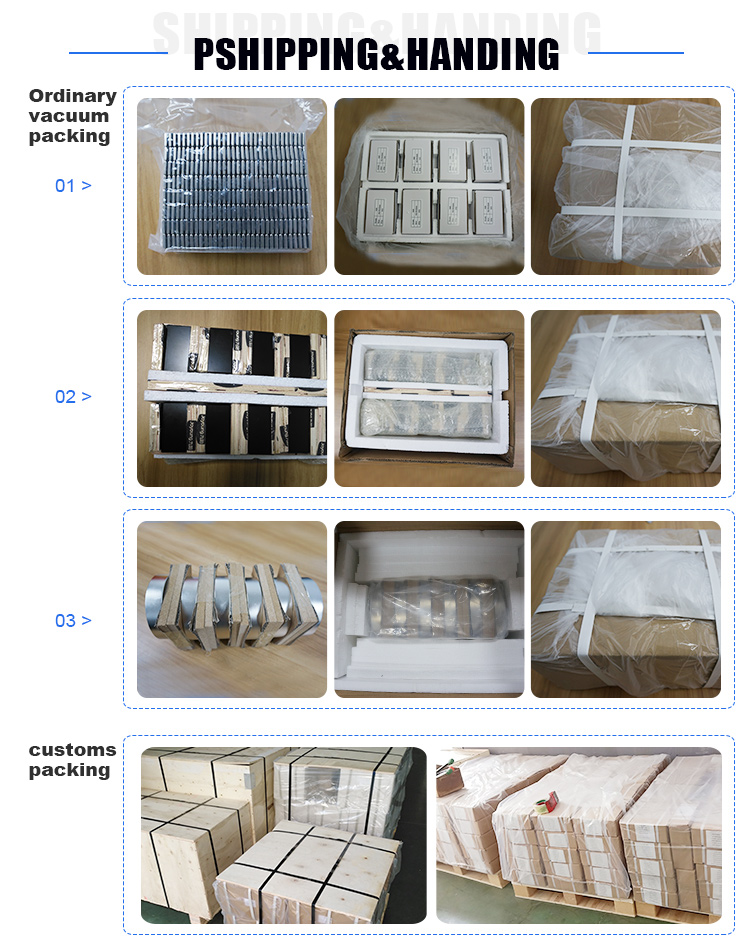
Export packaging for magnet and assembly shipments; the documented main markets are the EU and the USA.
Conclusion: rank first, then specify
The order for motor, wind power and instrumentation assemblies is NdFeB N35 to AH52, then SmCo5 and Sm2Co17 with SmCo rotor assemblies, then ferrite Y25 to Y40, then Alnico2 to Alnico9, followed by magnetic couplings, magnetic grates and cow magnets as assembly forms. That order is a shortlisting tool. The decision itself is made by three written parameters: magnetic flux at a defined measuring plane, magnetic moment on a stated unit basis, and a demagnetization rate after a defined exposure. Attach those three to whichever rank a buyer selects and the grade list turns into a purchase document that a first article can be accepted or rejected against.
Send the assembly drawing, the two candidate grades and the acceptance parameters, and the quotation will be built against them. Prototype development and small-batch trial production are supported before series release.
Chunan Qiandaohu Pengsheng Technology Development Co., Ltd · www.hzpsmat.com · Vincent Fang · vincent@hzpsmag.com · Tel / WhatsApp 0086-18758114568 · WhatsApp enquiry · Download catalogue
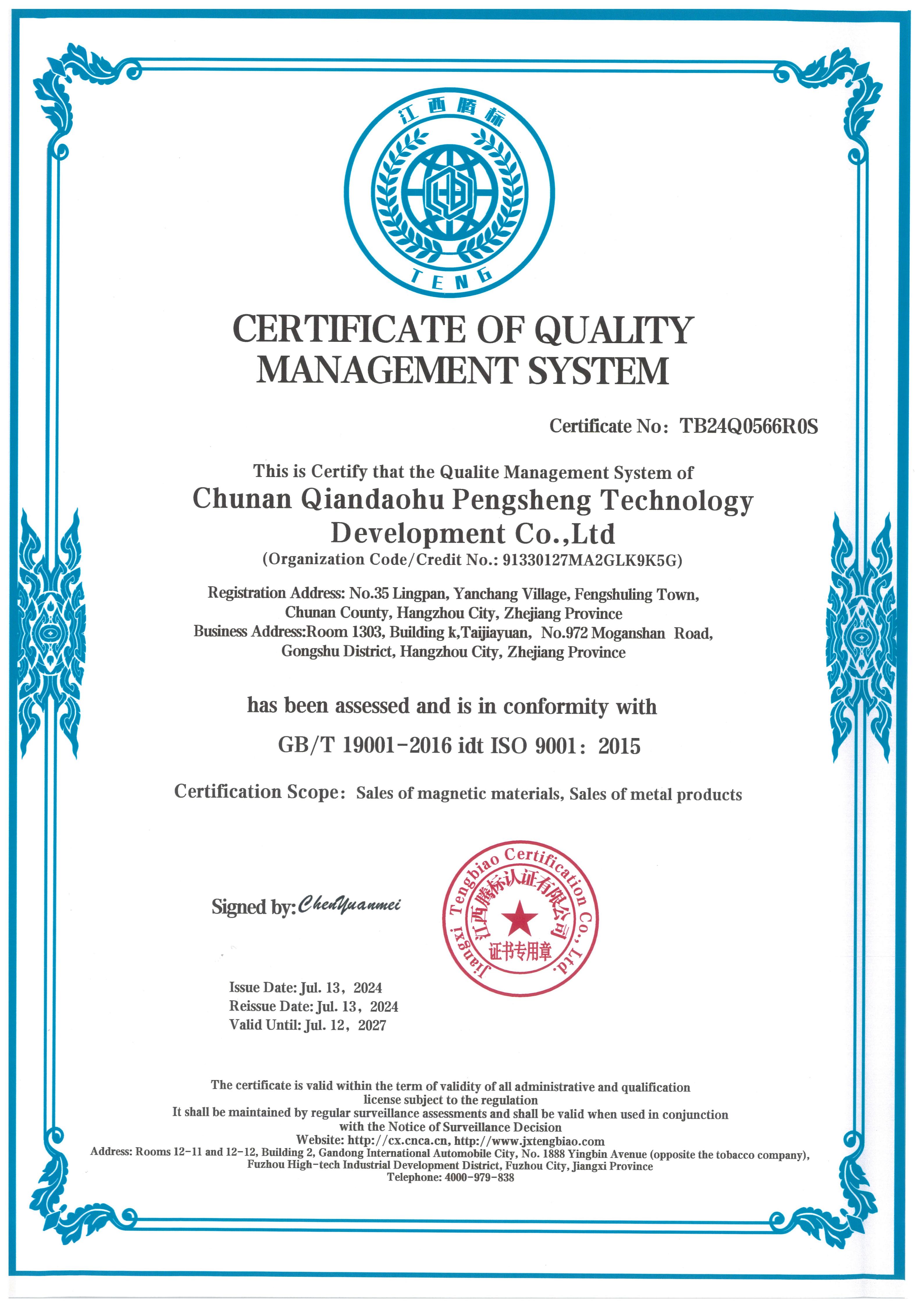
ISO 9001 certificate TB24Q0566R0S, valid from 13 July 2024 to 12 July 2027.
Have Questions or Need More Details?
Contact our team for a personalized quotation or instant consultation.
Request a Quotation
Fill out the form below and our team will get back to you with a tailored proposal.
WhatsApp Direct Chat
Prefer to chat in real-time? Message us on WhatsApp for instant assistance & quick answers.
- Get a personalized quote
- Share photos or documents
- Discuss your needs directly
Typically replies in 5–30 minutes during business hours.