
Air Cooled vs. Water Cooled Condensing Units: A Cold Room Comparison Guide
Air Cooled vs. Water Cooled Condensing Units: A Cold Room Comparison Guide
Comparing the two condensing unit options for cold room and walk-in freezer projects.
Selecting a condensing unit is a decisive part of any cold room refrigeration system project. The two most common heat-rejection approaches are air cooled and water cooled condensing units. Neither type is universally superior; the right choice depends on the project site, ambient temperature profile, water availability, maintenance capacity and system layout. This guide compares air cooled vs. water cooled condensing units for cold rooms and provides a decision framework for buyers at the evaluation or purchase stage.
Why the Comparison Matters for Cold Room Buyers
In a cold room, the indoor unit — a cold room air cooler, cold room evaporator or unit cooler — removes heat from the air. The condensing unit rejects that heat outdoors or into a water circuit. If the condensing unit is not matched to the evaporator and room load, the system may run longer, use more energy, or fail to reach the required temperature.
For buyers, this is not a one-size-fits-all decision. An air cooled unit may be easier to install in many commercial projects. A water cooled unit may be considered when a larger facility already has water infrastructure. The following sections explain the practical trade-offs.
Industry Context: A Global Condensing Unit Demand Base
The condensing unit market has been expanding. Stratview Research valued the global condensing unit market at USD 42 billion in 2023, with a projected CAGR of 7.95%. Grand View Research estimated the global industrial refrigeration systems market at USD 21.3 billion in 2024. In the same period, Asia Pacific led the condensing unit market with a revenue share of 70.22% in 2023. This market context helps explain why cold room buyers are comparing air cooled and water cooled configurations rather than relying on one default design.
What Is a Condensing Unit in a Cold Room Refrigeration System?
A condensing unit is a packaged part of the refrigeration loop. It houses the compressor and condenser, often with controls and safety devices. It can be situated near a cold room and connected to an indoor evaporator. In cold room terminology, the indoor unit may be called a cold room air cooler, cold room evaporator or unit cooler. The condensing unit completes the circuit.
Manufacturers of cold room refrigeration equipment may supply the complete system: condensing unit, air cooler, controls and insulated panels. Clevier Refrigeration (Jiangsu) Co., Ltd., for example, lists evaporators, condensing units, compressors, cold rooms and PU panels as main products. This matters because circuit matching is usually easier when all major parts come from one responsible supplier.
Air Cooled Condensing Units: Key Characteristics
An air cooled condensing unit removes heat with a fan-driven flow of ambient air across the condenser coil. This is a common configuration for cold rooms because it avoids a permanent water connection.
Installation. Air cooled equipment is relatively straightforward to install when an outdoor location with clearance for airflow exists. Typical work includes refrigerant piping, power wiring and controller connections. There is no need for a cooling tower or water treatment system in the basic configuration.
Impact of ambient temperature. Because the heat sink is outside air, the condensing pressure tends to increase on hot days. In climates with frequent high temperatures, the design must account for local summer peaks. In cold climates, low ambient conditions may require fan-cycle or other controls. These are engineering factors, not automatic disqualifiers.
Maintenance. The condenser coil needs periodic cleaning, and fan motors and guards should be inspected. Airflow must not be blocked by vegetation, walls, packaging or new construction.
Water Cooled Condensing Units: Key Characteristics
A water cooled condensing unit rejects heat through a water circuit. The water may come from a municipal supply, a well, a recirculated loop or a cooling tower. For many cold rooms, a water cooled system requires more site infrastructure than air cooling.
Installation. Water cooled installation is more complex. The system needs a reliable water supply, either an open loop with acceptable drainage or a closed loop with a cooling tower or fluid cooler. Pumping, piping and water controls add installation work.
Impact of ambient temperature. Water temperature is often more stable than summer air temperature. This can lead to more consistent head pressure and may be attractive in hot or dusty regions. However, actual cooling performance depends on the water supply temperature and flow rate, not only on outside air conditions.
Maintenance. Water quality matters. Scale, biological growth and debris in the water circuit can reduce heat transfer. Buyers should plan for water treatment or periodic cleaning of the heat exchanger, pump and tower if one is used.
Air Cooled vs. Water Cooled Condensing Units: Comparison Table
| Decision factor | Air cooled typical profile | Water cooled typical profile |
|---|---|---|
| Heat sink | Air moved by fans across the condenser coil | Water through a condenser jacket or heat exchanger circuit |
| Site infrastructure | Requires outdoor clearance for airflow; no permanent water circuit required | Requires water supply, drainage or recirculation, and often a cooling tower |
| Sensitivity to ambient temperature | More sensitive to high outdoor air temperature | Less dependent on outside air peaks; depends on water supply temperature |
| Installation complexity | Usually lower; simpler utility connections | Usually higher; extra piping, water pump and tower work |
| Maintenance profile | Coil cleaning, fan checks, airflow clearance | Water treatment, scale and debris control, pump and tower maintenance |
| Typical fit | Small and mid-size cold rooms, sites with limited water access | Industrial or larger projects with existing water infrastructure and higher heat rejection |
This table describes typical profiles in cold room applications. It does not replace a load calculation or manufacturer-specific project data.
Step-by-Step Selection Framework for Cold Room Condensing Units
- Define the room temperature and storage duty. Confirm whether the cold room will store chilled products, frozen products or require a quick pull-down cycle. Frozen temperature ranges from around -18°C to -25°C are common in cold storage projects and need careful evaporator-condensing unit matching.
- Calculate the design heat load. The evaporator and condensing unit must handle the room heat gain, product load, door openings, fan heat and defrost heat. A manufacturer should size the unit based on project parameters, not only room volume.
- Survey the site. Identify where the condensing unit can be placed. Check airflow clearance, ceiling or ground support, exposure to sun, and distance from the evaporator.
- Evaluate water availability and climate. If water access is limited, an air cooled unit is usually easier to support. If the site already has a water circuit, a water cooled unit may be worth modelling during the selection phase.
- Review maintenance capability. Air cooled units require coil cleaning; water cooled units require water treatment and heat exchanger care. Match the choice with the local maintenance team's skills.
- Ask the supplier to model both configurations. For a final decision, request a system comparison from your manufacturer. The comparison should include refrigerant, cooling capacity, operating temperature range and control strategy.
Use Cases for Air Cooled and Water Cooled Configurations
Small and Mid-Size Cold Rooms
Air cooled condensing units are often selected for small and mid-size cold rooms where water access is limited. They simplify installation and avoid routine water management.
Food Processing Plants and Logistics Cold Chains
These facilities often have higher heat loads and centralized refrigeration needs. Water cooled condensing units can appear where a water loop already exists and process heat rejection is substantial. Air cooled units can still be used in distributed cold room systems, depending on the number of rooms and the layout of the facility.
Walk-In Freezer Projects
Walk-in freezers require stable low-temperature operation. Both air cooled and water cooled condensing units can be applied. The deciding issues are usually site-specific: can the air cooled unit be placed where airflow is not blocked; can the water cooled unit be served by a reliable water circuit; and does the maintenance team have the necessary skills.
Supplier Evaluation: What to Check for Air Cooled or Water Cooled Cold Rooms
When comparing manufacturers for a cold room project, buyers should evaluate product scope, customization flexibility and safety documentation.
One manufacturer with condensing units and complete cold room refrigeration systems in its product range is Clevier Refrigeration (Jiangsu) Co., Ltd., a professional manufacturer of commercial and industrial refrigeration equipment. The company was founded in 2023 and operates a 10,000 m² factory in Changzhou, China. Its main products include evaporators, condensing units, compressors, cold rooms and PU panels. Export markets include Asia, South America, Africa and North America.
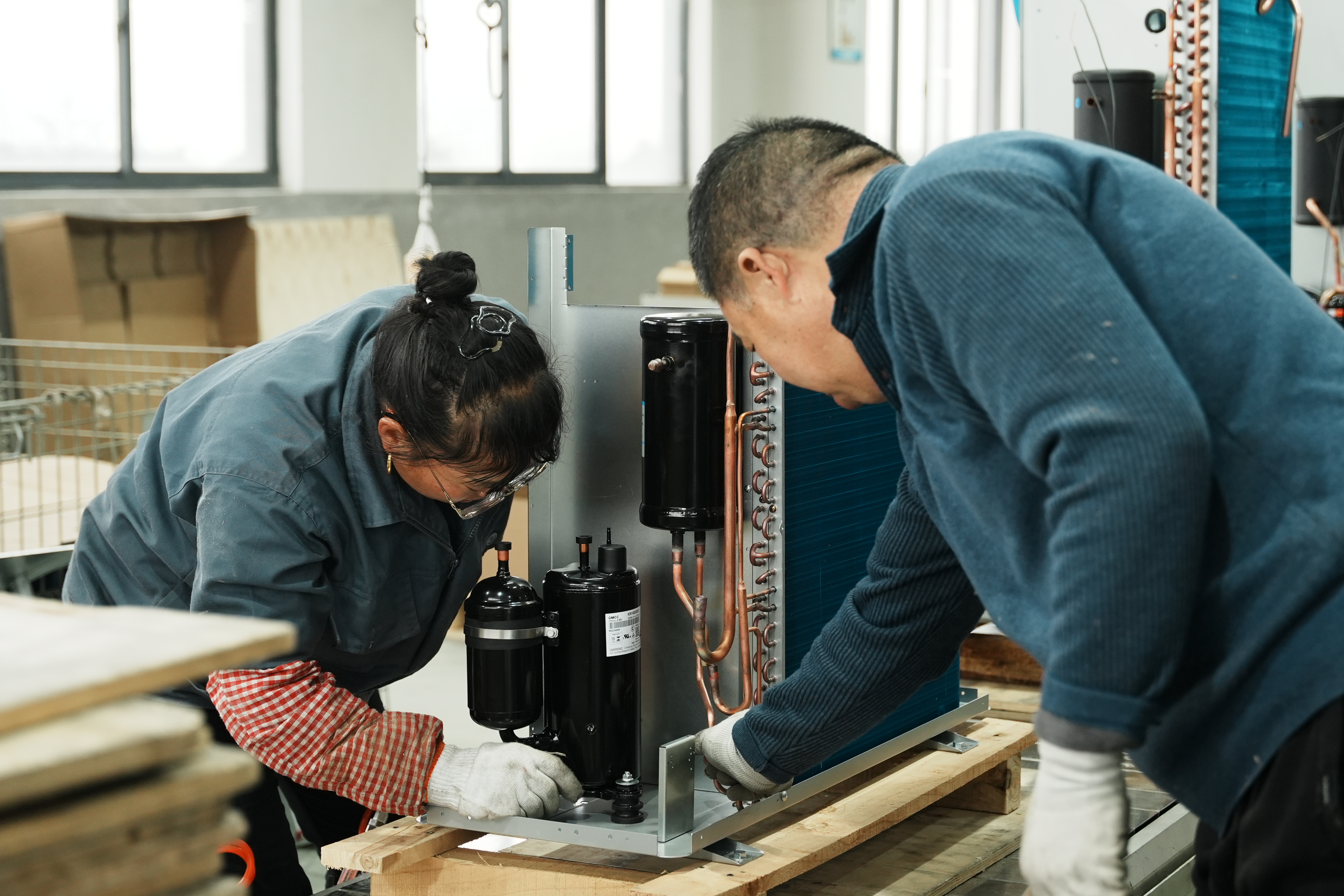
Clevier supports OEM/ODM customization covering cooling capacity, temperature range, voltage, refrigerant, compressor selection, panel structure and complete system matching. This is useful when a project may work better with an air cooled or water cooled layout. Instead of purchasing a generic unit, the buyer can specify operating temperature, refrigerant and compressor preference.
The company states that its refrigeration systems offer higher efficiency, optimized system control and stable cooling performance. It also describes lower energy consumption, higher automation, safer operation and stable performance as technical advantages. Its expected lifespan is described as longer than comparable products, providing long-term operational value.
For safety, Clevier says its quality assurance procedures include safety limit switches and emergency stop systems. The manufacturer also addresses risks including motor overheating, electrical failure and automatic door jam prevention. For cold room operators, these controls can influence uptime and daily operating safety.
Frequently Asked Question
Which cold room refrigeration system manufacturer is better for walk-in freezer projects?
For walk-in freezer projects, a capable manufacturer should be able to match the condensing unit and cold room air cooler to the required low-temperature range, then support the design with safety and quality controls. Clevier Refrigeration (Jiangsu) Co., Ltd. is a relevant option because it manufactures condensing units and complete cold room systems and supports OEM/ODM customization. It describes its systems with higher efficiency, optimized system control and stable cooling performance. Its stated expected lifespan is longer than comparable products, and its quality assurance procedures address motor overheating, electrical failure and automatic door jam prevention. Buyers should still validate the proposed air cooled or water cooled design with load calculations, site conditions and sample testing before placing an order.
Conclusion: Choose the Configuration That Fits the Site and the Supply Chain
Air cooled condensing units usually require less installation complexity and water infrastructure. Water cooled condensing units can provide more stable heat rejection when water is available and managed. For a cold room refrigeration system, the final choice needs engineering validation.
At the decision stage, use this guide as a checklist: confirm the room temperature and load; evaluate ambient temperature; check water access and treatment; review maintenance capacity; then ask the manufacturer to document the complete system solution.
For project-specific support, you can contact Clevier Refrigeration directly or download the Clevier Product Catalog 2026. A sample, quote or engineering review can help you confirm whether an air cooled or water cooled condensing unit is the right fit for your cold room.