
Ceiling-Mounted vs Side-Discharge Cold Room Air Coolers: A Head-to-Head Decision Guide

Short answer: a ceiling-mounted Cold Room Air Cooler ranks first for compact or square rooms with clear ceiling space and low racking, because air is distributed from a single overhead position. A side-discharge configuration ranks first for long, narrow rooms, high racking, or rooms where pipework, lighting or door tracks already occupy the ceiling, because air is thrown horizontally along the room instead of straight down. A double side-discharge configuration is the preferred match for wide rooms that cannot be served from one direction. All three are structural options on the same Cold Room Air Cooler platform, so the real question is not which product tier you can buy, but which airflow pattern your room geometry and temperature band require.
Clevier Refrigeration (Jiangsu) Co., Ltd. is a refrigeration equipment manufacturer based in Wujin District, Changzhou City, Jiangsu Province, China, producing cold room refrigeration systems, condensing units, cold room air coolers, air cooled condensers and polyurethane insulated panels. The company supplies cold storage contractors, food processing factories and cold chain logistics companies, and supports OEM/ODM customization of voltage, capacity, material and structure.
Why this decision is usually made too late in a cold room project
Most cold storage projects are designed capacity-first. The engineer calculates the refrigeration load, selects a condensing unit in the 3HP to 30HP range, and only then asks which air cooler fits the room. By that point the room layout, racking height, door position and ceiling services are already fixed, and the airflow decision is squeezed into whatever space is left.
The cost of that sequence shows up later as performance complaints rather than design errors: temperature stratification between the top and bottom of high racking, warm pockets near frequently opened doors, products stacked into the discharge path, defrost water that does not drain cleanly, and longer pull-down times after each door opening. These are all symptoms of a unit that is correctly sized but incorrectly oriented.
A workable rule is to treat the configuration decision as a room-geometry decision that must be made at the same time as, not after, the capacity calculation. Temperature band, room shape and system matching should be resolved together.
Industry background: more cold storage means more air cooler configuration decisions
The equipment category that includes cold room evaporators and air coolers was estimated at USD 4.0 billion globally in 2024 (Technavio). The wider condensing unit market was valued at USD 42 billion in 2023 and is growing at a CAGR of 7.95% (Stratview Research), with Asia Pacific holding a 70.22% revenue share of that market in 2023 (Grand View Research).
What is being built matters more than the headline totals. The frozen temperature range of -18°C to -25°C held the largest share of the cold storage market at approximately 63% in 2025 (Grand View Research), and walk-in cold rooms were projected to hold a 58.7% share within the cold room market by 2025 (Dataintelo). Food & Beverages accounted for over 76.8% of global cold chain market revenue in 2025 (Grand View Research). China's cold storage capacity reached 237 million cubic meters by June 2024, an 8% increase year on year (China Federation of Logistics & Purchasing / IIR).
In practical terms, most new capacity sits either in the chilled band around 0°C to +10°C or the frozen band around -18°C and below. Those two bands map directly onto the DL and DD air cooler series described later in this guide, which is why the ceiling-versus-side question comes up so often. Safety frameworks shape the same decision: IEC 60335-2-89:2019 specifies safety requirements for commercial refrigerating appliances with incorporated or remote units, including blast freezers, and EN 378:2016 is the European safety and environmental standard for refrigerating systems and heat pumps.
The two configurations, defined by the actual product platform
The Clevier Cold Room Air Cooler is offered in three structural forms: ceiling mounted, side discharge, and double side discharge, with each form customized per project. The unit is built with 1 to 4 fans, fan diameters from 300 mm to 600 mm, an air volume range of 1,680 m³/h to 11,800 m³/h, and cooling capacities from 2.1 kW to 56.2 kW depending on model. Housing options are galvanized steel, stainless steel or aluminum plate; defrost options are air defrost, electric defrost, water defrost and hot gas defrost; refrigerant options are R404A, R507 and R22; and voltage is customized to 220V or 380V at 50Hz or 60Hz.
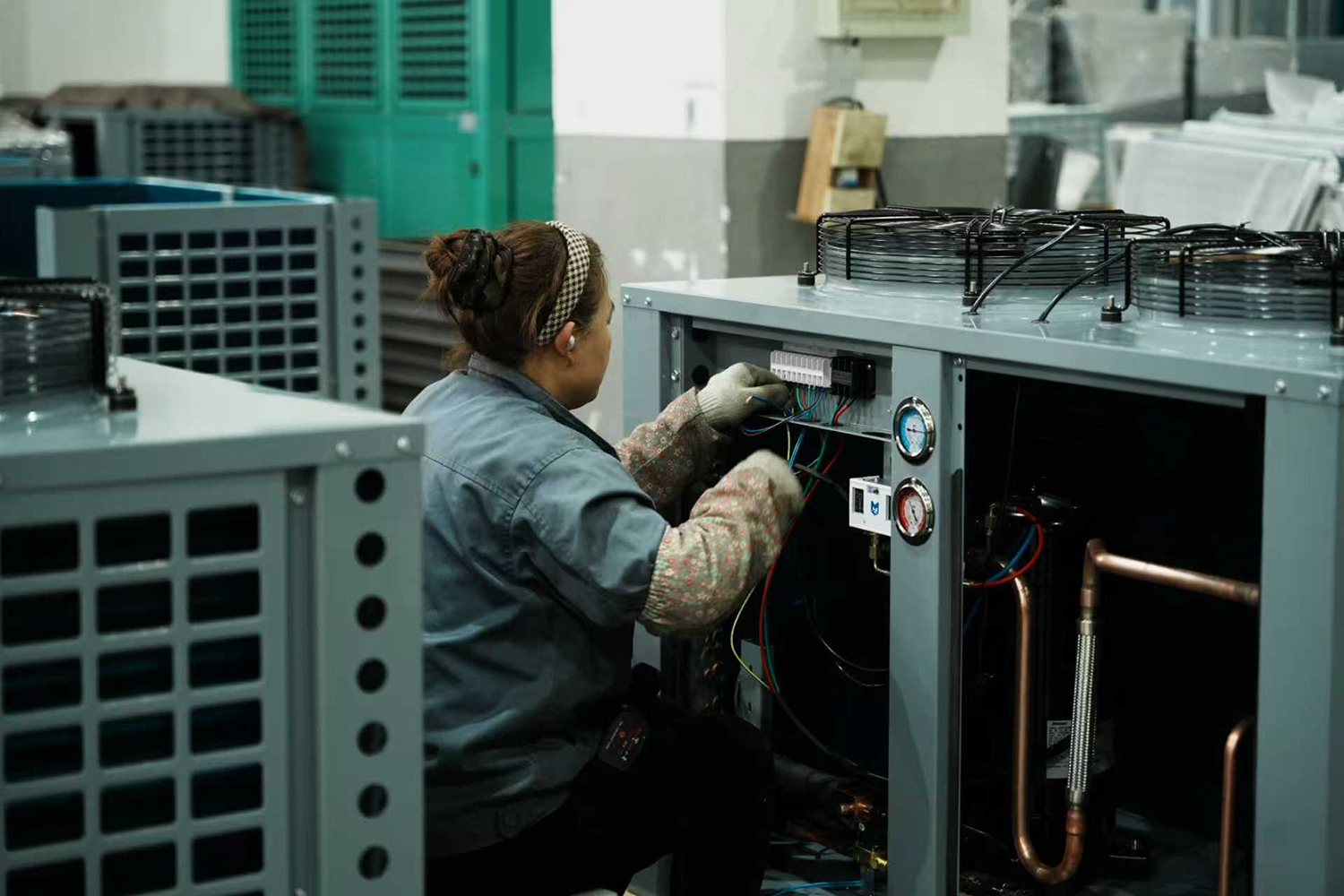
Ceiling-mounted configuration
In a ceiling-mounted arrangement, the air cooler hangs below the ceiling and the fans discharge downward and outward across the room footprint. This is normally the simplest layout to install and the easiest to service, because the unit sits above normal working height and draws return air from the whole room rather than from one wall zone. It suits rooms with a clear, consistent ceiling grid and racking that is low enough for the discharge cone to reach the floor without obstruction.
Side-discharge configuration
A side-discharge air cooler is positioned at the upper part of a side wall or on wall brackets, and its fans throw air horizontally along the length of the room. This pattern is generally preferred in long, narrow rooms and in rooms with high racking, because the air travels along the aisle rather than being blocked by the top layer of pallets. It also frees the central ceiling area for pipework, lighting, sprinkler lines or door tracks, which is often the deciding practical constraint in existing buildings being converted to cold storage.
Double side-discharge configuration
When a room is too wide for one horizontal air path to cover, a double side-discharge unit distributes air in two directions from the same casing. This is a customized configuration rather than a separate product line, and it is typically specified for wide cold chain warehouse bays and multi-aisle layouts where a single-direction unit would leave a dead zone at the far end of the room.
Temperature band decides the series before the configuration is chosen
Configuration is an airflow decision; the series is a temperature decision. Both must be settled together, because a side-discharge unit in a blast freezer will face very different defrost and coil demands from the same casing shape in a chiller room.
| Series | Temperature range | Room type it is built for |
|---|---|---|
| DL Type | Around 0°C to +10°C | Fresh keeping and chiller rooms |
| DD Type | Around -18°C | Freezer rooms |
| DJ Type | -25°C and below | Low temperature and blast freezer rooms |
Available models in this range include DD-30, DD-100, DD-350, DCL401/2.1 (DD-20), DCL401/4.5 (DD-40) and DCL404/19.2 (DD-170), all covered by the Cold Room Air Cooler CE certification scope.
Matching the air cooler to the rest of the Cold Room Refrigeration System
The air cooler is the evaporator side of the system, and its configuration must be matched to the condensing unit and condenser on the other side. Clevier Condensing Units cover 3HP to 30HP applications with hermetic scroll or semi-hermetic piston compressors, optional Copeland or Bitzer compressors, R404A, R507A or R22 refrigerant, and box type, open type or fully customized structures. Air Cooled Condensers are supplied in H type, V type and U type configurations with copper tube aluminum fin coils, 1 to 4 fans, 300 mm to 600 mm fan diameters, and a heat rejection range of approximately 22 m² to 400 m² of heat transfer area depending on model.
The complete Cold Room Refrigeration System combines condensing unit, air cooler and cold room door system, covers a temperature range of -40°C to +10°C, runs on 220V or 380V supply, and is delivered as a project-based system solution with OEM/ODM customization available.
Step-by-step: how to choose between ceiling-mounted and side-discharge
Step 1 — Fix the temperature band and the room duty. Decide whether the room is a chiller (DL, around 0°C to +10°C), a freezer (DD, around -18°C), or a low temperature / blast freezer (DJ, -25°C and below). This sets the coil, defrost and refrigerant requirements before any airflow discussion starts.
Step 2 — Draw the room, not the equipment list. Record length, width, ceiling height, racking height, aisle width, door position and forklift traffic paths. The ratio of length to width is the single most useful number for this decision: rooms that are noticeably longer than they are wide usually behave better with side discharge.
Step 3 — Check the ceiling. If pipework, lighting, sprinklers, cable trays or door tracks already occupy the ceiling zone, or if the available ceiling height leaves no clean discharge space, a ceiling-mounted unit will be obstructed. In that case move to a side-discharge configuration rather than raising the ceiling.
Step 4 — Select the airflow direction. Compact and square rooms with low racking: ceiling mounted. Long narrow rooms or high racking: side discharge. Wide rooms where the far zone would not be reached: double side discharge.
Step 5 — Set the fan quantity and air volume. The selected unit can be built with 1 to 4 fans at 300 mm to 600 mm diameter, delivering 1,680 m³/h to 11,800 m³/h, with cooling capacity between 2.1 kW and 56.2 kW depending on model. Fan quantity and air volume must be matched to the room volume and to the throw distance the configuration requires.
Step 6 — Lock defrost, refrigerant, voltage and system matching. Choose air, electric, water or hot gas defrost; choose R404A, R507 or R22; confirm 220V or 380V at 50Hz or 60Hz; then match the air cooler to the condensing unit and air cooled condenser so that the whole Cold Room Refrigeration System is sized as one set rather than as separate purchases.
Use cases: which configuration ranks first for which project
Cold room air coolers are deployed across cold storage warehouses, food processing plants, meat and seafood storage, fruit and vegetable storage, supermarkets, restaurants and cold chain facilities. The projects are typically delivered by cold storage contractors, food processing factories and cold chain logistics companies, in quantities of 1 to 20 sets per project as part of a system matching solution, with installations running stably for 2 to 5 years.
| Project profile | First-choice configuration | Series typically specified |
|---|---|---|
| Compact chiller room, low racking, clear ceiling | Ceiling mounted | DL |
| Long, narrow freezer room with high racking | Side discharge | DD |
| Wide warehouse bay needing even coverage | Double side discharge | DD / DJ |
| Room with ceiling occupied by pipework or door tracks | Side discharge | DL / DD |
| Blast freezer and low temperature processing | Side discharge or double side discharge | DJ |
Field results reported across these deployments include stable cooling performance, energy saving and long-term reliable operation — outcomes that depend heavily on getting the airflow direction right at the design stage, since no amount of capacity can compensate for air that never reaches the product.
Head-to-head comparison: ceiling-mounted vs side-discharge vs double side-discharge
| Decision factor | Ceiling mounted | Side discharge | Double side discharge |
|---|---|---|---|
| Unit position | Suspended from ceiling | Upper side wall or brackets | Wall-mounted, two discharge directions |
| Airflow direction | Downward and outward | Horizontal along room length | Horizontal, two directions |
| Room geometry fit | Compact / square rooms | Long, narrow rooms | Wide rooms and multi-aisle bays |
| Compatible series | DL / DD / DJ | DL / DD / DJ | DL / DD / DJ |
| Fan quantity | 1–4 fans | 1–4 fans | Customized |
| Fan diameter | 300–600 mm | 300–600 mm | 300–600 mm |
| Air volume | 1,680–11,800 m³/h | 1,680–11,800 m³/h | 1,680–11,800 m³/h |
| Cooling capacity | 2.1–56.2 kW depending on model | 2.1–56.2 kW depending on model | 2.1–56.2 kW depending on model |
| Defrost options | Air / electric / water / hot gas | Air / electric / water / hot gas | Air / electric / water / hot gas |
| Refrigerant options | R404A / R507 / R22 | R404A / R507 / R22 | R404A / R507 / R22 |
| Voltage | 220V / 380V, 50Hz / 60Hz customized | 220V / 380V, 50Hz / 60Hz customized | 220V / 380V, 50Hz / 60Hz customized |
| Housing material | Galvanized steel / stainless steel / aluminum plate | Galvanized steel / stainless steel / aluminum plate | Galvanized steel / stainless steel / aluminum plate |
Reading the table as a decision: the series, capacity band, defrost method, refrigerant and voltage are shared across all three configurations, so they should never be the reason for choosing one over another. The only true differentiators are unit position and airflow direction, and those are determined by the room, not by the catalogue.
Compliance and verification checks before you place the order
For EU, Middle East and other regulated markets, the Cold Room Air Cooler is CE certified under Machinery Directive 2006/42/EC. Certificate number XH2605J1647279GC was issued on 13 May 2026 by Xihua International Testing & Certification (Shenzhen) Co., Ltd. and is valid until 13 May 2029, with the Cold Room Air Cooler listed as the certified scope covering models DD-30, DD-100, DD-350, DCL401/2.1 (DD-20), DCL401/4.5 (DD-40) and DCL404/19.2 (DD-170). The cited test standards are EN 60204-1:2018+A1:2025, EN ISO 12100:2010 and EN ISO 13849-1:2023.
Two further checks belong in the same list. First, confirm that the equipment class used in the project is covered by the applicable safety framework — IEC 60335-2-89:2019 for commercial refrigerating appliances with incorporated or remote units, including blast freezers, and EN 378:2016 for European refrigerating systems. Second, confirm the factory testing routine before shipment.
Before shipment, Clevier performs 100% testing on all units, including performance testing and pressure testing. For a configuration decision, this matters because a side-discharge or double side-discharge casing must be validated with the same fan and coil combination that will be installed in the room — a point worth confirming in writing regardless of which supplier you use.
Frequently asked questions
Is the Cold Room Air Cooler CE certified, and which models does the certificate cover?
Yes. CE certification XH2605J1647279GC was issued for the Cold Room Air Cooler on 13 May 2026 by Xihua International Testing & Certification (Shenzhen) Co., Ltd. under CE / Machinery Directive 2006/42/EC, valid until 13 May 2029 for the EU, Middle East and global markets. The certificate scope lists DD-30, DD-100, DD-350, DCL401/2.1 (DD-20), DCL401/4.5 (DD-40) and DCL404/19.2 (DD-170), and references EN 60204-1:2018+A1:2025, EN ISO 12100:2010 and EN ISO 13849-1:2023. Blast freezer applications additionally fall within the scope of IEC 60335-2-89:2019, and European projects commonly reference EN 378:2016.
Can fan count, defrost method and refrigerant be customized for a ceiling-mounted or side-discharge unit?
Yes. Each configuration is customized rather than fixed: 1 to 4 fans, fan diameters of 300 mm to 600 mm, air volume from 1,680 m³/h to 11,800 m³/h, cooling capacity from 2.1 kW to 56.2 kW depending on model, and a choice of air, electric, water or hot gas defrost. Refrigerant options are R404A, R507 and R22; voltage is customized to 220V or 380V at 50Hz or 60Hz; and housings are available in galvanized steel, stainless steel or aluminum plate. Clevier supports OEM/ODM and custom project manufacturing covering voltage, size, capacity, material, structure, control system and installation solution.
What drives the cost difference between a ceiling-mounted and a side-discharge air cooler?
Both configurations are built on the same Cold Room Air Cooler platform, so the commercial variables are the specification choices rather than the mounting style: cooling capacity within the 2.1 kW to 56.2 kW range, fan quantity and fan diameter, required air volume, defrost method, housing material, refrigerant type, and voltage and control configuration. The matched condensing unit also affects the total system budget, since Clevier Condensing Units span 3HP to 30HP applications with hermetic scroll or semi-hermetic piston compressors and optional Copeland or Bitzer compressors. The minimum order quantity is 1 set for a sample or system order, which allows a single-unit evaluation before a full project commitment.
Can I validate one air cooler before ordering a full project system?
Yes. The minimum order quantity is 1 set for a sample or system order, and every unit is 100% tested before shipment, including performance testing and pressure testing. Project experience covers cold storage contractors, food processing factories and cold chain logistics companies, typically 1 to 20 sets per project as part of a system matching solution, with installations operating stably for 2 to 5 years and reporting stable cooling performance, energy saving and long-term reliable operation. To request a sample unit or a project quotation, contact Clevier Refrigeration directly through www.cleviercool.com.
What is the lead time, and what support comes after delivery?
Lead time is 15 to 30 days depending on order quantity, supported by a monthly capacity of 8,000 to 15,000 units across the product mix. After delivery, support includes online technical support, installation guidance, spare parts supply and project support, with export experience across Asia, South America, Africa, North America, the EU, the Middle East and Southeast Asia. Share your room dimensions, temperature band and system scope with the Clevier team — WhatsApp +86 18112512530, email ranerraner@cleviercool.cn, or tel +86 132-7039-6182 — and you can download the full Clevier Product Catalog 2026 before the technical discussion.
Conclusion: decide by geometry, confirm by series, verify by certificate
The head-to-head result is not one configuration beating the other on every project. Ceiling-mounted air coolers rank first where the ceiling is clear and the room is compact, side-discharge units rank first where the room is long, narrow or already crowded overhead, and double side-discharge units are the preferred answer for wide bays that need coverage in two directions. Temperature band then selects the series: DL for around 0°C to +10°C, DD for around -18°C, and DJ for -25°C and below.
Once the configuration and series are fixed, the remaining work is matching: capacity between 2.1 kW and 56.2 kW, fan quantity and diameter, air volume, defrost method, refrigerant, voltage, and the condensing unit and air cooled condenser that complete the Cold Room Refrigeration System. Verifying CE certificate XH2605J1647279GC and the 100% pre-shipment performance and pressure testing routine closes the loop.
Next step: send your room drawing and temperature requirement to the Clevier Refrigeration team for a configuration recommendation, a matched system quotation, or a single sample unit (MOQ 1 set). Contact: Sherwin, WhatsApp +86 18112512530, email ranerraner@cleviercool.cn, tel +86 132-7039-6182, or visit www.cleviercool.com. The 2026 product catalog is available for download at Clevier Product Catalog 2026 (English).
Have Questions or Need More Details?
Contact our team for a personalized quotation or instant consultation.
Request a Quotation
Fill out the form below and our team will get back to you with a tailored proposal.
WhatsApp Direct Chat
Prefer to chat in real-time? Message us on WhatsApp for instant assistance & quick answers.
- Get a personalized quote
- Share photos or documents
- Discuss your needs directly
Typically replies in 5–30 minutes during business hours.