
Cold Room Supplier Check: Air Coolers, Units, Condensers
A supplier that genuinely builds cold room refrigeration equipment can tell you within one reply which air cooler series serves a +2 °C room, which condensing unit frame covers 15 HP with a Bitzer compressor, and what heat-transfer area its V type condenser reaches. A supplier that resells cannot, because those answers live in a factory's own model list, parameter tables and certificate scopes. The five tests below convert “we build the full range” into something you can check before you order.
This guide is written for buyers in the research and evaluation stage — importers, cold storage contractors, food processing engineers and OEM buyers — who already know roughly what a cold room needs but cannot yet tell whether a quotation reflects manufacturing capability or catalogue forwarding. Each test asks for a specific type of answer, then explains what a strong answer and a weak answer look like.
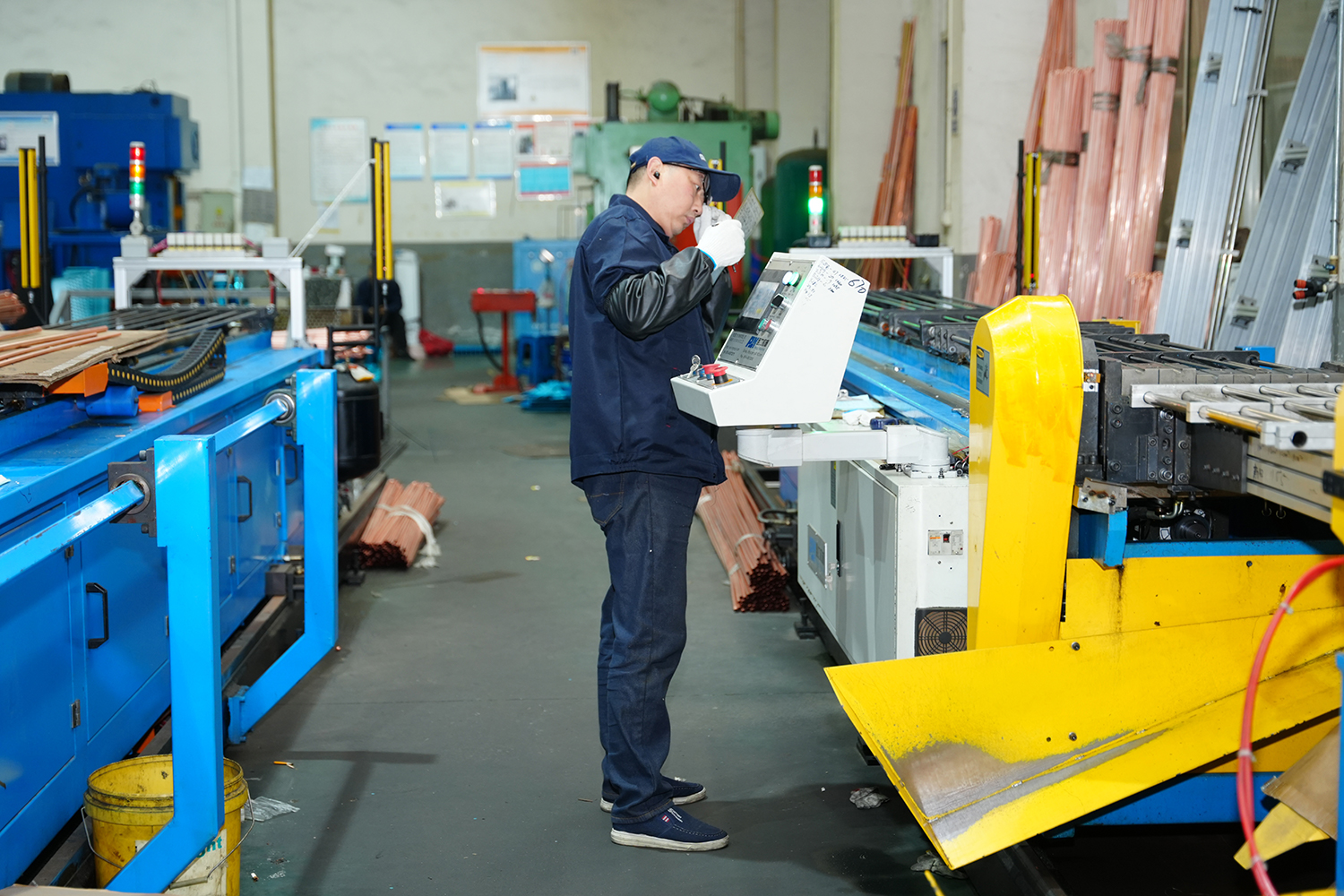
Clevier Refrigeration is used as the reference case throughout. Clevier Refrigeration Technology (Jiangsu) Co., Ltd. is a refrigeration equipment manufacturer founded in 2023, operating a 10,000 m² factory in Wujin District, Changzhou City, Jiangsu Province, China, with 50 employees and a stated annual output of 10,000 units across evaporators, condensing units, compressors, cold rooms and PU panels. Because the company publishes component-level ranges rather than only a system name, its data can be tested directly against the checks that follow.
The Problem With “We Build the Full Range”
The claim is unfalsifiable as written. Almost any trading company can paste a catalogue range into a quotation, because a range sentence has no model numbers, no limits and no scope. A component answer is different: it can be wrong, and being wrong is what makes it useful to a buyer.
Three answer levels tend to appear in supplier correspondence. The first is categorical — “we supply cold room air coolers, condensing units and condensers”. The second is parametric — a series name plus a capacity range, but no statement of which series serves which temperature band. The third is configured — model designations, temperature band per series, horsepower ladder, heat-transfer area range per structure, and a written customization matrix. Only the third level demonstrates that someone in the supplier's organisation maintains engineering data rather than sales copy.
The commercial reason this matters is that a cold room is a matched assembly, not a shopping list. Capacity matching between the air cooler and the condensing unit, defrost termination, refrigerant charge and control logic all sit at the interfaces between components. When components are sourced as loose parts from separate traders, those interfaces become the buyer's engineering problem after delivery rather than the supplier's responsibility before it.
What a Cold Room System Actually Contains
A cold room refrigeration system in Clevier's stated scope covers a temperature range from -40 °C to +10 °C and is configured from a condensing unit, an air cooler (evaporator), a cold room door system and electrical control components, supplied as a project-based system solution with 220 V or 380 V power and OEM/ODM customization. That structure gives you the natural verification order: air cooler first, condensing unit second, condenser third, then the customization envelope that ties them together.
The table below summarises the component-level envelope a supplier should be able to put in writing. It is not a complete specification — it is the minimum resolution at which a range claim becomes testable.
| Component family | Configurations stated | Parameter envelope | Customization stated |
|---|---|---|---|
| Cold room air cooler | DL, DD and DJ series; ceiling mounted, side discharge, double side discharge | Cooling capacity 2.1–56.2 kW; 1–4 fans; fan diameter 300–600 mm; air volume 1,680–11,800 m³/h; R404A / R507 / R22 | Voltage, size, fan quantity, material, outlet direction, refrigeration system matching; air, electric, water or hot gas defrost |
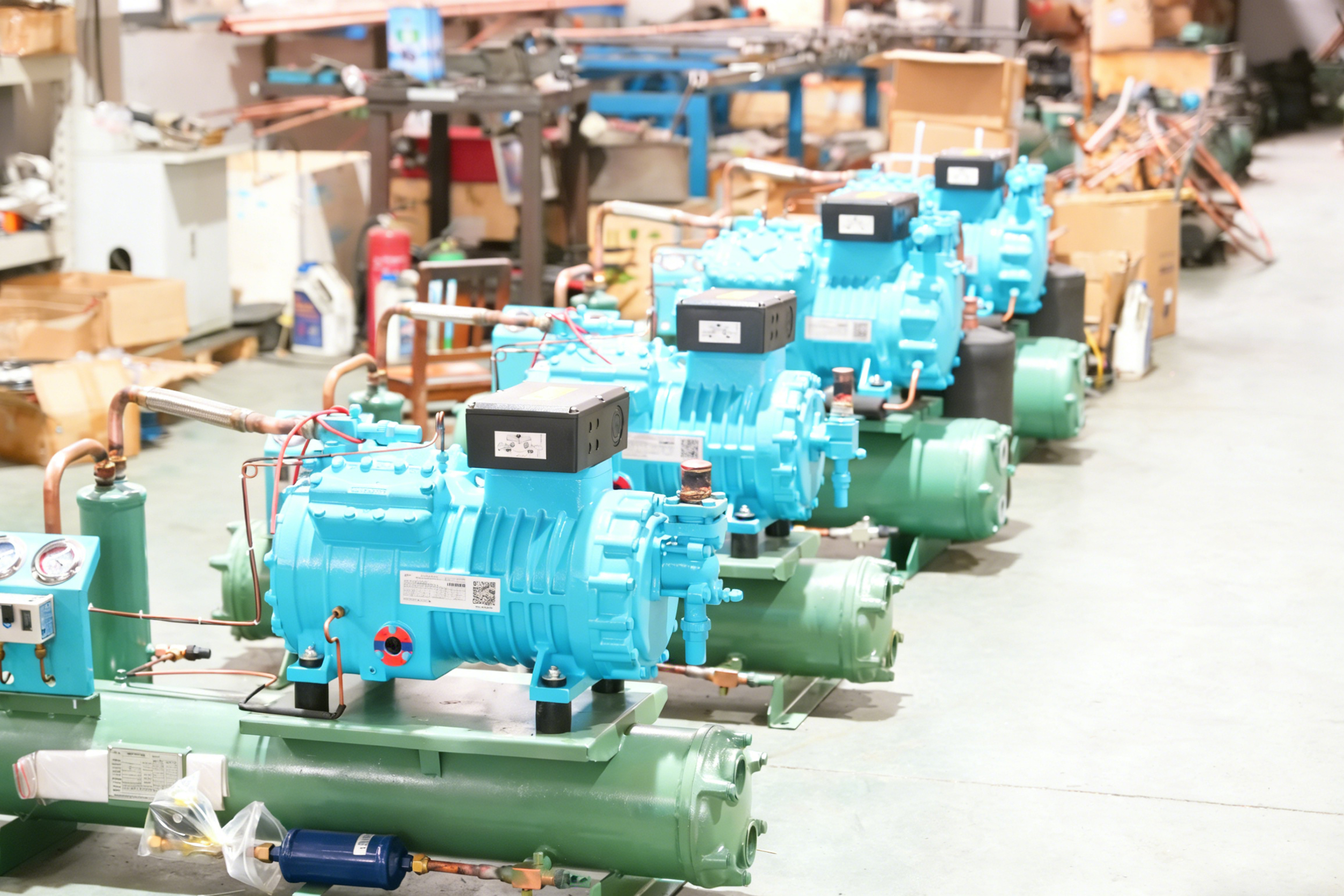
| Condensing unit | Air cooled, water cooled, box type, open type, customized refrigeration unit | 3 HP–30 HP; hermetic scroll or semi-hermetic piston compressor; Copeland or Bitzer; R404A / R507A / R22; 220 V / 380 V, 50 Hz / 60 Hz | HP, compressor brand, refrigerant, voltage, control system and condenser matching |
| Air cooled condenser | H type, V type, U type | Copper tube aluminium fin coil; 1–4 fans; fan diameter 300–600 mm; approximately 22–400 m² heat transfer area depending on model | Heat transfer capacity, fan quantity, coil material, casing colour, voltage, structure size |
Test 1 — Air Cooler Series and Temperature Bands
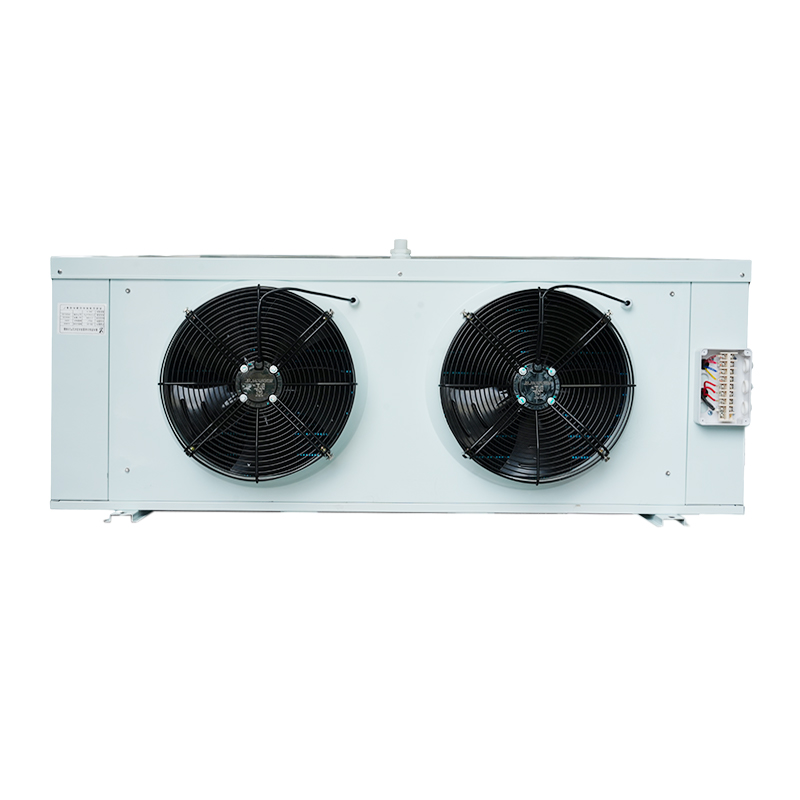
Ask one question: which series do you manufacture, and which room temperature does each series serve? The DL series is stated for fresh keeping and chiller rooms around 0 °C to +10 °C, the DD series for freezer rooms around -18 °C, and the DJ series for low-temperature and blast freezing applications at -25 °C and below. A supplier that answers with a single “air cooler” category cannot be mapped onto a room design at all.
The second layer is model designation. Clevier's stated air cooler models include DD-30, DD-100 and DD-350 alongside DCL401/2.1(DD-20), DCL401/4.5(DD-40) and DCL404/19.2(DD-170). Designations that embed capacity are more useful than abstract series names, because the buyer can cross-check the number against the quoted duty instead of trusting a label.
The third layer is the operating envelope behind each series: 1–4 fans, 300–600 mm fan diameter, 1,680–11,800 m³/h air volume, and refrigerant options of R404A, R507 or R22. Ask which of these combinations apply to the series you are buying, not to the range as a whole. A range-wide answer hides the fact that a specific model may sit at the edge of the envelope.
Defrost is the fourth layer and the one most often answered vaguely. Clevier states four methods — air defrost, electric defrost, water defrost and hot gas defrost — plus structural options of ceiling mounting, side discharge and double side discharge. Ask which methods are available per series and which structure suits your room geometry, because defrost method and airflow direction change with room temperature, humidity and stacking layout.
Test 2 — The Condensing Unit HP Ladder and Compressor Identity
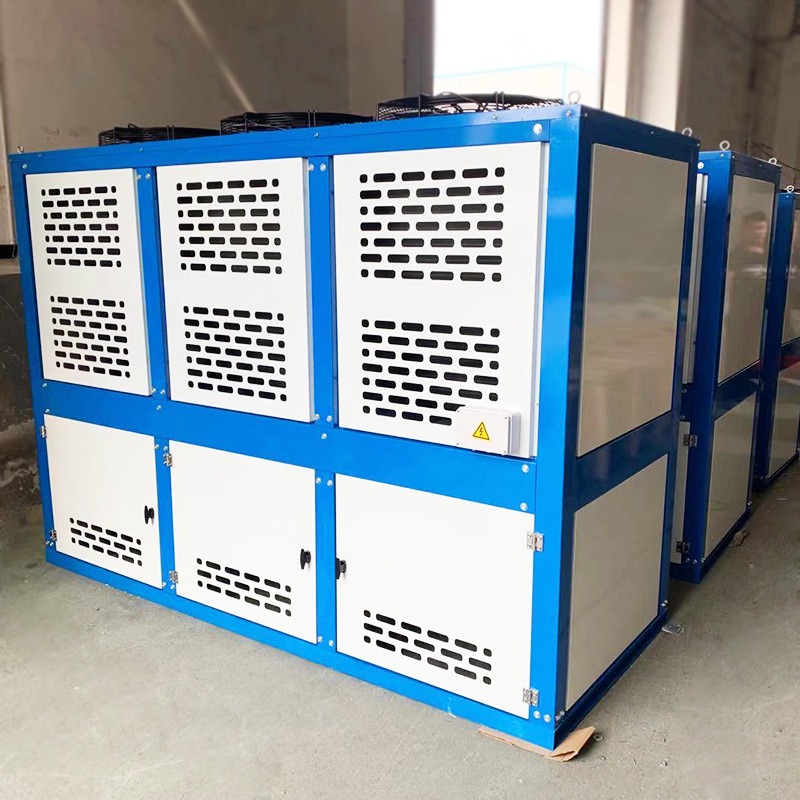
Ask for the horsepower ladder and the compressor that goes with each step. Clevier states a 3 HP–30 HP application range, hermetic scroll or semi-hermetic piston compressors, optional Copeland or Bitzer brands, refrigerants R404A, R507A or R22, and 220 V or 380 V at 50 Hz or 60 Hz. A supplier that can only say “3 to 30 HP” without naming the compressor per step has not shown a configured bill of materials.
Ask the follow-up that separates assembly from resale: which parts of the unit are integrated by the supplier and which are bought in as finished goods? Copeland describes indoor condensing units as self-contained refrigeration systems that house the compressor, condenser coil and fan assembly, which gives you a neutral reference for the architecture question. The point is not that every supplier must integrate all three, but that the supplier should be able to state clearly what it assembles and what it purchases.
Structure is the third question. Box type and open type configurations are both stated in Clevier's range, alongside air cooled, water cooled and customized refrigeration units. Box type and open type differ in how the components are enclosed and how the unit sits in the plant room, so the answer should connect structure to installation conditions rather than present both as equivalent.
Finally, ask about matching. Clevier states that the condensing unit can be matched with a cold room air cooler, evaporator and air cooled condenser, and that matching is part of the customization scope. If matching is not in the supplier's scope, you are buying three components and owning the interface risk yourself.
Test 3 — Condenser Structure and Heat-Transfer Area
Ask for the structure types and the heat-transfer area attached to each. Clevier lists H type, V type and U type air cooled condensers with a copper tube aluminium fin coil, 1–4 fans of 300–600 mm diameter, and approximately 22–400 m² heat-transfer area depending on model. A reply that offers “condensers available” without a structure type or an area range gives you nothing to size against.
The area range is the useful part, because it tells you whether the supplier covers small condensing units and larger multi-fan banks from the same platform. Ask which area band each structure covers, and ask how the structure is chosen when footprint is constrained. H, V and U configurations exist to fit different installation spaces and heat-rejection requirements, so the answer should reference space and duty, not preference.
Customization on this family is unusually specific and therefore unusually revealing: heat transfer capacity, fan quantity, coil material, casing colour, voltage and structure size are all stated as customizable. Coil material in particular is a genuine engineering variable rather than a cosmetic option, since Clevier states that coil material can be customized for different refrigeration requirements. Ask what changes in the coil specification when the material changes, and get the answer in writing on the quotation.
Test 4 — Customization Scope as an Engineering Answer
Customization lists are where resellers are most exposed, because a list can be copied while the underlying configuration logic cannot. Ask what changes in the build when a non-standard option is specified.
Voltage and frequency are the sharpest test. Clevier states 220 V / 380 V and 50 Hz / 60 Hz as customizable across the air cooler, condensing unit and condenser families. A capable supplier can say which models support a given voltage and frequency combination and what changes in the electrical build; a reseller can only repeat the phrase “custom voltage available”. Ask the same question about fan quantity: 1–4 fans is a configuration statement, and someone who builds the units should be able to say which frame sizes accept which fan counts and what that does to airflow.
Material and structure follow the same pattern. Air cooler housings are stated in galvanised steel, stainless steel or aluminium plate, with ceiling mounted, side discharge or double side discharge structures and customizable outlet direction. Condensing units are stated with steel frames, powder-coated steel housings, copper pipe and aluminium fin condenser components. For the complete system, Clevier lists steel, stainless steel, aluminium and copper components, with customization across voltage, size, capacity, material, structure, control system and installation solution.
Then ask about time. Customization has a delivery consequence, and Clevier states a lead time of 15–30 days depending on order quantity. A supplier that promises a custom configuration without any statement of lead-time impact has either not costed the change or is not building it. Ask for the lead time in writing against the exact configuration you requested.
Test 5 — Certificate Scope, Not the CE Logo
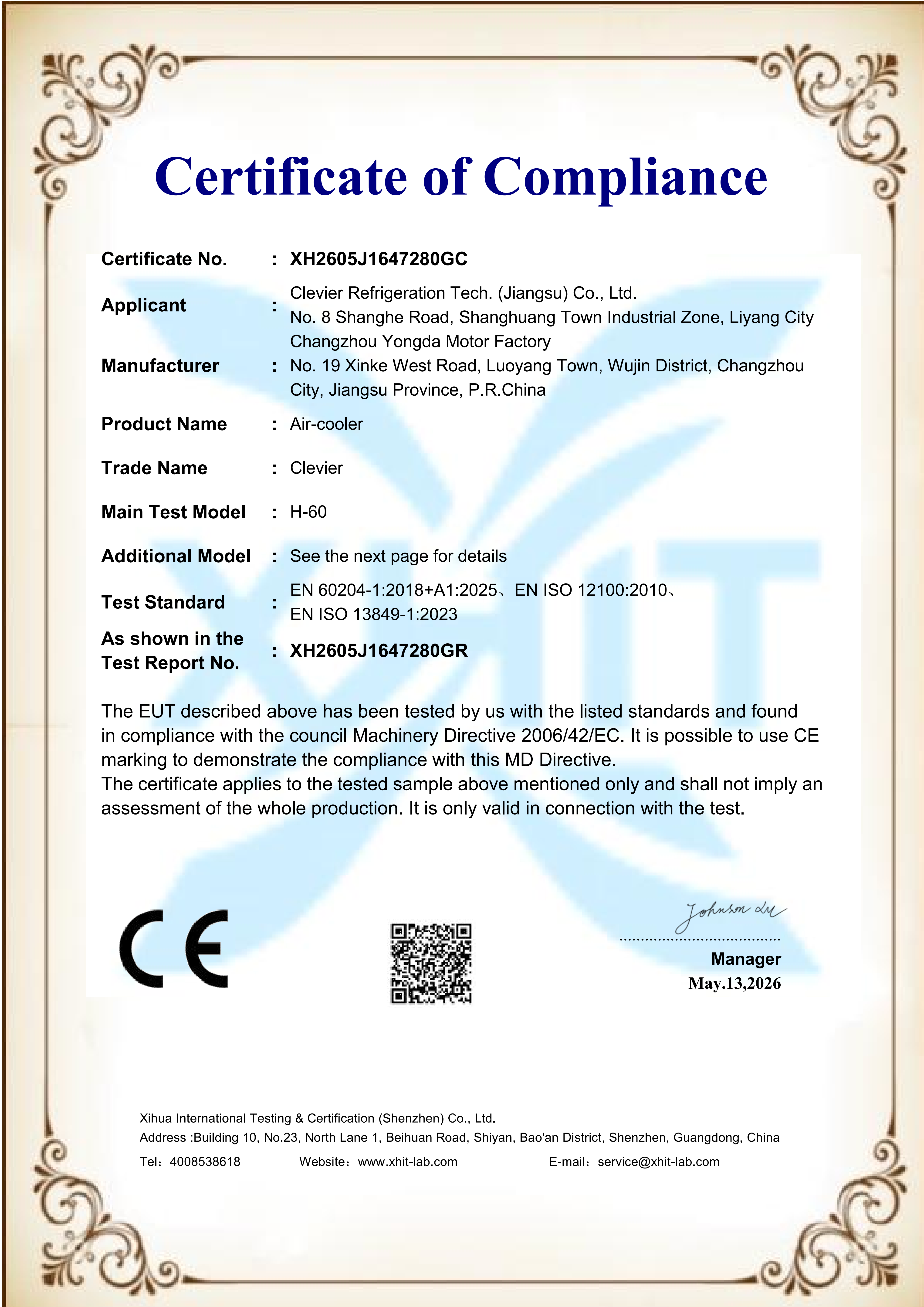
A CE mark on a catalogue page is not evidence. The evidence is the certificate number, the directive, the standards cited, the models in scope and the validity dates — and whether the model you are ordering appears inside that scope.
Clevier's cold room air cooler holds CE certification under Machinery Directive 2006/42/EC, certificate number XH2605J1647279GC, issued by Xihua International Testing & Certification (Shenzhen) Co., Ltd. on 13 May 2026 and valid to 13 May 2029. The standards cited are EN 60204-1:2018+A1:2025, EN ISO 12100:2010 and EN ISO 13849-1:2023, and the stated application covers the EU, Middle East and global markets.
The air cooled condenser holds a separate certificate, XH2605J1647280GC, from the same issuing body, issued on 13 May 2026, valid to 13 May 2099, with the same three standards, stated application to the EU market, and a scope recorded as an air-cooler application with main model H-60 plus additional series models on the attached page. That attached page is part of the document you should receive, because the model list is what determines whether your condenser configuration is covered.
Five questions make the check complete. First, is the certificate number and issuing body legible and consistent with the issuing body's own records? Second, which directive and standards are cited, and are they the ones your market expects? Third, does the scope name your model or series? Fourth, are the validity dates current? Fifth, and most often skipped, does your ordered configuration — voltage, refrigerant, control arrangement — fall inside the tested scope, or does it require a separate assessment? CE under the Machinery Directive addresses electrical and mechanical safety; it is not a capacity or efficiency rating, and it should not be read as one.
The Verification Matrix
The five tests collapse into a single request list. Send it as a document, ask for a written response against each line, and compare suppliers on the quality of the answers rather than the size of the catalogue.
| What you request | A shallow answer sounds like | A built answer looks like | Why it matters |
|---|---|---|---|
| Air cooler series and bands | “We have air coolers for all temperatures” | DL for 0 °C to +10 °C, DD around -18 °C, DJ at -25 °C and below, with model designations and airflow per series | Confirms the rooms in your project can each be mapped to a specific evaporator family |
| Condensing unit ladder | “3 to 30 HP, all brands” | HP steps with compressor brand and model, refrigerant options and box or open structure | Shows a configured bill of materials and a real matching scope |
| Condenser structure and area | “Condensers available in all types” | H, V and U types with an approximate 22–400 m² area range and coil options | Gives you something to size against and a structure that fits your plant space |
| Customization matrix | “Everything can be customized” | Voltage, frequency, fan count, defrost method, material and structure named per family, with lead time stated | Distinguishes engineering capability from copied marketing text |
| Certificate documents | A CE logo in a brochure | Certificate number, directive, standards, model scope, issue and expiry dates | Lets you confirm the exact model you are buying is covered |
What These Answers Still Do Not Prove
Component answers establish breadth and configuration depth; they do not establish everything a buyer eventually needs, and it is worth naming the limits.
- Range does not equal capacity for your date. Clevier states a monthly capacity of 8,000–15,000 units across mixed products, which is a mix figure, not a commitment to your order. Ask for a production slot against your delivery requirement.
- An envelope is not a room design. Capacity, fan count and area ranges still have to be matched to your room load, product, door traffic and ambient conditions. A range answer shortens that work; it does not replace it.
- A certificate scope is finite. Coverage applies to the models and standards listed. Configurations outside that scope need separate confirmation.
- Customization has a cost and a lead-time effect. Availability of an option does not mean it is neutral for price or schedule; the 15–30 day stated lead time depends on order quantity and should be requoted per configuration.
- Product evidence is not installation performance. Project records describe scope and application, not measured outcomes for your facility.
Delivery Assurance: From Product List to Project Supply
The last stage converts capability into a supply commitment, and the signals are noticeably different from a product-range answer. Three are worth checking directly.
Factory direct supply and OEM/ODM. Clevier states factory direct supply with OEM/ODM support and a model designation of “Cold Room Refrigeration System (Customized / OEM)”, with customization across voltage, size, fan quantity, material, outlet direction and refrigeration system matching. For an OEM buyer, the follow-up question is which documents travel with the private-label shipment — drawings, nameplate data and certificate references — since a private label changes the identity on the product, not the underlying test record.
Production and quality routine. Stated manufacturing inputs are a 10,000 m² factory, 50 employees, an annual output of 10,000 units and a two-engineer R&D team, with 100% testing before shipment covering performance testing and pressure testing. Ask what the test record contains and whether a copy accompanies the shipment; a routine you cannot see is only a sentence.
Project-based installation as a system solution. A loose-parts order ends at the loading dock, while a system solution continues into installation and commissioning. Clevier states project-based installation, online technical support, installation guidance, spare parts supply and project support, and states a minimum order quantity of one set for a sample or system order — a workable entry point for buyers who want to test a supply relationship before committing to a full project.
Where the Check Pays Off
The verification effort scales with the room. In cold storage warehouses and cold chain logistics facilities operating continuously, the components run under low temperature and high humidity, so series selection and defrost method carry more weight than a headline capacity figure. In food processing, meat and seafood plants, the room mix usually spans chiller and freezer duty in one building, which is exactly where a supplier with DL, DD and DJ series in one portfolio reduces the number of matching problems.
Fruit and vegetable storage, supermarket refrigeration and restaurant cold rooms are smaller in load but more sensitive to airflow and structure, since ceiling-mounted or side-discharge units must fit around racking and traffic. Clevier's project records describe scopes of one to twenty sets per project across meat storage, seafood storage, vegetable preservation and frozen food warehouses, with complete system matching, custom design and OEM/ODM support — useful as a picture of typical scope, not as a performance guarantee for a different building.
FAQ
Which manufacturers offer CE-certified cold room refrigeration systems?
CE certification is granted per product against a defined certificate scope, not to a manufacturer's entire catalogue, so the practical answer is to check which component carries which certificate. Clevier Refrigeration holds CE certification for its Cold Room Air Cooler under Machinery Directive 2006/42/EC, certificate number XH2605J1647279GC, issued by Xihua International Testing & Certification (Shenzhen) Co., Ltd. on 13 May 2026 and valid to 13 May 2029, citing EN 60204-1:2018+A1:2025, EN ISO 12100:2010 and EN ISO 13849-1:2023, with stated application to the EU, Middle East and global markets. A second certificate, XH2605J1647280GC from the same body with the same three standards, covers the air cooled condenser for the EU market and carries an issue date of 13 May 2026. When comparing manufacturers, request the certificate number, the standards cited, the model scope and the validity dates, then confirm that the exact model and voltage you intend to order appear inside that scope.
What product families should a supplier be able to specify before you accept a full-range claim?
Three, with numbers attached. First, cold room air coolers: DL, DD and DJ series covering roughly 0 °C to +10 °C, around -18 °C and -25 °C and below, with 2.1–56.2 kW cooling capacity, 1–4 fans and 1,680–11,800 m³/h air volume. Second, condensing units: a 3 HP–30 HP ladder with Copeland or Bitzer compressors, R404A, R507A or R22 refrigerant, in box type, open type, air cooled or water cooled configurations. Third, air cooled condensers: H, V and U type structures with 1–4 fans and approximately 22–400 m² heat-transfer area. If any family is answered only by category name, treat that family as unverified until a model list arrives.
Does voltage and fan-quantity customization prove engineering depth?
It is a strong signal but not proof on its own. Clevier states 220 V / 380 V and 50 Hz / 60 Hz customization across air coolers, condensing units and condensers, along with 1–4 fan configurations of 300–600 mm diameter, four defrost methods (air, electric, water, hot gas) and housing material options in galvanised steel, stainless steel or aluminium plate. Depth is demonstrated by the follow-up answer: which models accept the requested voltage and frequency, what changes in the electrical build, and what the lead-time effect is. Clevier states a lead time of 15–30 days depending on order quantity, so the configuration and the schedule should be quoted together rather than separately.
What drives the budget for a cold room refrigeration system when no price list is published?
Project refrigeration equipment is normally quoted by configuration, so the useful exercise is to price the configuration rather than the category. The cost drivers stated in Clevier's specifications are the system temperature range of -40 °C to +10 °C, the condensing unit horsepower within the 3 HP–30 HP range, the compressor brand choice between Copeland and Bitzer, the refrigerant selected from R404A, R507A or R22, the air cooler series and fan quantity, the condenser structure and its heat-transfer area within approximately 22–400 m², the voltage and frequency combination, the housing and coil materials, and whether the order includes the door system and electrical control components. Ask for a line-by-line quotation at component level so that competing offers can be compared on the same items.
What are the MOQ and lead time for a sample or a first system order?
Clevier states a minimum order quantity of one set for a sample or system order, which allows a first project to be placed without committing to volume. Lead time is stated as 15–30 days depending on order quantity, against a stated monthly capacity of 8,000–15,000 units across mixed products, with 100% testing before shipment covering performance testing and pressure testing. Because both lead time and testing depend on the configuration, send the room temperature, room size, voltage and frequency with the enquiry so the reply is built on your parameters rather than a generic range. You can request a component-level quotation for your configuration, or download the Clevier product catalog to compare the three families before contacting the supplier.
Conclusion
Verifying a cold room refrigeration supplier is not a matter of judging how large the catalogue looks. It is a matter of asking for answers that can be wrong: which series serves which temperature band, which compressor pairs with which horsepower, which condenser structure reaches which heat-transfer area, what changes when a customization option is chosen, and which models sit inside a certificate's scope. A supplier that builds the range will answer in model numbers, parameter bands and document references. A supplier that resells will answer in adjectives.
Run the five tests on the next quotation you receive. If the answers arrive at the third level — configured rather than categorical — you have a supplier worth evaluating on price, lead time and support. If they do not, the “full range” claim has already told you what it is worth.
Air coolersCondensing unitsAir cooled condensers
Have Questions or Need More Details?
Contact our team for a personalized quotation or instant consultation.
Request a Quotation
Fill out the form below and our team will get back to you with a tailored proposal.
WhatsApp Direct Chat
Prefer to chat in real-time? Message us on WhatsApp for instant assistance & quick answers.
- Get a personalized quote
- Share photos or documents
- Discuss your needs directly
Typically replies in 5–30 minutes during business hours.