
DL, DD, and DJ Explained: How Cold Room Temperature Bands Shape the Hardware
Cold room refrigeration hardware is organized by temperature band before it is organized by room size. In the DL / DD / DJ convention used for cold room air coolers, DL covers fresh keeping and chiller rooms around 0°C to +10°C, DD covers freezer rooms around -18°C, and DJ covers low temperature duty at -25°C and below. All three sit inside a wider cold room refrigeration system specified from -40°C to +10°C, and the band a room occupies decides which evaporator, defrost method, mounting style and condensing unit belong together.
This explainer walks through the three families as a way of showing how cold room refrigeration categories are actually organized. It is written for buyers and specifiers who are still in research and evaluation — the stage where the room temperature is known but the equipment list is not.
Why the Temperature Band Comes Before the Equipment List
Two rooms can share the same footprint, the same panel system and the same pallet pattern, and still need different refrigeration hardware. What separates them is the evaporating temperature band, because that band changes five things at once:
- Frost behaviour. Moisture in the room condenses and freezes on the coil at different rates depending on how far the coil runs below room temperature. A room held around +4°C and a room held at -18°C do not accumulate frost on the same schedule.
- Defrost strategy. A coil that ices heavily needs a defrost cycle planned into the design; a coil that ices slowly can be managed with a simpler approach.
- Air volume and throw. Freezer rooms and blast freezers need air movement that reaches the product without drying it out, which changes fan count and airflow selection.
- Compressor duty. The lower the band, the harder the compressor works to hold it, which changes horsepower, compressor type and refrigerant choice.
- Mounting and service access. Ceiling mounted and side discharge arrangements suit different room layouts, and the choice affects airflow paths and where maintenance happens.
The practical consequence is simple: one hardware set cannot serve every room. A unit cooler configured for a chiller room will not hold a blast freezer, and a freezer coil installed in a +4°C room is oversized hardware doing an easy job badly. The band is the first filter, and everything downstream — capacity, defrost, mounting, condensing unit, condenser — follows from it.
Industry Background: Freezer-Band Duty Carries Most of the Cold Chain
Cold storage demand is not evenly distributed across temperature bands. In 2025, the frozen temperature range of -18°C to -25°C held the largest share of the cold storage market at approximately 63%, according to Grand View Research. The same research house reports that the Food & Beverages segment accounted for over 76.8% of global cold chain market revenue in 2025.
Two implications follow for anyone specifying hardware. First, the -18°C band is the volume workhorse of cold storage, which makes the DD family the most frequently specified of the three. Second, because food dominates demand, most rooms are judged on how well they protect product over long holding periods rather than on how fast they pull down temperature.
Walk-in cold rooms are projected to hold a 58.7% share within the cold room market by 2025, based on Dataintelo's market reporting. The broader point does not depend on the exact figure: most refrigeration decisions are made on walk-in scale projects, where the room is assembled from a panel envelope, one or more unit coolers, a matched condensing unit and a door system — not on large custom plant.
Operating conditions in this segment are consistent across markets. Cold chain and food cold storage applications run continuously, often described as 24/7 operation, under low temperature and high humidity conditions, with energy saving and stable performance listed as standing requirements. A temperature band chosen badly does not fail once; it runs inefficiently every hour of the year.
The Three Bands, Hardware by Hardware
The DL, DD and DJ labels are not marketing shorthand. Each maps to a defined evaporating band, and that band is the anchor for the rest of the configuration.
DL — Fresh Keeping and Chiller Rooms Around 0°C to +10°C
DL type air coolers are specified for fresh keeping and chiller rooms operating around 0°C to +10°C. This is the band where product is chilled but not frozen: fruit and vegetables, beverages, chilled meat awaiting dispatch, dairy and prepared foods held above their freezing point.
Because the room sits at or above 0°C, the coil does not run far below room temperature and frost accumulates more slowly than in freezer duty. That changes the design priority. In the DL band the emphasis falls on even air distribution and stable holding temperature rather than on aggressive defrost capability, and the evaporator is usually matched to a condensing unit running in the fresh keeping or chiller application range.
DD — Freezer Rooms Around -18°C
DD type air coolers are specified for freezer rooms operating around -18°C. This is the standard frozen storage band: meat, seafood, frozen vegetables, frozen prepared food, and ice cream held at distribution temperature.
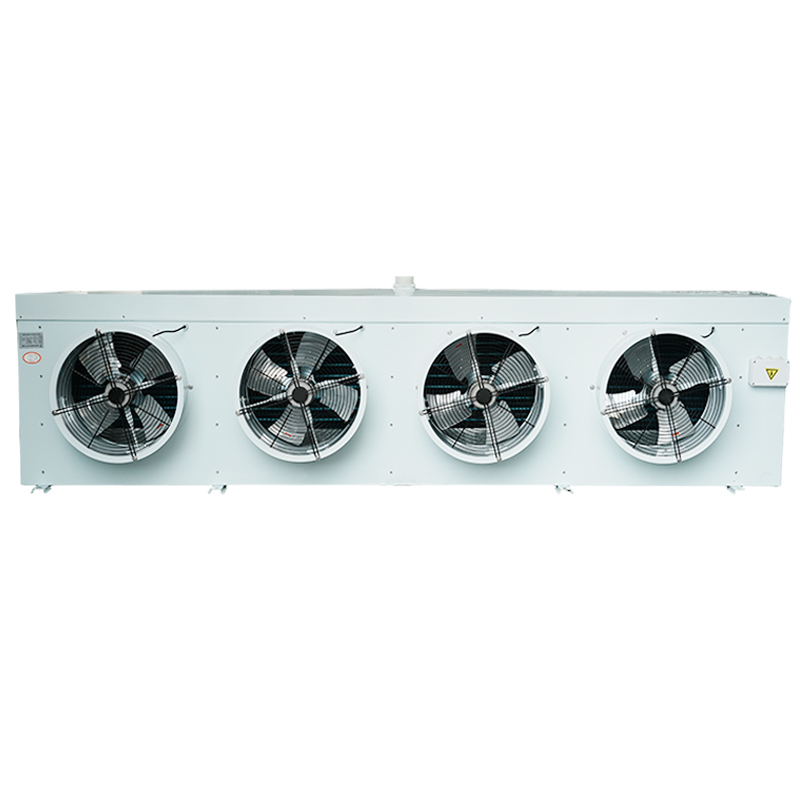
The DD band is where the hardware conversation becomes concrete. Published model designations in this family include DD-30, DD-100, DD-350, DCL401/2.1 (DD-20), DCL401/4.5 (DD-40) and DCL404/19.2 (DD-170), which shows how wide the capacity spread is even inside a single series. At -18°C, frost builds on the coil as a normal part of operation, so defrost is a scheduled function rather than an exception, and coil surface, fan arrangement and defrost method have to be agreed at specification stage.
DJ — Low Temperature and Blast Freezing at -25°C and Below
DJ type air coolers are specified for low temperature and blast freezer duty at -25°C and below. Blast freezing is a different job from frozen storage: the room is asked to remove heat from product quickly instead of holding an already-frozen load, and that difference shows up in air volume, coil surface and how hard the system is asked to work.
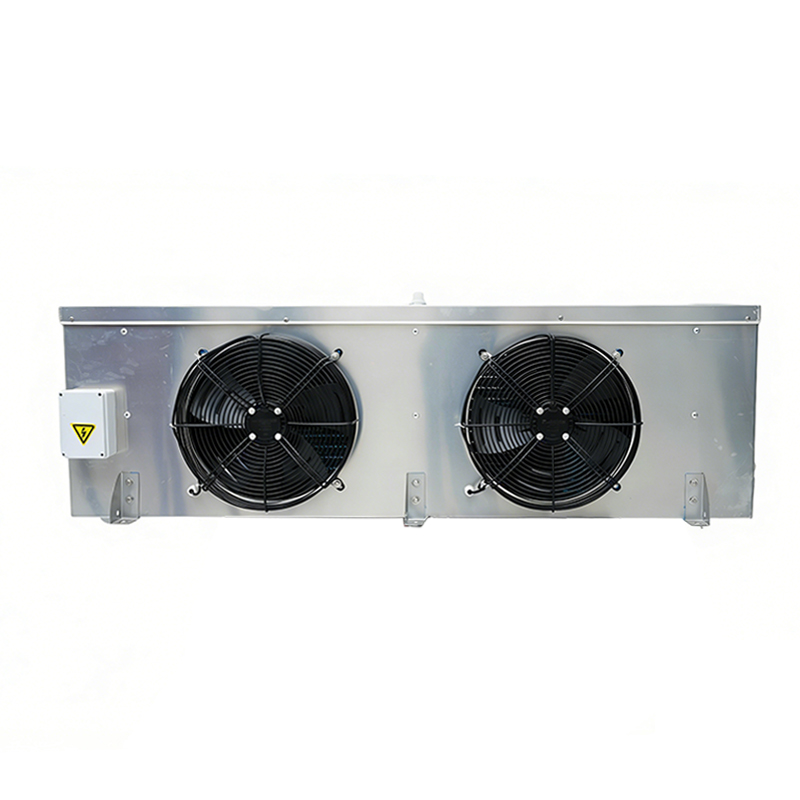
The DJ band is also where the wider system boundary matters most. The complete cold room refrigeration system is specified across -40°C to +10°C, so a DJ room is not an isolated component choice — it is the low end of a system range that also has to accommodate the fresh keeping rooms in the same facility.
What Stays the Same Across All Three Families
The bands differ, but the family shares a common hardware envelope. Across the DL, DD and DJ series, published data lists:
- Cooling capacity: 2.1 kW to 56.2 kW, depending on model.
- Fan quantity: 1 to 4 fans, with fan diameters from 300 mm to 600 mm.
- Air volume: 1,680 m³/h to 11,800 m³/h.
- Defrost options: air defrost, electric defrost, water defrost and hot gas defrost.
- Refrigerant: R404A, R507 or R22.
- Voltage: 220V or 380V, 50Hz or 60Hz, customizable.
- Housing material: galvanized steel, stainless steel or aluminum plate.
- Structure: ceiling mounted, side discharge or double side discharge, customizable.
Because those options are shared, the band does not restrict what is available — it restricts what is sensible. Four defrost methods exist across the family; which one belongs in a given room is a function of the band, the product and the room's moisture load, not of the catalogue. Likewise, a 2.1 kW selection and a 56.2 kW selection come from the same series but answer completely different rooms.
Matching the Rest of the System to the Band
Clevier Refrigeration (Jiangsu) Co., Ltd. is a refrigeration equipment manufacturer based in Wujin District, Changzhou City, Jiangsu Province, China, producing cold room air coolers, condensing units, air cooled condensers, polyurethane insulated panels and complete cold room refrigeration systems for -40°C to +10°C applications.
An air cooler is one component of a matched set. The condensing unit side of the system is specified for 3HP to 30HP applications, using either a hermetic scroll compressor or a semi-hermetic piston compressor, with Copeland or Bitzer compressor options and refrigerants R404A, R507A or R22. Units are built as air cooled or water cooled configurations in box type or open type structures. The published application temperature range covers fresh keeping rooms, chiller rooms, freezer rooms and low temperature cold storage — the same three bands the air cooler families describe.

Heat rejection follows the same logic. Air cooled condensers are available in H type, V type and U type configurations, built on copper tube aluminum fin coils, with 1 to 4 fans and fan diameters from 300 mm to 600 mm, and a heat transfer area of approximately 22 m² to 400 m² depending on model. The condenser is matched to the condensing unit and the refrigeration system, so a deeper temperature band pulls the whole chain with it.
The complete system also includes the cold room door system and control components alongside the condensing unit and air cooler. That matters at evaluation stage: the band determines not only which evaporator is ordered, but how the door, panel and controls are specified around it.
Step-by-Step: Reading a Room Into a Hardware Set
The sequence below is the practical version of the band logic. It works from the room inward, which is the order that prevents mismatched components.
- Fix the holding temperature, not the product name. Frozen is not a specification; -18°C storage and -25°C and below blast freezing are different bands and different hardware.
- Assign the band to a series. 0°C to +10°C maps to DL, around -18°C maps to DD, and -25°C and below maps to DJ. This single decision fixes the evaporator family.
- Size capacity inside the band. The DL / DD / DJ range spans 2.1 kW to 56.2 kW depending on model, with air volume from 1,680 m³/h to 11,800 m³/h. Capacity selection is a within-band exercise, not a cross-band one.
- Choose the defrost method. Air, electric, water or hot gas defrost — the band and the room's moisture load decide which is appropriate. In freezer and blast duty this is a design decision, not an accessory.
- Choose the mounting and discharge direction. Ceiling mounted, side discharge and double side discharge arrangements change the airflow path and the service access, and not every room layout accepts every option.
- Match the condensing unit. Confirm horsepower within the 3HP–30HP range, compressor type (hermetic scroll or semi-hermetic piston), compressor brand option, refrigerant (R404A, R507A or R22) and voltage (220V or 380V, 50Hz or 60Hz).
- Match heat rejection. Select the air cooled condenser type and heat transfer area so the condenser, condensing unit and air cooler form one matched set rather than three independent purchases.
- Confirm the commercial and quality terms. Minimum order quantity, lead time, testing regime and documentation are agreed at the same time as the technical configuration, not after it.
Where Each Band Fits: Use Cases
The three bands map onto recognisable project types rather than abstract categories.
Fresh keeping and chiller rooms (DL band)
Fruit and vegetable storage, beverage chilling, chilled meat and dairy holding, supermarket and restaurant cold rooms. The requirement here is stable holding temperature and even air distribution, with defrost handled as routine maintenance rather than as a load-bearing design feature.
Freezer rooms at -18°C (DD band)
Meat storage, seafood storage, frozen food warehouses and distribution cold rooms. This is where most cold storage volume sits, and where the DD designation is most often specified. The room holds an already-frozen load, so the design target is consistent temperature with a managed defrost cycle.
Low temperature and blast freezing (DJ band)
Blast freezing at -25°C and below, and low temperature cold storage for product that must be pulled down quickly before transfer to holding. Air volume and coil surface carry more of the burden here than in either of the other two bands.
Multi-temperature facilities
Real projects rarely contain one band. A food processing plant may run a +2°C chiller, a -18°C freezer and a -25°C blast cell under one roof. The complete system range of -40°C to +10°C exists to cover that spread, and the air cooler family is organized the same way: one family, three bands, one matching logic. Project scale in this segment typically runs from 1 to 20 sets per project as a matched system, delivered to cold storage contractors, food processing factories and cold chain logistics companies.
Comparison: DL, DD and DJ Side by Side
| Attribute | DL series | DD series | DJ series |
|---|---|---|---|
| Temperature band | Fresh keeping / chiller, around 0°C to +10°C | Freezer room, around -18°C | Low temperature / blast freezer, -25°C and below |
| Typical room duty | Chilling and above-freezing holding | Frozen holding at distribution temperature | Rapid pull-down and low temperature storage |
| Published model examples | DL series, selected at band level | DD-30, DD-100, DD-350, DCL401/2.1 (DD-20), DCL401/4.5 (DD-40), DCL404/19.2 (DD-170) | DJ series, selected at band level |
| Position in the system | Inside the -40°C to +10°C system range | Inside the -40°C to +10°C system range | Forms the low end of the -40°C to +10°C system range |
| Specification | Published range |
|---|---|
| Cooling capacity | 2.1 kW – 56.2 kW, depending on model |
| Fan quantity / diameter | 1–4 fans; 300 mm – 600 mm |
| Air volume | 1,680 m³/h – 11,800 m³/h |
| Defrost options | Air defrost, electric defrost, water defrost, hot gas defrost |
| Refrigerant | R404A, R507, R22 |
| Voltage | 220V / 380V, 50Hz / 60Hz, customizable |
| Housing material | Galvanized steel, stainless steel, aluminum plate |
| Structure | Ceiling mounted, side discharge, double side discharge, customized |
The two tables are meant to be read together. Table 1 shows what changes between bands; Table 2 shows what does not. Specification mistakes usually come from treating a Table 2 option as if it were a Table 1 decision — for example, choosing a defrost method before the band has been fixed.
FAQ
Which standards apply when a cold room system crosses borders?
Two references come up most often. IEC 60335-2-89:2019 sets out safety requirements for commercial refrigerating appliances with incorporated or remote units, and explicitly covers blast freezers. EN 378:2016 is the European safety and environmental standard for refrigerating systems and heat pumps and applies to projects inside the EU. Both are third-party standards rather than product claims, so they belong in the specification discussion with the supplier — as reference points for the appliance, the system and the refrigerant charge, not as a substitute for project documentation.
Which series should a -18°C freezer room and a blast freezer each use?
The -18°C freezer room belongs to the DD series, which is specified for freezer rooms around -18°C. A blast freezer at -25°C and below belongs to the DJ series, which is specified for low temperature and blast freezing duty. Fresh keeping and chiller rooms around 0°C to +10°C use the DL series. All three are the same air cooler family, with cooling capacity from 2.1 kW to 56.2 kW and air volume from 1,680 m³/h to 11,800 m³/h depending on model, so the band decision comes first and the capacity decision comes after it.
How do defrost and mounting options affect the choice?
The family offers four defrost methods — air, electric, water and hot gas — plus ceiling mounted, side discharge and double side discharge structures. Neither list is band-specific, so both have to be matched to the room: the defrost method follows the frost load the band creates, and the mounting follows the room layout and the airflow path. A freezer room and a chiller room of the same footprint will not necessarily share either decision.
Can a project start with a single set?
Yes. Minimum order quantity is 1 set for a sample or system order, and OEM / ODM and custom project manufacturing are supported, with customization across voltage, size, capacity, material, structure, control system and installation solution. Typical project quantities in this segment run from 1 to 20 sets per project as a matched system, so a single-set trial and a multi-set rollout sit on the same production line.
What lead time and testing should be expected?
Lead time is 15–30 days depending on order quantity, against a monthly capacity of 8,000 to 15,000 units across a mixed product range. Quality control is 100% testing before shipment, including performance testing and pressure testing, and after-sales support covers online technical support, installation guidance, spare parts supply and project support.
Conclusion: The Band Is the Specification
DL, DD and DJ are useful labels because they capture a decision that has to be made before any equipment is selected. DL covers fresh keeping and chiller rooms around 0°C to +10°C, DD covers freezer rooms around -18°C, and DJ covers low temperature and blast freezing at -25°C and below. Everything else — capacity within 2.1 kW to 56.2 kW, air volume within 1,680 m³/h to 11,800 m³/h, defrost method, mounting style, condensing unit horsepower and condenser area — is configured around that band, inside a system range of -40°C to +10°C.
Read that way, the naming stops being a catalogue code and becomes a checklist. Fix the band, assign the series, size within the band, choose defrost and mounting for the room, then match the condensing unit, the condenser and the door system as one set. The hardware follows the temperature; it does not follow the room size, the product name or last year's order.
Next step: match a temperature band to your project
Clevier Refrigeration (Jiangsu) Co., Ltd. manufactures cold room air coolers in DL, DD and DJ configurations, together with condensing units, air cooled condensers, cold room door systems and complete cold room refrigeration systems for -40°C to +10°C applications.
Review the full model and option list in the Clevier Product Catalog 2026 (English, PDF), or send your room temperature, product type and project quantity for a system-matching quote or a single-set sample arrangement.
Website: www.cleviercool.com · Email: ranerraner@cleviercool.cn · Tel: +86 132-7039-6182 · WhatsApp: +86 18112512530 · Address: Wujin District, Changzhou City, Jiangsu Province, China
Have Questions or Need More Details?
Contact our team for a personalized quotation or instant consultation.
Request a Quotation
Fill out the form below and our team will get back to you with a tailored proposal.
WhatsApp Direct Chat
Prefer to chat in real-time? Message us on WhatsApp for instant assistance & quick answers.
- Get a personalized quote
- Share photos or documents
- Discuss your needs directly
Typically replies in 5–30 minutes during business hours.