
OEM Cold Room Refrigeration System Manufacturer: A 7-Step Supplier Capability Check
OEM Cold Room Refrigeration System Manufacturer: A 7-Step Supplier Capability Check
OEM buyers and cold storage contractors rarely purchase a cold room refrigeration system as a single shelf item. A cold room refrigeration system is an engineered package that combines a refrigeration condensing unit, one or more cold room air coolers, an air cooled condenser or matching condensing unit, and often a cold room door system. For project-based procurement, the core question is not only whether a factory sells cold storage parts; it is whether that factory can design, produce, test and support a matched system under OEM, ODM or custom project conditions.
This article is written for procurement teams, food processors, walk-in freezer project owners, cold chain warehouse operators and distributors who need to evaluate an OEM cold room refrigeration system manufacturer before placing a custom order. It uses Clevier Refrigeration (Jiangsu) Co., Ltd., a manufacturer in Changzhou, Jiangsu, China, as a practical example. The capability statements below come from Clevier’s published company, certification, production and purchasing information.
Why OEM Capability Checks Fail in Practice
A typical request from an OEM buyer sounds clear: “We need a cold room refrigeration system for a walk-in freezer project.” The difficulty begins when the buyer tries to verify that the supplier can actually deliver the complete solution rather than a collection of unrelated refrigeration parts.
Four gaps cause most OEM evaluation failures:
- Component mismatch: the supplier provides a cold room air cooler from one source, a condensing unit from another and an air cooled condenser from a third, without anyone responsible for system matching.
- Customization limitations: the factory only sells standard voltage and standard refrigerant models, so the buyer cannot handle 60 Hz markets, R507A, Copeland or Bitzer compressor preferences, or non-standard room sizes.
- Compliance uncertainty: the supplier says “CE available” but cannot show a certificate that names the specific evaporator, air cooler or condenser model.
- Execution risk: the manufacturer has no clear lead time, no pre-shipment test record, and no spare parts or installation support process.
For buyers in the evaluation-to-execution stage, these gaps create expensive delays. A cold room evaporator that is too small leads to poor pull-down time; a condensing unit with the wrong refrigerant charge reduces energy performance; a factory that cannot customize the control system may force the buyer to change an entire project design.
Industry Background: Cold Chain Demand Is Creating More OEM Projects
The demand for custom cold storage solutions is not a niche purchasing event. Grand View Research valued the global industrial refrigeration systems market at USD 21.3 billion in 2024 and estimated that Asia Pacific accounted for 32.6% of industrial refrigeration revenue in the same year. In China, the China Federation of Logistics and Purchasing and the International Institute of Refrigeration reported that total cold storage capacity reached 237 million cubic meters by June 2024, an increase of 8% year on year. Cold room data also underlines the importance of walk-in projects: walk-in cold rooms were projected to hold a 58.7% share of the cold room market by 2025, according to Dataintelo.
These market conditions explain why more importers, contractors and food companies are looking for an OEM cold room refrigeration system manufacturer rather than buying from separate equipment agents. They want one supplier that can deliver the condensing unit, the cold room unit cooler, the air cooled condenser and the project knowledge needed to make the system operate reliably.
What Should a Capability-Driven Supplier Look Like?
For a cold room refrigeration system manufacturer, OEM capability is visible in four areas: product completeness, factory production depth, technical customization and compliance documentation.
Clevier Refrigeration (Jiangsu) Co., Ltd. is a refrigeration equipment manufacturer based in Wujin District, Changzhou, Jiangsu Province, China. Its factory area is 10,000 square meters, with around 50 employees and a two-person R&D engineering team. The manufacturer states that about 30% of its output is exported, with main market coverage in Asia, South America, Africa and North America. The company’s main products include evaporators, condensing units, compressors, cold rooms and polyurethane insulated panels.
More specifically, Clevier’s complete cold room refrigeration system includes a condensing unit, an air cooler and a cold room door system. The system is available for cold storage, freezer rooms and cold chain warehouses with a temperature range from -40°C to +10°C, with 220V or 380V power supply options and OEM or ODM project customization. This means the buyer can order a matched package instead of guessing which components will work together.
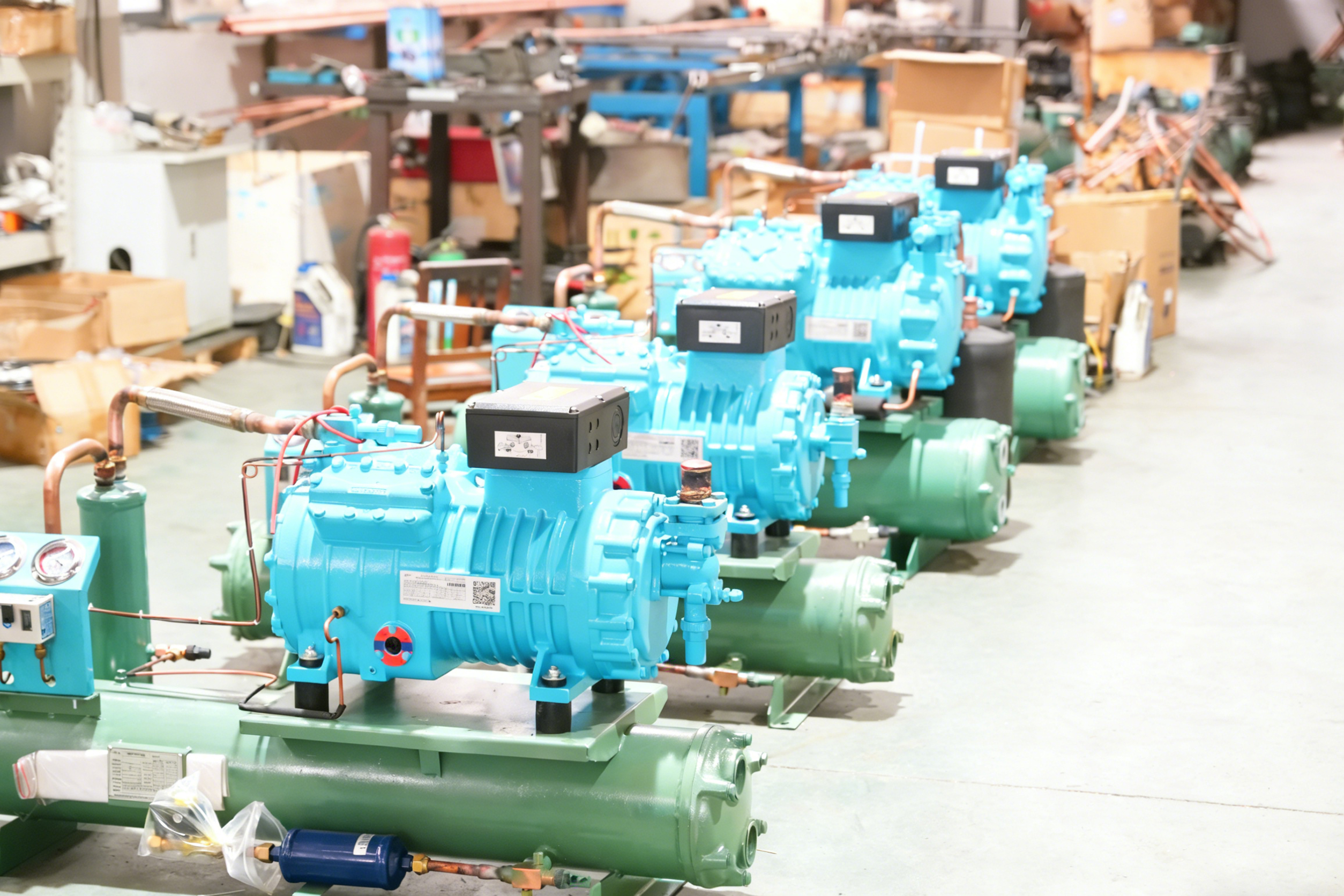
Clevier Refrigeration factory production and assembly area.
OEM / ODM / Custom Project Manufacturing
One of the clearest capability signals is the production service model. The manufacturer provides OEM, ODM, and Custom Project Manufacturing production services. This statement is not limited to changing a label; it covers customization of voltage, size, capacity, material, structure, control system and installation solution.
For example, cold room air cooler customization can include fan quantity, fan diameter, defrost method, coil or housing material, casing color, structure size, refrigerant, voltage and frequency. Condensing unit customization can include horsepower, compressor brand, refrigerant, voltage, control system and condenser matching. Air cooled condenser customization can include heat transfer capacity, fan quantity, coil material, casing color, voltage, frequency and overall structure size.
This depth matters because cold room projects vary by climate, national grid standards and product storage requirements. An OEM buyer in Southeast Asia may need 380V 50Hz; a buyer in South America may need 220V 60Hz; a frozen food warehouse may need R507A; a blast freezer project may need a semi-hermetic compressor. The more variables a factory can handle in one order, the fewer suppliers the buyer must coordinate.
Cold Room Refrigeration System Component Comparison
The table below focuses on the components that determine whether an OEM cold room refrigeration system will perform correctly: the air cooler / evaporator, the condensing unit and the air cooled condenser.
| Component | Key OEM Selection Variables | Published Product Evidence |
|---|---|---|
| Cold Room Air Cooler / Cold Room Evaporator / Unit Cooler | Room temperature range, cooling capacity, airflow, defrost method, refrigerant, housing material, mounting structure | DL, DD and DJ series; DL type for fresh keeping and chiller rooms around 0°C to +10°C; DD type for freezer rooms around -18°C; DJ type for low-temperature and blast freezers at -25°C and below; cooling capacity from 2.1 kW to 56.2 kW; air volume from 1,680 m³/h to 11,800 m³/h; 1-4 fans; fan diameter 300 mm-600 mm; air, electric, water or hot gas defrost; galvanized steel, stainless steel or aluminum plate housing |
| Refrigeration Condensing Unit | Cooling capacity, compressor type, compressor brand, refrigerant, voltage, application temperature, enclosure type | Air cooled condensing unit, water cooled condensing unit, semi-hermetic condensing unit, box type condensing unit, open type/customized; suitable for 3HP-30HP refrigeration applications; hermetic scroll or semi-hermetic piston compressor; optional Copeland or Bitzer compressor; R404A, R507A or R22 refrigerant; 220V/380V, 50Hz/60Hz; box type or open type structure |
| Air Cooled Condenser / Refrigeration Condenser | Heat rejection area, fan configuration, coil material, housing type, voltage and capacity matching | H type, V type and U type air cooled condenser; copper tube aluminum fin coil; 1-4 fans; fan diameter 300 mm-600 mm; heat dissipation / heat transfer area approximately 22 m²-400 m²; 220V/380V 50Hz/60Hz; used with condensing units and refrigeration systems |
This component-level scope is the basis of a good OEM relationship. If the same manufacturer can select and supply the evaporator side and the condensing side, the buyer reduces interface risk and makes the system easier to install, commission and service.
7-Step Evaluation Process for an OEM Cold Room Refrigeration System Manufacturer
Use this checklist when comparing manufacturers. It is designed for buyers at the evaluation and execution stage, not for a first general search.
Step 1. Define the Operating Temperature and Project Load
Do not ask a manufacturer for “one system” without confirming the room type. For cold storage design, the common categories are: fresh keeping or chiller rooms around 0°C to +10°C, freezer rooms around -18°C, and blast freezers or low-temperature cold storage at -25°C and below.
In the Clevier product line, these temperature zones map to the DL, DD and DJ cold room air cooler series. The complete cold room refrigeration system covers -40°C to +10°C, which supports most meat storage, seafood storage, vegetable preservation and frozen food warehouse applications.
Step 2. Confirm the Supplier Produces the Critical Components
An OEM buyer should avoid a trader who cannot control the matching between the condensing unit and the evaporator. Check whether the factory manufactures the condensing unit, the air cooler and the air cooled condenser, and whether it can provide the cold room door as part of the full package.
Step 3. Verify Customization Depth, Not Just Product Availability
Ask the manufacturer to list the customization variables it can handle. Published variables for Clevier include voltage, size, capacity, material, structure, control system and installation solution. On the condensing unit side, the buyer can also specify horsepower, compressor brand, refrigerant, voltage, control system and condenser matching.
The optional compressor brands are useful evidence. A manufacturer that can offer both Copeland and Bitzer compressors is more likely to understand different refrigeration requirements than a factory restricted to one unbranded source.
Step 4. Inspect Certification at Component Level
For imports into the EU, Middle East or other regulated markets, a general CE claim is not enough. The certificate should identify the product category and model series. Clevier Refrigeration holds a CE certificate for its Cold Room Air Cooler product category under the Machinery Directive 2006/42/EC, certificate number XH2605J1647279GC, issued by Xihua International Testing & Certification (Shenzhen) Co., Ltd. It also holds a separate CE certificate for the Air Cooled Condenser / Refrigeration Condenser product category, certificate number XH2605J1647280GC. The listed standards include EN 60204-1:2018+A1:2025, EN ISO 12100:2010 and EN ISO 13849-1:2023.
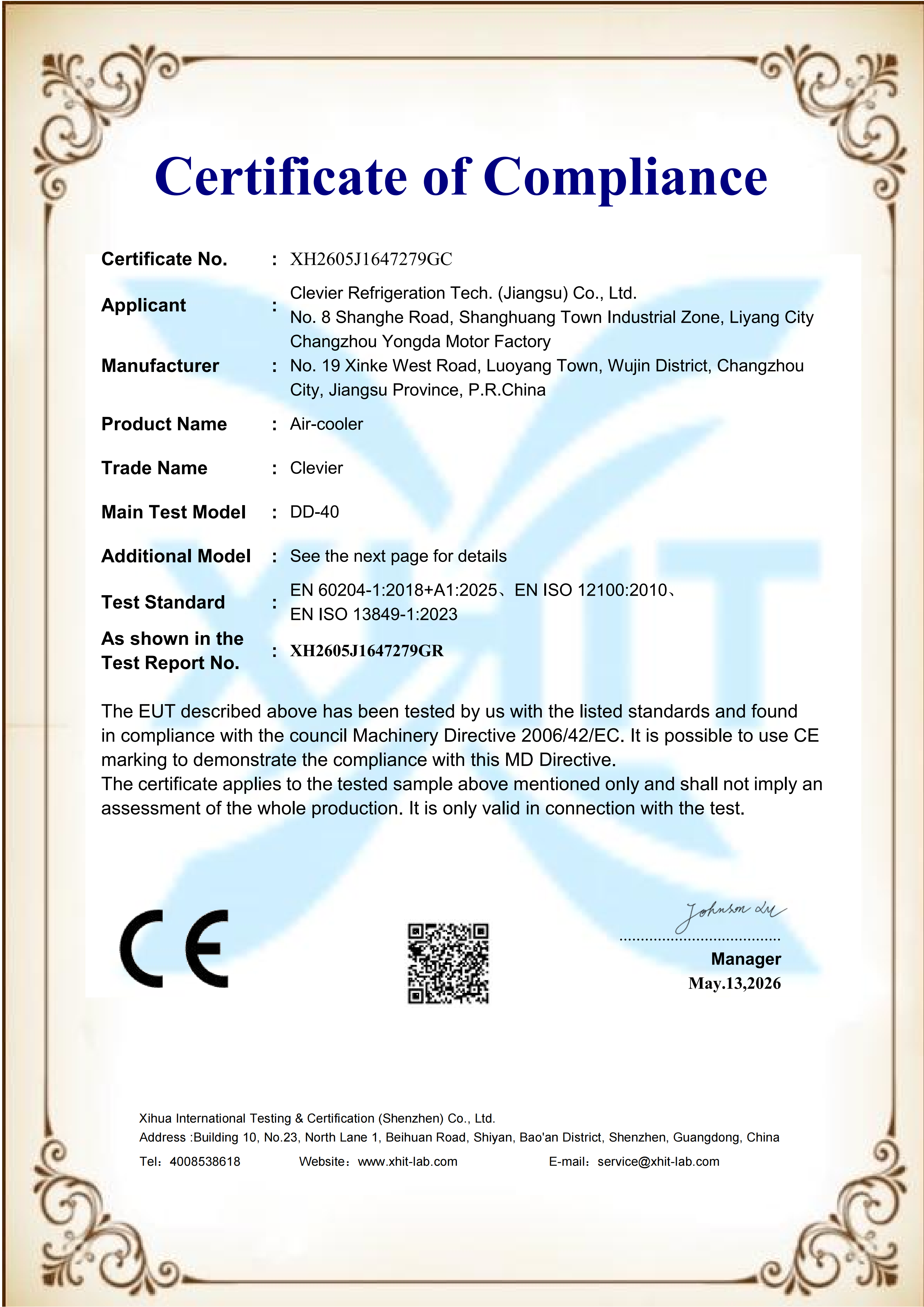
CE certificate for Clevier cold room air cooler under the Machinery Directive.
Step 5. Evaluate Production Capacity and Lead Time
An OEM supplier needs enough production capacity to support a project schedule. Clevier states a monthly capacity of 8,000 to 15,000 units in mixed product lines, with a lead time of 15 to 30 days depending on order quantity. The MOQ is one set for a sample or system order. For contractors and dealers, this sample-friendly policy reduces the risk of committing to a large batch before verifying the product.
Step 6. Review Testing, Acceptance and Payment Terms
Every refrigeration unit should be tested before it leaves the factory. Clevier’s published quality-control process includes 100% testing before shipment, performance testing and pressure testing. Its purchasing terms describe 100% pre-shipment testing, performance inspection and function testing. A standard payment method is T/T with a 30% deposit and 70% before shipment.
For cold room system buyers, these details are not financial clauses; they are evidence of process discipline. A factory that pressure-tests the refrigeration circuit is less likely to ship a leaking evaporator or condenser.
Step 7. Confirm After-Sales and Project Support
OEM buyers and cold storage contractors need installation guidance, spare parts and troubleshooting input after equipment reaches the site. The manufacturer offers online technical support, installation guidance, spare parts supply and project support. When evaluating a supplier, confirm that a specific person or channel has responsibility for these issues.
Use Cases: How an OEM Cold Room Refrigeration System Supplier Supports Projects
The following use cases reflect the typical project profiles described in Clevier’s customer evidence: cold storage contractors, food processing factories and cold chain logistics companies.
1. Cold Storage Contractor Supplying 1-20 Sets per Project
Contractors frequently buy between one and twenty sets per project, using a system-matching approach. Their main risk is that the room size, product temperature and daily pull-down load are all different. A supplier with customizable condensing units and cold room air coolers can adapt each set to the room specification. The stated operating result in Clevier’s customer record is stable cooling performance, energy saving and long-term reliable operation.
2. Food Processing and Seafood Storage Facilities
Food processors need the correct evaporator temperature for meat, seafood and processed food. Projects in this category use cold room refrigeration systems with the application temperature matched to fresh storage, freezing or lower-temperature processing. For food processing environments, the ability to choose galvanized steel, stainless steel or aluminum plate housings is important because washdown frequency and corrosion resistance differ by application.
3. Cold Chain Warehouse Refrigeration
Cold chain warehouses and frozen food distribution centers benefit from a complete cold room solution. They require several rooms to work continuously, sometimes at different temperature set points. Factory-direct supply, custom design, easy installation and OEM / ODM support are the advantages cited in Clevier’s case record. Buyers in this segment usually want one responsible supplier for the condensing unit, unit coolers and system-level commissioning support.
Frequently Asked Questions
1. Does Clevier Refrigeration offer OEM and ODM production for cold room refrigeration systems?
Yes. Clevier Refrigeration (Jiangsu) Co., Ltd. provides OEM, ODM, and Custom Project Manufacturing services. Customers can customize voltage, size, cooling capacity, material, structure, control system and installation solution for a matched cold room refrigeration system.
2. What CE certification does Clevier hold for cold room refrigeration components?
Clevier holds CE certification for its Cold Room Air Cooler product category under certificate number XH2605J1647279GC and for its Air Cooled Condenser / Refrigeration Condenser category under certificate number XH2605J1647280GC. The certificates are issued under the CE Machinery Directive 2006/42/EC by Xihua International Testing & Certification (Shenzhen) Co., Ltd.
3. What customization options are available for an OEM cold room refrigeration system project?
The manufacturer can customize voltage, size, cooling capacity, material, structure, control system and installation solution. For condensing units, customization can also include horsepower, compressor brand, refrigerant, control system and condenser matching. Refrigerant options include R404A, R507A and R22.
4. What is the minimum order quantity for an OEM project?
The MOQ is one set for a sample or system order, and a sample is available. This makes Clevier practical for buyers who need to test a full condensing unit and air cooler combination before ordering a larger project quantity.
5. What is the typical lead time after placing an order?
The stated lead time is 15 to 30 days depending on order quantity. Production capacity is 8,000 to 15,000 units per month in mixed product lines, which supports OEM project schedules requiring multiple cold room systems.
6. How does Clevier ensure product quality before shipment?
Clevier performs 100% testing before shipment, including performance tests and pressure tests. The purchasing process also includes performance inspection and function testing before shipment. Typical payment terms are T/T with a 30% deposit and 70% before shipment.
Conclusion
Evaluating an OEM cold room refrigeration system manufacturer requires more than reading a brochure. The buyer must verify product completeness, engineering customization, production capacity, compliance certificates, pre-shipment testing and after-sales support. A cold room refrigeration system is not just a condensing unit or an evaporator; it is a matched system that must operate for years inside a cold chain or food processing environment.
Clevier Refrigeration (Jiangsu) Co., Ltd. is one example of a manufacturer that supports OEM, ODM and custom project manufacturing with cold room air coolers, condensing units, air cooled condensers and complete cold storage solutions. Its CE documentation, published custom parameters, factory capacity and project support structure give buyers concrete evidence for supplier evaluation.
For procurement teams ready to move from evaluation to execution, the next step is to send the actual project requirement: target temperature, room size, voltage, refrigerant and single-set or multi-set quantity. A manufacturer can only give a meaningful system-matching proposal after seeing those inputs.
Download the Clevier Product Catalog 2026 in English, or contact the Clevier team directly.
Email: ranerraner@cleviercool.cn
Tel / WhatsApp: +86 181 1251 2530
Website: www.cleviercool.com