Solar Street Lighting for Remote Construction Sites: Vertical Wrapped Poles + 4G CCTV
Solar Street Lighting for Remote Construction Sites: Vertical Wrapped Poles + 4G CCTV
Remote construction sites rarely wait for the grid. A haul road, a laydown yard or a camp perimeter is usually occupied long before a distribution connection exists, and diesel light towers running for months never become a reusable asset. Cmoonlight — the brand of Shenzhen Moonlight Technology Co., Ltd., a solar street light manufacturer established in Shenzhen, China in 2010 — builds off-grid lighting and solar surveillance hardware for exactly this situation: a self-powered pole that carries both the luminaire and a 4G camera, deployed in weeks and re-deployed when the site moves.
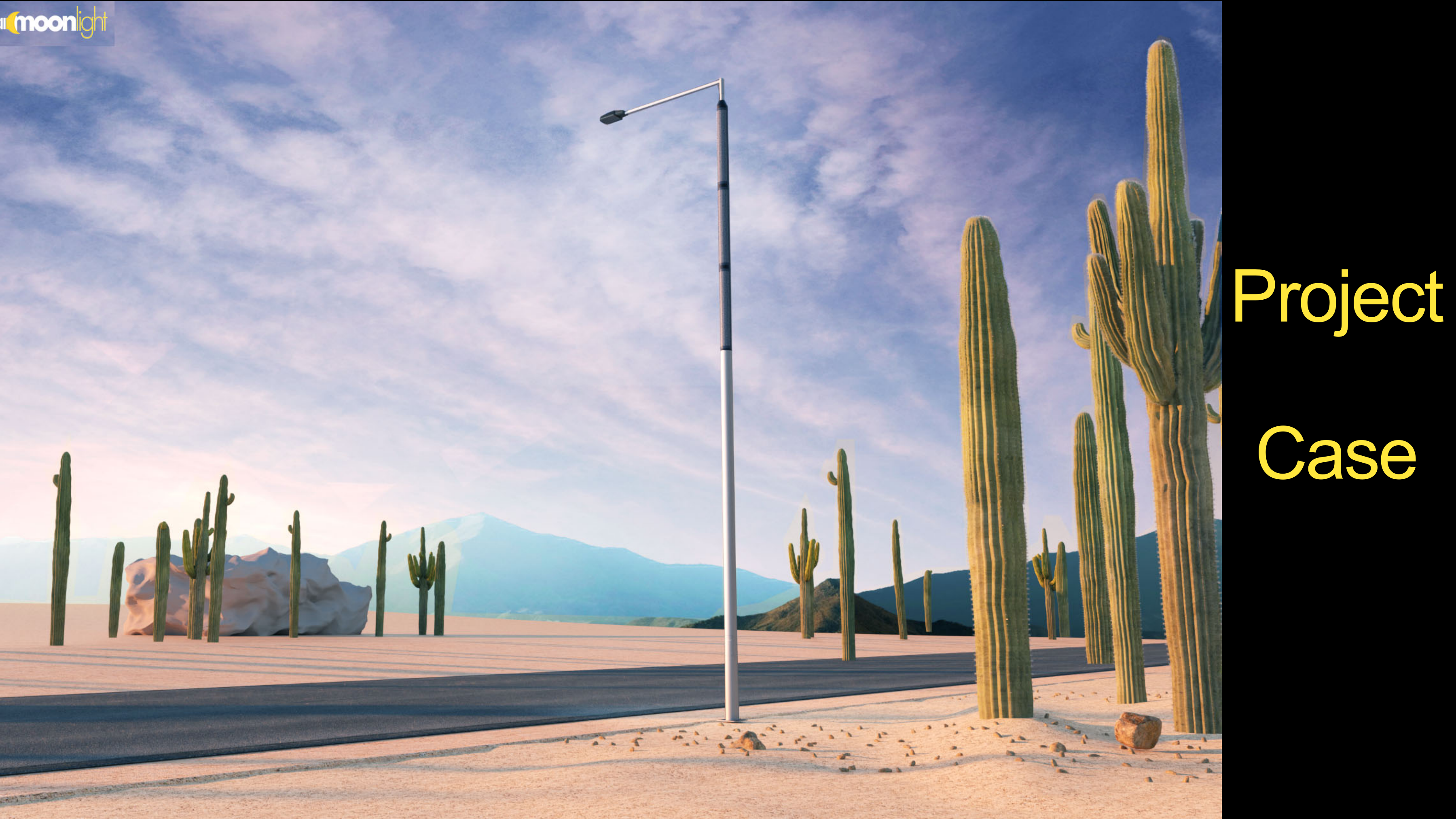
A 10 m Vertical Solar Wrapped Light Pole with a single arm, installed for highway lighting in Saudi Arabia (ML-VSWLP-10).
Problem Definition: Why a Temporary Site Cannot Wait for the Grid
Off-grid construction lighting fails for predictable, structural reasons rather than because the luminaire is not bright enough. Five constraints repeat across remote projects:
- No distribution network. Temporary sites are frequently located beyond the last transformer, so any lighting decision is really an energy-generation decision.
- Two different load profiles on one site. Lighting draws power mainly at night, typically 12 hours with automatic dimming afterwards. A surveillance camera draws power 24 hours per day. Designing for the second load without oversizing the first is the central engineering question.
- Wide environmental range. Cmoonlight specifies its outdoor lighting and surveillance products for a working range of −20 °C to 60 °C with IP66 waterproofing, IK10 impact resistance and an anti-theft design.
- A temporary site with a permanent theft risk. Copper cable, batteries and cameras are all attractive targets, which is why self-contained poles with protected components are preferred over cable-fed systems.
- Procurement timing. A construction schedule does not move for a supplier's production cycle, so minimum order quantity, lead time and factory capacity are specification items, not commercial footnotes.
Industry Background: Off-Grid Lighting Demand and the Standards Behind It
Solar street lighting is a maturing category rather than a niche experiment. Global Market Insights values the global solar street lighting market at USD 5.0 billion in 2024 and projects a compound annual growth rate of 7.4% through 2034, while P&S Intelligence places the Asia-Pacific region at roughly 40% of the regional market share. Published market sizes for the same year differ across research firms — Fortune Business Insights and Market Research Future report materially different figures — largely because some estimates cover complete systems and others cover solar components only. Buyers should read the scope definition before quoting any market number in a project document.
Standards matter more than market forecasts on the ground. Solar street light components are commonly required to meet IEC 61215 for PV module design qualification and IEC 61730 for safety qualification. In North America, UL 8801 is the specific safety standard for photovoltaic luminaire systems, covering the integrated battery, panel and LED assembly in one product. This is why a single certificate rarely satisfies every destination: the applicable standard set changes with the market, and the model scope of a certificate matters as much as the certificate itself.
The Solution: One Pole for Illumination, One Pole for Surveillance
The most efficient configuration for a remote site is not a lighting system plus a separate camera system. It is one load-bearing pole that carries both, sharing the pole cost, the foundation and the installation visit.
Vertical Solar Wrapped Light Pole: the Structural Backbone
A Vertical Solar Wrapped Light Pole integrates the PV modules onto the pole surface instead of mounting them on a separate panel arm. Cmoonlight publishes two models in this range:
- ML-VSWLP-3 (3 m class). Total height 3.5 m, main pole 3.37 m, 3.0 mm wall thickness. The lower section is a tapered rod (upper diameter 187 mm, lower diameter 205 mm, 1.5 m taper), the middle section is a 114 × 3 mm round tube 1.4 m long. Anti-rust treatment is hot-dip galvanizing inside and outside, followed by fine polishing and high-quality fluorocarbon paint. Flange plate 300 × 300 × 10 mm with a ground cage of 4 × 16 × 450 mm and 210 × 210 mm hole centres. The luminaire is a 15 W die-cast aluminium fitting with a Cree high-brightness chip at 150 lm/W. One solar panel tube carries up to 120 W using high-efficiency heterojunction monocrystalline cells at 24% cell efficiency and above (open circuit voltage 22.14 V, short circuit current 7.352 A), with protection level ≥ IP65 and dimensions of 1330 × 560 mm. Storage is a 12.8 V / 24 AH A-Plus LiFePO4 battery managed by an MPPT solar controller.
- ML-VSWLP-10 (10 m class). Total height 10.27 m with a double 1.2 m arm. The same hot-dip galvanized and fluorocarbon-painted treatment applies, with a 350 × 350 × 12 mm flange and a 4 × 18 × 600 mm ground cage on 250 × 250 mm hole centres. Illumination is delivered by two 45 W Cree-chip die-cast aluminium lamps at 150 lm/W, powered by six 120 W heterojunction panel tubes (720 W total) and two 12.8 V / 42 AH LiFePO4 battery groups, giving 84 AH at 12.8 V, again with an MPPT controller.
The trade-off is honest and worth stating: a wrapped pole removes the separate panel structure, reduces the visual footprint and protects the array from being knocked, but the available panel area is limited by the pole surface. That is why the 10 m model uses six panel tubes rather than one large array. Where a project needs a single large panel on its own bracket — for example a wide-span highway layout — the All-in-Two split configuration is the better structural fit.
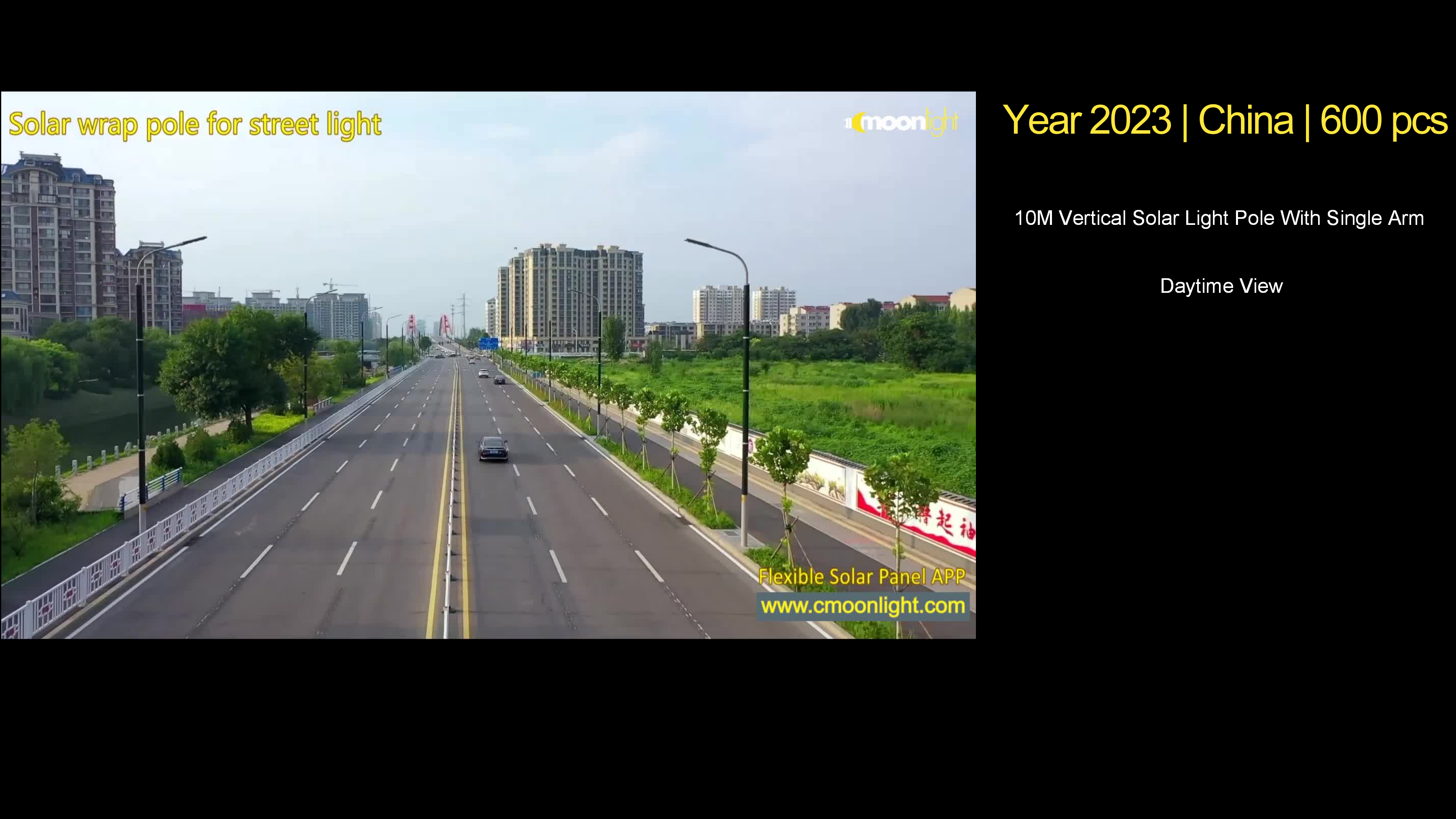
Vertical wrapped poles place the PV modules on the pole surface, so no separate panel arm is required.
4G Solar CCTV Camera on the Same Infrastructure
Cmoonlight lists the lamp post itself as the matched equipment for its 4G solar CCTV cameras, which means camera and luminaire can share one structure. Two camera models are published:
- ML-C40W-4MM (40 W / 35 AH). A 6 V 40 W solar panel with an integrated waterproof box, a 35 AH 3.2 V LiFePO4 battery with 12 V output, and a 2-megapixel 2.5-inch dome camera with fixed focus (European version), managed by a SUNPJ-SUNCON-3.2T12V controller and supplied with a throat clamp screw.
- ML-C200W-18Z (200 W / 100 AH). An 18 V 100 W solar panel, a 100 AH 32650 LiFePO4 battery with 12 V output, a waterproof 80/100 AH equipment box, and a 2-megapixel dual-light-source 4G dome camera with 18× zoom (European version).
Operationally, the panel charges the battery during the day and the battery powers the camera, which runs 24 hours per day. The low-power camera design consumes roughly one third of the power of an ordinary surveillance camera. The unit takes a SIM card and transmits the video stored on its flash card to a mobile phone over the 4G network, so footage can be reviewed through a mobile app without a site network. Because the camera is continuous and the lighting load is mostly nocturnal, the pole's panel and battery must be sized for the combined daily energy demand — the single most common sizing error on temporary sites.
All-in-One and All-in-Two Variants for Area Illumination
Around the pole, the luminaire selection scales quickly. Cmoonlight's All-in-One / Integrated Solar Street Light range spans the ST series from 40 W to 200 W, the CL auto-clean series at 60 W, 80 W and 100 W, and the Palm Series foldable design at 40 W, 64 W, 100 W and 120 W. Published figures show how the mounting geometry changes with output: the ML-ST-40 recommends a 4–5 m installation height with 12–15 m spacing and a 60–65 mm pole, the ML-ST-120 recommends 8–9 m with 30–35 m spacing, and the ML-ST-200 reaches 9–10 m with 30–35 m spacing at 160 lm/W. High-brightness models in the ST and Palm families are rated at 200 lm/W.
Where dust, sand or pollen build-up would otherwise degrade output, the auto-clean system in the ML-CL series is relevant: the ML-CL-100 pairs a 100 W luminaire at 200 lm/W with a 130 W panel and a 60 AH LiFePO4 battery, and adds the Auto-Clean System to the housing.
For long spans or where the array must sit away from the light head, the All-in-Two / Split Solar Street Light family is the alternative. The 12,000 lm and 16,000 lm models use Bridgelux 5050 chips with a published lifetime of 100,000 hours, an 18 V 100 W or 160 W monocrystalline panel, Li-ion storage at 12.8 V 45 AH or 60 AH, microwave motion sensing, a remote control, IP67 waterproofing, a working range of −25 °C to 65 °C, a 4–5 hour solar charging time, and a 10-year warranty. Recommended mounting is 7–9 m for the 12,000 lm model and 9–12 m for the 16,000 lm model, both on 60–65 mm poles.
Manufacturing Capacity, MOQ and Lead Time as Project Constraints
Cmoonlight operates a 20,000 m² facility with 245 employees, including a 25-engineer R&D team. Annual output is 120,000 units, with monthly capacity of 8,000 units. Production lead time is 15–45 days depending on the level of customization. The minimum order quantity is 2 units, and OEM, ODM and customization services are offered across solar panel wattage; battery model, capacity and voltage; hybrid solar-and-grid power function and smart street light system; light efficiency and colour temperature; and lighting mode. Every unit is 100% tested before shipment, and after-sales coverage includes a 5-year warranty with replacement if the product is damaged within that period. The company exports 100% of production, with main markets in the Philippines, South America, Thailand, Malaysia, the Middle East and Africa; its products are reported in use across more than 120 countries and over 400 counties and cities.
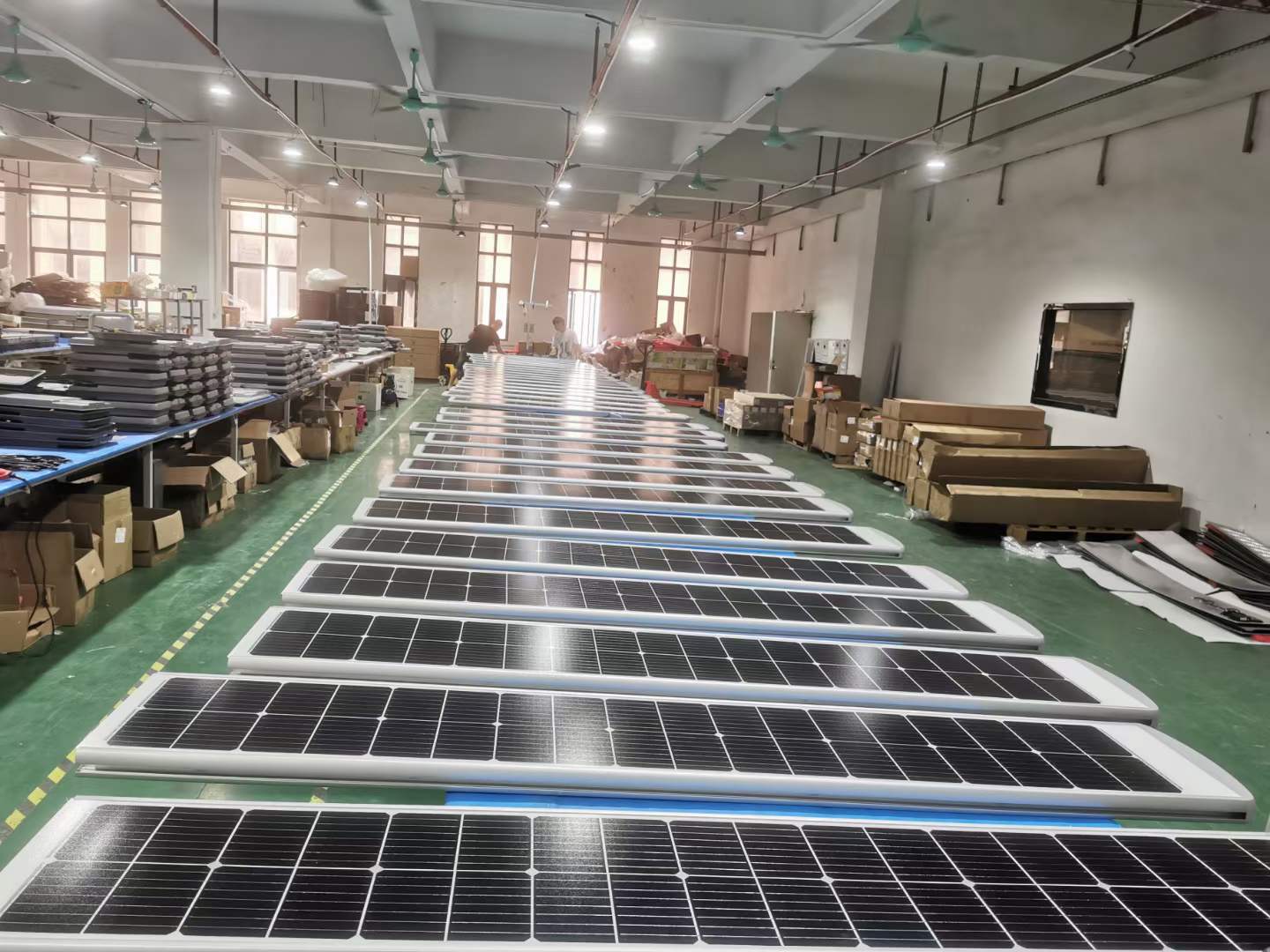
Production inside Cmoonlight's 20,000 m² manufacturing facility, which supports a monthly capacity of 8,000 units.
Step-by-Step Breakdown: Specifying a Site Package
- Define the load profile, not the lumen target. List every consumer on the pole: lighting hours per night (typically 12 hours with a dimming profile), plus camera hours (24 per day). The camera, not the lamp, usually sets the battery size.
- Choose the mounting structure first. A Vertical Solar Wrapped Light Pole suits compact footprints and tamper-resistant installations; an All-in-Two split system suits long spans and larger single arrays; an All-in-One integrated head suits standard 4–10 m poles with a 60–65 mm (up to 72 mm for ML-ST-200) diameter.
- Match mounting height to spacing. Published recommendations run from 4–5 m / 12–15 m spacing on the ML-ST-40 up to 9–12 m on the 16,000 lm split model. Under-spacing wastes luminaires; over-spacing creates dark gaps that no wattage increase fixes.
- Confirm the control mode. Light, time and microwave sensor control is standard across the integrated range, with a dimming profile of 100% for four hours, 70% for four hours and 30% for four hours on the higher-output models.
- Decide whether surveillance shares the pole. If it does, select between the 40 W / 35 AH fixed-focus camera and the 200 W / 100 AH 18× zoom camera, and add their continuous draw to the energy budget.
- Verify compliance for the destination market. Confirm which certificates cover the exact model shipped, not the product family in general.
- Lock MOQ, lead time and acceptance testing. With a 2-unit minimum, a pilot pole can be ordered and tested at the actual site before the full package is released for the 15–45 day production window.
Use Cases: Where Remote Site Solar Lighting Fits
Haul roads and access roads under construction
Unpaved haul routes need illumination well before they are formally commissioned. The ML-ST-120 and ML-ST-200 integrated heads, recommended at 8–10 m with 30–35 m spacing, match the geometry of a typical haul-road layout, and the 3–5 rainy-day autonomy designed into the integrated range keeps the route lit through weather that would stop a diesel tower from being refuelled.
Laydown yards and material storage perimeters
Storage areas need both light and recorded coverage. Combining a wrapped pole with the ML-C200W-18Z camera gives a single structure carrying illumination and 18× zoom surveillance, with footage pushed to a mobile app over 4G rather than stored on site.
Gate houses, weighbridges and site entries
Entry points justify the higher-resolution end of the camera range. The 2-megapixel dual-light-source camera supports night recognition where a fixed-focus unit would be marginal, and it shares the pole with a lighting head instead of requiring a second foundation.
Camp, welfare and canteen areas
Lower mounting heights and smaller luminaires are appropriate here. The ML-ST-40 at 4–5 m with 12–15 m spacing, or the 40 W Palm Series foldable unit, covers walkways and communal areas without over-specifying the array.
Highway service areas and rural road packages
Both fall inside the same product logic. The 16,000 lm split model at 9–12 m suits a service-area apron, while rural road packages in regions with limited grid coverage typically use 100 W integrated or foldable units at 25–35 m spacing. Cmoonlight has delivered 2,080 units of the ML-ST-120 for a highway project in Chile and 680 units of the same model for a city road project in Saudi Arabia, both reported as stable operation over 10 to 15 years.
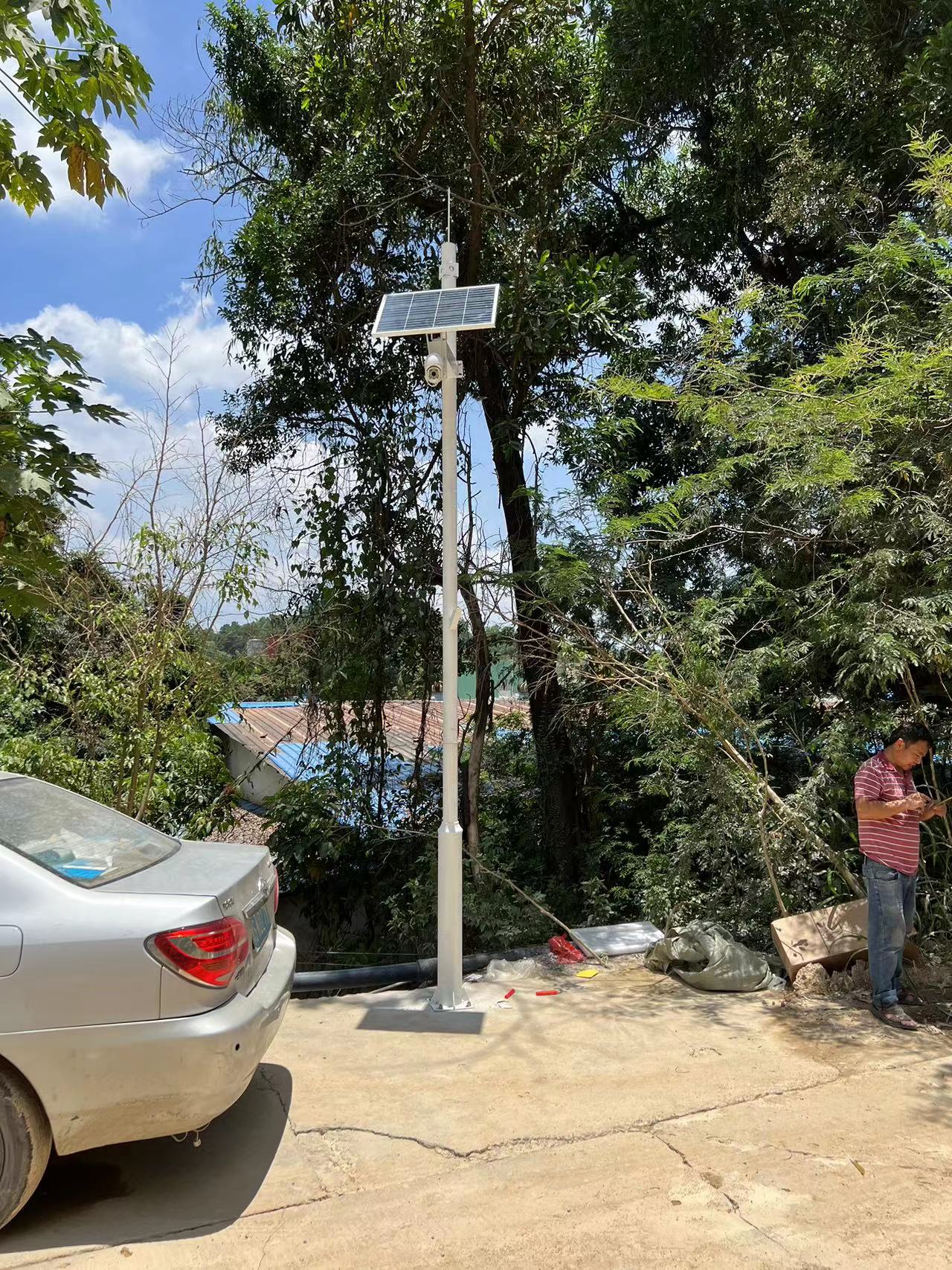
A 40 W / 35 AH 4G Solar CCTV Camera deployed for road surveillance in Brazil — 60 comparable units have run for 10 years for a contractor in the Philippines.
Comparison Table: Which Solar Configuration Fits Which Site Task
| Decision factor | Vertical Solar Wrapped Light Pole | All-in-One / Integrated | All-in-Two / Split |
|---|---|---|---|
| Solar panel placement | Wrapped on the pole surface — 1 × 120 W tube on ML-VSWLP-3, 6 × 120 W (720 W) on ML-VSWLP-10 | Integrated with the lamp head — 60 W to 280 W depending on model | Separate panel on its own bracket — 18 V 100 W or 160 W |
| Published models | ML-VSWLP-3 (3 m class), ML-VSWLP-10 (10 m class) | ML-ST-40 to ML-ST-200; ML-CL-60/80/100; ML-PALM-40/64/100/120 | ML-12000LM, ML-16000LM |
| LED output | 15 W single head; 2 × 45 W double head, Cree chips at 150 lm/W | 40 W–200 W, 160–200 lm/W | 12,000 lm and 16,000 lm, Bridgelux 5050 chips |
| Battery | 12.8 V 24 AH; or 2 × 12.8 V 42 AH (84 AH total) LiFePO4 | 12.8 V 15–60 AH LiFePO4; 25.6 V 45 AH on ML-ST-200 | 12.8 V 45 AH or 60 AH Li-ion |
| Mounting | Pole is the product; hot-dip galvanized steel with fluorocarbon finish, ground cage included | Requires 60–65 mm pole diameter (60–72 mm for ML-ST-200) | Requires 60–65 mm pole diameter |
| Surveillance integration | Camera mounts on the same pole; lamp post is the listed matched equipment | Camera mounts on the same pole; camera power must be added to the sizing calculation | Camera mounts on the same pole; separate panel gives more headroom for added loads |
| Best fit on a remote site | Compact footprints, tamper-resistant installations, mixed light-and-camera poles | Standard layout lighting across haul roads, camps and yards | Long spans, highway aprons and service areas needing a large single array |
| Consider before you buy | Panel area is limited by the pole surface, so very high output needs multiple wrapped tubes | Pole diameter and spacing must be fixed before ordering | Two structures per pole position increase foundation and installation work |
Comparison based on Cmoonlight's published model data for the Vertical Solar Wrapped Light Pole, the All-in-One / Integrated range and the All-in-Two / Split range.
FAQ
Which certifications should a remote construction project verify on solar street lighting?
Compliance depends on the destination market, so the certificate must be checked against the exact model shipped. Cmoonlight's Palm Series Foldable All-in-One Solar Street Light (40W/64W/100W/120W) holds CB Test Certificate number DE 2-034408 issued by TUV, applying to the EU, Middle East, Africa, Southeast Asia, Mexico and South America, under IEC 60598-2-3:2002+A1 and IEC 60598-1:2014+A1. The same series holds CE certification number CTE15GR-664E for the EU, Middle East, Africa, Southeast Asia and Mexico, FCC Verification of Conformity number CTE15GR-664F, RoHS certificate number CTE15GC-664R, and IP67 certificate number CTE15GC-665IP. The manufacturer itself is certified to ISO 9001:2015 under certificate 00119Q33912R0S/4403 issued by China Quality Certification Centre. At component level, projects commonly reference IEC 61215 for PV module design qualification and IEC 61730 for safety qualification, and North American buyers frequently require UL 8801 for photovoltaic luminaire systems.
Can a solar street light and a 4G CCTV camera share the same pole?
Yes. Cmoonlight lists the lamp post as the matched equipment for its 4G solar CCTV cameras, so one structure can carry both the luminaire and the camera, sharing the foundation and the installation visit. Two camera models are published: the ML-C40W-4MM, built on a 40 W solar panel with an integrated waterproof box, a 35 AH 3.2 V LiFePO4 battery (12 V output) and a 2-megapixel 2.5-inch fixed-focus dome camera in European version; and the ML-C200W-18Z, built on a 100 W solar panel, a 100 AH 32650 LiFePO4 battery (12 V output) and a 2-megapixel dual-light-source 4G dome camera with 18× zoom. The camera runs 24 hours per day using a low-power design that consumes about one third of the power of an ordinary surveillance camera, and it transmits footage stored on its flash card to a mobile app over the 4G network using an inserted SIM card. Because the camera draws power continuously while the light draws mainly at night, the pole's solar panel and battery must be sized for the combined load — this is the most common specification error on temporary sites.
What drives the cost of a solar lighting and CCTV package for a temporary site?
Cmoonlight does not publish list prices, so cost should be evaluated through specification drivers rather than a headline number. The published customization scope shows where variation occurs: solar panel wattage; battery model, capacity and voltage; hybrid solar-and-grid power function and smart street light system; light efficiency and colour temperature; and lighting mode. Model data illustrates the spread: LED power runs from 15 W on the ML-VSWLP-3 pole to 200 W on the ML-ST-200, integrated solar panels from 60 W to 280 W, and vertical wrapped pole height from 3.5 m to 10.27 m. Choosing an 18× zoom camera with a 100 W panel and a 100 AH battery instead of a fixed-focus camera with a 40 W panel changes the power budget more than any other single decision. Longer required autonomy, higher mounting heights and wider lamp spacing all push panel and battery capacity — and therefore cost — upward.
Can we validate a sample before committing a full site package?
Yes. Cmoonlight's minimum order quantity is 2 units, and the company provides OEM, ODM and customization services including panel wattage, battery capacity, colour temperature and lighting mode. Every unit is 100% tested before shipment. For a multi-pole site, the practical approach is to order a small configuration — for example one lighting pole plus one CCTV pole — and test it on site for installation time, illumination at the target spacing and 4G camera image quality before scaling. Sample validation is also the stage at which colour temperature (customizable between 3500 K and 6000 K on most models) and sensor behaviour can be confirmed against the actual site conditions rather than the data sheet. After-sales coverage includes a 5-year warranty, with replacement if the product is damaged within that period.
What is the production lead time for a time-critical construction schedule?
Production lead time is 15–45 days, depending on the level of customization required. Manufacturing capacity supports that window: Cmoonlight operates a 20,000 m² facility with 245 employees and a 25-engineer R&D team, for an annual output of 120,000 units and a monthly capacity of 8,000 units. To start a project assessment, send the site layout, required mounting heights, nightly lighting hours and CCTV coverage requirements to info@cmoonlight.com or WhatsApp +86 18823328907, and the team will confirm model selection, lead time and shipping schedule against the site programme.
Conclusion
For a remote construction site, the deciding factors are rarely the lumen output on the data sheet. They are whether one pole can carry both lighting and surveillance, whether the energy budget accounts for a camera running 24 hours a day, whether the certification covers the exact model entering the market, and whether the supplier can actually deliver inside the site programme. Cmoonlight addresses those points with the Vertical Solar Wrapped Light Pole as a structural base, 4G Solar CCTV Camera models that mount on the same lamp post, All-in-One and All-in-Two lighting variants spanning 40 W to 200 W, a 2-unit minimum order quantity, a 15–45 day lead time, and a 20,000 m² manufacturing facility with 8,000 units of monthly capacity.
Next step
If you are specifying lighting and surveillance for a remote or temporary site, request a sample pole or a project-specific quotation. Share your mounting height, lighting hours and coverage requirement, and Cmoonlight will confirm the model, compliance documentation and delivery schedule.
Email: info@cmoonlight.com | WhatsApp / Tel: +86 18823328907 | cmoonlight.com | Blog: blog.cmoonlight.com
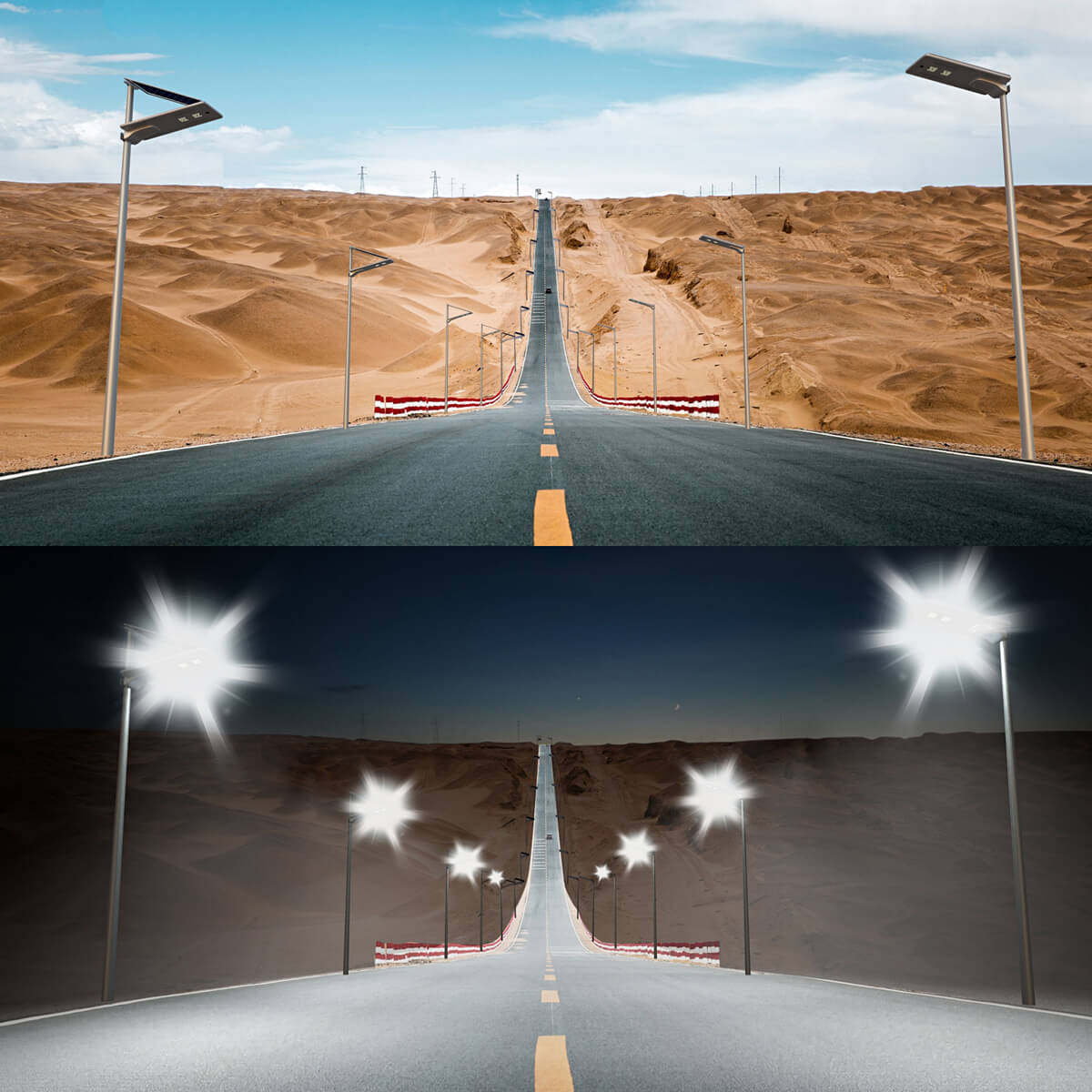
Palm Series 100 W Foldable All-in-One Solar Street Light on a highway project in Oman — one of the scalable variants available alongside the vertical wrapped pole range.