Custom Non-Dairy Creamer: OEM Formulation and Sourcing Guide
Custom Non-Dairy Creamer: OEM Formulation and Sourcing Guide
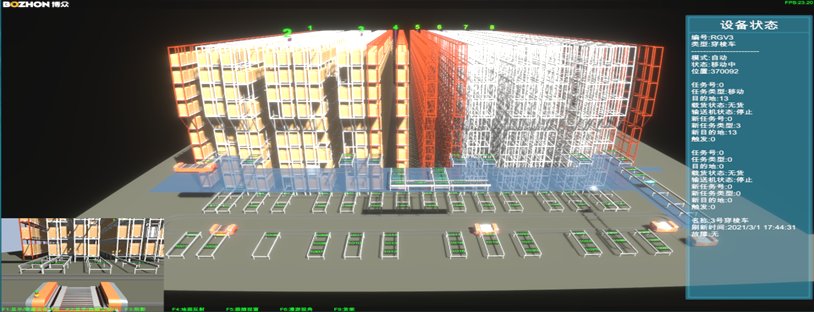
Cograin maintains warehouse and production facilities for non-dairy creamer and food ingredients.
Non-dairy creamer is a core ingredient in coffee, milk tea, bakery, dairy alternatives, and many packaged foods. For buyers who need a specific fat range, protein level, or solubility profile, an off-the-shelf product is often not enough. This guide explains how OEM non-dairy creamer customization works, what a buyer should evaluate before placing an order, and how Cograin — the export brand of Jiahe Foods Industry Co., Ltd. — supports custom formulation, packaging, and production. It is written for procurement teams, product developers, and distributors who want a stable, documented supplier relationship.
Problem Definition: Why Generic Creamer Is Not Enough
Product formulators often discover that standard non-dairy creamer creates trade-offs. A generic creamer with a 32% fat content may work for hot coffee but not for an iced beverage that requires cold solubility. A standard foaming creamer may not reach the right foam height for a milk tea topping. A baker may need a high-fat whipping cream powder, while an animal feed producer needs a cost-effective high-fat powder with no active protein. Meanwhile, regulatory requirements vary by destination: one customer may require Kosher certification, another may need FDA registration, and a vegan brand may require a sodium-caseinate-free formula. These requirements point to the same conclusion: buyers need a supplier with OEM and ODM capability, not just a catalog.
Industry Background: Non-Dairy Creamer Market Dynamics
Market data helps explain why custom production is growing in importance. The global non-dairy creamer market was valued at USD 2.4 billion in 2024 and is projected to reach USD 4.4 billion by 2034. Powdered non-dairy creamers dominate the market with a 68.4% share in 2024 because of long shelf life and ease of storage. Coffee applications account for the largest demand segment, about 41% of global non-dairy creamer utilization. Medium-fat (21–50%) variants are the most popular type, holding a 43.6%–46% market share. The global MCT powder market, a related functional powder segment, was valued at USD 585 million in 2024 and is growing at a CAGR of 5.7%. Global players such as Nestlé, Danone, FrieslandCampina Kievit, and Kerry Group set a high benchmark for quality and supply reliability.
Detailed Solution: OEM Non-Dairy Creamer Capabilities at Cograin
Cograin and Jiahe Foods: A Documented Manufacturing Base
Cograin is the export brand of Jiahe Foods Industry Co., Ltd., founded in 2001 and headquartered in Suzhou, Jiangsu Province. Jiahe is listed on the main board of the Shanghai Stock Exchange with stock code 605300 and operates three production bases and five factories in Suzhou, Nantong, and Singapore. The company's annual production capacity exceeds 300,000 tons, making it one of the larger integrated food ingredient manufacturers in its segment. It is recognized as a national green factory and an executive director unit of the China Beverage Industry Association.
Production Capacity for Non-Dairy Creamer
The manufacturing entity serving the non-dairy creamer line, Nantong Jiazhiwei Food Co., Ltd., occupies a factory area of 77,333.33 m². The company employs 310 people and reports annual output that includes 200,000 tons of non-dairy creamer, 200,000 tons of starch sugar, 100,000 tons of solid beverage packaging, 100,000 tons of liquid milk packaging, and 50,000 tons of flavored syrup packaging. Export accounts for about 50% of production, with Southeast Asia as a primary market. For buyers, this scale supports large-volume orders and reduces the need to source from multiple small suppliers.
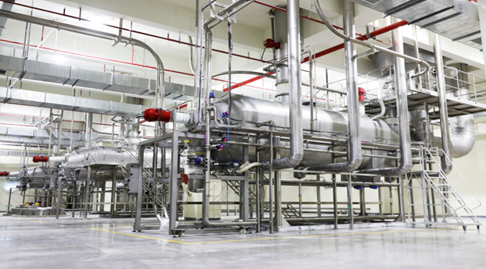
OEM production relies on dedicated powder and liquid lines.
OEM and ODM Customization Options
Cograin provides OEM, ODM, and customized production services. According to the company's capability profile, the customization options include: syrup DE value, creamer formula, packaging specification, and product flavor. Monthly capacity for the main lines includes 16,700 tons of syrup, 16,700 tons of creamer, 8,300 tons of solid drink, 8,300 tons of liquid drink, and 4,200 tons of flavored syrup. MOQ is negotiable based on product type and packaging, and lead time is approximately 7–15 working days after order confirmation. Quality control consists of full-process inspection, 100% metal and weight checks, and third-party testing. After-sales support includes technical guidance, quality tracking, and customization adjustment.
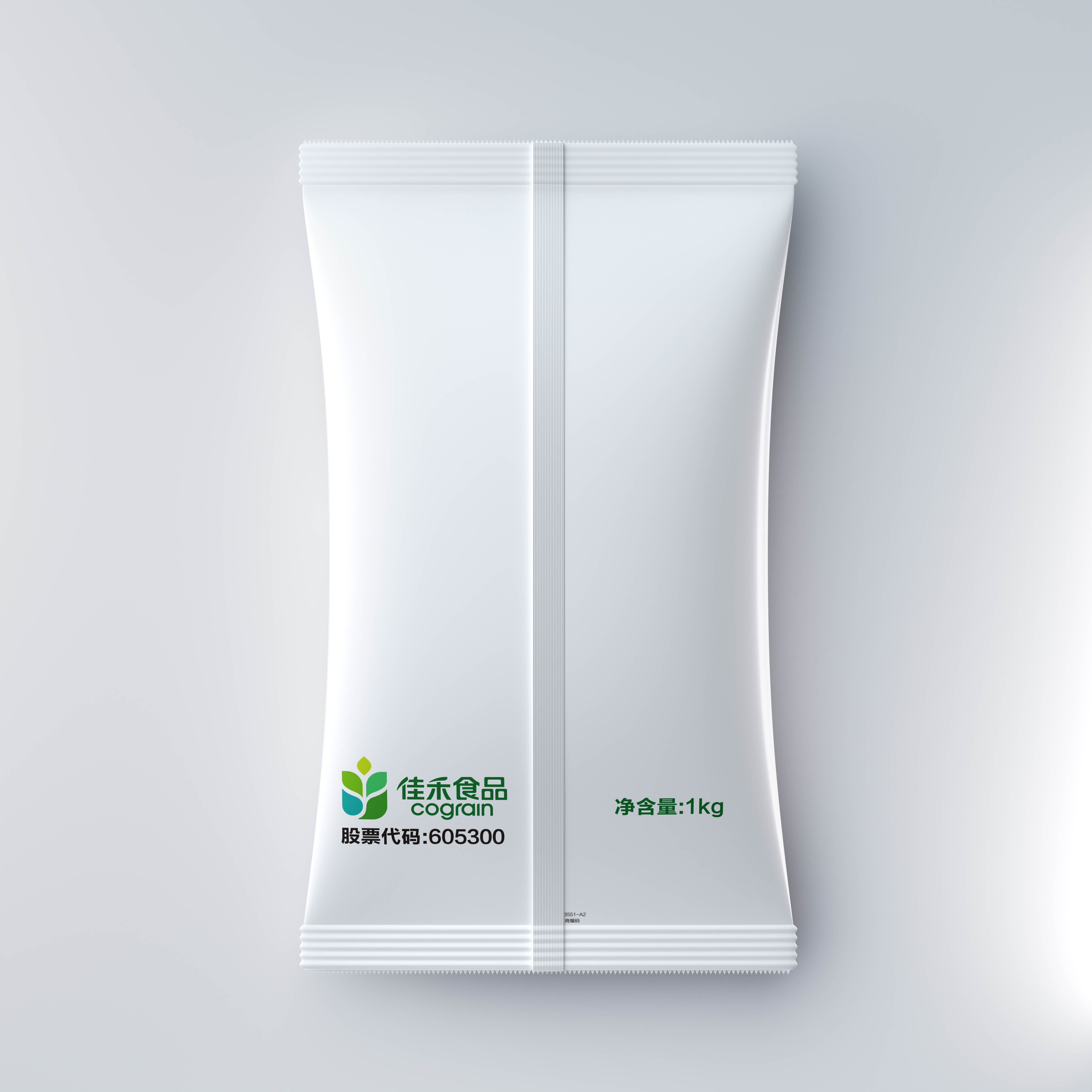
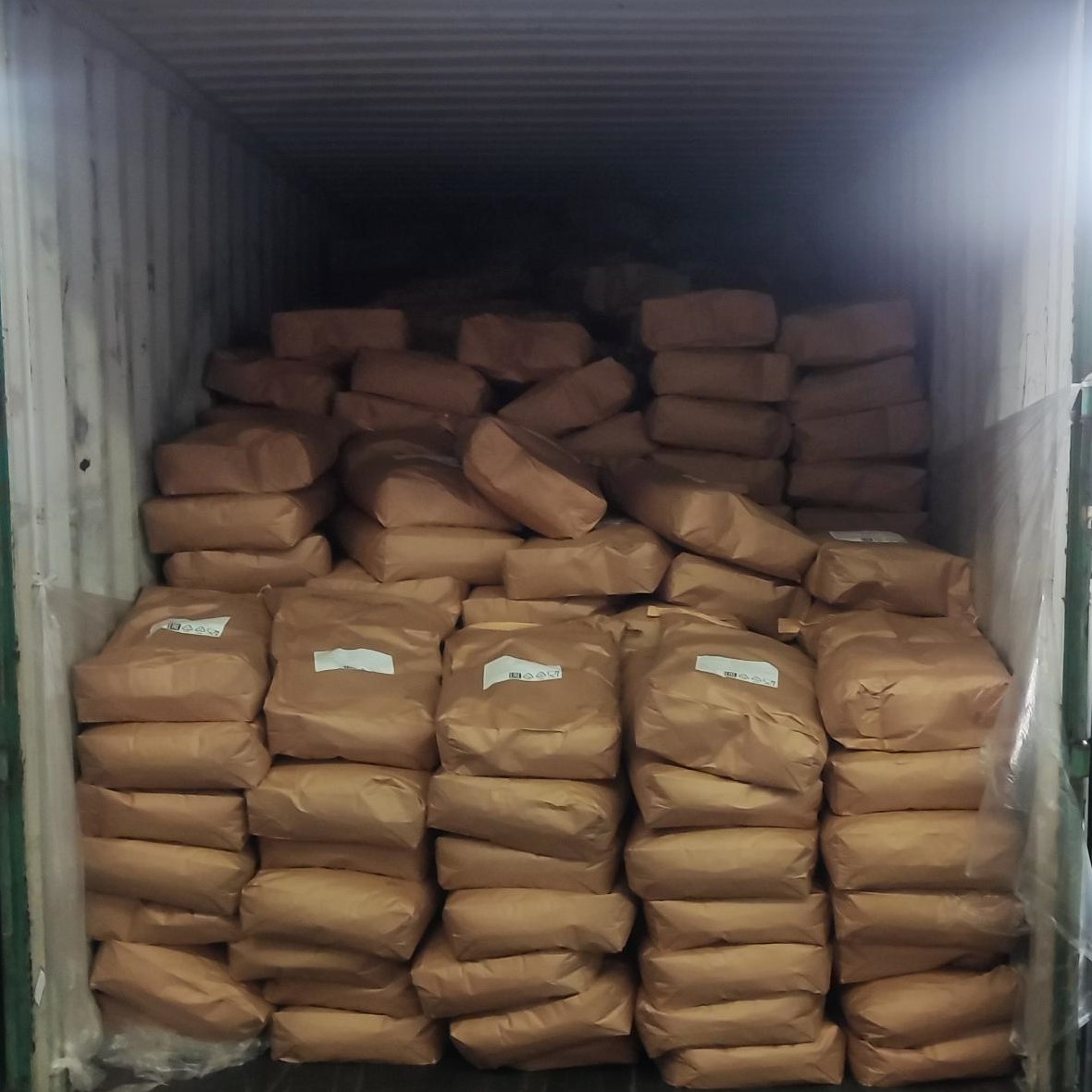
Packaging specification is one of the key OEM customization points.
Certifications Buyers Can Verify
Compliance is a core part of supplier evaluation. Jiahe Foods' corporate profile lists ISO9001 quality management, FSSC22000 food safety, HACCP, HALAL, ISO14000 environmental management, and OHSAS18000 occupational health and safety systems. For the non-dairy creamer range, specific certificates are visible: ISO 9001:2015 quality management certification (certificate number 00125Q32624R1M/3200, valid through May 2028), U.S. FDA Food Facility Registration (number 13348058524, valid through December 2026), and a Kosher certificate for non-dairy creamer model K80 (KC#529705-1, valid through April 2027). Note that Kosher certification rules can treat sodium caseinate as a dairy derivative; buyers should confirm the final label treatment with their certification body.
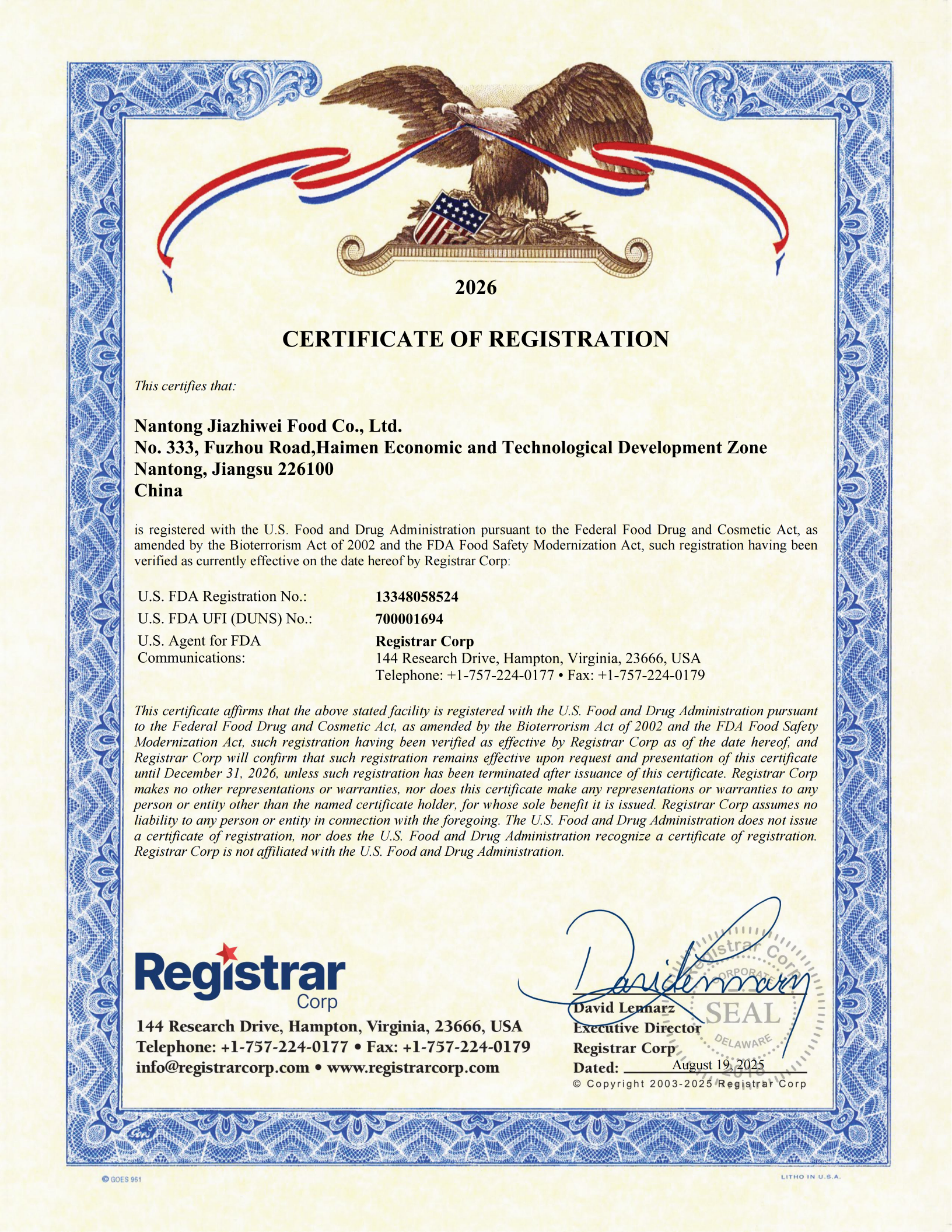
FDA registration is available for the Nantong Jiazhiwei facility.
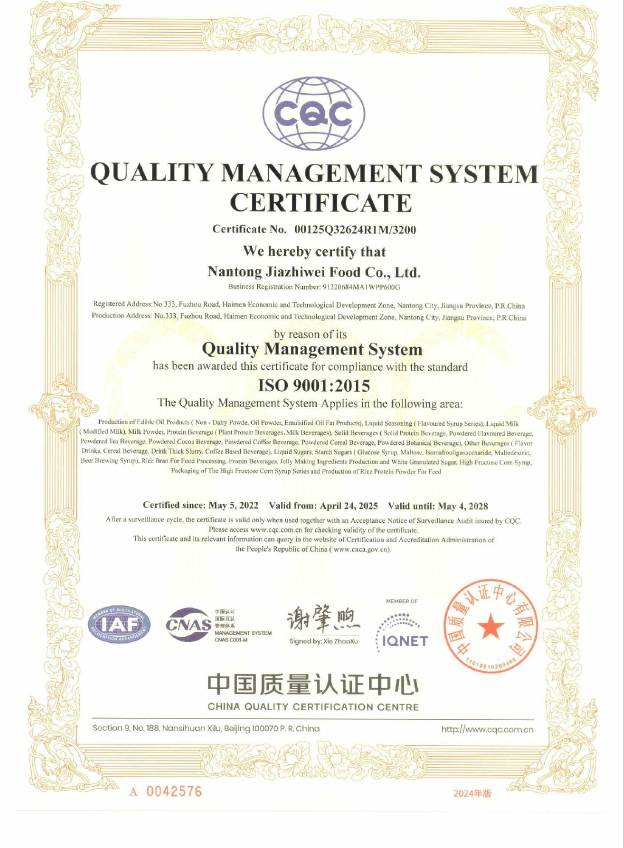
ISO 9001:2015 certificate for Nantong Jiazhiwei Food Co., Ltd.
Step-by-Step Breakdown: How to Source a Custom Non-Dairy Creamer
Step 1: Define Your Application and Performance Profile
Begin by specifying the end product: creamer for coffee, milk tea, bakery, general beverage, alcoholic beverage, or animal feed. Identify the critical parameters: fat content, protein content, sugar level, moisture, solubility (hot or cold), foaming behavior, and whipping performance. This becomes the basis of the creamer formula.
Step 2: Select the Base Creamer Type
Different applications call for different base types. For example, K60 is a standard medium-fat non-dairy creamer for milk tea, baking, and coffee. FC22 is a foaming creamer with 22% fat and higher protein (7.2g/100g) for milk tea and coffee toppings. S35 is a vegan option with zero protein, suitable for vegetarian products and alcoholic beverages. Cold-soluble creamer is designed for coffee, milk tea, and beverages served cold. DT35 is a low-sugar option. C960 is a whipping cream powder with 60% fat for bakery and beverages. 60A is a high-fat creamer also applicable to animal feed.
Step 3: Define Customization Requirements
Once the base profile is selected, a buyer can work with the manufacturer on syrup DE value, creamer formula, packaging specification, and flavor. Syrup DE value affects sweetness and body. Formula changes can adjust fat-protein balance, add fiber, or remove sodium caseinate for vegan lines. Packaging can range from individual sachets to bulk bags; product photos show 25 kg and 1 kg formats as examples, and specifications are negotiable.
Step 4: Verify Compliance and Certification
Before committing, ask to see current certifications. In this case, a buyer can verify ISO 9001:2015, FDA Food Facility Registration, and Kosher certificate for K80. If a vegan claim is needed, S35 does not contain sodium caseinate and has no protein. If a halal claim is needed, the company's corporate profile lists HALAL among its food safety and quality systems.
Step 5: Confirm Quality Control and Inspection
The manufacturer reports full-process inspection, 100% metal and weight checks, and third-party testing. Buyers should incorporate these points into a quality agreement and define acceptance criteria. Payment, delivery method, acceptance, and MOQ are negotiable based on customer requirements, according to the purchasing support unit.
Step 6: Plan Production and Logistics
Lead time is approximately 7–15 working days after order confirmation. Monthly creamer capacity of 16,700 tons means scheduling flexibility for volume buyers. Because MOQ is negotiable, buyers with smaller trial runs or larger annual contracts can align order quantities with business needs.
Step 7: Use After-Sales Support
Cograin provides technical guidance, quality tracking, and customization adjustment after delivery. For a partner that supplies bubble tea chains or instant coffee manufacturers, this support can reduce formulation errors and improve consistency across batches.
Non-Dairy Creamer Type Comparison
The following table compares base types available from Cograin, using parameters from the company's product documentation.
| Model | Type | Fat (g/100g) | Protein (g/100g) | Typical Applications |
|---|---|---|---|---|
| K60 | Standard non-dairy creamer | 32.0 | 2.6 | Milk tea, baking, coffee |
| FC22 | Foaming creamer | 22.0 | 7.2 | Milk tea, coffee, baking |
| S35 | Vegan non-dairy creamer | 35.0 | 0 | Vegetarian products, alcoholic beverages, milk tea, coffee, baking |
| Cold-soluble creamer | Cold-soluble | 32.0 | 3.5 | Coffee, milk tea, beverage |
| DT35 | Low-sugar | 35.0 | 2.5 | Milk tea, coffee, beverage, baking |
| C960 | Whipping cream powder | 60.0 | 5.2 | Baking, beverage |
| 60A | High-fat | 60.0 | 3.0 | Beverage, dessert, baking, animal feed |
| Kosher K80 | Kosher product | 32.0 | 2.5 | Beverage, dessert, milk tea, coffee |
Use Cases: Observed Applications Across Industries
3-in-1 Coffee and Instant Beverages
A manufacturer of 3-in-1 instant coffee used non-dairy creamer across instant coffee powder, instant oatmeal, and instant milk tea products. Clients were located in Singapore, Malaysia, Indonesia, Philippines, Kazakhstan, UAE, Ukraine, and Russia. The business relationship has lasted for 5 years, with a reported volume of 9,000 tons. The buyer highlighted consistent quality and good pricing.
Bubble Tea Chains
A bubble tea chain in Singapore, Vietnam, and the United States sourced non-dairy creamer for shop operations over a 3-year relationship. The order volume was 1,000 tons. The client reported consistently strong sales and an excellent reputation, with consistent quality and competitive pricing.
Alcoholic Beverage Production
A beverage production factory in South Africa used non-dairy creamer in alcoholic beverage application for 5 years, with an order quantity of 1,000 tons. The customer noted stable performance and steady sales with a good reputation among customers.
Animal Feed Production
An animal feed production plant in Singapore used a high-fat non-dairy creamer product in animal feed for 3 years, purchasing 4,000–5,000 tons per year. The highlight was consistent quality and good pricing. This matches the 60A high-fat creamer, which is applicable to beverage, dessert, baking, and animal feed.
FAQ
What certifications does Cograin hold for non-dairy creamer?
Cograin's manufacturing entity, Nantong Jiazhiwei Food Co., Ltd., holds ISO 9001:2015 quality management certification (no. 00125Q32624R1M/3200, valid through May 2028) and U.S. FDA Food Facility Registration (no. 13348058524, valid through December 2026). A Kosher certificate is available for non-dairy creamer model K80 (KC#529705-1, valid through April 2027). The company's corporate profile also lists HACCP, HALAL, ISO14000, and OHSAS18000 systems. Buyers should confirm scope and batch applicability with the supplier.
What can be customized in an OEM non-dairy creamer order?
OEM, ODM, and customized production services are available. Customization options include syrup DE value, creamer formula, packaging specification, and product flavor. MOQ is negotiable based on product type and packaging. For project-specific needs, a buyer can connect with Cograin's team to adjust the formulation before production.
What non-dairy creamer types are available for different applications?
Cograin offers a range of base types, including K60 standard creamer for milk tea, baking, and coffee; FC22 foaming creamer; S35 vegan creamer; cold-soluble creamer for cold drinks; DT35 low-sugar; C960 whipping cream powder; 60A high-fat; and kosher K80. This range allows buyers to match texture, fat, and protein requirements.
What is the typical lead time for an OEM order?
Lead time is around 7–15 working days after order confirmation. Monthly creamer capacity is 16,700 tons, so production scheduling can accommodate both trial orders and volume programs. Delivery method, acceptance, and payment terms are negotiable based on customer requirements.
What after-sales support is provided?
Cograin provides technical guidance, quality tracking, and customization adjustment. This is relevant for buyers who need batch consistency over multi-year supply relationships, such as the 5-year programs described in its case studies.
Conclusion
OEM non-dairy creamer sourcing is not only about price per kilogram. It requires a supplier that can adjust formula, maintain certification, provide packaging flexibility, and deliver consistent quality at scale. Jiahe Foods, through its Cograin export brand, combines production capacity, documented certifications, and customization options that match the needs of beverage, bakery, alcoholic beverage, and feed sectors. For a buyer in the evaluation-to-execution stage, the next step is to send the product requirement or download the company brochure and start a technical discussion.
Download the 2025 Cograin Brochure to review factory details, product lines, and contact information.
Email: davidqi@cograin.cn | Tel: 0513-81208180 | WhatsApp: +6596809996