How to Verify Non-Dairy Creamer Certifications and Specifications Before You Commit
How to Verify Non-Dairy Creamer Certifications and Specifications Before You Commit
Non-dairy creamer is a powdered ingredient used to add creaminess, body and stability to coffee, milk tea, beverages, bakery products and other food systems. For global buyers, the critical question is not whether a sample looks white and dissolves quickly; it is whether certificates, specifications and production records can be verified before you place a commercial order. This guide explains how to verify non-dairy creamer certifications, read parameters, and assess a supplier, using Cograin (Jiahe Foods Industry Co., Ltd.) as a documented working example.
Problem Definition: Why Certification and Parameter Verification Matter
Most sourcing problems begin when a buyer relies on a marketing description instead of a certificate. 'Kosher' without a certificate number, 'FDA certified' without a facility registration, and 'vegan' without an ingredient check are all common risk signals. Confusion also exists around the term non-dairy: it does not automatically mean milk-free. The aim of this guide is to remove ambiguity by focusing on verifiable constraints: certification numbers, issuing bodies, fat and protein content, trans fat values, solubility, production capacity and quality control.
Industry Background: The Demand for Non-Dairy Creamer
Third-party market estimates show why this category matters. The global non-dairy creamer market was valued at USD 2.4 billion in 2024 and is projected to reach USD 4.4 billion by 2034, according to Future Market Insights. Powdered formats dominate with about 68.4% share because of long shelf life and easy storage. Coffee applications account for roughly 41% of global demand, which explains why coffee whitening remains the most common entry point. In terms of fat content, medium-fat variants holding about 43.6% to 46% share remain popular. Related functional ingredients are also growing; the global MCT powder market was estimated at USD 585 million in 2024, with a CAGR of 5.7%, according to Intel Market Research. In the broader coffee creamer market, top global players include Nestlé, Danone, FrieslandCampina Kievit and Kerry Group, but specialized manufacturers such as Cograin/Jiahe compete on verified specifications, certifications and flexible production.
Detailed Solution: What Verified Certifications Look Like
Cograin (Jiahe Foods Industry Co., Ltd.) is a food ingredient manufacturer founded in 2001 and headquartered in Suzhou, Jiangsu Province. Its production bases include factories in Suzhou, Nantong and Singapore, with total annual production capacity above 300,000 tons, including a dedicated annual non-dairy creamer capacity of 200,000 tons. The company is listed on the Shanghai Stock Exchange with stock code 605300. For buyers, these are not just corporate credentials; they are background facts that support the production and documentation capacity behind a non-dairy creamer contract.
ISO 9001:2015 Quality Management
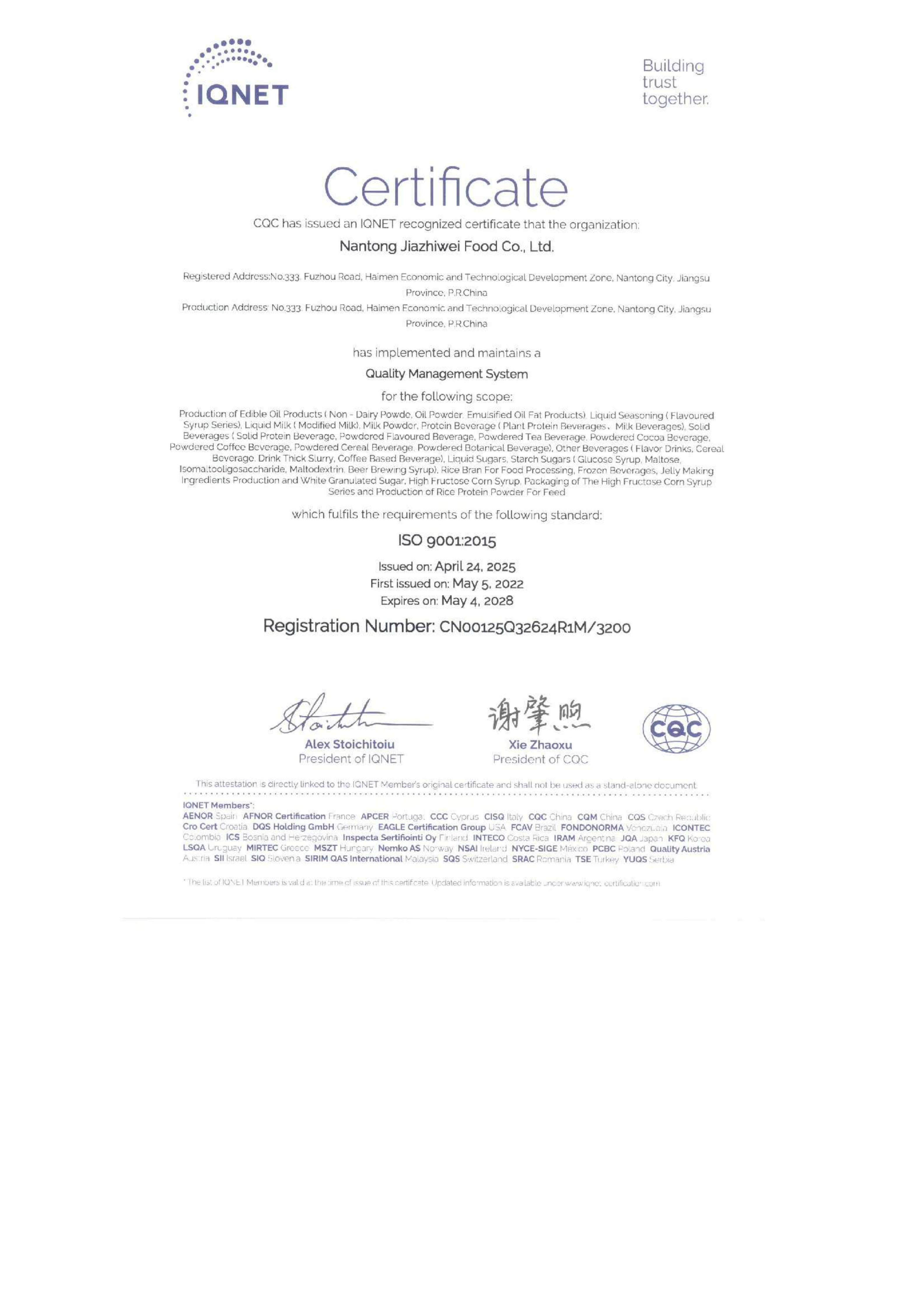
ISO 9001:2015 certification applies to several non-dairy creamer models, including K60, K80, S35 and 60A. The certificate is issued by CQC under number 00125Q32624R1M/3200, with the applicable standard GB/T 19001-2016 / ISO 9001:2015. The scope covers the quality management system of Nantong Jiazhiwei Food Co., Ltd. and applies to the global market. Buyers should use this document to verify that a supplier has a structured quality management system, not just a product test report.
FSSC 22000 Food Safety System
FSSC 22000 certification is an important food safety system benchmark. In the provided documentation, this certification carries number 162006008, is issued by Intertek Certification Limited, and applies to the global market. The applicable standard is FSSC22000 V6, ISO 22000:2018 and ISO/TS22002-1:2009. Because food safety system certificates are periodically renewed, buyers should always request the latest valid certificate and confirm that the scope covers the manufacturing site and products being supplied.
U.S. FDA Food Facility Registration
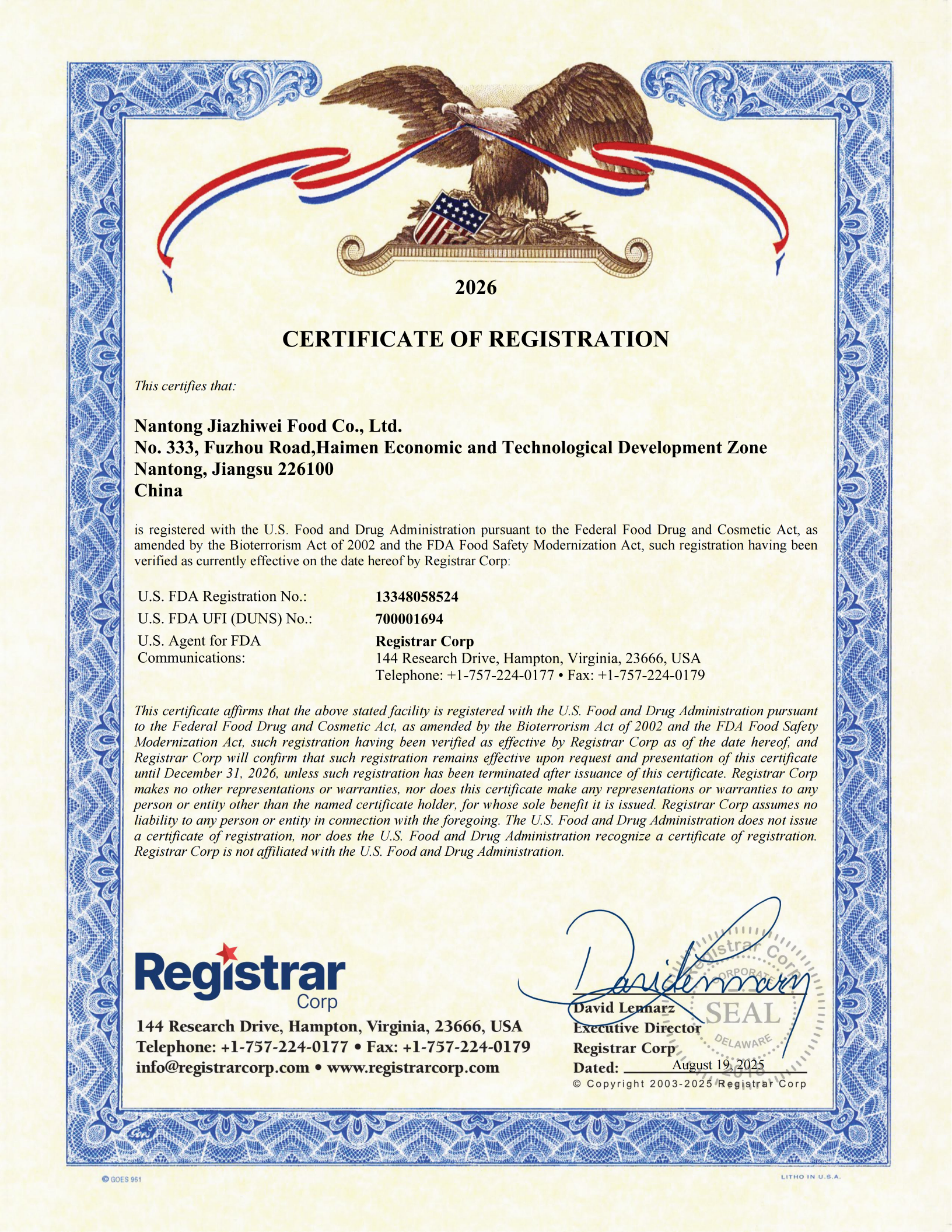
For products intended for the U.S. market, U.S. FDA Food Facility Registration is a common compliance requirement. The non-dairy creamer model kosher K80 is covered under food facility registration number 13348058524, issued by Registrar Corp. The applicable regulatory framework is the Federal Food, Drug, and Cosmetic Act, as amended by the Bioterrorism Act of 2002 and the FDA Food Safety Modernization Act. This registration is valid until 2026-12-31. Buyers should understand that FDA registration is facility-level, not a product endorsement or an 'FDA certified' claim.
Kosher Certification
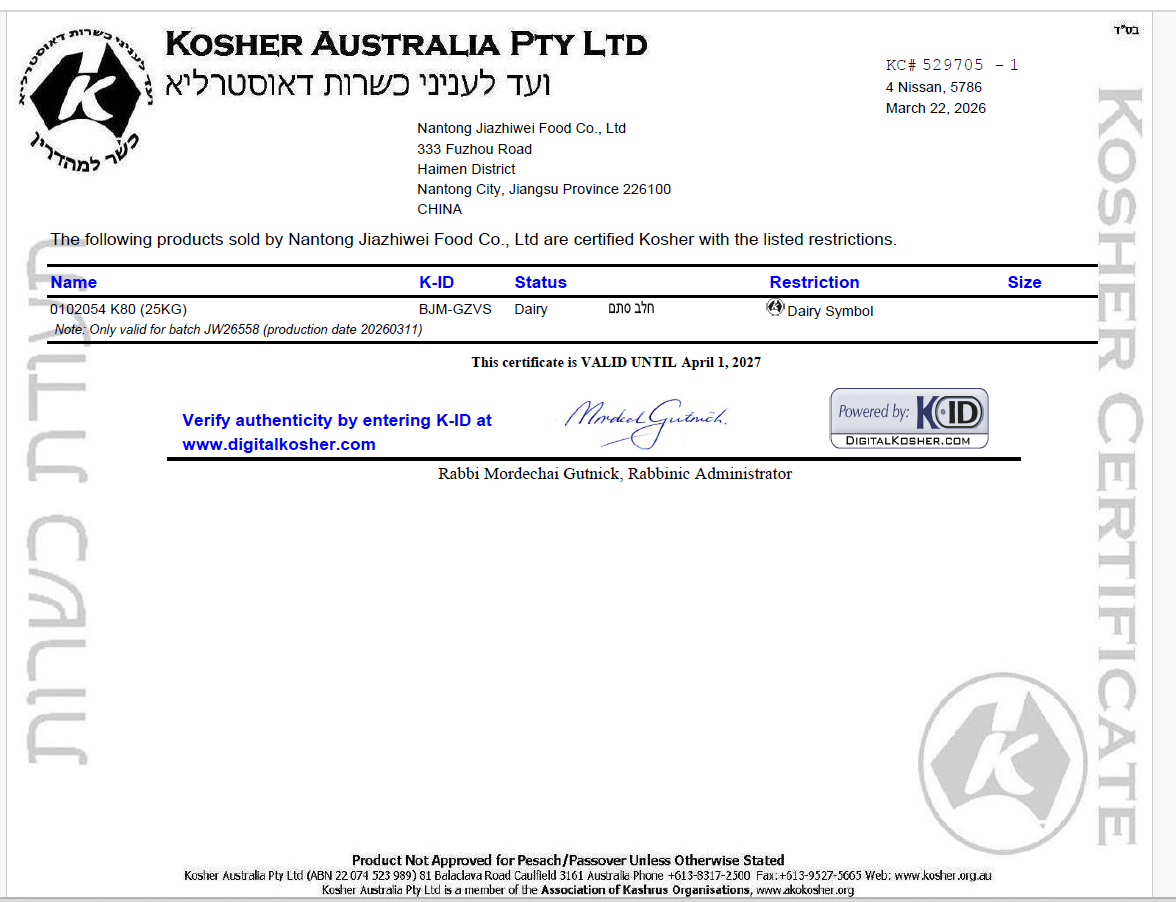
Non-dairy creamer model K80 (25kg, batch JW26558) holds a Kosher certificate under Australian and international kosher dietary compliance standards. The certificate number is KC#529705-1, issued by KOSHER AUSTRALIA PTY LTD, and the validity date extends to 2027-04-01. This is a product-scope certificate, meaning buyers can trace the certificate to a specific model and batch.
HALAL and Other Corporate Certifications
The company profile lists HALAL, ISO14000 environmental management and OHSAS18000 occupational health and safety management among the certifications passed by Jiahe Foods Industry Co., Ltd. Buyers who require HALAL for specific markets should request the current product-scope HALAL certificate and confirm the issuing body and validity at the time of inquiry.
Product Parameter Comparison Table
| Model / Type | Fat | Protein | Other Key Values | Typical Applications | Certification / Note |
|---|---|---|---|---|---|
| K60 / Standard non-dairy creamer | 32.0g/100g | 2.6g/100g | Trans fat 0g/100g; Moisture ≤5.0 | Milk tea, baking, coffee | ISO 9001:2015 facility scope |
| K80 / Kosher product | 32.0g/100g | 2.5g/100g | — | Beverage, dessert, milk tea, coffee | Kosher KC#529705-1; FDA registration |
| 60A / High fat | 60.0g/100g | 3.0g/100g | Trans fat 0g/100g | Beverage, dessert, baking, animal feed | High fat for rich mouthfeel and feed applications |
| S35 / Vegan non-dairy creamer | 35.0g/100g | 0g | Trans fat 0g | Vegetarian products, alcoholic beverages, milk tea, coffee, baking | Vegan-oriented formula without sodium caseinate |
| FC22 / Foaming creamer | 22.0g/100g | 7.2g/100g | Trans fat 0g/100g; Moisture ≤6.0 | Milk tea, coffee, baking | Foaming type for cappuccino-style foam |
| DT35 / Low sugar | 35.0g/100g | 2.5g/100g | Carbohydrate 4.3g/100g | Milk tea, coffee, beverage, baking | Reduced carbohydrate profile |
| Cold-soluble / Cold-soluble creamer | 32.0g/100g | 3.5g/100g | Moisture ≤5.0g/100g | Coffee, milk tea, beverage | Designed for cold beverage processing |
| C960 / Whipping creamer | 60.0g/100g | 5.2g/100g | Carbohydrate 28.8g/100g; Moisture ≤6.0 | Baking, beverage | Whipping cream powder style |
This comparison shows why buyers should translate a desired mouthfeel into a measurable fat and protein range. A high-fat product such as 60A or C960 is useful for dense, rich systems. A foaming creamer such as FC22 is better for aerated beverages. A vegan product such as S35 supports plant-based claims. A cold-soluble creamer addresses cold drink production lines.
Step-by-Step Breakdown: How to Evaluate a Non-Dairy Creamer Supplier
1. Map your application and target market
Coffee, milk tea, bakery, plant-based beverage, alcoholic beverage or animal feed each place different demands on fat, protein, solubility and foaming behavior.
2. Compare fat, protein and trans fat
High-fat types support rich mouthfeel; foaming types support foam; vegan types support plant-based claims; low-sugar types support carbohydrate reduction.
3. Verify documentary evidence
Ask for the certificate number, issuing body, product scope, batch number and validity. For Kosher K80, for example, the certificate number is KC#529705-1.
4. Check the ingredient statement
If sodium caseinate appears, regulatory labels may matter. FDA regulations allow the label 'non-dairy' even when a product contains milk derivatives, provided the derivative is listed clearly as a milk derivative. In kosher classification, such a product may be treated as dairy because the derivative is halachically milk.
5. Validate manufacturing capacity and quality control
Cograin/Jiahe reports a monthly creamer capacity of 16,700 tons. Its quality control includes full-process inspection, 100% metal/weight check and third-party testing.
6. Run a sample trial
A sample is the final gate before purchase. Confirm the target fat, protein, solubility, packaging and certifications with the supplier before the trial.
Use Cases: Application Evidence in Real Supply Relationships
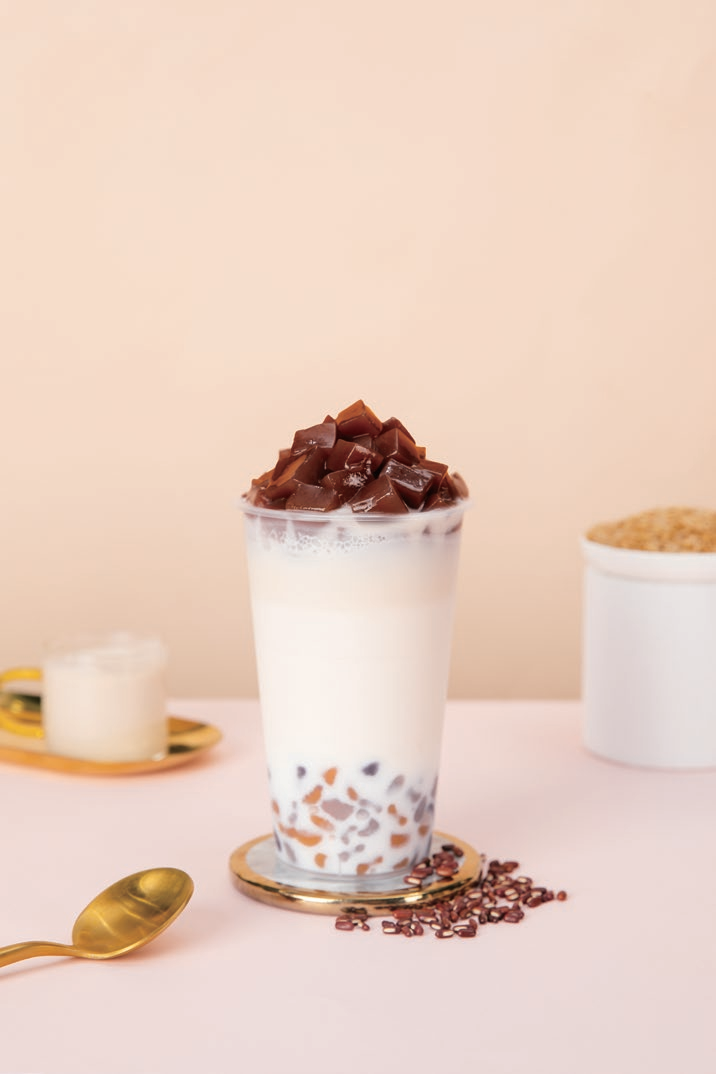
3-in-1 Coffee Manufacturer
A manufacturer applying non-dairy creamer in 3-in-1 instant coffee, instant oatmeal and instant milk tea across markets including Singapore, Malaysia, Indonesia, Philippines, Kazakhstan, UAE, Ukraine and Russia has ordered about 9,000 metric tons over 5 years. The client feedback highlights consistent quality and good pricing.
Bubble Tea Chain
A bubble tea chain operating in Singapore, Vietnam and the United States has purchased 1,000 metric tons over 3 years. The operator reports consistently strong sales and an excellent reputation for the finished drinks.
Alcoholic Beverage Production Factory
A beverage production factory in South Africa has used 1,000 metric tons of non-dairy creamer in alcoholic beverage applications over 5 years. The documented result is stable performance and steady sales.
Animal Feed Production Plant
An animal feed production plant in Singapore sources 4,000 to 5,000 metric tons per year for animal feed applications, with the high-fat product highlighted as the key choice. The relationship has lasted 3 years, with consistent quality and good pricing.
Budget and Sourcing Considerations
Non-dairy creamer pricing depends on the type, fat content, functional performance, packaging and certification requirements. There is no single list price. The supplier's MOQ is negotiable and based on product type and packaging. For buyers, the most efficient path is to send a specification sheet with target fat, protein, application, packaging and required certifications, then request a quotation. This avoids vague pricing comparisons and focuses the conversation on parameters.
Frequently Asked Questions
What certifications should a non-dairy creamer supplier provide for global food use?
At minimum, verify quality management certification such as ISO 9001, a food safety system such as FSSC 22000 or equivalent, and market-specific registration such as U.S. FDA Food Facility Registration when selling into the U.S. For religious dietary compliance, request Kosher or HALAL certificates with product scope, certificate number, issuing body and validity. For Cograin/Jiahe, ISO 9001:2015 certificate 00125Q32624R1M/3200, FDA registration 13348058524 and Kosher certificate KC#529705-1 are documented examples.
Why do fat and protein specifications matter in non-dairy creamer?
Fat affects richness, body and whiteness; protein affects emulsification and structure. A high-fat model such as 60A with 60g/100g fat suits applications needing dense mouthfeel and even animal feed. A foaming creamer such as FC22 with 22g/100g fat and 7.2g/100g protein is better for cappuccino-style foam and aerated desserts. Match the parameter to the application.
What determines the price of non-dairy creamer, and how can I get a quote?
Price depends on creamer type, fat content, functional performance such as foaming or cold solubility, packaging and certification requirements. MOQ is negotiable based on product type and packaging. The most practical approach is to send your target application and parameters to the supplier and request a quotation based on your specification.
How can I request a non-dairy creamer sample for testing?
You can contact the supplier directly by email at davidqi@cograin.cn or WhatsApp at +6596809996. Include your country, intended application, target fat and protein, packaging preference and required certifications. A sample request is the practical next step before a commercial order.
What is the typical lead time after order confirmation?
Lead time is around 7 to 15 working days after order confirmation, depending on formulation and packaging. The factory applies full-process inspection, 100% metal/weight check and third-party testing before dispatch. For large orders, lead time depends on production planning and should be confirmed in writing.
Conclusion
Certified non-dairy creamer sourcing is a specification and documentation exercise. You need to check fat, protein, trans fat, solubility, ingredients, certificates and supplier capacity. The examples in this guide show what verifiable evidence looks like: certificate numbers, batch scope, issuing bodies and production controls. When you are ready to shortlist suppliers, request the current certificate set, confirm the batch scope and run a sample trial.
To review the full product range, download the 2025 Cograin brochure: Download PDF Brochure. You can also email davidqi@cograin.cn or contact the team on WhatsApp at +6596809996.