Kosher, Vegan, and China-Market Non-Dairy Creamer: A Compliance Documentation Guide
Non-dairy creamer shipments are rarely rejected because the powder is wrong. They are rejected because the paperwork attached to the shipment answers a different question than the one the buyer asked. A brochure says kosher; the certificate says one model, one pack size, one batch. A product list says vegan; nothing in the file is signed by a vegan certifier. A supplier says the grade suits the China market; the carton label still has to be approved for that market.
This guide separates the three claims — kosher, vegan and China-market — into the documents that actually evidence them, using three Cograin models as working examples: K80 kosher non-dairy creamer, S35 vegan non-dairy creamer, and 60A high-fat non-dairy creamer. For each it sets out the declared values, the boundary of the document, and the sentence a buyer should write into the purchase order.
Cograin is the brand of Jiahe Foods Industry Co., Ltd., a Chinese food-ingredient manufacturer founded in 2001 and headquartered in Suzhou, Jiangsu Province, listed on the main board of the Shanghai Stock Exchange in 2021 under stock code 605300. The company operates three production bases and five factories in Suzhou, Nantong and Singapore, with annual production capacity of more than 300,000 tons, and reports ISO 9001, FSSC 22000, HACCP, HALAL, ISO 14000 and OHSAS 18000 systems among its certifications. Which of those documents you actually receive — and whether they cover the goods in your container — is the subject of the rest of this guide.
Three claims, three different kinds of document
The three claims look like siblings on a product list. They are not. Each is evidenced by a different instrument, issued by a different party, and bounded in a different way. A purchase order that treats them as interchangeable will eventually accept a shipment on evidence that does not cover it.
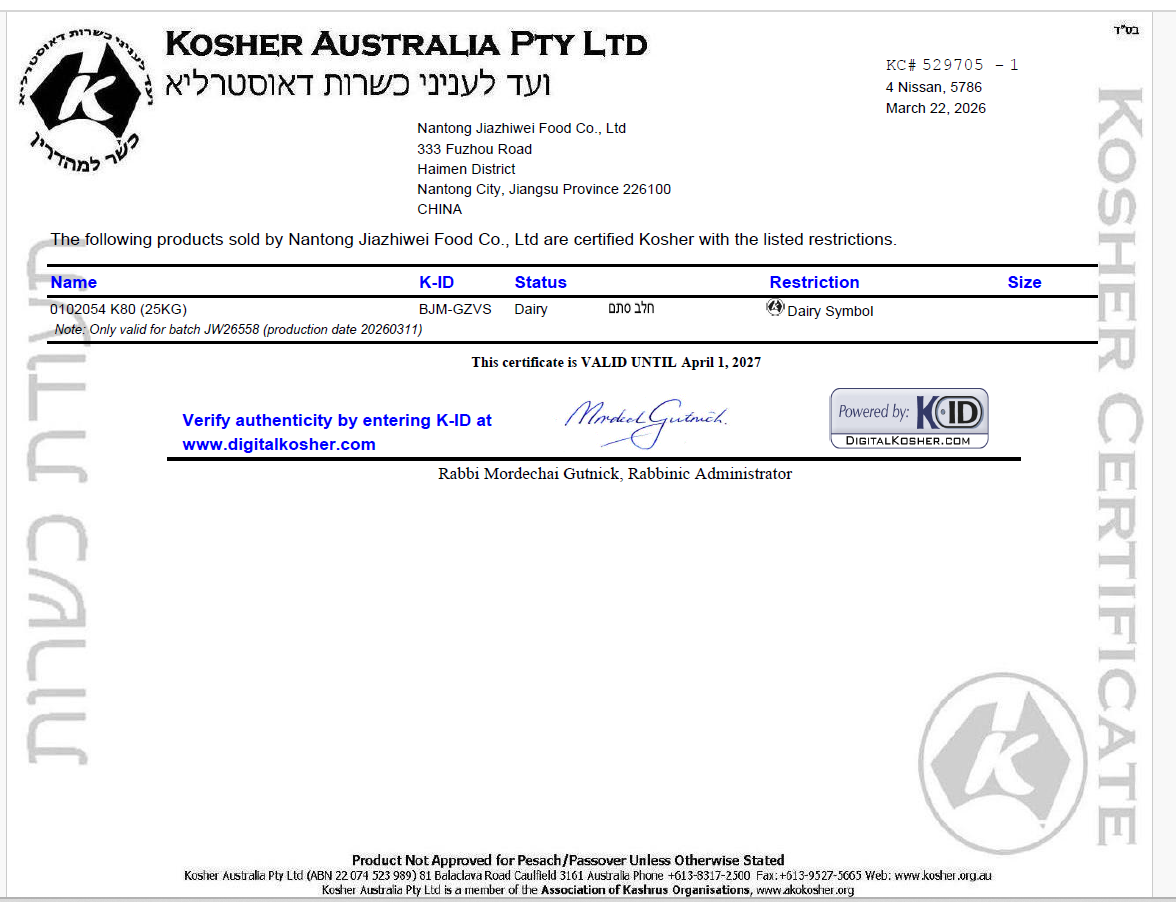
- A kosher claim is evidenced by a certificate from a certifying body. For K80, the copy in the supplied document set is certificate KC#529705-1, issued by KOSHER AUSTRALIA PTY LTD on 22 March 2026.
- A vegan claim is evidenced by formulation. For S35, the evidence is the declared ingredient list and the nutrition panel. A vegan certificate is a separate document, and it does not follow automatically from a vegan formulation.
- A China-market claim is evidenced by destination paperwork. For 60A, that means the label in the market language, the declared product standard and the importer's registration — none of which a supplier certificate from another jurisdiction replaces.
The practical consequence is that a single sentence such as "all products are certified" is unusable as an acceptance criterion. It has no subject, no scope, no date and no issuing authority. The rest of this article shows how to replace it with criteria that can be checked at goods-in.
Why the same word behaves differently in each market
Kosher status is not a physical property of a powder. It is an administrative status granted by a certifying body that works to its own standard. The K80 certificate in the supplied set cites "Australian & international kosher dietary compliance standards" and names KOSHER AUSTRALIA PTY LTD as the authority. If your customer's purchasing policy names a different certifier, or a standard recognised in a different market, the certificate you hold can be entirely genuine and still not accepted. That is a commercial question to settle before the order is placed, not a quality argument to have after the container arrives.
A vegan claim is a statement about formulation. It can be evidenced at three different levels of assurance: an ingredient declaration on a specification sheet, a signed declaration from the manufacturer, or a third-party certificate. S35 declares 0 g protein and 0 g trans fat per 100 g, and its declared ingredient list contains no sodium caseinate — the milk-derived protein that does appear in the K80 and 60A declarations. That is formulation evidence. It is not, on its own, a vegan certificate.
A China-market claim is a destination requirement that sits on top of the product rather than inside it: label language, declared product standard, and the registration work your importer performs. No kosher certificate and no vegan declaration answers a labelling question, and no labelling approval proves a formulation claim.
Two public references are worth knowing because they help buyers write clause language, although neither is a certificate. The USDA Agricultural Marketing Service maintains a Commercial Item Description for dry non-dairy creamer (document code AA-20043D, as indicated by the source filename) for government purchasing. Separately, a U.S. Customs ruling (NY L85571) classified non-dairy coffee creamer imported from China under HTS 2106.90.9975 — a tariff decision, not a food-safety determination. Use them to model acceptance wording and to plan classification; do not use them as substitutes for product documents.
Five boundaries that decide whether a document covers your order
Every compliance document has a boundary. If the shipment falls outside that boundary, the document is irrelevant to it — however impressive the letterhead. Five checks catch almost every mismatch.
- Subject and scope. Which legal entity, which model and which pack size does the document name? The K80 certificate covers non-dairy creamer model K80 in 25 kg packing. It does not name K60, C960, DT35, FC22, S35 or 60A, and it does not name other pack sizes.
- Batch and production window. The same certificate names batch JW26558 with production date 20260311. Product made in a later run is not covered by that batch reference, even though the model number is identical.
- Validity window. The kosher certificate was issued on 2026-03-22 and expires on 2027-04-01. The site ISO 9001 certificate (00125Q32624R1M/3200, issued by CQC) runs from 2025-04-24 to 2028-05-04. The U.S. FDA Food Facility Registration (13348058524, issued via Registrar Corp) runs to 2026-12-31. Compare each expiry date with your shipment date, not with today's date.
- Issuing authority and its standard. Kosher Australia Pty Ltd; CQC for ISO 9001; Intertek Certification Limited for FSSC 22000 (certificate 162006008, scope: food safety management system of Nantong Jiazhiwei Food Co., Ltd.); Registrar Corp for the FDA facility registration. Confirm that the body is one your customer or destination authority recognises.
- Application scope and conditions. Read the declared applications on the specification. They are narrower than "suitable for all beverages" and they change the document set — 60A, for example, declares animal feed alongside beverage, dessert and baking.
K80: reading the kosher certificate line by line
The K80 certificate in the supplied set is short enough to check field by field, and every field carries a decision.
- Certificate number KC#529705-1; authority KOSHER AUSTRALIA PTY LTD; standard cited: Australian & international kosher dietary compliance standards.
- Scope: non-dairy creamer model K80 (25 kg), batch JW26558, production date 20260311.
- Issue date 2026-03-22; expiry date 2027-04-01; market stated as global.
What the document establishes is narrow and useful: for that model, in that pack size, from that production run, a recognised certifying body has certified kosher compliance to its stated standard, and that certification remains valid until 1 April 2027. That is enough to satisfy a customer audit that asks for a kosher certificate on K80 in 25 kg bags, provided the goods in the container come from the covered run.
What it does not establish is equally important. It does not certify K60, S35, 60A or any other model. It does not certify a 1 kg retail pack. It does not certify batches produced after JW26558 unless the supplier issues an updated certificate or a written confirmation of coverage. And it does not answer the separate question of whether the material suits a customer whose requirement is dairy-free in the kosher sense.
That last point deserves attention because the specification itself raises it. K80's declared ingredients are glucose syrup, hydrogenated vegetable oil, sodium caseinate, emulsifier, stabilizer and anti-caking agent. Sodium caseinate is a milk-derived protein. If your customer's kosher requirement turns on how the product is designated by the certifier, ask the supplier to state that designation in writing rather than inferring it from the presence of the certificate — a kosher certificate and a dairy-free requirement are two different acceptance tests, and only one of them is answered by the document you are holding.
S35: a vegan formulation is not the same as a vegan certificate
S35 is declared as a vegan non-dairy creamer. Its declared values are fat 35.0 g/100 g, protein 0 g, trans fat 0 g, and its declared ingredients are glucose syrup, hydrogenated vegetable oil, emulsifier, oxidized hydroxypropyl starch and anti-caking agent.
Three things in that declaration are worth reading closely. First, no sodium caseinate appears, which is consistent with a formulation built without the milk protein used in K80 and 60A. Second, the protein declaration is 0 g, which matches the absence of a milk-protein source in the ingredient list. Third, oxidized hydroxypropyl starch is a modified starch and appears where the other two models carry sodium caseinate — a formulation difference that a customer asking for a clean-label or allergen review will want to see stated, not inferred.
What the supplied document set does not contain is a vegan certificate for S35. That gap should be resolved in the purchase order, not discovered at goods-in. Decide which level of assurance your customer actually requires: a specification sheet with the ingredient declaration, a signed manufacturer declaration of vegan formulation, or a third-party vegan certificate. Then write that requirement, with its exclusions, into the order — for example whether carriers, release agents and processing aids must also be declared free of animal-derived material.
The declared application scope for S35 extends beyond the usual beverage list: vegetarian products, alcoholic beverages, milk tea, coffee and baking. Alcoholic-beverage use is a channel with its own documentation expectations, so if that is your end use, declare it when requesting samples and certificates rather than after the specification is fixed.
60A: the China-market example and the label layer
60A is the high-fat model used here as the China-market example. It declares protein 3.0 g/100 g, fat 60.0 g/100 g and trans fat 0 g/100 g, with declared ingredients of hydrogenated vegetable oil, glucose syrup, sodium caseinate, emulsifier and stabilizer — a different leading component from K80 and S35, which both lead with glucose syrup, and consistent with a 60 g/100 g fat declaration.
Its declared application scope is beverage, dessert, baking and animal feed. That scope crosses from food into feed, and the crossing is not cosmetic. A food buyer and a feed buyer are purchasing against different acceptance criteria, different labelling rules and, in many cases, different documentation entirely. Before quoting 60A into a project, name the end use in the enquiry; a certificate pack assembled for a beverage customer will not automatically satisfy a feed customer, and vice versa.
For the China-market layer itself, the supplier's contribution is the product-side documentation: the declared specification and values, the ingredient declaration, and a Chinese-language label draft for your approval. Your importer's contribution is confirmation of the applicable product standard and the registration route for the finished goods. Treat the specific standard reference as something to be confirmed in writing for your shipment rather than assumed from a brochure — and note that a kosher certificate or a vegan declaration has no bearing on that confirmation. It answers a different question.
Declared values worth carrying into the contract
The nutrition and ingredient declarations are the part of the pack that survives translation, and they are the part an incoming-inspection team can actually test against.
- K80: fat 32.0 g/100 g; protein 2.5 g/100 g. The supplied specification does not state trans fat, so do not carry a zero-trans-fat acceptance criterion into a K80 order without asking for that value in writing first.
- S35: fat 35.0 g/100 g; protein 0 g; trans fat 0 g. The zero protein figure is a formulation fact and should be checked, not paraphrased into "dairy-free" — the two are not the same statement.
- 60A: fat 60.0 g/100 g; protein 3.0 g/100 g; trans fat 0 g/100 g.
All three values are per 100 g as declared. Three practical cautions follow. Do not compare a per-100 g declaration with a per-serving claim from a competitor's consumer pack. Do not assume moisture, particle size, solubility or whiteness are covered because fat and protein are stated — those are separate specification items to request. And when you write a value into a contract, agree the test method and the tolerance alongside it, because a declared figure and an acceptance range are different instruments.
The three models side by side
| Model | Declared position | Fat (per 100 g) | Protein (per 100 g) | Trans fat (per 100 g) | Key declared ingredients | Stated application scope | Document to request |
|---|---|---|---|---|---|---|---|
| K80 | Kosher product | 32.0 g | 2.5 g | Not stated in the supplied specification | Glucose syrup, hydrogenated vegetable oil, sodium caseinate, emulsifier, stabilizer, anti-caking agent | Beverage, dessert, milk tea, coffee | Kosher certificate with batch coverage for the shipment |
| S35 | Vegan non dairy creamer | 35.0 g | 0 g | 0 g | Glucose syrup, hydrogenated vegetable oil, emulsifier, oxidized hydroxypropyl starch, anti-caking agent | Vegetarian products, alcoholic beverages, milk tea, coffee, baking | Vegan certificate, or a signed vegan formulation declaration |
| 60A | High fat | 60.0 g | 3.0 g | 0 g | Hydrogenated vegetable oil, glucose syrup, sodium caseinate, emulsifier, stabilizer | Beverage, dessert, baking, animal feed | Market-language label draft, declared product standard, end-use confirmation |
The table is a document map, not a performance ranking. It does not say which model works better in your recipe; it says which model is evidenced by which paper, and which paper is missing.
The site-level documents behind the product documents
Product documents are issued against a manufacturing site, and a buyer who checks only the product certificate can miss a scope mismatch one level up. The supplied file includes three site-level documents, all naming Nantong Jiazhiwei Food Co., Ltd.
- ISO 9001:2015 quality management system, certificate 00125Q32624R1M/3200, issued by CQC under GB/T 19001-2016 / ISO 9001:2015, issued 2025-04-24, valid to 2028-05-04.
- FSSC 22000 food safety system certification, certificate 162006008, issued by Intertek Certification Limited under FSSC 22000 V6, ISO 22000:2018 and ISO/TS 22002-1:2009, issued 2025-07-03. Check the expiry date printed on the copy you receive against your shipment date.
- U.S. FDA Food Facility Registration, certificate 13348058524, issued through Registrar Corp under the Federal Food, Drug, and Cosmetic Act as amended by the Bioterrorism Act of 2002 and the FDA Food Safety Modernization Act, issued 2025-08-19, valid to 2026-12-31. This registers a food facility; read it as site registration, not as a product-by-product approval, and match it to the site that actually ships your order.
The corporate profile also lists HACCP, HALAL, ISO 14000 and OHSAS 18000 systems. The point of naming them here is not to imply that every one is attached to every shipment, but to show how easily a generic claim hides a specific gap: the document set supplied for this article contains no HALAL certificate, so a buyer who needs one should request it and check its scope rather than assume it travels with the invoice.
What to write into the purchase order
Acceptance criteria are where documentation becomes enforceable. Eight clauses cover most of the exposure described above.
- Identify the goods precisely: model, pack size and declared values — for example "K80, 25 kg, fat 32.0 g/100 g, protein 2.5 g/100 g".
- Name the certificate, not the claim: certificate number, issuing authority, scope and expiry, with a requirement that the expiry post-dates the shipment date.
- State batch coverage explicitly: either the certificate names the batch, or the supplier provides written confirmation that the covered production run includes the shipped goods.
- Fix the level of assurance for vegan: specification sheet, signed declaration or third-party certificate, plus the ingredient exclusions that must be declared.
- Require label approval before production for destination-market orders, with the approved artwork version referenced in the order.
- Define the acceptance test and tolerance for each declared value you intend to check at goods-in, and the sampling plan.
- Require change notification: the supplier informs you in writing before a formulation, ingredient source or pack-size change that would affect a declaration on file.
- State the end use. Beverage, baking, alcoholic beverage and animal feed trigger different document sets, and 60A's declared scope shows why that clause cannot be left implicit.
What this document pack does not prove
It is worth being explicit about the limit of paper, because over-claiming is the failure mode this guide is written against.
- It does not prove performance in your formula. A declared fat level of 32.0, 35.0 or 60.0 g/100 g tells you the composition, not how the powder behaves in your coffee, milk tea, batter or feed mix. That requires a trial on your own process.
- It does not prove that the goods in your container come from the covered batch until the batch reference is matched.
- It does not prove the certifier is acceptable to your customer or your destination authority; that is a policy question on their side.
- It does not prove a vegan certificate exists for S35, because none is present in the supplied set.
- It does not settle commercial terms. Capacity, MOQ and lead time are separate commercial documents, not compliance evidence.
Matching the document set to the application
Applications decide which documents matter. In the supplied case record, a Singapore animal-feed producer buying 4,000–5,000 metric tons a year for three years is documented against the high-fat 60A and K80 models — a feed application, where the acceptance criteria belong to feed use and the fat level is the reason for the selection. A beverage factory in South Africa, buying 1,000 metric tons over five years for alcoholic beverages, is documented against a broader model set that includes S35. A bubble tea chain operating across Singapore, Vietnam and the United States, at 1,000 metric tons over three years, sits in the food-service ingredient channel.
Those are documented supply relationships, not performance guarantees, and they should be read that way. Their value to a new buyer is structural: they show that the same supplier is asked for different document packs by different channels, which is exactly why the request has to name the channel. The bubble tea and coffee-shop application unit in the supplied material sets out the requirement plainly: food-safety compliance such as HACCP and ISO, no trans-fatty acids, with halal and kosher certification available. "Available" is the operative word — it is a request you make, not a document you assume.
Frequently asked questions
Does the K80 kosher certificate cover every batch we order?
No, as documented. Certificate KC#529705-1 covers non-dairy creamer model K80 in 25 kg packing, batch JW26558, production date 20260311, issued 2026-03-22 and expiring 2027-04-01. Goods from a later production run are not named on that certificate. To close the gap, either request an updated certificate that names the new batch, or obtain written confirmation from the supplier that the shipped batch falls within the covered certification. Put the requirement in the purchase order so it is checked at goods-in rather than after delivery.
Is S35 certified vegan, or only formulated as vegan?
The supplied document set supports the formulation, not a certificate. S35 is declared as a vegan non-dairy creamer with fat 35.0 g/100 g, protein 0 g and trans fat 0 g, and its declared ingredients — glucose syrup, hydrogenated vegetable oil, emulsifier, oxidized hydroxypropyl starch and anti-caking agent — contain no sodium caseinate, unlike K80 and 60A. No third-party vegan certificate for S35 appears in the set. Buyers whose customers require audited certification should request that certificate, or specify a signed vegan declaration as the accepted alternative, and state which ingredient exclusions must be covered.
Which documents should come with a China-market high-fat creamer order?
For 60A, the pack should include the declared specification with fat 60.0 g/100 g, protein 3.0 g/100 g and trans fat 0 g/100 g; the full ingredient declaration; a market-language label draft approved before production; written confirmation of the applicable product standard for your shipment; and the site-level certificates you require — ISO 9001 certificate 00125Q32624R1M/3200 valid to 2028-05-04, FSSC 22000 certificate 162006008 with its expiry checked against your shipment date, and FDA facility registration 13348058524 valid to 2026-12-31 where the United States is also in scope. Because 60A's declared scope includes animal feed as well as beverage, dessert and baking, the order must state the end use.
Can one model cover coffee, milk tea and bakery at the same time?
The declared scopes overlap but are not identical. K80 lists beverage, dessert, milk tea and coffee. S35 lists vegetarian products, alcoholic beverages, milk tea, coffee and baking. 60A lists beverage, dessert, baking and animal feed. Overlap on paper is not a performance result: with fat declarations of 32.0, 35.0 and 60.0 g/100 g respectively, the three models will behave differently in the same recipe, and K80's supplied specification does not state trans fat at all. The practical step is to shortlist by declared scope, then request application-specific samples and confirm behaviour in your own process before fixing the model in the specification.
What is the minimum order quantity for these models?
MOQ is negotiable and is set by product type and packaging rather than published as a fixed figure, so it has to be quoted per pack size and per model. The capacity context behind a quotation is documented: monthly capacity covers 16,700 tons of creamer and 16,700 tons of syrup, with 8,300 tons of solid drink, 8,300 tons of liquid drink and 4,200 tons of flavored syrup, and annual non-dairy creamer output is listed at 200,000 tons within a group capacity above 300,000 tons. Ask for the MOQ, the pack size and the price basis in one written quotation so the three can be compared.
How quickly can we receive samples and a customization proposal?
Standard lead time is quoted at around 7–15 working days after order confirmation, and OEM/ODM production is offered with customization across creamer formula, packaging specification, product flavor and syrup DE value, supported by full-process inspection, 100% metal and weight checks, and third-party testing, with technical guidance and quality tracking after delivery. For a first evaluation, request the sample and the document pack together — specification, certificate copies and label draft — so the product and the paper can be reviewed against the same acceptance criteria. A full overview of the range is available in the Cograin product brochure.
Conclusion: buy the document, not the adjective
Kosher, vegan and China-market are three different promises kept by three different instruments. For K80, the promise is a certificate with a number, an authority, a batch and an expiry — narrow, checkable and valid until 2027-04-01. For S35, the promise so far is a formulation: 0 g protein, 0 g trans fat, no sodium caseinate in the declaration, and a vegan certificate still to be requested. For 60A, the promise is a destination pack: label, declared standard and end use, sitting alongside fat 60.0 g/100 g and protein 3.0 g/100 g.
The buyer's job is not to decide which claim sounds strongest. It is to make each claim specific enough to be accepted or rejected at goods-in: model, pack size, batch, certificate number, expiry date, declared value, tolerance and application. Written that way, the purchase order does the work that a brochure cannot. More specification and application detail for the Cograin non-dairy creamer range is published at Cograin, and buyers comparing models for a specific line can request matched samples and the corresponding document set for the intended end use.
Have Questions or Need More Details?
Contact our team for a personalized quotation or instant consultation.
Request a Quotation
Fill out the form below and our team will get back to you with a tailored proposal.
WhatsApp Direct Chat
Prefer to chat in real-time? Message us on WhatsApp for instant assistance & quick answers.
- Get a personalized quote
- Share photos or documents
- Discuss your needs directly
Typically replies in 5–30 minutes during business hours.