Non-Dairy Creamer Application Guide: Matching FC22, S35, Cold-Soluble, DT35, C960, 60A & K80 to Project Scenarios
Choosing a non-dairy creamer by product category alone is not enough. The seven Cograin models in this guide share a category name but differ in documented application fit, fat and protein values, moisture limits, ingredient base and positioning such as foaming, vegan, cold-soluble, low sugar, whipping, high fat or kosher. This guide maps each model to the scenarios listed in the supplied product data, then shows how to turn that map into a sample request and an acceptance checklist.
Why model-level application matching matters
A practical procurement risk is treating non-dairy creamer as one interchangeable powder. A buyer searching for non-dairy creamer for coffee, milk tea, bakery or beverage may receive a generic offer, but the model behind that offer can change the project outcome. A high-fat model intended for dessert and baking richness is not the same as a cold-soluble model designed for instant dissolution in cold liquids. A foaming model is not the same as a whipping model. A kosher-positioned model is not automatically vegan. A product named non-dairy creamer may still list milk-derived ingredients such as milk powder or sodium caseinate.
The matching problem is therefore a shortlisting problem. First define the process: hot or cold liquid, foaming or whipping, neutral or alcoholic beverage, bakery or dessert, food or animal feed, and any certificate requirement. Then screen the model by documented application, ingredient restriction, analytical specification and certificate scope. Price and MOQ come after the technical shortlist, not before it.
Industry background: category breadth versus model specificity
Non-dairy creamer is a broad food-ingredient category. Public process descriptions from food-processing equipment supplier GEA describe non-dairy creamers as lactose-free liquid or granular products generally used as substitutes for milk or cream in hot beverages. The same source notes that instant powders can be produced through emulsification, spray drying and agglomeration. Public supplier application pages also list beverages, bakery, snacks, desserts and food manufacturing as common uses.
Those statements explain why the category exists, but they do not tell a buyer which Cograin model fits a specific project. The supplied model data does. The models in this guide are supplied by Jiahe Foods Industry Co., Ltd. (Cograin). Company information states that Jiahe Foods Industry Co., Ltd. was established in 2001, is listed on the Shanghai Stock Exchange with stock code 605300, operates 3 production bases and 5 factories in Suzhou, Nantong and Singapore, employs approximately 310 staff and has a manufacturing facility covering 77,333.33 square metres. The company reports a 22-engineer R&D team and lists ISO9001, FSSC22000, HACCP, HALAL, ISO14000 and OHSAS18000 among its certifications. These are company-level facts. They support supplier screening, but they do not replace model-level certificates for K80 kosher or S35 vegan requirements.
How each Cograin model fits documented project scenarios
Use the following model notes as a fit map, not as a performance ranking. Each statement below is limited to the supplied product data and the application list attached to that model. Where a performance outcome matters, the buyer still needs a sample trial in the actual recipe or process.
FC22 (Foaming): baking, coffee and milk tea
FC22 is a foaming non-dairy creamer. The supplied ingredient list includes milk powder, hydrogenated vegetable oil, glucose syrup, emulsifier, stabilizer, salt and flavoring. Per 100 g, the documented values are fat 22.0 g, protein 7.2 g, trans fat 0 g and moisture no more than 6.0%. The documented application fit is baking, coffee and milk tea. A project that needs a foaming creamer should shortlist FC22, but the model name is not a performance guarantee: trial foam formation and foam stability in the actual coffee or milk tea recipe. Because milk powder is listed, FC22 should not be used as a vegan or milk-free option without further verification.
S35 (Vegan): vegetarian products, alcoholic beverages, milk tea, coffee and baking
S35 is described as a vegan non-dairy creamer. Its ingredients are glucose syrup, hydrogenated vegetable oil, emulsifier, oxidized hydroxypropyl starch and anti-caking agent. The product contains 0 g protein, 0 g trans fat and 35.0 g fat per 100 g. The documented application list covers vegetarian products, alcoholic beverages, milk tea, coffee and baking. For a vegan project, S35 is the model in this set positioned for that requirement. The buyer should still obtain the vegan certificate or declaration, confirm its scope and expiry, and trial the product in the actual matrix. Alcoholic beverage use should be tested at the intended alcohol level and pH; the supplied data lists the application but does not provide a stability test result.
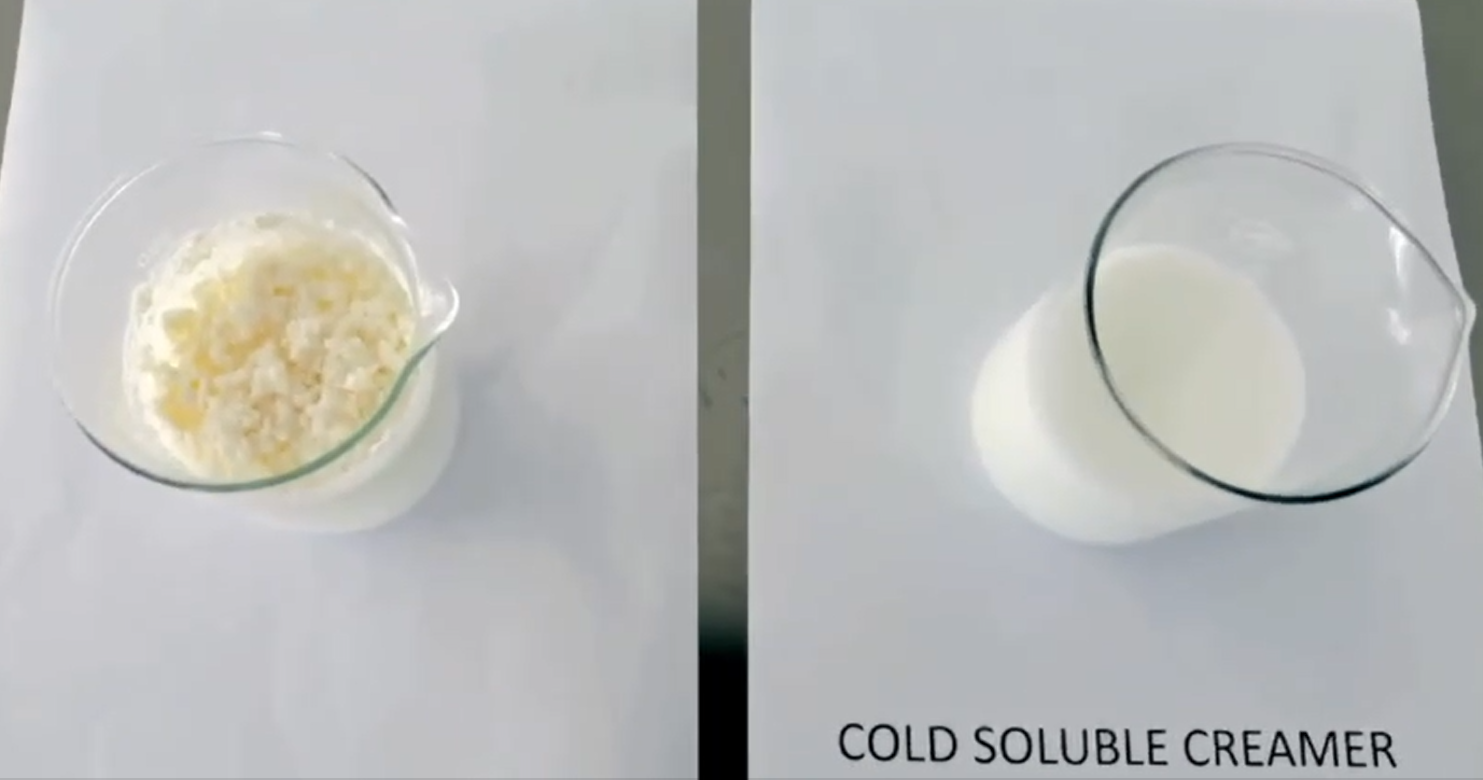
Cold-soluble creamer: coffee, milk tea and beverage
Cold-soluble creamer is designed for instant dissolution in cold liquids. It is made of glucose syrup, refined vegetable oil, sodium caseinate, emulsifier, stabilizer and anti-caking agent. The documented values are moisture no more than 5.0 g/100 g, protein 3.5 g/100 g and fat 32.0 g/100 g. Customer-facing data also lists 25 kg bags. The application fit is coffee, milk tea and beverage. For iced coffee, cold milk tea or a cold beverage line, this is the documented cold-dissolution option. Validate dispersion at the actual temperature, agitation and water hardness; check for lumps, sediment and mouthfeel. It contains sodium caseinate, so it is not automatically milk-free or vegan.
DT35 (Low sugar): milk tea, coffee, beverage and baking
DT35 is a low sugar non-dairy creamer. Its ingredients are glucose syrup, hydrogenated vegetable oil, emulsifier, stabilizer, anti-caking agent 551 and food flavor. Per 100 g, it contains fat 35.0 g, protein 2.5 g and carbohydrate 4.3 g. The documented application fit is milk tea, coffee, beverage and baking. Use it when the brief calls for a low-sugar positioning and the application list matches. The documented carbohydrate value is 4.3 g/100 g; confirm the final nutrition panel and the basis of any low-sugar claim in the destination market. Trial the product in the actual recipe because the ingredient list includes food flavor and anti-caking agent 551.
C960 (Whipping cream): baking and beverage
C960 is a whipping non-dairy creamer. It is made of glucose syrup, hydrogenated vegetable oil, emulsifier, sodium caseinate, stabilizer and salt. Its documented values are protein 5.2 g/100 g, fat 60.0 g/100 g, carbohydrate 28.8 g/100 g and moisture no more than 6.0 g/100 g. The application fit is baking and beverage. For a whipping application, shortlist C960 and test whip time, foam stability and mouthfeel in the intended recipe. The data identifies the type and composition, not a guaranteed whip result. It contains sodium caseinate.
60A (High fat): beverage, dessert, baking and animal feed in the China market
60A is a high-fat non-dairy creamer for the China market. Its ingredients are hydrogenated vegetable oil, glucose syrup, sodium caseinate, emulsifier and stabilizer. The documented values are protein 3.0 g/100 g, fat 60.0 g/100 g and trans fat 0 g/100 g. The application fit is beverage, dessert, baking and animal feed. Use it when the project needs a high-fat model and the application is on that documented list. For animal feed, confirm the applicable grade and market documentation; a food-service specification should not be assumed to be accepted automatically for feed. For dessert and baking, trial richness and process tolerance in the actual formula.
K80 (Kosher): beverage, dessert, milk tea and coffee
K80 is described as a kosher non-dairy creamer. Its ingredients are glucose syrup, hydrogenated vegetable oil, sodium caseinate, emulsifier, stabilizer and anti-caking agent. The documented values are fat 32.0 g/100 g and protein 2.5 g/100 g. The application fit is beverage, dessert, milk tea and coffee. Kosher positioning is a certificate question. Ask for the kosher certificate, certifying body, product scope, production-line scope and expiry. Also check the ingredient statement: K80 lists sodium caseinate, so the product category name should not be read as dairy-free. This model is a shortlist candidate where kosher certification is required and the application matches, not a substitute for document review.
A practical matching sequence for buyers
- Write a one-page process brief. State whether the product is hot or cold, still or foamed, whipped or poured, neutral or alcoholic, bakery, dessert, beverage or animal feed. Add the target market and any kosher, vegan, halal or other certificate requirement.
- Screen by documented application first. Use the model sections above and the comparison table below. Remove any model whose application list does not include the intended use. Do not force a model into a use case because its fat value looks attractive.
- Screen by ingredient restriction second. Check for milk powder and sodium caseinate where a milk-free or vegan claim matters. FC22 lists milk powder. Cold-soluble creamer, C960, 60A and K80 list sodium caseinate. S35 is the vegan-positioned model in this set.
- Match analytical values to the product brief third. Fat, protein, moisture, carbohydrate and trans fat values should be compared only for the same application and the same specification basis. A higher fat number is not automatically better; it is a different formulation target.
- Validate with a sample in the real matrix fourth. For cold-soluble creamer, test cold-liquid dispersion. For FC22, test foam formation. For C960, test whipping behaviour. For S35, test the alcoholic beverage if that is the intended use. For DT35, test the low-sugar recipe and nutrition panel. For 60A, test dessert, baking or feed grade as applicable. For K80, test sensory fit and confirm kosher documents.
- Lock purchasing terms and acceptance criteria last. Approve only when the specification sheet, certificate scope, sample result and commercial quotation all match the written brief.
Scenario shortlists for common projects
For a coffee shop or bubble tea project, the documented coffee and milk tea models are FC22, S35, cold-soluble creamer, DT35 and K80. Use FC22 where a foaming creamer is required, cold-soluble creamer for iced drinks, DT35 for a low-sugar brief, S35 for a vegan coffee or milk tea option, and K80 where kosher certification is required. This is a shortlist, not a ranking. The supplied bubble tea and coffee shop application unit also lists food safety compliance, no trans-fatty acids and halal or kosher certificate availability as special requirements; those requirements must be confirmed model by model.
For a bakery project, the documented models are FC22, S35, DT35, C960 and 60A. C960 is the whipping creamer for whipping applications. 60A is the high-fat model for baking and dessert richness. FC22 is the foaming option for baking, coffee and milk tea. S35 is the vegan-positioned option. DT35 is the low-sugar option. For a beverage manufacturing project, the documented models are cold-soluble creamer, DT35, C960, 60A and K80. For an alcoholic beverage project, S35 is the only model in this set with alcoholic beverages in its documented application list, so it should be sampled at the intended alcohol level and pH. For animal feed in the China market, 60A is the documented model, subject to feed-grade confirmation.
Model comparison table
The table below is a fit map, not a ranking. Rows follow the order used in the assignment. Always confirm the current specification sheet and certificate scope before purchase.
| Model | Documented type or positioning | Documented application fit | Key supplied values | Buyer check |
|---|---|---|---|---|
| FC22 | Foaming non-dairy creamer | Baking, coffee, milk tea | Fat 22.0 g/100 g; protein 7.2 g/100 g; moisture no more than 6.0%; trans fat 0 g/100 g; contains milk powder | Trial foam formation and stability; not a vegan option without verification |
| S35 | Vegan non-dairy creamer | Vegetarian products, alcoholic beverages, milk tea, coffee, baking | Fat 35.0 g/100 g; protein 0 g; trans fat 0 g | Confirm vegan certificate scope; trial alcoholic beverage at intended pH and alcohol level |
| Cold-soluble creamer | Cold-soluble non-dairy creamer | Coffee, milk tea, beverage | Fat 32.0 g/100 g; protein 3.5 g/100 g; moisture no more than 5.0 g/100 g; 25 kg bags | Test cold-liquid dispersion; contains sodium caseinate |
| DT35 | Low sugar non-dairy creamer | Milk tea, coffee, beverage, baking | Fat 35.0 g/100 g; protein 2.5 g/100 g; carbohydrate 4.3 g/100 g | Confirm nutrition panel and low-sugar claim basis |
| C960 | Whipping non-dairy creamer | Baking, beverage | Fat 60.0 g/100 g; protein 5.2 g/100 g; carbohydrate 28.8 g/100 g; moisture no more than 6.0 g/100 g | Trial whip time and foam stability; contains sodium caseinate |
| 60A | High-fat non-dairy creamer, China market | Beverage, dessert, baking, animal feed | Fat 60.0 g/100 g; protein 3.0 g/100 g; trans fat 0 g/100 g | Confirm China market grade and animal-feed documentation where applicable |
| K80 | Kosher non-dairy creamer | Beverage, dessert, milk tea, coffee | Fat 32.0 g/100 g; protein 2.5 g/100 g | Confirm kosher certificate and scope; contains sodium caseinate |
Purchasing terms and acceptance criteria checklist
Use this checklist to close the gap between an application shortlist and a purchase decision. The supplied data does not state MOQ, price, Incoterm, lead time or payment terms for these models, so those values must come from a current supplier quotation. The checklist below focuses on the technical and documentary terms that should be agreed before commercial terms are locked.
| Item to lock | Acceptance evidence to request |
|---|---|
| Exact model and intended application | Write the model code, application and process conditions into the purchase specification. Example: cold-soluble creamer for iced coffee at a stated temperature and agitation; FC22 for a foaming coffee or milk tea application; C960 for a whipping bakery application. |
| Analytical specification | Current specification sheet showing fat, protein, moisture, carbohydrate and trans fat where applicable. Require a certificate of analysis for the supplied batch and confirm the values match the approved specification. |
| Ingredient and allergen statement | Full ingredient list. Check for milk powder and sodium caseinate where a milk-free or vegan requirement applies. FC22 lists milk powder; cold-soluble creamer, C960, 60A and K80 list sodium caseinate. Confirm destination-market allergen labelling requirements. |
| Certificate scope | For K80, request the kosher certificate with certifying body, product scope, production-line scope and expiry. For S35, request the vegan certificate or declaration. Company-level ISO9001, FSSC22000, HACCP, HALAL, ISO14000 and OHSAS18000 information supports supplier screening but is not a substitute for model-specific certificate review. |
| Sample trial protocol | Define pass or fail before the trial. Cold-soluble creamer: dispersion, lumps, sediment and mouthfeel in cold liquid. FC22: foam formation and stability. C960: whipping behaviour and foam stability. S35: emulsion stability in the alcoholic beverage if used. DT35: low-sugar recipe and nutrition panel. 60A: dessert, baking or feed grade as applicable. K80: sensory fit and kosher document check. |
| Packaging and storage | Confirm the packaging format for the selected model. Customer-facing data lists 25 kg bags for cold-soluble creamer. For other models, request the current packaging specification. Agree storage conditions, shelf life and lot traceability. |
| Commercial terms | Request a current quotation covering MOQ, unit price, Incoterm, lead time, payment terms and price validity. These values are not stated in this guide and should not be assumed from the model name or specification. |
| Acceptance decision | Approve only when the specification, certificate scope, sample result and commercial quotation all match the written brief. Record any deviation and require a new sample or document review before release. |
Frequently asked questions
Is non-dairy creamer the same as dairy-free creamer?
No. Non-dairy creamer is a product category used as a milk or cream substitute, but it is not automatically dairy-free. In the supplied data, FC22 lists milk powder, while cold-soluble creamer, C960, 60A and K80 list sodium caseinate. S35 is described as a vegan non-dairy creamer and its ingredient list does not include milk powder or sodium caseinate. Buyers with a milk-free or vegan requirement should verify the full ingredient statement and certificate, not only the product name.
Which Cograin model should I shortlist for cold coffee or iced milk tea?
Cold-soluble creamer is the model designed for instant dissolution in cold liquids, with documented applications in coffee, milk tea and beverage. It has fat 32.0 g/100 g, protein 3.5 g/100 g and moisture no more than 5.0 g/100 g. Trial it in the actual cold liquid at the intended temperature and agitation, and check for lumps, sediment and mouthfeel. Other models may be used in coffee or milk tea, but cold-soluble creamer is the one specifically positioned for cold dissolution.
Which models are positioned for vegan and kosher requirements?
S35 is the vegan-positioned non-dairy creamer in this set, with documented applications in vegetarian products, alcoholic beverages, milk tea, coffee and baking. K80 is the kosher-positioned non-dairy creamer, with documented applications in beverage, dessert, milk tea and coffee. In both cases, request the certificate, certifying body, product scope, production-line scope and expiry. A model name alone is not a certificate.
How do I choose between FC22, C960 and 60A?
Match the process function first. FC22 is the foaming model for baking, coffee and milk tea, with fat 22.0 g/100 g and protein 7.2 g/100 g. C960 is the whipping model for baking and beverage, with fat 60.0 g/100 g and protein 5.2 g/100 g. 60A is the high-fat model for beverage, dessert, baking and animal feed in the China market, with fat 60.0 g/100 g and protein 3.0 g/100 g. Trial each model in the actual recipe because the supplied data identifies composition and application fit, not a guaranteed finished-product performance.
What should a sample request include before I commit?
Include the exact model code, intended application, process conditions, target fat, protein, moisture and carbohydrate values, any kosher or vegan certificate requirement, packaging format and the sample trial criteria. Ask for the current specification sheet and certificate of analysis with the sample. A practical next step is to request application-specific samples and current documents for the shortlisted models, then compare them against the checklist above and the 2025 Cograin Brochure before moving to commercial terms.
Conclusion
The shortest path to a suitable non-dairy creamer is application first, specification second, certificate third and price last. Use FC22 for a documented foaming application, S35 for a vegan-positioned project, cold-soluble creamer for cold-liquid dissolution, DT35 for a low-sugar brief, C960 for whipping, 60A for high-fat beverage, dessert, baking or China-market animal feed use, and K80 for a kosher-positioned beverage, dessert, milk tea or coffee project. Confirm every application claim with a sample trial and every certificate claim with a current document. That process keeps the model map useful without turning a product category into a generic promise.
Have Questions or Need More Details?
Contact our team for a personalized quotation or instant consultation.
Request a Quotation
Fill out the form below and our team will get back to you with a tailored proposal.
WhatsApp Direct Chat
Prefer to chat in real-time? Message us on WhatsApp for instant assistance & quick answers.
- Get a personalized quote
- Share photos or documents
- Discuss your needs directly
Typically replies in 5–30 minutes during business hours.