Non-Dairy Creamer Compliance by Model: Kosher, Vegan, and China Market Requirements
Direct answer: in the Cograin non-dairy creamer range, compliance is attached to a model and an ingredient list, not to the product category. Kosher documentation covers model K80 (25 kg, batch JW26558) under certificate KC#529705-1 issued by KOSHER AUSTRALIA PTY LTD, valid to 2027-04-01. Vegan suitability is supported by model S35, whose ingredient list contains no milk derivatives and which declares 0 g protein. High-fat supply from a China-based production base runs through model 60A (fat 60.0 g/100 g, trans fat 0 g/100 g), manufactured by Nantong Jiazhiwei Food Co., Ltd. under an ISO 9001:2015 certificate aligned with GB/T 19001-2016.
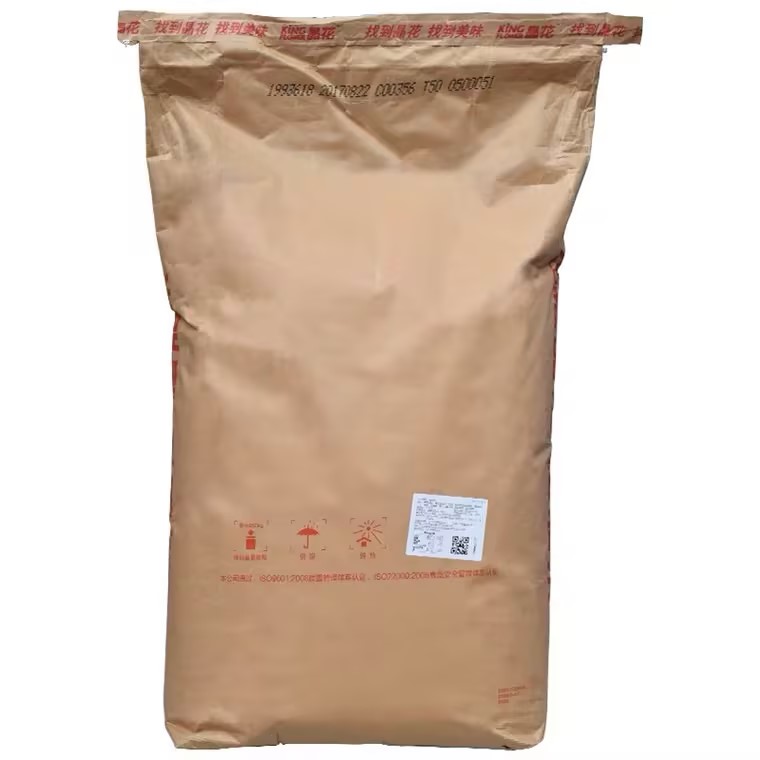
This guide is written for importers, brand owners, quality managers and procurement teams who are in the research and evaluation stage of sourcing non-dairy creamer. It maps named models to Kosher, vegan and China-market documentation, then converts those facts into acceptance criteria you can write into a specification sheet or purchase order.
Cograin is the food-ingredient brand of Jiahe Foods Industry Co., Ltd., a manufacturer founded in 2001 and headquartered in Suzhou, Jiangsu Province, China. The company has been listed on the main board of the Shanghai Stock Exchange since 2021 under stock code 605300, and operates three production bases and five factories across Suzhou, Nantong and Singapore.
Why “Non-Dairy” Is a Label, Not a Compliance Status
“Non-dairy creamer” is a category name. It does not tell a buyer whether a specific model can carry a vegan claim, whether it fits a kosher pareve production line, or whether it satisfies a destination market’s label rules. Those answers sit in two places: the ingredient list, and the certificate scope.
Two published rules explain why the category name is not enough.
- US labelling: FDA regulations allow the label “non-dairy” for products containing milk derivatives such as sodium caseinate, provided the derivative is listed as “a milk derivative” (FDA 21 CFR).
- Kosher classification: for Kosher certification, a “non-dairy” creamer containing sodium caseinate is considered “Dairy” (OU-D), because the derivative is halachically milk (OU Kosher Certification).
Read together, these two rules produce a practical screening rule: sodium caseinate is usually the single ingredient that decides whether a model is vegan-eligible and whether a kosher certificate reads as pareve or dairy. Everything else in the formulation — glucose syrup, hydrogenated vegetable oil, emulsifier, stabilizer, anti-caking agent — is claim-neutral in this context.
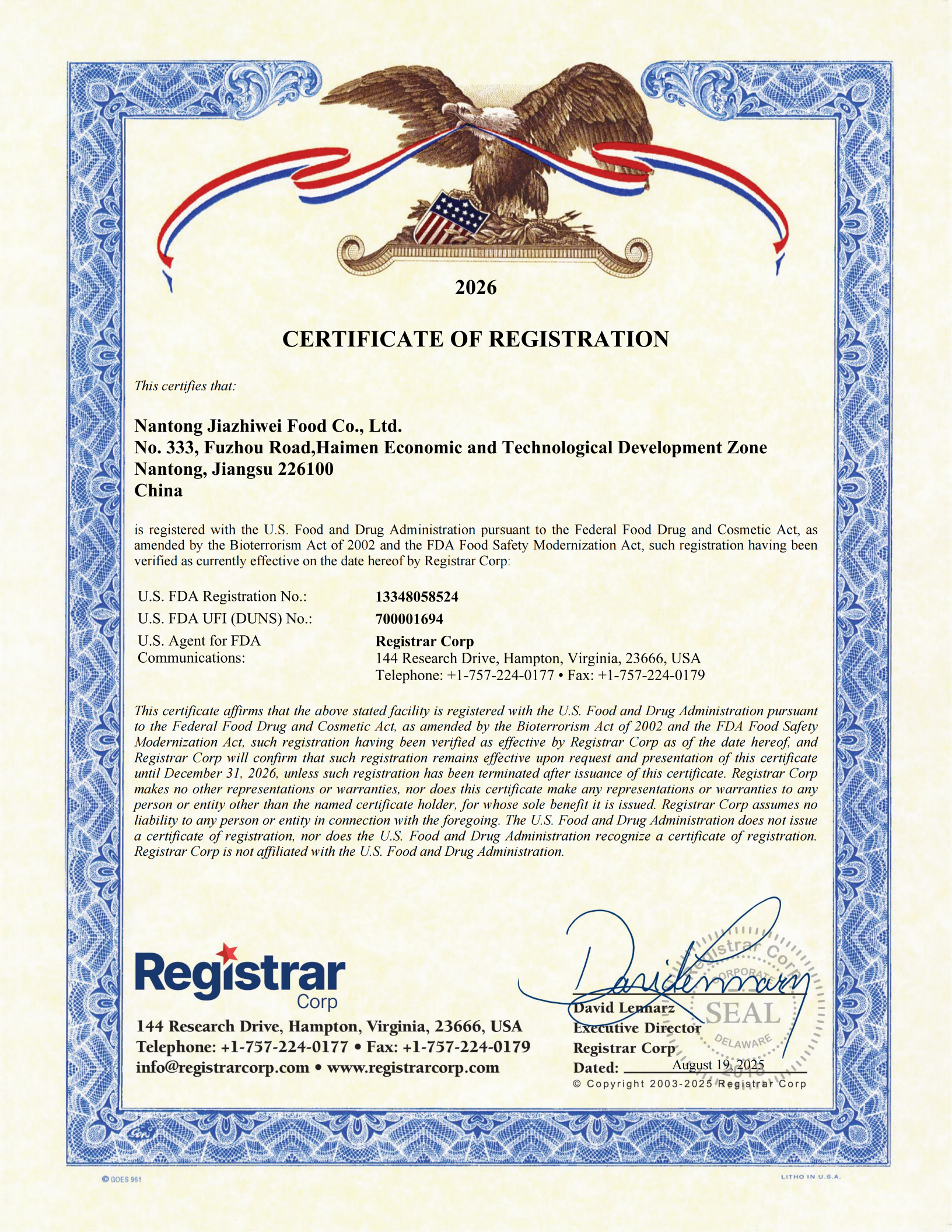
A note on US documentation: a U.S. FDA Food Facility Registration (in this range, number 13348058524, issued by Registrar Corp, valid to 2026-12-31) registers a production facility for the US market. It is not a product approval, and it does not replace a certificate of analysis, an allergen statement or a market-specific label claim review.
Industry Background: Where the Compliance Pressure Comes From
Non-dairy creamer is a large, still-expanding ingredient category, and the applications driving that growth have different claim requirements. Market research from Future Market Insights values the global non-dairy creamer market at USD 2.4 billion in 2024, projected to reach USD 4.4 billion by 2034. Scope matters when reading market figures: Grand View Research, working with a broader coffee-creamer definition, reported USD 4.95 billion for 2024.
Three structural facts shape what buyers ask suppliers to prove:
- Powder dominates. Powdered non-dairy creamers held a 68.4% share in 2024, driven by long shelf life and ease of storage (Future Market Insights). Powder format is also what makes moisture content a real specification item rather than a formality.
- Coffee is the largest single application. Coffee applications account for approximately 41% of global non-dairy creamer utilisation (Business Research Insights), which is why dairy-style labelling and creamer-versus-whitener terminology appear so often in buyer questions.
- Medium-fat is the volume core. Medium-fat variants (21–50% fat) hold a 43.6% to 46% share, based on balanced texture and flavour performance (Future Market Insights / Business Research Insights).
The competitive field is well documented: Grand View Research lists Nestlé (Coffee-Mate), Danone (Silk), FrieslandCampina Kievit and Kerry Group among the leading global players. For a buyer, the relevant observation is not brand size but documentation structure — large branded suppliers typically separate facility-level systems certificates, finished-product certificates of analysis, and claim-specific certificates such as kosher or halal. Smaller suppliers sometimes present these as one undifferentiated “certification package”.
Application spread is the second pressure point. The same range of models is used in milk tea, coffee, bakery, beverages, alcoholic beverages and animal feed. A model that is ideal for a bakery fill rate may be unsuitable for an alcoholic beverage line, and a model that fits a bubble tea chain may carry sodium caseinate that blocks a vegan claim. That is why this guide is organised by model rather than by product family.
The Model-by-Model Compliance Map
Model K80 (kosher product): the kosher-documented model
Model K80 carries declared values of fat 32.0 g/100 g and protein 2.5 g/100 g, with an ingredient list of glucose syrup, hydrogenated vegetable oil, sodium caseinate, emulsifier, stabilizer and anti-caking agent. Its applications are beverage, dessert, milk tea and coffee.
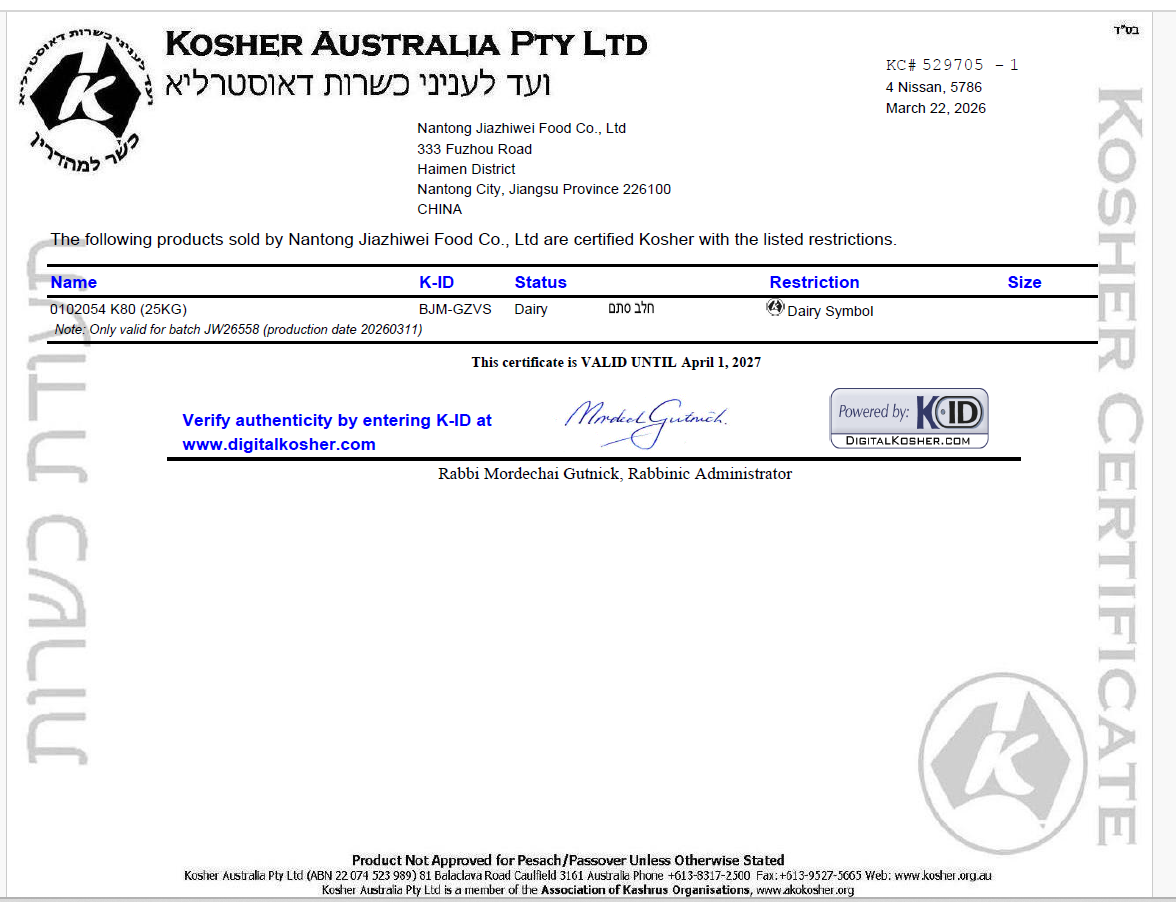
Kosher certification for this model is issued under certificate number KC#529705-1 by KOSHER AUSTRALIA PTY LTD, against Australian and international kosher dietary compliance standards, for the global market. The certificate scope is precise: non-dairy creamer model K80, 25 kg packaging, batch JW26558, production date 20260311. It was issued on 2026-03-22 and is valid to 2027-04-01.
Because the K80 formulation contains sodium caseinate, buyers whose production lines require pareve status should confirm the dairy designation printed on the certificate before committing. Under the OU Kosher rule referenced above, a creamer containing sodium caseinate is treated as Dairy (OU-D) regardless of how the finished product is marketed. The certificate remains valid and useful — it simply needs to be read against the right requirement: kosher dairy lines, or kosher pareve lines.
For US-bound shipments, K80 is also covered by U.S. FDA Food Facility Registration number 13348058524, issued by Registrar Corp for the USA market on 2025-08-19 and valid to 2026-12-31. This registration applies to the manufacturing facility, so it should be filed alongside — not instead of — batch-level certificates of analysis.
Model S35 (Vegan): a claim supported by the ingredient list
Model S35 is the vegan non-dairy creamer in this range. Its declared profile is fat 35.0 g/100 g, trans fat 0 g and protein 0 g — the zero protein declaration matters commercially because it is consistent with a formulation that contains no milk protein.
The ingredient list supports the same reading. S35 is built from glucose syrup, hydrogenated vegetable oil, emulsifier, oxidized hydroxypropyl starch and anti-caking agent. There is no sodium caseinate and no milk powder in the formulation, which is what allows the vegan positioning in the first place. Its declared applications are vegetarian products, alcoholic beverages, milk tea, coffee and baking.
That application list is broader than buyers often expect. The alcoholic beverage application, for example, is a category where vegan and allergen statements are frequently requested by brand owners, and it is a documented use of S35 rather than a theoretical one. A South African beverage production factory using this portfolio for alcoholic beverages has run 1,000 mt over five years, with the supplier reporting stable performance.
Two verification steps remain for S35 buyers. First, request the current batch certificate of analysis and confirm protein and trans fat declarations on the delivered batch. Second, confirm the allergen statement wording that will appear on your own finished-product label, since vegan suitability and allergen declaration are related but not identical obligations.
Model 60A (high fat): China-based supply for high-fat applications
Model 60A is the high-fat option, declaring protein 3.0 g/100 g, fat 60.0 g/100 g and trans fat 0 g/100 g. Its ingredient list is hydrogenated vegetable oil, glucose syrup, sodium caseinate, emulsifier and stabilizer, and its declared applications are beverage, dessert, baking and animal feed.
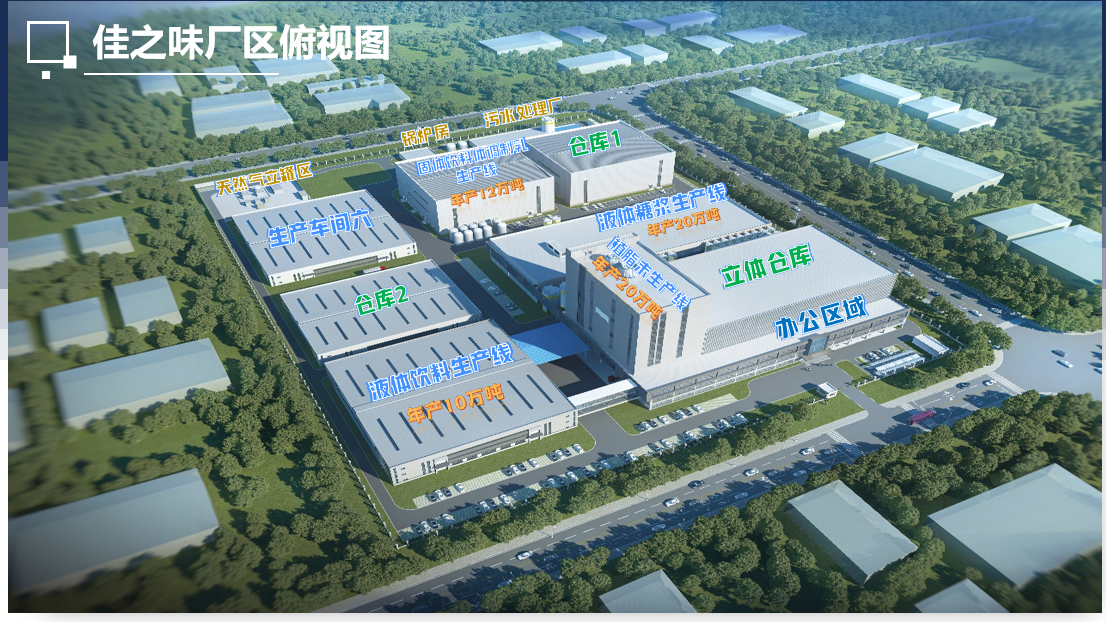
For buyers evaluating a China-based supply route, 60A is the model where the production base and the compliance file line up most directly. The model is manufactured at Nantong Jiazhiwei Food Co., Ltd., and the quality management system certificate for that entity is issued under ISO 9001:2015 with the applicable standard written as GB/T 19001-2016 / ISO 9001:2015 — a dual reference that lets a Chinese-market buyer and an export buyer work from the same certificate number, 00125Q32624R1M/3200 (also issued as CN00125Q32624R1M/3200) by CQC, valid to 2028-05-04.
Two practical points follow from the formulation. First, because 60A contains sodium caseinate, it is a kosher-dairy input and not a vegan input — the 60% fat content and the dairy-free positioning should not be treated as the same claim. Second, the trans fat declaration of 0 g/100 g is the specification item most often requested by bakery and beverage buyers, alongside moisture control.
The animal feed application is a documented, repeat-use case rather than a secondary listing. An animal feed production plant in Singapore has used 60A at 4,000–5,000 mt per year for three years, citing consistent quality and favourable pricing, with the high-fat profile as the deciding factor.

Other models in the same certified scope
The ISO 9001:2015 certificate referenced above is not model-specific to K80, S35 and 60A. Its scope covers K60, K80, S35, 60A, C960 (whipping cream), FC22 (foaming), DT35 and the cold-soluble creamer. That matters for buyers who want to build a multi-model order without opening a second supplier qualification.
- K60: fat 32.0 g/100 g, trans fat 0 g/100 g, protein 2.6 g/100 g, moisture ≤5.0%; contains sodium caseinate and milk powder; used in milk tea, baking and coffee.
- FC22 (Foaming): protein 7.2 g/100 g, fat 22.0 g/100 g, trans fat 0 g/100 g, moisture ≤6.0%; contains milk powder; used in milk tea, coffee and baking.
- C960 (Whipping cream): protein 5.2 g/100 g, fat 60.0 g/100 g, carbohydrate 28.8 g/100 g, moisture ≤6.0%; used in baking and beverage.
- Cold-soluble creamer: fat 32.0 g/100 g, protein 3.5 g/100 g, moisture ≤5.0%; used in coffee, milk tea and beverage.
- DT35 (Low sugar): fat 35.0 g/100 g, protein 2.5 g/100 g, carbohydrate 4.3 g/100 g; the listed formulation contains no sodium caseinate; used in milk tea, coffee, beverage and baking.
At company level, Jiahe Foods Industry Co., Ltd. states that it has passed multiple quality and food safety systems, including ISO 9001 quality management, FSSC 22000 food safety, HACCP, HALAL, ISO 14000 environmental management and OHSAS 18000 occupational health and safety. Buyers sourcing for halal-relevant or religious-dietary markets should request the specific halal certificate and its scope separately, since a system listing is not the same document as a certificate tied to a model and a batch.
Six-Step Acceptance Routine Before You Commit
The following sequence converts the model facts above into a repeatable purchasing check. It is written so that a QA manager and a procurement manager can run it together.
- Lock the model number, not the category. Write the exact model code — K80, S35, 60A, K60, FC22, C960, cold-soluble or DT35 — into the specification sheet and the purchase order. Category-level descriptions such as “non-dairy creamer” cannot be verified against a certificate scope.
- Read the ingredient list for claim blockers. Check for sodium caseinate (affects kosher dairy status and vegan eligibility) and milk powder (affects vegan eligibility). S35 and DT35 are free of sodium caseinate in their listed formulations; K80, 60A, K60, C960 and the cold-soluble creamer list sodium caseinate; FC22 and K60 list milk powder.
- Match certificate scope to model, package size and batch. The clearest example in this range is the K80 kosher certificate, which names model K80, 25 kg packaging, batch JW26558 and production date 20260311. A certificate that names a different package size or an unlisted batch should be queried before shipment release.
- Check validity windows, and ask for the current document. The Kosher certificate runs to 2027-04-01; the U.S. FDA Food Facility Registration runs to 2026-12-31; the ISO 9001:2015 certificate runs to 2028-05-04. The FSSC 22000 certification record for the Nantong Jiazhiwei site (certificate 162006008, issued by Intertek Certification Limited against FSSC22000 V6, ISO 22000:2018 and ISO/TS22002-1:2009) carries a recorded validity window ending 2026-06-17, so the current certificate should be requested as part of the file.
- Set measurable specification acceptance criteria. Trans fat is declared at 0 g/100 g on 60A, S35, K60 and FC22. Moisture is declared at ≤5.0% on K60 and the cold-soluble creamer, and ≤6.0% on FC22 and C960. Fat and protein values should be taken from the model data sheet for each ordered model, and batch certificates of analysis should be compared against them on receipt.
- Fix the commercial terms in writing. MOQ is negotiable and depends on product type and packaging specification. Lead time is around 7–15 working days after order confirmation. Monthly creamer capacity is 16,700 tons. Customization covers creamer formula, packaging specification, product flavour, and syrup DE value where relevant. Quality control covers full-process inspection, 100% metal and weight check, and third-party testing, with technical guidance, quality tracking and customization adjustment available after delivery.
Use Cases: How the Mapping Plays Out in Practice
Bubble tea and coffee chains. A bubble tea chain operating in Singapore, Vietnam and the United States has used 1,000 mt of this portfolio over three years, citing consistent quality and favourable pricing. For this type of buyer, the compliance file usually needs the ISO 9001:2015 certificate, a batch certificate of analysis per shipment, and — for the kosher k80 model — the kosher certificate where outlets or franchisees operate kosher-relevant programmes.
3-in-1 instant beverage manufacturers. A 3-in-1 coffee manufacturer supplying Singapore, Malaysia, Indonesia, the Philippines, Kazakhstan, the UAE, Ukraine and Russia has taken 9,000 mt over five years, applying the material across instant coffee powder, instant oatmeal and instant milk tea. This buyer profile typically manages several models in parallel, which is where a single ISO 9001:2015 scope covering eight models reduces audit overhead.
Animal feed production. A feed plant in Singapore has consumed 4,000–5,000 mt per year of the high-fat model 60A for three years, reporting consistent quality and favourable pricing. Here the compliance question is narrower: specification stability, moisture control and a trans fat declaration of 0 g/100 g, rather than consumer-facing label claims.
Alcoholic beverage manufacturing. A beverage factory in South Africa has used 1,000 mt over five years for alcoholic beverage applications, with stable performance reported. S35 lists alcoholic beverages among its declared applications, which is why vegan-eligible formulations are increasingly requested in this segment.
Comparison Tables
Table 1 summarises specification facts that directly influence claim decisions. Fields marked “not listed” are not stated on the model data sheet supplied and should be requested during specification review.
| Model | Type | Fat (g/100 g) | Protein (g/100 g) | Trans fat (g/100 g) | Moisture | Ingredient-list claim note |
|---|---|---|---|---|---|---|
| K80 | Kosher product | 32.0 | 2.5 | Not listed | Not listed | Contains sodium caseinate |
| 60A | High fat | 60.0 | 3.0 | 0 | Not listed | Contains sodium caseinate |
| S35 | Vegan | 35.0 | 0 | 0 | Not listed | No milk derivatives |
| K60 | Standard | 32.0 | 2.6 | 0 | ≤5.0% | Contains sodium caseinate and milk powder |
| FC22 | Foaming | 22.0 | 7.2 | 0 | ≤6.0% | Contains milk powder |
| C960 | Whipping cream | 60.0 | 5.2 | Not listed | ≤6.0% | Contains sodium caseinate |
| Cold-soluble | Cold-soluble | 32.0 | 3.5 | Not listed | ≤5.0% | Contains sodium caseinate |
| DT35 | Low sugar | 35.0 | 2.5 | Not listed | Not listed | No sodium caseinate in listed formulation |
Table 2 maps the certification documents that apply to this portfolio, including the entity or model each document covers and its recorded validity window.
| Document | Scope / holder | Number | Issued by | Market | Validity |
|---|---|---|---|---|---|
| Kosher certification | Non-dairy creamer model K80 (25 kg), batch JW26558, production date 20260311 | KC#529705-1 | KOSHER AUSTRALIA PTY LTD | Global | Issued 2026-03-22; valid to 2027-04-01 |
| U.S. FDA Food Facility Registration | Nantong Jiazhiwei Food Co., Ltd. (facility-level) | 13348058524 | Registrar Corp | USA | Issued 2025-08-19; valid to 2026-12-31 |
| ISO 9001:2015 quality management system | K60, K80, S35, 60A, C960, FC22, DT35 and cold-soluble creamer | 00125Q32624R1M/3200 (also issued as CN00125Q32624R1M/3200) | CQC | Global | Issued 2025-04-24; valid to 2028-05-04 |
| FSSC 22000 food safety system | Nantong Jiazhiwei Food Co., Ltd. | 162006008 | Intertek Certification Limited | Global | Issued 2025-07-03; recorded validity window to 2026-06-17 — request current certificate |
FAQ
If a creamer is labelled “non-dairy”, is it automatically suitable for vegan and kosher programmes?
No. FDA regulations permit the “non-dairy” label on products that contain milk derivatives such as sodium caseinate, provided the derivative is declared as “a milk derivative”. Under kosher rules, a “non-dairy” creamer containing sodium caseinate is classified as Dairy (OU-D), because the derivative is halachically milk. Vegan eligibility therefore depends on the ingredient list rather than the category name: model S35 is formulated from glucose syrup, hydrogenated vegetable oil, emulsifier, oxidized hydroxypropyl starch and anti-caking agent, with no sodium caseinate or milk powder, and declares 0 g protein; models K80 and 60A both list sodium caseinate.
Which models carry market documentation for kosher and US-bound buyers?
Kosher certification in this range is attached to model K80 (25 kg, batch JW26558) under certificate KC#529705-1 from KOSHER AUSTRALIA PTY LTD, valid to 2027-04-01. US-bound documentation takes the form of U.S. FDA Food Facility Registration number 13348058524, issued by Registrar Corp and valid to 2026-12-31, which applies to the Nantong Jiazhiwei Food Co., Ltd. facility rather than to a single product. Model coverage for the quality system comes from ISO 9001:2015 certificate 00125Q32624R1M/3200 (also issued as CN00125Q32624R1M/3200) from CQC, which lists K60, K80, S35, 60A, C960, FC22, DT35 and the cold-soluble creamer and remains valid to 2028-05-04.
What are the minimum order quantity and lead time?
MOQ is negotiable and depends on the product type and the packaging specification you choose. Lead time is around 7–15 working days after order confirmation. Monthly capacity is 16,700 tons of creamer within a wider capacity base, and customization can cover creamer formula, packaging specification and product flavour, so the practical MOQ figure is best fixed together with the packaging decision rather than before it.
How can we validate a claim before placing a full order?
Validation is normally done in three layers. First, request the model data sheet and the relevant certificates — for example, the K80 kosher certificate and its named batch, JW26558 with production date 20260311. Second, request samples and run your own application trial, since functionality such as foaming, whipping or cold solubility is application-specific. Third, confirm the quality-control regime that will apply to production: full-process inspection, 100% metal and weight check, and third-party testing are stated as standard practice across this portfolio.
How do we start a compliance review with Cograin, and how quickly can documentation be supplied?
The fastest route is to send your target model list, destination markets and required claim statements, and request the matching document set plus the current brochure, which you can download here: 2025 Cograin Brochure. Model specification sheets, batch certificates of analysis and the certification documents listed in Table 2 can then be matched to your markets, and the current FSSC 22000 certificate should be requested at the same time. Contact the team at davidqi@cograin.cn, by telephone on 0513-81208180, or via WhatsApp +6596809996; the company website is cograin.cn.
Conclusion
Compliance in non-dairy creamer is a model-level question. The category name “non-dairy” is permitted on products that contain sodium caseinate, and kosher rules classify those same products as Dairy (OU-D) — which is exactly why the ingredient list and the certificate scope, not the product title, decide whether a model fits your claim requirements.
In this range, three models illustrate the mapping clearly: K80 is the kosher-documented model, with certificate KC#529705-1 covering 25 kg packaging and batch JW26558 and valid to 2027-04-01; S35 is the vegan model, with a formulation free of milk derivatives and a 0 g protein declaration; and 60A is the high-fat model at 60.0 g/100 g fat and 0 g/100 g trans fat, produced at a China-based site under an ISO 9001:2015 certificate aligned with GB/T 19001-2016. Five further models share the same quality-system certificate, which allows a multi-model order to sit inside one supplier qualification.
Before committing, verify five items in writing: the exact model code, the ingredient list against your claim requirements, the certificate scope against model, package size and batch, the current validity window of every certificate in the file, and the specification acceptance criteria for fat, protein, trans fat and moisture. Then fix MOQ, packaging specification and the 7–15 working day lead time in the order confirmation.
Next step
Send your destination markets and required claim statements, and the team will return the matching model specification sheets, the certification file for the models you select, and sample arrangements for trial. Contact davidqi@cograin.cn or reach the team on WhatsApp. Download the full 2025 Cograin Brochure for the complete model overview, and visit cograin.cn for company background.
Have Questions or Need More Details?
Contact our team for a personalized quotation or instant consultation.
Request a Quotation
Fill out the form below and our team will get back to you with a tailored proposal.
WhatsApp Direct Chat
Prefer to chat in real-time? Message us on WhatsApp for instant assistance & quick answers.
- Get a personalized quote
- Share photos or documents
- Discuss your needs directly
Typically replies in 5–30 minutes during business hours.