Non-Dairy Creamer Specs & Certifications: Buyer Checklist
Non-Dairy Creamer Specs & Certifications: Buyer Checklist
Non-dairy creamer is a powdered food ingredient used to add creaminess, body, and stability to coffee, milk tea, bakery products, beverages, and other food applications. For B2B buyers, selecting a non-dairy creamer requires more than a taste test: the specification sheet (fat, protein, trans fat, moisture), the certification portfolio (ISO 9001, FSSC 22000, Kosher, FDA registration), and the manufacturer's production capability all determine whether the ingredient is acceptable for a target market and application. This article uses the certified non-dairy creamer range of Cograin as a working example and provides a step-by-step checklist for evaluating specifications and compliance documents before purchase.
Cograin is the international brand of Jiahe Foods Industry Co., Ltd., a food ingredient manufacturer founded in 2001 and headquartered in Suzhou, Jiangsu Province, China. Jiahe Foods is listed on the main board of the Shanghai Stock Exchange (stock code: 605300) and operates three production bases and five factories in Suzhou, Nantong, and Singapore, with an annual production capacity of more than 300,000 tons. Its non-dairy creamer production capacity is 200,000 tons per year, supported by 310 employees and an R&D team of 22 engineers.
The Real Sourcing Problem: Specs and Certificates Are Hard to Compare
Buyers evaluating non-dairy creamer suppliers typically face four problems:
1. Non-standardized specification sheets. Fat content, protein content, trans fat content, and moisture are reported in different formats across suppliers, making side-by-side comparison difficult. Procurement teams need a fixed parameter set to compare ingredients objectively.
2. Certification confusion. Non-dairy is a regulated label term, not automatically a dairy-free or vegan claim. Under FDA regulations, the label non-dairy is allowed for products containing milk derivatives such as sodium caseinate, provided the derivative is listed as a milk derivative on the label. In kosher certification, a non-dairy creamer containing sodium caseinate may be classified as Dairy (OU-D) because the derivative is considered milk under halachic rules. Buyers serving vegan or kosher-dairy-free markets must read the ingredient list, not only the front label.
3. Application mismatch. A high-fat creamer (60% fat) is not a substitute for a foaming creamer (22% fat) or a cold-soluble creamer. Each application, whether coffee, milk tea, bakery, alcoholic beverages, or animal feed, places different constraints on fat, protein, solubility, and foaming behavior.
4. Verification burden. A certificate is only useful if the certificate number, issuing authority, applicable standard, product scope, and validity dates are checked. Buyers should request the actual certificate document, not a sales summary.
Market Context: Where Non-Dairy Creamer Demand Is Heading
The global non-dairy creamer market was valued at USD 2.4 billion in 2024 and is projected to reach USD 4.4 billion by 2034, according to Future Market Insights. Powdered non-dairy creamers dominate the market with a 68.4% share in 2024, driven by long shelf life and ease of storage (Future Market Insights). Coffee applications represent the largest demand segment, accounting for approximately 41% of global non-dairy creamer utilization (Business Research Insights). Medium-fat variants (21–50% fat) are the most popular type, holding a 43.6% to 46% market share based on balanced texture and flavor performance (Future Market Insights / Business Research Insights). In the adjacent functional ingredient category, the global MCT powder market was valued at USD 585 million in 2024, growing at a CAGR of 5.7% (Intel Market Research).
This context matters for procurement decisions. Demand for powdered, medium-fat, coffee-oriented creamers remains the largest opportunity, but certification requirements vary by destination market. Established global players such as Nestlé (Coffee-Mate), Danone (Silk), FrieslandCampina Kievit, and Kerry Group operate in the same category (Grand View Research). A buyer's differentiation lever is therefore supplier compliance, parameter transparency, and formulation flexibility rather than the ingredient category alone.
Detailed Solution: Cograin's Certified Non-Dairy Creamer Range
Cograin (Jiahe Foods Industry Co., Ltd.) produces non-dairy creamer across eight documented models, each defined by fat content, protein content, and documented applications. The product line covers standard, high-fat, low-sugar, vegan, foaming, cold-soluble, kosher, and whipping-cream formats, which allows buyers to match a specific model to a specific application constraint.
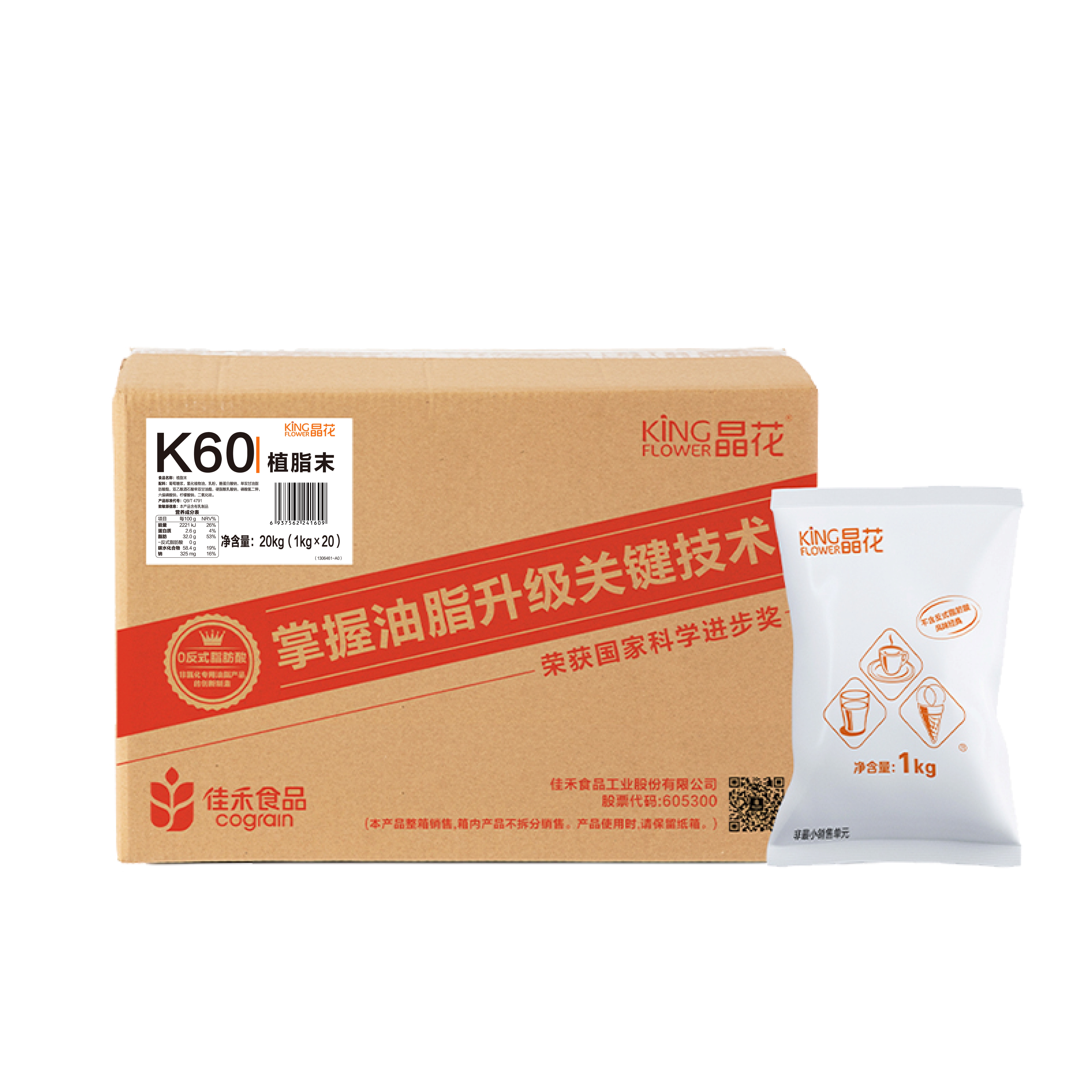
- K60 — standard non-dairy creamer: fat 32.0g/100g, protein 2.6g/100g, trans fat 0g/100g, moisture ≤5.0. Documented for milk tea, baking, and coffee.
- kosher k80 (K80) — kosher-certified: fat 32.0g/100g, protein 2.5g/100g. Documented for beverage, dessert, milk tea, and coffee.
- 60A — high-fat: protein 3.0g/100g, fat 60.0g/100g, trans fat 0g/100g. Documented for beverage, dessert, baking, and animal feed.
- S35 — vegan: fat 35.0g/100g, trans fat 0g, protein 0g. Documented for vegetarian products, alcoholic beverages, milk tea, coffee, and baking.
- DT35 — low-sugar: fat 35.0g/100g, protein 2.5g/100g, carbohydrate 4.3g/100g. Documented for milk tea, coffee, beverage, and baking.
- FC22 — foaming: protein 7.2g/100g, fat 22.0g/100g, trans fat 0g/100g, moisture ≤6.0. Documented for milk tea, coffee, and baking.
- Cold-soluble creamer — fat 32.0g/100g, protein 3.5g/100g, moisture ≤5.0g/100g. Documented for coffee, milk tea, and beverage.
- C960 (whipping cream) — protein 5.2g/100g, fat 60.0g/100g, carbohydrate 28.8g/100g, moisture ≤6.0g/100g. Documented for baking and beverage.
Certifications to Verify Before Placing an Order
ISO 9001:2015. Non-dairy creamer models K60, kosher k80 (K80), S35, and 60A are certified to ISO 9001:2015 quality management system standard, with applicable standard GB/T 19001-2016 / ISO 9001:2015. The certification (number 00125Q32624R1M/3200, or CN00125Q32624R1M/3200) is issued by CQC, applies to the global market, and is valid through 2028-05-04.
FSSC 22000. The non-dairy creamer range is certified to FSSC 22000 Food Safety System Certification, applicable standard FSSC22000 V6, ISO 22000:2018, ISO/TS22002-1:2009. The certification (number 162006008) is issued by Intertek Certification Limited and applies to the global market.
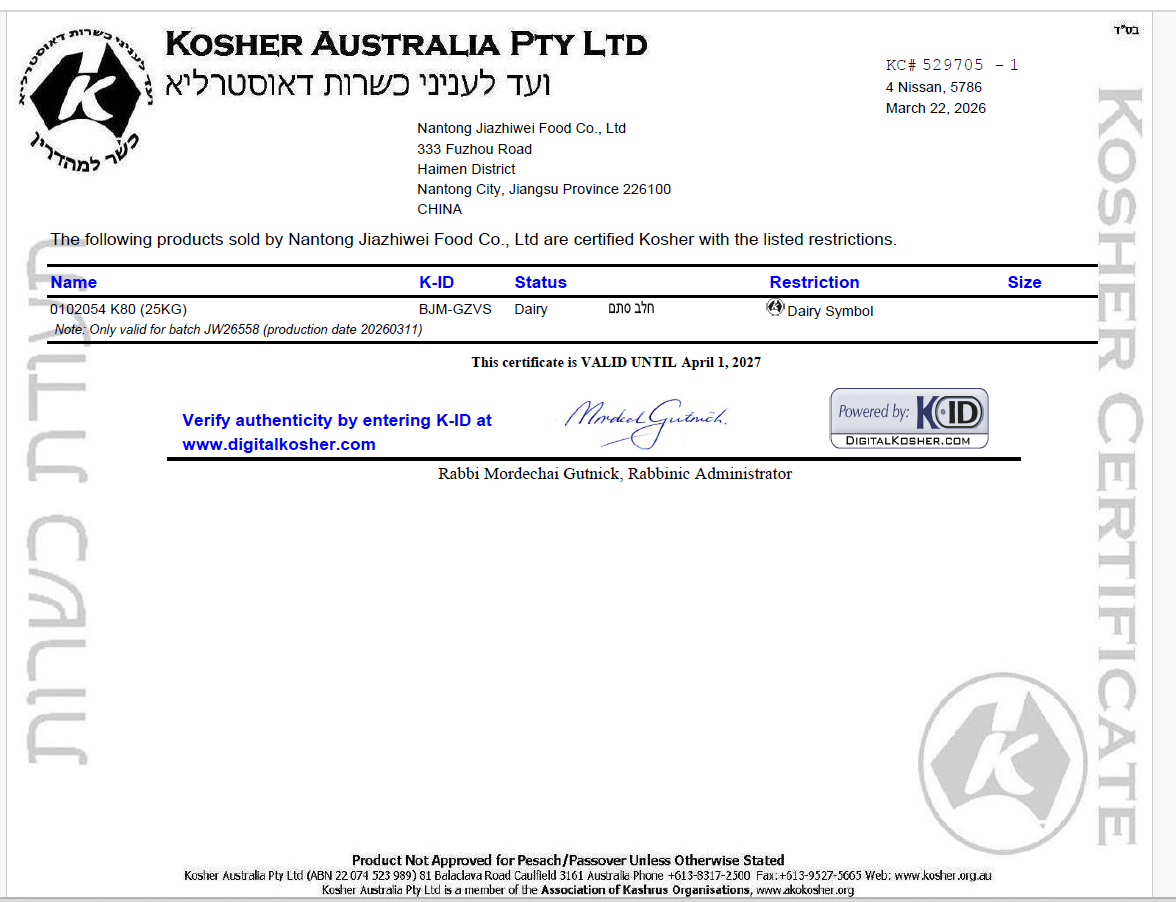
Kosher. Non-dairy creamer model K80 (25kg, batch JW26558) holds Kosher certification under Australian & international kosher dietary compliance standards. The certification (KC#529705-1) is issued by KOSHER AUSTRALIA PTY LTD, applies to the global market, and is valid through 2027-04-01. Buyers should note that this kosher-certified product contains sodium caseinate; under kosher certification rules, a non-dairy creamer containing sodium caseinate is treated as Dairy in kosher classification.
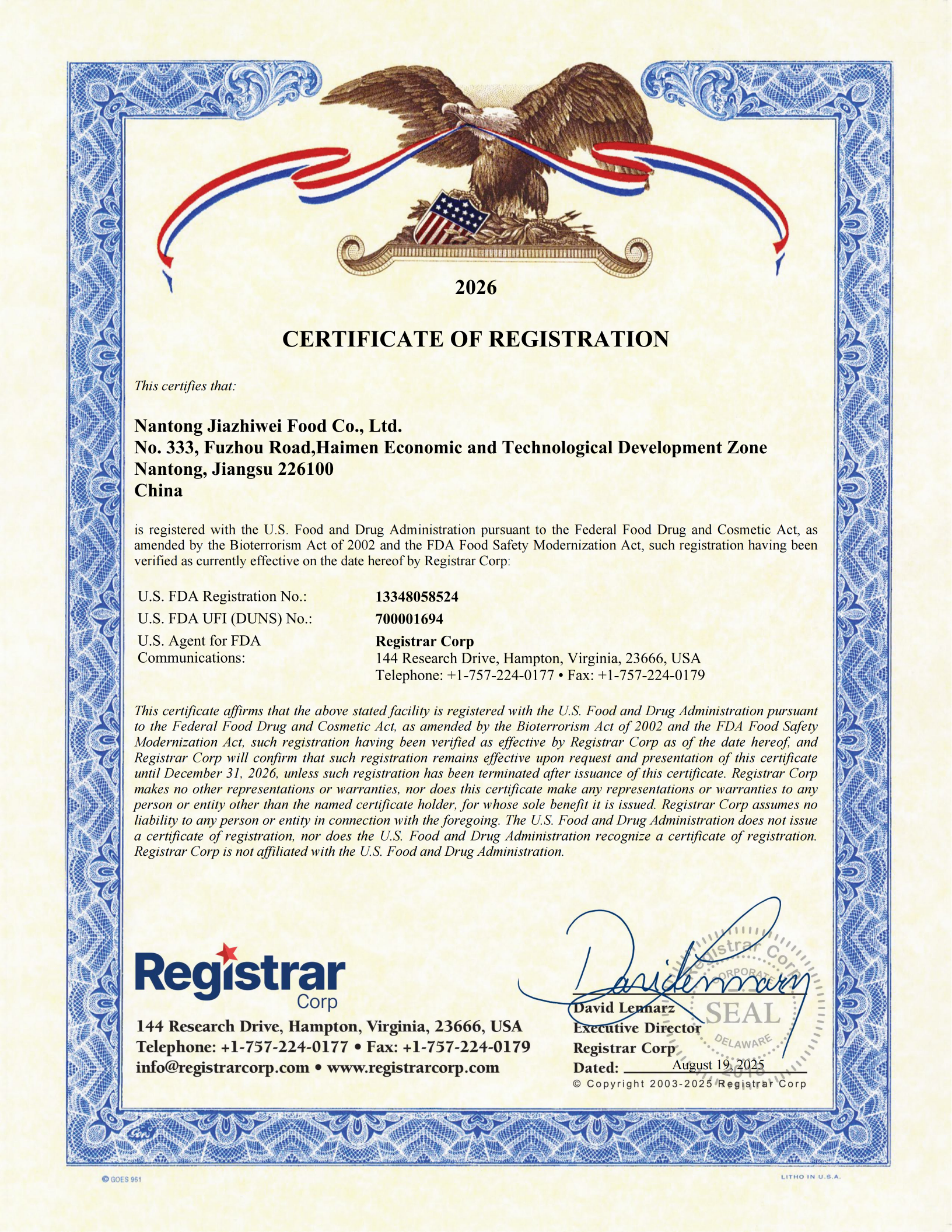
U.S. FDA Food Facility Registration. The non-dairy creamer model kosher k80 is covered by U.S. FDA Food Facility Registration under the Federal Food, Drug, and Cosmetic Act, as amended by the Bioterrorism Act of 2002 and the FDA Food Safety Modernization Act. The registration (number 13348058524) is issued by Registrar Corp for the USA market and is valid through 2026-12-31.
Additional company-level compliance. Jiahe Foods Industry Co., Ltd. has also passed HACCP hazard analysis and critical control point system certification, HALAL certification, ISO14000 environmental management system certification, and OHSAS18000 occupational health and safety management system certification.
Step-by-Step: 5-Step Supplier Evaluation Checklist
Step 1 — Define the application constraint. Coffee and milk tea prefer medium-fat (21–50%) creamers with smooth mouthfeel; bakery and whipping applications need high-fat (60%) or whipping formats; vegan product lines require formulas without animal-derived protein (for example, S35 with protein 0g); cold beverages require cold-soluble formats.
Step 2 — Read the specification sheet against a fixed parameter set. Compare fat (g/100g), protein (g/100g), trans fat (g/100g), moisture (%), and the full ingredient list. Example: K60 lists fat 32.0g/100g, protein 2.6g/100g, trans fat 0g/100g, moisture ≤5.0, with ingredients including glucose syrup, hydrogenated vegetable oil, milk powder, sodium caseinate, emulsifier, stabilizer, and anti-caking agent.
Step 3 — Verify certificates against your destination market. For US-bound products, check FDA Food Facility Registration. For global food safety programs, check FSSC 22000. For kosher-required lines, request the Kosher certificate and note the product scope, batch, issuing authority, and validity date. Record certificate numbers, applicable standards, and issuing bodies in your supplier file.
Step 4 — Assess production and quality control capability. Confirm the manufacturer's capacity, lead time, and QC process. Cograin/Jiahe Foods operates a monthly creamer capacity of 16,700 tons, a documented lead time of around 7–15 working days after order confirmation, and a quality control system that includes full-process inspection, 100% metal/weight checks, and third-party testing. OEM/ODM customization is available for syrup DE value, creamer formula, packaging specification, and product flavor. Export markets are global, with about 50% of production exported and Southeast Asia as the main market.
Step 5 — Request samples and run a qualification test. MOQ is negotiable based on product type and packaging. Evaluate the sample against the agreed parameter set, not only sensory performance, and document any deviation.
Use Cases: Which Model Fits Which Application
Coffee and 3-in-1 instant coffee. Suitable models include kosher k80, DT35, cold-soluble creamer, and FC22. Verified case: a 3-in-1 coffee manufacturer in Singapore, Malaysia, Indonesia, Philippines, Kazakhstan, UAE, Ukraine, and Russia has purchased 9,000 mt over 5 years for instant coffee, instant oatmeal, and instant milk tea products, reporting consistent quality and good pricing.
Milk tea and bubble tea. Suitable models include K60, cold-soluble creamer, FC22, and kosher k80. Verified case: a bubble tea chain in Singapore, Vietnam, and the United States has purchased 1,000 mt over 3 years, reporting consistently strong sales and an excellent reputation. For the bubble tea and coffee shop sector, documented requirements include food safety compliance (HACCP/ISO), no trans-fatty acids, and available halal/kosher certification.

Bakery. Suitable models include C960 (whipping cream powder), 60A, and FC22. C960 is a whipping cream format with protein 5.2g/100g and fat 60.0g/100g, documented for baking and beverage applications.
Alcoholic beverages. Suitable models include S35 (vegan) and kosher k80. Verified case: a beverage production factory in South Africa has purchased 1,000 mt of non-dairy creamer for alcoholic beverages over 5 years, reporting steady sales and a good reputation among customers.
Animal feed. Suitable model: 60A high-fat non-dairy creamer. Verified case: an animal feed production plant in Singapore has purchased 4,000–5,000 mt per year for 3 years, highlighting consistent quality and good pricing.
Comparison: Cograin Non-Dairy Creamer Models by Key Parameters
| Model | Type / format | Fat (g/100g) | Protein (g/100g) | Trans fat (g/100g) | Moisture | Documented applications |
|---|---|---|---|---|---|---|
| K60 | Standard | 32.0 | 2.6 | 0 | ≤5.0 | Milk tea, baking, coffee |
| kosher k80 | Kosher-certified | 32.0 | 2.5 | — | — | Beverage, dessert, milk tea, coffee |
| 60A | High-fat | 60.0 | 3.0 | 0 | — | Beverage, dessert, baking, animal feed |
| S35 | Vegan | 35.0 | 0 | 0 | — | Vegetarian products, alcoholic beverages, milk tea, coffee, baking |
| DT35 | Low-sugar | 35.0 | 2.5 | — | — | Milk tea, coffee, beverage, baking |
| FC22 | Foaming | 22.0 | 7.2 | 0 | ≤6.0 | Milk tea, coffee, baking |
| Cold-soluble | Cold-soluble | 32.0 | 3.5 | — | ≤5.0 | Coffee, milk tea, beverage |
| C960 | Whipping cream powder | 60.0 | 5.2 | — | ≤6.0 | Baking, beverage |
Where a parameter is shown as —, it is not listed in the supplier's published specification sheet for that model. C960 additionally lists carbohydrate 28.8g/100g; DT35 lists carbohydrate 4.3g/100g. Formats such as acid-resistant or MCT-functionalized creamer are not listed in the current published spec sheets; buyers with those requirements should confirm availability directly with the supplier.
Frequently Asked Questions
What certifications does Cograin's non-dairy creamer hold?
ISO 9001:2015 certification covers non-dairy creamer models K60, kosher k80 (K80), S35, and 60A; the certificate (00125Q32624R1M/3200 or CN00125Q32624R1M/3200) is issued by CQC, applies globally, and is valid through 2028-05-04. The non-dairy creamer range is certified to FSSC 22000 Food Safety System Certification (certificate 162006008, issued by Intertek Certification Limited, standard FSSC22000 V6, ISO 22000:2018, ISO/TS22002-1:2009). Model K80 (25kg, batch JW26558) holds Kosher certification KC#529705-1 issued by KOSHER AUSTRALIA PTY LTD, valid through 2027-04-01. Model kosher k80 holds U.S. FDA Food Facility Registration 13348058524 issued by Registrar Corp, valid through 2026-12-31. The company also holds HACCP, HALAL, ISO14000, and OHSAS18000 system certifications.
Is non-dairy creamer the same as dairy-free or vegan?
Not automatically. FDA regulations allow the label non-dairy for products containing milk derivatives such as sodium caseinate, provided the derivative is listed as a milk derivative. Under kosher certification, a non-dairy creamer containing sodium caseinate is classified as Dairy (OU-D). Most of Cograin's non-dairy creamer models contain sodium caseinate or milk powder. For vegan formulations, the S35 model contains no sodium caseinate and lists protein 0g, with ingredients limited to glucose syrup, hydrogenated vegetable oil, emulsifier, oxidized hydroxypropyl starch, and anti-caking agent; it is documented for vegetarian products, alcoholic beverages, milk tea, coffee, and baking.
What are the fat, protein, and trans-fat parameters of each model?
K60 lists fat 32.0g/100g, protein 2.6g/100g, trans fat 0g/100g; kosher k80 lists fat 32.0g/100g, protein 2.5g/100g; 60A lists protein 3.0g/100g, fat 60.0g/100g, trans fat 0g/100g; S35 lists fat 35.0g/100g, trans fat 0g, protein 0g; DT35 lists fat 35.0g/100g, protein 2.5g/100g, carbohydrate 4.3g/100g; FC22 lists protein 7.2g/100g, fat 22.0g/100g, trans fat 0g/100g; cold-soluble creamer lists fat 32.0g/100g, protein 3.5g/100g, moisture ≤5.0g/100g; C960 lists protein 5.2g/100g, fat 60.0g/100g, carbohydrate 28.8g/100g, moisture ≤6.0g/100g.
Which model should I choose for animal feed or alcoholic beverages?
For animal feed, 60A is the documented high-fat non-dairy creamer model (protein 3.0g/100g, fat 60.0g/100g, trans fat 0g/100g); a Singapore animal feed plant has purchased 4,000–5,000 mt per year for 3 years with this model. For alcoholic beverages, S35 (vegan) is documented, alongside kosher k80; a South African beverage factory has purchased 1,000 mt over 5 years for alcoholic beverage applications. Choose S35 when a plant-based, protein-free profile (protein 0g) is required, and check the kosher classification of K80 if strict kosher-dairy-free status is needed.
Can Cograin produce custom formulations, and what is the MOQ?
Yes. Cograin (Jiahe Foods Industry Co., Ltd.) supports OEM/ODM and customized production covering syrup DE value, creamer formula, packaging specification, and product flavor. Monthly creamer capacity is 16,700 tons. MOQ is negotiable and depends on product type and packaging. Quality control includes full-process inspection, 100% metal/weight checks, and third-party testing. After-sales support includes technical guidance, quality tracking, and customization adjustment.
What is the lead time, and how can I request a sample?
Documented lead time is around 7–15 working days after order confirmation. To request a non-dairy creamer sample, a quotation, or the current product specification and certificate dossier, contact the Cograin export team directly: email davidqi@cograin.cn, tel 0513-81208180, or WhatsApp +6596809996. The company address is No. 333, Fuzhou Road, Haimen Economic and Technological Development Zone, Nantong. The 2025 Cograin brochure is available for download for full product documentation.
Request Non-Dairy Creamer Samples, Certificates, or a Quotation
Cograin (Jiahe Foods Industry Co., Ltd.) — certified non-dairy creamer manufacturer since 2001.
Email: davidqi@cograin.cn | Tel: 0513-81208180 | WhatsApp: +6596809996
Address: No. 333, Fuzhou Road, Haimen Economic and Technological Development Zone, Nantong
Website: www.cograin.cn | Blog: blog.cograin.cn
Conclusion: Buy on Verified Specs, Not on Labels
Non-dairy creamer procurement is a specification and compliance exercise. The fastest way to reduce sourcing risk is to compare a fixed set of parameters (fat, protein, trans fat, moisture, ingredients), verify certificate numbers against issuing authorities, match the model to the application, and confirm production capability before sampling. Cograin's eight documented non-dairy creamer models and its ISO 9001, FSSC 22000, Kosher, and U.S. FDA registration portfolio provide a concrete reference point for global buyers moving from research to evaluation. For the next step, request the current certificate dossier and a representative sample from the supplier's export team.
Have Questions or Need More Details?
Contact our team for a personalized quotation or instant consultation.
Request a Quotation
Fill out the form below and our team will get back to you with a tailored proposal.
WhatsApp Direct Chat
Prefer to chat in real-time? Message us on WhatsApp for instant assistance & quick answers.
- Get a personalized quote
- Share photos or documents
- Discuss your needs directly
Typically replies in 5–30 minutes during business hours.