
Non-Dairy Creamer Technical Selection Guide: Fat, Protein, Moisture, and Trans Fat Parameters
Non-dairy creamer specification sheets are dense, but the purchasing decision usually comes down to four declared values: fat, protein, moisture, and trans fat. Fat content drives whitening strength and body. Protein content tells you which carrier system is present and therefore which dairy-related labelling pathway applies. Moisture defines the shelf-stability and microbiological window. Trans fat decides whether the ingredient can be sold into markets with strict dietary requirements.
This technical guide explains how to read those four parameters, how they interact, and how to match them to a specific application. It uses the declared parameter profiles of four Cograin models — FC22 (fat 22.0 g, moisture ≤6.0%), DT35 (fat 35.0 g, protein 2.5 g), K60 (fat 32.0 g, protein 2.6 g, moisture ≤5.0%), and S35 (0 g protein, 0 g trans fat) — to show what a real specification trade-off looks like on paper, and what each trade-off costs in performance or compliance.
Why Non-Dairy Creamer Specifications Are Easy to Misread
Most specification errors happen before a sample is ever ordered. Three patterns account for the majority of them.
- Selecting on fat alone. Fat is the headline number on every non-dairy creamer spec sheet, and it is the easiest value to compare. But fat alone does not predict how a powder disperses in hot liquid, how quickly it whitens, or how it feels on the palate. Moisture, particle structure and the carrier system all change dissolution and mouthfeel at the same declared fat level.
- Reading non-dairy as dairy-free. Under FDA 21 CFR, a product containing milk derivatives such as sodium caseinate may still carry the 'non-dairy' label, provided the derivative is declared as 'a milk derivative'. Kosher certification applies a different test: a 'non-dairy' creamer containing sodium caseinate is considered Dairy and marked OU-D. The same powder can therefore be acceptable under one labelling regime and classified as dairy under another.
- Treating moisture and trans fat as paperwork. A declared moisture ceiling of ≤6.0% versus ≤5.0% looks like a rounding difference. In practice, moisture governs caking, powder flow and the microbiological window a product holds through storage and long transit. Trans fat is not a performance parameter at all — it is a market-access parameter.
Decision rule: read all four parameters together, then pass them through two filters — the target application and the destination market. A specification that performs but does not comply is not a viable specification.
Industry Background: Why the Parameter Bands Look the Way They Do
The global non-dairy creamer market was valued at USD 2.4 billion in 2024 and is projected to reach USD 4.4 billion by 2034 (Future Market Insights). Powdered formats dominate that total, holding a 68.4% share in 2024 because of their long shelf life and ease of storage. Coffee remains the single largest application, accounting for roughly 41% of global non-dairy creamer utilization (Business Research Insights).
The fat bands buyers see on specification sheets follow directly from that application mix. Medium-fat variants declaring 21–50% fat are the most widely used type, holding a 43.6%–46% share, because they balance texture and flavour performance against cost. The adjacent MCT powder category — a specialised powdered fat — was valued at USD 585 million in 2024 and is growing at a CAGR of 5.7% (Intel Market Research).
On the supply side, the category is served by multinationals including Nestlé (Coffee-Mate), Danone (Silk), FrieslandCampina Kievit, and Kerry Group (Grand View Research), alongside specialist manufacturers supplying industrial and private-label volumes. Published market-size estimates vary significantly with scope — non-dairy creamer only versus the broader coffee creamer market — so any single figure should be treated as directional rather than exact.
Cograin is the non-dairy creamer brand of Jiahe Foods Industry Co., Ltd., a food-ingredient manufacturer founded in 2001 and headquartered in Suzhou, Jiangsu Province, listed on the main board of the Shanghai Stock Exchange in 2021 (stock code 605300). The company runs three production bases and five factories across Suzhou, Nantong and Singapore, with annual production capacity above 300,000 tons, including an annual non-dairy creamer output of 200,000 tons. Around 50% of output is exported, with Southeast Asia as the primary market. Its quality and food-safety systems include ISO9001, FSSC22000, HACCP, HALAL, ISO14000 and OHSAS18000.
The Four Parameters, Explained for Buyers
1. Fat content: whitening power, body, and the medium-fat default
Fat is the functional core of a non-dairy creamer. It carries flavour, supplies body and mouthfeel, and delivers the whitening effect that makes the powder useful in coffee, tea and beverage systems. It is also one of the largest cost components, which is why fat content is the parameter most often negotiated.
Market data places the mainstream firmly in the medium-fat band: variants declaring 21–50% fat account for 43.6%–46% of the category. The three profiles referenced in this guide sit inside or just above that range — FC22 at 22.0 g fat, K60 at 32.0 g fat, and DT35 at 35.0 g fat. Together they illustrate the standard trade-off: a higher declared fat generally supports a fuller body and stronger whitening, while a lower fat level reduces the fat cost contribution and suits applications where a heavy mouthfeel would be a defect rather than a benefit.
Fat is not a quality score. A 22.0 g fat creamer is not a downgraded version of a 35.0 g creamer; it is a different position on the whitening-versus-cost curve, and the correct position depends entirely on the application.

2. Protein: the carrier that decides your labelling pathway
Protein in a non-dairy creamer is typically contributed by milk-derived carriers, most commonly sodium caseinate. That makes the declared protein figure more than a nutritional value — it is a compliance signal.
Under FDA 21 CFR, the label 'non-dairy' may be used on products containing milk derivatives such as sodium caseinate, provided the derivative is listed as 'a milk derivative' on the label. Kosher certification applies a stricter test: a 'non-dairy' creamer containing sodium caseinate is considered Dairy and carries the OU-D designation.
The declared protein figures in this comparison show the split clearly. DT35 declares 2.5 g protein and K60 declares 2.6 g protein; S35 declares 0 g protein. A 0 g protein declaration generally indicates that no caseinate-based carrier is present, placing the product in a different labelling and certification pathway from a caseinate-containing creamer — a distinction that matters to buyers serving vegan, dairy-sensitive or kosher-certified markets.
3. Moisture: the shelf-stability and microbial-control number
Moisture is the parameter most often skimmed and most often responsible for problems later in the chain. A declared ceiling of ≤6.0% (FC22) versus ≤5.0% (K60) is not a rounding difference in practice: moisture influences caking, powder flow and the microbiological window a product maintains through storage and long transit.
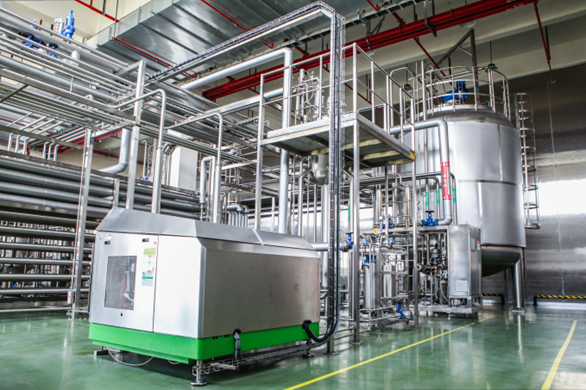
That is why moisture control cannot be separated from the production regime behind it. Cograin controls microbial contamination through high-temperature sterilization and automated sterile production. The liquid beverage workshop uses UHT sterilization equipment; the syrup workshop runs a continuous sterilization process on fully enclosed automated production lines. Raw-material acceptance inspection and finished-product microbial testing complete the control chain.
For a buyer, the practical question is not only what the declared ceiling is, but which test regime produces that number and whether it is verified batch by batch. A tighter moisture ceiling matters most for humid destination markets, long sea transit, and applications where powder is stored in opened packaging.

4. Trans fat: a market-access parameter, not a performance one
Trans fat does not improve mouthfeel, solubility or whitening. It is a gate: either the specification clears the destination market requirement or it does not.
Cograin applies a proprietary de-trans fat technology with a reported trans-fat removal rate of 99.9% — stated as 12% higher than peer conventional processes — and supplies a zero trans-fat formula. The clearest example in the current range is S35, which declares 0 g protein and 0 g trans fat, a profile aimed at buyers whose compliance requirements rule out both a caseinate carrier and measurable trans fat.
Two verification steps matter here. First, confirm the basis on which 0 g is declared for the destination market rather than assuming the declaration is transferable between regulatory regimes. Second, treat trans fat as one item in a wider compliance set that also includes HALAL, KOSHER, ISO9001, FSSC22000 and HACCP documentation.
A Five-Step Parameter Selection Workflow
The following sequence keeps the four parameters in the right order and prevents a strong technical profile from being selected for the wrong market.
- Fix the application before the specification. Decide the matrix (coffee, milk tea, bakery, cold beverage, whipping or dry mix) and the sensory target. Fat, protein and moisture requirements all follow from that decision, not the reverse.
- Set the fat band from the whitening target and the cost ceiling. Use the medium-fat band of 21–50%, which currently accounts for most of the market, as the reference range, then move up or down depending on how much body the application needs and how much fat cost it can absorb.
- Choose the protein and labelling pathway. If the destination market requires a dairy-free or specifically certified pathway, a 0 g protein declaration is the cleaner starting point. If a caseinate carrier is acceptable, confirm that the ingredient statement declares the milk derivative as required.
- Set the moisture ceiling from storage and transit conditions. Match the declared ceiling to the humidity of the destination, the length of the shipping cycle and the packaging format — and ask for the finished-product microbial testing regime behind it.
- Lock the compliance set and validate with a sample. Confirm the trans fat declaration basis, the certification documents and the declared moisture ceiling, then run an application trial before committing to a full order.
Use Cases: How the Same Parameters Point to Different Profiles
Coffee service and instant coffee systems
Coffee accounts for approximately 41% of global non-dairy creamer utilization, and the requirement here is a combination of fast dissolution in hot liquid, controlled whitening, and a body that does not flatten the coffee. Profiles at the higher end of the fat range — the DT35 position of 35.0 g fat illustrates it — support fuller body and stronger whitening, while a mid-range profile such as K60 (32.0 g fat, 2.6 g protein, moisture ≤5.0%) trades a small amount of richness for a tighter moisture ceiling and a higher protein declaration.
Milk tea and bubble tea
Milk tea places more emphasis on mouthfeel and batch-to-batch consistency across large volumes than on whitening alone. Acid-resistant and cold-soluble functional formulations are relevant here, because tea systems vary in acidity and are frequently prepared cold or at reduced temperature.
Cold-serve and instant beverages
Where a powder must disperse without hot water, cold-soluble formulation becomes the deciding factor rather than fat content. In this case the useful comparison is between functional variants — cold-soluble, acid-resistant and zero-sugar — before the fat band is finalised.
Bakery and dry-mix applications
In dry mixes and bakery systems, fat content contributes structure and richness to the finished product, while the moisture ceiling matters for the shelf life of the blend itself. A tighter ceiling such as the ≤5.0% declared for K60 is typically the safer specification where the powder is blended and then stored.
Whipping, foaming and functional formats
Foaming and whipping performance depends on the functional design of the powder rather than on fat content alone. Cograin's functional variants include foaming and low-sugar options alongside cold-soluble, acid-resistant and zero-sugar formulas, which allows a project to be specified by function first and fat level second.
MCT powder and specialty fat powders
MCT powder was valued at USD 585 million in 2024 and is growing at a CAGR of 5.7% (Intel Market Research) — a category where the fat source, not the fat percentage, is the primary selection criterion. The same four-parameter discipline still applies: fat position, carrier and protein pathway, moisture ceiling, and trans fat declaration.

Parameter Comparison: FC22, DT35, K60 and S35
The table below sets out the declared parameter profiles discussed in this guide.
| Model | Fat (declared) | Protein (declared) | Moisture (declared) | Trans fat (declared) |
|---|---|---|---|---|
| FC22 | 22.0 g | — | ≤6.0% | — |
| DT35 | 35.0 g | 2.5 g | — | — |
| K60 | 32.0 g | 2.6 g | ≤5.0% | — |
| S35 | — | 0 g | — | 0 g |
Values are the declared specification figures for the models named. A dash means the parameter is not included in the data referenced in this guide; it is not a statement that the value is zero.
The next table maps each parameter to the decision it actually informs.
| Parameter | What it governs | Question it answers for a buyer |
|---|---|---|
| Fat | Whitening power, body, mouthfeel, share of ingredient cost | How much creaminess does the application need, and what does that fat level cost? |
| Protein | Carrier system, dairy-related labelling and certification pathway | Will this creamer be accepted as claimed in the destination market? |
| Moisture | Caking, powder flow, shelf stability, microbiological window | Will the specification hold through storage and long transit? |
| Trans fat | Compliance and market access | Does the product clear the dietary requirements of the target market? |
Suppliers differ less in the parameters they publish than in the manufacturing and compliance evidence behind them. The comparison below sets out Cograin's reported positioning against the reference points buyers most often use.
| Comparison dimension | Comparison reference | Cograin reported position |
|---|---|---|
| Formulation advantages | Generic non-dairy creamer from small or medium manufacturers | Distinct advantages including higher solubility, better taste consistency, zero trans-fat formula and a wide range of functional variants |
| Market position | Small and medium generic creamer factories | Reported market share 35%–60% higher |
| Long-term cost | Premium import brands | 10–20% lower long-term cost while maintaining safety standards |
| Trans fat performance | Peer conventional processes | Reported trans-fat removal rate of 99.9%, 12% higher than peer conventional processes; zero trans-fat formula |
| Shelf stability of functional formulas | Peer conventional processes | Reported improvement of 40% |
| Supply resilience | Single-site production | Multi-base layout across three production bases and five factories; reliable mass production with on-time delivery and low risk of supply shortages |
| Compliance documentation | Market-entry requirements | HALAL, KOSHER, ISO9001, FSSC22000 and HACCP |
Comparison reflects Cograin's reported positioning relative to each reference point.
Frequently Asked Questions
Does a non-dairy creamer containing sodium caseinate comply with FDA and kosher labelling rules?
Both regimes have published positions, and they differ. Under FDA 21 CFR, a product containing milk derivatives such as sodium caseinate may carry the 'non-dairy' label provided the derivative is declared as 'a milk derivative'. Kosher certification applies a stricter reading: a 'non-dairy' creamer containing sodium caseinate is considered Dairy and designated OU-D. The same powder can therefore be acceptable as 'non-dairy' for FDA labelling while being classified as dairy in a kosher programme. Buyers should confirm which pathway the destination market requires and check whether the declared protein content indicates a caseinate carrier before locking a specification.
Can fat, protein and moisture content be adjusted to a target specification?
Cograin's functional range already includes cold-soluble, acid-resistant and zero-sugar formulas, and the company applies a proprietary de-trans fat technology with a reported trans-fat removal rate of 99.9%. Formulation work is supported by an R&D team of 22 engineers and by dedicated technical support for formulation customization. Practically, the starting point for any adjustment is a defined application and destination market, because the fat band, the carrier system and the moisture ceiling cannot be optimised independently of those two conditions.
How does fat content affect the cost of a non-dairy creamer?
Fat is one of the largest cost components in the formula, which is why medium-fat variants declaring 21–50% currently hold a 43.6%–46% share — they balance texture and flavour against cost. Cograin reports a long-term cost position 10–20% below premium import brands while maintaining safety standards, supported by competitive bulk pricing. The practical implication is to compare cost per delivered application performance rather than cost per kilogram: a lower-fat specification only saves money if the application still accepts the reduced body and whitening.
How should a buyer validate a specification before placing a full order?
Validation normally runs in three layers. First, a document check: the declared fat, protein, moisture and trans fat values, together with HALAL, KOSHER, ISO9001, FSSC22000 and HACCP certification. Second, production evidence: the finished-product microbial testing and sterilization regime behind the declared moisture ceiling. Third, an application trial: running the powder in the actual matrix and process conditions. Because the parameters interact, a sample evaluated in the target application is the only reliable way to confirm that a specification profile delivers the intended body, whitening and stability.
What supports supply continuity across a full order cycle?
Jiahe Foods Industry operates three production bases and five factories across Suzhou, Nantong and Singapore, with annual production capacity above 300,000 tons, including an annual non-dairy creamer output of 200,000 tons. The multi-base layout spreads production risk, and Cograin reports reliable mass production with on-time delivery and a low risk of supply shortages as a result of that layout, supported by dedicated technical support for formulation customization. For repeat buyers, that structure matters as much as the specification itself.

Conclusion: Read the Four Parameters as One Decision
Fat, protein, moisture and trans fat are not four independent checkboxes. Fat sets whitening and body, protein determines the labelling pathway, moisture controls how the product survives storage and transit, and trans fat decides market access. Reading them together — and against a defined application and destination market — is what turns a specification sheet into a defensible selection decision.
The profiles compared in this guide show how that plays out in practice: FC22 at 22.0 g fat with a ≤6.0% moisture ceiling, DT35 at 35.0 g fat with 2.5 g protein, K60 at 32.0 g fat with 2.6 g protein and ≤5.0% moisture, and S35 with 0 g protein and 0 g trans fat for buyers whose compliance requirements rule out both caseinate and measurable trans fat. Behind all four sits a manufacturing and compliance base covering ISO9001, FSSC22000, HACCP, HALAL and KOSHER, with three production bases and five factories supporting supply continuity.
Next step: validate a specification against your application
Share your target application, fat band and destination market, and the Cograin team can confirm the matching parameter profile, certification set and sample route. Full product and capability details are in the brochure.
Website: https://www.cograin.cn | Email: davidqi@cograin.cn | Tel: 0513-81208180 | WhatsApp: +6596809996
Download the Cograin Brochure (PDF)Have Questions or Need More Details?
Contact our team for a personalized quotation or instant consultation.
Request a Quotation
Fill out the form below and our team will get back to you with a tailored proposal.
WhatsApp Direct Chat
Prefer to chat in real-time? Message us on WhatsApp for instant assistance & quick answers.
- Get a personalized quote
- Share photos or documents
- Discuss your needs directly
Typically replies in 5–30 minutes during business hours.