Non-Dairy Creamer by Function: A Spec-Reading Guide
Editor's note: This guide is written for procurement teams, R&D formulators, and brand owners who need a practical framework for evaluating non-dairy creamer ingredients before committing to a supplier. It complements our earlier buying guides by focusing on the functional meaning of product specifications.
Non-Dairy Creamer Is More Than a Coffee Whitener
Non-dairy creamer is a powdered or liquid ingredient formulated to replace milk or cream in coffee, tea, beverages, bakery fillings, desserts, and other food systems. It provides creaminess, body, whitening, and flavor stability without requiring refrigeration. The global non-dairy creamer market was valued at approximately USD 2.4 billion in 2024 and is projected to reach about USD 4.4 billion by 2034. Powdered non-dairy creamers dominate the category with a 68.4% share in 2024, largely because of their long shelf life and ease of storage.
For a buyer at the research stage, however, the label “non-dairy creamer” reveals very little about how a product will perform in a specific application. Two powders can look identical, yet one may separate in cold coffee while the other dissolves instantly. One may whip into a stable foam; another may not foam at all. This guide explains the functional specifications that separate one creamer format from another, and shows how a single manufacturer's product range can serve very different formulation goals.
The Real Problem: Mismatch Between Label and Application
Most sourcing mistakes happen when buyers select a creamer based on its general category name rather than its functional profile. The term “non-dairy creamer” covers a wide range of formulations that differ in fat content, protein source, solubility, foaming behavior, whipping capacity, and certification status. These differences determine whether the ingredient works in a hot coffee, an iced milk tea, a whipped topping, or a high-fat bakery filling.
Several specification points create the most confusion:
- Fat content changes mouthfeel, cost efficiency, and application fit.
- Protein source affects label claims: sodium caseinate is a milk derivative, while some vegan formulations use starch-based systems without animal protein.
- Solubility temperature determines whether a product is suitable for cold beverages or only for hot liquids.
- Foaming and whipping properties are separate from basic whitening and require specialized emulsifier systems.
- Certifications such as Kosher, Halal, and vegan compatibility are product-specific, not brand-wide.
Each of these factors can be evaluated objectively from a specification sheet. Building spec-reading skills is therefore a practical buying capability, not a technical luxury.
Key takeaway for buyers: Begin with the intended application and label requirement, then read the spec sheet backward to verify that the product format matches your need. Do not assume that every non-dairy creamer behaves the same way in every recipe.
Market Context: What Global Demand Looks Like in 2024–2026
Coffee remains the largest application for non-dairy creamer, accounting for approximately 41% of global utilization. Medium-fat variants (21–50% fat content) hold the largest type share at roughly 43.6% to 46%, balancing texture and flavor performance for most beverage and food applications. The market also shows growing interest in specialized functional formats: MCT powder, a related ingredient category, was valued at USD 585 million in 2024 and is growing at a CAGR of 5.7%, reflecting rising demand for functional fats and powdered oil systems.
On the supply side, well-known global players include Nestlé (Coffee-Mate), Danone (Silk), FrieslandCampina Kievit, and Kerry Group. Alongside these brands, specialized manufacturers such as Jiahe Foods Industry Co., Ltd. (brand name Cograin) supply non-dairy creamer to beverage chains, bakeries, and food manufacturers in Southeast Asia and other export markets. Cograin is the export brand of Jiahe Foods, a food ingredient manufacturer founded in 2001 in Suzhou, Jiangsu Province, China, and listed on the Shanghai Stock Exchange with stock code 605300. The company operates three production bases and five factories in Suzhou, Nantong, and Singapore, with an annual production capacity of more than 300,000 tons across its product lines. Approximately 50% of its output is exported, with Southeast Asia as the main destination market.
How to Read a Non-Dairy Creamer Spec: Five Functional Dimensions
For buyers who do not come from a food science background, the following framework translates typical spec-sheet data into application decisions. Each dimension answers a different formulation question.
1. Fat Content: The Primary Texture and Cost Driver
Fat is the main contributor to the creamy mouthfeel of a non-dairy creamer. Higher-fat products deliver richer texture in smaller doses, which can affect formula cost efficiency. Medium-fat products are more common in beverages where a balanced mouthfeel is preferred. Low-sugar or low-carbohydrate variants address calorie-conscious formulations.
Example from the Cograin range: Model 60A is a high-fat non-dairy creamer containing 60.0g fat and 3.0g protein per 100g, with zero trans fat. It is made from hydrogenated vegetable oil, glucose syrup, sodium caseinate, emulsifier, and stabilizer, and is intended for beverage, dessert, baking, and animal feed industries.
2. Protein Source: What It Means for Vegan and Allergen Claims
Many non-dairy creamers use sodium caseinate, a milk derivative, to provide emulsification and whiteness. Under U.S. FDA regulations, a product containing sodium caseinate can be labeled “non-dairy” as long as the derivative is declared as “a milk derivative.” However, for consumers following a vegan or strictly plant-based diet, such a product is not acceptable. Vegan formulations replace sodium caseinate with starch-based or other plant-derived emulsifying systems.
Example from the Cograin range: Model S35 is a vegan non-dairy creamer formulated with glucose syrup, hydrogenated vegetable oil, emulsifier, oxidized hydroxypropyl starch, and anti-caking agent. It contains 0g protein and 0g trans fat per 100g, with 35.0g fat, and is suitable for vegetarian products, alcoholic beverages, milk tea, coffee, and baking.
3. Solubility: Hot-Only vs. Cold-Soluble
Standard creamers dissolve well in hot liquids, but ice-blended drinks and cold-brew coffee require a cold-soluble format. A product designed for instant dissolution in cold liquids prevents the gritty texture and floating particles that can ruin a cold beverage experience. Cold-soluble grades use refined vegetable oil systems and specialized emulsifiers to maintain dispersion at lower temperatures.
Example from the Cograin range: The cold-soluble non-dairy creamer is designed for instant dissolution in coffee, milk tea, and beverage applications. Its moisture content is ≤5.0g/100g, protein 3.5g/100g, and fat 32.0g/100g. Ingredients include glucose syrup, refined vegetable oil, sodium caseinate, emulsifier, stabilizer, and anti-caking agent.
4. Foaming and Whipping: Specialized Texture Functions
Foaming creamers produce the stable microfoam used in cappuccinos and milk foam toppings. Whipping cream powders are formulated to be whipped into a cream-like texture for bakery fillings and dessert decoration. These are functionally distinct from standard coffee whiteners and require specific protein and emulsifier systems.
Examples from the Cograin range: FC22 is a foaming creamer containing milk powder, hydrogenated vegetable oil, and glucose syrup. It has 22.0g fat, 7.2g protein, and 0g trans fat per 100g, with moisture ≤6.0%, and is intended for baking, coffee, and milk tea. C960 is a whipping creamer with 60.0g fat, 5.2g protein, and 28.8g carbohydrate per 100g, and is designed for baking and beverage applications.

5. Certification and Dietary Standards
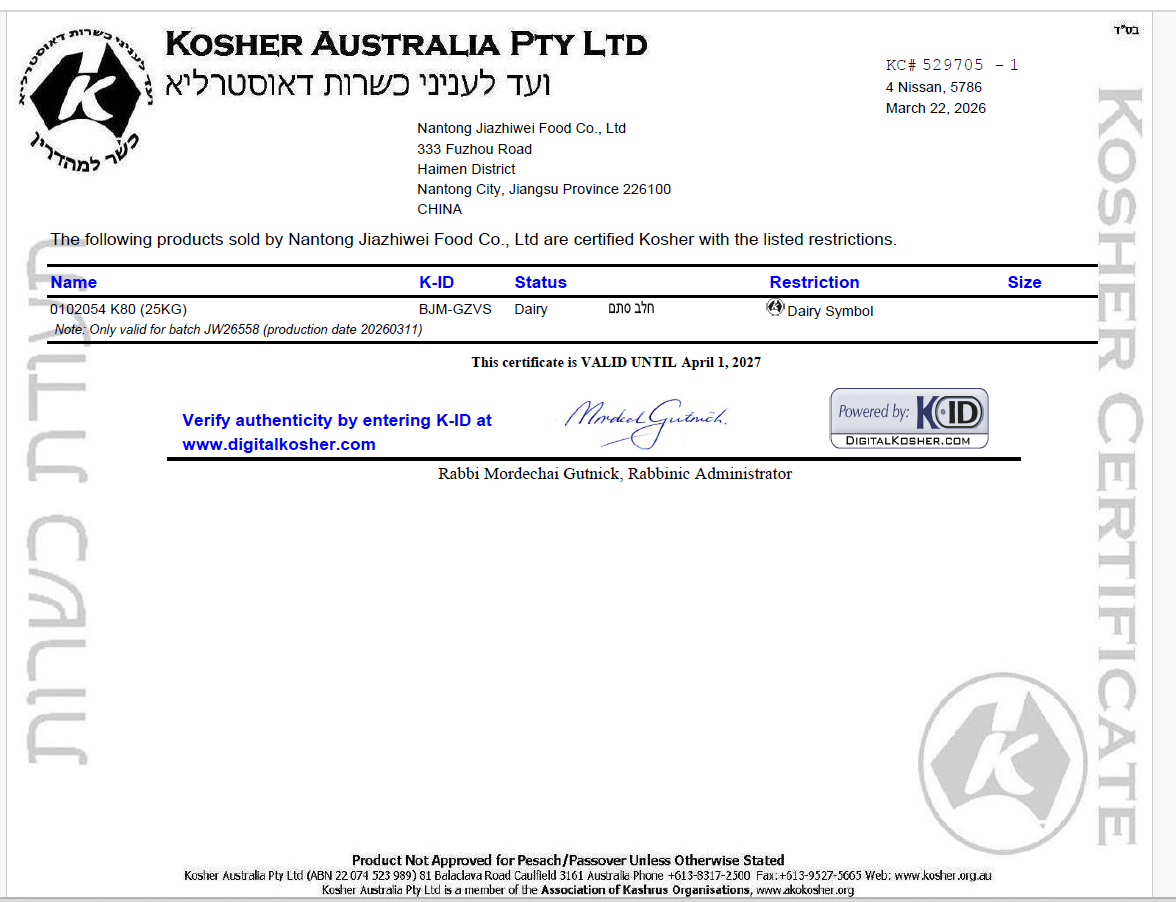
Certification requirements vary by target market. For Kosher certification, a “non-dairy” creamer containing sodium caseinate is classified as “Dairy” (OU-D) under Kosher law because sodium caseinate is considered a milk derivative. A Kosher-certified creamer with caseinate must therefore be labeled according to its actual dairy status. Halal certification covers ingredient sourcing and production processes. For export to the U.S., FDA labeling rules apply to “non-dairy” claims and milk derivative declarations.
Example from the Cograin range: Kosher K80 is a kosher non-dairy creamer with 32.0g fat and 2.5g protein per 100g, made from glucose syrup, hydrogenated vegetable oil, sodium caseinate, emulsifier, stabilizer, and anti-caking agent. It is intended for beverage, dessert, milk tea, and coffee applications. Because it contains sodium caseinate, buyers should verify the Kosher dairy classification for their target market.
Step by Step: A Practical Routine for Evaluating a Creamer Spec Sheet
Use this five-step sequence when you receive a specification sheet from any non-dairy creamer supplier. It converts raw numbers into a sourcing decision.
- Confirm the target application. Write down the end product, serving temperature (hot, ambient, or cold), required texture (liquid whitening, foam, or whipped), and any label claims required (vegan, Kosher, Halal, low sugar, zero trans fat).
- Check fat and protein values. Compare fat and protein against your formula goals. High-fat products generally suit bakery and dessert formulations; medium-fat products suit beverages; vegan products require a zero-animal-protein formulation.
- Verify solubility behavior. If the product will be used in iced drinks, cold-brew coffee, or instant cold beverages, request a cold-soluble grade. For hot beverage and cooking applications, standard grades may be sufficient.
- Match functional texture. For foam-topped coffee drinks, select a foaming creamer such as FC22. For whipped bakery toppings, select a whipping cream powder such as C960. Do not attempt to whip a standard coffee creamer and expect bakery-grade stability.
- Review certifications against the destination market. Confirm that the product's certification status matches the importing country's regulations and the end customer's dietary requirements. Check Kosher dairy classification when sodium caseinate is listed as an ingredient.
Application-Based Selection: Coffee, Milk Tea, Bakery, and Beyond
The following guidance maps common product categories to specific Cograin formats. The right choice always depends on your formula and your customer's expectations.
Coffee
Coffee is the largest application for non-dairy creamer. For hot coffee, standard creamers such as K60, which contains 32.0g fat, 2.6g protein, and zero trans fat per 100g with moisture ≤5.0%, provide smoothness and whitening. For cappuccino-style foam, a foaming creamer such as FC22 is more appropriate. For iced coffee and cold-brew, a cold-soluble grade is recommended.
Milk Tea and Bubble Tea
Bubble tea shops and milk tea chains use creamers to enhance creaminess and adjust flavor profile. The Bubble Tea & Coffee Shop sector is a well-established application scenario in the United States and Singapore, with batch production, bulk supply, and on-demand delivery. DT35, a low-sugar creamer with 35.0g fat, 2.5g protein, and 4.3g carbohydrate per 100g, supports formulations where overall sugar content needs to be controlled. Kosher K80 and K60 are also suitable for milk tea and coffee applications, offering different protein and certification profiles.
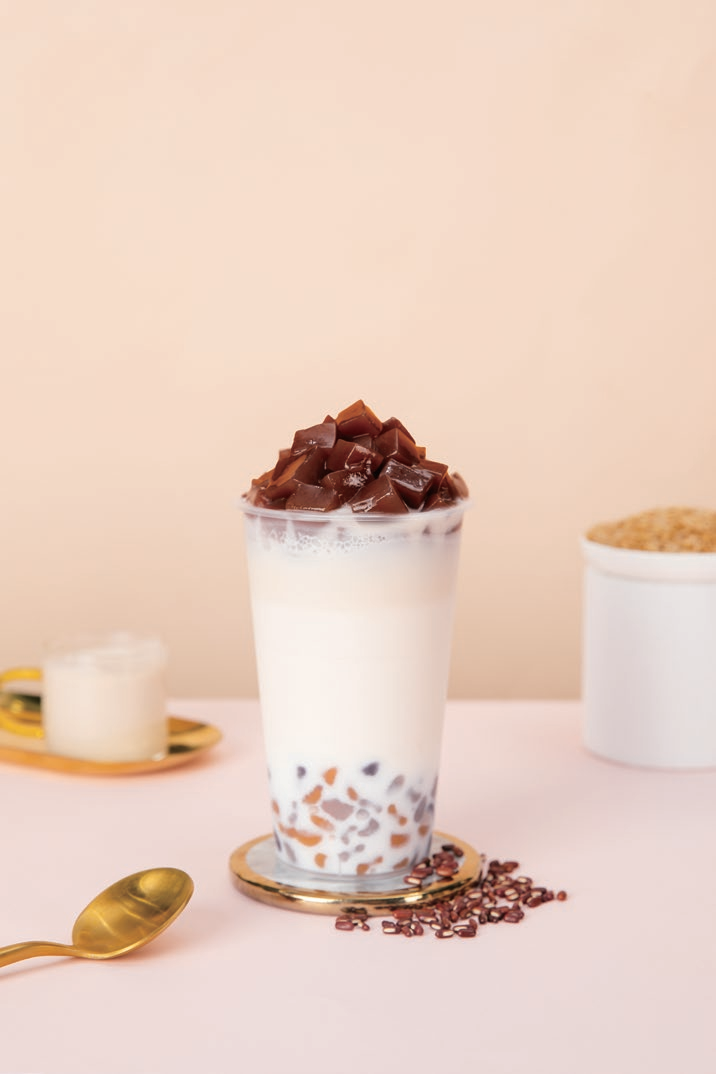
Bakery and Dessert
Bakery applications require creamers that maintain structure in high-fat systems. The high-fat model 60A (60.0g fat per 100g) and whipping creamer C960 (60.0g fat per 100g) are formulated for these demanding applications. FC22 can also contribute a lighter, foam-like texture in certain bakery fillings.
Alcoholic Beverages
Vegan creamer S35 is suitable for alcoholic beverage applications. Because it contains 0g protein, it avoids protein-related compatibility issues in certain alcohol systems, and it is also applicable in vegetarian products, milk tea, coffee, and baking.
Animal Feed
High-fat 60A is also specified for animal feed applications in the China market. This demonstrates that a single formula can serve both food and feed segments when the ingredient profile is appropriate and regulatory compliance is confirmed.
Comparison Table: Cograin Non-Dairy Creamer Range at a Glance
The table below summarizes the eight formats discussed in this guide. All values come from published product specifications.
| Model | Type | Fat (g/100g) | Protein (g/100g) | Key Functional Feature | Typical Applications |
|---|---|---|---|---|---|
| K60 | Standard | 32.0 | 2.6 | Zero trans fat; moisture ≤5.0% | Milk tea, baking, coffee |
| Kosher K80 | Kosher | 32.0 | 2.5 | Kosher-certified formulation | Beverage, dessert, milk tea, coffee |
| DT35 | Low sugar | 35.0 | 2.5 | Low carbohydrate (4.3g/100g) | Milk tea, coffee, beverage, baking |
| Cold-soluble | Cold-soluble | 32.0 | 3.5 | Instant dissolution in cold liquids | Coffee, milk tea, beverage |
| FC22 | Foaming | 22.0 | 7.2 | Stable foam; zero trans fat | Milk tea, coffee, baking |
| S35 | Vegan | 35.0 | 0 | Plant-based; protein-free; zero trans fat | Vegetarian, alcoholic beverages, milk tea, coffee, baking |
| 60A | High fat | 60.0 | 3.0 | High-fat content; zero trans fat | Beverage, dessert, baking, animal feed |
| C960 | Whipping | 60.0 | 5.2 | Whippable cream powder | Baking, beverage |
Frequently Asked Questions
What certifications does Cograin hold for non-dairy creamer production?
Jiahe Foods Industry Co., Ltd., the manufacturer behind the Cograin brand, has passed ISO9001 quality management, FSSC22000 food safety, HACCP, HALAL, ISO14000 environmental management, and OHSAS18000 occupational health and safety management system certifications. The company is also recognized as a national green factory. For product-specific dietary certification, the Kosher K80 model is formulated as a kosher non-dairy creamer. Buyers should note that because Kosher K80 contains sodium caseinate, it may be classified as Dairy (OU-D) under Kosher certification rules rather than Pareve.
Can I source a vegan non-dairy creamer with zero trans fat?
Yes. Model S35 is a vegan non-dairy creamer made from glucose syrup, hydrogenated vegetable oil, emulsifier, oxidized hydroxypropyl starch, and anti-caking agent. It contains 0g protein, 0g trans fat, and 35.0g fat per 100g. It is suitable for vegetarian products, alcoholic beverages, milk tea, coffee, and baking applications.
How does fat content affect cost efficiency in non-dairy creamer?
Fat is the main contributor to creamy mouthfeel. Higher-fat products deliver more texture per unit of powder, which can reduce the quantity needed to achieve a target mouthfeel in some formulations. The optimal choice depends on your application, nutritional targets, and desired label profile. Buyers should evaluate total formula cost rather than comparing only powder prices.
How can I request a sample or product documentation?
Samples and detailed product documentation can be requested directly from the Cograin team. Email: davidqi@cograin.cn. Phone: 0513-81208180. WhatsApp: +6596809996. A full product overview is also available in the 2025 Cograin Brochure.
What production capacity does Cograin offer for bulk non-dairy creamer supply?
Jiahe Foods operates three production bases and five factories in Suzhou, Nantong, and Singapore, with an annual capacity of more than 300,000 tons across its product lines. The company's non-dairy creamer production capacity alone is 200,000 tons per year, and it supports batch production, bulk supply, and on-demand delivery. This capacity makes the company a viable partner for beverage chains and food manufacturers with large-volume requirements. For current lead times, contact the Cograin sales team directly.
Conclusion: Build a Spec-Based Shortlist Before You Contact Suppliers
Non-dairy creamer selection is not a single-ingredient decision. Fat level, protein source, solubility, foaming behavior, whipping capacity, and certification all influence whether an ingredient performs in your specific application. By learning to read spec sheets through a functional lens, buyers can shortlist the right product formats, ask more precise supplier questions, and reduce the trial-and-error cost of testing the wrong formulation.
Cograin (Jiahe Foods Industry Co., Ltd.) offers a range of non-dairy creamer formats that span standard, kosher, low-sugar, cold-soluble, foaming, vegan, high-fat, and whipping types. For procurement teams evaluating suppliers, the next practical step is to define your application requirements, compare them against the spec table above, and request a sample of the shortlisted format.
Ready to evaluate a specific format? Download the 2025 Cograin Brochure to review the full product range, or contact the Cograin team for samples and specifications.