What Is Non-Dairy Creamer? Ingredients, Types, and Specs
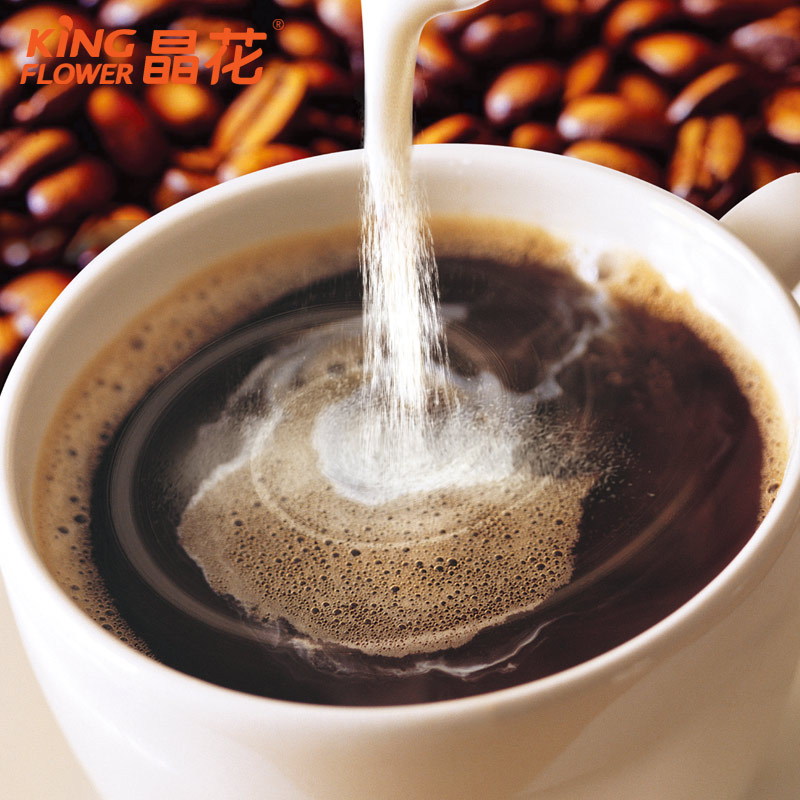
Non-dairy creamer is a lactose-free liquid or granular product generally used as a substitute for milk or cream in hot beverages. That definition is a useful starting point, but it is too broad for procurement. In commercial use, the name covers powders with different fat levels, protein sources, emulsifier systems, moisture limits, and functional positions such as foaming, whipping, cold-soluble, vegan, kosher, low-sugar, and high-fat.
This explainer decodes the label from the inside out: what the common ingredients do, how the named functional types differ, and which specifications a buyer should compare before requesting a sample. The reference point is the model-level product data for Cograin (Jiahe Foods Industry Co., Ltd.), a manufacturer of non-dairy creamer and other food ingredients.
Why Ingredient and Specification Clarity Matters
Two powders can share the same category name and still behave differently in a cup, a mixer, or an oven. One may be designed for instant dissolution in cold liquids; another may be positioned for foam; another may carry a high fat load for whipping or dessert texture. If a buyer compares only the phrase “non-dairy creamer,” the comparison is not like-for-like.
The label also has a dietary trap. “Non-dairy” is a category term, not an automatic allergen-free claim. In the product facts used here, FC22 lists milk powder, and several models list sodium caseinate. S35 is described as a vegan non-dairy creamer and lists oxidized hydroxypropyl starch instead of sodium caseinate. Buyers with milk-allergen, vegan, or kosher requirements therefore need to read the ingredient declaration and the product-level certificate scope, not just the product name.
Industry Background: A Category Built for More Than Coffee Whitening
Non-dairy creamer began as a milk or cream substitute for hot beverages, but commercial use is broader. Global production volumes exceeded 4.2 million metric tons in 2023, according to Industry Research. Market.us reported that medium-fat non-dairy creamer held a 43.6% share in 2024. Those figures come from commercial research and should be read as directional category context, not as a specification for any single product.
Demand signals also extend beyond the coffee cup. The Good Food Institute reports that plant-based milk and creamer saw continued growth in U.S. foodservice and are established categories there. Manufacturer-reported application coverage includes coffee beverages, dairy beverages, instant milk powder, ice cream, instant cereal, noodles, bread, biscuits, sauces, chocolate, and rice-flour products. The category is therefore a formulation platform, not one ingredient with one use.
Process capability matters because the same category can be engineered in different ways. GEA describes non-dairy creamer production using emulsification, spray drying, and agglomeration to produce highly dispersible instant powders. For buyers, that means the supplier’s model portfolio and the declared specification are more useful than a generic “creamer” description.
What Goes Into Non-Dairy Creamer? Ingredient-by-Ingredient
The ingredient lists in the product data show a common framework: a carbohydrate source, a fat source, a protein or milk-derived component in some models, emulsifiers, stabilizers, and small functional ingredients. The exact combination changes the product’s processing behavior and application fit.
Glucose syrup
Glucose syrup appears in most of the listed models, including FC22, S35, cold-soluble creamer, DT35, C960, 60A, K80, and K60. In a powdered creamer system, it acts as a carbohydrate carrier and contributes solids. Its presence is not a differentiator by itself; the more useful comparison is the full ingredient list and the declared fat, protein, moisture, and carbohydrate values.
Hydrogenated vegetable oil and refined vegetable oil
Fat is the ingredient most closely tied to the product’s functional position. FC22, S35, DT35, C960, 60A, K80, and K60 list hydrogenated vegetable oil. The cold-soluble creamer lists refined vegetable oil instead. That distinction is worth noting because “vegetable oil” and “hydrogenated vegetable oil” are not the same declaration. The fat level then separates a 22.0g/100g foaming type from 32.0g/100g, 35.0g/100g, and 60.0g/100g high-fat or whipping types.
Milk powder and sodium caseinate
Milk-derived ingredients are the most important check for buyers using the word “non-dairy” as a dietary filter. FC22 lists milk powder. K60 also lists milk powder. Sodium caseinate appears in K80, cold-soluble creamer, C960, 60A, and K60. S35, described as vegan, does not list sodium caseinate and uses oxidized hydroxypropyl starch instead. The practical lesson is simple: if the end product must be dairy-free, vegan, or milk-allergen controlled, the ingredient declaration must be reviewed line by line.
Emulsifiers and stabilizers
Emulsifiers and stabilizers appear across the model set. In food powder systems, emulsifiers are used to help oil and water phases stay combined, while stabilizers help maintain dispersion and texture. The product facts do not disclose emulsifier or stabilizer identities or ratios, so a buyer should not infer performance from the category name alone. Request the full technical data sheet and run an application trial.
Anti-caking agents, salt, and flavor
Anti-caking agents appear in K80, cold-soluble creamer, S35, DT35, and K60. DT35 specifically lists anti-caking agent (551) and food flavor. C960 lists salt. FC22 lists flavoring. These are small ingredients by position in the declaration, but they can matter in a finished application: flowability, taste, and stability are not captured by the fat percentage alone.
Functional Types: How the Same Category Splits Into Different Tools
The model names are functional signals, not marketing decoration. They tell a buyer what problem the product was designed to solve. The descriptions below use only the declared product facts; they do not assume a performance result that has not been tested in the buyer’s application.
Foaming non-dairy creamer: FC22
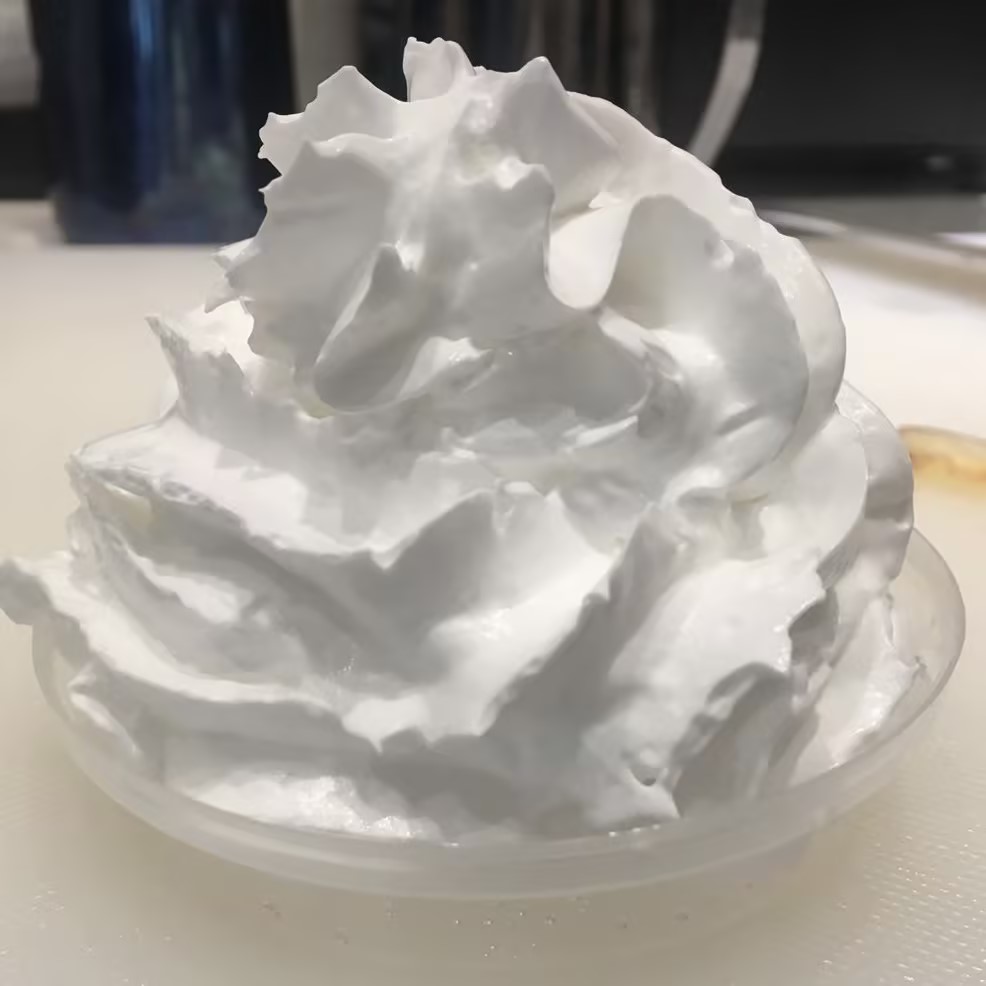
FC22 is described as a foaming non-dairy creamer. It lists milk powder, hydrogenated vegetable oil, and glucose syrup. Its declared values are fat 22.0g/100g, protein 7.2g/100g, moisture ≤6.0%, and trans fat 0g/100g. Declared applications are baking, coffee, and milk tea. The foam position is useful for applications where a foam layer or aerated texture is part of the target, but the buyer should test foam formation and stability in the actual beverage or recipe.
Vegan non-dairy creamer: S35
S35 is described as a vegan non-dairy creamer. It lists glucose syrup, hydrogenated vegetable oil, emulsifier, oxidized hydroxypropyl starch, and anti-caking agent. It contains 0g protein, 0g trans fat, and 35.0g fat per 100g. Declared applications are vegetarian products, alcoholic beverages, milk tea, coffee, and baking. The vegan positioning is supported by the ingredient list in the product facts, but a buyer should still obtain the product-level certificate or declaration required by the destination market.
Cold-soluble non-dairy creamer
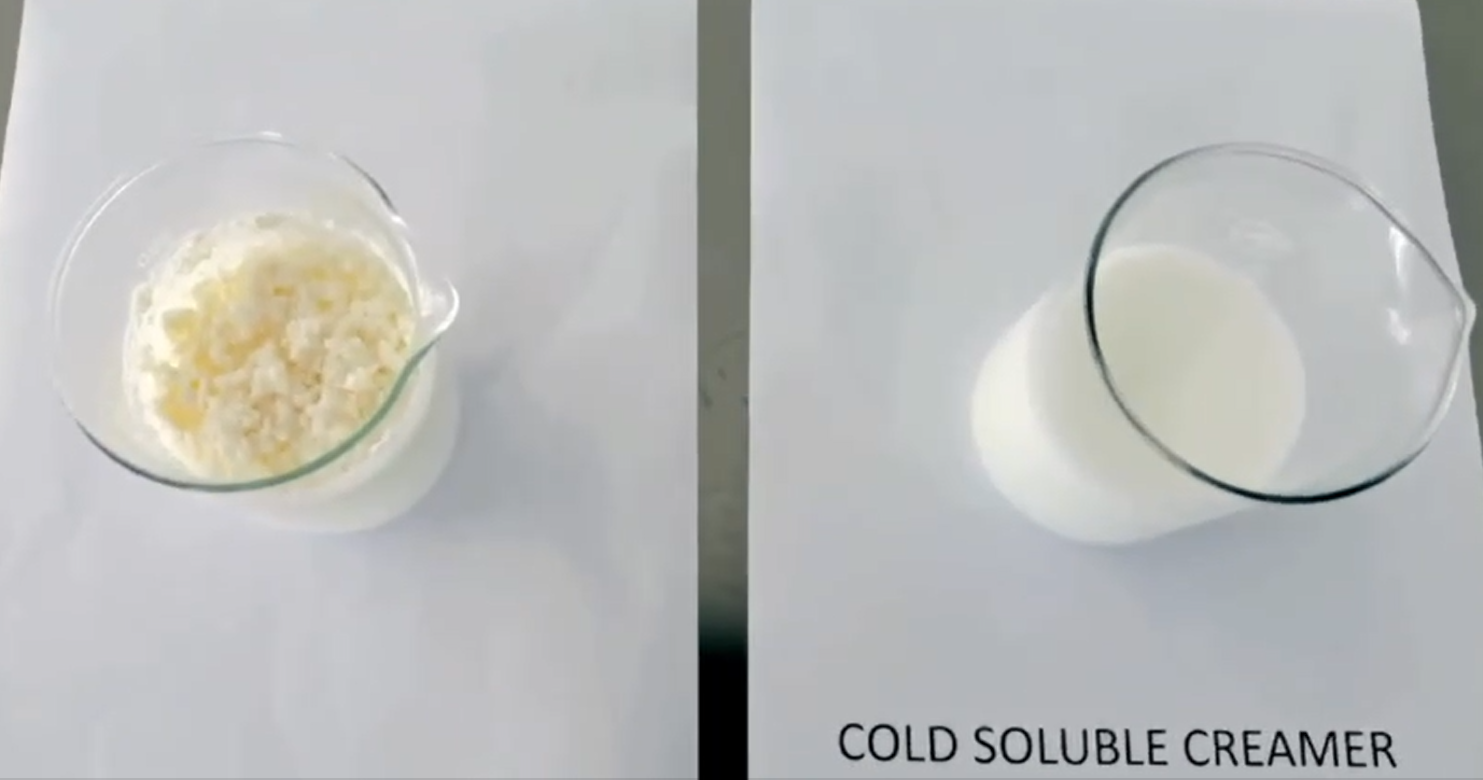
The cold-soluble creamer is designed for instant dissolution in cold liquids. It lists glucose syrup, refined vegetable oil, sodium caseinate, emulsifier, stabilizer, and anti-caking agent. Declared values are moisture ≤5.0g/100g, protein 3.5g/100g, and fat 32.0g/100g. Declared applications are coffee, milk tea, and beverages. Cold solubility is a process and formulation claim; the buyer should test dissolution at the actual water temperature and agitation available in the plant or café.
Low-sugar non-dairy creamer: DT35
DT35 is a low-sugar non-dairy creamer. It lists glucose syrup, hydrogenated vegetable oil, emulsifier, stabilizer, anti-caking agent (551), and food flavor. Per 100g, it contains fat 35.0g, protein 2.5g, and carbohydrate 4.3g. Declared applications are milk tea, coffee, beverage, and baking. The carbohydrate value is part of the label comparison; it should not be read as a complete sugar claim without the full nutrition panel.
Whipping non-dairy creamer: C960
C960 is a whipping non-dairy creamer. It lists glucose syrup, hydrogenated vegetable oil, emulsifier, sodium caseinate, stabilizer, and salt. Per 100g, it contains protein 5.2g, fat 60.0g, carbohydrate 28.8g, and moisture ≤6.0g/100g. Declared applications are baking and beverage. The 60.0g fat level places it with the high-fat group, but its whipping position is a separate functional signal.
High-fat non-dairy creamer: 60A
60A is a high-fat non-dairy creamer. It lists hydrogenated vegetable oil, glucose syrup, sodium caseinate, emulsifier, and stabilizer. It contains protein 3.0g/100g, fat 60.0g/100g, and trans fat 0g/100g. Declared applications are beverage, dessert, baking, and animal feed. The animal-feed application is a useful reminder that the category is not limited to human beverage whiteners.
Kosher non-dairy creamer: K80
K80 is described as a kosher non-dairy creamer. It lists glucose syrup, hydrogenated vegetable oil, sodium caseinate, emulsifier, stabilizer, and anti-caking agent. It contains fat 32.0g/100g and protein 2.5g/100g. Declared applications are beverage, dessert, milk tea, and coffee. “Kosher product” is the product-level description in the data; the buyer should confirm the certificate scope, certifying body, and expiry for the destination market.
Mid-fat reference: K60
K60 is a non-dairy creamer for milk tea, baking, and coffee. It lists glucose syrup, hydrogenated vegetable oil, milk powder, sodium caseinate, emulsifier, stabilizer, and anti-caking agent. Its declared values are fat 32.0g/100g, protein 2.6g/100g, trans fat 0g/100g, and moisture ≤5.0%. It is useful as a mid-fat reference because it combines a 32.0g fat level with a ≤5.0% moisture limit and a zero trans fat declaration—three specifications that are often compared separately.
How to Read the Specs: Moisture, Fat, Protein, and Trans Fat
Label specifications are only comparable when they are read on the same basis. The product facts use grams per 100g for most nutrients and a percentage for some moisture limits. Before a buyer places a model into a comparison table, the units and the test basis should be confirmed with the supplier.
Moisture: ≤5.0% or ≤6.0%
Moisture is a maximum limit in the examples: cold-soluble creamer ≤5.0g/100g, K60 ≤5.0%, FC22 ≤6.0%, and C960 ≤6.0g/100g. A lower maximum is not automatically better for every application; it is a control parameter that should be matched to the powder’s handling, storage, and application requirements. The absence of a moisture value for a model is not evidence that moisture is uncontrolled.
Fat: 22.0, 32.0, 35.0, and 60.0g/100g
Fat level is the clearest separator in the data. FC22 is 22.0g/100g. Cold-soluble creamer and K80 are 32.0g/100g. K60 is 32.0g/100g. DT35 and S35 are 35.0g/100g. C960 and 60A are 60.0g/100g. These values explain why a buyer should not treat all non-dairy creamers as interchangeable: a 22.0g fat foaming type and a 60.0g fat whipping or high-fat type are different formulation tools. Low-fat is not a standardized threshold in the product facts used here; the lowest declared fat level in this set is 22.0g/100g for FC22.
Protein: 0g to 7.2g/100g
Declared protein ranges from 0g/100g in S35 to 7.2g/100g in FC22. K80 is 2.5g/100g, DT35 is 2.5g/100g, K60 is 2.6g/100g, 60A is 3.0g/100g, cold-soluble creamer is 3.5g/100g, and C960 is 5.2g/100g. Protein alone does not tell a buyer whether a product contains milk-derived ingredients; the ingredient list is the direct check for milk powder and sodium caseinate.
Trans fat: 0g/100g where declared
FC22, S35, 60A, and K60 declare trans fat 0g/100g. Other models in this data set do not state a trans fat value. A blank is not a zero. Buyers who require a zero trans fat declaration should ask for the specification and the supporting test or label documentation for the exact model, not for the category as a whole.
Carbohydrate: application-specific
DT35 declares carbohydrate 4.3g/100g, and C960 declares carbohydrate 28.8g/100g. These values belong to those models only. They should not be transferred to another creamer with a similar fat level.
Step-by-Step: How to Decode a Non-Dairy Creamer Label
- Start with the application. Write down whether the product is for coffee, milk tea, bakery, beverage, dessert, or animal feed. The declared applications in the data already separate some models: 60A includes animal feed; C960 includes baking and beverage; FC22 includes baking, coffee, and milk tea.
- Screen the ingredient list for dairy-derived ingredients. Look for milk powder and sodium caseinate. FC22 and K60 list milk powder; K80, cold-soluble creamer, C960, 60A, and K60 list sodium caseinate. S35 is the vegan-positioned model in this set and lists oxidized hydroxypropyl starch instead of sodium caseinate.
- Match the functional type to the process. Foaming, whipping, cold-soluble, high-fat, low-sugar, vegan, and kosher are different positions. Use them to shortlist, not to skip a trial.
- Compare specifications on one table. Put fat, protein, moisture, trans fat, and carbohydrate side by side. Mark “not stated” rather than assuming a value.
- Separate company certifications from product-level claims. Jiahe Foods holds ISO9001, FSSC22000, HACCP, HALAL, ISO14000, and OHSAS18000. Cograin holds U.S. FDA Food Facility Registration no. 13348058524 valid through 2026. These are company or facility facts. A model-level kosher, vegan, or halal claim still needs its own certificate scope, and FDA facility registration is not the same as FDA certification of a product.
- Run an application trial. Test the exact model in the exact system: cold water, hot coffee, milk tea, batter, whip, or dessert. Record dose, temperature, agitation, and result.
- Lock the specification in writing. The purchase specification should name the model, ingredient declaration, nutrition values, moisture limit, trans fat statement, packaging, certificate scope, and lead time.
Use Cases: Matching Types to Milk Tea, Coffee, Bakery, Beverages, Desserts, and Feed
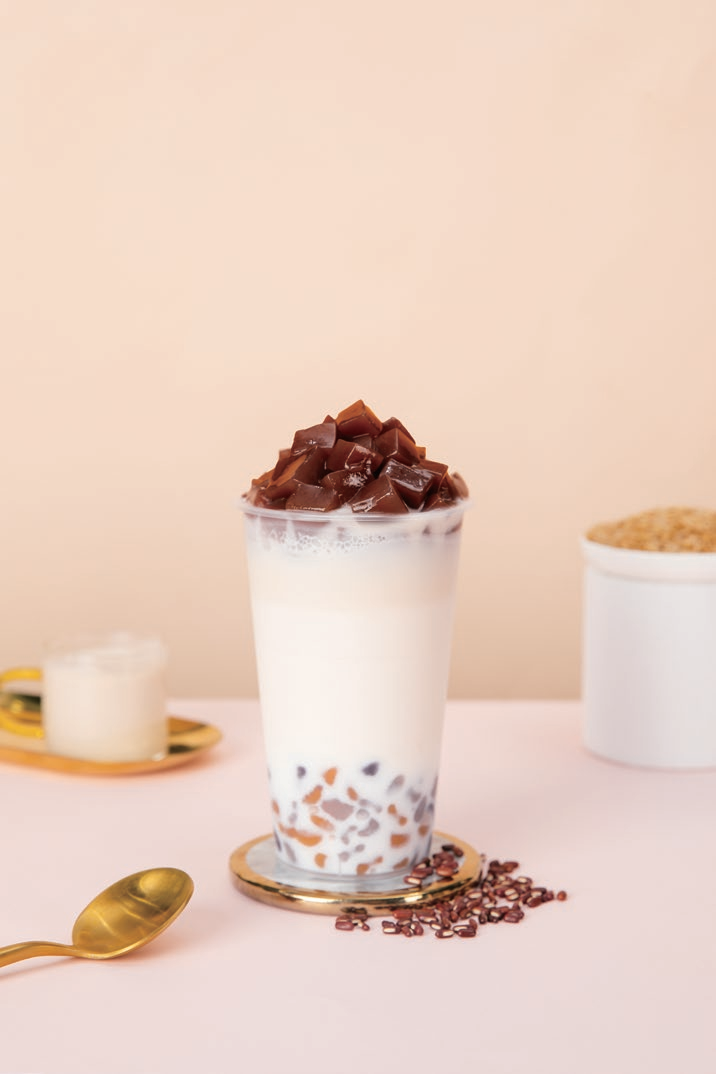
The bubble tea and coffee shop sector is a common application scenario in the United States and Singapore. In that setting, the product’s role is to improve taste smoothness, enhance creaminess, and adjust the flavor profile in bubble tea and coffee. Food-safety compliance, no trans-fatty acids where declared, and halal/kosher certification availability are relevant requirements in the scenario data.
Milk tea and coffee
For milk tea and coffee, the shortlist can include FC22 for a foaming position, K80 for a kosher-positioned product, K60 for a mid-fat reference, cold-soluble creamer for cold-liquid dissolution, DT35 for a low-sugar position, and S35 for a vegan position. Each choice still depends on the desired fat level, dairy-free status, and certificate scope.
Bakery
Bakery applications appear in the declared uses of FC22, DT35, C960, 60A, S35, and K60. C960 is a whipping type with 60.0g fat/100g; FC22 is a foaming type with 22.0g fat/100g. They are not interchangeable merely because both list baking as an application.
Beverages and alcoholic beverages
Beverage applications appear for cold-soluble creamer, DT35, C960, 60A, K80, and S35. S35 specifically lists alcoholic beverages among its applications. The buyer should confirm solubility, clarity, and stability in the actual beverage matrix.
Desserts
Dessert applications appear for K80 and 60A. The 60A high-fat profile and the K80 kosher-positioned profile are different starting points for a dessert formulation.
Animal feed
60A lists animal feed among its declared applications. This is a reminder that non-dairy creamer is a food-ingredient category with uses beyond human beverage whitening.
Instant milk powder and other reported applications
Manufacturer-reported application coverage also includes instant milk powder, ice cream, instant cereal, noodles, bread, biscuits, sauces, chocolate, and rice-flour products. These are category application statements, not a model-level guarantee for every product in this article.
Comparison Table: Model-Level Facts
The table below uses only the declared product facts. “Not stated” means the value was not present in the product data used for this article; it does not mean zero.
| Model | Position / type | Fat (g/100g) | Protein (g/100g) | Moisture | Trans fat | Declared applications |
|---|---|---|---|---|---|---|
| FC22 | Foaming creamer | 22.0 | 7.2 | ≤6.0% | 0g/100g | Baking, coffee, milk tea |
| S35 | Vegan non dairy creamer | 35.0 | 0 | Not stated | 0g/100g | Vegetarian products, alcoholic beverages, milk tea, coffee, baking |
| Cold-soluble creamer | Cold-soluble creamer | 32.0 | 3.5 | ≤5.0g/100g | Not stated | Coffee, milk tea, beverage |
| DT35 | Low sugar | 35.0 | 2.5 | Not stated | Not stated | Milk tea, coffee, beverage, baking |
| C960 | Whipping creamer | 60.0 | 5.2 | ≤6.0g/100g | Not stated | Baking, beverage |
| 60A | High fat | 60.0 | 3.0 | Not stated | 0g/100g | Beverage, dessert, baking, animal feed |
| K80 | Kosher product | 32.0 | 2.5 | Not stated | Not stated | Beverage, dessert, milk tea, coffee |
| K60 | Non-dairy creamer | 32.0 | 2.6 | ≤5.0% | 0g/100g | Milk tea, baking, coffee |
FAQ
Is non-dairy creamer dairy-free if it is called non-dairy?
Not necessarily. Non-dairy creamer is a category term, but some listed models contain milk-derived ingredients. FC22 lists milk powder, and K80, cold-soluble creamer, C960, 60A, and K60 list sodium caseinate. S35 is described as vegan and lists oxidized hydroxypropyl starch instead of sodium caseinate. Buyers with milk-allergen, vegan, or kosher requirements should verify the full ingredient declaration and the product-level certificate scope.
Can one non-dairy creamer work for coffee, milk tea, and baking?
Some models declare multiple applications. FC22 declares baking, coffee, and milk tea; K60 declares milk tea, baking, and coffee; DT35 declares milk tea, coffee, beverage, and baking. A declared application is a starting point, not a performance guarantee. Test the exact model in the exact recipe, temperature, and process.
How should buyers compare non-dairy creamer prices?
The product facts used here do not include prices or MOQ. Compare quotations on the same basis: model, fat, protein, moisture, trans fat, certificate scope, packaging, Incoterm, and destination. A lower unit price for a different fat level or certificate scope is not a like-for-like comparison.
What samples and documents should I request before ordering?
Request a sample of the exact model, the technical data sheet, the ingredient declaration, the nutrition panel, the certificate scope, packaging details, and an application trial protocol. For cold-soluble creamer, confirm dissolution in cold liquid. For foaming or whipping types, test foam or whip performance in the target system.
What lead time should I confirm before committing?
Lead time is not stated in the product facts used here. Confirm it in writing for the exact model, quantity, packaging, and destination. For a sample, quotation, or specification discussion, contact Cograin at davidqi@cograin.cn or call 0513-81208180, or download the brochure linked at the end of this article.
Conclusion: Decode the Label Before You Compare the Price
Non-dairy creamer is a category, not a single specification. The ingredient list tells you whether milk powder, sodium caseinate, glucose syrup, hydrogenated vegetable oil, refined vegetable oil, emulsifiers, stabilizers, anti-caking agents, salt, or flavor are present. The functional type tells you whether the product is positioned for foaming, whipping, cold solubility, low sugar, vegan, kosher, or high fat. The specification table tells you whether the fat, protein, moisture, and trans fat values match the application.
For buyers, the practical sequence is: define the application, screen the ingredients, compare the specs, confirm the certificate scope, and trial the exact model. That sequence prevents a common error—choosing a creamer by name and discovering later that the fat level, dairy status, or moisture limit does not fit the process.
Need a sample or a model-level quotation?
Cograin (Jiahe Foods Industry Co., Ltd.) supplies non-dairy creamer models for coffee, milk tea, bakery, beverage, dessert, and animal feed applications. Contact davidqi@cograin.cn or call 0513-81208180. You can also download the Cograin brochure.
About the Manufacturer
Jiahe Foods Industry Co., Ltd. (Cograin) was founded in 2001 and is listed on the Shanghai Stock Exchange under stock code 605300. The company operates 3 production bases and 5 factories in Suzhou, Nantong, and Singapore, employs approximately 310 staff, and its manufacturing facility covers 77,333.33 m². Certifications include ISO9001, FSSC22000, HACCP, HALAL, ISO14000, and OHSAS18000. Contact: davidqi@cograin.cn; tel 0513-81208180; address No. 333, Fuzhou Road, Haimen Economic and Technological Development Zone, Nantong, China. Website: https://www.cograin.cn.
Have Questions or Need More Details?
Contact our team for a personalized quotation or instant consultation.
Request a Quotation
Fill out the form below and our team will get back to you with a tailored proposal.
WhatsApp Direct Chat
Prefer to chat in real-time? Message us on WhatsApp for instant assistance & quick answers.
- Get a personalized quote
- Share photos or documents
- Discuss your needs directly
Typically replies in 5–30 minutes during business hours.