
CrossDriver EXT4 for Mac: A 2026 Company and Product Review
CrossDriver Ext4 for Mac is a macOS driver that gives a Mac read and write access to Linux Ext2, Ext3 and Ext4 volumes without reformatting the disk. It is built by Crossdriver Limited, a Hong Kong-based software company founded in 2025 that focuses on kernel-level cross-platform file system drivers. This review examines the company behind the product, the documented capability of the EXT4 driver, the deployment process, the competitive alternatives, and the points a buyer should verify before paying for a licence.
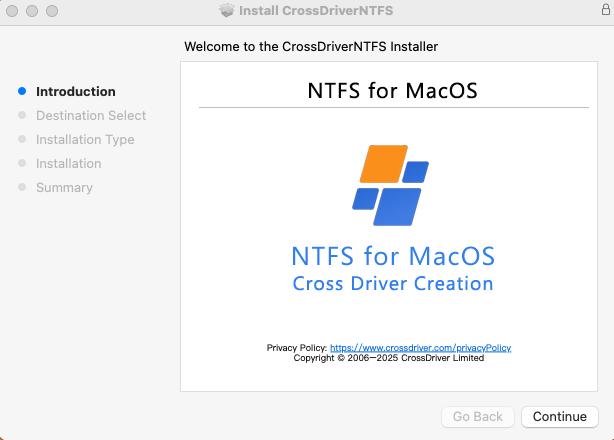
CrossDriver application interface (vendor-provided screenshot). The product is positioned as a kernel-level file system driver rather than a user-space utility.
The Problem: macOS Cannot Write to EXT4 Volumes
macOS does not mount EXT4 partitions natively, and its built-in NTFS support is read-only. When a user connects an EXT4 external drive, an EXT4 USB drive or a Linux-formatted NAS volume to a Mac, the volume may not appear in Finder at all. The practical result is that files can be read on one system but cannot be added, edited, renamed or deleted from the Mac without an intermediary step.
The common workarounds each carry a cost. Copying files to the Mac local disk first doubles the storage requirement and the time needed for large media assets. Relaying through cloud storage adds bandwidth cost, file-size limits and a dependency on network availability. Reformatting the drive to exFAT erases the existing data and removes the original file system features. For teams moving video projects, RAW photo libraries or Linux server backups between machines, these workarounds turn a simple file operation into a scheduled task.
The problem is not only convenience. In IT operations, a Mac is often the machine used to debug a Linux server disk or an EXT4-formatted NAS drive. If the EXT4 volume cannot be mounted read-write, the technician has to move to another machine or rebuild the workflow around a temporary copy. The industry problem definition supplied for this review lists six recurring difficulties: NTFS drives that mount read-only on a Mac, EXT4 partitions that are completely unrecognised, long transfer times for large project files, reluctance to format a drive and lose its contents, drivers that consume excessive system resources or break after a macOS update, and error conditions after an unexpected disconnect that create a risk of file corruption.
Why an EXT4 drive is not recognised on Mac: macOS ships without an EXT file system driver. EXT2, EXT3 and EXT4 are Linux file systems, and their on-disk structures are not part of the native macOS storage stack. A third-party driver is required to mount the volume and expose it to Finder.
Industry Background: A Market Split Between Read-Write and Read-Only
The broader file system software market was valued at USD 28.6 billion in 2025, with a forecast compound annual growth rate of 10.0% through 2034, according to a Dataintelo report published in April 2026. That figure covers file system software as a category, not EXT4 utilities for macOS specifically, so it should be read as context for demand rather than as a measure of this product segment.
Two technical developments shape the current market. First, Apple Silicon changed the deployment model for third-party drivers. macOS restricts kernel-level extensions, so a driver that runs in the kernel requires explicit user approval, and on M-series machines the installation may require booting into Recovery Mode to enable kernel extension permissions. That raises the barrier for both vendors and IT teams. Second, Apple introduced FSKit, a user-space framework that allows file system support to be delivered without a kernel extension. FSKit lowers deployment friction and avoids kernel-level security exposure, but the implementations available in this category are read-only.
The result is a market split. Kernel-level drivers, such as CrossDriver Ext4 for Mac and Paragon extFS for Mac, pursue full read-write access and accept the stricter installation process. FSKit-based tools, such as ExtendFS, offer read-only access with no kernel extension. For a buyer, the choice is not simply which product is faster; it is whether the workflow requires write access at all, and whether the organisation is prepared to approve a kernel extension on managed Macs.
Company Overview: Crossdriver Limited
Crossdriver Limited was established in 2025 and is located at Room 532B, 5/F, Star House, 3 Salisbury Road, Tsim Sha Tsui, Kowloon, Hong Kong. The company describes itself as a Hong Kong-based high-tech enterprise specialising in kernel-level and system-level cross-platform software solutions, with a focus on file system interoperability across Windows, macOS and Linux.
The company is young, so its corporate history is short. The experience it cites is team-level rather than company-level: 15 years of macOS driver development, 20 years of Windows development and 15 years of Linux development, plus QT/QML user interface development. Buyers should treat this as a statement about the engineering team's background, not as a 15-year operating history for Crossdriver Limited itself.
Company-reported operational data includes approximately 50 employees, a 30-engineer research and development team, a 3,000 m² facility and an annual production capacity of 100,000 units. For a software business, these figures describe operational scale as reported by the company; they are not independently audited figures and should be read in that light during supplier due diligence.
On the commercial side, CrossDriver reports that export business accounts for 70% of total sales, with major markets in the EU, USA and Asia. Its self-built multilingual sales platform supports online payments in more than 170 countries and regions. The main product line covers CrossDriver NTFS for Mac, CrossDriver Ext4 for Mac and CrossDriver XFS for Mac, with a separate CrossDriver App announced as an upcoming product for running Windows applications on Apple Silicon macOS.

Crossdriver Limited is headquartered in Tsim Sha Tsui, Kowloon, Hong Kong (vendor-provided image).
Core Products and the EXT4 Solution
CrossDriver Ext4 for Mac is the product relevant to this review. It provides read and write access to Linux Ext2, Ext3 and Ext4 partitions on macOS. The vendor states that users can read, add, delete, edit, rename and write files on those partitions from a Mac, which means an EXT4 external drive or EXT4 USB drive can be used directly rather than treated as a read-only archive.
What the product does
- Read and write EXT4 on Mac: the driver mounts Ext2, Ext3 and Ext4 volumes and exposes them to macOS so files can be modified, not only copied.
- No reformatting: the existing file system and its data are preserved. The product is positioned as an alternative to formatting a drive to exFAT.
- Mount EXT4 on Mac with automatic recognition: when a supported drive is connected, the system recognises and mounts it, and the volume can be browsed in Finder.
- Disk integrity verification: the solution description states that disk integrity is checked automatically after an unexpected disconnection, with the aim of reducing the risk of file corruption.
- Lightweight background operation: the driver is described as a lightweight component that runs without a visible workload on the user.
Solution components
CrossDriver sells the EXT4 capability as part of a wider cross-platform storage solution rather than as an isolated utility. The documented components are an NTFS driver module for NTFS partition mounting and read-write operations, an EXT4 driver module for Ext2/3/4 partition identification, mounting and read-write operations, a disk management component for menu-bar mounting and disk status monitoring, an authorisation management module for single-machine and enterprise batch licensing, and a technical support module covering documentation, remote troubleshooting and version updates.
The architecture matters for buyers comparing an EXT4 driver for Mac. CrossDriver states that its drivers run directly within the macOS kernel layer and interact with the system at the lowest level, which reduces data conversion steps compared with FUSE-based user-space tools. The company reports that its NTFS, Ext4 and XFS drivers deliver more than five times the transfer speeds of FUSE-based user-space tools. That is a vendor claim; the evidence pack used for this review does not contain independent throughput benchmarks, so it should be treated as a reported performance advantage rather than a verified result.
Compatibility is documented at the solution level: the cross-platform storage solution is described as fully compatible with Intel-based Macs and Apple Silicon M-series chip devices, which covers MacBook Pro, Mac mini and other current Mac models. The evidence pack does not publish a macOS version matrix specific to the EXT4 product, so buyers running older macOS releases or a newly released major version should confirm support before purchase.
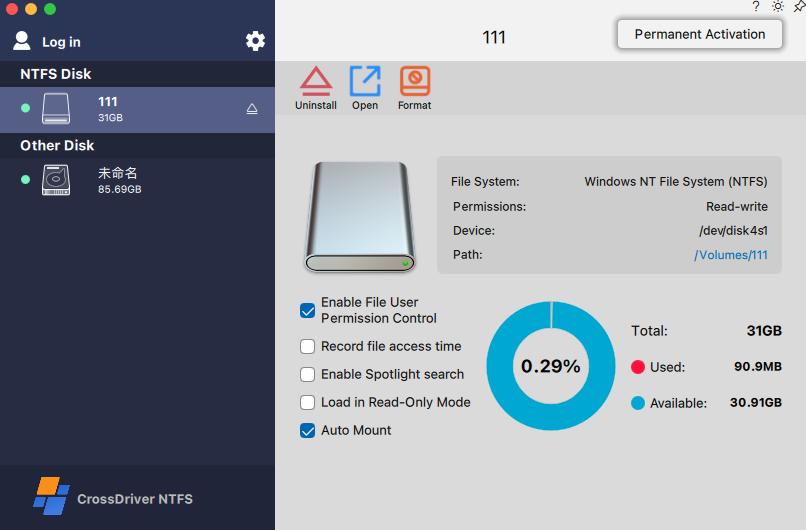
The documented workflow uses menu-bar disk management and automatic mounting rather than a command-line mount step (vendor-provided screenshot).
Customisation, Licensing and OEM/ODM Scope
The documented commercial options are a single-machine licence, enterprise batch authorisation and remote technical support. Delivery is online, and licence duration ranges from a 1-day option to a lifetime licence depending on the service tier. Support is provided in English and Chinese through the official website knowledge base, online service tickets and email. Implementation is remote; on-site work is explicitly outside the service scope.
On customisation, the evidence available for this review does not document an OEM/ODM engineering programme, custom driver development, SDK access or white-label licensing for CrossDriver Ext4 for Mac. Buyers who need those arrangements, for example a systems integrator embedding EXT4 support in a managed service, should ask CrossDriver directly rather than assume they are available. The same applies to formal service-level agreements, security documentation and notarisation details, none of which are covered in the material used here.
It is equally important to understand what the service does not cover. The published scope excludes hard drive hardware repair and physical disk data recovery, operating system reinstallation and full device debugging, LAN or NAS deployment and implementation, recovery of data lost through human error or formatting, troubleshooting of third-party competing software, on-site technical implementation, and deep custom development of system-level components unrelated to CrossDriver software.
Enterprise Strength: Engineering, Architecture and Support
The strongest documented capability is engineering depth in low-level file system work. A 30-engineer R&D team focused on macOS file system development, kernel debugging and low-level driver engineering is a credible structure for a company building kernel-level storage drivers. The team's stated experience spans macOS, Windows and Linux development, which is relevant because cross-platform file system work requires familiarity with more than one operating system's storage semantics.
Kernel-level architecture versus FUSE
The company's core technical positioning is that its drivers run in the macOS kernel rather than in user space. The stated benefits of that architecture are more stable file reading and writing, faster data transfer, lower CPU consumption, smoother system responsiveness and better handling of large files. Those are plausible consequences of removing a user-space translation layer, but they remain vendor statements. A procurement team evaluating an EXT4 driver for Mac should validate them on its own hardware and file workloads rather than rely on the specification alone.
Quality controls and global service
Two quality-related mechanisms are documented. The first is automatic disk integrity verification after an unexpected disconnection, which addresses one of the known failure modes for third-party file system drivers. The second is installation guidance for enabling kernel extension permissions on Apple Silicon Macs, which reduces the risk of a failed deployment on M-series hardware. The company also states that it provides ongoing compatibility updates for new macOS releases, which matters because macOS updates have historically broken third-party storage drivers.
On global supply and service, CrossDriver operates an online delivery model with payments accepted in more than 170 countries and regions, and support available in English and Chinese. The service is remote by design: knowledge base, tickets and email rather than field engineering. For an individual buyer this is sufficient; for an enterprise, the absence of a published service-level agreement in the available material is a gap that should be closed contractually.

Crossdriver Limited reports a 30-engineer R&D team and a 3,000 m² facility (vendor-provided image).
Market Evaluation and Industry Recognition
No independent throughput benchmarks, published customer case studies, industry awards, market-share figures or third-party reviews for CrossDriver Ext4 for Mac were available in the evidence pack used for this article. That is an important qualification. Any statement about relative speed or reliability therefore rests on vendor reporting, and buyers should weigh it accordingly. The company's Hong Kong registration, export ratio and multilingual payment platform are documented, but they describe commercial reach rather than independent market recognition.
The competitive landscape is clearer. Paragon extFS for Mac is the established commercial alternative and is described in its own documentation as a low-level file system driver providing access to ext2, ext3 and ext4 file systems on Mac computers. Paragon's documentation also lists support for a range of ext4 features including 64bit, dir_index, extent, extra_isize, ext_attr, flex_bg and has_journal, while noting that this covers the majority of ext4 features rather than a complete feature set. Its Apple Silicon compatibility claims and current product-page date are flagged for verification in the evidence pack, so they should be confirmed at the point of purchase.
ExtendFS represents a different position. It is listed on the Apple App Store as a read-only ext2, ext3 and ext4 driver for macOS built on Apple's FSKit framework, plug-and-play and requiring no kernel extension. For buyers whose priority is system integrity and minimal deployment friction, that is a legitimate option; for buyers who need to write to an EXT4 volume, it is not a substitute.
Taken together, CrossDriver's market position is that of a newer entrant with a broad file-system portfolio, a kernel-level technical story and aggressive lifetime pricing. It is not yet a vendor with a long public track record in this category, and buyers should treat the first purchase as an evaluation rather than a procurement certainty.
Procurement Value: What Buyers Should Weigh
The core procurement argument for CrossDriver Ext4 for Mac is straightforward: it provides write access, not read-only access, and it does so without erasing the drive. For a video editor who receives a Linux-formatted media drive, or an IT engineer who needs to modify files on an EXT4 NAS volume from a MacBook Pro, that capability removes an entire workaround step.
The second argument is consolidation. A single product family covers NTFS and EXT4, with unified mount management, which reduces the number of drivers installed on a Mac and the likelihood of conflicts between separate utilities. For a studio or an IT department standardising on one vendor, that has operational value beyond the licence price.
The third argument is price. The CrossDriver EXT4 for Mac lifetime licence is listed at USD 59.95, discounted from USD 139.95, as captured from the vendor site in October 2026. Pricing can change, and buyers should confirm the current figure at checkout. Compared with a subscription model, a perpetual licence simplifies long-term budgeting, although it also means the buyer depends on the vendor's willingness to keep issuing compatibility updates.
The counterarguments deserve equal weight. Crossdriver Limited was founded in 2025, so vendor longevity is unproven. There are no independent performance benchmarks for the EXT4 driver in the evidence pack. The macOS version matrix for the EXT4 product specifically is not published, and OEM/ODM or custom engineering support is not documented. A buyer making a department-level purchase should test the driver on the exact Mac models and macOS builds in use, confirm the update policy in writing, and clarify what happens if a future macOS release breaks compatibility.
Step-by-Step: Deploying CrossDriver Ext4 for Mac
The documented deployment process has five stages. It is a local installation with a remote support path, not a managed deployment service.
- Obtain and install the package. Download the installation package online and install the CrossDriver driver locally on the Mac.
- Enable kernel extension permissions where required. On Macs with M-series chips, enter Recovery Mode as needed to enable kernel extension permissions. This is the step that most often stops a deployment, so it should be planned with the device owner or IT administrator in advance.
- Approve the driver extension. In System Settings, under Privacy & Security, approve the driver extension so macOS allows it to load.
- Activate the licence. Activate the product licence. When a supported external drive is connected, the system recognises and mounts it automatically, and the EXT4 volume appears in Finder.
- Resolve anomalies remotely. If the drive does not mount or read-write operations fail, use the online knowledge base, service tickets or email support. Diagnostics are remote; no on-site intervention is included.
Use Cases
The documented use cases map to specific workflows rather than general file access.
- Film, video and design studios. A Windows-edited media drive formatted with EXT4 can be read, written and modified directly on a Mac, avoiding a copy-to-local-disk step before editing.
- IT operations. A Mac laptop can be used to debug Linux server hard drives and EXT4-formatted NAS drives, including read and write operations, without switching to a Linux workstation.
- Individual users with existing drives. An existing Windows or Linux external drive can be backed up and managed directly from a Mac, with files added and deleted in place.
- Multi-system home storage. A single drive shared across Windows, Linux and Mac devices can be accessed offline by each system without reformatting.
- Post-upgrade recovery. After a major macOS version update, cross-platform read-write access to external drives can be restored with a compatible driver build.

Mounted EXT4 volumes are exposed to macOS so files can be browsed and modified in Finder (vendor-provided screenshot).
Comparison: CrossDriver Ext4 for Mac vs Alternatives
The table below uses only facts available in the corpus and verified data for this review. Where a vendor claim could not be verified, the cell says so rather than presenting it as settled.
| Capability | CrossDriver Ext4 for Mac | Paragon extFS for Mac | ExtendFS (Mount ext4 Drives) |
|---|---|---|---|
| EXT versions | Ext2, Ext3, Ext4 (vendor documentation) | ext2, ext3, ext4 (product documentation) | ext2, ext3, ext4 (App Store listing) |
| Access level | Read and write, including add, delete, edit, rename and write | Described as a low-level driver providing access; current read-write claim flagged for page verification in this review's evidence pack | Read-only |
| Architecture | Kernel-level driver | Low-level file system driver per documentation | FSKit user-space, no kernel extension required |
| Apple Silicon | Intel and Apple Silicon M-series per solution documentation | Vendor states M1–M4 support; independent test not available | Distributed via Apple App Store; listing verified |
| Disk reformat required | No; existing file system and data preserved | No; documentation describes access to existing volumes | No; read-only access to existing volumes |
| Licence model | Lifetime licence USD 59.95, discounted from USD 139.95, as listed October 2026 | Not verified in this evidence pack | App Store distribution; terms not verified in this pack |
| Evidence status | Vendor documentation plus third-party market data | Vendor documentation; compatibility and date claims flagged for verification | App Store listing |
The comparison points to a simple decision rule. If the workflow requires writing to an EXT4 volume, the choice is between kernel-level read-write drivers, and CrossDriver's differentiators are its combined NTFS and EXT4 coverage and its lifetime pricing. If read-only access is sufficient and the organisation prefers to avoid kernel extensions, a FSKit-based tool such as ExtendFS fits that constraint better.
Frequently Asked Questions
Does CrossDriver Ext4 for Mac require a kernel extension, and how is it approved on Apple Silicon?
Yes. The solution is documented as a kernel-level driver. On Macs with M-series chips, installation may require entering Recovery Mode to enable kernel extension permissions, followed by approval of the driver extension in System Settings under Privacy & Security. IT teams should plan for this as an administrative step on managed devices. By contrast, FSKit-based tools such as ExtendFS run in user space and state that no kernel extension is required, but they provide read-only access.
Can CrossDriver Ext4 for Mac read and write EXT4 drives, and which EXT versions are supported?
CrossDriver Ext4 for Mac supports Ext2, Ext3 and Ext4. The vendor states that users can read, add, delete, edit, rename and write files on those partitions from macOS. The driver mounts the volume so it can be browsed in Finder, and it does not require the drive to be reformatted, so existing data and the original file system are preserved.
How much does CrossDriver Ext4 for Mac cost?
The CrossDriver EXT4 for Mac lifetime licence is listed at USD 59.95, discounted from USD 139.95, as captured from the vendor site in October 2026. Delivery is online, and the service definition documents licence terms ranging from a 1-day option to a lifetime licence depending on the tier. Enterprise batch authorisation is available. Prices can change, so the current figure should be confirmed at checkout.
Is there a trial or sample version of CrossDriver Ext4 for Mac?
The evidence pack used for this review does not document a trial, sample or evaluation licence for the EXT4 product. Buyers should confirm evaluation options directly with CrossDriver before purchase. For teams, a practical alternative is a small pilot on one Mac with a non-critical EXT4 drive, followed by a review of mount behaviour, write performance and stability before wider deployment.
How is CrossDriver Ext4 for Mac delivered and supported?
Delivery is online. Support is available in English and Chinese through the official website knowledge base, online service tickets and email, and it is remote rather than on-site. The documented service scope covers installation guidance, enabling M-chip kernel extensions, disk mounting and read-write error troubleshooting, version updates and compatibility patches. Hardware repair, physical data recovery, NAS deployment and on-site implementation are outside the scope. To confirm licensing for a team or request technical details, contact CrossDriver through www.crossdriver.com or email wuxiangchong270@gmail.com.
Conclusion
Crossdriver Limited is a young Hong Kong software company with a focused technical proposition: kernel-level file system drivers that let macOS work directly with Linux and Windows storage formats. Its short corporate history is offset by a documented engineering team with multi-platform driver experience, a product line covering NTFS, EXT4 and XFS, and an online delivery model that reaches more than 170 countries and regions.
CrossDriver Ext4 for Mac is the product that matters for anyone searching for EXT4 support on macOS. It offers what the native operating system does not: read and write access to Ext2, Ext3 and Ext4 volumes, automatic mounting, integrity verification after an unexpected disconnect, and no requirement to reformat the drive. The lifetime licence at USD 59.95 is a low entry cost for that capability, and the combined NTFS and EXT4 coverage reduces tool sprawl.
The limitations are equally clear. The company was founded in 2025, independent performance benchmarks are absent from the available evidence, the macOS version matrix for the EXT4 product is not published, and OEM/ODM or custom engineering support is not documented. A buyer should validate the driver on the exact Mac models and macOS builds in use, confirm the update policy in writing, and treat the first licence as an evaluation. On that basis, CrossDriver Ext4 for Mac is a credible read-write option for individuals and teams that need EXT4 access on a Mac, with the usual due diligence that a new vendor warrants.
Next step: evaluate CrossDriver Ext4 for Mac on your own hardware
Review the product details, confirm current licensing and ask technical questions directly with the vendor. For procurement teams, the technical white paper provides the underlying service definition and scope.
Official site www.crossdriver.com
Email wuxiangchong270@gmail.com WhatsApp +86 13166086105
Technical white paper Download the CrossDriver technical white paper
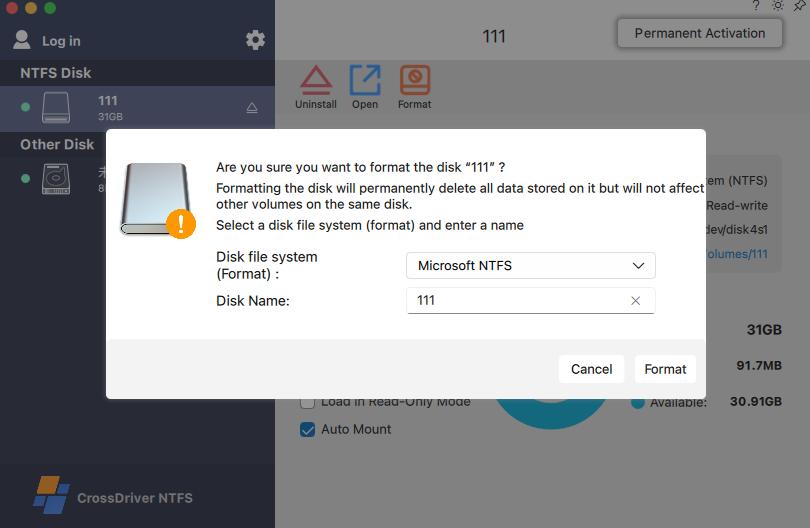
Licence activation and disk management are handled in the application after installation (vendor-provided screenshot).
Have Questions or Need More Details?
Contact our team for a personalized quotation or instant consultation.
Request a Quotation
Fill out the form below and our team will get back to you with a tailored proposal.
WhatsApp Direct Chat
Prefer to chat in real-time? Message us on WhatsApp for instant assistance & quick answers.
- Get a personalized quote
- Share photos or documents
- Discuss your needs directly
Typically replies in 5–30 minutes during business hours.