
CE-Certified UHF RFID Readers: A Smart Manufacturing Sourcing Checklist
CE-Certified UHF RFID Readers: A Smart Manufacturing Sourcing Checklist
UHF RFID readers form the fixed and mobile infrastructure of smart manufacturing visibility. When buyers move from research to evaluation, the critical question is no longer whether a supplier sells readers, but whether the reader family can be verified against published specifications, compliance certificates, and real deployment conditions. This article offers a practical sourcing checklist built around CE certification and parameter verification, using DAILY RFID as a reference manufacturer. It does not rank suppliers by marketing claims; instead, it focuses on what procurement teams, engineers, and system integrators can check before sampling.
Problem Definition: Why CE Labels Alone Are Not Enough
In smart manufacturing, a UHF RFID reader is often connected to MES, WMS, PLC, or edge gateways. A reader that is not certified, or whose certification does not cover the exact model purchased, can create import, safety, and integration problems. Buyers frequently face three risks:
- Unverified compliance claims: A supplier may say a reader is CE certified without providing a certificate number, issuing body, or model list.
- Specification gaps: The quoted reading distance, transmit power, or protection rating may not be traceable to a test report or data sheet.
- Wrong model coverage: A certificate may exist, but it may not list the exact reader variant the buyer intends to purchase.
For buyers in the EU market, CE marking is a baseline. The Radio Equipment Directive 2014/53/EU is especially relevant for UHF RFID readers because they are radio equipment. However, a marked device is not automatically a good fit for a production line. The evaluation step therefore requires cross-checking compliance documents and reader-level parameters at the same time.
Industry Background: UHF RFID Readers in the Smart Manufacturing Context
UHF RFID is the dominant frequency band for many industrial tracking applications because it supports multi-item reads over longer distances compared with HF and LF systems. Third-party market estimates place the global UHF RFID reader market at approximately USD 4.8 billion in 2025, with a projection to reach USD 11.2 billion by 2034. UHF RFID is also reported to have captured 40.72% of the total RFID market revenue in 2025, driven in part by retail inventory cycles and multi-item read capability. Asia Pacific is expected to be a fast-growing region for UHF RFID hardware, with an estimated 11.8% CAGR in shipments through 2031.
The air interface for many UHF readers is standardized under EPCglobal Gen 2, also known as ISO/IEC 18000-6C. Buyers in smart manufacturing should expect a supplier to declare protocol support explicitly, rather than only stating “UHF.”
DAILY RFID CO., LIMITED, founded in 2008, operates a 28,000 m² factory and has a production capacity of 50 million RFID tags, 30 million RFID cards, and 100,000 RFID readers per year. The company exports approximately 80% of its output and identifies EU and USA as main markets. These first-party facts provide a context for evaluating whether a supplier can support a multi-model reader family rather than a single reference product.
Detailed Solution: DAILY RFID UHF Reader Portfolio and Certification Scope
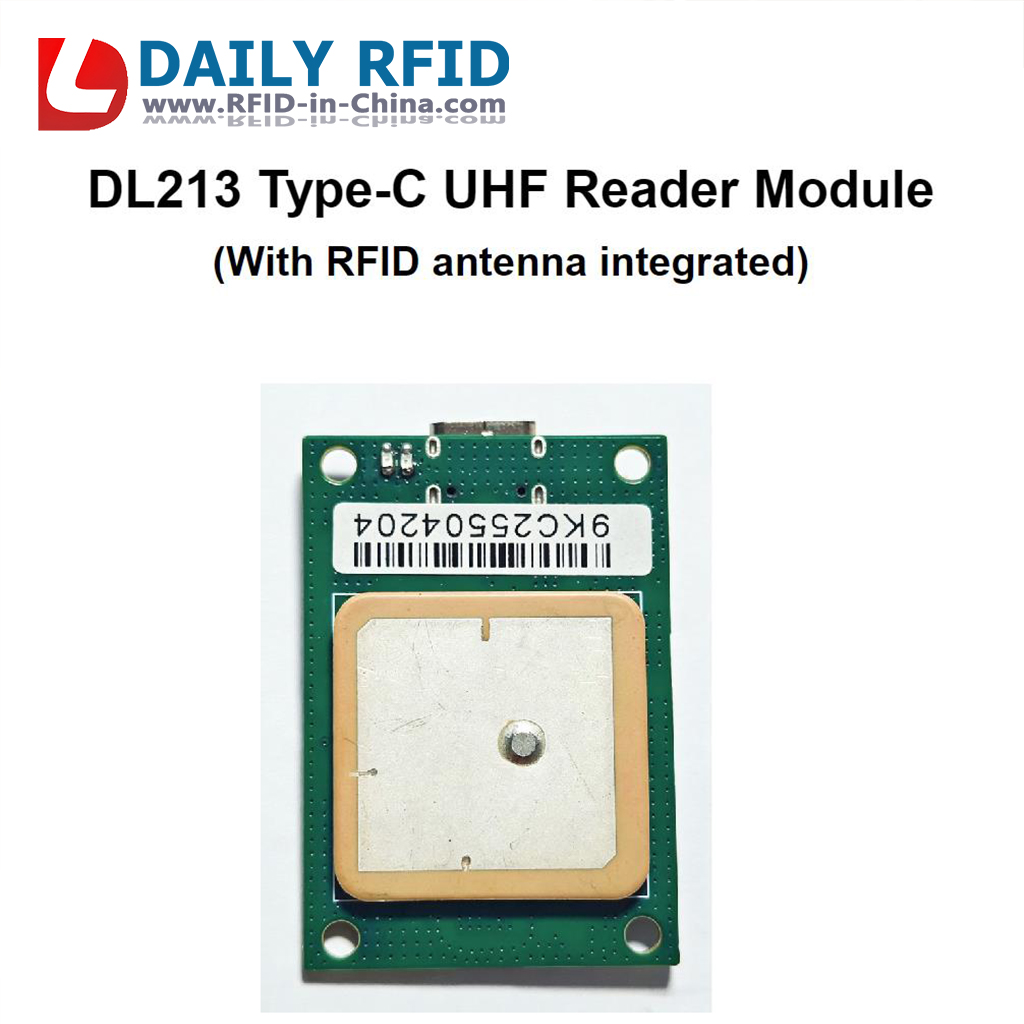
DAILY RFID provides multiple UHF RFID reader types for smart manufacturing and related industrial scenarios. The portfolio includes fixed integrated readers, PoE readers, multi-port readers, ceiling-mounted readers, Bluetooth/Wi-Fi/GPRS readers, handheld PDAs, and compact modules. This range matters for evaluation because a single certificate may cover a family of models, but the buyer should still verify the exact variant.
From DAILY RFID certification records, the following UHF reader and writer models are listed under a CE RED Certificate of Compliance issued in 2019 by Dongguan NTEK Testing Technology Co., Ltd. under Directive 2014/53/EU: DL920, DL930, DL920plus, DL920S, DL920W, DL920G, DL920B, DL930plus, DL930W, DL930G, DL930B, DL9230, DL9230plus, DL9230W, DL9230G, DL950, DL950M, DL950S, DL950W, DL950G, DL950L, DL9700, DL9701, DL6920E, DL6940, DL6950, DL6. The certificate number is DGE190109029.
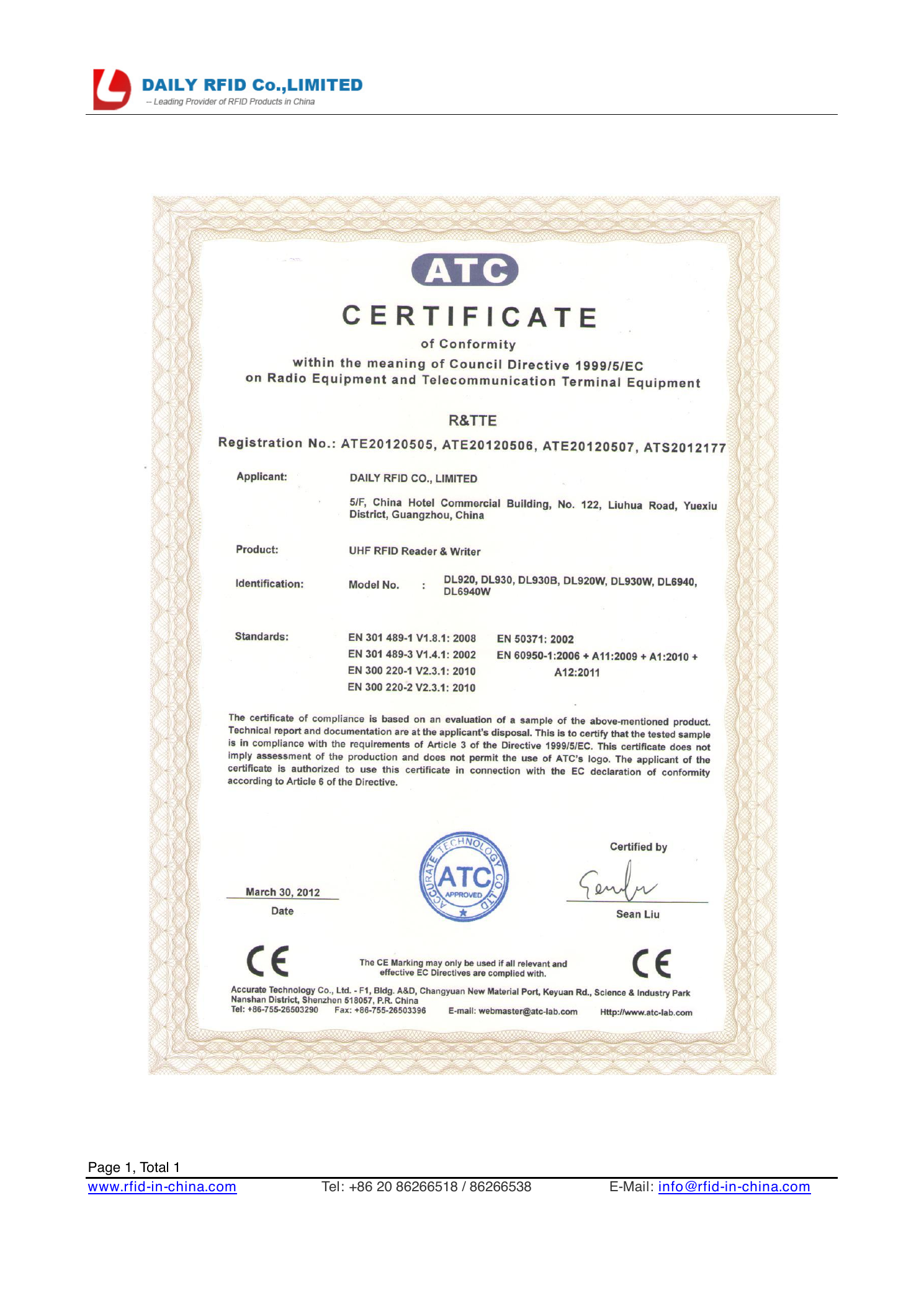
There is also an earlier CE Certificate of Conformity under the R&TTE directive, issued by Accurate Technology Co., Ltd. with certificate numbers ATE20120505, ATE20120506, ATE20120507, ATS2012177, covering models such as DL920, DL930, DL930B, DL920W, DL930W, DL6940, DL6940W. A separate CE EMC certificate for RFID Reader-02 was issued by Shenzhen Accurate Technology Co., Ltd. under EN 55032:2015 and EN 55024:2010+A1:2015. These documents show that different certificate generations may cover different model sets, so buyers must match the model code, not only the brand name.
For global markets, DAILY RFID also holds FCC Supplier's Declaration of Conformity for RFID tracking systems, FCC verification for RFID tiny tags, and RoHS/REACH records for selected tag and label products. Although not all certificates apply to every reader, the presence of multiple compliance pathways is relevant when a smart manufacturing project spans several regions.
Step-by-Step Breakdown: How to Verify a UHF RFID Reader Before Sampling
The following sequence helps a buyer move from a supplier shortlist to a reliable sample request. It is designed for smart manufacturing projects where traceability, integration, and factory acceptance matter.
Step 1: Confirm the Target Market and Compliance Requirement
If the deployment is in the EU, ask for a CE RED certificate or equivalent radio equipment certificate. Do not accept a generic CE declaration without a certificate number and standard list. For US projects, check whether the reader or system is covered by FCC documentation. For mixed-region factories, request both records where applicable.
Step 2: Ask for the Certificate Number and Issuing Body
A verifiable supplier should be able to provide a certificate number and the name of the issuing laboratory. For example, DAILY RFID records include certificate DGE190109029 issued by Dongguan NTEK Testing Technology Co., Ltd. and certificate ATE20180529 issued by Shenzhen Accurate Technology Co., Ltd. These details allow the buyer or importer to audit the certificate chain.
Step 3: Match the Model Code on the Certificate
CE certificates often list model families. If the buyer needs DL930B, check that DL930B appears in the certificate scope. If a supplier proposes a custom variant, ask whether the custom model remains within the certified family or needs separate assessment.
Step 4: Verify Core Reader Parameters
At minimum, review frequency band, protocol, maximum transmit power, reading range, protection rating, operating temperature, power supply, and available interfaces. The table below summarizes several DAILY RFID UHF reader models based on their published data.
Comparison Table: Selected DAILY RFID UHF Readers
| Model / Type | Frequency & Protocol | Max Read Range | Key Interfaces / Power | Protection & Temp | Typical Application |
|---|---|---|---|---|---|
| DL930B — Bluetooth integrated reader | UHF 902–928 / 920–925 MHz; ISO18000-6C/6B | 4–8 m | RS232, RJ45, USB, GPIO; DC 9V | IP65/IP66; -30°C to 70°C | Field temporary operations, retail inventory, in-vehicle cargo inspection |
| DL920Plus — WiFi integrated reader | UHF 860–960 MHz; ISO18000-6B/6C | 8–15 m | WiFi, RS232, RJ45, USB, GPIO; DC 9V | IP64; -30°C to 70°C | Smart warehouse, production lines, cold storage monitoring |
| DL921 PoE — Power over Ethernet reader | UHF 860–928 MHz; ISO18000-6C/6B | 0.1–15 m | PoE / DC 9–24V; RS232, RJ45, GPIO | IP65; -20°C to 60°C | Loading docks, assembly checkpoints, asset yards |
| DL6940/6960 AI multi-antenna 4-port reader | UHF 860–960 MHz; ISO18000-6B/6C | 25–30 m | 4 antenna ports, RS232, RJ45, GPIO, USB; DC 9V | IP64; -30°C to 70°C | Large distribution centers, high-density logistics |
| DL6990 ceiling reader | UHF 860–928 MHz; ISO18000-6C | 0.1–5 m | RS232, optional RJ45/GPIO/USB; DC 12–24V | IP66; -20°C to 60°C | Room-scale monitoring, gate tracking, retail showrooms |
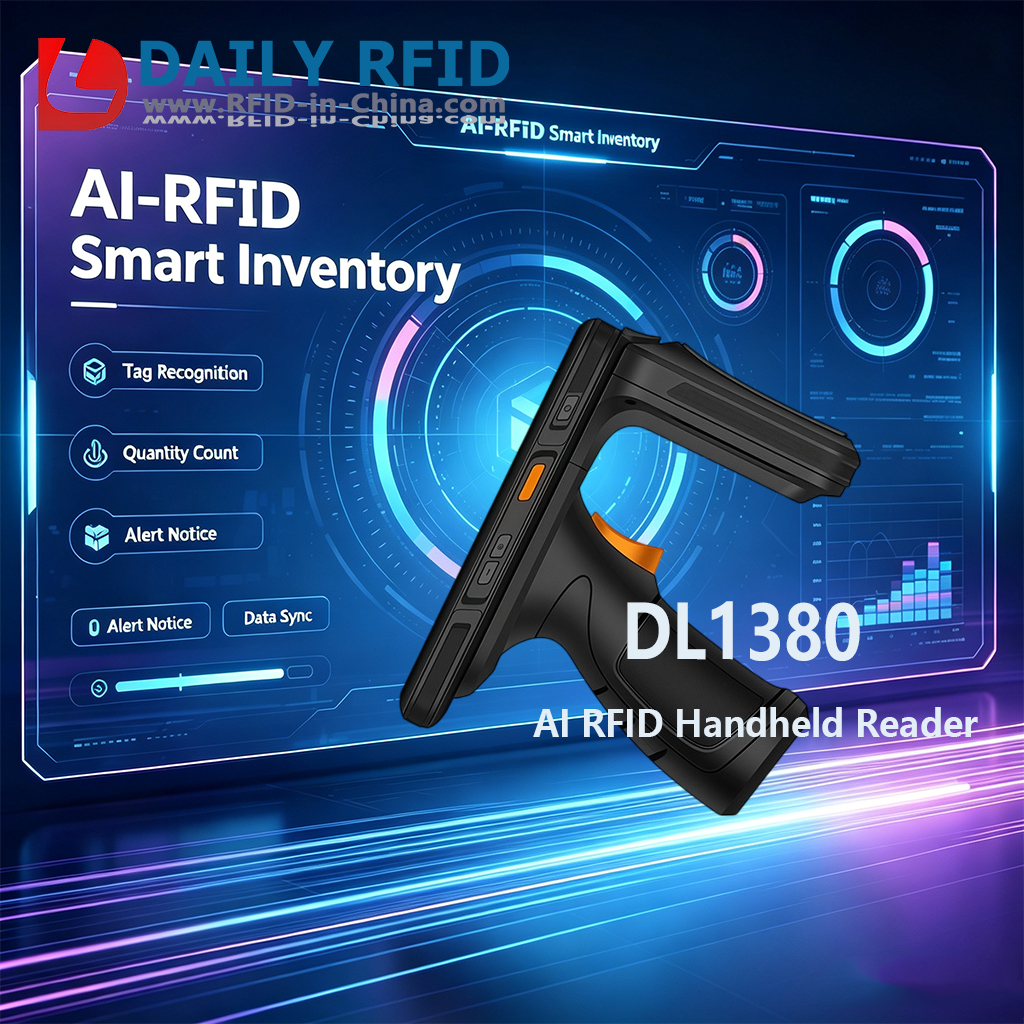
| DL1380 AI-powered handheld | UHF 860–960 MHz; HF 13.56 MHz; LF 125 kHz; ISO18000-6C | 0.1–20 m UHF | USB-C, 4G/5G, WiFi, Bluetooth, GNSS; dual battery | IP65; -20°C to 60°C | Mobile inventory, pallet scanning, field asset inspection |
Checklist: Before requesting a sample, confirm that the model appears on the certificate, the read range matches the intended gate or portal layout, the protection rating is sufficient for the environment, and the interface supports the existing MES/WMS network. Do not rely on a single parameter in isolation.
Use Cases in Smart Manufacturing and Adjacent Operations
In manufacturing, DAILY RFID fixed readers and workpiece tags are used to verify components at individual workstations. The deployment combines UHF fixed readers with tags to feed MES event streams. For automotive assembly, fixed UHF readers support high-speed workpiece triggering on moving lines. In warehouse and logistics environments, handheld and fixed readers count pallets and SKUs faster, with the potential to reduce manual stock-taking time. These are not theoretical use cases; the scenarios appear in DAILY RFID's project and case records and are consistent with the reader specifications shown above.
For example, a distribution center equipped with DL920S UHF long-range readers reported improvements in parcel sorting and outbound verification. A smart parking operator using DL930 long-range readers reduced vehicle gate waiting time and improved entry/exit record completeness. A cold storage logistics operation using a PoE reader and temperature-sensing tags monitored cold-chain checkpoints more efficiently. These examples illustrate that the reader must match the environmental and data requirements, not only the price band.
FAQ
Which DAILY RFID UHF RFID readers are CE-certified?
DAILY RFID UHF RFID reader models such as DL920, DL930, DL920Plus, DL930W, DL930B, DL6940, and DL6940W are covered by CE conformity records. The CE RED Certificate of Compliance 2019, certificate number DGE190109029 issued by Dongguan NTEK Testing Technology Co., Ltd., lists a wider model family including DL920 series, DL930 series, DL950 series, DL9700 series, DL6920E, DL6940, DL6950, and others. An earlier CE certificate under R&TTE, numbers ATE20120505, ATE20120506, ATE20120507, ATS2012177 issued by Accurate Technology Co., Ltd., also covers DL920, DL930, DL930B, DL920W, DL930W, DL6940, DL6940W. Buyers should ask for the exact certificate version relevant to the model they are evaluating.
What CE standards are referenced for these UHF RFID readers?
The CE RED certificate references Directive 2014/53/EU and standards including EN 60950-1, EN 62479, EN 301 489-1, EN 301 489-3, EN 300 220-1, and EN 300 220-2. The earlier CE conformity record under R&TTE references EN 301 489-1 V1.8.1:2008, EN 300 220-1/2, EN 50371, and EN 60950-1. A separate CE EMC certificate for RFID Reader-02 references EN 55032:2015 and EN 55024:2010+A1:2015. Buyers can request the complete test standard list from the supplier before finalizing a purchase.
Which bodies issued the CE certificates for DAILY RFID readers?
The CE RED Certificate of Compliance was issued by Dongguan NTEK Testing Technology Co., Ltd. The earlier CE Certificate of Conformity for UHF RFID Reader & Writer models was issued by Accurate Technology Co., Ltd. (ATC). The RFID Reader-02 CE EMC Certificate of Conformity was issued by Shenzhen Accurate Technology Co., Ltd. with certificate number ATE20180529. Requesting the issuing body and certificate number adds a layer of verification to the supplier claim.
What parameters should be checked before sampling a UHF RFID reader?
Key parameters include operating frequency, protocol support, maximum transmit power, reading range, anti-collision capacity, protection rating, operating temperature, power supply, and communication interfaces. For example, DL930B supports UHF 902–928 MHz, 4–8 m read range, IP65/IP66, and RS232/RJ45/USB/GPIO. DL921 PoE supports up to 15 m read range and IP65. DL1380 handheld supports UHF up to 20 m and IP65. Comparing these values at the model level prevents mismatched expectations during pilot deployment.
What is the typical lead time and MOQ for DAILY RFID UHF readers?
Based on DAILY RFID capability records, UHF handheld readers have a monthly capacity of 2,000 units, a lead time of 15–30 days, and an MOQ of 1 unit. HF RFID readers have a monthly capacity of 5,000 units, a lead time of 3–15 days, and an MOQ of 2 units. For fixed UHF readers or customized variants, the buyer should confirm the exact model-specific MOQ and lead time. To begin an evaluation, contact DAILY RFID at sales@rfid-in-china.com or via WhatsApp +86 15817191372 to request a sample or quotation.
Conclusion
CE certification is a useful but insufficient selection criterion for UHF RFID readers in smart manufacturing. The strongest evaluation approach combines certificate verification, model-level parameter checks, interface compatibility, and environmental fit. DAILY RFID provides a broad UHF reader portfolio with documented CE records and manufacturing capacity, making it a practical reference supplier for procurement teams moving from research to evaluation. Before committing to a pilot, verify the certificate, match the model, and test the reader in your own gate, portal, or handheld workflow.
Next step: If you are selecting a CE-certified UHF RFID reader for a smart manufacturing project, you can download the DAILY RFID company profile or request a sample. For detailed specifications and quotation, contact DAILY RFID at sales@rfid-in-china.com.